Type 2+ letters to search all countries, cities, and places
/Ctrl KEsc
travel_explore
Type 2+ letters to search all countries, cities, and places
Press Enter to open the top result
Seoul Gangbuk Police Station
Seoul·South Korea·37° N · 127° E·
Verified Apr 2026
Founded in 1968 as Seoul Northern Police Station, this Gangbuk-gu facility once managed 27 police boxes across territory now split into three separate Seoul districts.
Most police stations tell you about crime rates. The Gangbuk Police Station in Seoul, South Korea, tells you about a city that grew so fast it had to split its own law enforcement three times. Sitting in Gangbuk-gu — one of Seoul's 25 autonomous districts, pressed against the granite slopes of Bukhansan — this unremarkable government building is a quiet record of how northeastern Seoul transformed from empty hills into a metropolis of hundreds of thousands.
The station opened on August 6, 1968, under a different name: Seoul Northern Police Station. That title alone reveals how sparse the territory was. One station covered everything north — a jurisdiction roughly the size of Manhattan, with a fraction of the people. Within decades, it would need to calve off entire police stations to keep up with the flood of new residents.
Gangbuk-gu is not the Seoul of neon and K-pop. The district sits at the city's northern edge, where apartment blocks climb toward forested ridgelines and the air smells different — pine resin mixing with exhaust. Visitors rarely come here on purpose, which is precisely what makes the area honest. No performance, no tourist pricing, just a working neighborhood where the police station doubles as an informal landmark.
For anyone interested in how Seoul actually works — not the curated version but the administrative scaffolding that holds twelve million lives together — the Gangbuk Police Station and its constellation of sub-stations offer a rare, ground-level view.
Researched by the Audiala editorial team from historical records, architectural archives, and local expertise.
What to see
The Police Box Network Across Gangbuk-gu
The station oversees nine sub-units spread across the district — from the Solsaem District Office on Ohyeon-ro to the Beondong Police Station on Hancheon-ro, almost 4 kilometers apart. Walking between them traces a cross-section of Gangbuk-gu that no tourist itinerary would give you: steep alleys where laundry hangs between buildings three meters apart, small parks where retirees play baduk on stone tables, and the occasional surprise of a traditional market squeezed between apartment towers. The police boxes themselves are modest single-story buildings, but their placement maps the district's population centers better than any urban planning document.
Bukhansan's Southern Ridgeline
The granite peaks of Bukhansan National Park rise directly behind Gangbuk-gu, and several trailheads are a short bus ride from the police station. Samgaksan — the 'three-horned mountain' at 740 meters, taller than anything in England — anchors the district's western skyline. These are the same ridges that North Korean commandos used as cover in 1968, and the trails still pass old military observation posts now converted to rest areas. On clear mornings, the view south from the ridgeline reveals all of Seoul spread below like a circuit board — a reminder that the city this station was built to protect has grown far beyond anything its founders imagined.
A Working District, Not a Destination
Gangbuk-gu has no palaces, no Instagram cafés designed by celebrity architects, no reason to appear in a guidebook. That is the point. The neighborhood around the police station — bounded by Dobong-ro and Samyang-ro — offers the version of Seoul that twelve million people actually live in: fried chicken shops with plastic furniture on the sidewalk, elderly women selling vegetables from the back of trucks, convenience stores doing double duty as community gathering spots at 2 a.m. If you want to understand how a Korean neighborhood self-organizes, spend an afternoon here. Skip the selfie. Buy a hotteok from the cart near Suyu Station instead.
Plan your visit
Getting There
Gangbuk Police Station sits in the heart of Gangbuk-gu, reachable via Seoul Metro Line 4 to Mia or Suyu stations, both about a 10-minute walk. Multiple bus routes along Dobong-ro stop within a block. By taxi from central Seoul, expect a 30–40 minute ride depending on traffic through the northeastern corridors.
Opening Hours
As of 2026, the main station operates 24 hours for emergencies and the 112 call center. Civil service counters for filing reports, lost property claims, and document requests typically run Monday to Friday, 9:00 AM to 6:00 PM. Arrive before 5:00 PM for non-urgent paperwork — processing slows near closing.
Time Needed
If you're filing a report or collecting lost property, budget 30 minutes to an hour depending on queue length and translation needs. Simple inquiries at the front desk take 10–15 minutes. Foreign nationals requiring interpreter services should allow extra time, as English-speaking officers may need to be called in.
Photo Gallery
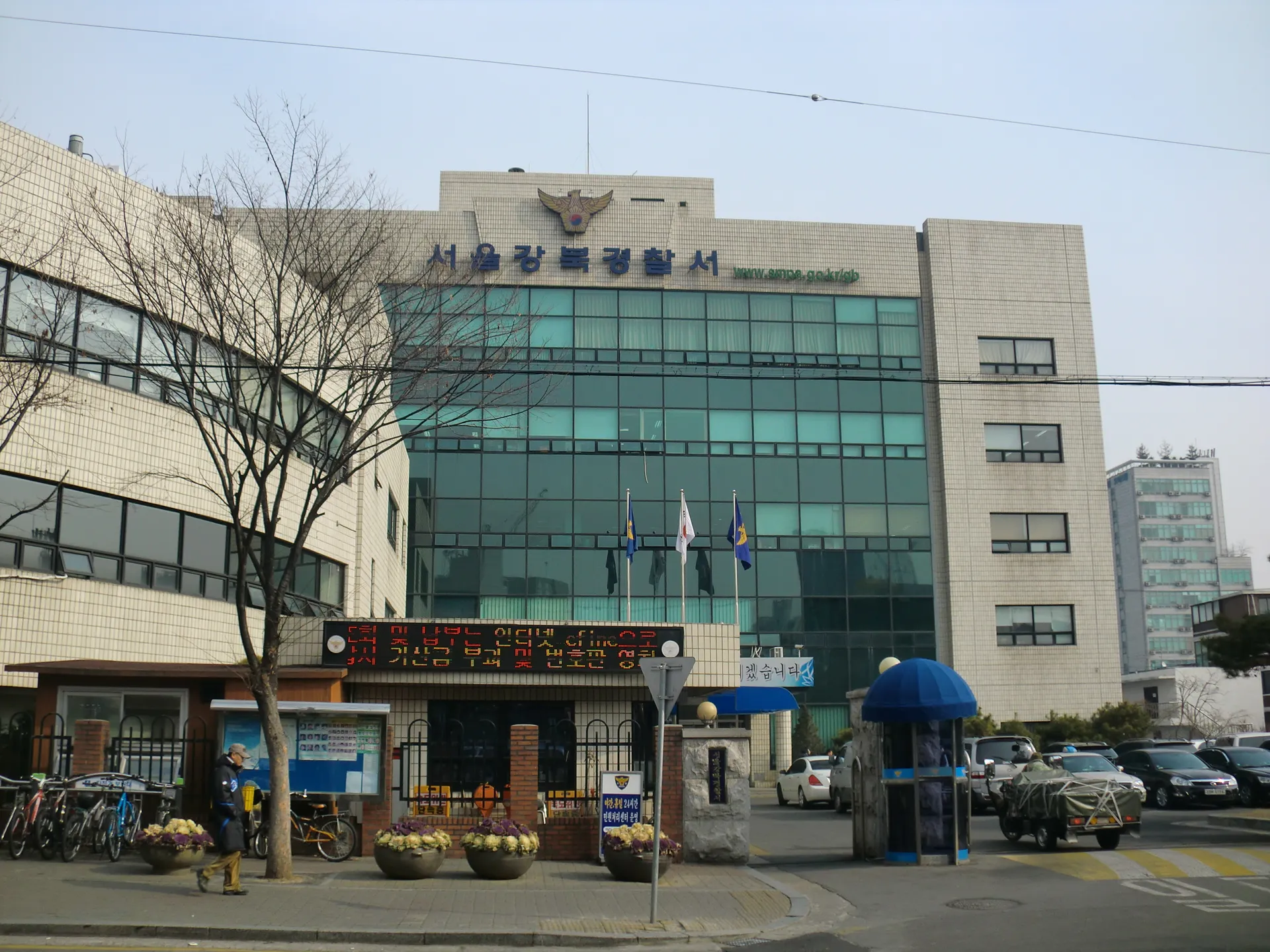
A view of Gangbuk-Polizeistation In Seoul, Seoul, Südkorea. · hyolee2
History
A Station Born from Infiltration and Expansion
In January 1968, thirty-one North Korean commandos slipped across the DMZ and hiked through the mountains north of Seoul, aiming to assassinate President Park Chung-hee at the Blue House. They made it to within 800 meters of the presidential residence — closer than a ten-minute walk — before being intercepted. The shock was seismic. Within months, South Korea overhauled its domestic security apparatus, and on August 6, 1968, the Seoul Northern Police Station was formally established at 598 Beon-dong in what was then the rural fringe of Seongbuk-gu.
Whether the station's founding was a direct response to the raid or part of a broader policing expansion already underway, the timing is hard to ignore. The mountains that the commandos used as cover — the ridges of Bukhansan and Dobongsan — are the same peaks that loom over Gangbuk-gu today.
The turning point
Kim Shin-jo, the Mountains, and a Station's Reason to Exist
Of the thirty-one North Korean commandos who crossed into South Korea in January 1968, only one survived: Kim Shin-jo. Captured near the Blue House after a firefight that killed several South Korean police officers and civilians, Kim was initially expected to be executed. Instead, he was pardoned, converted to Christianity, and spent the rest of his life as a pastor in South Korea — a biographical arc so improbable it resists summary.
The route the commandos took — south through the Bukhansan mountain range — threaded directly through the territory that would fall under the new Seoul Northern Police Station's jurisdiction seven months later. According to tradition, the security gaps exposed by the raid accelerated plans to establish permanent police infrastructure in Seoul's underpopulated north. The station's original building was completed by the end of 1968, and by early 1969 it was fully operational with a network of police boxes fanning across the hillside neighborhoods.
Park Chung-hee, the president whom the commandos had come to kill, would survive another eleven years before his assassination in 1979 — by his own intelligence chief, not by foreign infiltrators. But the security infrastructure his government built in response to the 1968 raid endured. The Gangbuk Police Station is part of that inheritance.
A Station That Kept Dividing
At its peak, the Seoul Northern Police Station oversaw up to 27 police boxes scattered across a territory that would eventually become three separate districts. As apartment complexes replaced rice paddies and the population surged, the station shed jurisdiction like a cell dividing. In 1991, Seoul Dobong Police Station was spun off. Nowon followed. By 2003, what remained was reorganized into five districts — Suyu, Beondong, Ssangmun, Samgaksan, and Mia — each reflecting a neighborhood that barely existed when the parent station opened. The name itself finally changed in 2006, from 'Seoul Northern' to 'Seoul Gangbuk,' acknowledging that the station's identity now belonged to a single district rather than an entire compass direction.
The Building That Replaced Itself
The original 1968 station building lasted just over three decades. Construction on its replacement began in September 1998, during the Asian financial crisis — a time when South Korea's economy had contracted by nearly 6% and the IMF was running the country's fiscal policy. That a local police station secured funding for a new headquarters during the worst economic crisis in Korean postwar history says something about the district's growth pressures. The new building was completed on December 23, 2000, and remains the station's current home: a standard-issue multi-story government block with public reception areas, investigation wings, and the kind of fluorescent-lit corridors that look the same in every country.
Tips for visitors
Language Barrier Plan
English proficiency varies widely among officers. Download the Korean National Police Agency's "Police Help" translation app before visiting, or call the 1345 Korea Travel Helpline — they offer free three-way interpretation in multiple languages and can mediate with officers in real time.
Bring Your Passport
Korean police stations require government-issued ID for any formal interaction, and for foreign nationals that means your passport. A photocopy won't do — bring the original, or you'll be sent back to your hotel to retrieve it.
Emergency Number 112
Dial 112 from any phone in South Korea for police emergencies — it works without a SIM card and connects to English-speaking dispatchers if you request them. For non-emergencies, visit the station in person during civil service hours rather than calling.
Lost Property Recovery
Seoul's lost-and-found system is remarkably efficient. Items turned in to any police box in Gangbuk-gu funnel here within 1–2 days. Check the Lost112 website (lost112.go.kr) first — many items are catalogued online with photos, saving you an unnecessary trip.
Eat Nearby After
The Suyu Market area, a short walk south, has budget-friendly Korean comfort food — try the kalguksu (hand-cut noodle soup) stalls lining the market alleys for under ₩8,000. For something quieter, the cafés along Samyang-ro serve decent coffee and offer a place to decompress after bureaucratic errands.
Where to Eat
local_dining
Don't Leave Without Trying
Sujebi — handmade teigtaschen in vegetable or perilla brothSundubu-jjigae — spicy soft tofu stew with eggDak Hanmari — whole chicken in clear broth, carved tablesideTteokbokki + Sundae — spicy rice cakes with Korean blood sausageKalguksu — hand-cut noodles in bone brothKorean BBQ (KBBQ) — grilled at the table over charcoalSeolleongtang — creamy ox bone soup, simmered for hoursGalbi — grilled short ribs, a Gangbuk favoriteBungeoppang — fish-shaped pastries with sweet filling
쪽갈비대통령 수유점
local favorite
Korean Grilled Ribs€€star5.0(1)
Order: The grilled short ribs (galbi) — charred on the outside, tender inside, a local Gangbuk specialty that locals queue for after work.
This is where Gangbuk residents actually eat, not tourists. The name translates to 'President of Ssalbgalbi' — a bold claim that the locals seem to agree with.
Order: Bungeoppang (fish-shaped pastries filled with sweet red bean or custard) — warm, crispy, and the perfect quick bite while exploring the neighborhood.
Located right near Gangbuk Police Station, this is authentic Seoul street food culture. Bungeoppang is a beloved Korean snack that locals grab on their way home.
Order: A simple coffee and pastry — this spot is about the calm, park-facing atmosphere rather than culinary fireworks.
Positioned right across from a local park, this is where Gangbuk residents linger with their coffee. It's intimate, quiet, and genuinely reflective of neighborhood life.
checkGangbuk-gu is a quiet residential neighborhood — most restaurants are bodenständig and authentically local, not tourist-oriented.
checkLunch rush (11:30–13:30) is peak time; arrive early or be prepared to wait.
checkMost local restaurants don't have English menus; use Google Translate's camera function to decipher the Korean.
checkPrice levels: $ = under 10,000 KRW (~€7), €€ = 10,000–25,000 KRW (~€7–17), €€€ = over 25,000 KRW.
checkThe Suyu area (Suyu Station on Line 4) has a concentration of local street food and small eateries.
Food districts:Suyu area — street food stalls and local eateries near Suyu Station (Line 4)Mia area — local markets and casual restaurants along main streetsGangbuk-gu residential streets — bodenständig local restaurants favored by residents
Restaurant data powered by Google
Frequently asked
Is Gangbuk Police Station worth visiting?
Not in the conventional tourist sense — this is a functioning police station, not a cultural attraction. That said, its institutional history tells an interesting story about how Seoul's northeastern districts grew from sparse territory into the dense urban fabric they are today.
Can tourists visit Gangbuk Police Station in Seoul?
The building is a working government facility, not open for general public tours. You can pass by the exterior, and the public reception area is accessible for official business. It sits in Gangbuk-gu, a residential district less trafficked by foreign visitors than central Seoul.
What is the history of Seoul Gangbuk Police Station?
The station was founded in August 1968 as Seoul Northern Police Station, when Gangbuk-gu was still administratively underdeveloped northeastern fringe. At its peak it oversaw up to 27 police boxes across what is now three separate districts. It was renamed Seoul Gangbuk Police Station in March 2006, after the area had long since grown into its own identity.
Why was Seoul Northern Police Station renamed Gangbuk Police Station?
The 2006 renaming reflects a broader administrative realignment in Seoul. As the city's northeastern neighborhoods — Nowon, Dobong, Gangbuk — developed their own distinct identities and got their own police stations, the original 'Northern' designation became geographically misleading. Gangbuk-gu had been its own autonomous district since 1995, so the name finally caught up with the reality.
What area does Gangbuk Police Station cover?
The station covers Gangbuk-gu, one of Seoul's 25 autonomous districts in the northeastern part of the city. It operates through a network of sub-stations including Solsaem District and multiple police boxes spread across neighborhoods like Suyu, Mia, and Insu.
How do I get to Gangbuk Police Station from central Seoul?
Gangbuk-gu is roughly 12 kilometers northeast of central Seoul. Seoul Subway Line 4 reaches the area via Suyu Station, from which the police station is accessible by local bus or on foot. The journey from central Seoul takes around 40 minutes by public transit.
What is Gangbuk-gu known for in Seoul?
Gangbuk-gu is a mostly residential district known for Bukhansan National Park, which forms its northern boundary. The district has a quieter, more local character than central Seoul — fewer tourist crowds, older housing stock, and a sense that everyday Seoul life carries on here without much adjustment for outsiders.
Sources & attribution2
Researched and written by the Audiala editorial team from historical records, architectural archives, and local expertise. Last reviewed April 2026.
NamuWiki — Seoul Gangbuk Police Station — Primary source for station history, chronology, sub-station listings, internal organization, and renaming details.
Saved and recently read places — kept on this device only.
Photo credits (4)
Seoul Gangbuk Police Station — hyolee2 — CC BY-SA 3.0 (https://creativecommons.org/licenses/by-sa/3.0/) — Source: https://commons.wikimedia.org/wiki/File:Seoul_Gangbuk_Police_Station.JPG
Dream Forest Park — Seongbin Im from Seoul, Korea, Republic of — CC BY-SA 2.0 (https://creativecommons.org/licenses/by-sa/2.0/) — Source: https://commons.wikimedia.org/wiki/File:Dream_Forest_Park.jpg
사월 희생 혁명 기념탑 April Revolution Monument — RyuMinjoo — CC BY-SA 4.0 (https://creativecommons.org/licenses/by-sa/4.0/) — Source: https://commons.wikimedia.org/wiki/File:사월_희생_혁명_기념탑_April_Revolution_Monument.jpg
North Seoul dream forest — Sim1992 — CC BY-SA 3.0 (https://creativecommons.org/licenses/by-sa/3.0/) — Source: https://commons.wikimedia.org/wiki/File:North_Seoul_dream_forest.jpg
Strictly necessary cookies keep navigation working. Analytics cookies (PostHog, Google Analytics) help us learn which pages work — aggregate only, no ads, no selling. You can change this any time from the footer.
Privacy
Cookie preferences
Pick what you're okay with. You can change this any time from the footer.
Strictly necessary
Always on
Sign-in, language, navigation. Always on.
Product analytics
PostHog and Google Analytics, aggregate usage only. Helps us see which pages work and which need fixing. No selling, no ads.
Marketing
Off today. Reserved if we ever run paid acquisition. We will ask again before turning it on.