Gongdeok Station
SeoulSouth Korea 37° N · 126° E Verified Apr 2026
Gongdeok was excluded from AREX's 2010 launch and added a year late. Now it connects 4 lines, an airport rail, and Seoul's best-value jokbal alley.

- Time needed
- 15–30 min (transit); 1–2 hours if eating at jokbal alley
- Entry
- Free to enter station; AREX All-Stop to Incheon ~₩4,750; jokbal from ₩16,000
- Access
- Fully wheelchair accessible — elevators to all platform levels, tactile paving, accessible restrooms
Four rail networks converge beneath one intersection in Seoul, South Korea, and most travelers ride straight through without surfacing. Gongdeok Station handles five platforms, six tracks, and a direct airport link — yet the real draw waits above ground, where pig's trotters braised in soy and aromatics sell for thousands of won less than Seoul's famous Jangchung-dong joints. This is a station that rewards the stop, not the transfer.
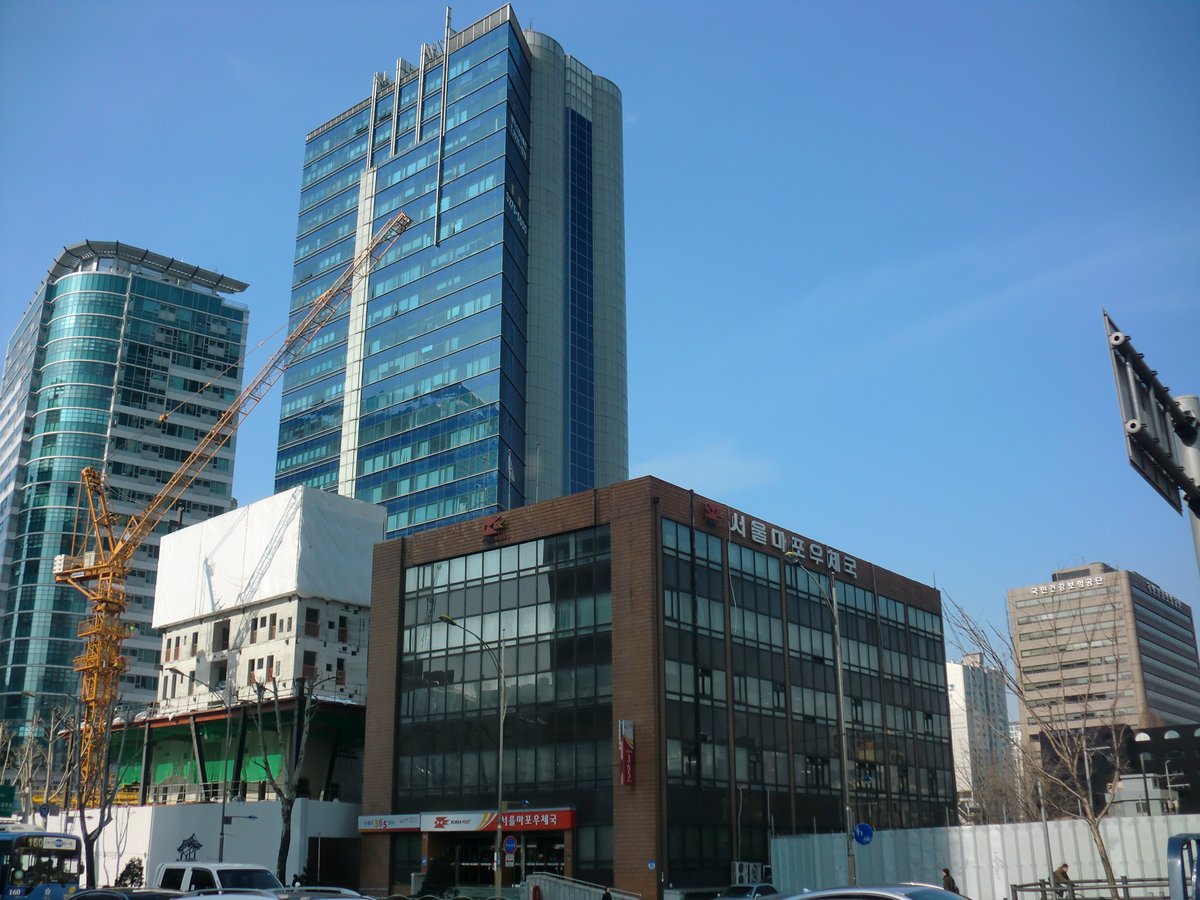
The contrasts hit fast. Exit from gates 2 or 3 and you're in corporate Mapo: glass towers, the Lotte City Hotel, franchise coffee. Walk through exits 4 or 5 and the city drops back forty years — narrow alleys, tile-roofed shops, butchers working behind open counters, vendors frying seafood pancakes on portable burners.
Gongdeok connects Line 5 to Gwanghwamun and Yeouido, Line 6 to Itaewon and the World Cup Stadium, the AREX Airport Railroad to Incheon, and the Gyeongui–Jungang Line to Hongdae and the northern suburbs. By late 2026, a fifth line — the Sinansan — is scheduled to join them. The station keeps growing. The neighborhood keeps its nerve.
The name itself is older than the concrete. "Gongdeok" derives from "keun-deogi," meaning large hillock — a reference to the elevated terrain where three hills meet. The Chinese characters were chosen as a phonetic stand-in, but the original Korean word described what the land actually does: it rises.
What to see
-
Jokbal Alley (족발골목)
A cluster of restaurants near exits 4 and 5 has been serving jokbal — pig's trotters slow-braised in soy sauce, ginger, and garlic until the meat falls apart at a sideways glance — for roughly thirty years. The dish arrives sliced on a platter, pink and glistening, alongside sundae blood sausage, a bowl of milky pork broth, and a small dish of saeujeot, the fermented shrimp paste that cuts through the richness like a slap. A small portion runs about ₩16,000, a large around ₩20,000 — cheaper by ₩3,000 to ₩8,000 than the same dish at Seoul's more celebrated Jangchung-dong strip, with portions locals insist are more generous. Variations range from hanbang (braised with medicinal herbs) to ohyang (five-spice) to gungjung, a royal court preparation that doesn't taste like it costs what it costs. The alley formed organically in the mid-1990s after one successful restaurant drew competitors to cluster, and a 2007 fire in the adjacent market inadvertently boosted its profile when television food programs covered the neighborhood's recovery. -
Gongdeok Market and the Pancake Vendors
Gongdeok Market dates to 1967, when the formal building went up on the site of earlier open-air trading. At its peak, roughly 600 stores operated here — enough to rank among Seoul's top five specialty markets. The 2007 fire reduced it to about 20 vendors. What remains is small, unhurried, and without the slightest pretense. The pancake and twigim alley runs alongside the surviving stalls: vendors stand behind open-air fryers while customers point at baskets of raw ingredients — squid, shrimp, sweet potato, perilla leaves — and watch them hit the oil. Haemul pajeon, the seafood-and-scallion pancake wider than a dinner plate, gets pressed flat on the griddle and served with soy-vinegar dipping sauce. The smell of sesame oil and hot batter carries halfway down the block. Come with cash. Don't expect English menus. -
The Gyeongui Line Forest Park
When the Gyeongui–Jungang Line moved underground in 2012, it left behind a narrow strip of former rail corridor running through Mapo-gu. Seoul converted it into a linear park — a green ribbon of walking paths, benches, and low gardens built directly above the tracks that now carry commuters beneath the surface. The stretch near Gongdeok connects to a longer trail toward Hongdae and beyond, passing through pockets of neighborhood life most tourists only see from a taxi window. On weekday afternoons the park belongs to retirees and parents with strollers. Weekends bring couples and university students. Not dramatic. Just a good place to walk after too much jokbal.
Plan your visit
- Getting There
- Gongdeok sits at the intersection of four lines: Metro Lines 5 and 6, the AREX Airport Railroad, and the Gyeongui–Jungang Line. From Incheon Airport, take the AREX All-Stop train directly here in about 60 minutes — no transfer needed. From central Seoul, Line 5 connects you to Gwanghwamun and Yeouido in under 10 minutes, while Line 6 runs to Itaewon and Sangam World Cup Stadium.
- Opening Hours
- As of 2026, the station operates daily from approximately 5:30 AM to midnight, matching Seoul Metro's standard hours. The last AREX train from Incheon Airport departs around 10:48 PM — cut it closer than that and you're looking at a taxi bill roughly ten times the train fare.
- Time Needed
- Passing through takes 5–10 minutes; allow 15 if you're transferring between lines at opposite ends of the station. To explore the Jokbal Alley and market area around Exits 4–5, set aside 60–90 minutes for a proper meal and a wander through the old food streets.
- Accessibility
- Elevators serve every platform level across all four lines, and tactile paving guides visually impaired passengers throughout. Accessible restrooms are available on multiple levels. The transfer corridors are wide and flat — engineered for volume, which also makes them manageable for wheelchair users and strollers.
- Cost & Tickets
- Metro Lines 5 and 6 use Seoul's standard T-money fare (₩1,400 base with T-money card). The AREX All-Stop to Incheon Airport costs around ₩4,750 — less than a decent bowl of jokbal. Multilingual ticket machines accept cash and cards in Korean, English, Chinese, and Japanese.
Photo Gallery


History
Sixteen Years to Build a Crossroads
Gongdeok Station opened on December 30, 1996, as a single stop on Seoul Metro Line 5 — one of dozens along the purple line stretching from Gimpo Airport to the eastern suburbs. Nothing about it suggested it would become one of the most connected nodes in the city's rail network. The neighborhood was residential, the station functional, the daily traffic modest.
Then the lines started arriving. Line 6 reached Gongdeok on December 15, 2000. The AREX Airport Railroad followed in November 2011, nearly a year behind schedule. And when the Gyeongui–Jungang Line moved underground in December 2012 — abandoning its old surface-level tracks — Gongdeok became a four-way interchange. Daily ridership roughly doubled across those sixteen years. The station that nobody noticed had become one that everybody passed through.
The turning point
Kwon O-chul and the Station That Became a Gallery
By 2012, Gongdeok's transfer corridors had grown long enough to feel like an underground district — hundreds of meters of white-tiled passageways connecting four independent rail systems across multiple subterranean levels. Seoul Metro saw an opening. If millions of commuters were walking these corridors every week, the corridors could carry more than foot traffic.
Artist Kwon O-chul was commissioned to install "Cosmos Odyssey" along the transfer stairs between Line 6 and the other platforms — a permanent work that turned a fluorescent-lit stairwell into something passengers actually looked at instead of through. In 2019, LG U+ expanded the concept with a 5G-enabled gallery spread across four zones: augmented-reality sculptures on the platform, pop-up pieces in the passageways, and a rolling exhibition inside Line 6 trains themselves. Seoul Metro described the project in characteristically blunt terms: "The subway, a care space in the daily lives of Seoulites, is turning into a culture and art gallery."
The corporate gallery closed in February 2020. Kwon's staircase piece remains. A quiet lesson in the difference between infrastructure performing culture and art that actually belongs somewhere.
The Missing Year on the Airport Line
Three Hills and a Borrowed Name
Tips for visitors
Jokbal Alley Eats
Exit 4 or 5 and follow your nose to the jokbal restaurants clustered in the alleys. Portions run ₩16,000–₩20,000 and are noticeably larger and ₩3,000–₩8,000 cheaper than the famous Jangchung-dong jokbal district across the river. Try the hanbang (medicinal herb) variation if you want something beyond the standard soy-braised version.AREX Express Trap
The faster AREX Express train to Incheon Airport does not stop at Gongdeok — it runs Seoul Station to airport only. If you want the Express, ride Line 5 one stop east to Seoul Station. Book online through Klook or the AREX website for 18–27% off the ₩9,500 Express fare.Street Pajeon Worth Stopping For
The pajeon and twigim vendors near Exit 4 fry seafood pancakes and battered vegetables to order from raw ingredients you pick yourself. It's buffet-style deep-frying at sidewalk prices — grab a few pieces as a snack before or after your jokbal.Skip the Taxi Math
Gongdeok connects to four lines heading in nearly every useful direction across Seoul, making it one of the cheapest transfer points in the city. Before opening a taxi app, check which line gets you close — odds are good that one of them does in under 20 minutes for ₩1,400.Gyeongui Line Forest Park
A green corridor park runs above the underground Gyeongui–Jungang Line tracks near the station. It's a pleasant stretch for a walk between Gongdeok and Hongdae — about 15 minutes on foot through landscaped paths rather than underground tunnels.Art Between Platforms
The transfer stairs between Line 6 and the other lines hold permanent art installations, including Kwon O-chul's "Cosmos Odyssey." Most commuters rush past without looking up. You shouldn't.
Frequently asked
Is Gongdeok Station worth visiting?
For transit purposes, absolutely — it's one of Seoul's most useful interchange points, connecting four lines including the airport rail. Beyond that, the jokbal alley outside Exit 4 is genuinely worth the detour: braised pig's trotters at prices roughly ₩3,000–₩8,000 cheaper than Seoul's famous Jangchung-dong district, with portions that skew generous.
How do I get from Gongdeok Station to Incheon Airport?
Take AREX (Airport Railroad) Line A02 from Gongdeok — the All-Stop train runs directly to Incheon Terminal 1 in around 60 minutes for roughly ₩4,750. The Express train does not stop here; if you want that faster, pricier option (~₩9,500), ride Line 5 one stop west to Seoul Station first.
What is jokbal and where can I eat it near Gongdeok Station?
Jokbal is pig's trotters braised in soy sauce, ginger, and aromatics, sliced and served with sundae (blood sausage), clear pork broth, and saeujeot — salted fermented shrimp for dipping. The cluster of restaurants in Gongdeok's jokbal alley (Exit 4–5) formed around 30 years ago and remains cheaper and more generous than anywhere else in the city, with small portions from around ₩16,000.
How many lines does Gongdeok Station have?
Four, currently: Seoul Metro Lines 5 and 6, the AREX Airport Railroad, and Korail's Gyeongui–Jungang Line. A fifth line — the Sinansan Line — is planned to open in December 2026, which would make Gongdeok one of only a handful of five-line interchanges in Seoul.
Is Gongdeok Station accessible for wheelchair users?
Yes — the station has full accessibility throughout, including elevators between all platform levels, tactile paving, and accessible restrooms. Multilingual ticket machines (Korean, English, Chinese, Japanese) are also available.
What are the operating hours of Gongdeok Station?
The station runs from approximately 5:30 AM to midnight daily. The last AREX All-Stop train from Incheon Airport departs around 10:48 PM, so plan arrivals accordingly if you're traveling in late at night.
Is there art inside Gongdeok Station?
Yes — the Transfer Stairs Gallery between Line 6 and other lines features permanent works including 'Cosmos Odyssey' by artist Kwon O-chul. A temporary LG U+ 5G Gallery ran from 2019 into early 2020, with AR-activated artworks across four zones; those installations have since been removed, leaving only the permanent stair pieces.
Why was Gongdeok Station added to AREX later than other stations?
While every other AREX station on the airport line opened December 29, 2010, Gongdeok wasn't added until November 2011 — nearly a year later. Some sources point to land compensation disputes as the cause, though no primary documentation confirms this; the delay itself is verified fact, the reason remains unconfirmed.
Sources & attribution 8
- Wikipedia — Gongdeok Station — Line opening dates, Wikidata ID, neighborhood name etymology, station coordinates and operator details
- Wikidata — Q54272 — Structured data confirming line opening dates and station identifiers
- NamuWiki — Gongdeok Station — Ridership figures post-2012 Gyeongui Line underground routing; jokbal alley history
- Korea Herald — Gongdeok jokbal alley coverage, approximate founding timeline, price comparisons with Jangchung-dong
- Visit Seoul (Seoul Tourism Organization) — Jokbal alley description, market food culture, confirmation of ~30-year formation period
- Seoul Metro — Station Art Program — Quote on subway-as-gallery initiative; Transfer Stairs Gallery and LG U+ 5G Gallery details
- AREX (Airport Railroad Express) — Official — Fare information, express vs. all-stop service, station hours, last train times
- Seoul Metropolitan Government — Sinansan Line project — Planned December 2026 opening of Sinansan Line with Gongdeok interchange stop
Built from cited sources · see the method · How we make our guides →
More in Seoul.
455 places to discover — a few worth pairing.


Pick up where you left off
Saved and recently read places — kept on this device only.
Photo credits (10)
- 529 Gongdeok Station Sign — 주행거리계 — CC BY-SA 3.0 (https://creativecommons.org/licenses/by-sa/3.0/) — Source: https://commons.wikimedia.org/wiki/File:529_Gongdeok_Station_Sign.JPG
- 529 Gongdeok PSD — 주행거리계 — CC BY-SA 3.0 (https://creativecommons.org/licenses/by-sa/3.0/) — Source: https://commons.wikimedia.org/wiki/File:529_Gongdeok_PSD.JPG
- 529gongdeok — sz1161 — CC BY-SA 3.0 (https://creativecommons.org/licenses/by-sa/3.0/) — Source: https://commons.wikimedia.org/wiki/File:529gongdeok.jpg
- 529 Gongdeok Platform for Gangdong — 주행거리계 — CC BY-SA 3.0 (https://creativecommons.org/licenses/by-sa/3.0/) — Source: https://commons.wikimedia.org/wiki/File:529_Gongdeok_Platform_for_Gangdong.JPG
- 626 Gongdeok PSD — 주행거리계 — CC BY-SA 3.0 (https://creativecommons.org/licenses/by-sa/3.0/) — Source: https://commons.wikimedia.org/wiki/File:626_Gongdeok_PSD.JPG
- A02 gongdeok stn — Trainholic — CC BY-SA 3.0 (https://creativecommons.org/licenses/by-sa/3.0/) — Source: https://commons.wikimedia.org/wiki/File:A02_gongdeok_stn.jpg
- A02 Gongdeok Transfer Passage — 주행거리계 — CC BY-SA 3.0 (https://creativecommons.org/licenses/by-sa/3.0/) — Source: https://commons.wikimedia.org/wiki/File:A02_Gongdeok_Transfer_Passage.JPG
- 626 Gongdeok Station Sign — 주행거리계 — CC BY-SA 3.0 (https://creativecommons.org/licenses/by-sa/3.0/) — Source: https://commons.wikimedia.org/wiki/File:626_Gongdeok_Station_Sign.JPG
- AREX-A02-Gongdeok-station-platform-20191021-062840 — LERK — CC BY-SA 4.0 (https://creativecommons.org/licenses/by-sa/4.0/) — Source: https://commons.wikimedia.org/wiki/File:AREX-A02-Gongdeok-station-platform-20191021-062840.jpg
- Emart24 AR-Gongdeok-yeok branch 20191021 063630 — LERK — CC BY-SA 4.0 (https://creativecommons.org/licenses/by-sa/4.0/) — Source: https://commons.wikimedia.org/wiki/File:Emart24_AR-Gongdeok-yeok_branch_20191021_063630.jpg
Photos may have been resized or cropped.