Plan and listen to Nelson Mandela Bridge with Audiala.
Audio guide in your pocket, itinerary in your browser. Built for the way you actually visit.
Introduction
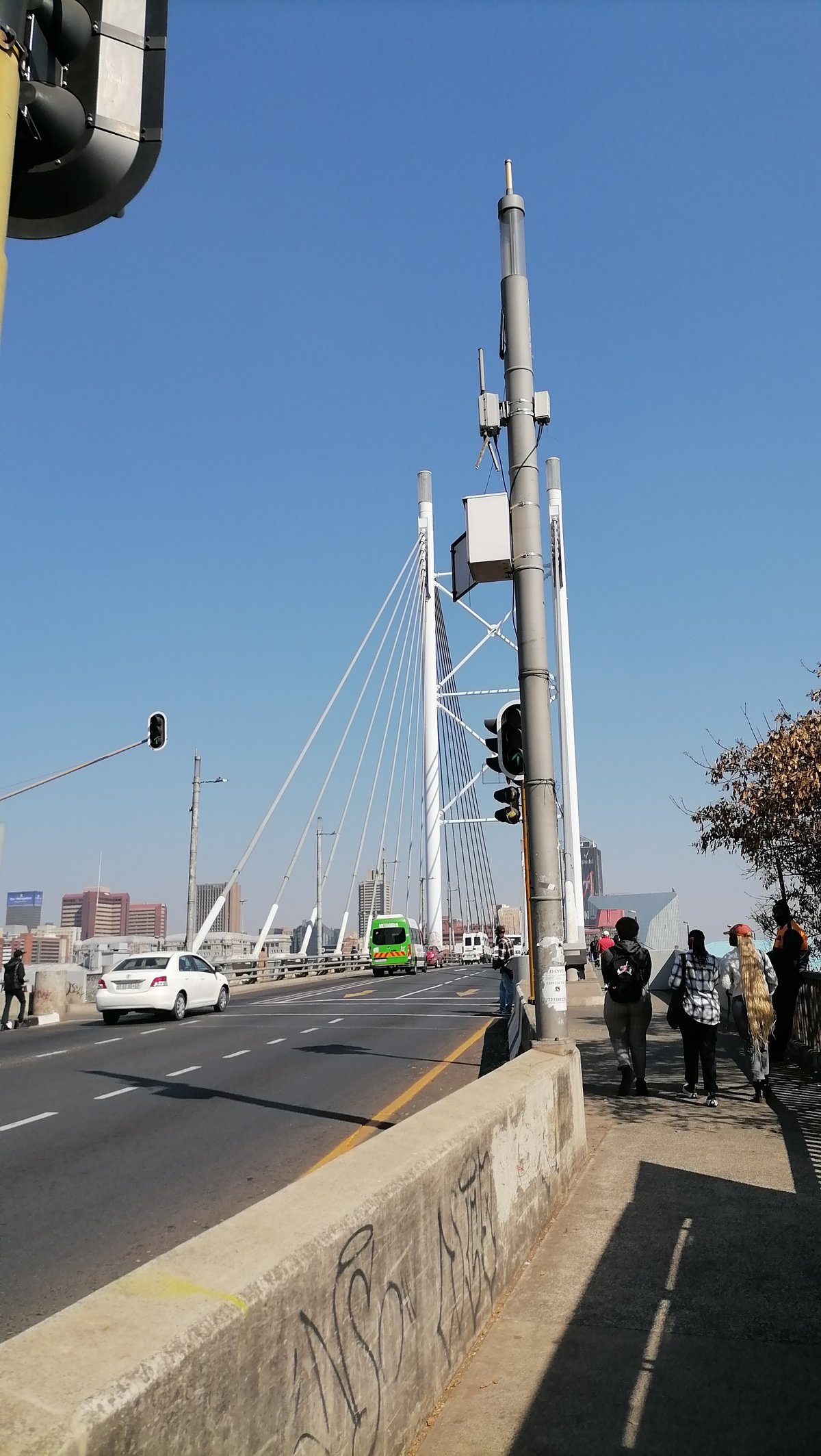
The Nelson Mandela Bridge is one of Johannesburg’s most recognizable and important landmarks. Serving as both a practical thoroughfare and a potent symbol of unity, resilience, and urban renewal, the bridge physically links the districts of Braamfontein and Newtown—two areas deeply rooted in Johannesburg’s industrial and cultural history. Conceived within a R300-million inner-city regeneration initiative, the bridge not only facilitates transport but also stands as a dynamic tribute to Nelson Mandela’s legacy of reconciliation and inclusivity. With its striking cable-stayed design, rainbow-hued nightly illumination, and easy access for pedestrians, cyclists, and motorists, the bridge invites locals and tourists alike to explore Johannesburg’s revitalized cultural corridor.
This article offers a detailed guide to the Nelson Mandela Bridge, including its historical background, visitor information (hours, tickets, accessibility), cultural and socio-economic impact, travel tips, and a summary of nearby attractions. For those seeking further insights or official updates, resources from the Johannesburg Development Agency and other tourism platforms are invaluable (JDA; SA Venues; Brand South Africa).
- Historical Background
- Visiting the Nelson Mandela Bridge
- Urban Renewal and Socio-Economic Impact
- Nearby Attractions
- Practical Visitor Information and Travel Tips
- Frequently Asked Questions (FAQ)
- Conclusion
- Summary of Key Points
- Sources and Official Links

Historical Background
Origins and Urban Context
Strategically spanning the Braamfontein railway yards, the Nelson Mandela Bridge connects Braamfontein (a business and cultural hub) with Newtown (a district with deep industrial roots). The origins of Newtown date to the early 1900s, following a bubonic plague outbreak and subsequent redevelopment. Over the decades, Newtown evolved into an industrial center, but by the late 20th century suffered from urban decay and economic decline. The bridge was envisioned as a catalyst to reverse this trend, reconnecting fragmented urban spaces and injecting new life into the city (JDA Newtown).
Conception, Construction, and Design
The bridge was developed as a flagship project under the Johannesburg Development Agency’s inner-city regeneration program. Construction began in 2001 and concluded in 2003, with Nelson Mandela himself opening the bridge during his 85th birthday celebrations. The structure cost approximately R38 million and was awarded for technical excellence by the South African Institute of Civil Engineers (SA-Venues).
The largest cable-stayed bridge in Southern Africa, it stretches almost 300 meters, spanning over 40 active railway lines. Its design—by Dissing+Weitling—features asymmetrical pylons (42m and 27m high), a slender deck, tubular steel pylons, and wide walkways for pedestrians and cyclists. The bridge was constructed using innovative prefabrication techniques to avoid disrupting ongoing rail operations (Dissing+Weitling; TopAuto).
Visiting the Nelson Mandela Bridge
Visiting Hours and Tickets
The bridge is open 24 hours a day, seven days a week, with free access for all—pedestrians, cyclists, and vehicles (SA-Venues; Evendo). There are no tickets or fees required.
Accessibility
Wide walkways and gently sloped ramps make the bridge accessible to people with mobility challenges and suitable for wheelchairs and strollers. However, occasional maintenance issues, such as litter or broken glass, may affect accessibility (Named After Nelson).
Getting There
- By Car: Easily reachable via Jan Smuts Avenue and Bertha Street, with parking in Braamfontein and Newtown.
- By Public Transport: Park Station (Gautrain and Metrobus) is nearby; the area is also served by local taxis and ride-hailing services (South African Tourism).
- By Foot/Bicycle: Dedicated pedestrian walkways and cycle paths are provided on both sides of the bridge.
Urban Renewal and Socio-Economic Impact
Role in Urban Regeneration
The Nelson Mandela Bridge was integral to the R300-million Greater Newtown Development—an ambitious project that included new housing, cultural venues, public squares, and improved transport links. The bridge physically and symbolically reconnected divided urban spaces, improving access to Soweto, Gold Reef City, and key city destinations (JDA Newtown).
Cultural and Community Significance
The bridge is a living monument to Nelson Mandela’s ideals, serving as a visual and functional link across previously segregated neighborhoods. Its rainbow-colored lighting (recently restored after years of vandalism) reinforces its status as a beacon of hope and inclusivity (Daily Maverick). The structure is also a central feature of Johannesburg’s “cultural arc,” connecting sites such as Constitution Hill, the Market Theatre, Museum Africa, and Mary Fitzgerald Square.
Economic Impact
The bridge’s construction and related urban renewal attracted new businesses, residents, and tourists, revitalizing the inner city and boosting the local economy (HSF Focus). Over 2,200 new housing units—half of them subsidized—were developed in the area, fostering social inclusion. Despite ongoing challenges (e.g., office vacancies, crime), the bridge remains a model for successful urban regeneration (JDA Newtown).
Recent Restoration and Community Engagement
Recent projects have revitalized the bridge, including the installation of new LED color lighting, replacement of damaged glass panels, enhanced security, and community clean-up campaigns. These efforts underscore the bridge’s importance as a community resource and symbol of civic pride (Daily Maverick).
Nearby Attractions
The bridge is a gateway to some of Johannesburg’s most significant cultural and historical sites:
- Constitution Hill: Former prison complex and home to South Africa’s Constitutional Court.
- Market Theatre: Legendary performing arts venue.
- Museum Africa: Exploring the city’s and continent’s history.
- Mary Fitzgerald Square: Site for festivals and public gatherings.
- Wits University: Prestigious university campus.
- Gold Reef City: Theme park and historical gold mine (South African Tourism).
Practical Visitor Information and Travel Tips
- Best Time to Visit: Daytime, especially late afternoon for photography and safety.
- Photography: The bridge offers excellent vantage points for cityscapes, especially at sunset and night when illuminated.
- Amenities: No restrooms, kiosks, or food vendors on the bridge; amenities are available in nearby districts.
- Safety: While security has improved, standard urban precautions are advised—stay alert, keep valuables out of sight, and avoid isolated areas after dark (Life from a Bag).
- Guided Tours: Many city walking or bus tours include the bridge as a highlight (GetYourGuide).
Frequently Asked Questions (FAQ)
Q: Is the Nelson Mandela Bridge open all day?
A: Yes, it is open 24/7 for pedestrians, cyclists, and vehicles.
Q: Is there an entrance fee or ticket required?
A: No, the bridge is free to access.
Q: Is the bridge wheelchair accessible?
A: Yes, though occasional debris may affect accessibility.
Q: Are guided tours available?
A: The bridge is featured in many city tours, but there are no dedicated guided tours for the bridge alone.
Q: Is it safe to visit at night?
A: Improved security measures are in place, but daytime visits are recommended for safety.
Q: Are there facilities on the bridge?
A: No; amenities are available in Braamfontein and Newtown.
Summary of Key Points
- Iconic Landmark: The largest cable-stayed bridge in Southern Africa, symbolizing unity and renewal.
- Open Access: 24/7, free to all users—pedestrians, cyclists, and vehicles.
- Urban Renewal: Central to the Greater Newtown Development, fostering economic and social revitalization.
- Cultural Corridor: Connects key attractions including Constitution Hill, Market Theatre, and Museum Africa.
- Visitor Experience: Excellent for sightseeing and photography; best visited during daylight.
- Ongoing Challenges: Urban safety and maintenance are priorities, with recent improvements enhancing the visitor experience.
- Community Engagement: Restoration efforts and events highlight the bridge’s role as a beacon of hope and unity for Johannesburg.
Listen to the full story in the app
The whole Nelson Mandela Bridge,
told well.
Audio guides for 1,100+ cities across 96 countries. History, stories, and local insight — offline ready.
Verified, and shown.
Researched and written by the Audiala editorial team from historical records, architectural archives, and local expertise.
Researched from Wikidata, Wikipedia & official sources · fact-checked · How we make our guides →