Plan and listen to General Maister Monument with Audiala.
Audio guide in your pocket, itinerary in your browser. Built for the way you actually visit.
Introduction
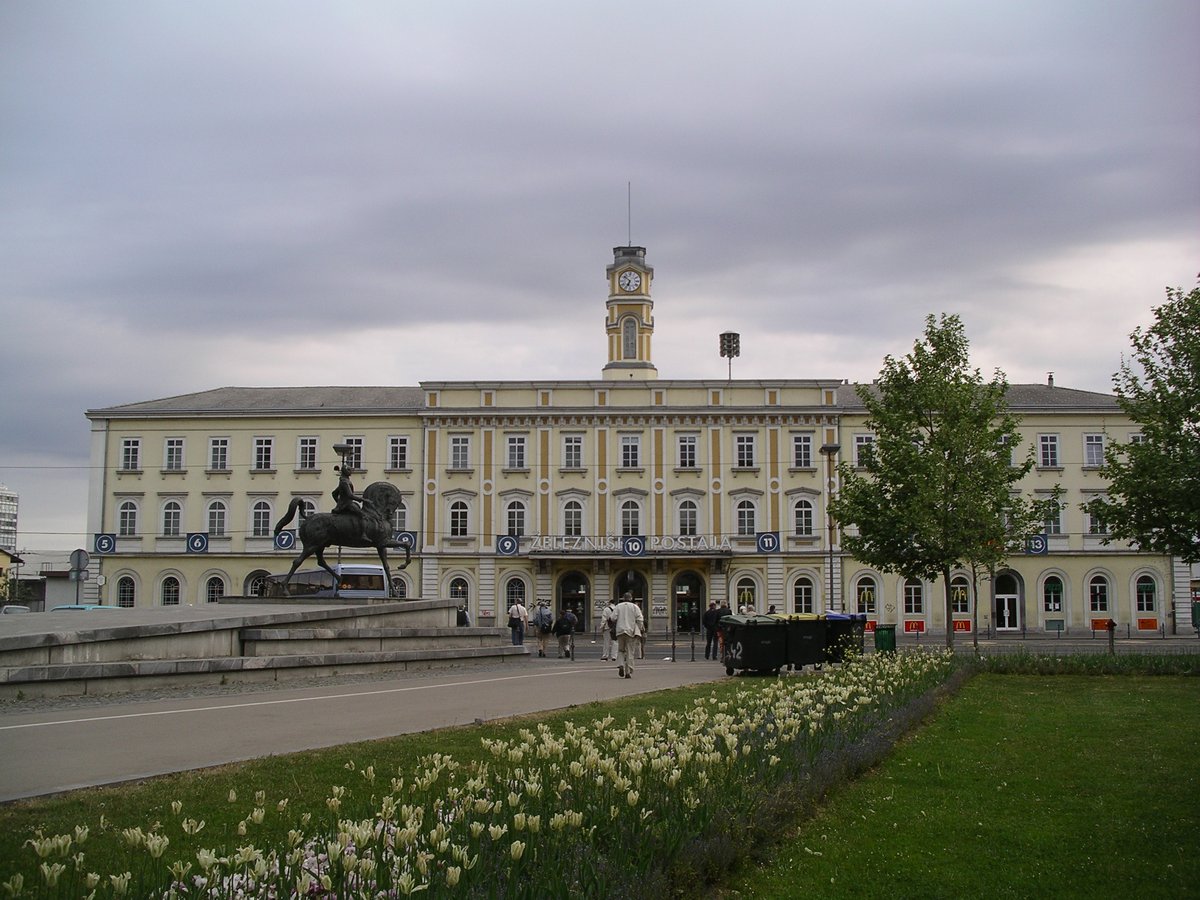
The General Maister Monument in Ljubljana stands as a powerful tribute to General Rudolf Maister, one of Slovenia’s most influential national figures. Celebrated for his decisive role in securing Slovenia’s northern territories after World War I and renowned for his cultural contributions as a poet and bibliophile, Maister embodies the spirit of Slovenian sovereignty and identity. The monument, crafted by acclaimed sculptor Jakov Brdar and unveiled in 1999, is prominently located near the Ljubljana Railway Station, integrating seamlessly into the city’s vibrant public spaces. This guide offers in-depth historical context, practical visiting information, and insights into the monument’s artistic and cultural significance, ensuring a meaningful visit for anyone interested in Ljubljana’s rich heritage (AroundUs; Ljubljana.si; slovenia.si).

Historical Background
General Rudolf Maister: Life and Legacy
Born in Kamnik in 1874, Rudolf Maister’s upbringing in a multicultural region during the decline of the Austro-Hungarian Empire profoundly influenced his commitment to Slovenian identity. After receiving military training, Maister rose through the Austro-Hungarian Army ranks. However, it was the turmoil following World War I that cemented his place in history.
When German-speaking councils in cities like Maribor threatened Slovenian lands with annexation to German Austria, Maister mobilized local Slovenian forces, forming the first regular Slovenian army. In November 1918, he successfully secured Maribor and Lower Styria, ensuring these territories became part of the new South Slavic state. His defense of the northern border laid the foundation for Slovenia’s modern sovereignty (slovenia.si).
Cultural Contributions
Maister’s legacy extends beyond the military sphere. Writing poetry under the pseudonym Vojanov and collecting books, he contributed to Slovenian culture and the preservation of national identity. This dual legacy is echoed in the monument, which celebrates both his martial achievements and intellectual pursuits (sloveniaguide.si).
Commemoration and National Significance
November 23 is marked as Rudolf Maister Day in Slovenia, with commemorations taking place nationwide, including special events at the Ljubljana monument. The year 2024 marked the 150th anniversary of Maister’s birth, highlighting his continued significance in Slovenian public life (rudolfmaister.si).
The General Maister Monument: Design, Symbolism, and Urban Integration
Artistic Features
Jakov Brdar’s equestrian bronze statue of Maister stands 3.5 meters tall atop a minimalist concrete plinth at Trg Osvobodilne fronte (Liberation Front Square). The statue captures Maister as a resolute leader on horseback, symbolizing resilience and Slovenian patriotism. The expressive details—uniform textures, the horse’s dynamic posture, and the interplay of bronze patina with light—emphasize both the general’s strength and poetic sensibility (AroundUs; Ljubljana.si).
Symbolic Context
Maister’s equestrian depiction is rare in Slovenian public art, emphasizing his unique role as a national hero. The monument also acknowledges his cultural achievements, making it the only major Slovenian monument to honor him as both a soldier and a bibliophile (sloveniaguide.si; Academia.edu).
Urban Setting and Accessibility
Strategically located near the main railway station and major city thoroughfares, the monument is integrated into Ljubljana’s urban landscape. The site is wheelchair accessible, and the surrounding square offers benches, green areas, and easy pedestrian access (mapcarta.com; Evendo).
Visitor Information
Opening Hours and Admission
- Hours: The monument is outdoors and accessible 24/7.
- Admission: Visiting is free; no tickets are required.
Getting There
- Location: Trg Osvobodilne fronte (Liberation Front Square), near Ljubljana Railway Station.
- Transport: Easily reachable on foot, by public transport, taxi, or car. Public parking is available nearby.
- Accessibility: The area is fully accessible for wheelchair users.
Guided Tours and Events
- Local tourism operators often include the monument in city walking tours, offering historical context and stories.
- Annual commemorations, especially on Rudolf Maister Day (November 23), feature ceremonies and cultural programs open to the public (rudolfmaister.si; Ljubljana.si).
Travel Tips
- Combine your visit with nearby attractions such as Ljubljana Castle, Tivoli Park, the National Museum of Slovenia, and the Dragon Bridge.
- Spring (May–June) and early autumn (September–October) offer pleasant weather and fewer crowds (showcasingtheglobe.com).
- The monument is well-lit at night, allowing for safe evening visits.
Nearby Attractions
- Ljubljana Castle: Panoramic city views and historical exhibits (chasingthedonkey.com).
- National Museum of Slovenia: Artifacts and displays from prehistory to the present.
- Tivoli Park: A green oasis ideal for relaxation.
- Dragon Bridge, Miklošič Park, Path of Remembrance and Comradeship: Notable landmarks within walking distance.
Frequently Asked Questions (FAQ)
What are the visiting hours?
The General Maister Monument is accessible 24 hours a day, year-round, with no entry restrictions.
Is there an admission fee?
No, visiting the monument is free of charge.
How do I reach the monument?
It is centrally located and easily accessible on foot, by public transport, taxi, or car.
Are guided tours available?
Yes, many city walking tours include the monument and provide in-depth historical commentary.
Is the monument wheelchair accessible?
Yes, the area features paved paths and ramps, making it suitable for all visitors.
When is the best time to visit?
Daytime is ideal for appreciating the monument’s details; commemorative events on November 23 offer additional cultural experiences.
Educational and Cultural Significance
The General Maister Monument serves not only as a historical marker but also as a living educational resource. Informational plaques provide context, and nearby museums, such as the National Museum of Slovenia and the Museum of Contemporary History, offer related exhibitions. Annual events like Maister Day bring together locals, students, and tourists, fostering greater awareness and appreciation for Slovenia’s journey to independence (rudolfmaister.si; STA, 2018).
Responsible Tourism
Visitors are encouraged to respect the monument and its surroundings, refrain from littering, and engage thoughtfully with the site. Attending ceremonies and reading inscriptions helps preserve and honor Slovenian heritage.
Discover More
The General Maister Monument in Ljubljana is more than a statue—it is a living symbol of Slovenian resilience, independence, and cultural pride. Its central location, artistic distinction, and historical resonance make it a must-see for anyone visiting the capital. Enhance your experience by joining guided tours, attending commemorative events, and exploring the many nearby historical sites.
For up-to-date information, guided tour bookings, and cultural event listings, download the Audiala app and follow us on social media. Discover more about Slovenia’s heritage and plan your journey through its most significant historical landmarks.
Listen to the full story in the app
The whole General Maister Monument,
told well.
Audio guides for 1,100+ cities across 96 countries. History, stories, and local insight — offline ready.
Verified, and shown.
Researched and written by the Audiala editorial team from historical records, architectural archives, and local expertise.
Researched from Wikidata, Wikipedia & official sources · fact-checked · How we make our guides →