Introduction
The Danube here smells faintly of diesel and apricots. From the UFO Tower's observation deck at sunset, Bratislava, Slovakia reveals its trick: a capital city the size of a large town, where medieval spires cast shadows across 1970s housing blocks and Vienna's skyline hovers 60 kilometers west like a postcard held at arm's length.
This is the only European capital that borders two countries at once, and it shows. Hungarian paprika lingers in goulash thicker than Vienna's, while Slovak bryndza cheese arrives crumbled over potato dumplings that would make a Bavarian weep. The 18th-century Primates' Palace — where Napoleon signed the Treaty of Pressburg after crushing the Habsburgs — sits three blocks from a Soviet-era riverside that locals still call "the new bridge" though it opened in 1973.
Walk the Old Town at 7 AM and you'll have Michael's Gate to yourself, its 51-meter tower watching over cobblestones worn smooth by coronation processions — 11 Hungarian kings and 8 queens were crowned at St. Martin's Cathedral between 1563 and 1830. By noon, the same streets smell of fried cheese and fresh kofola, and somewhere a busker is playing Moravian folk songs on a violin that probably crossed these borders without papers in 1946.
Places to Visit
The Most Interesting Places in Bratislava
Bratislava Castle
Bratislava Castle stands as an enduring symbol of Slovakia’s rich historical tapestry and cultural heritage, majestically perched atop a hill overlooking the…
Grassalkovich Palace
Nestled in the heart of Bratislava, Slovakia, Grassalkovich Palace stands as a magnificent emblem of the city’s rich historical tapestry, architectural…
St. Martin'S Cathedral, Bratislava
Nestled beneath the historic Bratislava Castle and overlooking the Danube River, St.
Most Snp
Most SNP, commonly known as the UFO Bridge, is one of Bratislava’s most distinctive landmarks, offering visitors a compelling blend of history, architectural…
Slovak National Museum
The Slovak National Museum (SNM) in Bratislava stands as Slovakia’s foremost cultural institution, offering visitors an unparalleled journey into the nation’s…
Primate'S Palace
Nestled in the vibrant heart of Bratislava’s Old Town, the Primate’s Palace (Primaciálny palác) stands as a magnificent testament to neoclassical architecture…
Church of St. Elisabeth
Nestled in the eastern part of Bratislava’s Old Town, the Church of St.
Apollo Bridge
The Apollo Bridge (Most Apollo) in Bratislava, Slovakia, stands as a remarkable emblem of the city’s evolution, seamlessly blending its rich industrial past…
Summer Archbishop'S Palace
Nestled in the vibrant heart of Bratislava, Slovakia’s capital, the Summer Archbishop’s Palace (Letný arcibiskupský palác) stands as a captivating monument…
Kamzík Tv Tower
Nestled atop the highest natural point in Bratislava, Kamzík Hill, the Kamzík TV Tower stands as a towering symbol of Slovak modernity, technological…
Snp Square
Nestled at the heart of Bratislava’s Old Town, SNP Square (Námestie Slovenského národného povstania) stands as a vibrant testament to Slovakia’s rich…
Franciscan Church
Nestled in the heart of Bratislava’s historic Old Town, the Franciscan Church (Františkánsky kostol) stands as one of the city’s oldest and most treasured…
What Makes This City Special
The Upside-Down Table
Bratislava Castle's rebuilt white cube sits 85 m above the Danube like a piece of modernist tableware dropped on a Baroque city. From the ramparts you can see three countries at once—Slovakia, Austria, Hungary—because the Iron Curtain used to run right below the walls.
Blue Church, Inside and Out
Art-Nouveau parish church of St Elizabeth is glazed in the exact shade of Wedgwood, down to the mosaics and the priest’s vestment cupboard. Locals use it as a colour-calibration chart for wedding photos—if the bride’s dress doesn’t match the façade, the filter gets tossed.
Europe’s Oldest Riverside Garden
Sad Janka Kráľa predates New York’s Central Park by four decades; its plane trees shade open-air concerts all summer and the scent of linden drifts across the Danube promenade at dusk. Bring a picnic and watch cargo barges slide under the SNP Bridge’s UFO disc.
Communist-Era Škoda Bar Crawl
Drink in Gallery Andy, a former train-carriage bar on Beblavého where the ceiling curves like a 1970s sleeper compartment and Stupavar craft lager flows from repurposed dashboard taps. The barman still keeps a Škoda ignition key to tap the keg.
Historical Timeline
Where Three Rivers Remember Every Empire
From Celtic mint to UFO bridge—25 centuries of border-city survival
Celts Mint Silver Coins
The Boii tribe carve an oppidum into Castle Hill and strike silver coins stamped 'Biatec'—the first recorded name tied to Bratislava soil. Fourteen hoards of these coins will surface during future construction works, proof that the settlement already thought in money, not just barter. The Danube below is still the frontier of the known world.
Biatec, Prince of the Danube
A local king signs his name on silver drachms—Bratislava’s first autograph, currency, and political manifesto in one. The coins travel as far as the Baltic; merchants learn to trust the weight of the Danube mint. Biatec himself vanishes into fog, but his name will later be given to the main bus station—an accidental resurrection.
Romans Build Gerulata
On the south bank, the 10th Legion erects Gerulata—stone barracks, bathhouse, and a customs post for river traffic. The north bank stays barbarian; soldiers warm their hands at watchfires and stare into dark forests. Excavated foundations now lie under a quiet suburb street—kids skateboard over mosaic floors.
Battle of Bratislava: Magyars Arrive
Hungarian horsemen shatter Bavarian lines on the Marchfeld; the Salzburg annals first write ‘Brezalauspurc.’ The victors camp on both rivers, and the Slavic garrison learns new saddle songs. What began as a fortress becomes a capital-in-waiting.
Free Royal City Charter
King Andrew III signs parchment granting Pressburg self-government, weekly markets, and the right to hang thieves from its own gallows. The seal shows a triple-towered wall—aspiration more than reality. Merchants from Vienna and Kraków now pay tolls to the city, not the castle.
Corvinus Founds Istropolitana
Matthias Corvinus charters Academia Istropolitana—Hungary’s first university—inside the cloister of St. Martin’s canons. Lectures begin at dawn in Latin; students argue over Aristotle while the Danube fog lifts outside. The school dies with its patron, but the street keeps the name, a quiet boast.
Pressburg Becomes Hungarian Capital
With Buda in Ottoman hands, the diet moves north. Carpenters hammer together a parliament hall beside the castle; coronation processions wind through freshly cobbled streets. For 247 years, kings receive their crowns here while the minarets glint ominously downstream.
Maximilian Crowned at St. Martin’s
The first royal coronation inside the Gothic basilica sets the ritual: knight’s sword, Hungarian sabre, crown pressed down on a head already heavy with duty. Bells drown out the Danube ice cracking below. Ten more kings and eight queens will follow the same carpet.
Maria Theresa’s Midnight Plea
French and Bavarian armies threaten Vienna; the pregnant queen flees to Pressburg and begs the diet for troops in German, Latin, and halting Hungarian. The nobles cheer ‘Vivat!’—then ride off to war. She never forgets the night the city saved her throne.
Peace of Pressburg Signed
In the Mirror Hall of Primates’ Palace, Napoleon’s diplomats force Francis II to cede Venice and Tyrol. Champagne is served at 3 a.m.; candles gutter in silver sconces. Europe wakes up smaller, and the city’s name is etched into a treaty that redraws borders from the Adriatic to the Alps.
Castle Burns for Three Days
A careless soldier knocks over a stove; flames race through wooden apartments housing the royal family. Locals watch embers drift across the Danube like infernal snow. The castle shell stands roofless for 140 years—an accidental monument to imperial overreach.
Ľudovít Štúr Codifies Slovak
In a narrow Old-Town flat, Štúr and friends choose the central-Slovak dialect as the written standard, slicing the language away from Czech. Pamphlets roll off a hand-press; police spies take notes. The decision will echo in every future independence speech.
First Danube Bridge Opens
Iron rivets scream as the cantilever spans 460 meters—engineers toast with slivovitz while the emperor’s band plays. Farmers from Žitný ostrov no longer wait for ferries that froze in winter. The bridge survives both world wars; its green trusses still carry trams today.
Czechoslovak Soldiers March In
Legionaries in French helmets cross the former imperial border; German and Hungarian shopkeepers watch curtains twitch. Overnight, street signs swap Königgrätz for Štefánik. The city’s tri-lingual identity is suddenly illegal in two of its own tongues.
Red Army Liberation
T-34s grind past bullet-scarred façades; SS units retreat toward the castle hill. Civilians wave white flags sewn from bedsheets. The Danube runs rust-red for a day, then carries away the evidence.
UFO Bridge Lands
Socialist engineers close the Old Town waterfront, ram a single pylon into the riverbed, and hoist a flying-saucer restaurant 95 meters above current. Critics call it a cosmic middle finger to heritage. At night the red aviation beacon pulses like a heartbeat no one asked for.
Velvet Revolution Reaches Square
Candle-holding students link arms below St. Martin’s spire, chanting ‘We’re not like them!’ Factory workers arrive with homemade banners; the police hesitate, then lower batons. By midnight the Communist Party headquarters is dark—its neon star switched off for good.
Bratislava Becomes National Capital
At 12:01 a.m. the Czechoslovak flag is lowered in the castle courtyard; the Slovak tricolor climbs slowly, snagging twice on the brisk wind. Border posts vanish along the Morava; Vienna is suddenly 45 minutes away. A city used to hosting crowns now writes its own laws.
Zuzana Čaputová Elected President
The environmental lawyer takes the oath in the same Mirror Hall where Napoleon humiliated Austria. Outside, crowds cheer a divorced liberal woman leading a nation once ruled by priests. The castle courtyard smells of linden blossoms and possibility.
Notable Figures
Johann Nepomuk Hummel
1778–1837 · Composer & pianistA child prodigy rehearsing in the cathedral where kings were crowned, Hummel later sent piano innovations rippling across Europe. Today his birthplace hosts open-air concerts on the same square where he once improvised for pocket money.
Philipp Lenard
1862–1947 · Nobel-winning physicistIn a lab perched above the Danube, Lenard chased cathode rays long before electronics shops lined the riverbank. His 1905 Nobel medal sits in the Slovak museum inside the castle he grew up staring at from the rooftops below.
Zuzana Čaputová
born 1973 · President of SlovakiaShe walked environmental lawsuits through these courthouse corridors long before moving into the Grassalkovich Palace gardens she now opens to the public each summer. Locals still spot her buying fresh bread at Saturday markets without bodyguards.
Rudolf von Laban
1879–1958 · Dance theoristHe mapped human movement in cafés along Hviezdoslav Square, sketching stick figures that became the global Labanotation system. Dancers today pirouette on the same cobblestones he hurried across to reach the opera house.
Photo Gallery
Explore Bratislava in Pictures
A striking contrast between historic castle architecture and the modern UFO Bridge spanning the Danube River in Bratislava, Slovakia.
Tuğba Sarıtaş on Pexels · Pexels License
The striking Most SNP bridge, featuring its signature UFO observation deck, glows above the Danube River in Bratislava, Slovakia at twilight.
Vlastimil Starec on Pexels · Pexels License
A newlywed couple strolls through the scenic grounds of the historic Bratislava Castle in Slovakia on a bright, cloudy day.
Helena Jankovičová Kováčová on Pexels · Pexels License
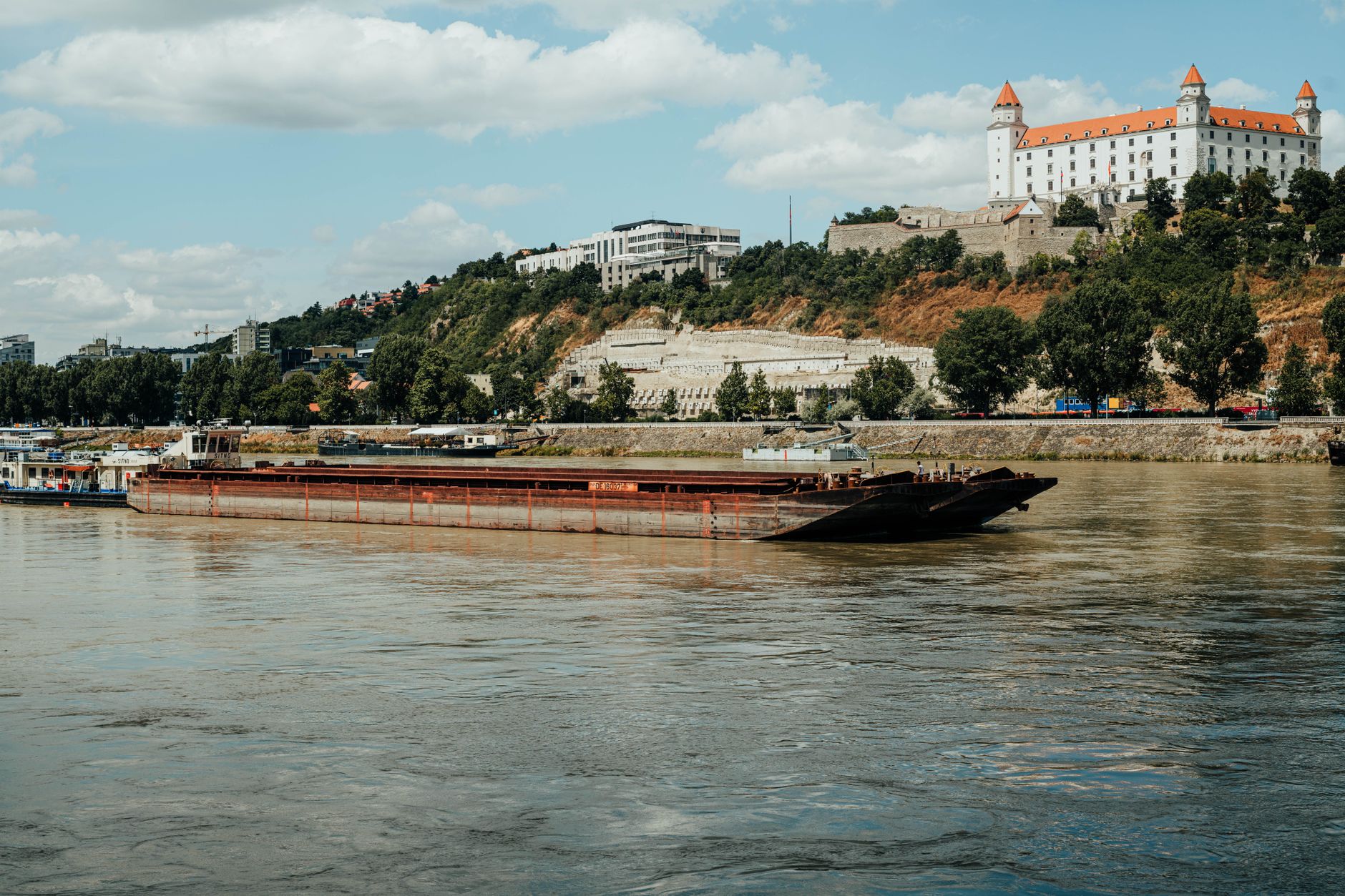
A large cargo barge navigates the Danube River in Bratislava, Slovakia, set against the historic backdrop of the majestic Bratislava Castle.
Helena Jankovičová Kováčová on Pexels · Pexels License
A stunning elevated view of Bratislava, Slovakia, showcasing the contrast between the historic St. Martin's Cathedral and the city's modern high-rise skyline.
Kendra Valócsik on Pexels · Pexels License
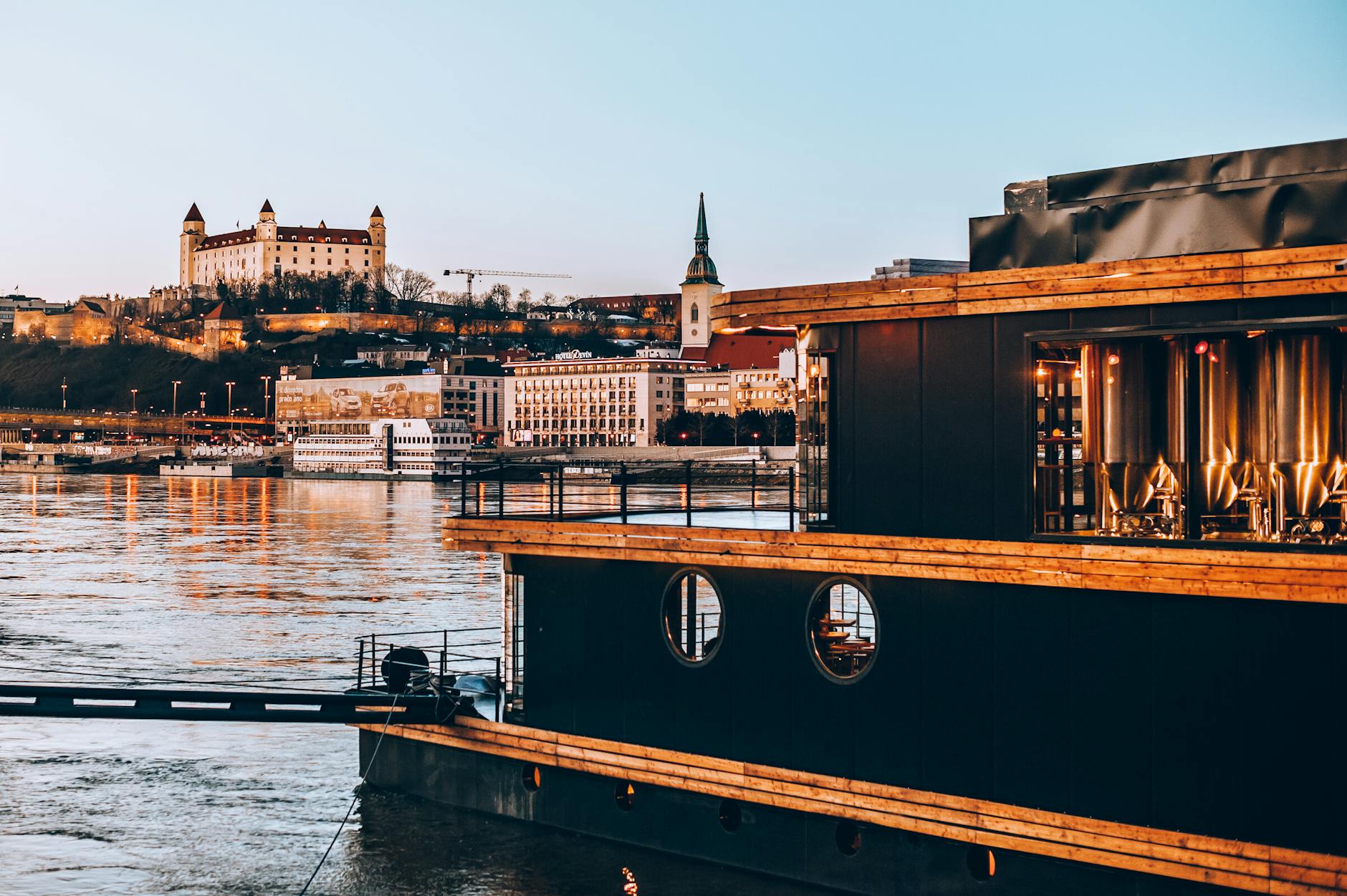
The historic Bratislava Castle stands proudly over the Danube River, contrasted by the warm, inviting glow of a modern floating brewery in the foreground.
Helena Jankovičová Kováčová on Pexels · Pexels License
A cloudy day along the Danube promenade in Bratislava, Slovakia, showcasing the iconic UFO bridge and the historic castle in the background.
William Gevorg Urban on Pexels · Pexels License
A peaceful view of the iconic Bratislava Castle overlooking the Danube River and the Most SNP bridge in Slovakia.
William Gevorg Urban on Pexels · Pexels License
A bright, sunny day in Bratislava, Slovakia, showcasing the iconic hilltop castle overlooking the Danube River and docked cruise ships.
Milan Kiro on Pexels · Pexels License
Practical Information
Getting There
Fly into Bratislava M.R. Štefánik (BTS) 9 km northeast, or Vienna International (VIE) 40 km west—both linked by Slovak Lines bus in 20 min and 1 hr 10 min respectively. Main train station is Hlavná stanica; direct rail from Vienna Hauptbahnhof every 30 min. Highways D1 and D2 feed in from Budapest and Prague.
Getting Around
No metro—Bratislava runs 8 tram lines, 50+ bus and trolley routes. Tram 1 slices from the main station to the Old Town edge; Bus 29 shuttles to Devín Castle every 15 min. A 24-hour Bratislava City Card covers all transit plus museum discounts (€12/2026). Bolt e-scooters and Rekola yellow bikes blanket the centre; Danube cycle path is part of EuroVelo 6.
Climate & Best Time
Spring 11–21 °C brings lilac scent up the castle hill; summer peaks at 27 °C but riverfront cafés stay breezy. September goldens to 21 °C with half the crowds. Winter hovers around 0 °C—pack traction for polished cobblestones. May and early October deliver the best light for photography and cheaper rooms than July.
Language & Currency
Slovak is the tongue, but English works in every café on Michalská. German helps with older tram conductors. Euro coins only for bus drivers—cards accepted everywhere else. Tipping: round up or add 10 % in restaurants; tell the server the total when you hand over cash.
Where to Eat
Don't Leave Without Trying
Bistronomy
fine diningOrder: The 7-course tasting menu is a revelation—each dish balances creativity with flawless execution, especially the smoke-infused creations that avoid overpowering flavors.
A stylish, intimate space where the chef’s playful techniques meet top-quality ingredients. Perfect for a special occasion or foodie adventure.
Bistro Zepen House
local favoriteOrder: The Chachapuri (cheese-filled bread) and Kubdari (spiced meat pie) are must-try Georgian classics, with authentic flavors transporting you to Tbilisi.
A hidden gem for hearty, flavorful Georgian food with a cozy vibe. The perfect spot for a lively, communal meal with friends.
Gatto Matto Ventúrska
fine diningOrder: The mafaldine pasta with duck ragout and cauliflower soup are standouts, but save room for the tiramisu—it’s worth the hype.
A warm, elegant Italian restaurant with impeccable service and artfully plated dishes. Ideal for a romantic dinner or celebratory meal.
Balans Bistro
local favoriteOrder: The cauliflower with leeks and peas is a comforting winter dish, and the banana bread is a must-try for desserts.
A vegan gem with creative, flavorful dishes that appeal to all diners. The friendly staff and relaxed atmosphere make it a go-to for plant-based lovers.
Roxor
quick biteOrder: The goat cheese burger is a game-changer, with perfectly balanced flavors and premium ingredients.
A lively spot for some of the best burgers in Bratislava, with a fun atmosphere and generous portions.
Frištuk
cafeOrder: Their homemade pastries are fresh and delicious, especially the sweet options—try the pistachio and lemon cream kouign-amann.
A charming bakery with warm, friendly service and some of the best pastries in town. Perfect for a quick breakfast or coffee break.
Kauka
cafeOrder: The strawberry vegan cheesecake is legendary—rich, creamy, and not to be missed. Pair it with their excellent cappuccino.
A cozy, pet-friendly café with a unique vibe and some of the best vegan desserts in Bratislava. Ideal for a relaxed afternoon.
Irin.
fine diningOrder: The twice-smoked trout with marinated beets is unforgettable, as is the fermented pumpkin sauce with duck and corn foam.
A transcendent fine-dining experience with inventive, flavorful dishes that stand out even among Bratislava’s top spots.
Dining Tips
- check Lunch is the main meal—expect restaurants to be packed between 11:30 AM and 2:00 PM.
- check Reservations are essential for Sunday lunch, the busiest meal of the week.
- check Tipping is standard: round up to the nearest euro in casual spots; add ~10% in proper restaurants.
- check Soup is a standard starter at both lunch and dinner.
- check Full menus often unavailable between 3:00 PM and 5:00–6:00 PM—plan accordingly.
- check Dining is communal—plates are piled high, and dishes are shared.
Restaurant data powered by Google
Tips for Visitors
Pay by App
Buy bus/tram tickets in the ubian.sk app and validate with one tap—drivers sell paper tickets but give no change. A single ride is €1, and inspectors board without warning.
Skip the Castle Hill
If mobility is an issue, hop the Presporáčik tourist tram that drops you inside Bratislava Castle’s upper courtyard for €8 return—saves the 85-metre climb.
Eat Lunch Early
Centrálna jedáleň canteens (e.g., on Špitálska) serve bryndzové halušky for under €5 until 14:00—after that the pots are scraped clean and restaurants double the price.
Blue Church Hour
Arrive at the Art-Nouveau Blue Church at 10:00 when the caretaker unlocks the side door; interior mosaics glow turquoise for twenty minutes before the sun swings round.
Station After Dark
Main train station (Hlavná stanica) is lit but empty after 22:00—order a taxi via the HOPIN app instead of waiting outside; unlicensed cabs circle and overcharge.
City Card Maths
The 24-hr Bratislava City Card costs €14 and pays for itself if you ride public transport four times and enter any two museums—pick it up at the tourist office on Klobučnícka.
Explore the city with a personal guide in your pocket
Your Personal Curator, in Your Pocket.
Audio guides for 1,100+ cities across 96 countries. History, stories, and local insight — offline ready.
Audiala App
Available on iOS & Android
Join 50k+ Curators
Frequently Asked
Is Bratislava worth visiting or just a day trip from Vienna? add
Stay at least one night. The Old Town’s pastel façades look tame by day, but lamp-lit cobbles and cellar bars hum after dark. Add Devín Castle, a UFO-tower sunset, and Slovak wine tastings and you’ll need two full days.
How many days do I need in Bratislava? add
Two days covers the essentials: Old Town, castle, Blue Church, UFO tower, Devín half-day, and an evening on the Danube promenade. Stretch to three if you want gallery depth, cycling to the wine villages, or a spa afternoon in Piešťany.
Can I use euros, cards and English in Bratislava? add
Slovakia has used the euro since 2009. Cards work everywhere except market stalls and the bus 61 driver—carry a few coins. English is standard in restaurants; older locals switch to German.
Is Bratislava safe for solo travellers at night? add
Old Town is lively and patrolled until late, but avoid the underpasses around the main bus station after midnight. Pickpockets work crowded trams 61 and 93—keep phones off table edges.
What’s the cheapest way from Vienna airport to Bratislava? add
RegioJet or Slovak Lines bus, €9–12 one-way, leaves Vienna Schwechat every 30–60 min and drops you at Bratislava’s Most SNP in 70 min—often faster than the city-hopping train combo.
Which local food must I try and where? add
Bryndzové halušky (potato dumplings in sheep-cheese) at Slovak Pub or Modrá Hviezda; follow with a poppy-seed Bratislavský rožok from Konditorei Kormuth. Wash it down with draft Kofola, the communist-era cola.
Sources
- verified Visit Bratislava Official — Ticket prices, transport routes, City Card details and airport connections
- verified The Better Beyond — Attraction logistics, UFO tower timing and Blue Church photo advice
- verified Transport operator DPB — Current fares, mobile app links and tram/bus maps
- verified Backroad Planet — Devín Castle directions, Presporáčik tram option and safety notes
Last reviewed: