An introduction.
Researched by the Audiala editorial team from historical records, architectural archives, and local expertise.
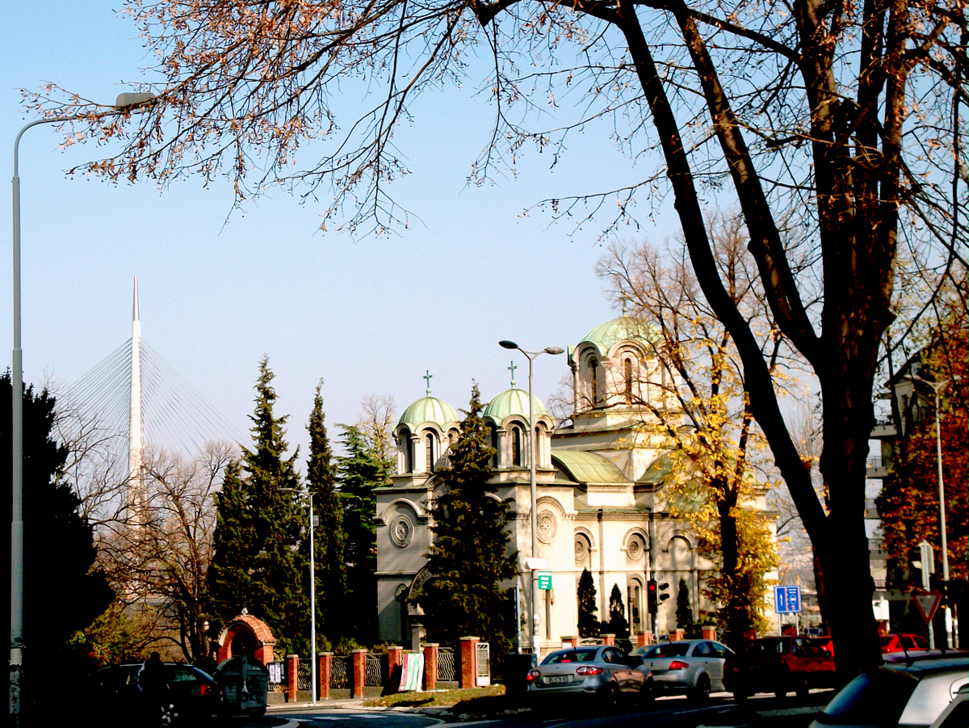
AA church built from a father's grief stands over Belgrade, Serbia, with the calm confidence of a neighborhood landmark and the private ache of a family tomb. Church of Saint George on Banovo Brdo rewards a visit because it hides a far stranger story than its interwar walls first suggest: Russian exile architecture, a merchant's memorial for his dead children, and a crypt beneath the floor that changes the whole mood of the place. Step inside when the light turns soft and the painted saints begin to glow against the dim nave. The building stops being local background and starts feeling personal.
Church of Saint George sits at Kirovljeva 1, at the corner with Zrmanjska, in Čukarica's Banovo Brdo district. From the street, the setting feels almost ordinary: trams, traffic, apartment blocks, daily errands. Then the church rises above them, and the noise drops a register.
Records on the parish site show the building went up between 1928 and 1932 to designs by the Russian architect Vasilij Androsov, one of the émigré architects who left a deep mark on Orthodox Belgrade after 1917. That alone would make it worth your time. But the real pull is emotional, not architectural.
This was conceived as a public church and a family memorial at once. Once you know that, the iconostasis, the later frescoes, even the stillness of the interior read differently. You are not just looking at a parish church. You are standing inside one man's attempt to give grief a permanent shape.
01 What to see.
The West Front on Kirovljeva
The Dome, the Iconostasis, and the Colored Light
A Short Walk from the Church to the Edge Above the Sava
Plan and listen to Church Of Saint George with Audiala.
Audio guide in your pocket, itinerary in your browser. Built for the way you actually visit.
03 Visitor logistics.
The practical scaffolding for a good visit — kept short.
Getting There
The church stands at the corner of Kirovljeva and Zrmanjska on Banovo Brdo, about 150 meters south of Ada Mall, which is roughly the length of one and a half city buses parked nose to tail. The nearest stop is Kirovljeva, about 99 meters away, served by lines 23, 37, 37N, 51, 51N, 52, 53, 56N, 58, 85, 87, 87A, 88, and E2; if you drive, Ada Mall’s garage and rooftop parking are the easiest nearby option, with entrances from Paštrovićeva and Visoka streets.
Opening Hours
As of 2026, the parish does not publish tourist visiting hours, but it does publish seasonal worship times. Summer services are generally at 08:00 and 18:00, winter services at 08:00 and 17:00, with Sunday liturgy at 09:00 year-round; if you want a guaranteed open door outside services, call ahead because no newer 2026 closure notice was posted.
Time Needed
Give it 10 to 15 minutes for a quick look, 20 to 30 minutes for a proper visit, or 45 to 60 minutes if you plan to light a candle and stay through part of a service. This is a working neighborhood church, not a museum circuit, so the visit tends to stretch if the choir is rehearsing or incense is still hanging in the air.
Accessibility
Wheelchair access is not confirmed on the parish site, and I found no published statement about ramps, lifts, or accessible toilets. Banovo Brdo is literally a hill, so expect sloping approaches around the church; if step-free access matters, call the parish first and use Ada Mall nearby as the safer fallback for accessible facilities.
Cost & Tickets
As of 2026, I found no admission fee, no booking system, and no skip-the-line option. Ordinary access appears to be free, which fits the fact that this is an active Serbian Orthodox parish church rather than a timed-entry monument.
05 Tips for visitors.
Small things that change the day.
Dress Respectfully
Treat this as a living Serbian Orthodox church, not a photo stop. Modest clothing is the safe move: covered shoulders, no beachwear, men bareheaded, and keep still and quiet if liturgy is underway.
Ask Before Photos
Exterior shots are fine, but inside the church, especially during worship, ask before raising your camera. Skip flash and forget the tripod unless someone from the parish explicitly says yes.
Watch The Traffic
The real nuisance here is not scams but Banovo Brdo traffic and crowded buses around Požeška and the market area. Keep your phone and wallet close on packed transport, then pay more attention to crossings than to pickpockets.
Eat Nearby
For a local meal, head toward Banovo Brdo market and Šumadijski trg: Restoran ŽAR is a solid budget grill choice, Walter Sarajevski Ćevap does dependable budget ćevapi, and Druga Kuća Banovo Brdo works well if you want a more sit-down mid-range lunch. If you just need coffee and a reset, Kafeterija Banovo Brdo is the better neighborhood move than hiding in the mall.
Come Near Service
The safest visiting window is close to posted worship times, because those are the hours the parish actually confirms. Late afternoon can be especially good: the light softens on the hill, candles are being lit, and the building feels used rather than staged.
Pair It Well
Don’t cross Belgrade for this church alone unless neighborhood life is the point. Pair it with Ada Ciganlija, Banovo Brdo market, or a walk down toward Ada Mall, and the church starts to make sense as a landmark in everyday Čukarica rather than an isolated monument.
Where to Eat
Don't Leave Without Trying
Dining Tips
- check Order ajvar and kajmak with grilled meats for an authentic experience.
- check Banovo Brdo offers a mix of traditional Serbian and modern Mediterranean dining.
- check For a quick bite, try a gurmanska pljeskavica from local fast-food spots.
Restaurant data powered by Google
04 A history of reinvention.
A Memorial Disguised as a Parish Church
Church of Saint George did not begin as a state project or a medieval inheritance polished for visitors. Parish records show it began with Mitar Jovanović, a Belgrade merchant who wanted to commemorate his children Julijana and Ljubomir on his Čukarica property, then was persuaded to turn private mourning into a church for the neighborhood.
That shift matters. Banovo Brdo was growing fast between the wars, and Čukarica still lacked its own Orthodox church. The building that appeared here between 1928 and 1932 answered a public need, yet its emotional engine remained painfully private.
Mitar Jovanović's Bargain With Memory
According to parish history, Mitar Jovanović wrote to Patriarch Dimitrije on 1 January 1925 offering land for a church dedicated to St. George, his family patron saint, and asking for a crypt beneath it. What was at stake for him was not reputation. He had already buried his infant son Ljubomir and his daughter Julijana, and he wanted memory fixed in stone before time could wear it smooth.
The turning point came in May 1928, when Patriarch Dimitrije consecrated the foundations on the hill above Čukarica. A plan for a family memorial became a public sacred place that local residents could enter, pray in, and claim as their own. Grief changed address.
Records show the church was completed in 1932, but the story did not end with dedication. After the Second World War, communist authorities confiscated Jovanović's estate, and the church with its crypt became the clearest surviving trace of the donor's life. That is why the building feels different from many interwar parish churches: it carries the weight of a bargain one man made with loss, and partly lost anyway.
A Russian Architect on a Belgrade Hill
The Interior Arrived Later
Listen to the full story in the app
The whole Church Of Saint George,
told well.
Audio guides for 1,100+ cities across 96 countries. History, stories, and local insight — offline ready.

06 Frequently asked.
The questions travellers send us most about Church Of Saint George.
Is Church of Saint George worth visiting?
Yes, if you want a real Belgrade church rather than a polished landmark. The surprise here is the backstory: this 1928-1932 parish church on Banovo Brdo began as a bereaved merchant's memorial to his dead children, with a family crypt beneath it. Go for the carved iconostasis, the later frescoes under the dome, and the feeling of a neighborhood still using the place as part of ordinary life.
How long do you need at Church of Saint George?
Most visitors need 20 to 30 minutes. Give it 10 to 15 minutes for a quick look, or closer to an hour if you want to sit through part of a service, light a candle, and let your eyes adjust to the colored light and painted interior. This isn't a museum circuit; it rewards a slower pause.
How do I get to Church of Saint George from central Belgrade?
The easiest way is by bus to the Kirovljeva stop, about 99 meters from the church. PlanPlus lists lines 23, 37, 51, 52, 53, 58, 85, 87, 87A, 88 and a few night routes, and Ada Mall is only about 150 meters away if you prefer to use that as your marker. Belgrade still has no operating metro as of April 14, 2026, so surface transport does the job.
What is the best time to visit Church of Saint George?
Late morning outside the main liturgy tends to work best if you want quiet and decent light. Sundays at 09:00 and feast days feel most alive, with chant rising into the dome, while spring around St George's Day and January's Epiphany procession show the church as part of neighborhood ritual rather than as a static building. If you need guaranteed access outside service times, call ahead.
Can you visit Church of Saint George for free?
Yes, ordinary access appears to be free. I found no ticket page, no admission fee, and no booking system on the parish site, which fits the fact that this is an active Serbian Orthodox church rather than a timed-entry monument. Bring modest clothing and ask before taking interior photos, especially during worship.
What should I not miss at Church of Saint George?
Don't miss the carved iconostasis, the Christ Pantocrator in the dome, and the west portal with St George above the entrance. Also look for the smaller things that usually slip past people: the builder's plaque on the west wall, the bifora windows and rosettes outside, and the candle room beside the church with its stained-glass image of St Petka. The church's secret sits below your feet too: it was conceived from the start as a memorial with a family crypt.
Verified, and shown.
Researched and written by the Audiala editorial team from historical records, architectural archives, and local expertise.
Official parish homepage used for identification, summary history, active parish life, and current church context.
Official contact page used for address, phone numbers, and practical visitor confirmation.
City page used for landmark listing and alternate address reference.
Used for location details, nearby public transport stop, and orientation near Kirovljeva.
Checked to confirm the church is not listed as a UNESCO World Heritage or tentative site.
Main source for construction history, donor story, architecture, iconostasis, and fresco chronology.
Used for entity identification and corroboration of completion year.
Used for choir history and confirmation of choir dates.
Used to confirm the 1933 origin of the choir tradition.
Used for donor biography, foundation blessing references, and memorial context.
Used for donor family history, memorial motive, and postwar fate of the family legacy.
Used for background on architect Vasilij Androsov and his wider work.
Used for Androsov context and the church's place in Belgrade's church architecture.
Used for the church's ceremonial role in local civic-religious events.
Used for neighborhood background and Čukarica/Banovo Brdo context.
Used for published summer service times and liturgy schedule.
Used for published winter service times and evening schedule.
Used to check current published service schedule and absence of separate tourist opening hours.
Used for mapping context, hill-edge setting, and proximity to Ada Mall.
Used for nearby landmark orientation around Ada Mall.
Used to confirm Belgrade still had no operating metro as of March 27, 2026.
Used for nearby facilities, parking context, mall hours, and support services.
Used for documented nearby parking details.
Used for nearby coffee option and hours.
Used for nearby food option and hours.
Used for nearby dining cluster information.
Used for nearby street food reference close to the church.
Used as evidence for dependable mall visitor facilities and restrooms nearby.
Used for nearby luggage locker information.
Used for supplementary overview and siting context.
Used for gallery captions and visual details such as dome painting and exterior elements.
Used for supplementary visual reference to the church exterior and setting.
Used for parish complex context and associated facilities.
Used for choir-event evidence and the church as a sounding space.
Used for Epiphany procession and ritual role of the church.
Used for current reporting on Epiphany liturgy and local ritual use.
Used for procession-to-river event context tied to the church.
Used for St George's Day and parish celebration atmosphere.
Used for local perspective, emotional tone, and neighborhood identity.
Used as local evidence for the church serving as a neighborhood waypoint.
Used for local orientation and nearby urban context.
Used for evidence of active parish development and community life.
Used for neighborhood traffic context and practical local conditions.
Used for local ceremonial role of the church in the Epiphany procession.
Used for municipal procession history beginning at the church.
Used for Banovo Brdo neighborhood feel and local-life framing.
Used for neighborhood orientation and local commercial spine context.
Used for neighborhood atmosphere and Banovo Brdo character.
Used for nearby market context and crowd/transport conditions.
Used for nearby landmark context and visitor orientation.
Used for broad safety guidance relevant to Belgrade visitors.
Used for market identity and local food context.
Used for local grill culture around the neighborhood.
Used for nearby restaurant recommendation and local food context.
Used in research to note address inconsistency and city listing behavior.
Used for general Serbian Orthodox church etiquette guidance.
Used for dress, behavior, and photography etiquette in Orthodox settings.
Used for drone and airspace caution near urban church sites.
Used for general Belgrade travel caution, including taxi overcharging context.
Used for nearby food recommendation in Banovo Brdo.
Used for nearby coffee recommendation.
Used for nearby traditional Serbian dining recommendation.
Used for nearby more polished dining option.
Used for nearby Serbian meal option in the wider area.
Last reviewed
Researched from Wikidata, Wikipedia & official sources · fact-checked · How we make our guides →


