Introduction
This Senegal travel guide starts with a useful surprise: the country runs on Atlantic light, river history, and one of West Africa's most layered food cultures.
Senegal makes sense fast once you stop reducing it to beaches and baobabs. Dakar is the western edge of the continent, a capital where Atlantic rollers hit basalt cliffs at Les Mamelles, street grills smoke over lunch, and ferries still pull people toward Gorée Island, 3.5 kilometers offshore. North, Saint-Louis sits on a narrow island in the Senegal River with a French colonial grid that now feels fragile rather than triumphant. This is a country where the map keeps changing your expectations: salt-pink Lac Rose near the capital, then the mangrove maze of the Sine-Saloum Delta, then the greener south of Casamance around Ziguinchor.
The history has weight, but it never stays inside museums. On Gorée Island, memory of the Atlantic slave trade shapes the mood of the streets even as bougainvillea spills over ocher facades. In Touba, the Great Mosque anchors the spiritual force of the Mouride brotherhood and the annual Grand Magal can redraw national travel patterns overnight. East and south, Senegal opens into older landscapes: the shell islands and tidal creeks of the Sine-Saloum Delta, bird migrations near Saint-Louis, and village roads in Casamance lined with kapok trees and rice fields. Distances look modest on a map. Travel times are not.
Food is one reason many travelers remember Senegal more vividly than they expected. Thiéboudienne is not a token national dish but a full grammar of fish, rice, tomato, cassava, and etiquette, and yassa poulet in Casamance tastes sharper and deeper than most versions served abroad. The practical upside is real: Dakar has the best flight connections, the dry season from November to April is the easiest all-round window, and a 7 to 12 day trip lets you combine city life, coast, and one slower region. Build your route around Dakar, Saint-Louis, Gorée Island, and either the Sine-Saloum Delta or Casamance. That mix shows the country properly.
A History Told Through Its Eras
The Stone Circles and the Memory Without Writing
Before the Kingdoms, c. 300 BCE-1500 CE
Morning light falls across the laterite pillars at Sine Ngayene, east of Kaolack, and the place looks less like a ruin than a court still waiting for its dead. More than 50 circles stand here, each stone cut, hauled, and planted with a discipline that still unsettles archaeologists. No royal chronicle tells us who ordered them. The stones kept the secret.
Ce que l'on ignore souvent, c'est que these monuments were not used once and abandoned. Excavations show repeated burials, generation after generation, with iron spearheads, copper ornaments, and signs of social rank. A family, a clan, perhaps a ruling line kept returning to the same ground, as if power itself needed an address.
Long before Dakar, Saint-Louis, or Gorée Island entered the record, Senegambia already knew how to turn landscape into ceremony. These circles, built between roughly the first millennium BCE and the second millennium CE according to current archaeological dating, tell us that political prestige and ritual memory were already tightly bound here. No palace survives. The funerary geometry does.
Then came the age of courts and tributary kingdoms. Once authority learned to gather itself not only around tombs but around living rulers, the savannah gave way to dynasties, alliances, rivalries, and those old aristocratic passions that ruin empires with such efficiency.
The unknown patrons of the stone circles remain anonymous, yet their ambition was plain: they wanted memory to outlast flesh.
At Sine Ngayene, some circles contain multiple burials layered over centuries, which means the site stayed politically meaningful long after its first founders were gone.
Jolof, or the Art of Ruling Proud Men
The Wolof Kingdoms, c. 1200-1549
Picture a royal court somewhere in the interior, not marble and chandeliers but horses stamping in the dust, leather amulets, praise-singers, tributary envoys waiting their turn. This was the world of Jolof, the Wolof confederation that rose across much of present-day Senegal and bound Cayor, Baol, Sine, Saloum, and Waalo into a political order neither loose nor fully centralized. That balance was the whole trick.
Tradition gives the founding role to Ndiadiane Ndiaye, a figure half prince, half apparition. The story says he emerged from the water, astonished the local rulers, and persuaded them to accept his authority. Legend, yes, but a revealing one: in Senegalese political imagination, legitimacy was never only force. It needed charisma, lineage, and a touch of the marvelous.
Ce que l'on ignore souvent, c'est que Jolof did not collapse under foreign invasion. It was wounded by aristocratic insult, that oldest poison in noble houses. Around 1549, Amari Ngone Sobel Fall of Cayor led a revolt after humiliation at the Buurba's court; the Battle of Danki broke the confederation and the vassal kingdoms walked away from imperial discipline.
The consequence was immense. Senegal did not pass from one neat medieval kingdom into European control. It entered a harsher, more brilliant mosaic of rival courts, proud dynasties, and regional powers. When Portuguese ships pressed the coast, they found not a vacuum but a political world already skilled in bargaining, competing, and remembering slights for generations.
Ndiadiane Ndiaye matters less as a provable monarch than as a mirror of what power had to look like in Wolof memory: persuasive, sacred, and just a little mysterious.
The fall of Jolof is tied in oral tradition to court humiliation, which gives the episode the feel of a family scandal scaled up to an empire.
Gorée, Saint-Louis, and the Elegant Face of Violence
Atlantic Trade and Colonial Ports, 1444-1895
In 1444, Portuguese raiders seized captives near the Senegal coast and fed the Atlantic trade that would deform four continents. A few years, a few voyages, a few contracts, and human beings were already being priced, sorted, and shipped. History often enters quietly. Here it arrived with chains and bookkeeping.
Gorée Island, only 3.5 kilometers off Dakar, became the most famous symbol of that world, though historians still argue over the scale of deportations from the island itself. The argument matters, but not in the simple way people imagine. Joseph N'Diaye, the unforgettable curator of the Maison des Esclaves, understood that memory is not only arithmetic; he turned a house into a moral theater and forced visitors to confront the Atlantic from the threshold now called the Door of No Return.
Another scene belongs beside it. In Saint-Louis, founded in 1659 on its narrow island near the Senegal River mouth, merchants, administrators, and signares built a city of balconies, courtyards, and carefully staged respectability. Those signares, often women of African and European descent, wore muslin, gold, and power with great assurance. Some negotiated directly with captains and governors. Some also owned enslaved people. Nothing in this society was innocent, and certainly not elegance.
By the nineteenth century, France wanted more than coastal trade. It wanted territory, taxes, roads, soldiers, and obedience from the interior. The old river and island cities became laboratories of empire, and from Saint-Louis colonial authority pushed inland, colliding with Muslim reformers, warrior states, and local rulers who had no intention of surrendering their dignity without a fight.
Anne Pepin, one of Gorée's best-known signares, embodies the discomfort of the age: a woman barred from full European status who still exercised wealth, influence, and ownership over others.
The House of Slaves on Gorée Island is globally famous, yet scholars have long disputed whether the building functioned exactly as the memorial story claims; the symbolic force of the place survived the debate.
From Faidherbe's Cannons to Senghor's Pen
Conquest, Brotherhoods, and the Republic, 1855-1960
The nineteenth century in Senegal smelled of powder, leather, and Qur'anic ink. Governor Louis Faidherbe, energetic and relentless, turned Saint-Louis into a headquarters for expansion and ordered forts, roads, and campaigns meant to break resistance along the Senegal River and beyond. He was an organizer of empire in the most French sense: part engineer, part soldier, part bureaucrat, fully convinced of his mission.
But Senegal was not waiting passively to be administered. El Hadj Omar Tall preached reform and built a Toucouleur state through jihad and war. Lat Dior Diop, the Damel of Cayor, fought French penetration and understood very early that railways were not innocent machinery; the line toward Dakar was a weapon of control before it was a transport project. He died in battle at Dekheule in 1886, sword against empire, which is how proud nations prefer to remember their refusals.
Ce que l'on ignore souvent, c'est that another answer to colonial pressure came not only through war but through spiritual organization. In Touba, Amadou Bamba founded the Mouride brotherhood and built an authority the French never fully mastered. They exiled him, watched him, feared his influence, and still failed to reduce him to a footnote. Today the Grand Magal brings millions to Touba, proof that a saint can outlast an administrator.
Then the stage changed. Blaise Diagne entered French politics; Léopold Sédar Senghor entered literature and then power. By the time Senegal took independence on 4 April 1960, the country had passed through kingdoms, commerce, conquest, and colonial citizenship experiments. The new republic did not begin from emptiness. It inherited old courts, old grievances, Islamic brotherhoods, French institutions, and that delicate art of holding different worlds in one frame.
What followed was not a fairy tale, but it was rare. In a region repeatedly shaken by coups, Senegal made a habit of political continuity, while Dakar became the capital of argument, music, newspapers, and ambition. The modern state, for all its flaws, grew from a much older habit: Senegal has long been a place where authority is contested in public and remembered for a very long time.
Léopold Sédar Senghor gave the new nation a poet-president, which is not the safest political formula, though in Senegal it proved more durable than cynics expected.
French officials exiled Amadou Bamba to Gabon in 1895, yet the exile only magnified his aura; persecution gave the saint a larger public than tolerance might have done.
The Cultural Soul
A Greeting Longer Than a Doorway
French runs the ministries, the courts, the schoolbooks. Wolof runs the bloodstream. In Dakar, a taxi negotiation can begin in French, bend into Wolof for the real business, then return to French as if nothing happened; bilingualism here is not decoration but choreography, a country stepping sideways with elegance.
The greeting is the first revelation. You do not toss a hello like a coin and walk on. You ask after health, sleep, family, work, children, peace, and the answer often circles back to "Maa ngi fi" — I am here. That sounds modest until you hear it ten times in a morning and understand that existence itself is being confirmed, person by person, like a liturgy performed at the curb.
Visitors who rush this ceremony expose themselves at once. Time in Senegal is generous with courtesy and merciless with impatience. Learn three Wolof greetings before you arrive in Dakar or Saint-Louis, and doors that looked closed will discover hinges.
A language can be a table set for strangers. Wolof is that table, with extra places laid out before anyone asks.
Rice at the Center, Pride at the Rim
Senegal eats from a common bowl and turns that simple fact into a social constitution. Thiéboudienne arrives like a small territory: rice red with tomato, fish stuffed with rof, cassava, carrot, cabbage, eggplant, each thing in its appointed place, and everyone seated around the metal platter as if around a map that cannot be redrawn.
The rule is severe and tender. You eat from the section before you. You do not lunge toward your neighbor's fish. You do not rake through the rice like a pirate. Etiquette here is not stiffness; it is a way of saying that appetite must learn manners before it can call itself human.
Then come the flavors that outsiders often fear first and miss later: yéet, guedj, the fermented sea speaking from the bottom of the pot. They give the food its bass note, its old-soul gravity. Without them, many dishes would still be good. With them, they become unmistakably Senegalese.
In Mbour, a fish lunch can taste of wood smoke and Atlantic salt. In Casamance, yassa sharpens into lemon and onion so intense it feels almost moral. A cuisine reveals what a people consider worth sharing; Senegal shares the center of the bowl.
The Drum That Pulls at the Spine
Mbalax does not ask permission from the body. It takes the sabar drum, Wolof praise-song traditions, electric guitars, keyboards, microphones, city voltage, and makes them live in one feverish sentence. You hear it at weddings, in taxis, from courtyards, from phones held together by faith, and each time the rhythm lands in the lower back before it reaches the intellect.
Youssou N'Dour gave mbalax its passport, but the music was already a citizen long before the world learned his name. The drummers converse in volleys, the singer rides above them, and dancers answer with shoulders, hips, wrists, small explosions of control. Polyrhythm is not a technical word here. It is public emotion.
Saint-Louis keeps another register. Jazz lingers there from the colonial port years, brass and river air and old balconies looking down as if they had heard worse. Yet even in that city of faded facades and elegant melancholy, rhythm refuses to behave politely for long.
A country can tell the truth with percussion. Senegal often does.
Dust, Prayer, and the White City of Touba
Senegal is mostly Muslim, but numbers tell you almost nothing about the texture of belief. The texture is Sufi: brotherhoods, marabouts, devotional poems, work as discipline, prayer as public rhythm. Faith here often appears not as argument but as habit repeated until it becomes architecture.
Touba is the clearest statement. The Great Mosque rises from the inland dust with minarets and marble and a seriousness that refuses spectacle even while producing it. During the Grand Magal, millions arrive to honor Cheikh Ahmadou Bamba, founder of the Mouride brotherhood, and the city becomes a moving organism of buses, white robes, recitation, commerce, waiting, generosity, exhaustion, and purpose. Pilgrimage is logistics, yes. It is also metaphysics with traffic jams.
What fascinates is the intimacy between piety and labor. Mouride teaching dignifies work to an almost monastic degree; the market stall, the peanut field, the transport depot can all become sites of devotion if the intention holds. Western visitors often expect religion to remove people from the world. In Senegal it often pushes them deeper into it.
And then Gorée Island offers another register of the sacred: memory. Silence can be a form of prayer too.
The Elegance of Waiting Your Turn
Senegalese politeness has backbone. It smiles, but it does not dissolve. You greet elders first. You use the right hand for eating, giving, receiving. You do not barge into the point of a conversation as if your urgency were a law of nature. Kersa — restraint, reserve, social grace — gives shape to daily life with more authority than many police forces.
Meals teach this faster than books. Around a shared bowl, the youngest watch the elders, portions are offered rather than seized, and a good guest understands that hunger is not the only appetite in the room. The scene can look relaxed to an outsider. It is in fact highly coded, which is why it works.
Teranga, the famous hospitality, gets misunderstood by foreigners who hear only softness in the word. They should hear discipline as well. To host well is work. To receive well is also work. A guest who accepts kindness without observing the house has mistaken generosity for chaos.
This is why Senegal can feel so gentle and so exacting at once. Courtesy is never fluff. It is social engineering with beautiful manners.
Balconies, Shells, and the Geometry of Heat
Senegalese architecture changes character with astonishing speed. Dakar can move from glass towers and concrete ministries to low compounds, roadside mosques, and Atlantic corniches in the time it takes a driver to finish a voice note. The city is not trying to look coherent. It is trying to live.
Saint-Louis is another matter: a river island laid out on a colonial grid, balconies of wood and wrought iron, facades in ochre, cream, faded pink, shutters half-open against heat and memory. The beauty is real, but so is the instability. Salt air and rising water have begun their patient vandalism, and the city now wears fragility as part of its style.
In the Sine-Saloum Delta, shell mounds rise from older worlds, made from centuries of discarded shells compacted into human-made hills. Architecture begins long before the first architect. In Touba, the Great Mosque turns faith into skyline. On Gorée Island, pastel houses and courtyards stage one of history's ugliest trades inside some of West Africa's most graceful urban lines.
That contradiction is not an exception. Senegal builds with climate, faith, commerce, memory, and vanity all arguing at once. The result is rarely pure. Purity would be dull.
What Makes Senegal Unmissable
Atlantic history, unsimplified
Gorée Island and Saint-Louis carry some of West Africa's heaviest history, but neither reads like a frozen monument. You feel the trade routes, empire, faith, and memory in the street plan, the facades, and the arguments still attached to them.
A serious food country
Senegalese cooking has range and structure: thiéboudienne, yassa, mafé, grilled fish, baobab juice, millet desserts. Dakar is the easiest place to start, but some of the sharpest plates still come from family kitchens and roadside grills.
Delta and ocean landscapes
The Sine-Saloum Delta folds 200-plus islands, mangroves, shell mounds, and brackish channels into one of the country's most distinctive landscapes. Add the Atlantic coast near Dakar, Mbour, and Lac Rose, and water shapes almost every itinerary.
Faith shapes the map
Religion here is public, architectural, and practical. Touba is not a side note but one of the country's defining cities, and the Mouride calendar can affect transport, crowds, and hotel availability across Senegal.
Birds, baobabs, and dry light
From migratory bird concentrations near Saint-Louis to giant baobabs and the greener river country of Casamance, Senegal rewards travelers who like landscape with character. The dry season light is especially good for long drives and photography.
Cities
Cities in Senegal
Dakar
"A city of 3.5 million balanced on a volcanic peninsula where the Atlantic hits from three sides, producing a capital that feels perpetually on the edge of something — politically, musically, gastronomically."
24 guides
Saint-Louis
"A UNESCO-listed island city built by the French on a sandbar between the Senegal River and the sea, its crumbling colonial balconies and jazz festival making it feel like New Orleans left to ripen in the Sahel sun."
Gorée Island
"Twenty-eight hectares of bougainvillea and cannon-pocked walls sitting 3.5 km off Dakar, where the Door of No Return at the Maison des Esclaves opens directly onto open ocean — no metaphor, just architecture."
Ziguinchor
"The Casamance capital sits on a navigable river in the greenest, wettest corner of Senegal, a full climatic and cultural world away from Dakar, where Diola traditions and palm-wine culture operate on their own logic."
Touba
"The holy city of the Mouride brotherhood draws three million pilgrims annually for the Grand Magal, making it Senegal's second-largest city by population density during a single week — a theocratic metropolis that runs e"
Thiès
"Senegal's second city by permanent population is where the country's most celebrated tapestry workshop, the Manufactures Sénégalaises des Arts Décoratifs, translates paintings by artists like Picasso and Braque into monu"
Kaolack
"The peanut basin's commercial hub, sitting on the Saloum estuary, is unglamorous and essential — the market at Grand Marché is where the country's groundnut trade has moved in XOF for generations, and the smell of roasti"
Sine-Saloum Delta
"Two hundred islands of mangrove, tidal creek, and Serer fishing villages spread across a UNESCO World Heritage landscape where the distinction between river, sea, and land dissolves entirely at high tide."
Tambacounda
"The eastern gateway to Niokolo-Koba National Park is a hot, unhurried junction town where the railway from Dakar to Bamako once stopped, and where the West African bush begins in earnest — lions, hippos, and Derby eland "
Mbour
"The Petite Côte's working hub is simultaneously a major artisanal fishing port — the morning landing of pirogues at the beach market is one of the most kinetic scenes in West Africa — and the service town for the resort "
Lac Rose
"Thirty kilometres from Dakar, a hypersaline lake turns flamingo-pink from Dunaliella salina algae, its salt so dense that harvesters walk across the surface crust to collect crystals by hand, as they have for decades."
Casamance
"Less a city than a state of mind — the region's forested river villages, accessible by pirogue, operate under a cultural and botanical logic entirely distinct from the Sahelian north, where Jola sacred forests and rice p"
Regions
Dakar
Cap-Vert and the Atlantic Rim
This is the Senegal most visitors meet first: dense, loud, coastal, and short on patience. Dakar moves fast between ministries, markets, embassies, beaches, and nightclubs, while Gorée Island and Lac Rose sit close enough for day trips that change the mood completely.
Saint-Louis
The Northern River and Sahel Edge
Saint-Louis belongs to the river as much as to the sea, and that tension shapes the whole north. The streets still show the old colonial grid, but the wider region is about fishing pirogues, dry heat, bird migrations, and the long flat horizon that runs toward Mauritania.
Touba
The Mouride and Market Heartland
Central Senegal is where religion, trade, and road traffic meet. Touba draws pilgrims on a scale that can reorder national logistics, Thiès works as a transport hinge, and Kaolack remains one of the country's big market cities, rough-edged and useful rather than polished.
Mbour
Petite Côte and Fishing Town Coast
South of Dakar, the coast loosens into beaches, fish markets, resort strips, and day-trip country. Mbour gives you the working version of the shore, not the brochure version, with canoes landing at speed and smoke from grilled fish hanging in the air by late afternoon.
Sine-Saloum Delta
Sine-Saloum and the Delta Country
The Sine-Saloum Delta trades roads for water channels, mangroves, shell islands, and villages reached best by boat. It is one of the strongest landscape shifts in Senegal: slower, more tidal, more dependent on the calendar of rain, fish, and birds than on the clock.
Ziguinchor
Eastern Routes and Casamance
The east and south feel less compressed by the capital. Tambacounda is the practical gateway for inland travel, while Ziguinchor and broader Casamance bring greener scenery, stronger Christian presence, rice fields, river transport, and a cultural mix that feels distinct from Wolof-dominated central Senegal.
Suggested Itineraries
3 days
3 Days: Dakar and Gorée Island
This is the short route for travelers who want Senegal's political center, Atlantic edge, and the hardest chapter of its Atlantic history without wasting hours in transit. Base yourself in Dakar, take the ferry to Gorée Island, and use the spare time for markets, museums, and one long evening by the corniche.
Best for: first-timers, short breaks, history-focused travelers
7 days
7 Days: Colonial North and Surf Coast
Start in Saint-Louis for river light, colonial grids, and access to the bird life of the north, then cut south to Lac Rose and Mbour for salt lake landscapes and the Petite Côte. It covers three very different versions of Senegal in one week without forcing a back-and-forth through the same base every day.
Best for: photographers, birders, beach travelers, second-time visitors
10 days
10 Days: Pilgrimage Roads and Delta Waterways
This route moves through the religious and commercial heart of central Senegal, then slows down in the tidal channels of the Sine-Saloum Delta. Touba and Kaolack give you crowds, trade, and devotion at full volume; the delta gives you mangroves, shell mounds, and silence broken by paddles and birds.
Best for: cultural travelers, repeat visitors, people who want more than coast-and-capital
14 days
14 Days: Eastern Gate to Casamance
This is the long southern route, built for travelers who want the part of Senegal that feels greener, looser, and farther from the capital's orbit. Go overland through Tambacounda, then continue into Ziguinchor and wider Casamance, where river crossings, Catholic villages, Diola country, and beach escapes pull the trip in a different direction.
Best for: slow travelers, overland planners, travelers returning to Senegal for depth
Notable Figures
Ndiadiane Ndiaye
fl. c. 13th-14th century · Legendary founder of JolofHe is the semi-mythical ancestor every kingdom would like to claim when it needs grandeur and legitimacy. Oral tradition says he appeared from the water and persuaded rival chiefs to accept his rule, which tells you something important about Senegal: power here had to charm before it commanded.
Amari Ngone Sobel Fall
16th century · Ruler of Cayor and rebel aristocratHe enters history with the energy of a nobleman who refuses an insult and then breaks a political system to answer it. Around 1549 his rebellion helped destroy Jolof's supremacy, leaving behind the fiercely independent Wolof kingdoms that shaped early modern Senegal.
Anne Pepin
18th century · Signare and merchant eliteAnne Pepin belonged to the world of Gorée's signares, women who ran property, trade, and social alliances with more authority than colonial etiquette liked to admit. She also stood inside the slave economy, which makes her hard to romanticize and impossible to ignore.
Louis Faidherbe
1818-1889 · Colonial governor and military strategistFaidherbe looked at Senegal and saw a machine to be built: forts, roads, taxation, river control, military posts. Saint-Louis still carries his shadow, because he helped turn a trading foothold into an inland conquest project.
El Hadj Omar Tall
c. 1797-1864 · Muslim reformer and state-builderAfter the hajj, Omar Tall returned with religious authority and imperial ambition, a combination that rarely leaves the map unchanged. His campaigns were fierce, admired, feared, and still argued over, because he was resisting one order while imposing another.
Lat Dior Diop
1842-1886 · Damel of Cayor and anti-colonial leaderLat Dior understood early that the railway toward Dakar was not progress in the abstract; it was a steel line of submission. He fought French encroachment until his death in battle, and Senegal remembers him with the tenderness reserved for those who lost magnificently.
Cheikh Amadou Bamba
1853-1927 · Founder of the Mouride brotherhoodBamba built no army to rival the French, yet he created something they found just as difficult to govern: disciplined spiritual allegiance. Touba remains his living monument, and during the Grand Magal the city becomes a reminder that religious authority can outlast administrations, governors, and empires.
Blaise Diagne
1872-1934 · Politician and first Black deputy in the French ChamberDiagne mastered the language of the Republic well enough to force the Republic to hear him. He won citizenship rights for residents of the Four Communes, though always at a price, and his career sits exactly where Senegalese history likes to become morally complicated.
Léopold Sédar Senghor
1906-2001 · Poet and first president of SenegalSenghor wrote like a man listening to several civilizations at once and governed like someone trying to keep them from quarreling too loudly. He gave Senegal the unusual figure of a head of state who quoted verse without embarrassment and still managed to build lasting institutions.
Photo Gallery
Explore Senegal in Pictures
A vibrant Senegalese flag flutters against a serene sea backdrop, symbolizing national pride.
Photo by Papa birame Faye on Pexels · Pexels License
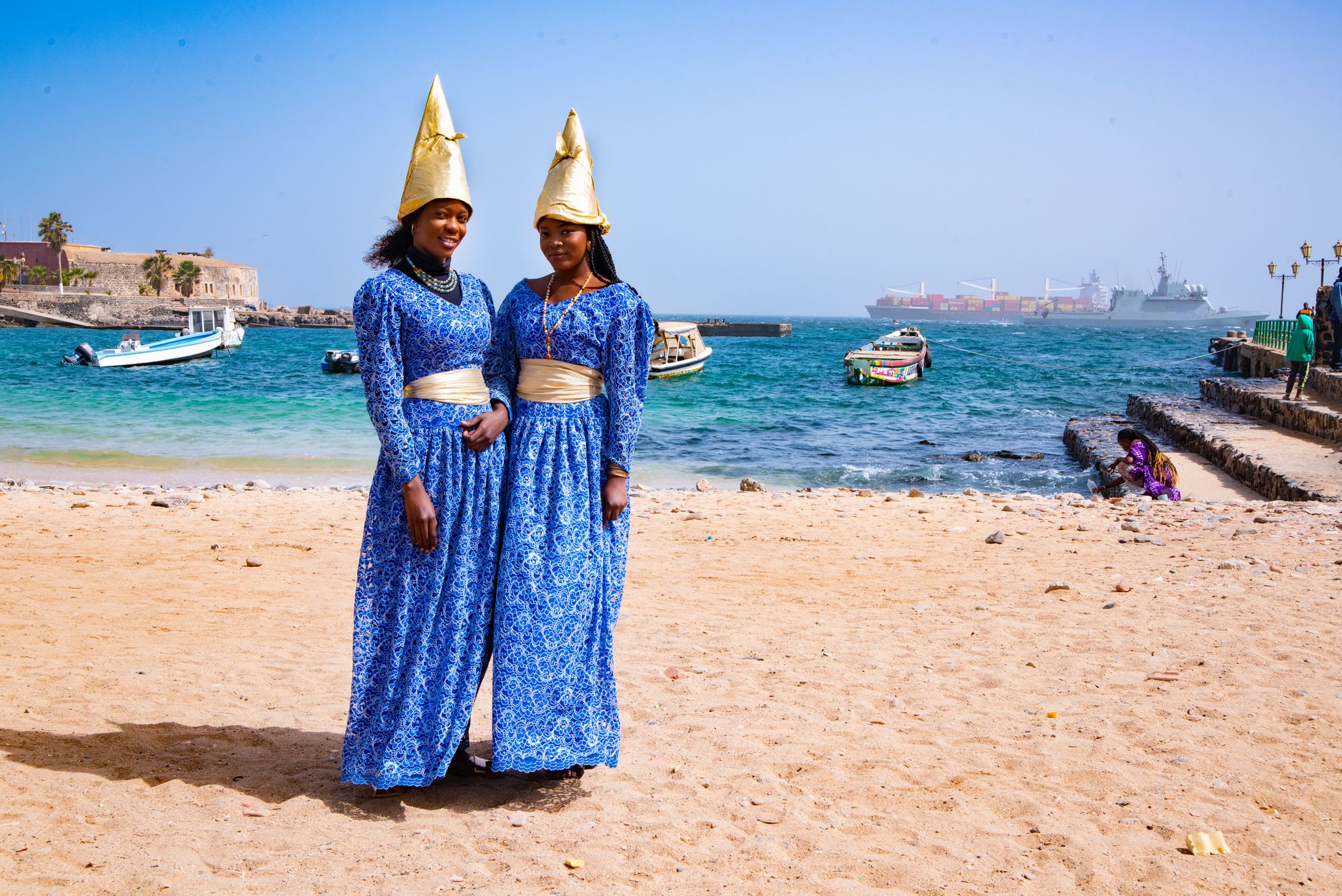
Two women in blue traditional dresses with cone hats on a sunny beach in Dakar, Senegal.
Photo by William Adams on Pexels · Pexels License
A street musician in Senegal playing a traditional African Djembe drum.
Photo by Hello Massamba on Pexels · Pexels License
Top Monuments in Senegal
Dieuppeul-Derklé
Dakar
Mermoz-Sacré-Cœur
Dakar
Our Lady of Victories Cathedral, Dakar
Dakar
Parcelles Assainies
Dakar
Fann-Point E-Amitié
Dakar
Cambérène
Dakar
Sicap-Liberté
Dakar
Hann Bel-Air
Dakar
Grand Yoff
Dakar
Embassy of Japan in Senegal
Dakar
Autonomous Port of Dakar
Dakar
Ngor
Dakar
Dakar-Plateau
Dakar
Embassy of Indonesia in Senegal
Dakar
House of Slaves
Dakar
Hôpital Aristide Le Dantec
Dakar
Stade Léopold Sédar Senghor
Dakar
Place Du Souvenir Africain (Dakar)
Dakar
Practical Information
Visa
Many travelers can enter Senegal visa-free for up to 90 days, including passport holders from the US, UK, Canada, and most EU countries. Your passport should usually be valid for at least 6 months beyond arrival, and border officers may ask for onward travel, accommodation details, and a yellow fever certificate if you are arriving from or transiting more than 12 hours in a risk country.
Currency
Senegal uses the West African CFA franc, abbreviated XOF, with a fixed peg of 655.957 XOF to 1 euro. Cards work in better hotels and restaurants in Dakar, but cash still matters in Saint-Louis, Kaolack, Tambacounda, and smaller ferry or market transactions, so withdraw before you leave major towns.
Getting There
Most international arrivals land at Blaise Diagne International Airport, 47 km east of Dakar near Diass. Direct or one-stop routings usually come through Paris, Casablanca, Istanbul, Dubai, Addis Ababa, or New York, and the airport offers free Wi-Fi once you are inside the terminal.
Getting Around
For city travel in Dakar, use official buses, app taxis, or the TER commuter rail between Dakar and Diamniadio. For longer hops, shared sept-place taxis and minibuses are cheap but cramped, while domestic flights make the most sense for Cap Skirring and sometimes Ziguinchor when schedules are running normally.
Climate
The easiest travel window is November to April, when the air is drier and Dakar often sits between 22 and 28C. July to October brings the rains, especially in Casamance and the Sine-Saloum Delta, while the north around Saint-Louis turns hottest and dustiest before the wet season breaks.
Connectivity
Mobile data is easy to arrange in Dakar and other large towns, and local plans with 10 GB or more are inexpensive by European standards. Expect solid coverage on the main road corridors, but signal can thin out in the Sine-Saloum Delta, parts of Casamance, and on longer stretches east toward Tambacounda.
Safety
Senegal is one of the steadier destinations in West Africa, but petty theft, bag snatching, and night-time transport risks are real, especially in busy parts of Dakar and around transport hubs. Use registered drivers after dark, keep cash split in two places, and verify current advice before planning overland travel near border areas in the far southeast or around any route affected by seasonal flooding.
Taste the Country
restaurantThiéboudienne
Communal bowl. Noon table. Right hand, your section, family and guests in a circle.
restaurantYassa poulet
Chicken marinates in lemon and onion, then meets rice. Weeknight dish, family dish, Casamance dish, eaten with talk and bread nearby.
restaurantMafé
Groundnut sauce coats meat and rice. Lunch, Sunday, long appetite, full table.
restaurantPastels
Street stall, hot oil, fish filling, pepper sauce. Hands, standing, noon heat, office workers, students, drivers.
restaurantCafé Touba
Coffee brews with Guinea pepper and cloves. Dawn, bus station, workshop, market corner; men talk, women pass, sleep retreats.
restaurantThiakry
Millet, sour milk, sugar. Breakfast, dessert, fasting break, spoon, family visit.
restaurantAttaya
Green tea boils three times. Courtyard ritual, slow afternoon, friends, debate, patience.
Tips for Visitors
Cash First
Withdraw enough XOF in Dakar or another major town before heading to Saint-Louis, the Sine-Saloum Delta, or Casamance. Small hotels, ferries, market stalls, and many drivers still prefer cash even when a card machine is technically present.
TER Limits
The TER is useful for Dakar to Diamniadio, but do not build your airport plan around a promised rail extension unless you verify it right before travel. For Blaise Diagne airport, road transfer remains the safe assumption.
Book Magal Early
If your dates come anywhere near the Grand Magal in Touba, reserve rooms and drivers far in advance. Beds disappear across a wide area, roads clog, and prices climb fast.
Eat By Time
Lunch is often the strongest value meal of the day, especially for thiéboudienne and yassa in local places. Go early when the pots are full; by mid-afternoon the best dish may already be gone.
Night Transport
After dark, especially on arrival days, use hotel-arranged or app-booked drivers rather than bargaining on the street. It costs more, but it saves the one thing you cannot replace at 11 pm outside a transport hub: certainty.
Buy a SIM
A local SIM or eSIM is usually cheaper than roaming within a day or two. It also makes app taxis, ferry coordination, and hotel contact much easier once you leave airport Wi-Fi behind.
Greeting Matters
A quick greeting before a question goes further than rushing straight to the transaction. In shops, stations, and family-run guesthouses, that small pause reads as respect rather than formality.
Rain Changes Roads
In the wet season, pad your schedule in Casamance and the Sine-Saloum Delta. Ferries, roads, and lodge transfers can still run, but the timetable becomes an argument rather than a fact.
Explore Senegal with a personal guide in your pocket
Your Personal Curator, in Your Pocket.
Audio guides for 1,100+ cities across 96 countries. History, stories, and local insight — offline ready.
Audiala App
Available on iOS & Android
Join 50k+ Curators
Frequently Asked
Do US citizens need a visa for Senegal? add
Usually no, not for tourist stays of 90 days or less. You should travel with a passport valid for at least 6 months beyond arrival, and officers may ask for onward travel, accommodation details, and health documents depending on your route.
Is Senegal expensive for tourists? add
No, Senegal can be good value if you use local transport and simple guesthouses, though Dakar is noticeably pricier than the rest of the country. A careful budget traveler can often stay around 30,000 to 50,000 XOF per day, while comfort trips with private rooms and paid transport land much higher.
What is the best time to visit Senegal? add
November to April is the easiest window for most travelers. The air is drier, roads are simpler, beach weather is better, and places such as Saint-Louis and the Sine-Saloum Delta are easier to move through than during the wet months from July to October.
Can you use credit cards in Senegal? add
Yes in parts of Dakar and in higher-end hotels, but no one sensible travels Senegal assuming cards will cover everything. Carry cash for taxis, ferries, market food, tips, smaller hotels, and many transactions outside the capital.
How do you get from Dakar airport to the city? add
The practical answer is by road, using a prebooked transfer, taxi, or app driver. The airport rail connection has been discussed for years, but unless you confirm live operations just before travel, treat it as a future promise rather than today's transport.
Is Senegal safe for solo travelers? add
Generally yes, especially compared with many regional peers, but you still need urban common sense. Petty theft, careless night transport, and weak road safety cause more trouble for visitors than headline-level violence.
How many days do you need in Senegal? add
A first trip needs at least 7 days if you want more than Dakar and Gorée Island. With 10 to 14 days, you can add Saint-Louis, Touba, the Sine-Saloum Delta, or Ziguinchor without turning the trip into a checklist.
Do I need yellow fever vaccination for Senegal? add
Sometimes as an entry rule, and often as a health precaution. It is generally required if you arrive from or transit for more than 12 hours in a yellow-fever-risk country, and many health authorities still recommend it for most travelers to Senegal even when border control does not demand the certificate.
Is it better to fly or go overland to Casamance? add
It depends on your budget and tolerance for uncertainty. Flying saves time when schedules are running well, but overland travel through Tambacounda gives you more of the country and avoids building the whole trip around a route that can change.
Sources
- verified U.S. Department of State - Senegal International Travel Information — Used for visa-free stay limits, passport validity guidance, and current entry requirements for US travelers.
- verified UK Foreign, Commonwealth & Development Office - Entry Requirements for Senegal — Used to confirm UK entry rules, passport validity expectations, and border documentation practices.
- verified BCEAO - West African CFA Franc Reference Information — Used for currency details and the euro peg of the West African CFA franc.
- verified Blaise Diagne International Airport — Used for airport role, location, and passenger-facing services such as terminal Wi-Fi.
- verified SETER - Train Express Regional Dakar — Used for current TER operations between Dakar and Diamniadio and to avoid overstating airport rail access.
Last reviewed: