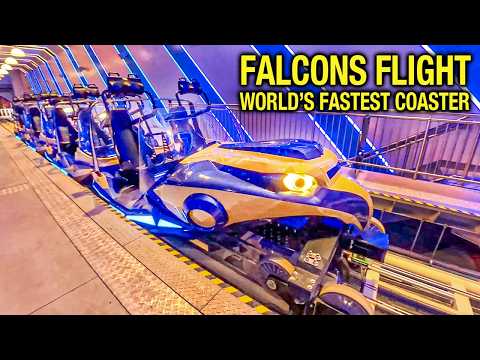
Falcons Flight 4K On Ride POV - Six Flags Qiddiya City
Theme Park Worldwide
4 min
245K
Riyadh ProvinceSaudi Arabia 24° N · 46° E Updated May 2026
Built into the Tuwaiq escarpment, Falcons Flight drops 195 meters and turns a Saudi cliff face into the backbone of the world's fastest coaster.
 Photo: Martin Lewison · CC BY 4.0
Why does the world's most advanced roller coaster cling to a Jurassic cliff that Bedouin travelers once used as a landmark? At Falcons Flight in Riyadh Province, Saudi Arabia, you stand above the pale limestone edge of the Tuwaiq Escarpment, watching steel track flash into the desert haze while trains howl past faster than a falcon's stoop. Come for the records if you like, but visit for the shock of seeing raw geology, national ambition, and pure mechanical nerve forced into one line of sight.
Most people expect a record-breaking coaster to rise from a flat amusement park lot. Falcons Flight does the opposite. Intamin and Qiddiya dropped 4.25 kilometers of track across a cliff face and a valley, using a natural elevation change of 195 meters, roughly the height of a 60-story tower, instead of pretending the desert began empty.
The ride's falcon name is not a costume draped over imported thrills. It borrows from a real Saudi symbol with older roots: falconry, which UNESCO inscribed in 2021 as living heritage, and Tuwaiq, the long escarpment that records and local memory tie to routes, watchpoints, and the stubborn self-image of Najd.
Then the train launches. Wind presses hard, the track skims the cliff edge, and the whole thing feels faintly unreasonable, which is exactly the point. Few places show Saudi Arabia's post-oil confidence so bluntly, or so fast.
History
Falcons Flight has almost no old history of its own. Records show the ride opened with Six Flags Qiddiya City on 31 December 2025, which makes it younger than most airport terminals and far younger than the escarpment it rides across.
But the ground beneath it is old enough to supply the drama. The Tuwaiq Escarpment, a limestone wall formed in the Jurassic period, gave the project its drop, its profile, and its symbolism; Vision 2030 gave it money, urgency, and an audience far beyond Riyadh.
The turning point
At first glance, Falcons Flight looks like a familiar story told bigger: a world-record coaster wearing Saudi falcon imagery, branded with the Six Flags name, built to give Qiddiya a headline. Most visitors accept that version and move on. Fair enough.
Then the details start to scratch at it. Six Flags did not build or operate the park; records show Qiddiya Investment Company licensed the brand. And Daniel Schoppen, Intamin's Vice President of Design and Development, was not polishing an old formula but staking his reputation on something the industry had never carried this far: a 250 km/h launch coaster in desert heat, stretched across a cliff, with more than 722 LSM stators firing in sequence and no margin for a sloppy alignment.
The turning point came in December 2024, when crews installed the final track piece over the escarpment. Before that moment, Falcons Flight was still a rendering, a promise, a very expensive act of national theater. After it, Schoppen and Qiddiya had a physical fact on the cliff edge, and Crown Prince Mohammed bin Salman had something even more valuable for Vision 2030: proof that a Saudi entertainment project could seize the world-record conversation from Ohio, Japan, and Abu Dhabi and drag it west of Riyadh.
Knowing that changes your gaze. The falcon theme stops looking decorative and starts reading as a translation device, a way to root a brand-new machine in older Saudi symbols. When you watch the train bank out over Tuwaiq now, you are not looking at inherited heritage. You are looking at a state-backed attempt to manufacture future memory in plain sight.
Yes, if you care about engineering spectacle or roller coasters at all. Falcons Flight opened on 31 December 2025 and rewrote the record book with a 163-meter structure, a 195-meter elevation change, and top speed around 250 km/h, which feels less like a ride and more like being fired across a desert valley. The real surprise is the setting: steel track pinned to the Tuwaiq Escarpment, with limestone cliffs turning a theme-park brag into something oddly grand.
Plan 3 to 5 hours if Falcons Flight is your main goal. A single ride lasts about 2.5 minutes, but queues can stretch from 45 to 120 minutes, and many riders want a recovery break after the wind roar, launch force, and cliff-edge drop. If you're doing the wider Six Flags Qiddiya park, give it a full day because the resort spreads across 320,000 square meters, about 45 football fields.
The simplest route is by car or ride-hailing, with Qiddiya about 40 minutes west of Riyadh in normal traffic. Visitor reports also point to a metro-plus-shuttle option, but exact line details and schedules should be checked close to your visit because Qiddiya's transport links are still settling into place. Don't try to walk in from the city side; highways and desert terrain make that a bad idea fast.
November to February is the sweet spot, and the first hour after opening is your best play. Winter air in Riyadh Province is cooler and clearer, which makes the cliff views sharper and the wait less punishing, while local reports suggest lines swell quickly later in the day. Weekdays beat weekends by a mile.
No official free-entry option has been published for Falcons Flight or Six Flags Qiddiya City. Ticket prices were still being finalized in early 2026, and the best current guidance is to expect paid park admission with possible holiday or partner promotions rather than routine free access. If a deal appears, check the official park channels first, because social-media resellers have already become part of the noise.
Don't miss the outward-banked turn over the escarpment and the dead-silent holding brake just before the drop. Riders talk about the speed, but the stranger moment is that brief hush when the train pauses above the valley and the desert seems to stop breathing. Also look at the front car before boarding: those curved windshields are there so 250 km/h desert air doesn't sandblast your face.
Built from cited sources · see the method · How we make our guides →
70 places to discover — a few worth pairing.
Saved and recently read places — kept on this device only.
Photos may have been resized or cropped.