Destinations Saudi Arabia

Saudi Arabia.

Riyadh 12 cities

Saudi Arabia is not one trip but five distinct landscapes held inside one border: coral coast, basalt desert, mountain highlands, oasis country, and cities rewriting themselves in real time.

Get the app Cities in Saudi Arabia
Saudi Arabia
Riyadh
Capital
12
Cities
November-March
best season
7-12 days
trip length
Saudi riyal (SAR)
currency

Entry1-year multiple-entry eVisa for many US, UK, EU, Canadian, and Australian travelers

01 An introduction

verified

SThis Saudi Arabia travel guide starts with the surprise most first-time visitors miss: the country has cool mountain summers, Red Sea reefs, and Nabataean tombs older than many European capitals.

Saudi Arabia works best when you stop treating it as one desert and start reading its regions properly. Riyadh rises from the Najd plateau with wide boulevards, mudbrick history in nearby Diriyah, and a skyline built at speed. Jeddah faces the Red Sea with coral-stone houses in Al-Balad and humid nights that feel built for long dinners. Then the land breaks open again in AlUla and Hegra, where sandstone outcrops hold 111 Nabataean tombs cut with legal inscriptions, curses, and a level of preservation that still feels faintly unreal at dawn.

Distances are serious here, which is why a good trip usually picks two or three zones instead of trying to conquer the map. The northwest gives you AlUla, Hegra, and winter nights cold enough for a jacket. The southwest around Abha and Taif climbs into rain, terraces, juniper slopes, and the 3,133-meter heights near Jabal Sawda. Eastward, Dammam opens the Gulf side, while Hail carries some of the Arabian Peninsula's oldest rock art. Saudi Arabia makes more sense once you accept its scale. It rewards focus, not box-ticking.

History Buff Foodie Outdoor Adventure Luxury Photography Hotspot Off the Beaten Path

A History Told Through Its Eras

When Stone, Incense, and Contracts Ruled the Desert

Caravan Arabia, c. 10000 BCE-300 CE

A basalt wall at Jubbah in Hail still carries the scratch of a hunter's hand from roughly 10,000 years ago. He cut ibex, dogs, and human figures into black rock while the climate was wetter and lakes still held in northern Arabia. You begin here because the peninsula was never empty. It was watched, crossed, marked.

Then the caravans took over. Frankincense and myrrh moved north from southern Arabia toward the Mediterranean, and the routes that stitched this trade together ran through what is now Saudi Arabia, from oasis to oasis, under a sun that spared nobody. Ce que l'on ignore souvent, c'est que Rome paid dearly for perfume and ritual smoke; Pliny grumbled that imperial gold was vanishing east in exchange for scent.

At Hegra, near today's AlUla, the Nabataeans turned sandstone into law. Their tomb facades were not just beautiful. They were legal documents in stone, naming owners, heirs, and penalties for intruders. One inscription threatens a fine of 500 silver coins to anyone who opens a grave without right. The afterlife, here, came with clauses.

And then came silence. After Rome annexed Petra in 106 CE, Hegra lost the trade pulse that had made it rich. Local tradition later tied the abandoned city to the story of the prophet Salih and the punished people of Thamud, which helps explain why generations kept their distance. A city survived because fear outlived commerce. That tension between profit, sanctity, and memory never really left Arabia.

Obodas III, the Nabataean king deified after his death, presided over a kingdom rich enough to tempt Rome and fragile enough to be undone by its own court intrigues.

Several tombs at Hegra preserve curses against anyone who might resell burial rights, as if a Nabataean notary were still whispering from the rock.

Mecca, Medina, and the Birth of a New World

The Sacred Cities, 570-1258

A cave on Jabal al-Nour, a merchant trembling under the weight of a voice, a wife who understands before anyone else. That is how the great upheaval begins. Khadijah bint Khuwaylid, wealthy, widowed, formidable, wrapped Muhammad in a cloak after the first revelation and believed him when others did not. History often puts the prophet alone on the mountain. It is truer, and more moving, to remember the woman waiting at home.

The Hijra in 622 was not a pageant. It was an escape planned with care, carried out under threat, ending in Yathrib, soon to be Medina. From that move came a new political and spiritual order. Mecca and Medina were no longer simply towns on caravan lines; they became the axis of a civilization that would reach from Iberia to Central Asia within a century.

Pilgrimage changed everything. The roads of the Hejaz filled with scholars, merchants, mystics, soldiers, and the devout, all moving toward the holy cities, then onward again with stories, ideas, and money. Jeddah grew as the Red Sea gate to Mecca. What looked from afar like desert austerity concealed one of the busiest circulations of people on earth.

But holiness never erased conflict. Control of the pilgrimage routes, the sharifs of Mecca, and the revenues attached to them drew in larger powers, first regional dynasties, then the Mamluks, then the Ottomans. The sacred made the Hejaz revered. It also made it contested. By the medieval period, the peninsula's future would depend on who could claim not just territory, but legitimacy.

Khadijah bint Khuwaylid stands at the beginning of Islamic history not as a footnote, but as the merchant whose wealth, judgment, and steadiness helped make revelation survivable.

According to tradition, when Muhammad fled Mecca, pursuers came so close to the Cave of Thawr that only a spider's web and a nesting bird convinced them nobody could be inside.

Mudbrick, Reform, and the House at Diriyah

Diriyah and the Desert Alliance, 1446-1891

Mudbrick walls in Diriyah do not look like the beginning of a state meant to change Arabia. That is precisely the point. At-Turaif rose above the Wadi Hanifa in layered earth tones, practical and defensive, a settlement shaped by drought, tribal loyalties, and the stubborn arithmetic of oasis life. Riyadh, nearby, would matter later. First came Diriyah.

In 1744, Muhammad ibn Saud, local ruler of Diriyah, allied himself with the religious reformer Muhammad ibn Abd al-Wahhab. One brought protection and ambition, the other doctrine and a language of purification. It was a marriage of power and piety, and like many effective marriages in history, it changed the balance far beyond the household where it began.

The First Saudi State expanded with startling speed across Najd and beyond, eventually seizing the holy cities. That success invited retaliation. The Ottomans, ruling through their Egyptian viceroy Muhammad Ali Pasha, sent Ibrahim Pasha into central Arabia. In 1818 Diriyah was besieged, battered, and pulled down. Ce que l'on ignore souvent, c'est que this was not the end of a dynasty but the education of one. Families displaced by force rarely forget the lesson.

A second Saudi state rose from Riyadh in 1824, more brittle than the first and torn by internal rivalry. Brothers fought brothers while the Al Rashid of Hail gathered strength in the north. In 1891 the Saudis were driven into exile in Kuwait. The story looks finished on paper. It was only waiting for a young man bold enough to return by night.

Muhammad ibn Saud was less a desert chieftain than a patient state-builder who understood that ideas need walls, grain stores, and armed men if they are to survive.

When Ibrahim Pasha destroyed Diriyah in 1818, parts of the ruined capital were deliberately left as a warning, a political message written in broken mudbrick.

From the Riyadh Raid to the Glass Towers

Kingdom, Oil, and Reinvention, 1902-present

It begins with a gate at dawn. In January 1902, Abd al-Aziz ibn Saud, still in his twenties, returned from exile and retook the Masmak Fortress in Riyadh with a small band of followers. The episode has entered national legend, but legends often hide the detail that matters most: it was a gamble born of family dispossession, not inevitability. He won a city first, then a realm.

Over the next three decades he consolidated Najd, absorbed al-Ahsa, took the Hejaz with Mecca and Medina, and in 1932 proclaimed the Kingdom of Saudi Arabia. This was not elegant work. It involved tribal negotiations, marriages, force, religious alliance, and hard bargains with local elites. States are often described as if they descend fully dressed from treaties. This one was stitched together on horseback, in tents, in forts, and in long councils over coffee.

Then oil altered the scale of everything. In 1938, commercial quantities were struck at Dammam Well No. 7 after several discouraging failures. Americans arrived, company towns grew, and Dhahran became one of those strange 20th-century places where geology rewrote politics. The wealth was immense. So were the contradictions. Migrant labor expanded, cities swelled, welfare systems grew, and conservative social structures coexisted with a petro-state tied to global markets.

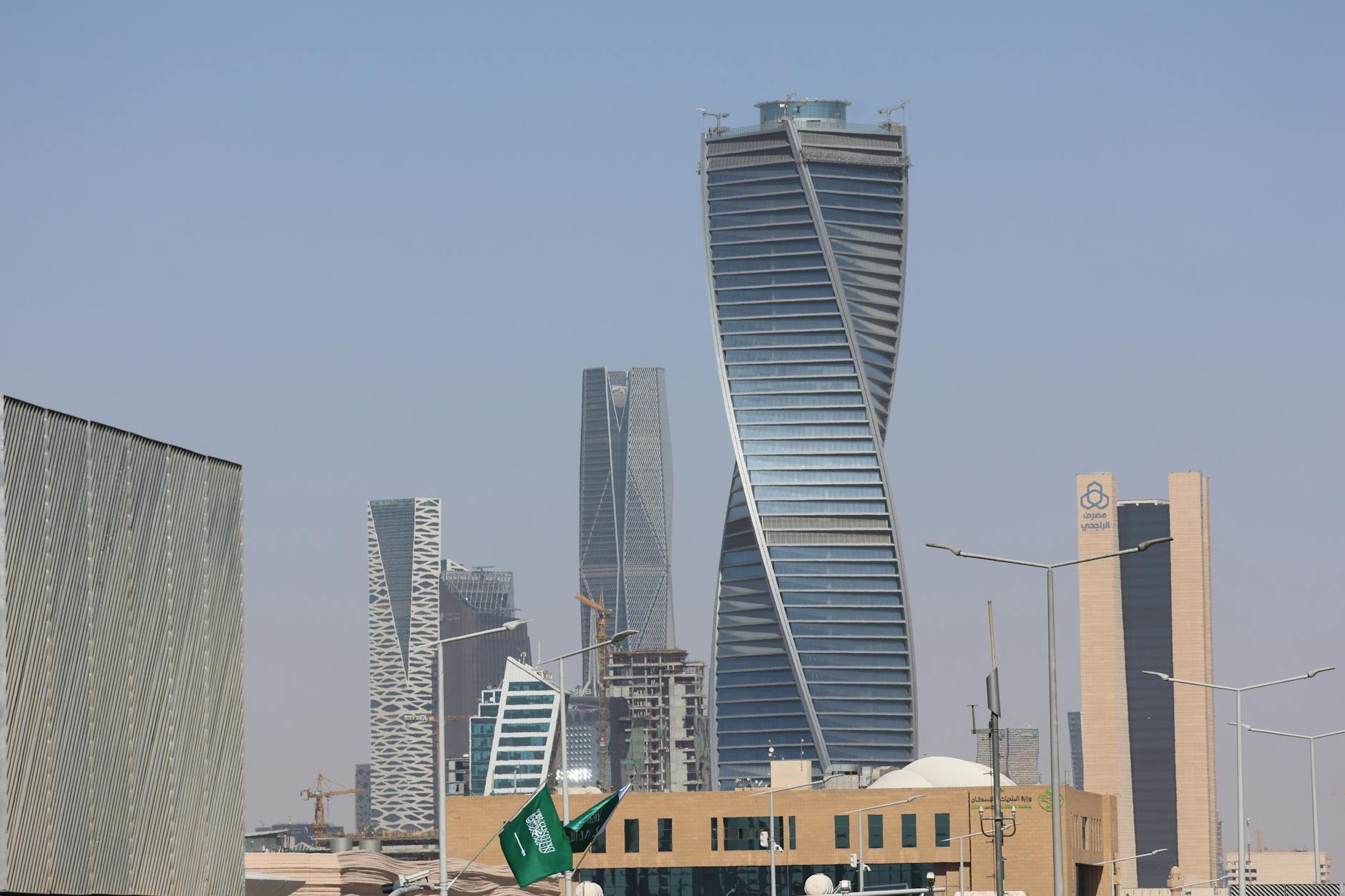
The modern kingdom has moved through shocks rather than smooth chapters: the 1979 seizure of the Grand Mosque in Mecca, the Gulf War, the post-9/11 reckoning, and the vast acceleration of reform and spectacle under Vision 2030. In Riyadh, glass towers now rise where mudbrick once carried authority; in Jeddah, coral houses still lean over lanes shaped by pilgrims; in AlUla and Hegra, antiquity has returned to the center of the national story. The country is changing fast, sometimes dazzlingly, sometimes harshly. That is what makes it historically interesting. You can still see the older layers pushing through the new surface.

Ibn Saud, later King Abdulaziz, had the rare gift of looking both tribal and modern at once, a founder who could sit in a tent one day and negotiate petroleum with foreign engineers the next.

Dammam Well No. 7 was nicknamed the 'Prosperity Well' only after earlier drill sites had disappointed so badly that some investors wanted to stop searching altogether.

The Cultural Soul

A Greeting That Opens Like a Door

Saudi Arabic does not greet you. It receives you. In Riyadh, the Najdi cadence lands with a dry precision that suits the plateau; in Jeddah, Hijazi speech moves more loosely, as if the Red Sea had taught consonants to breathe. Even a simple as-salamu alaykum carries architecture inside it: blessing first, business later.

A foreigner hears inshallah and thinks hesitation. The Saudi ear hears proportion. Human intention is small, God is large, and grammar knows the difference. I have rarely met a country where ordinary speech remembers metaphysics so faithfully, where a timetable, a promise, and a cup of coffee can all contain the same acknowledgement that the world does not belong to us.

Then comes the pleasure of the exact word. Wasta is not friendship, not influence, not corruption; it is the weight of relationship made visible. Karama is honor with a pulse. Ghurba is homesickness sharpened into an instrument. A language becomes beautiful when it refuses lazy translation. Saudi Arabia refuses it with style.

Rice for the Many, Coffee for the Soul

Saudi food understands that hunger is rarely solitary. A tray of kabsa arrives like a small territory: rice perfumed with cardamom and dried lime, roasted meat set at the summit, almonds and raisins scattered with the authority of a final signature. One dish, many hands, no speeches. Civilization can be measured by how it organizes a shared meal.

The national genius lies in patience. Jareesh asks wheat to surrender slowly. Harees abolishes the distinction between grain and meat. Mandi and madfoon trust the earth to finish the sentence that fire began. Nothing performs. Everything persists. Even sweetness has gravity: date syrup, saffron, rosewater, the perfume of Taif turned edible by restraint rather than excess.

And then qahwa. Pale gold, almost ascetic, served in a finjan too small for greed. The dallah tilts, the coffee lands, cardamom rises first, saffron arrives after, and hospitality becomes ritual rather than mood. In a majlis in Diriyah or a family house outside Abha, the cup is never just a cup. It is a declaration that your presence has altered the room.

The Ceremony Before the Conversation

Saudi etiquette does not waste time by being indirect. It spends time in order to make truth bearable. You are asked about your health, your family, your journey, your parents, and only an impatient culture would call this delay. The questions build the room in which anything worth saying can be said.

Coffee comes first. Often dates. Sometimes tea. Repetition follows, but repetition here is not redundancy; it is respect made audible. A direct refusal sounds harsher in this atmosphere than in English, almost primitive. So answers may circle, soften, approach from the side. One learns quickly that bluntness is not honesty everywhere. Sometimes it is merely poor breeding.

The codes are exact. Right hand for eating. Shoes handled with awareness. Public conduct measured, not theatrical. In return, hospitality can become almost embarrassing in its amplitude, because karama attaches to the guest as much as to the host. To receive badly would injure the household. A country is a table set for strangers.

Time Kept by the Unseen

Religion in Saudi Arabia is not confined to buildings, though the mosques can be magnificent in their geometries of silence. It enters the day through smaller openings: the call to prayer loosening the city's grip for a moment, the formulas tucked into greetings, the pauses in conversation when a name of God appears and no one treats that name as decorative. Faith here is not a weekend arrangement. It keeps time.

For the traveler, the first surprise is not severity but texture. The sacred is woven into ordinary transactions so densely that one stops noticing the seam between devotion and habit. Shops close. Families reorder the evening. Language bends toward remembrance. Even those who live with modern acceleration carry inside it an older rhythm, one measured less by the clock than by recurrence.

This requires humility from visitors. Makkah remains closed to non-Muslims, and parts of Madinah are restricted. The prohibition is clear. Yet outside those boundaries, in Riyadh, Jeddah, or the roads that lead toward Taif, one can still feel how the geography of pilgrimage has shaped the country: a hospitality trained by centuries of guests, a seriousness about ritual, a sense that movement through space can also be movement of the soul.

Mud, Coral, and the Art of Surviving Heat

Saudi architecture begins with climate and ends with grace. In Diriyah, mudbrick rises from the earth in forms so intelligent they almost embarrass modern glass: thick walls, shaded courtyards, narrow passages that discipline the sun. The material looks humble until one notices what it can do. Wealth here was once measured not by glitter but by coolness.

On the Red Sea, Jeddah answers with coral stone and rawasheen, those projecting wooden screens that filter light, air, and visibility with the delicacy of lace and the cunning of engineering. Privacy and breeze share the same device. Morality and meteorology often collaborate more elegantly than architects admit.

Then the country changes register. In AlUla and Hegra, sandstone becomes archive and monument at once, cut into facades whose precision still feels faintly insolent after two millennia. In the Asir highlands near Abha, tower houses climb stone by stone against mountain weather. One nation, several grammars of survival. Saudi Arabia is never less interesting than when it builds.

Stone That Remembers Animals

Long before oil, before states, before the names by which the modern map recognizes itself, the land around Hail was already a gallery. At Jubbah and Shuwaymis, prehistoric hands carved ibex, hunters, dogs, cattle, processions of bodies in pursuit and fear. The petroglyphs do not ask for admiration. They ask for attention. Ten thousand years later, the animals still move.

I find this profoundly moving. A desert is often imagined as absence, yet Saudi Arabia keeps some of its oldest memories in rock so exposed that sunlight becomes part of the conservation process. The artist disappears, the basalt remains, and image outlives biography. Literature is rarely granted that privilege.

The visual instinct did not vanish. It migrated into calligraphy, geometric pattern, woven forms, carved doors, silver jewelry, incense burners, coffee pots, the stern beauty of objects that must serve before they may charm. Even contemporary design in Riyadh or AlUla often borrows from this older discipline: ornament with a task, beauty that does not apologize for utility. Art, in Saudi Arabia, prefers to earn its keep.


02 What Makes Saudi Arabia Unmissable.

account_balance

Nabataean Stone Cities

AlUla and Hegra deliver rock-cut tombs, inscriptions, and desert light that changes by the hour. The scale feels cinematic, but the details are legal, human, and strangely intimate.

castle

Mudbrick State Origins

Diriyah tells the political story of the first Saudi state in thick mudbrick walls and courtyards outside Riyadh. You are not looking at ruins alone; you are looking at the architecture of power in central Arabia.

scuba_diving

Red Sea Reefs

Off Jeddah and the Farasan Islands, the Red Sea holds warm water, coral gardens, and marine life that stayed comparatively protected while mass tourism built elsewhere. Divers notice the difference fast.

landscape

Highland Saudi

Around Abha and Taif, Saudi Arabia lifts into green terraces, fog, and summer temperatures that can sit twenty degrees below Riyadh. It overturns the lazy idea that the whole country is flat and furnace-hot.

restaurant

Coffee, Rice, Smoke

Saudi food is hospitality with structure: qahwa poured in small cups, kabsa scented with cardamom and dried lime, mandi built on smoke and patience. Meals explain the country as clearly as museums do.

directions_car

Road-Trip Scale

This is a country of long distances, strong domestic flight networks, and routes that shift from expressway to lava field to escarpment in a day. Plan by region, and the travel itself becomes part of the story.

03 Cities in Saudi Arabia.

12 cities — start with the ones we'd send you to first.

Riyadh
01 67 guides

Riyadh

A 19th-century clay fort and a 302-metre glass tower share the same skyline — Riyadh is a city that has decided, emphatically, not to choose between its past and its future.

Jeddah
02

Jeddah

The Red Sea port where Ottoman-era coral-stone towers lean over fish markets in Al-Balad, and the world's tallest fountain throws water 312 metres into salt air that smells of frankincense and diesel.

AlUla
03

AlUla

A valley of rose-sandstone monoliths and Nabataean tomb facades where 111 carved mausoleums — some still bearing their owners' names and legal curses against grave-robbers — have stood untouched since the first century C

Abha
04

Abha

The highland capital of Asir sits above 2,200 metres where summer temperatures rarely crack 28°C, terraced farms catch actual rain, and the Saturday Abha market sells silver jewellery and woven baskets in styles unchange

Diriyah
05

Diriyah

The mud-brick birthplace of the Saudi state, where the At-Turaif district's earthen towers once housed the Al Saud family's first court and are now a UNESCO site being excavated and restored in real time.

Dammam
06

Dammam

The gateway to the Eastern Province puts you within reach of the Al-Ahsa Oasis — 2.5 million date palms fed by ancient qanat channels, the largest natural oasis on earth — and the offshore Bahrain causeway in under an ho

Taif
07

Taif

Perched at 1,800 metres above Mecca on a granite escarpment, Taif is where Hejazi families have retreated from coastal heat for generations, and where Rosa damascena is still harvested each spring for the rose-water that

Hegra
08

Hegra

Saudi Arabia's first UNESCO World Heritage Site is a Nabataean necropolis in the AlUla region where 111 rock-cut tomb facades rise from the desert floor, the city they served abandoned so suddenly in the 2nd century CE t

Hail
09

Hail

The northern plateau city is the access point for the Jubbah petroglyphs at Jabal Umm Sinman, where Neolithic hunters carved aurochs and ibex into basalt 10,000 years ago, making this one of the earliest galleries of hum

All 12 cities

04 Regions.

Riyadh

Central Najd

Central Saudi is the political core of the modern kingdom and the part of the country where scale hits first: broad highways, dry light, winter evenings that turn cold after sunset. Riyadh gives the region its speed and ambition, while Diriyah explains where the state began and why mudbrick still matters here.

Riyadh Diriyah
Jeddah

Red Sea Hejaz

The western coast feels less severe than the interior and far more outward-looking, shaped for centuries by pilgrims, merchants, and ships crossing the Red Sea. Jeddah is the obvious anchor, but Taif adds mountain air and rose farms while Yanbu offers a calmer port city rhythm and an easier coastal pause.

Jeddah Taif Yanbu
AlUla

Northwest Desert Heritage

Northwest Saudi is built on distance, stone, and silence. AlUla is the practical base, Hegra is the historical shock, and Hail broadens the picture by linking the region's monumental sites to older desert routes, rock art, and the long history of people moving through harsh country with purpose.

AlUla Hegra Hail
Dammam

Eastern Province

The Gulf side of Saudi Arabia is flatter, more humid, and more commercial, with port cities, causeways, and the infrastructure of the oil economy never far away. Dammam works as the regional anchor, and the appeal here is not postcard scenery but a sharper view of contemporary Saudi life, business travel, and the country's eastward orientation.

Dammam
Abha

Southern Highlands and Frontier South

The southwest is the country's relief valve: terraced slopes, summer fog, and temperatures that feel improbable after Riyadh or Jeddah. Abha is the easiest entry point, Najran carries a different historical and tribal texture near the Yemeni border, and the Farasan Islands pull the region outward to coral reefs and seabird-filled waters.

Abha Najran Farasan Islands

05 Top Monuments in Saudi Arabia.

Prophet'S Mosque

Medina

Founded in 622 as a palm-trunk prayer space, the Prophet's Mosque became Medina's sacred center, where gates, prayer rhythms, and memory still shape the city.

Green Dome

Medina

The Prophet was buried in Aisha's room here in 632, and Medina grew around that fact.

Sad Elab Dam

Riyadh

Kingdom Centre

Riyadh

At-Turaif District

Riyadh

Boulevard City

Riyadh

Al-Salam Museum

Medina

Diriyah

Riyadh

Al Shareef Museum

Ta'If

National Museum of Saudi Arabia

Riyadh

Jaffali Mosque

Jeddah

Masmak Fort

Riyadh

Deera Square

Riyadh

Masjid Al-Haram

Mecca

Mosque of Al-Ghamama

Medina

The Prophet prayed for rain here in 631 CE — and it fell.

Quba Mosque

Medina

Islam's oldest mosque, founded 622 CE, promises a reward equal to Umrah for every prayer said here — and locals return every Saturday to claim it.

Riyadh Water Tower

Riyadh

Built top-down in 1971, Riyadh's mushroom-shaped water tower was once the kingdom's tallest structure — modeled on a Swedish design and raised by hydraulic jacks.

Prince Mohammed Bin Abdul Aziz Stadium

Medina

06 From Rock Art to Oil Power

Saudi Arabia's story runs from prehistoric carvings and caravan wealth to sacred cities, mudbrick capitals, and a state remade by petroleum.

  1. history_edu
    c. 10000 BCEPrehistoric Arabia

    Earliest rock art at Jubbah

    Hunters and herders carve animals and human figures into the rock around Jubbah in today's Hail region. These images are older than the pyramids and prove that northern Arabia was inhabited, observed, and imagined in deep time.

  2. local_shipping
    1st millennium BCECaravan Arabia

    Incense routes bind Arabia to empires

    Caravans carrying frankincense and myrrh move north through oasis networks across the peninsula. Long before oil, Arabian wealth rode on scent, ritual, and the taxation of trade.

  3. person
    c. 9 BCENabataean Arabia

    Death of Obodas III

    The Nabataean ruler later worshipped as a god leaves behind a kingdom whose southern reaches include Hegra. His reign shows how closely northwest Arabia was tied to the politics of Petra and Rome.

  4. account_balance
    106 CENabataean Arabia

    Rome annexes Petra

    When the Roman Empire absorbs the Nabataean kingdom, the balance of trade shifts. Hegra begins its long decline, and one of Arabia's great carved cities slowly falls silent.

  5. person
    570Prophetic Arabia

    Birth of Muhammad in Mecca

    Islamic tradition places Muhammad's birth in the Year of the Elephant. Mecca is already a sanctuary town and caravan center, but history is about to give it a different destiny.

  6. auto_stories
    610Prophetic Arabia

    First revelations at Hira

    In a cave outside Mecca, Muhammad receives the revelations that Muslims believe form the beginning of the Quran. A local religious experience becomes the seed of a world civilization.

  7. south
    622Prophetic Arabia

    Hijra to Medina

    Muhammad and his followers leave Mecca for Medina, founding a new community and a new calendar. The move transforms Islam from a persecuted message into a political order.

  8. public
    632Early Caliphates

    Arabia unites under Islam

    By the time of Muhammad's death, most of the Arabian Peninsula has entered the Muslim fold. The sacred geography of Mecca and Medina becomes central to the expanding Islamic world.

  9. directions_boat
    750Early Caliphates

    Pilgrimage routes enrich the Hejaz

    Under successive caliphates, western Arabia thrives on the annual movement of pilgrims. Jeddah grows in importance as the Red Sea port serving Mecca.

  10. castle
    1517Ottoman Hejaz and Tribal Najd

    Ottoman suzerainty over the Hejaz

    The Ottomans take control of the holy cities through local sharifs, binding the Hejaz more tightly to imperial politics. Mecca's sanctity now carries Istanbul's shadow.

  11. home_work
    1446Ottoman Hejaz and Tribal Najd

    Diriyah is founded

    On the banks of Wadi Hanifa, Diriyah begins as an oasis settlement in Najd. Centuries later, its mudbrick quarters will become the first capital of the House of Saud.

  12. handshake
    1744First Saudi State

    Alliance at Diriyah

    Muhammad ibn Saud and Muhammad ibn Abd al-Wahhab forge the pact that launches the First Saudi State. It is one of Arabian history's decisive bargains: power joins reform.

  13. mosque
    1803First Saudi State

    Saudi forces enter Mecca

    The expanding Saudi-Wahhabi state captures the holy city, alarming Ottoman authorities. Control of sacred space becomes a geopolitical crisis.

  14. swords
    1818First Saudi State

    Fall of Diriyah

    Ibrahim Pasha's Egyptian-Ottoman forces besiege and destroy Diriyah. The First Saudi State collapses, but the dynasty's memory of defeat becomes part of its future strength.

  15. fort
    1824Second Saudi State

    Second Saudi State rises from Riyadh

    Turki ibn Abdullah restores Saudi rule, this time with Riyadh as the capital. The center of gravity shifts from Diriyah's ruins to a new urban base in Najd.

  16. north_east
    1891Second Saudi State

    Saudi exile in Kuwait

    Defeated by the Al Rashid of Hail, the Al Saud family flees Najd. Exile looks terminal in the moment. It is not.

  17. military_tech
    1902Unification of the Kingdom

    Ibn Saud retakes Riyadh

    Abdulaziz Ibn Saud captures the Masmak Fortress in a daring raid and reclaims Riyadh. Modern Saudi political mythology begins at this gate and in this gamble.

  18. water
    1913Unification of the Kingdom

    Al-Ahsa joins Ibn Saud's domain

    The capture of al-Ahsa gives Ibn Saud access to the Gulf coast and a far broader strategic horizon. Najd is no longer sealed in the interior.

  19. location_city
    1925Unification of the Kingdom

    The Hejaz falls to Ibn Saud

    Jeddah, Mecca, and Medina pass under Ibn Saud's control after the defeat of the Hashemite kingdom in the Hejaz. The ruler of Najd now holds Islam's holiest cities.

  20. flag
    1932Kingdom of Saudi Arabia

    Kingdom of Saudi Arabia proclaimed

    The regions united by conquest and negotiation are formally named the Kingdom of Saudi Arabia. A dynastic realm becomes a modern state on paper, though its diversity remains immense.

  21. oil_barrel
    1938Oil Kingdom

    Oil struck at Dammam Well No. 7

    After repeated frustration, commercial oil is found in the Eastern Province. The country's future changes with the pressure rising from one wellhead.

  22. warning
    1979Oil Kingdom

    Seizure of the Grand Mosque

    Militants occupy Islam's holiest sanctuary in Mecca, shocking the kingdom and the wider Muslim world. The trauma hardens the state's religious posture for years to come.

  23. shield
    1990Late 20th Century Saudi Arabia

    Gulf War reshapes security

    Iraq's invasion of Kuwait brings foreign troops onto Saudi soil and exposes new vulnerabilities. The kingdom's strategic role deepens, along with domestic unease.

  24. trending_up
    2016Vision 2030 Era

    Vision 2030 announced

    The state launches a sweeping program to diversify the economy and recast its global image. Heritage sites such as Diriyah, AlUla, and Hegra become central to that new narrative.

07 The story of Saudi Arabia.

01c. 10000 BCE-300 CE

When Stone, Incense, and Contracts Ruled the Desert

Caravan Arabia

Obodas III, the Nabataean king deified after his death, presided over a kingdom rich enough to tempt Rome and fragile enough to be undone by its own court intrigues.

A basalt wall at Jubbah in Hail still carries the scratch of a hunter's hand from roughly 10,000 years ago. He cut ibex, dogs, and human figures into black rock while the climate was wetter and lakes still held in northern Arabia. You begin here because the peninsula was never empty. It was watched, crossed, marked.

Then the caravans took over. Frankincense and myrrh moved north from southern Arabia toward the Mediterranean, and the routes that stitched this trade together ran through what is now Saudi Arabia, from oasis to oasis, under a sun that spared nobody. Ce que l'on ignore souvent, c'est que Rome paid dearly for perfume and ritual smoke; Pliny grumbled that imperial gold was vanishing east in exchange for scent.

At Hegra, near today's AlUla, the Nabataeans turned sandstone into law. Their tomb facades were not just beautiful. They were legal documents in stone, naming owners, heirs, and penalties for intruders. One inscription threatens a fine of 500 silver coins to anyone who opens a grave without right. The afterlife, here, came with clauses.

And then came silence. After Rome annexed Petra in 106 CE, Hegra lost the trade pulse that had made it rich. Local tradition later tied the abandoned city to the story of the prophet Salih and the punished people of Thamud, which helps explain why generations kept their distance. A city survived because fear outlived commerce. That tension between profit, sanctity, and memory never really left Arabia.

Did you know

Several tombs at Hegra preserve curses against anyone who might resell burial rights, as if a Nabataean notary were still whispering from the rock.

02570-1258

Mecca, Medina, and the Birth of a New World

The Sacred Cities

Khadijah bint Khuwaylid stands at the beginning of Islamic history not as a footnote, but as the merchant whose wealth, judgment, and steadiness helped make revelation survivable.

A cave on Jabal al-Nour, a merchant trembling under the weight of a voice, a wife who understands before anyone else. That is how the great upheaval begins. Khadijah bint Khuwaylid, wealthy, widowed, formidable, wrapped Muhammad in a cloak after the first revelation and believed him when others did not. History often puts the prophet alone on the mountain. It is truer, and more moving, to remember the woman waiting at home.

The Hijra in 622 was not a pageant. It was an escape planned with care, carried out under threat, ending in Yathrib, soon to be Medina. From that move came a new political and spiritual order. Mecca and Medina were no longer simply towns on caravan lines; they became the axis of a civilization that would reach from Iberia to Central Asia within a century.

Pilgrimage changed everything. The roads of the Hejaz filled with scholars, merchants, mystics, soldiers, and the devout, all moving toward the holy cities, then onward again with stories, ideas, and money. Jeddah grew as the Red Sea gate to Mecca. What looked from afar like desert austerity concealed one of the busiest circulations of people on earth.

But holiness never erased conflict. Control of the pilgrimage routes, the sharifs of Mecca, and the revenues attached to them drew in larger powers, first regional dynasties, then the Mamluks, then the Ottomans. The sacred made the Hejaz revered. It also made it contested. By the medieval period, the peninsula's future would depend on who could claim not just territory, but legitimacy.

Did you know

According to tradition, when Muhammad fled Mecca, pursuers came so close to the Cave of Thawr that only a spider's web and a nesting bird convinced them nobody could be inside.

031446-1891

Mudbrick, Reform, and the House at Diriyah

Diriyah and the Desert Alliance

Muhammad ibn Saud was less a desert chieftain than a patient state-builder who understood that ideas need walls, grain stores, and armed men if they are to survive.

Mudbrick walls in Diriyah do not look like the beginning of a state meant to change Arabia. That is precisely the point. At-Turaif rose above the Wadi Hanifa in layered earth tones, practical and defensive, a settlement shaped by drought, tribal loyalties, and the stubborn arithmetic of oasis life. Riyadh, nearby, would matter later. First came Diriyah.

In 1744, Muhammad ibn Saud, local ruler of Diriyah, allied himself with the religious reformer Muhammad ibn Abd al-Wahhab. One brought protection and ambition, the other doctrine and a language of purification. It was a marriage of power and piety, and like many effective marriages in history, it changed the balance far beyond the household where it began.

The First Saudi State expanded with startling speed across Najd and beyond, eventually seizing the holy cities. That success invited retaliation. The Ottomans, ruling through their Egyptian viceroy Muhammad Ali Pasha, sent Ibrahim Pasha into central Arabia. In 1818 Diriyah was besieged, battered, and pulled down. Ce que l'on ignore souvent, c'est que this was not the end of a dynasty but the education of one. Families displaced by force rarely forget the lesson.

A second Saudi state rose from Riyadh in 1824, more brittle than the first and torn by internal rivalry. Brothers fought brothers while the Al Rashid of Hail gathered strength in the north. In 1891 the Saudis were driven into exile in Kuwait. The story looks finished on paper. It was only waiting for a young man bold enough to return by night.

Did you know

When Ibrahim Pasha destroyed Diriyah in 1818, parts of the ruined capital were deliberately left as a warning, a political message written in broken mudbrick.

041902-present

From the Riyadh Raid to the Glass Towers

Kingdom, Oil, and Reinvention

Ibn Saud, later King Abdulaziz, had the rare gift of looking both tribal and modern at once, a founder who could sit in a tent one day and negotiate petroleum with foreign engineers the next.

It begins with a gate at dawn. In January 1902, Abd al-Aziz ibn Saud, still in his twenties, returned from exile and retook the Masmak Fortress in Riyadh with a small band of followers. The episode has entered national legend, but legends often hide the detail that matters most: it was a gamble born of family dispossession, not inevitability. He won a city first, then a realm.

Over the next three decades he consolidated Najd, absorbed al-Ahsa, took the Hejaz with Mecca and Medina, and in 1932 proclaimed the Kingdom of Saudi Arabia. This was not elegant work. It involved tribal negotiations, marriages, force, religious alliance, and hard bargains with local elites. States are often described as if they descend fully dressed from treaties. This one was stitched together on horseback, in tents, in forts, and in long councils over coffee.

Then oil altered the scale of everything. In 1938, commercial quantities were struck at Dammam Well No. 7 after several discouraging failures. Americans arrived, company towns grew, and Dhahran became one of those strange 20th-century places where geology rewrote politics. The wealth was immense. So were the contradictions. Migrant labor expanded, cities swelled, welfare systems grew, and conservative social structures coexisted with a petro-state tied to global markets.

The modern kingdom has moved through shocks rather than smooth chapters: the 1979 seizure of the Grand Mosque in Mecca, the Gulf War, the post-9/11 reckoning, and the vast acceleration of reform and spectacle under Vision 2030. In Riyadh, glass towers now rise where mudbrick once carried authority; in Jeddah, coral houses still lean over lanes shaped by pilgrims; in AlUla and Hegra, antiquity has returned to the center of the national story. The country is changing fast, sometimes dazzlingly, sometimes harshly. That is what makes it historically interesting. You can still see the older layers pushing through the new surface.

Did you know

Dammam Well No. 7 was nicknamed the 'Prosperity Well' only after earlier drill sites had disappointed so badly that some investors wanted to stop searching altogether.

08 The cultural soul.

language

A Greeting That Opens Like a Door

Saudi Arabic does not greet you. It receives you. In Riyadh, the Najdi cadence lands with a dry precision that suits the plateau; in Jeddah, Hijazi speech moves more loosely, as if the Red Sea had taught consonants to breathe. Even a simple as-salamu alaykum carries architecture inside it: blessing first, business later.

A foreigner hears inshallah and thinks hesitation. The Saudi ear hears proportion. Human intention is small, God is large, and grammar knows the difference. I have rarely met a country where ordinary speech remembers metaphysics so faithfully, where a timetable, a promise, and a cup of coffee can all contain the same acknowledgement that the world does not belong to us.

Then comes the pleasure of the exact word. Wasta is not friendship, not influence, not corruption; it is the weight of relationship made visible. Karama is honor with a pulse. Ghurba is homesickness sharpened into an instrument. A language becomes beautiful when it refuses lazy translation. Saudi Arabia refuses it with style.

cuisine

Rice for the Many, Coffee for the Soul

Saudi food understands that hunger is rarely solitary. A tray of kabsa arrives like a small territory: rice perfumed with cardamom and dried lime, roasted meat set at the summit, almonds and raisins scattered with the authority of a final signature. One dish, many hands, no speeches. Civilization can be measured by how it organizes a shared meal.

The national genius lies in patience. Jareesh asks wheat to surrender slowly. Harees abolishes the distinction between grain and meat. Mandi and madfoon trust the earth to finish the sentence that fire began. Nothing performs. Everything persists. Even sweetness has gravity: date syrup, saffron, rosewater, the perfume of Taif turned edible by restraint rather than excess.

And then qahwa. Pale gold, almost ascetic, served in a finjan too small for greed. The dallah tilts, the coffee lands, cardamom rises first, saffron arrives after, and hospitality becomes ritual rather than mood. In a majlis in Diriyah or a family house outside Abha, the cup is never just a cup. It is a declaration that your presence has altered the room.

etiquette

The Ceremony Before the Conversation

Saudi etiquette does not waste time by being indirect. It spends time in order to make truth bearable. You are asked about your health, your family, your journey, your parents, and only an impatient culture would call this delay. The questions build the room in which anything worth saying can be said.

Coffee comes first. Often dates. Sometimes tea. Repetition follows, but repetition here is not redundancy; it is respect made audible. A direct refusal sounds harsher in this atmosphere than in English, almost primitive. So answers may circle, soften, approach from the side. One learns quickly that bluntness is not honesty everywhere. Sometimes it is merely poor breeding.

The codes are exact. Right hand for eating. Shoes handled with awareness. Public conduct measured, not theatrical. In return, hospitality can become almost embarrassing in its amplitude, because karama attaches to the guest as much as to the host. To receive badly would injure the household. A country is a table set for strangers.

religion

Time Kept by the Unseen

Religion in Saudi Arabia is not confined to buildings, though the mosques can be magnificent in their geometries of silence. It enters the day through smaller openings: the call to prayer loosening the city's grip for a moment, the formulas tucked into greetings, the pauses in conversation when a name of God appears and no one treats that name as decorative. Faith here is not a weekend arrangement. It keeps time.

For the traveler, the first surprise is not severity but texture. The sacred is woven into ordinary transactions so densely that one stops noticing the seam between devotion and habit. Shops close. Families reorder the evening. Language bends toward remembrance. Even those who live with modern acceleration carry inside it an older rhythm, one measured less by the clock than by recurrence.

This requires humility from visitors. Makkah remains closed to non-Muslims, and parts of Madinah are restricted. The prohibition is clear. Yet outside those boundaries, in Riyadh, Jeddah, or the roads that lead toward Taif, one can still feel how the geography of pilgrimage has shaped the country: a hospitality trained by centuries of guests, a seriousness about ritual, a sense that movement through space can also be movement of the soul.

architecture

Mud, Coral, and the Art of Surviving Heat

Saudi architecture begins with climate and ends with grace. In Diriyah, mudbrick rises from the earth in forms so intelligent they almost embarrass modern glass: thick walls, shaded courtyards, narrow passages that discipline the sun. The material looks humble until one notices what it can do. Wealth here was once measured not by glitter but by coolness.

On the Red Sea, Jeddah answers with coral stone and rawasheen, those projecting wooden screens that filter light, air, and visibility with the delicacy of lace and the cunning of engineering. Privacy and breeze share the same device. Morality and meteorology often collaborate more elegantly than architects admit.

Then the country changes register. In AlUla and Hegra, sandstone becomes archive and monument at once, cut into facades whose precision still feels faintly insolent after two millennia. In the Asir highlands near Abha, tower houses climb stone by stone against mountain weather. One nation, several grammars of survival. Saudi Arabia is never less interesting than when it builds.

art

Stone That Remembers Animals

Long before oil, before states, before the names by which the modern map recognizes itself, the land around Hail was already a gallery. At Jubbah and Shuwaymis, prehistoric hands carved ibex, hunters, dogs, cattle, processions of bodies in pursuit and fear. The petroglyphs do not ask for admiration. They ask for attention. Ten thousand years later, the animals still move.

I find this profoundly moving. A desert is often imagined as absence, yet Saudi Arabia keeps some of its oldest memories in rock so exposed that sunlight becomes part of the conservation process. The artist disappears, the basalt remains, and image outlives biography. Literature is rarely granted that privilege.

The visual instinct did not vanish. It migrated into calligraphy, geometric pattern, woven forms, carved doors, silver jewelry, incense burners, coffee pots, the stern beauty of objects that must serve before they may charm. Even contemporary design in Riyadh or AlUla often borrows from this older discipline: ornament with a task, beauty that does not apologize for utility. Art, in Saudi Arabia, prefers to earn its keep.

09 Notable Figures.

Khadijah bint Khuwaylid

c. 555-619Merchant and first believer
Lived in Mecca and financed the earliest Muslim community

Khadijah belongs to Mecca before she belongs to pious legend. She was a trader with caravan interests to Syria, older than Muhammad, and rich enough to employ him before choosing him. When revelation shattered the ordinary order of life, she gave it shelter, money, and her conviction.

Muhammad

c. 570-632Prophet of Islam
Born in Mecca, established the first Muslim community in Medina

His story in Arabia is tied to roads, caves, markets, and negotiations as much as to revelation. Mecca gave him opposition, Medina gave him a polity, and together the two cities turned western Arabia into the heart of a world religion.

Fatimah bint Muhammad

c. 605-632Daughter of the Prophet
A central figure of the prophetic household in Mecca and Medina

Statues do not exist for Fatimah, but memory does, and it is fierce. In Saudi history her presence matters because the household of the Prophet became the moral center around which legitimacy, grief, and devotion would be argued for centuries.

Muhammad ibn Saud

c. 1687-1765Founder of the First Saudi State
Ruled Diriyah and forged the alliance that launched Saudi statehood

He began with a settlement on Wadi Hanifa, not an empire. His gift was to see that a local ruler in Diriyah could become something larger if armed force, doctrine, and family ambition moved in step.

Muhammad ibn Abd al-Wahhab

1703-1792Religious reformer
Allied with the House of Saud in Diriyah

He is one of those figures who still rearranges a room centuries after his death. In Diriyah his preaching found political shelter, and that alliance gave a regional reform movement the reach of a state.

Ibrahim Pasha

1789-1848Egyptian-Ottoman commander
Destroyed Diriyah in 1818 during the campaign against the First Saudi State

He arrived in central Arabia as the empire's hard hand. His siege of Diriyah turned a mudbrick capital into rubble, but it also gave the Saudi story one of its founding wounds, the kind dynasties carry like a private relic.

Abdulaziz Ibn Saud

1875-1953Founder of modern Saudi Arabia
Recaptured Riyadh in 1902 and united the kingdom in 1932

The scene everyone remembers is the raid on the Masmak Fortress in Riyadh. The harder achievement came after: three decades of conquest, alliance, patience, and opportunism that turned exile into kingship.

Hassa bint Ahmed Al Sudairi

1900-1969Royal matriarch
Influential wife of Ibn Saud and mother of powerful princes

Men dominate the official photographs, but households shape kingdoms. Hassa bint Ahmed Al Sudairi, from the powerful Sudairi clan, sat at the center of one of the most consequential maternal networks in modern Saudi politics.

Aminah bint Hassan Al Nassif

1880-1954Hijazi educator and salon host
Worked in Jeddah's intellectual society during the late Ottoman and early Saudi periods

In Jeddah, where pilgrims and merchants carried ideas as readily as goods, Aminah Al Nassif represented a quieter form of influence. She moved through elite circles that preserved memory, shaped taste, and widened the space women could occupy in a changing Hejazi society.

10 Suggested Itineraries.

3 days

3 Days: Riyadh and Diriyah

This is the cleanest short introduction to central Saudi: modern Riyadh first, then the mudbrick foundations of the Saudi state in Diriyah. It works well for a long weekend because the transfers are easy, the contrast is sharp, and you do not waste time on extra flights.

RiyadhDiriyah
Best for: first-timers, business travelers, short city breaks
7 days

7 Days: Jeddah, Taif, and Yanbu

Start in Jeddah for Red Sea merchant history and late-night city energy, climb to Taif for cooler air and rose country, then finish in Yanbu for a quieter stretch of coast. This route suits travelers who want western Saudi without making the trip about one headline site.

JeddahTaifYanbu
Best for: culture travelers, food-focused trips, winter sun
10 days

10 Days: AlUla, Hegra, and Hail

Northwest Saudi is where the country turns cinematic: sandstone massifs, Nabataean tombs, and prehistoric rock art country. Base first in AlUla, take the time Hegra deserves, then continue to Hail for a deeper sense of how old caravan routes and desert settlement fit together.

AlUlaHegraHail
Best for: archaeology, landscapes, photographers
14 days

14 Days: Dammam, Abha, Najran, and Farasan Islands

This is a flight-heavy trip for travelers who already know the obvious names and want a wider map of Saudi Arabia. The route moves from the Gulf-facing east to the green highlands around Abha, then south to Najran near the Yemeni frontier, and ends on the Farasan Islands for reefs, mangroves, and a very different pace.

DammamAbhaNajranFarasan Islands
Best for: repeat visitors, regional specialists, travelers escaping the standard circuit

11 Taste the Country.

Kabsa

Friday gathers the family. Rice steams, lamb yields, hands meet at one platter. The guest receives the best cut first.

Qahwa and dates

A host pours from the dallah. Guests sip, pause, accept dates, speak, listen. The cup tilts side to side when enough becomes enough.

Jareesh

Noon favors the patient. Crushed wheat softens for hours, yogurt binds, chicken disappears into the bowl. Mothers serve it on Fridays and illness days.

Mandi

Night wants smoke. Friends sit late, rice catches the meat juices, conversation lengthens. Someone always reaches for the buried pieces first.

Saleeg

Hijazi tables keep this for family meals. White rice swells in broth, roasted chicken rests on top, ghee arrives last. Jeddah knows the comfort of it.

Mutabbaq

Sundown sends people to the stall. Dough folds around minced meat and egg, the griddle hisses, fingers shine with grease. Standing, walking, laughing: all acceptable.

Lugaimat

Ramadan evenings require sweetness. Dough fries, syrup falls, sesame lands. Children circle the plate before the adults finish talking.

Kleija

Visits and tea call for the cookie tin. Dates, cardamom, anise, crumbs on the saucer. Grandmothers win every argument with this.

14Before you go

Practical Information

description

Visa

Citizens of the US, UK, EU countries, Canada, and Australia can usually apply online for a Saudi tourist eVisa before arrival. The standard tourist eVisa is valid for 1 year, allows multiple entries, and permits stays of up to 90 days; use a passport with at least 6 months' validity. It covers tourism and Umrah, but not Hajj, and non-Muslims cannot enter Makkah.

payments

Currency

Saudi Arabia uses the Saudi riyal, abbreviated SAR, and the exchange rate is effectively fixed at 1 USD = 3.75 SAR. Cards work almost everywhere in Riyadh, Jeddah, Dammam, and AlUla, but keep some cash for roadside stops, older shops, and small cafes. Budget roughly 300-500 SAR a day for basic travel, 650-1,100 SAR for a comfortable mid-range trip, and much more if you book high-end stays in AlUla or on the Red Sea.

flight

Getting There

The main international gateways are Riyadh King Khalid Airport, Jeddah King Abdulaziz Airport, and Dammam King Fahd Airport. Jeddah works best for the Red Sea coast and the Haramain rail corridor, while Riyadh is the practical entry for central Saudi and Dammam for the Eastern Province. Smaller but useful airports include AlUla, Abha, Madinah, and Tabuk.

train

Getting Around

Saudi Arabia makes more sense when you mix trains and domestic flights instead of trying to cover everything by road. The Haramain High-Speed Railway is the easiest rail route for western Saudi, linking Jeddah, the airport, and Madinah, while the East Line connects Riyadh with Dammam. For AlUla, Abha, Hail, Najran, and Farasan Islands, a rental car or a domestic flight saves serious time.

wb_sunny

Climate

October through March is the sweet spot for most of the country: Riyadh is comfortable, AlUla is cool at night, and Jeddah is warm without the summer punch. May through September is punishing in the interior and on the Gulf, with Riyadh and Dammam often above 43 C, while Abha stays far milder thanks to altitude. Pack for sharp day-night swings in AlUla and Hegra, where winter evenings can feel cold fast.

wifi

Connectivity

4G and 5G coverage are strong in cities, airports, and along major highways, and hotel Wi-Fi is usually reliable in business-class and chain properties. Ride-hailing and transport apps matter here: Uber, Careem, Kaiian, darb, SAPTCO, and the rail booking apps save time and arguments. Buy a local SIM or eSIM on arrival if you plan to drive outside major centers, because distances are big and signage is not where you want to improvise.

health_and_safety

Safety

Saudi Arabia is generally safe for travelers who plan carefully, but the practical risks are heat, long distances, and restricted access rules around holy cities. Dress modestly, carry water even for short daytime outings, and double-check whether your route passes near Makkah or restricted parts of Madinah if you are not Muslim. Women now travel far more easily than even a few years ago, but conservative social norms still vary by region and are more noticeable in smaller towns than in Riyadh or Jeddah.

15 Tips for visitors.

Watch VAT

Saudi Arabia applies 15% VAT to most goods and services, and the final total can jump at the last checkout screen on hotel and activity sites. Compare prices at the payment stage, not on the first listing page.

Use Rail Smartly

The Haramain line saves time on the western corridor, especially if you land in Jeddah and plan to continue north. Book peak departures early on weekends and holidays, because the train is easier than the highway and people know it.

Reserve Early

In AlUla, big weekends and winter festivals can push hotel prices up fast and leave only expensive inventory. If your dates are fixed, lock rooms before flights, not after.

Plan Around Heat

Sightseeing after lunch in July is a bad idea in Riyadh, Dammam, and AlUla. Start early, hide in air-conditioning through the worst afternoon hours, and treat water like part of your ticket price.

Read the Room

Modest clothing makes life easier almost everywhere, even though dress rules are looser than they used to be. Public behavior is more conservative in smaller towns than in Riyadh or Jeddah, so keep volume, clothing, and PDA in check.

Download Apps

Uber and Careem cover the big cities, Kaiian often helps outside them, and the darb app matters in Riyadh. Keep transport apps, rail apps, and an offline map ready before you leave the airport Wi-Fi.

Carry Small Cash

You can get through most urban trips by card, but a few 10 and 20 SAR notes save time for coffee stands, roadside snacks, and small purchases. They also help when tipping drivers or rounding up a fare.
Explore Saudi Arabia with a personal guide in your pocket

Audiala App

Your Personal Curator, in Your Pocket.

Audio guides for 1,100+ cities across 96 countries. History, stories, and local insight — offline ready.

The first 5 guides are free
Audiala App
Available on iOS & Android
Download Now

Join 50k+ Curators

16 Frequently asked

Do I need a visa for Saudi Arabia as a US or UK citizen?

Yes, in most cases you need a visa, but the process is usually simple because both US and UK passport holders are on the tourist eVisa list. The standard tourist eVisa is multiple-entry, valid for 1 year, and allows stays of up to 90 days, but it does not cover Hajj.

Is Saudi Arabia expensive for tourists?

It can be moderate or very expensive, depending on where you sleep and how many flights you take. Riyadh and Jeddah can be manageable with chain hotels and cheap eats, but AlUla and high-end Red Sea stays push the budget up fast.

What is the best month to visit Saudi Arabia?

January and February are the safest all-round choices for most travelers. March and April are still good for Riyadh, Dammam, AlUla, and Abha, while summer makes much of the country hard work unless you stay in the highlands around Abha.

Can non-Muslims visit Mecca or Medina in Saudi Arabia?

Non-Muslims cannot enter Makkah. Parts of Madinah are also restricted, so non-Muslim travelers should check route details carefully and avoid assuming every rail or road connection is open to them in the same way it is elsewhere in the country.

Is it better to rent a car or fly in Saudi Arabia?

For long distances, flying usually wins. Rent a car when you want flexibility around AlUla, Abha, Hail, or smaller heritage sites, but use domestic flights between major regions because the country is vast and the hours add up quickly.

Can you travel around Saudi Arabia without speaking Arabic?

Yes, especially in Riyadh, Jeddah, airports, hotels, and tourist-facing sites. English goes a long way in the main travel corridors, but basic Arabic greetings and numbers still help with drivers, smaller shops, and more traditional towns.

How many days do you need for Saudi Arabia?

Seven to ten days is enough for one strong regional route, but not for the whole country. Saudi Arabia looks compact on a map until you start moving, and most rushed itineraries end up spending too much time in airports or on highways.

Is Saudi Arabia safe for solo female travelers?

Yes, many solo female travelers now visit without major issues, especially in big cities and established tourism areas. The practical approach is to dress modestly, prebook transport for late arrivals, and expect regional differences in how conservative daily life feels.

17 Sources & attribution

Last reviewed