landscape
The Pitons
Gros Piton and Petit Piton are not backdrop scenery but the island's geological signature, rising above Soufrière like sharpened volcanic monuments. Hike one, photograph both, and you understand why UNESCO stepped in.
Saint Lucia works because it refuses to be one thing: a volcanic island where luxury resorts, fishing villages, rainforest roads, and a bilingual Creole culture still sit side by side.
 Saint Lucia
EntryVisa-free up to 6 weeks for many US, UK, EU, and Canadian travelers
SThis Saint Lucia travel guide starts with the island's trick: a beach escape built on a live volcano, where reef swims and rainforest roads share the same day.
Saint Lucia is small enough to cross in a few hours and varied enough to keep changing the script. Castries gives you the market, the port, and the island's everyday tempo; Soufrière brings the Pitons, sulphur springs, and the rare chance to drive into an active geothermal field without leaving the car. Up north, Rodney Bay and Gros Islet lean into marinas, beaches, and Friday-night noise, while Vieux Fort feels more wind-cut and practical, built around the island's main international airport rather than the postcard fantasy visitors expect.
What makes Saint Lucia stick is the contrast. The west coast is all calm Caribbean water, fishing villages, and bays like Marigot Bay; the east faces the Atlantic and feels rougher, greener, less arranged for visitors. You hear English in offices and schools, then Kwéyòl in jokes, greetings, and the part of conversation that matters. Lunch might be green fig and saltfish, a plate shaped by empire and thrift, or a roadside roti eaten standing up. And the island's history still shows its seams: French and British flags changed here 14 times before 1814, which explains why forts, churches, place names, and manners all seem to belong to slightly different worlds.
First Islanders, c. 200-1600
A canoe noses into a dark bay, cassava cuttings tied beside clay pots, and the beach still belongs to iguanas. The Arawak called the island Iouanalao, "Land of the Iguana," which tells you something precious: the first name was not about conquest, but about what lived here before anyone drew a border.
Archaeological finds at Grande Anse suggest settled life long before any European chart bothered to notice Saint Lucia. People fished the calmer leeward coast, planted cassava, shaped ceramics with geometric patterns, and moved through an island of steep ridges and fast rivers that asked for skill, not brute force.
Then came the Kalinago, sea fighters with dugout pirogues and a hard eye for defensible coasts. They renamed the island Hewanorra, a word that still greets arrivals at the airport near Vieux Fort, which means every modern landing passes through an older memory.
Ce que l'on ignore often is that Saint Lucia's first political fact was difficulty. The cliffs, coves, and surf that now look theatrical from a boat near Soufrière once gave the island its best defense, and that choice of ground would decide the next century of its history.
The emblematic figures of this era are unnamed navigators whose skill survives only in pottery shards, place names, and the stubborn Kalinago word Hewanorra.
The island's international airport carries a pre-colonial name, so one of Saint Lucia's oldest words is also one of its busiest.
Kalinago Resistance and Early Contact, 1605-1650
Picture the scene in 1605: exhausted English settlers from the Olive Branch stagger ashore believing they have found a foothold. Within weeks they discover the opposite. Disease closes in, supplies thin out, and Kalinago resistance turns the dream of plantation empire into a short, humiliating panic.
Accounts describe around sixty-seven English colonists arriving, then dwindling fast under attack and illness. Only a remnant escaped. They left in a canoe, carrying not a colony but a warning.
A second English attempt in 1638 fared little better. Saint Lucia was not Barbados, with broad easy coasts and quick plantation logic. It was a volcanic stronghold where the people who knew the channels, landing places, and forest paths held the advantage.
That matters because later empires liked to begin the story when they finally succeeded. But the first act belongs to those who said no, and said it with such force that Europe needed decades to come back with more ships, more guns, and more patience. The struggle for Saint Lucia begins not with possession, but with refusal.
The human face of this era is the anonymous Kalinago war leader who never entered a European portrait but altered imperial plans all the same.
The first English survivors are said to have fled in a dugout canoe, a sharp reversal for men who had crossed the Atlantic in their own ship.
Helen of the West Indies, 1650-1814
A gun battery smokes above Castries, uniforms change color, and the same hill receives a new governor before the paint is dry on the last one's desk. Between the mid-17th century and 1814, Saint Lucia passed between France and Britain fourteen times, earning the grand nickname Helen of the West Indies. Grand, yes. Also accurate. Everyone wanted her.
The reason was brutally practical. Castries offered one of the eastern Caribbean's best harbors, while Pigeon Island, north of what is now Gros Islet and Rodney Bay, watched the Martinique channel like a spyglass turned into stone.
December 1778 is the scene to remember. Admiral Samuel Barrington seized the island for Britain; Admiral d'Estaing tried to take it back; the entrance to Grand Cul de Sac became a floating wall of cannon fire. Ce que l'on ignore souvent, c'est que two days of naval positioning off Saint Lucia helped shape the balance of power across the whole Caribbean.
Above the harbor rose Morne Fortune, the hill whose name promised luck and delivered casualties. French engineers fortified it, British officers expanded it, and both sides bled for it. Students now cross those grounds in modern Castries without always realizing they walk a former prize of empire.
And then there is the private theater beneath the strategy: officers writing letters home, merchants recalculating fortunes, enslaved people watching flags change while bondage remained. The island taught Europe an ugly lesson. Sovereignty could change overnight; power on the plantation changed far more slowly.
Admiral George Rodney turned Pigeon Island into an imperial lookout post, but the island remembers him less as a marble hero than as a man who knew the value of a harbor and a rumor.
Pigeon Island was once a true island; the causeway that now ties it to the mainland came later, long after admirals used it as a detached watchtower.
Crown Colony, Freedom, and Nationhood, 1814-1979
When the Treaty of Paris in 1814 finally confirmed British control, the drama did not end. It changed rooms. The fighting hills grew quieter, but estate houses, courtrooms, and churches became the stages on which Saint Lucia's next battles were fought.
Enslavement persisted until emancipation in the 1830s, and even then freedom arrived with conditions that favored planters and patience. The island's economy leaned on sugar, then adjusted awkwardly as prices shifted and old certainties failed. People built lives in the gaps empire left behind.
Castries burned more than once, most famously in 1948, when fire tore through the capital and remade its streetscape. What looks modern in the city is often the result of destruction rather than tidy planning, and that gives Castries its particular character: a port city rebuilt by necessity, not vanity.
Politics grew louder in the 20th century. Trade unionism, constitutional reform, and the long argument over self-government brought forward figures such as George F. L. Charles and John Compton, men who understood that small islands do not get history handed to them politely. They bargain for it, clause by clause.
Independence came on 22 February 1979. Not as a romantic thunderclap, but as the last step in a long administrative unwinding of empire. Still, the bridge had been crossed, and Saint Lucia could now turn from surviving other people's contests to staging its own ambitions.
Sir John Compton, tireless and often combative, spent decades turning constitutional paperwork into the architecture of statehood.
The 1948 Castries fire was so devastating that much of the capital's present look is, in effect, a post-disaster city center.
Independent Saint Lucia, 1979-present
A classroom in Castries, a stage lit for poetry, a lecture hall where economics meets hunger: this is where modern Saint Lucia performs its improbable trick. Few countries of any size can boast two Nobel laureates. Saint Lucia, with fewer people than many provincial towns, produced Derek Walcott and Arthur Lewis.
That is not a decorative fact. Walcott taught the world to see Castries, sea light, and colonial fracture with epic dignity, while Lewis explained how poor societies move, stall, and grow. One wrote the island into literature. The other wrote it into economic thought.
Modern Saint Lucia also lives in the register of tourism, migration, and resilience. Resorts rose around Rodney Bay and Marigot Bay, the Pitons became the image most outsiders carry home from Soufrière, and the island learned the familiar Caribbean balancing act between beauty as inheritance and beauty as industry.
But the people's story keeps interrupting the postcard. Kwéyòl remains the language of intimacy, Friday night fish fries in Anse La Raye and Dennery insist on local appetite over imported polish, and new public heroes emerge from unexpected places. Julien Alfred sprinting into history belongs to the same national narrative as Walcott writing a line that made the sea feel classical.
What comes next will not be decided only in hotels or ministries. It will be decided in how Saint Lucia protects the landscapes that made it famous, and how it keeps cultural memory from being polished into something too smooth to be true.
Derek Walcott gave Saint Lucia the rarest gift a writer can offer a place: he made its light, grief, and speech impossible to confuse with anywhere else.
Saint Lucia is one of the smallest sovereign states on earth to have produced two Nobel Prize winners.
Saint Lucia speaks in two temperatures. English does the paperwork, the school notice, the bank counter in Castries; Kwéyòl does the teasing, the consolation, the verdict passed over a pot before lunch. You hear the shift in a single conversation and understand that grammar can have blood pressure.
The first lesson is ceremonial: greet before you ask. "Good morning" is not padding. It is the key in the lock. Skip it in Soufrière or Dennery and you sound like a person who believes urgency outranks manners, which is a tragic modern delusion.
Then come the island words that refuse export. A lime is not a fruit but a drift of company. Mamaguy is sweet talk with a trapdoor under it. Tjenbwa belongs to that zone where herb, fear, rumor, and protection share one cupboard. A country is a dictionary of its anxieties.
Listen long enough and Kwéyòl stops sounding like a variation on French and starts sounding like Saint Lucia thinking aloud. That is different. Much more intimate.
Politeness here has architecture. You do not barge into it; you enter through the front gate with a greeting, an honorific, a small acknowledgment that the other person existed before your need arrived. The island is lively, loud, comic, and quite serious about this point.
Elders receive verbal space the way old houses receive shade. "Miss," "Mr.," "Auntie," "Uncle" are not quaint decorations but social load-bearing beams. A young person can joke, dance, argue, and still keep the frame intact. Freedom without form interests Saint Lucia less than visitors imagine.
Friday night in Gros Islet proves the rule by stretching it almost to breaking. Music climbs, grills smoke, beer opens, bodies sway in the street, and yet the old courtesies survive inside the noise like gold thread in dark cloth. People know how to abandon posture without abandoning respect.
This is refinement of a useful kind. It keeps public life from becoming a stampede.
Saint Lucian food tells the history of the island with less hypocrisy than official speeches. Salt cod from empire, green banana from plantation logic, dasheen from older continuities, pepper and thyme from the quick intelligence of cooks who had no reason to waste tenderness on abstraction: all of it lands on one plate and behaves as if it had always belonged together.
Take green fig and saltfish. The name misleads twice, which I admire. Green fig is banana. Saltfish arrives flaked with onion, herbs, and pepper, and breakfast suddenly has the moral authority of a parliament.
Bouyon is the opposite of elegance and therefore very close to grandeur. Dumplings, yam, breadfruit, meat, provisions, broth thick enough to count as an argument. One bowl explains why islands do not survive on coconut postcards.
Then come the rituals of appetite: accra bought hot enough to scorch fingertips, cocoa tea with its dark grain and spice, Friday fish on the coast near Anse La Raye, where smoke and sea air hold a practical marriage. Saint Lucia eats as if memory were perishable and needed daily renewal.
For 616 square kilometers, Saint Lucia has produced an indecent amount of literature. Derek Walcott alone would have been enough to make the island audible to the world: Castries, sea light, colonial fracture, the painter's eye that sees color and history in the same stroke. He wrote the Caribbean without asking permission to sound classical.
But islands should never be reduced to their Nobel laureates. Garth St Omer matters because he catches social pressure before it becomes slogan: class, intimacy, embarrassment, rooms where silence works harder than speech. Kendel Hippolyte brings another current, one closer to the stage and the civic nerve, where language does not simply decorate experience but tests it.
This is what strikes me in Castries. Literature is not treated as a museum object sealed behind polite admiration. It leaks into argument, school memory, radio cadence, the habit people have of telling a story sideways before they tell it straight.
Some places produce books. Saint Lucia produces sentences that keep listening to the sea after the page ends.
Music in Saint Lucia is not background. It is permission. Drums, Dennery Segment, soca, gospel harmonies, steelpan, the whole graduated science of bass applied to the human spine: sound here does not accompany the evening. It reorganizes it.
Dennery gave its name to a style that feels exactly like the Atlantic side of the island: rougher, faster, less interested in pleasing outsiders than in electrifying its own people. The beat can sound almost abrasive at first. Good. So can truth.
In Gros Islet on a Friday, speakers turn the street into public weather. Grills hiss. Rum pours. Someone dances with comic seriousness, which is the best kind of seriousness. A jump-up is not a party in the thin imported sense; it is a temporary republic of motion.
And then Sunday can belong to church song, close harmony, disciplined breath, the body returned to upright form after the previous night's glorious disorder. Saint Lucia understands that ecstasy has more than one uniform.
Roman Catholicism still shapes the island's calendar, vocabulary, and sense of occasion, even for people whose faith has become selective. Feast days, processions, white clothing, church titles, the seriousness of Sunday: these are not decorative leftovers. They are part of the island's pulse.
Yet Saint Lucia is too old, too creolized, and too intelligent to fit inside one official frame. Folk belief runs beside doctrine and sometimes through it, carrying herbs, warnings, protections, stories of unseen force, all that the word tjenbwa gestures toward without ever fully surrendering to translation. Orthodoxy likes clean shelves. Human beings do not.
You can feel this doubleness in a church service and later in a conversation on a veranda. One language for God in public, another for danger in private. Candles in one room, leaves steeping in another. Neither cancels the other.
The island's religion is not confusion. It is accumulation. Civilizations rarely work any other way.
Gros Piton and Petit Piton are not backdrop scenery but the island's geological signature, rising above Soufrière like sharpened volcanic monuments. Hike one, photograph both, and you understand why UNESCO stepped in.
Near Soufrière, Saint Lucia lets you get absurdly close to an active geothermal field. Sulphur springs, mud pools, and mineral baths turn textbook geology into something you can smell before you see it.
Saint Lucia's food is honest about where the island came from: green fig and saltfish, bouyon, accra, cocoa tea, breadfruit, smoked herring. You taste African technique, French residue, British rule, and Indo-Caribbean movement in the same meal.
Marigot Bay, Rodney Bay, and the anchorages around the northwest coast give the island a second life on the water. Even if you never set foot on a yacht, the sailing culture shapes the restaurants, rhythms, and views.
France and Britain fought over Saint Lucia so often that the island changed hands 14 times before 1814. Places like Castries and Pigeon Island still carry that argument in their street names, fort walls, and strategic viewpoints.
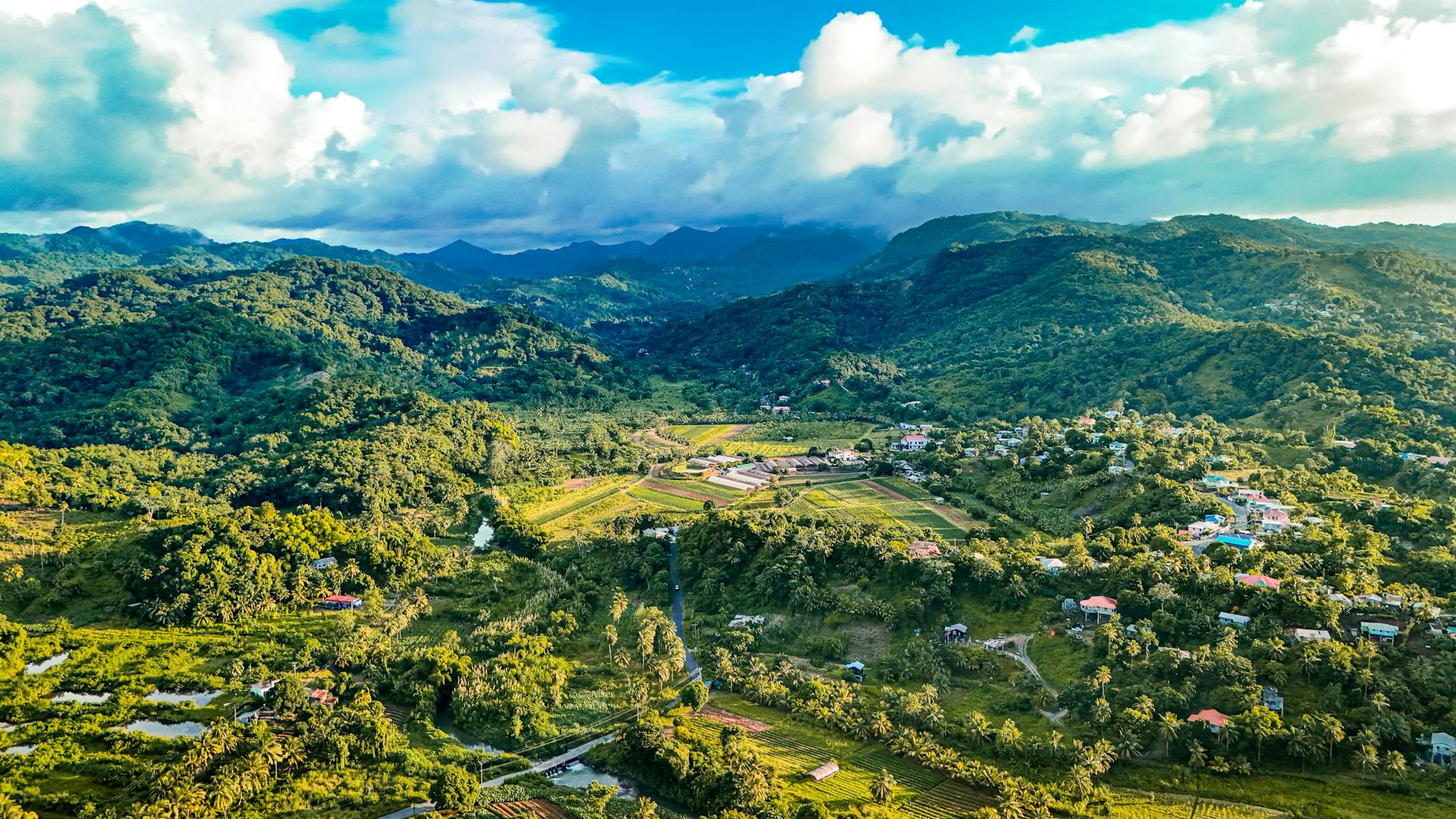
The interior rises fast into steep ridges, river valleys, and dense tropical forest where the air cools and the roads narrow. It is the part of Saint Lucia that explains the island's scale better than any beach ever could.
12 cities — start with the ones we'd send you to first.
The capital's Saturday market on Jeremie Street sells dasheen, dried herbs, and gossip in equal measure, with the iron-roofed central market building dating to 1894 still doing the same job.
The oldest French colonial town on the island sits directly beneath the Pitons and next to a drive-in volcanic crater where the mud pools smell of sulphur and the water runs warm and yellow.
A purpose-built marina village in the north that somehow works — yacht crews resupply, restaurants stay open late, and the Friday night jump-up at Gros Islet draws the whole northern end of the island.
The fishing village that hosts Saint Lucia's most famous street party every Friday has, Monday through Thursday, the unhurried pace of a place that has not yet been fully discovered by the people who discover places.
The island's second airport sits here, the Atlantic and Caribbean seas nearly meet at Moule à Chique Point, and the town itself is where Saint Lucians live and work without performing anything for visitors.
A harbor so narrow and sheltered that in 1778 a British fleet disguised their ships with palm fronds and hid from the French — today it is one of the most dramatically beautiful anchorages in the Caribbean.
Every Friday evening this small fishing village lays out grilled fish, lobster, and accra on tables along the waterfront for a fish fry that costs EC dollars and tastes like the reason people come to the Caribbean.
Wedged between cliffs and the Caribbean Sea with no bypass road, this quiet fishing village is the kind of place you pass through on the West Coast Road and immediately want to stop and not leave.
On the Atlantic side where most tourists never drive, Micoud is the gateway to the Fregate Islands Nature Reserve and the annual La Rose festival, the island's rival flower-society celebration to La Marguerite.
Castries is the island's working capital, not a staged version of one, and that is exactly why it matters. North from here, Rodney Bay, Gros Islet, and Pigeon Island shift the mood toward marinas, beaches, and nightlife, but the whole belt still runs on real traffic, ferry arrivals, market errands, and school-day rhythm.
Marigot Bay looks polished from the water, then the road carries you into villages where the west coast narrows and daily life hugs the hillside. Anse La Raye and Canaries are the stops for grilled fish, roadside bars, and the slower village cadence that gets lost if you only shuttle between airport and resort.
Soufrière is the island's geological showpiece and still a functioning town, which keeps it from turning into scenery alone. The Pitons, the sulphur springs, and the steep road south toward Choiseul pack Saint Lucia's volcanic drama into one compact region, with enough bends in the road to remind you that beauty here costs time.
Vieux Fort is practical, windy, and less interested in performing for visitors than the west coast. East from here through Micoud and up toward Dennery, the island opens onto rougher Atlantic water, farming districts, and villages where the food is often the reason to stop.
From Iouanalao to independence and beyond
Archaeological evidence points to early settled communities on Saint Lucia, especially along calmer leeward shores. Cassava farming, fishing, and ceramics begin the documented human story of the island.
Kalinago groups displace or absorb earlier communities and establish control over the island. They rename it Hewanorra, a word that still survives in modern Saint Lucia.
An English colonizing attempt collapses within weeks under Kalinago resistance and disease. The survivors flee, leaving behind one of the Caribbean's earliest and clearest imperial rebuffs.
A second English effort to settle Saint Lucia also fails. The island proves far harder to seize than its imperial suitors expected.
French interests establish a more durable presence on Saint Lucia, beginning the long Anglo-French struggle for control. From this point on, the island becomes a strategic obsession.
The French strengthen the heights above Castries, recognizing that whoever holds the ridge commands the harbor below. Morne Fortune becomes one of the island's enduring military stages.
British forces under Samuel Barrington seize the island, and the French fleet under d'Estaing fails to break the British defensive line in Grand Cul de Sac Bay. Saint Lucia becomes a hinge of the wider war in the Caribbean.
Admiral George Rodney uses Pigeon Island as a surveillance and naval base aimed at French Martinique. The rocky outpost becomes one of the most valuable lookout points in the eastern Caribbean.
The Treaty of Paris finally settles Saint Lucia under British control after decades of reversals. The flags stop changing, but plantation society and imperial hierarchy remain firmly in place.
Slavery is formally abolished in the British Empire, though apprenticeship and old planter power blunt the immediate meaning of freedom. For Saint Lucians, legal change arrives before social equality does.
The apprenticeship system ends, and formerly enslaved Saint Lucians gain fuller legal freedom. The island enters a new phase, though poverty and dependence still shape daily life.
A boy born in Castries will go on to become one of the 20th century's most important development economists. Saint Lucia's scale makes the future distinction even more astonishing.
Another child of Castries enters the world, destined to write Saint Lucia into world literature. His work will later make the island's sea light and historical fracture feel epic.
A devastating blaze destroys much of the capital and reshapes its urban fabric. Modern Castries is, in large part, a city rebuilt after catastrophe.
Saint Lucians gain the right to vote in a fuller democratic sense, widening political participation far beyond colonial elites. The electorate begins to look more like the country itself.
Saint Lucia becomes an Associated State of Britain, gaining internal self-government while London retains responsibility for external affairs and defense. Independence is now a matter of when, not whether.
On 22 February, Saint Lucia becomes an independent state within the Commonwealth. After centuries of being fought over, the island begins formally governing itself.
Sir John Compton stands at the center of the new state's early political architecture. He embodies the long, argumentative passage from colony to country.
The same year the country becomes independent, Arthur Lewis receives the Nobel Memorial Prize in Economic Sciences. It is a startling conjunction: a new state and a world-class mind from the same small island.
Walcott's Nobel confirms that Saint Lucia is not merely scenic but intellectually formidable. The island now has two Nobel laureates, a fact still disproportionate enough to sound invented.
The volcanic landscape around Soufrière, including Gros Piton and Petit Piton, gains World Heritage status. Saint Lucia's most recognizable silhouette becomes a formally protected global treasure.
Julien Alfred's sprinting success gives the island a modern hero of extraordinary force. Saint Lucia's story, once told through admirals and poets, now also runs through the track.
First Islanders
The emblematic figures of this era are unnamed navigators whose skill survives only in pottery shards, place names, and the stubborn Kalinago word Hewanorra.
A canoe noses into a dark bay, cassava cuttings tied beside clay pots, and the beach still belongs to iguanas. The Arawak called the island Iouanalao, "Land of the Iguana," which tells you something precious: the first name was not about conquest, but about what lived here before anyone drew a border.
Archaeological finds at Grande Anse suggest settled life long before any European chart bothered to notice Saint Lucia. People fished the calmer leeward coast, planted cassava, shaped ceramics with geometric patterns, and moved through an island of steep ridges and fast rivers that asked for skill, not brute force.
Then came the Kalinago, sea fighters with dugout pirogues and a hard eye for defensible coasts. They renamed the island Hewanorra, a word that still greets arrivals at the airport near Vieux Fort, which means every modern landing passes through an older memory.
Ce que l'on ignore often is that Saint Lucia's first political fact was difficulty. The cliffs, coves, and surf that now look theatrical from a boat near Soufrière once gave the island its best defense, and that choice of ground would decide the next century of its history.
The island's international airport carries a pre-colonial name, so one of Saint Lucia's oldest words is also one of its busiest.
Kalinago Resistance and Early Contact
The human face of this era is the anonymous Kalinago war leader who never entered a European portrait but altered imperial plans all the same.
Picture the scene in 1605: exhausted English settlers from the Olive Branch stagger ashore believing they have found a foothold. Within weeks they discover the opposite. Disease closes in, supplies thin out, and Kalinago resistance turns the dream of plantation empire into a short, humiliating panic.
Accounts describe around sixty-seven English colonists arriving, then dwindling fast under attack and illness. Only a remnant escaped. They left in a canoe, carrying not a colony but a warning.
A second English attempt in 1638 fared little better. Saint Lucia was not Barbados, with broad easy coasts and quick plantation logic. It was a volcanic stronghold where the people who knew the channels, landing places, and forest paths held the advantage.
That matters because later empires liked to begin the story when they finally succeeded. But the first act belongs to those who said no, and said it with such force that Europe needed decades to come back with more ships, more guns, and more patience. The struggle for Saint Lucia begins not with possession, but with refusal.
The first English survivors are said to have fled in a dugout canoe, a sharp reversal for men who had crossed the Atlantic in their own ship.
Helen of the West Indies
Admiral George Rodney turned Pigeon Island into an imperial lookout post, but the island remembers him less as a marble hero than as a man who knew the value of a harbor and a rumor.
A gun battery smokes above Castries, uniforms change color, and the same hill receives a new governor before the paint is dry on the last one's desk. Between the mid-17th century and 1814, Saint Lucia passed between France and Britain fourteen times, earning the grand nickname Helen of the West Indies. Grand, yes. Also accurate. Everyone wanted her.
The reason was brutally practical. Castries offered one of the eastern Caribbean's best harbors, while Pigeon Island, north of what is now Gros Islet and Rodney Bay, watched the Martinique channel like a spyglass turned into stone.
December 1778 is the scene to remember. Admiral Samuel Barrington seized the island for Britain; Admiral d'Estaing tried to take it back; the entrance to Grand Cul de Sac became a floating wall of cannon fire. Ce que l'on ignore souvent, c'est que two days of naval positioning off Saint Lucia helped shape the balance of power across the whole Caribbean.
Above the harbor rose Morne Fortune, the hill whose name promised luck and delivered casualties. French engineers fortified it, British officers expanded it, and both sides bled for it. Students now cross those grounds in modern Castries without always realizing they walk a former prize of empire.
And then there is the private theater beneath the strategy: officers writing letters home, merchants recalculating fortunes, enslaved people watching flags change while bondage remained. The island taught Europe an ugly lesson. Sovereignty could change overnight; power on the plantation changed far more slowly.
Pigeon Island was once a true island; the causeway that now ties it to the mainland came later, long after admirals used it as a detached watchtower.
Crown Colony, Freedom, and Nationhood
Sir John Compton, tireless and often combative, spent decades turning constitutional paperwork into the architecture of statehood.
When the Treaty of Paris in 1814 finally confirmed British control, the drama did not end. It changed rooms. The fighting hills grew quieter, but estate houses, courtrooms, and churches became the stages on which Saint Lucia's next battles were fought.
Enslavement persisted until emancipation in the 1830s, and even then freedom arrived with conditions that favored planters and patience. The island's economy leaned on sugar, then adjusted awkwardly as prices shifted and old certainties failed. People built lives in the gaps empire left behind.
Castries burned more than once, most famously in 1948, when fire tore through the capital and remade its streetscape. What looks modern in the city is often the result of destruction rather than tidy planning, and that gives Castries its particular character: a port city rebuilt by necessity, not vanity.
Politics grew louder in the 20th century. Trade unionism, constitutional reform, and the long argument over self-government brought forward figures such as George F. L. Charles and John Compton, men who understood that small islands do not get history handed to them politely. They bargain for it, clause by clause.
Independence came on 22 February 1979. Not as a romantic thunderclap, but as the last step in a long administrative unwinding of empire. Still, the bridge had been crossed, and Saint Lucia could now turn from surviving other people's contests to staging its own ambitions.
The 1948 Castries fire was so devastating that much of the capital's present look is, in effect, a post-disaster city center.
Independent Saint Lucia
Derek Walcott gave Saint Lucia the rarest gift a writer can offer a place: he made its light, grief, and speech impossible to confuse with anywhere else.
A classroom in Castries, a stage lit for poetry, a lecture hall where economics meets hunger: this is where modern Saint Lucia performs its improbable trick. Few countries of any size can boast two Nobel laureates. Saint Lucia, with fewer people than many provincial towns, produced Derek Walcott and Arthur Lewis.
That is not a decorative fact. Walcott taught the world to see Castries, sea light, and colonial fracture with epic dignity, while Lewis explained how poor societies move, stall, and grow. One wrote the island into literature. The other wrote it into economic thought.
Modern Saint Lucia also lives in the register of tourism, migration, and resilience. Resorts rose around Rodney Bay and Marigot Bay, the Pitons became the image most outsiders carry home from Soufrière, and the island learned the familiar Caribbean balancing act between beauty as inheritance and beauty as industry.
But the people's story keeps interrupting the postcard. Kwéyòl remains the language of intimacy, Friday night fish fries in Anse La Raye and Dennery insist on local appetite over imported polish, and new public heroes emerge from unexpected places. Julien Alfred sprinting into history belongs to the same national narrative as Walcott writing a line that made the sea feel classical.
What comes next will not be decided only in hotels or ministries. It will be decided in how Saint Lucia protects the landscapes that made it famous, and how it keeps cultural memory from being polished into something too smooth to be true.
Saint Lucia is one of the smallest sovereign states on earth to have produced two Nobel Prize winners.
Saint Lucia speaks in two temperatures. English does the paperwork, the school notice, the bank counter in Castries; Kwéyòl does the teasing, the consolation, the verdict passed over a pot before lunch. You hear the shift in a single conversation and understand that grammar can have blood pressure.
The first lesson is ceremonial: greet before you ask. "Good morning" is not padding. It is the key in the lock. Skip it in Soufrière or Dennery and you sound like a person who believes urgency outranks manners, which is a tragic modern delusion.
Then come the island words that refuse export. A lime is not a fruit but a drift of company. Mamaguy is sweet talk with a trapdoor under it. Tjenbwa belongs to that zone where herb, fear, rumor, and protection share one cupboard. A country is a dictionary of its anxieties.
Listen long enough and Kwéyòl stops sounding like a variation on French and starts sounding like Saint Lucia thinking aloud. That is different. Much more intimate.
Politeness here has architecture. You do not barge into it; you enter through the front gate with a greeting, an honorific, a small acknowledgment that the other person existed before your need arrived. The island is lively, loud, comic, and quite serious about this point.
Elders receive verbal space the way old houses receive shade. "Miss," "Mr.," "Auntie," "Uncle" are not quaint decorations but social load-bearing beams. A young person can joke, dance, argue, and still keep the frame intact. Freedom without form interests Saint Lucia less than visitors imagine.
Friday night in Gros Islet proves the rule by stretching it almost to breaking. Music climbs, grills smoke, beer opens, bodies sway in the street, and yet the old courtesies survive inside the noise like gold thread in dark cloth. People know how to abandon posture without abandoning respect.
This is refinement of a useful kind. It keeps public life from becoming a stampede.
Saint Lucian food tells the history of the island with less hypocrisy than official speeches. Salt cod from empire, green banana from plantation logic, dasheen from older continuities, pepper and thyme from the quick intelligence of cooks who had no reason to waste tenderness on abstraction: all of it lands on one plate and behaves as if it had always belonged together.
Take green fig and saltfish. The name misleads twice, which I admire. Green fig is banana. Saltfish arrives flaked with onion, herbs, and pepper, and breakfast suddenly has the moral authority of a parliament.
Bouyon is the opposite of elegance and therefore very close to grandeur. Dumplings, yam, breadfruit, meat, provisions, broth thick enough to count as an argument. One bowl explains why islands do not survive on coconut postcards.
Then come the rituals of appetite: accra bought hot enough to scorch fingertips, cocoa tea with its dark grain and spice, Friday fish on the coast near Anse La Raye, where smoke and sea air hold a practical marriage. Saint Lucia eats as if memory were perishable and needed daily renewal.
For 616 square kilometers, Saint Lucia has produced an indecent amount of literature. Derek Walcott alone would have been enough to make the island audible to the world: Castries, sea light, colonial fracture, the painter's eye that sees color and history in the same stroke. He wrote the Caribbean without asking permission to sound classical.
But islands should never be reduced to their Nobel laureates. Garth St Omer matters because he catches social pressure before it becomes slogan: class, intimacy, embarrassment, rooms where silence works harder than speech. Kendel Hippolyte brings another current, one closer to the stage and the civic nerve, where language does not simply decorate experience but tests it.
This is what strikes me in Castries. Literature is not treated as a museum object sealed behind polite admiration. It leaks into argument, school memory, radio cadence, the habit people have of telling a story sideways before they tell it straight.
Some places produce books. Saint Lucia produces sentences that keep listening to the sea after the page ends.
Music in Saint Lucia is not background. It is permission. Drums, Dennery Segment, soca, gospel harmonies, steelpan, the whole graduated science of bass applied to the human spine: sound here does not accompany the evening. It reorganizes it.
Dennery gave its name to a style that feels exactly like the Atlantic side of the island: rougher, faster, less interested in pleasing outsiders than in electrifying its own people. The beat can sound almost abrasive at first. Good. So can truth.
In Gros Islet on a Friday, speakers turn the street into public weather. Grills hiss. Rum pours. Someone dances with comic seriousness, which is the best kind of seriousness. A jump-up is not a party in the thin imported sense; it is a temporary republic of motion.
And then Sunday can belong to church song, close harmony, disciplined breath, the body returned to upright form after the previous night's glorious disorder. Saint Lucia understands that ecstasy has more than one uniform.
Roman Catholicism still shapes the island's calendar, vocabulary, and sense of occasion, even for people whose faith has become selective. Feast days, processions, white clothing, church titles, the seriousness of Sunday: these are not decorative leftovers. They are part of the island's pulse.
Yet Saint Lucia is too old, too creolized, and too intelligent to fit inside one official frame. Folk belief runs beside doctrine and sometimes through it, carrying herbs, warnings, protections, stories of unseen force, all that the word tjenbwa gestures toward without ever fully surrendering to translation. Orthodoxy likes clean shelves. Human beings do not.
You can feel this doubleness in a church service and later in a conversation on a veranda. One language for God in public, another for danger in private. Candles in one room, leaves steeping in another. Neither cancels the other.
The island's religion is not confusion. It is accumulation. Civilizations rarely work any other way.
Walcott grew up in Castries with the sea, the cathedral, and colonial fracture all within walking distance, and he spent a lifetime turning that visual world into literature. He did not treat Saint Lucia as a provincial footnote; he made it feel Homeric, wounded, funny, and fully equal to any classical landscape.
Arthur Lewis was born in Castries and went on to change how economists think about development, labor, and poverty. For Saint Lucia, his importance is almost theatrical: a small colonial island produced a man who explained how whole post-colonial economies might stand up on their own feet.
Compton was the architect-politician of modern Saint Lucia, the kind of leader who understood that constitutions are made not from ideals alone but from relentless negotiation. He led the island to independence in 1979 and remained impossible to ignore for decades after, admired by some, resisted by others, but never minor.
George Charles brought working people into the center of Saint Lucian politics with a force the old order could not comfortably absorb. The airport near Castries bears his name, which is fitting: he helped move the island from colonial deference toward public argument and organized pressure.
Rodney turned Pigeon Island into a listening post on empire's front line, watching the French fleet at Martinique and waiting for the right moment. He belongs to Saint Lucia's story because he understood, before many in London did, that this small island could control the rhythm of a much larger war.
If Walcott gave Saint Lucia grandeur, Garth St Omer gave it nerve endings. His fiction catches class unease, Catholic pressure, and the social claustrophobia of island life with an intimacy that feels less export-ready and more truthful.
Dunstan St Omer helped give independent Saint Lucia a visual language, from church murals to the design of the national coat of arms. He understood that symbols matter most in young states, because a country first has to picture itself before it can fully speak in its own voice.
Julien Alfred carries Saint Lucia into a new chapter, one written not in parchment or parliamentary speeches but in split seconds. Her rise gave the island a modern heroine whose achievement feels national in the deepest sense: small country, enormous nerve.
Base yourself in Castries or Rodney Bay and keep the driving short. This route works for a first trip with beach time, one good historical stop, and easy nights out in Gros Islet without burning a day on airport transfers between hotels.
This is the scenic Saint Lucia people picture before they book: sheltered bays, fishing villages, sharp green ridges, then Soufrière under the Pitons. The distances look small on a map, but the roads are slow, so this route works best if you move steadily down the west coast instead of trying to day-trip everything from one base.
Start near Vieux Fort for the practical side of the island, then work up the Atlantic coast through villages that see fewer resort guests and more ordinary daily life. You trade polished beaches for markets, roadside food, stronger sea views, and a better sense of how Saint Lucia feels outside the hotel corridor.
Morning plate. Family table. Green banana, salt cod, onion, thyme, pepper. Forks, talk, coffee, sea heat.
Midday bowl. Weekend kitchen. Yam, dasheen, breadfruit, dumplings, meat, broth. Spoons, silence, surrender.
Roadside snack. Paper bag, hot fingers. Saltfish fritters, pepper, lime, chatter, waiting, eating.
Early breakfast. Coal pot, cocoa stick, cinnamon, nutmeg, fried dough. Steam, dipping, gossip, school run.
Night ritual near Anse La Raye or Gros Islet. Grilled fish, green fig salad, rum, smoke, music. Standing, sharing, licking fingers.
Home meal. Roasted breadfruit, smoky fish, hands, enamel plate. Pull, tear, eat, repeat.
Street lunch. Flatbread, curry, folded paper, walking. Goat or chicken, sauce, bus stop, appetite.


U.S., U.K., Canadian, Australian, and most EU passport holders can enter Saint Lucia visa-free for short tourist stays, typically up to 6 weeks. You still need a passport valid for your stay, an onward or return ticket, and accommodation details. Air arrivals are encouraged to complete the electronic immigration form within 3 days before travel.
Saint Lucia uses the Eastern Caribbean dollar, written as XCD or EC$, fixed at EC$2.70 to US$1.00. U.S. dollars are widely accepted in Castries, Rodney Bay, Soufrière, and resort areas, but change usually comes back in EC$. Carry small EC$ notes for minibuses, market stalls, beach bars, and local taxis.
Most international visitors arrive at Hewanorra International Airport near Vieux Fort in the south. George F. L. Charles Airport near Castries handles mostly regional flights, but it is the more convenient airport for stays in Castries, Rodney Bay, Gros Islet, and Pigeon Island. Transfer times matter on this island: a road trip from UVF to the north usually takes around 90 minutes.
Saint Lucia drives on the left, and rental drivers need a local visitor permit issued through the rental company. Main coastal roads are manageable, but the mountain sections between Canaries, Soufrière, and Choiseul are narrow, steep, and slow after dark. Minibuses are cheap, taxis are common, and private transfers save time if you are changing bases with luggage.
December to May is the driest stretch, with lower humidity and the steadiest beach weather. June to November is cheaper and greener, but it overlaps with the Caribbean hurricane season and brings heavier rain, especially from August to October. The west coast around Castries and Rodney Bay is usually drier than the rainforest interior and the Atlantic side.
Digicel and Flow cover the main population centers, and 4G service is solid in Castries, Rodney Bay, Vieux Fort, and along most of the west coast. Signal drops in the rainforest interior and can weaken on remote stretches of the east coast. Hotels and resorts usually include Wi-Fi, but speeds vary enough that a local SIM is worth it if you need reliable mobile data.
Saint Lucia is manageable for independent travelers, but the usual island rules apply: do not leave bags unattended on beaches, avoid isolated roads at night, and confirm taxi fares before you start. Heavy rain can trigger landslides and road delays, especially on the western mountain roads. Check whether your restaurant or hotel already added a 10% service charge before tipping again.
Pay hotels and larger restaurants by card if you like, but keep Eastern Caribbean dollars for minibuses, rum shops, fish fries, and small groceries. U.S. dollars work in many tourist businesses, though the exchange rate at the counter is not always generous.
Public minibuses are the cheapest way to move between towns, with fares around a few EC dollars on shorter runs. They are good for daytime hops between Castries, Gros Islet, and nearby areas, less good when you are carrying luggage or trying to reach a hotel after dark.
Distances in Saint Lucia are short; travel times are not. A transfer that looks like 35 kilometers can still take more than an hour once the road starts climbing between Marigot Bay, Canaries, and Soufrière.
Many hotel and restaurant bills already include a 10% service charge. Read the bottom line before adding another tip out of habit, especially if you are used to U.S. pricing.
Rooms in Rodney Bay, Soufrière, and the better beach hotels tighten quickly from mid-December through mid-April. If you want a specific bay, sea-view room, or holiday-week stay, book months ahead, not weeks.
If you need maps, messaging, or mobile hotspot backup, buy a Digicel or Flow SIM soon after arrival. Hotel Wi-Fi is usually fine for browsing, but it can slow down sharply in the evening.
Say good morning or good afternoon before asking a question in a shop, at a bus stop, or on a roadside. It is basic courtesy in Saint Lucia, and skipping it makes you sound abrupt.
Explore Saint Lucia with a personal guide in your pocket
Audio guides for 1,100+ cities across 96 countries. History, stories, and local insight — offline ready.

No. U.S. passport holders can enter Saint Lucia for tourism without a visa for a short stay, provided they have a valid passport, onward or return ticket, accommodation details, and proof of funds if asked.
Yes, more than many mainland destinations, and especially on the resort-heavy west coast. A careful budget traveler can manage on about US$80-120 a day, while mid-range trips often land around US$180-300 once you add transfers, meals, and a few paid activities.
Bring a bank card and plan to use Eastern Caribbean dollars for daily spending. U.S. dollars are widely accepted, especially in Castries, Rodney Bay, and Soufrière, but buses, market stalls, and small local places work better with EC$ cash.
It depends on where you are staying. UVF near Vieux Fort is the main international airport, while SLU near Castries is much better for the north but mostly handles regional flights.
You can use minibuses, taxis, and pre-booked transfers, and many travelers do exactly that. Minibuses are cheap and useful on common routes, but taxis or private drivers make more sense for airport transfers, hotel changes, and the mountain roads around Soufrière.
December to May is the safest weather window for beach days, hiking, and smoother travel logistics. June to November is cheaper and greener, but rain is heavier and tropical systems can disrupt plans.
Yes, if you are comfortable driving on the left and handling steep, narrow roads. The real issue is not distance but road shape, especially between Canaries, Soufrière, and Choiseul, where nighttime driving is tiring even for confident drivers.
Yes in the main towns and resort areas, with some gaps inland and on remote stretches of the east coast. Buy a local SIM if you need dependable data, because hotel Wi-Fi is common but not always fast.
Last reviewed