Kremlin Wall Necropolis
Tverskoy DistrictRussia 55° N · 37° E Updated May 2026
238 coffins went into Red Square in one day, and the graves still sit beside selfie crowds, state rituals, winter fairs, and Lenin's mausoleum today.
 Photo: Tothkaroj · CC BY-SA 4.0
Why does the Kremlin Wall Necropolis in Moscow's Tverskoy District, Russia, feel less like a cemetery than a grave hidden inside a parade ground? Visit because nowhere else on Red Square shows so plainly how a state turned fresh loss into ritual, then into architecture, then into official memory. Today you pass dark granite busts, red stone, blue spruces, and carnations going sweet in the cold air while bootsteps click across the paving and the Kremlin wall itself holds urns behind bronze plaques.
Most visitors think this is a row of famous Soviet names beside Lenin's Mausoleum. Records show the place began as something rougher and sadder on 10 November 1917, when 238 coffins of workers and soldiers from the Moscow fighting went into mass graves by the wall. The celebrities came later.
That layered structure is why the necropolis repays slow attention. You are looking at three burial types compressed into one strip of Red Square: anonymous trenches under the paving, individual graves in the ground, and a columbarium built into the brick wall like a filing cabinet for the Soviet century.
The reason to stop here isn't reverence for every name. It's the chance to watch power at work in stone. A place that started with hurried mourning now still stages flower-laying, guarded silence, and arguments about what Russia should remember in the middle of its most watched square.
What to see
-
Lenin’s Mausoleum and the Wall of Plaques
The first surprise is how restrained it looks. Alexey Shchusev’s 1930 mausoleum sits in polished red granite, black labradorite, and gray stone like a stepped block cut for ceremony rather than grief, lower than many visitors expect and severe enough to make Saint Basil’s riot of color feel almost noisy by comparison. Walk slowly along the wall before you reach it: the small black plaques look modest against brick ramparts long enough to read like a railway embankment, then the names come into focus and you realize the wall itself is a columbarium, a state memory machine built one urn at a time. -
The Mass Graves and the Busts Behind the Mausoleum
The necropolis changes character behind the spectacle. On 10 November 1917, records show 238 coffins of workers and soldiers killed in Moscow’s street fighting were lowered into common graves here, and the granite slopes still carry 119 identified names while many others remain unknown; that gap matters, because the place is not only about famous men but about how revolutions consume the anonymous first. Then the route tightens behind the mausoleum, where portrait busts of Stalin, Brezhnev, Dzerzhinsky and others rise from individual graves, each head set on stone with the blunt authority of a courtroom monument, and the contrast with the near-silent plaques in the wall tells you exactly how Soviet power ranked its dead. -
Read the Necropolis as a Route, Not a Monument
Start at the Nikolskaya Tower end of the wall and give yourself permission to ignore the postcard view for a minute. The better experience comes on foot, with Red Square’s paving clicking under shoes, guard instructions cutting through the chatter, and the left side getting the attention most visitors deny it; John Reed’s plaque is easy to miss there, which feels oddly fitting for a place where political theater and selective memory have always worked together. By the time you emerge near the Spasskaya Tower, the necropolis stops looking like a strip beside a famous square and starts reading as three burial systems at once: mass graves in the ground, elite bodies behind the mausoleum, cremated remains inside the wall.
Plan your visit
- Getting There
- The necropolis runs along the Kremlin wall on Red Square, between Nikolskaya Tower and Spasskaya Tower, and you reach it through the Lenin's Mausoleum security route rather than by a separate gate. The simplest approach is metro: Okhotny Ryad, Teatralnaya, or Ploshchad Revolyutsii, then a 7-10 minute walk via Manezhnaya Square to the State Historical Museum side and the Nikolskaya checkpoint; from Aleksandrovsky Sad, allow about 10 minutes on foot. Car access is awkward in this part of central Moscow, and nearby paid parking at GUM or Okhotny Ryad costs time before you've even joined the queue.
- Opening Hours
- As of 2026, the public schedule follows Lenin's Mausoleum: Tuesday, Wednesday, Thursday, Saturday, and Sunday from 10:00 to 13:00; Monday and Friday are closed. Right now matters more than the routine: the Federal Protective Service suspended access from April 23 to May 17, 2026 inclusive, and similar closures happen during Victory Day preparations, state events, and preservation work.
- Time Needed
- A fast pass through the mausoleum route and necropolis takes about 10-15 minutes once you are inside, roughly the length of a short metro ride. Realistically, count on 45-90 minutes with security and queueing, and on busy holiday periods the total can stretch to 1-2 hours. If you read the plaques slowly and pair the visit with Red Square context, give it up to 2 hours.
- Cost & Tickets
- As of 2026, admission is free, which feels almost odd in the middle of Moscow's most choreographed square. No official online booking or skip-the-line system appears to exist, so paid tours do not spare you the public queue; they mostly buy explanation, not speed.
- Accessibility
- Official sources do not clearly confirm full wheelchair access for the mausoleum-necropolis route, and that uncertainty matters because the approach includes security screening, queueing, and uneven stone paving polished by millions of feet. The Kremlin visitor infrastructure nearby includes ramps and tactile paving, but I found no confirmed elevator for this route, so visitors who need step-free access should contact the Kremlin visitor centre before making the trip.
Photo Gallery



History
The Ritual Never Really Ended
Records show the necropolis has kept one function, even as empires, flags, and slogans changed around it: the state brings chosen dead to the wall and asks the living to look at them in public. First came the mass burial of 1917. Then came individual graves, urns set into the wall, Lenin's shrine, and the long habit of arriving with flowers.
Burials ended in 1985, but the rite did not. The site still works as a civic altar where descendants, party loyalists, military delegations, and space officials return with carnations, wreaths, and silence, all within sight of the Kremlin towers and the polished red geometry that Alexey Shchusev fixed into Red Square between 1929 and 1930.
The turning point
The Trench Beneath the Pantheon
At first glance, the Kremlin Wall Necropolis looks like a tidy honor roll of Soviet greatness: Lenin at the center, famous marshals and cosmonauts nearby, plaques set neatly into brick. Tourists often read it that way. The surface story says this is where the state rewarded its heroes.
Then the dates start arguing back. Official Kremlin Commandant history says the necropolis began on 10 November 1917, when 238 coffins from seven days of Moscow street fighting went into two mass graves by the wall, and most of those dead never became household names. That means the famous busts stand on top of an older, messier fact: this place began with anonymity, not celebrity.
The turning point came after Lenin died in January 1924. Alexey Shchusev had to solve a problem that was personal for him and political for the regime: if the burial ground at the empire's old center looked improvised, the new Soviet state would look improvised too. UNESCO notes that his permanent mausoleum became the prime example of Soviet monumental architecture; the revelation is that the polished shrine did not replace the trench, it taught visitors to see the trench through a new official script.
Once you know that, the whole place shifts. The busts look less like the beginning of the story than a later layer laid over the first wound, and every bouquet left here still answers that original November burial when Red Square stopped being only a ceremonial plaza and became a cemetery as well.
What Changed
What Endured
Tips for visitors
Funeral Corridor
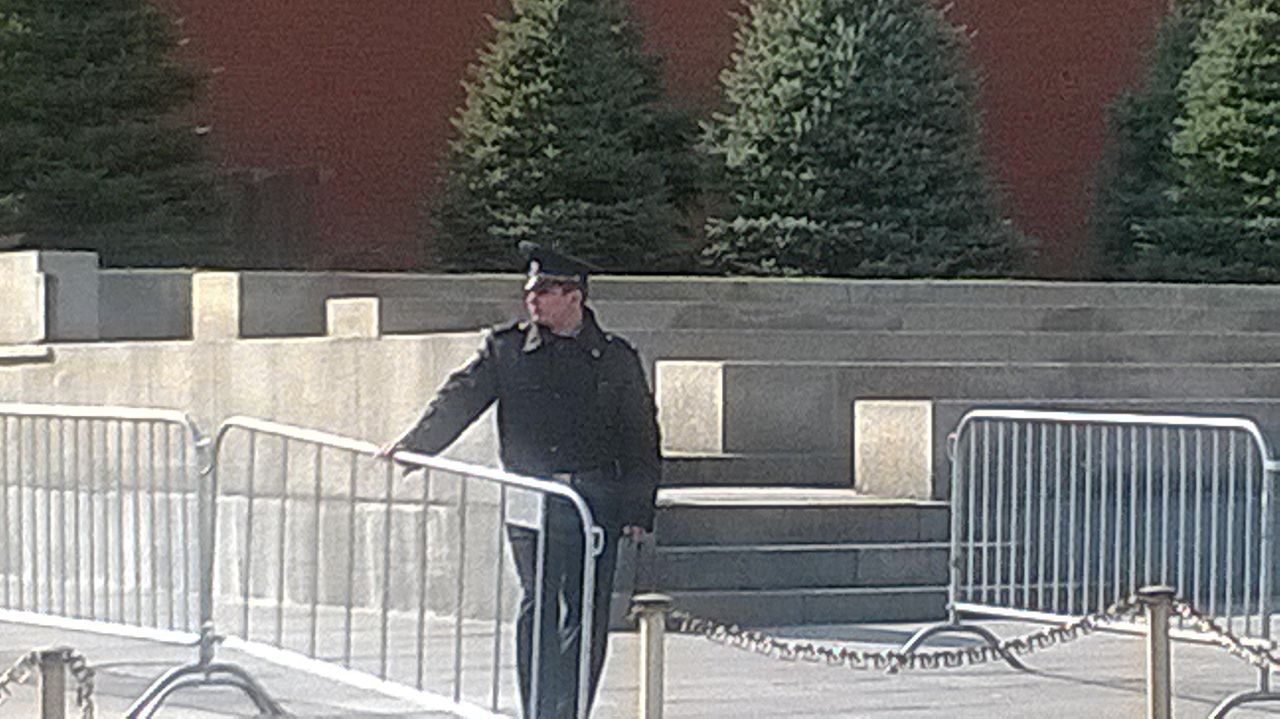
Treat the route like a memorial space, not a Red Square photo stroll. Men are expected to remove hats, silence is expected, guards keep people moving, and hands-in-pockets can draw a sharp correction.Camera Stays Off
Inside Lenin's Mausoleum, photography and video are off limits. Reports conflict about the outdoor necropolis stretch on the controlled route, so the safe rule is simple: keep your camera down until you are fully outside the checkpoint zone; drones are banned in Moscow anyway.Pack Light
Large bags create problems here, and left-luggage rules for mausoleum-only visitors remain fuzzy. Bring the bare minimum, skip liquids and bulky metal, and you'll move through screening faster instead of getting stuck beside the walls while the line creeps forward.Beat The Queue
Aim for a non-holiday Tuesday, Wednesday, or Thursday just before the 10:00 opening, when the square still feels cool and echoing rather than clogged. Avoid late April and early May unless you've checked closures that same week, because Victory Day preparations regularly shut the route with little romance and a lot of fencing.Eat In GUM
Afterward, cross to GUM instead of paying view tax right on the square. Stolovaya 57 is the best budget stop, Grand Cafe Dr. Zhivago works well for a mid-range Russian meal a short walk away, and Bosco Cafe is the splurge if you want Red Square outside the window and don't mind paying for that privilege.Pair It Properly
The necropolis makes more sense when you read it against the buildings around it: Lenin's Mausoleum, the State Historical Museum, St. Basil's Cathedral, and Alexander Garden sit within a 5-10 minute walk. Do GUM last; the jump from mass graves and state ritual to department-store ice cream is not a distraction, it is the point.
Frequently asked
Is Kremlin Wall Necropolis worth visiting?
Yes, if you care about how power stages memory in stone. This is not just a row of famous graves on Red Square: 238 coffins went into the first mass graves on 10 November 1917, and the wall itself holds urn burials, so the place reads as cemetery, columbarium, and political theater at once. Go for the clash between quiet black plaques and the constant scrape of footsteps outside.
How long do you need at Kremlin Wall Necropolis?
Plan on 45 to 90 minutes in real life, even though the route itself is short. The controlled visit can take only 10 to 15 minutes once you are moving, but security and queues often stretch the total, and on busy days it can run to 1 to 2 hours, about the length of a feature film. Move too fast and you miss the left-side plaques, including John Reed.
How do I get to Kremlin Wall Necropolis from Tverskoy District?
From most of Tverskoy District, the easiest route is the Moscow Metro to Okhotny Ryad, Teatralnaya, or Ploshchad Revolyutsii, then a short walk to the Red Square checkpoint by Nikolskaya Tower. The necropolis runs along the Kremlin wall between Nikolskaya and Spasskaya towers, and metro is the smarter choice because central traffic and event closures around Red Square can turn a simple car ride into dead time.
What is the best time to visit Kremlin Wall Necropolis?
The best time is an open morning on Tuesday, Wednesday, Thursday, Saturday, or Sunday right at 10:00. Public hours are usually only 10:00 to 13:00, a window shorter than a long lunch, and late spring can bring closures around state events; as of 1 May 2026, the site is closed from 23 April to 17 May 2026. Early entry also gives you the calmest soundscape before the square fills with tour groups and festival traffic.
Can you visit Kremlin Wall Necropolis for free?
Yes, admission is free when the route is open. You do not book a separate necropolis ticket in normal practice; access follows the Lenin's Mausoleum route, so the real cost is time in line, not money. Arrive light, because security rules are stricter than the price tag suggests.
What should I not miss at Kremlin Wall Necropolis?
Do not miss the mass-grave slopes, the small black wall plaques, and the bust graves behind the mausoleum, because those three layers explain the whole place. Most visitors clock the famous names and miss the harder fact: the necropolis began with mostly anonymous dead from the 1917 fighting, and only 119 identified names appear on the granite embankments. Also watch for the shift in mood as Red Square noise drops and the route tightens around dark polished stone.
Sources & attribution 9
- UNESCO World Heritage Centre — Confirmed that the necropolis sits within the Kremlin and Red Square World Heritage property and supplied context on Lenin's Mausoleum as part of the ensemble.
- Federal Protective Service of Russia — Provided the core historical facts for the necropolis, including the 10 November 1917 burial of 238 coffins and the memorial structure of the site.
- Federal Protective Service of Russia Visitor Rules — Provided standard opening days and hours and practical access rules tied to the mausoleum route.
- Interfax-Russia — Confirmed the closure of Lenin's Mausoleum and the Kremlin Wall Necropolis from 23 April to 17 May 2026.
- Tutu.ru — Supplied the short on-route visit estimate of roughly 10 to 15 minutes.
- TRN News — Helped with practical timing and route details, including the checkpoint side of Red Square and realistic visit duration.
- Tripadvisor — Provided visitor-pattern details on queues, route flow, and commonly missed plaques such as John Reed.
- Tourister — Supplied practical visitor information, common local usage, and confirmation that access is usually tied to the mausoleum route.
- Rusmania — Helped describe the physical layout of the necropolis, including wall plaques, individual bust graves, and the route through the site.
Built from cited sources · see the method · How we make our guides →
Pick up where you left off
Saved and recently read places — kept on this device only.
Photo credits (16)
- Kremlin Wall Necropolis — Bernt Rostad — CC BY 2.0 (https://creativecommons.org/licenses/by/2.0/) — Source: https://commons.wikimedia.org/wiki/File:Kremlin_Wall_Necropolis.jpg
- Kremlin Wall Necropolis & Lenin' s Mausoleum, Moscow 2007 — DIMSFIKAS at el.wikipedia — CC BY-SA 3.0 (https://creativecommons.org/licenses/by-sa/3.0/) — Source: https://commons.wikimedia.org/wiki/File:Kremlin_Wall_Necropolis_&_Lenin'_s_Mausoleum,_Moscow_2007.JPG
- Kremlin Wall Necropolis 24 — Tothkaroj — CC BY-SA 4.0 (https://creativecommons.org/licenses/by-sa/4.0/) — Source: https://commons.wikimedia.org/wiki/File:Kremlin_Wall_Necropolis_24.JPG
- Kremlin Wall Necropolis - Mass Grave No. 5 - Armand - Reed - Rusakov - Pekalov — Tothkaroj — CC BY-SA 4.0 (https://creativecommons.org/licenses/by-sa/4.0/) — Source: https://commons.wikimedia.org/wiki/File:Kremlin_Wall_Necropolis_-_Mass_Grave_No._5_-_Armand_-_Reed_-_Rusakov_-_Pekalov.jpg
- Kremlin Necropolis — Hayden Soloviev — CC BY-SA 4.0 (https://creativecommons.org/licenses/by-sa/4.0/) — Source: https://commons.wikimedia.org/wiki/File:Kremlin_Necropolis.jpg
- Moscow - 2025 - Kremlin Wall, Red Square — Юрий Д.К. — CC BY 4.0 (https://creativecommons.org/licenses/by/4.0/) — Source: https://commons.wikimedia.org/wiki/File:Moscow_-_2025_-_Kremlin_Wall,_Red_Square.jpg
- Kremlin Wall Necropolis 04 — Tothkaroj — CC BY-SA 4.0 (https://creativecommons.org/licenses/by-sa/4.0/) — Source: https://commons.wikimedia.org/wiki/File:Kremlin_Wall_Necropolis_04.JPG
- Eternal flame at the Kremlin wall in Moscow — АнИгМа — CC BY-SA 4.0 (https://creativecommons.org/licenses/by-sa/4.0/) — Source: https://commons.wikimedia.org/wiki/File:Eternal_flame_at_the_Kremlin_wall_in_Moscow.jpg
- July 1978 in Moscow 11 — Szilas — CC BY 4.0 (https://creativecommons.org/licenses/by/4.0/) — Source: https://commons.wikimedia.org/wiki/File:July_1978_in_Moscow_11.jpg
- Kreml 01645 — Araz Yaquboglu — CC BY-SA 4.0 (https://creativecommons.org/licenses/by-sa/4.0/) — Source: https://commons.wikimedia.org/wiki/File:Kreml_01645.jpg
- Kremlin 1 — Shirvanbeigi — CC BY-SA 4.0 (https://creativecommons.org/licenses/by-sa/4.0/) — Source: https://commons.wikimedia.org/wiki/File:Kremlin_1.jpg
- Kreml divarı 01646 — Araz Yaquboglu — CC BY-SA 4.0 (https://creativecommons.org/licenses/by-sa/4.0/) — Source: https://commons.wikimedia.org/wiki/File:Kreml_divarı_01646.jpg
- Kremlin (3) — Shirvanbeigi — CC BY-SA 4.0 (https://creativecommons.org/licenses/by-sa/4.0/) — Source: https://commons.wikimedia.org/wiki/File:Kremlin_(3).jpg
- Kremlin 2 — Shirvanbeigi — CC BY-SA 4.0 (https://creativecommons.org/licenses/by-sa/4.0/) — Source: https://commons.wikimedia.org/wiki/File:Kremlin_2.jpg
- Kremlin 3 — Shirvanbeigi — CC BY-SA 4.0 (https://creativecommons.org/licenses/by-sa/4.0/) — Source: https://commons.wikimedia.org/wiki/File:Kremlin_3.jpg
- Changing the guards at the Kremlin wall — АнИгМа — CC BY-SA 3.0 (https://creativecommons.org/licenses/by-sa/3.0/) — Source: https://commons.wikimedia.org/wiki/File:Changing_the_guards_at_the_Kremlin_wall.jpg
Photos may have been resized or cropped.