
The Motherland Calls
Tsentralny DistrictRussia 48° N · 44° E Updated May 2026
The 85-meter statue is held to its pedestal by nothing but its own weight — no bolts anchor Mother Russia to the hill of 35,000 dead.
 Photo: VladFedotov · CC BY-SA 4.0
- Time needed
- 2-3 hours
- Entry
- Free
- Access
- Limited — over 200 steep stairs, partial elevator access only
- Best season
- Late spring (May) or early autumn
She isn't bolted down. Eighty-five meters of concrete and tensioned steel rise from a Volgograd hilltop, and The Motherland Calls stands by weight and balance alone — monitored for tilt the way a patient is monitored for fever. Up close, she fills the sky. Climb Mamayev Kurgan in Tsentralny District, Volgograd, Russia, and you find the figure is only the climax: under her feet lie a mass grave, an engineered hill, and the ground where the Battle of Stalingrad turned.
Visitors climb past stone reliefs, past the Hall of Military Glory where an honor guard changes every hour, past the small mass grave and Marshal Chuikov's tomb. Then she fills the sky. Her sword — built from stainless steel sheathed in titanium, using aviation methods — was replaced with a perforated steel blade in 1972 because the original swayed and shrieked in the wind. Locals call her, simply, 'Mama.'
You come for the size; you stay for the layering. The hill itself was reshaped during construction — engineers brought in extra soil to stabilize the summit. The statue rests on internal cable tensioning that has been monitored every year since 1967. Groundwater rose in 2009. Restorers in 2019 counted roughly 180,000 surface defects and 14 kilometers of cracks. This monument has no finished state.
What to see
-
The Hall of Military Glory
Step inside and the temperature drops, the light goes amber, and Schumann's "Träumerei" loops through the circular chamber on a low wash of strings. A giant stone hand rises from the floor holding the eternal flame. Around the curved wall, 34 red mosaic banners carry the names of 7,200 defenders of Stalingrad — sons, fathers, teenagers, listed in tight columns you can read close enough to touch.
Every hour, on the hour, the honor guard changes. Three soldiers in dress uniform step in measured cadence around the flame, boots cracking against polished granite, and the room falls so quiet you can hear the candles in the hand pulling air. Time the visit to catch one shift. It is the most concentrated moment on the whole hill.
Look up before you leave. The roof opens to the sky, and from the right spot the oculus frames the lifted sword of the statue above — a deliberate sightline linking the dead inside to the figure who summons them. Most visitors miss it because they are watching the guards.
-
The Ruined Walls
After the open Square that Stood to the Death, the path squeezes between two long concrete walls — jagged, pocked, deliberately broken to mimic the shelled facades of 1942 Stalingrad. The walls press close enough that two people walking abreast brush shoulders. Helmets, faces, slogans, gun-barrels emerge from the surface in half-relief, as if the city itself were trying to push through the concrete.
Then the sound starts. Hidden speakers play wartime songs, the rasp of Soviet Information Bureau bulletins, distant artillery, the rhythm of a marching column. The corridor was engineered as an acoustic instrument, not a backdrop. Walk it slowly. The audio shifts as you move, so the same stretch reads differently on the way up than on the way down.
This is the memorial's most physical passage — the moment the architecture stops describing the battle and starts approximating what being inside it might have felt like. By the time you climb out into the Square of Heroes, the open sky lands like a held breath finally released.
-
Walk the Full Ascent — Don't Skip to the Summit
The statue is the climax, not the point. Sculptor Yevgeny Vuchetich and engineer Nikolai Nikitin choreographed the entire 200-step climb as a single composition: enter at the Memory of Generations relief, pause at the 12 granite niches holding soil from each Soviet hero-city, walk the poplar avenue, push through the Ruined Walls, cross the reflecting pool of the Square of Heroes, descend into the Hall of Military Glory for the guard change, then climb past the Square of Sorrow where Mother's Sorrow cradles her dead son in still water.
Only then do you reach the summit, where the figure lunges forward over a burial mound holding the remains of more than 35,000 defenders, including Marshal Vasily Chuikov who commanded the 62nd Army and asked to be buried with his men. Allow two hours minimum. Do it in order. The hill rewards the patient.
Plan your visit
- Getting There
- Take the skorostnoy tram or trolleybus 8a, 8k, 9, or 10a to Mamayev Kurgan stop on Lenin Avenue for the full ceremonial ascent — 820 metres up the axis, 78 metres of climb. For an easier approach, ride bus 21 or 25 to Teletsentr and enter from the rear. Yandex Go is the only taxi app worth trusting; ignore freelance drivers near the stops.
- Opening Hours
- As of 2026 the memorial grounds are open 24/7, year-round, with no closing day — entry to The Motherland Calls itself is always free. Official guided tours run daily 10:00–15:30, extended to 9:00–18:00 from 1–11 May 2026 around Victory Day. Around 2 February, 9 May and 22 June, expect crowd-control restrictions and vehicle bans, especially on the Rokossovsky side.
- Time Needed
- Allow 45–60 minutes for a quick climb covering the lower approach, the Hall of Military Glory, and the statue platform. A proper first visit — pausing at each sculptural group, reading the 6,480 names on the cemetery walls — runs 1.5 to 2.5 hours. Locals and recent visitors recommend 3 hours if you want to walk the full axis without rushing.
- Accessibility
- The ceremonial route from Lenin Avenue is hard: roughly 200 steps spread over 820 metres with 78 metres of vertical gain, plus winter ice. The museum-reserve has wheelchair lifting platforms inside its buildings and a dedicated accessibility line at +7 (8442) 55-01-51 ext. 1313 — call ahead. Wheelchair users and anyone with bad knees should start from the Teletsentr rear entrance, which skips most of the climb.
- Cost & Tours
- Independent entry is free for everyone. As of January 2026, an official guided tour costs 4,000 RUB per group of 1–5 for Russian/EAEU citizens, 5,000 RUB for foreign visitors, or 4,500 RUB if you bring your own interpreter. Book by phone at +7 906 170-14-70 or email [email protected] — there are no online instant tickets and no skip-the-line products.
Photo Gallery

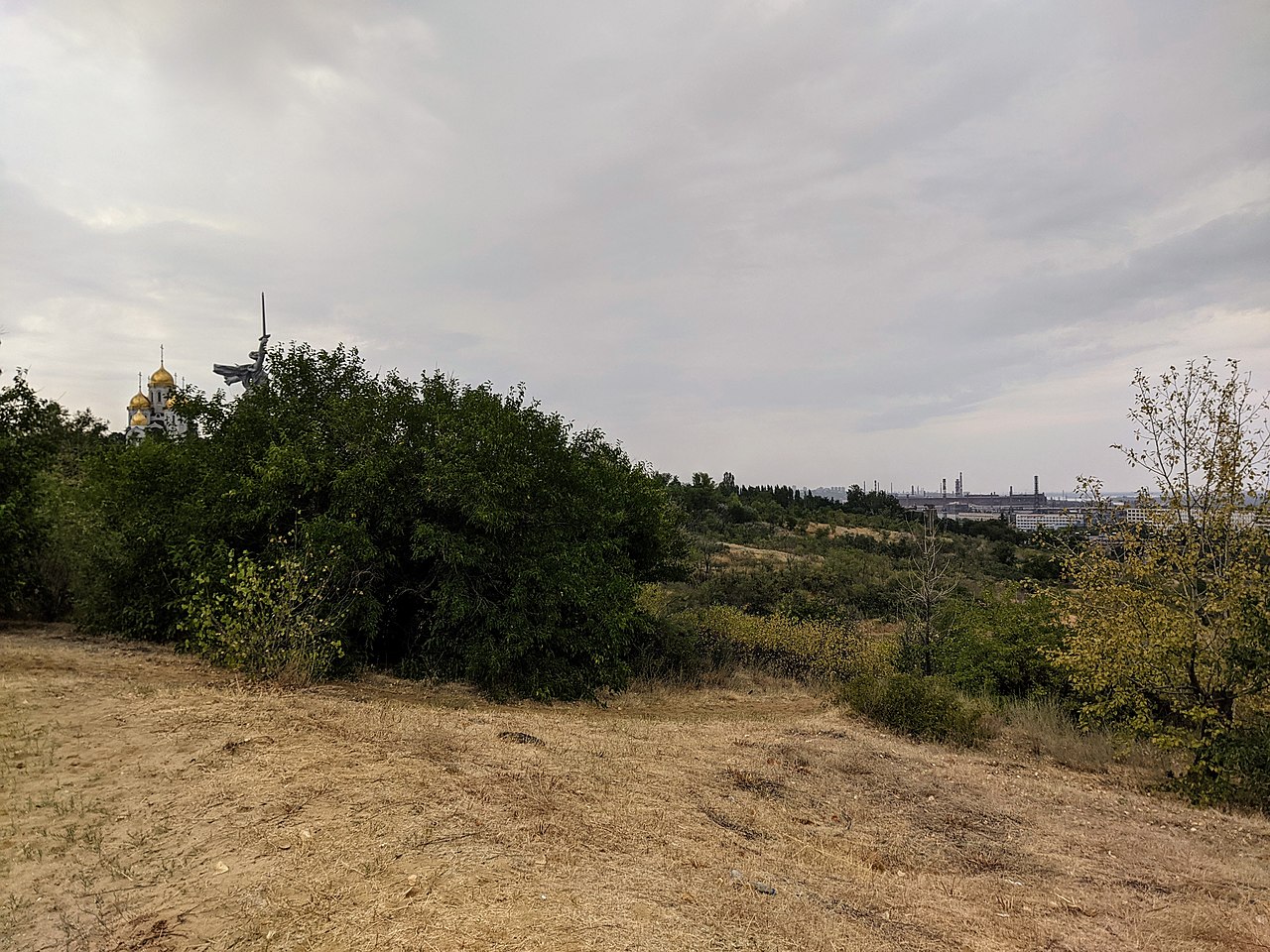

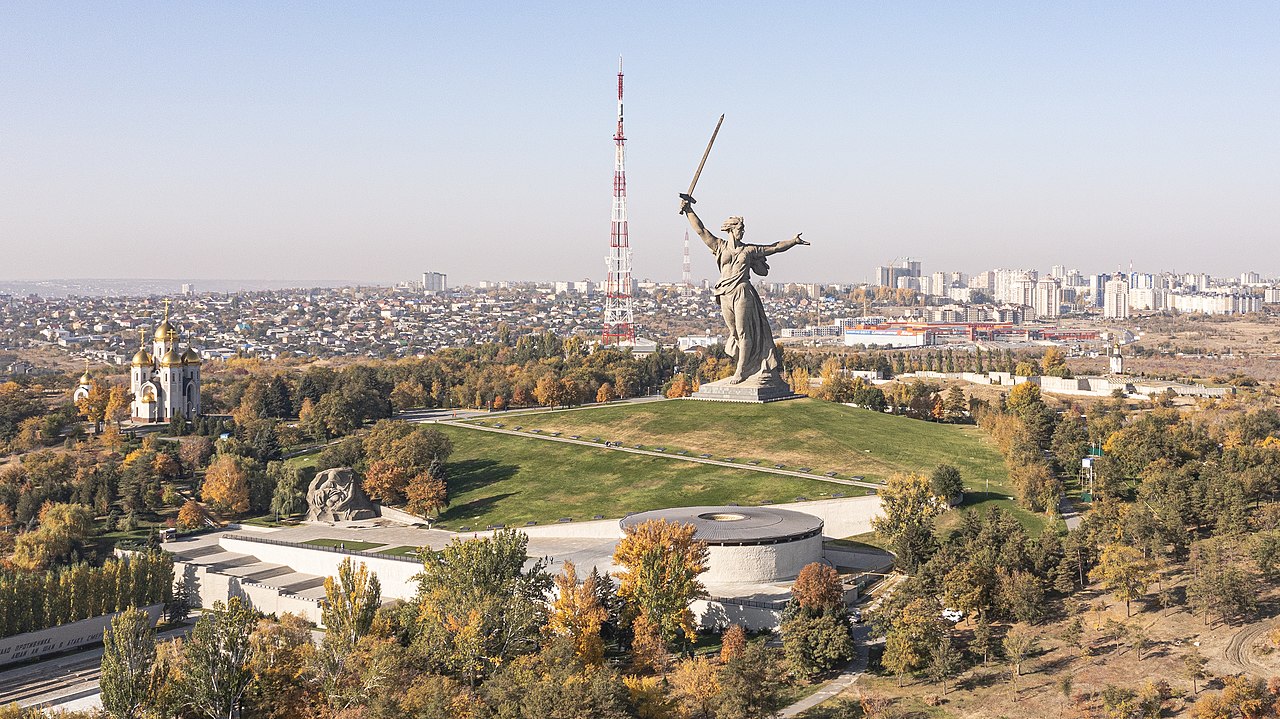


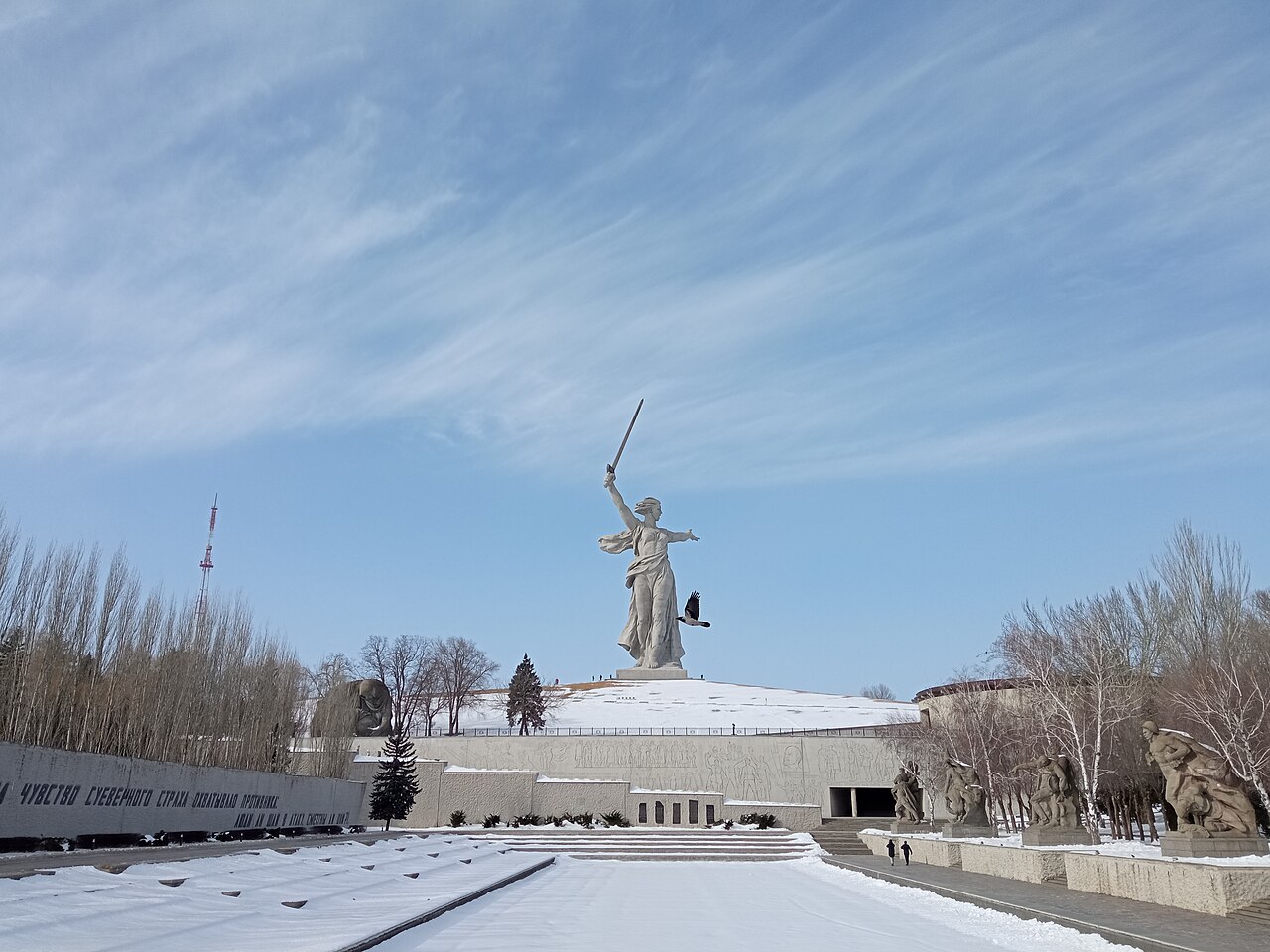
History
The Hill Called 102.0
Before the statue, before the granite, the place was simply a hill — Height 102.0 on Soviet wartime maps. From its summit you could see the rail hub, the factories, the Volga crossings. Whoever held the hill could see the battle. Both sides fought for it more than 130 days, hand to hand, often in the same hour.
After 2 February 1943, the hill held a mass grave packed with mines and shell fragments. Sappers cleared the ground. Residents climbed back. A wooden obelisk with crossed rifles went up on 8 February, less than a week after the battle ended. The figure overhead, the granite stairs, the Hall of Military Glory — all of it rests on top of that first improvised marker.
The turning point
What Vuchetich Threw Out
The statue looks inevitable — the obvious form for the obvious victory. Tourists treat her as the natural punctuation to a story that ended in 1943.
The original design wasn't her. Yevgeny Vuchetich (1908–1974), the chief sculptor, first proposed a smaller, two-figure composition: Motherland and a kneeling soldier accepting a sword. He scrapped it himself. The war it commemorated, he said, was not yet finished — its meaning still being argued in the Kremlin.
Khrushchev wanted scale. He pushed the height upward so the figure would stand taller than the Statue of Liberty. Engineer Nikolai Nikitin — who calculated Moscow's Ostankino Tower — designed her to stand by weight and balance, with internal cables under permanent tension. Nothing bolts her down. Annual tilt readings have run since opening on 15 October 1967. The body model is widely thought to be the discus thrower Nina Dumbadze; the face, Vuchetich's wife Vera. No one is certain.
Stand at her feet and the silhouette stops reading as triumph. It becomes a balanced load — concrete and tensioned cable raised over a mass grave by an artist who threw out his first answer because the meaning of victory kept moving.
What the City Calls Her
In Volgograd, residents drop the title. They call the figure simply 'Mama.' The nickname matters: it folds an 85-meter state monument back into family language. The same domestication runs through the song repertoire tied to the hill — Aleksandra Pakhmutova's 'Na Mamaevom Kurgane Tishina' is still taught in Volgograd schools and still sung at memorial concerts. The grieving mother waiting for her son remains the dominant lyric figure on the hill.
The Church on the Summit
The Parish of All Saints formed in 1993; the Church of All Saints opened on the hill in 2005. Sunday liturgies, feast-day services, and Orthodox funerals all happen here, beside the war graves. On the night of 21–22 June each year — the Day of Remembrance and Sorrow — visitors light candles at the Eternal Flame in the action 'Tomorrow There Was War.' On 2 February, the anniversary of victory, ZiS-3 guns from 1942 fire the 'Shot of Memory' at 13:00. The hill is a working memorial, not a closed exhibit.
Tips for visitors
Treat It As A Cemetery
The hill is a mass grave with 6,480 named soldiers and countless unknown ones — locals call it odna bolshaya mogila, one big grave. No picnicking on the lawns, no loud music, remove hats near the Eternal Flame, and don't pose climbing or touching the statue. A 2023 blogger who staged a disrespectful photo got 10 months of corrective labour under Russia's anti-Nazi-rehabilitation law.Photography Rules
Phone and ordinary camera shots are fine without a permit; tripods and obvious professional rigs may attract staff questions and need prior approval. Drones are strictly banned over Mamayev Kurgan without FSB authorisation — fines and confiscation are real. Inside the Hall of Military Glory, kill the flash.Best Time To Climb
Arrive between 6 and 8 AM for empty paths, soft light on the bronze sword, and the wind that howls around the blade unobstructed. February 2 — the Stalingrad victory anniversary — is the most powerful day to visit if you can handle the cold and crowds: residents lay carnations in the snow in near silence. Avoid mid-afternoon on 9 May unless you want full ceremonial pageantry.What To Wear
No formal dress code on the grounds, but skip swimwear and tank tops — modest, weather-appropriate clothing only. For the Church of All Saints near the summit, cover shoulders and knees; women traditionally cover their heads, and scarves are available at the entrance. Winter visits demand grippy soles: the stone steps ice over and the climb is genuinely dangerous in January.Eat Before Or After
Nothing on the memorial itself. Cafe Blindazh on Rokossovsky 102 opens at 9 AM for budget coffee and pelmeni; Kazachy Kuren a 10-minute walk away does proper Volga-Don river fish and borscht for 800–1,500 RUB; Stary Stalingrad is the splurge option (2,000–3,500 RUB) with river views. Cabbage pirozhki and smoked sterlet are the regional dishes worth ordering.Carnation Pricing Trick
Sellers stationed at the entrances charge 300–500 RUB for a single carnation aimed at tourists. Official stands inside sell the same flower for around 150 RUB, or buy a bunch from any city florist on the way over. Bring two — one for the Eternal Flame, one for the Memorial Walls.Combine The Visit
Pair Mamayev Kurgan with the Museum-Panorama Battle of Stalingrad on the embankment — together they make the battle legible in a way neither does alone. Descend toward the Volga afterwards for the Alley of Heroes and Central Embankment, about 15 minutes on foot. Volgograd Arena sits a short walk from the lower entrance if you're combining with a match.Parking Headache
Streets immediately around the memorial have no-stopping zones, and traffic controls tighten on commemorative days. Locals park at Europa City Mall or Marmelad and walk over — much less stressful than circling the Rokossovsky side. On 2 February, 9 May, and 22 June, just take the tram.
Watch & Explore The Motherland Calls.

Frequently asked
Is The Motherland Calls worth visiting?
Yes, but go knowing it's a working war memorial built over mass graves, not a sightseeing statue. The full ceremonial route up Mamayev Kurgan moves through eight sculptural stations before you reach the 85-meter figure at the summit, and the emotional weight comes from the climb, not the photo. Most visitors who treat it as a quick stop walk away underwhelmed; visitors who give it two hours leave shaken.
How long do you need at The Motherland Calls?
Plan 1.5 to 2.5 hours for a proper first visit, or 3 to 4 hours if you want the full ensemble plus the Hall of Military Glory, the Church of All Saints, and the military memorial cemetery on the west slope. The ceremonial axis runs 820 meters with a 78-meter climb and around 200 steps, so this isn't a ten-minute stop. A rushed 45 minutes covers the statue and Eternal Flame only.
How do I get to The Motherland Calls from Volgograd city center?
Take the Skorostnoy tram to the Mamayev Kurgan station, which drops you at the foot of Lenin Avenue's ceremonial entrance. Trolleybuses 8a, 8k, 9, and 10a also stop there, as do marshrutkas 3s, 123, 160, and 260. For an easier approach with less climbing, take buses 21 or 25 to the Teletsentr stop behind the memorial.
What is the best time to visit The Motherland Calls?
Early morning between 6 and 8 AM gives you empty paths, soft light, and a quiet hill — by midday on warm weekends, the route fills with school groups and tour buses. Avoid May 7-9 and February 2 unless you specifically want the Victory Day or Stalingrad anniversary ceremonies, which bring crowds, vehicle restrictions, and the projection event "Light of the Great Victory." Winter strips the site down to stone, snow, and exposed wind, and the stairs ice over.
Can you visit The Motherland Calls for free?
Yes — entry to the memorial complex is free for Russian and foreign visitors, with no ticket, no timed slot, and no skip-the-line product because the grounds stay open 24/7. Official guided tours run daily 10:00 to 15:30 and cost 5,000 RUB per group of one to five for foreign citizens, booked by phone at +7 906 170-14-70 or by email at [email protected]. Independent walking and photography are free.
What should I not miss at The Motherland Calls?
Don't skip the Hall of Military Glory at mid-route — the hourly honor guard change, the eternal flame held in a giant stone hand, and the 34 red banners listing 7,200 named defenders are the emotional core of the visit. Look for the sightline through the hall's open roof that frames the statue above, and find the 12 granite niches at the entry square that hold soil from hero cities. The small tank turret on a plinth marks one of the fiercest fighting points of the battle.
Why is The Motherland Calls so famous?
At 85 meters with the sword, it was the tallest statue in the world when unveiled on October 15, 1967, deliberately built taller than the Statue of Liberty under Khrushchev's orders. Engineer Nikolai Nikitin — who also designed Moscow's Ostankino Tower — held the figure together with internal steel cables under permanent tension rather than bolting it down, so she stands by weight and balance alone. She marks the summit of the Battle of Stalingrad's key tactical height, where fighting raged for over 130 days.
Is there a dress code at The Motherland Calls?
The memorial grounds have no formal dress code, but this is a war cemetery and visitors are expected to act accordingly — no swimwear, no tank tops, no eating, drinking, smoking, or loud music on the route. The Church of All Saints on the hill requires covered shoulders and knees, and women traditionally cover their heads with scarves available at the entrance. Hats come off near the Eternal Flame, and drones are strictly banned without FSB authorization.
Sources & attribution 26
- UNESCO World Heritage Centre — Mamayev Kurgan Tentative List 5936 — Battle of Stalingrad dates, memorial complex chronology, ensemble structure, and route description
- UNESCO World Heritage Centre — Stalingrad/Mamayev Kurgan nomination 6771 — Vuchetich quote, materials and engineering, role on Eastern Front, ceremonial composition
- UNESCO World Heritage Centre — Tentative List 6776 — Mass grave context, mine clearance, hill landscaping and engineered topography
- Stalingrad Battle Museum — Monument creation history — Statue construction timeline 1964-1967, original two-figure scheme, Chuikov consultancy
- Stalingrad Battle Museum — Visitor hours — 24/7 grounds access, daily excursion windows 10:00-15:30, booking 9:00-17:00
- Stalingrad Battle Museum — Tickets and pricing — Free entry policy, official guided tour pricing for Russian, EAEU, and foreign visitors
- Stalingrad Battle Museum — Excursion booking — Phone +7 906 170-14-70 and email [email protected] for tour booking
- Stalingrad Battle Museum — Hall of Military Glory — 34 red banners, 7,200 named defenders, hourly honor guard change, eternal flame description
- Stalingrad Battle Museum — Visit rules — Behavioral expectations, photography rules, commercial shoot permits
- Stalingrad Battle Museum — Light of the Great Victory 2026 — May 7-9 projection event schedule and Victory Day commemorative crowd information
- Stalingrad Battle Museum — May 2026 extended hours — May 1-11, 2026 extended excursion hours 9:00-18:00
- Mamayev Hill official site — Address and transport — Official address on Lenin Avenue, transport routes including tram and trolleybus numbers, rear Teletsentr access
- Mamayev Hill — Numbers and dimensions — 820m complex length, 78m elevation gain, 700+m walking distance to summit
- Mamayev Hill — Entrance Square — Memory of Generations relief, hero-city soil niches, ceremonial entrance description
- culture.ru — 10 facts about the monument — Sword replacement history, model identity, design competition timeline, freestanding structure
- Atlas Obscura — The Motherland Calls — 1959 construction start, 1972 sword replacement, groundwater concerns
- TASS — Reopening after restoration — June 24, 2020 reopening following 2017-2020 restoration
- Stalingrad Battle Museum — Honor guard at Eternal Flame — Daily excursion times and hourly guard change ceremony
- Tripadvisor — Mamayev Kurgan reviews — Visitor time recommendations, easier rear-side approach, contemporary visitor experience
- Stalingrad Battle Museum — Accessibility info — Accessibility contact and wheelchair lifting platform information
- AIF Volgograd — Photography rules — Amateur photography permitted, professional setups require permission
- Komsomolskaya Pravda — Mamayev Kurgan guide — Freestanding statue structural fact, parking guidance, etiquette warnings
- Church of All Saints on Mamayev Kurgan — Parish formed 1993, church built 2005, active services and feast-day worship
- Stalingrad Battle Museum — 83rd anniversary commemoration — February 2, 2026 wreath-laying at Eternal Flame, mass grave, and Chuikov's grave
- Wikipedia — The Motherland Calls — Statue dimensions, construction dates, Nike symbolism interpretation
- Wikipedia — Vasily Chuikov — 62nd Army commander biography, burial on Mamayev Kurgan, memorial consultancy role
Built from cited sources · see the method · How we make our guides →
Pick up where you left off
Saved and recently read places — kept on this device only.
Photo credits (13)
- Волгоград. Мамев курган. Родина-мать зовет — VladFedotov — CC BY-SA 4.0 (https://creativecommons.org/licenses/by-sa/4.0/) — Source: https://commons.wikimedia.org/wiki/File:Волгоград._Мамев_курган._Родина-мать_зовет.jpg
- Mamaev kurgan - 2024-02-17c — Dinamik — CC BY-SA 4.0 (https://creativecommons.org/licenses/by-sa/4.0/) — Source: https://commons.wikimedia.org/wiki/File:Mamaev_kurgan_-_2024-02-17c.jpg
- Mamayev Kurgan 2021-08-15 — Redboston — CC BY-SA 4.0 (https://creativecommons.org/licenses/by-sa/4.0/) — Source: https://commons.wikimedia.org/wiki/File:Mamayev_Kurgan_2021-08-15.jpg
- Hammond Slides Volgograd 19 — Thomas Taylor Hammond (1920-1993) — CC BY-SA 4.0 (https://creativecommons.org/licenses/by-sa/4.0/) — Source: https://commons.wikimedia.org/wiki/File:Hammond_Slides_Volgograd_19.jpg
- Mamayev Kurgan Volgograd — Arne Müseler — CC BY-SA 3.0 DE (https://creativecommons.org/licenses/by-sa/3.0/de/) — Source: https://commons.wikimedia.org/wiki/File:Mamayev_Kurgan_Volgograd.jpg
- Mamaev kurgan - 2024-02-17l — Dinamik — CC BY-SA 4.0 (https://creativecommons.org/licenses/by-sa/4.0/) — Source: https://commons.wikimedia.org/wiki/File:Mamaev_kurgan_-_2024-02-17l.jpg
- Mamaev kurgan (ОКН) — Администрация Волгоградской области — CC BY-SA 3.0 (https://creativecommons.org/licenses/by-sa/3.0/) — Source: https://commons.wikimedia.org/wiki/File:Mamaev_kurgan_(ОКН).JPG
- Mamaev kurgan - 2024-02-17k — Dinamik — CC BY-SA 4.0 (https://creativecommons.org/licenses/by-sa/4.0/) — Source: https://commons.wikimedia.org/wiki/File:Mamaev_kurgan_-_2024-02-17k.jpg
- Mamaev kurgan - 2024-02-17b — Dinamik — CC BY-SA 4.0 (https://creativecommons.org/licenses/by-sa/4.0/) — Source: https://commons.wikimedia.org/wiki/File:Mamaev_kurgan_-_2024-02-17b.jpg
- Mamajev kurgán, háttérben az Oroszország anya hív, a világ legnagyobb szobra. Farkas József és Burza Árpád a Magyar Televízió munkatársai. Fortepan 56040 — FOTO:Fortepan — ID 56040: Adományozó/Donor: Rádió és Televízió Újság. — CC BY-SA 3.0 (https://creativecommons.org/licenses/by-sa/3.0/) — Source: https://commons.wikimedia.org/wiki/File:Mamajev_kurgán,_háttérben_az_Oroszország_anya_hív,_a_világ_legnagyobb_szobra._Farkas_József_és_Burza_Árpád_a_Magyar_Televízió_munkatársai._Fortepan_56040.jpg
- Rostov-Ulyanovsk Trip 11 — Thomas Taylor Hammond (1920-1993) — CC BY-SA 4.0 (https://creativecommons.org/licenses/by-sa/4.0/) — Source: https://commons.wikimedia.org/wiki/File:Rostov-Ulyanovsk_Trip_11.jpg
- Mamajev kurgán, Oroszország anya hív, a világ legnagyobb szobra. Fortepan 31704 — FOTO:Fortepan — ID 31704: Adományozó/Donor: Jones, Gwen. — CC BY-SA 3.0 (https://creativecommons.org/licenses/by-sa/3.0/) — Source: https://commons.wikimedia.org/wiki/File:Mamajev_kurgán,_Oroszország_anya_hív,_a_világ_legnagyobb_szobra._Fortepan_31704.jpg
- The Motherland Calls, 2019 — duma.gov.ru — CC BY 4.0 (https://creativecommons.org/licenses/by/4.0/) — Source: https://commons.wikimedia.org/wiki/File:The_Motherland_Calls,_2019.jpg
Photos may have been resized or cropped.