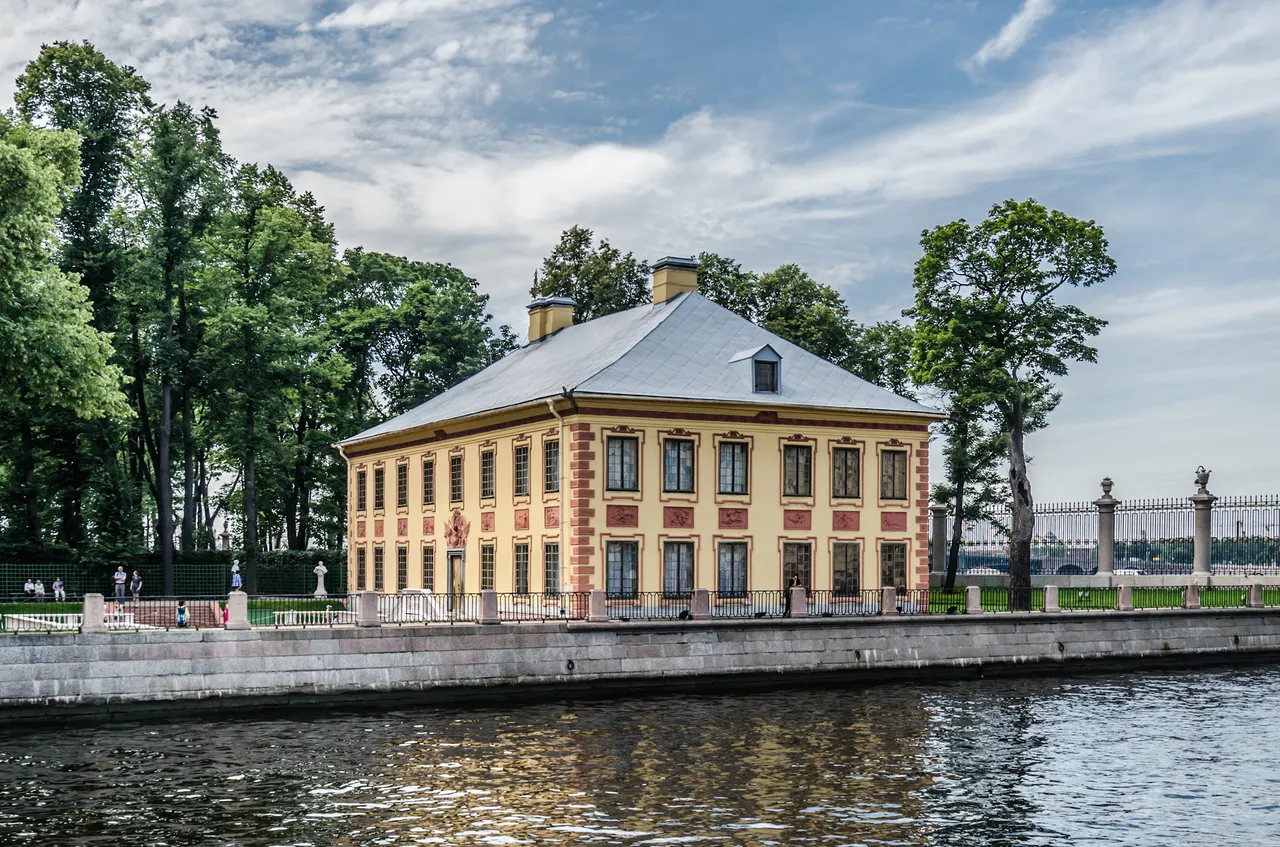
An introduction.
Researched by the Audiala editorial team from historical records, architectural archives, and local expertise.
WWhy does a tsar’s palace look less like a palace than a Dutch merchant’s townhouse—and why did its private dock disappear? The Summer Palace of Peter I in Saint Petersburg, Russia, rewards a visit with low rooms, Delft-tiled stoves, carved wood, and 29 weathered terracotta medallions that reveal power at domestic scale.
Before the grand Winter Palace, imperial life gathered here beside the Fontanka. Records show that Domenico Trezzini’s stone palace rose between 1710 and 1714, while the surrounding Summer Garden was laid out from 1704 in a formal Dutch style—straight alleys, clipped greenery, water, and marble sculpture.
The interior makes the building’s smallness feel deliberate. Its 14 rooms are closer to a compact townhouse than a court complex, with Peter’s study beside his lathe room, where the tsar worked wood and ivory before receiving officials; outside, the river wind once reached the palace’s private harbor steps.
Today, the State Russian Museum preserves the rooms as a warm-season memorial museum, open from May through October in keeping with the building’s original seasonal rhythm. Listen for the softened echo of footsteps, then look up at the facade: its mythological sea scenes are really a coded record of Russia’s victories over Sweden.
Things to do in Saint Petersburg, Russia 🇷🇺, Top places to visit in Saint Petersburg
Travel and Food01 What to see.
The palace exterior and Schlüter’s sea stories
Peter’s workshop and Catherine’s green cabinet
A short circuit through the Summer Garden and old harbor
02 In pictures.


Watch & Explore Summer Palace of Peter I.
Plan and listen to Summer Palace of Peter I with Audiala.
Audio guide in your pocket, itinerary in your browser. Built for the way you actually visit.
03 Visitor logistics.
The practical scaffolding for a good visit — kept short.
Getting There
From Gostiny Dvor or Nevsky Prospekt metro, walk about 1–1.2 km north along Sadovaya Ulitsa, past Mikhailovsky Castle and the Field of Mars, to the Summer Garden gates; allow 15–20 minutes. From the Winter Palace, follow Palace Embankment for roughly 15–20 minutes, or from the Church of the Savior on Spilled Blood walk through Mikhailovsky Garden in about 10 minutes. Buses 46, 49, and 76 stop near the Field of Mars; paid street parking is limited along the Fontanka embankment.
Opening Hours
As of 2026, the palace interior operates only in the warm season, typically from late May or June through late September or early October, with daily sessions generally running around 10:00/11:00–18:00/19:00; the first guided session often begins at noon. Tuesdays are usually closed, and heavy rain or high humidity can cancel admissions. The surrounding Summer Garden is generally open 10:00–22:00 from May 1 to September 30, 10:00–20:00 from October 1 to March 31, and closed throughout April for spring maintenance; check the Russian Museum before setting out.
Time Needed
Allow 45–60 minutes for the guided palace visit, which moves through Peter I’s ground-floor rooms and Catherine I’s upper quarters in a building of just 14 rooms. Give the palace and a full Summer Garden stroll 1.5–2.5 hours for the 29 exterior bas-reliefs, tree tunnels, fountains, benches, and Dovecote Pavilion displays.
Accessibility
The Summer Garden has mostly level paths of packed dirt and gravel, generally suitable for wheelchairs and strollers, though loose gravel may slow smaller wheels. The palace itself is not wheelchair accessible: high thresholds, original wooden stairs, and a steep, narrow staircase to Catherine’s floor remain part of the 1714 structure, with no elevator or modern ramp.
Cost and Tickets
As of 2026, entry to the Summer Garden grounds is free, while guided palace sessions generally cost about 800–1,500 RUB; discounted Russian and EAEU rates commonly fall around 150–400 RUB with valid documents. Interior groups are limited to 15 people, and tickets are sold shortly before sessions at the pavilion desk, so reserve through the State Russian Museum’s official portal at ticket.rusmuseum.ru during June–August.
04 Tips for visitors.
Small things that change the day.
Protective Covers Required
The palace provides shoe covers, called bakhily, to protect its 300-year-old parquet floors. Leave large backpacks, umbrellas, liquids, and bulky bags at the cloakroom, and skip beachwear, alcohol, lawn walking, bicycles, scooters, rollerblades, and skateboards inside the garden.
Photograph Without Flash
Handheld personal photography is generally allowed inside without flash, but tripods, monopods, and commercial equipment require permission from the State Russian Museum. Drones are banned across central Saint Petersburg airspace without federal and municipal permits.
Ignore Costume Touts
Near the Neva and Swan Canal gates, people dressed as Peter or Catherine may invite you into a photograph and then demand 1,000–3,000 RUB. Buy admission only from the official Russian Museum portal or the palace desk, and watch your belongings near the Chizhik-Pyzhik statue, where distracted coin-tossers attract pickpockets.
Eat Like a Petersburg Local
For a budget pause, the garden’s Tea House and Coffee House serve tea, coffee, and pastries for roughly 300–600 RUB; kiosks by Sadovaya Street and the Field of Mars sell traditional pyshki for about 150–350 RUB. For a proper meal, Duo Gastrobar near Kirochnaya Street runs about 1,500–2,500 RUB, while Koryushka near the Peter and Paul Fortress is a 2,500–4,500 RUB splurge for Baltic seafood and fried smelt.
Watch the Forecast
Visit early in the day during June–August for the calmest garden paths and softer light on the palace’s Schlüter bas-reliefs. Heavy rain and high humidity can close the interior to protect its ceiling paintings and woodwork, while June and July may bring classical concerts during the White Nights season.
Build a Riverside Route
Pair the palace with the Field of Mars, Mikhailovsky Castle, and the Church of the Savior on Spilled Blood before walking along the embankment toward the Winter Palace. The route turns a compact 45-minute museum visit into a two-hour study of how Peter’s modest summer house sits among later imperial monuments.
Save on the Garden
The garden itself costs nothing, so you can enjoy the fountains, trellis alleys, and replica statues without buying a palace ticket. If the interior matters, reserve an official small-group session rather than paying a street tout’s markup; the limited 15-person capacity is the real reason slots disappear.
05 The Tsar’s Small House and the Ruined Master Who Finished It
Peter I wanted a capital that behaved like a European port, not an old Muscovite court. Records show that after the capture of Nyenschantz in May 1703, he claimed this ground between the Neva and the Fontanka, first using a wooden dwelling to supervise construction and then ordering the Summer Garden in 1704.
The stone palace belongs to the years 1710–1714. Domenico Trezzini shaped its restrained Petrine Baroque envelope, while Peter’s own domestic habits—work, weather-watching, naval administration, and family life—gave the building its unusually personal character.
A Modest Residence with a Dangerous Message
At first glance, the Summer Palace seems to tell a tidy story: Peter I builds a modest Dutch-style summer residence, occupies the ground floor, and leaves Catherine I and the children the rooms above. Records show that the palace functioned as a seasonal home from roughly 1711 or 1712 until Peter’s death in 1725, with state business conducted beside kitchens, bedrooms, and a turning workshop.
Then the facade starts arguing with the story. A private country house should not need a chain of 29 terracotta medallions between its windows, especially when those scenes of Neptune, sea monsters, and classical combat are understood by specialists as allegories of Russia’s naval victories over Sweden. The detail that unsettles the easy version is Andreas Schlüter, a celebrated Prussian architect and sculptor who arrived in Saint Petersburg in 1713.
According to biographical accounts, Schlüter came after the 1706 collapse of Berlin’s Münzturm damaged his reputation, finances, and position at court. His livelihood was at stake, and Peter’s unfinished Baltic capital offered a last chance to recover his standing. The turning point came when Peter recruited him to organize the palace’s decorative work: Schlüter supervised the terracotta reliefs and completed his final major commission before dying in Saint Petersburg in May 1714. The revelation is that this was never merely a quiet retreat; it was a domestic command post wrapped in imperial naval propaganda.
Look again at the building now and its scale changes meaning. The low ceilings and narrow rooms speak of Peter’s practical routines, while the reliefs outside announce the new maritime power he wanted Europe to recognize. Even the vanished harbor matters: the palace once received boats at its threshold, so the little house was arranged less like a secluded villa than a desk facing the river.
Early Life & Vision
Legacy & Influence
Listen to the full story in the app
The whole Summer Palace of Peter I,
told well.
Listen to sourced travel stories with local history and practical context — ready offline.
06 Frequently asked.
The questions travellers send us most about Summer Palace of Peter I.
Is the Summer Palace of Peter I worth visiting?
Yes—especially if you prefer the working rooms of history to grand imperial spectacle. Domenico Trezzini’s compact 14-room building preserves Peter’s study, lathe workshop, Dutch tiled stoves, Catherine I’s Green Cabinet, and 29 exterior reliefs by Andreas Schlüter. The rooms feel closer to a ship’s captain’s quarters than the Winter Palace: low-ceilinged, practical, and full of cold tiles, dark wood, and northern light.
How long do you need at the Summer Palace of Peter I?
Plan 1.5–2.5 hours for the palace and the full Summer Garden, or 45–60 minutes for the palace interior alone. Allow time outside to study the 29 reliefs, find the former Gavanets mooring basin, walk the linden alleys, and cross the garden toward the Neva. The interior is visited in small timed groups, so your ticket slot may shape the visit.
How do I get to the Summer Palace of Peter I from Saint Petersburg?
From central Saint Petersburg, walk about 15–20 minutes from the Hermitage along Palace Embankment, or use Gostiny Dvor or Nevsky Prospekt metro stations and walk roughly 1–1.2 km through Sadovaya Street, past Mikhailovsky Castle and the Field of Mars. The palace stands at 3 Letny Sad, near the meeting of the Neva and Fontanka rivers. Gorkovskaya metro is another option, with a walk across Trinity Bridge and broad river views.
What is the best time to visit the Summer Palace of Peter I?
June through August is the best time to visit because the palace interior is open and Saint Petersburg’s White Nights fill its small-paned rooms with pale light late into the evening. Late September or early October brings quieter paths and gold foliage, but opening dates vary by year. The palace is seasonal, usually closing from late autumn through spring, and the Summer Garden closes on Tuesdays and throughout April.
Can you visit the Summer Palace of Peter I for free?
You can visit the Summer Garden for free, but the Summer Palace interior requires a ticket. Guided interior sessions generally cost about 800–1,500 RUB for adults, with reduced rates for eligible students, seniors, and children. The building admits no more than 15 people per session, so book through the State Russian Museum’s official ticket portal when visiting in June, July, or August.
What should I not miss at the Summer Palace of Peter I?
Don’t miss Peter’s study and its 1714 Dresden wind instrument, the lathe in his workshop, the blue-and-white Dutch tiles in the lower kitchen, and Catherine I’s Green Cabinet upstairs. Outside, look closely at Schlüter’s 29 hand-worked maritime reliefs and the palace’s dragon-headed rain spouts. These details reveal the building’s real character: a naval command post and family home disguised as a palace.
Verified, and shown.
Researched and written by the Audiala editorial team from historical records, architectural archives, and local expertise.
Provided the 1990 UNESCO World Heritage inscription and reference to the historic centre of Saint Petersburg.
Provided general information on the Summer Palace and its management by the State Russian Museum.
Provided construction, restoration, and 2015–2018 conservation information.
Provided chronology from the 1703 cabin through the palace’s construction, Peter’s occupation, and the Amber Room’s temporary storage.
Provided information about Peter’s initial wooden cabin and the early settlement near the palace.
Provided supporting chronology for the Summer Garden and palace construction.
Provided official UNESCO documentation for World Heritage Site 540.
Provided detailed chronology, architects, room count, reliefs, restoration history, and heritage designation.
Provided official information on the museum, the palace collection, wartime damage, restoration, and reopening.
Provided historical information on the former Swedish estate, the palace, and the 1903 bicentennial exhibition.
Provided practical and historical details on the palace’s domestic character, Peter’s study, the wind instrument, plumbing, and the Gangut celebrations.
Provided information on the palace’s architecture, Schlüter’s reliefs, the former Gavanets harbor, and the 1777 flood.
Provided information about Peter I as patron and the palace’s Dutch-influenced proportions.
Provided the official advance-booking portal for museum tickets.
Provided visitor logistics including seasonal opening, timed sessions, group limits, approximate visit length, and visitor facilities.
Provided supporting practical information on admission prices, discounts, free garden access, and construction dates.
Provided Summer Garden opening hours, Tuesday closures, April maintenance closure, transport information, and suggested visit duration.
Provided address, walking routes, palace layout, accessibility, architectural history, and nearby facilities.
Provided duplicate source coverage for Summer Garden hours, access routes, and the recommended time required.
Provided background on the Petrine Baroque architectural style.
Provided context on Petrine Baroque and the atmosphere of Saint Petersburg.
Provided façade, roof, dragon-spout, restoration, and nearby Coffee House information.
Provided supporting architectural information on the façade and decorative treatment.
Provided the room plan and information on the kitchens, Dutch tiles, sink, and palace circulation.
Provided information on Peter’s study, the Dresden wind instrument, maritime objects, tools, and sailor clothing.
Provided visual and visitor-context information for the palace interior and furnishings.
Provided information on Catherine I’s Green Cabinet and its decorative finish.
Provided seasonal opening, White Nights atmosphere, and winter preservation information.
Provided supporting information on the palace’s architecture, wind instrument, plumbing, garden, and historical setting.
Provided seasonal and atmospheric context for Saint Petersburg and the Summer Garden.
Provided information on seasonal closure and the palace’s unheated historic fabric.
Provided official historical information on Peter’s move into the palace in 1711.
Provided an unconfirmed claim about 18th-century interior redecoration campaigns.
Provided local cultural context, the palace’s modest scale, seasonal character, plumbing history, and related folklore.
Provided information on the 2009–2012 garden reconstruction, replicas of statues, events, and local preservation debates.
Provided information on the Summer Garden’s waterways, surrounding geography, and relationship to the palace.
Provided visitor information on park rules, safety, photography, weather closures, and common ticket and photo scams.
Provided information on timed entry and guided visits.
Provided information on the annual Summer Garden Day festival and its public cultural program.
Provided information on the palace’s seasonal operation and warm-season opening.
Provided information on the palace museum’s seasonal operation.
Provided context on the State Russian Museum and the palace’s memorial-museum function.
Provided scholarly and cultural context on the palace’s local identity and memorial role.
Provided information on educational programs, lectures, and historical excursions at the palace and garden.
Provided event details for Summer Garden Day programming.
Provided Peter the Great’s birth date for the festival context.
Provided information on Saint Petersburg cultural events, City Day, Museum Night, literary traditions, and public promenade culture.
Provided supporting information on the city’s May 27 founding commemoration.
Provided context on preservation debates surrounding the Summer Garden and its statues.
Provided information on public responses to the Summer Garden restoration.
Provided supporting biographical date information for Peter the Great.
Built from cited sources · see the method · How we make our guides →