An introduction.
Researched by the Audiala editorial team from historical records, architectural archives, and local expertise.
AA warship that helped make a revolution now sits so quietly on the Neva that you can hear the water tap its steel hull. Aurora, in Saint Petersburg, Russia, rewards a visit because it compresses the city’s whole biography into one vessel: imperial ambition, mutiny, siege, myth, and museum afterlife. You come for the famous shot, then stay for the harder story. The ship feels less like a monument than a survivor.
Moored at Petrogradskaya Embankment 2, Aurora belongs to the same historic riverfront world as the rest of central Saint Petersburg, though its legend reaches far beyond the quay. Records show the cruiser was laid down on 23 May 1897 at the New Admiralty shipyard and launched on 11 May 1900, which means the metal under your hand began here, in this city, under the smoke and hammering of imperial naval labor.
Most visitors arrive thinking about October 1917 and the blank shot linked to the assault on the Winter Palace. Fair enough. But the ship’s real power lies in how it refuses to stay inside one slogan: Aurora fought at Tsushima, drifted into revolution, lost guns to the defense of Leningrad, then returned as a museum branch of the Central Naval Museum.
Inside, the mood shifts from symbol to texture. Burned wood, twisted metal, brass fittings, the smell of paint and river damp, and those low compartments that make every modern visitor duck a little too late: all of it brings the ship back to human scale. That is why Aurora matters. It turns Russian history from poster art into something bruised and physical.
01 What to see.
The Upper Deck and Forward Guns
Aurora surprises from the first step aboard because she is slimmer and more elegant than the myth suggests: a 126.8-meter hull, longer than a football field, with three funnels, taut rigging, and a line of fourteen 152 mm guns aimed across the Neva. Stand near the bow and the ship stops reading as a museum piece; wind skims the deck, gulls cut across the water, and Saint Petersburg opens behind the barrels in pale northern light.
That famous 1917 blank shot hangs over the place, but the deck’s real power comes from older, quieter details: anchors the size of small cars, ladders polished by generations of hands, and the faint pitch underfoot that reminds you this vessel still floats. Stay a minute after the crowds take their photo and move on. The city suddenly looks less like an imperial backdrop and more like something watched, defended, and argued over from this exact stretch of river.
The Battery Deck and the Rooms People Miss
Below deck, Aurora gets better. Low ceilings press down, bulkheads tighten the route, and the air shifts from river wind to metal, paint, and the faint hospital-clean smell of the medical rooms; tall visitors will spend half the visit ducking, which turns naval history into something bodily instead of decorative.
Start with Hall 2, where hammocks and hanging tables reconstruct the sailors’ sleeping quarters with more force than any heroic painting, then slow down in Hall 3 for Captain Yegoryev’s portrait framed by charred planks and twisted metal from Tsushima. Most people come for revolution iconography and hurry past Hall 7, which is a mistake: the reconstructed shipboard iconostasis gives the cruiser back its imperial soul, and that small detour changes Aurora from propaganda symbol into a ship that carried prayer, boredom, surgery, fear, and long stretches of ordinary life.
From Aurora to the Winter Palace by Water
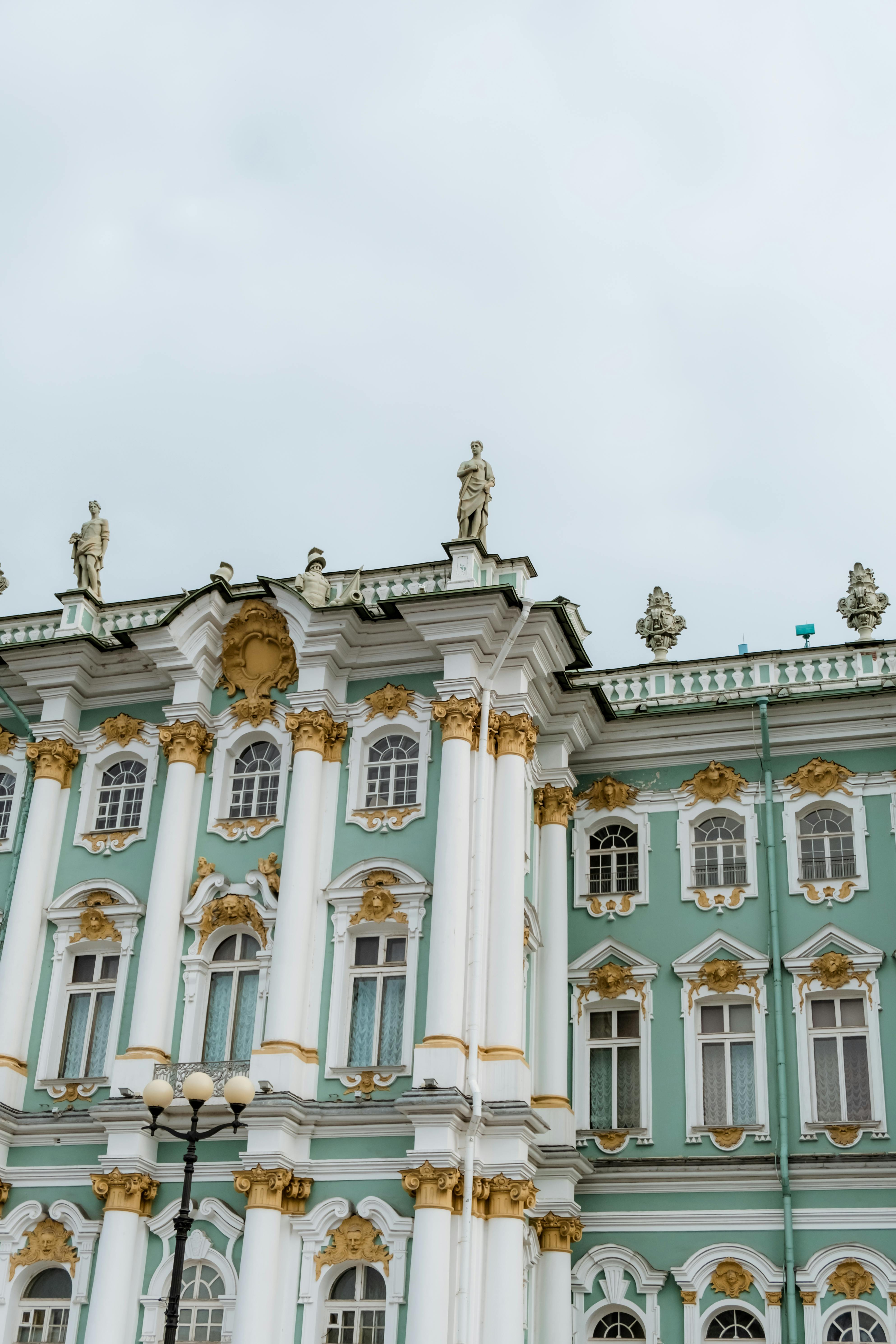
The best way to understand Aurora is to leave her. Walk the embankment after your visit, then follow the Neva toward the Winter Palace, and the distance between the two sites starts to feel absurdly short for a story that reshaped a country: one ship at Petrogradskaya Embankment 2, one palace across the water, and between them a few bends of river and a century of argument.
Do this late in the day if you can, when the light turns silver and the hull reads dark against the water. From shore, Aurora loses some of her onboard romance and gains scale; from farther off, she looks what she really is, a weapon turned witness, moored inside the historic core of Saint Petersburg like a sentence the city still hasn’t finished arguing with.
02 In pictures.


Plan and listen to Aurora with Audiala.
Audio guide in your pocket, itinerary in your browser. Built for the way you actually visit.
03 Visitor logistics.
The practical scaffolding for a good visit — kept short.
Getting There
Aurora is moored at Petrogradskaya Embankment 2. As of 2026, the official easiest route is metro to Gorkovskaya or Ploshchad Lenina, then tram 6 or bus 28; from Gorkovskaya, walking takes about 20 minutes, and from Peter and Paul Fortress about 15 to 20 minutes.
Opening Hours
As of 2026, Aurora opens Wednesday to Sunday and usually closes Monday and Tuesday. Hours run 11:00-18:00 from 1 September to 30 April and 10:00-18:00 from 1 May to 31 August, with the ticket office shutting at 17:15; one-off closures and weather interruptions do happen, so check the museum site before you go.
Time Needed
Give it 30 to 45 minutes if you only want exterior views and the upper deck. Most visitors need 60 to 90 minutes, while the expanded guided route stretches to about 90 minutes and a full stop with photos and nearby walking can easily take 2 hours.
Accessibility
Wheelchair users may enter only with an accompanying person, and official rules limit access to the upper deck. Expect stairs, thresholds, and tight ship compartments; for visitors with limited mobility, the deck and river views are the realistic main experience.
Tickets
As of 2026, standard admission costs 600 RUB for EAEU adults and 1000 RUB for non-EAEU visitors; reduced tickets start at 300 RUB, and children under 7 enter free. Online tickets are sold through the museum, valid only for the printed date, and the museum asks visitors to print them in advance.
04 Tips for visitors.
Small things that change the day.
Pack Light
Aurora is strict about bags: backpacks, suitcases, strollers, drinks, and food are not allowed through the visit route, and many items must be left at the checkpoint. Bring only what fits easily in a small bag, or you will waste time at storage.
Photo Rules
Casual photography is allowed, but leave the tripod, stabilizer, and extra lighting gear behind. Professional filming needs advance permission and payment, and a drone is a bad idea unless the museum gives you explicit approval.
Use Toilet First
No visitor toilet exists on board. Handle that before you queue, ideally at a cafe nearby, because once you are on the ship you are dealing with gangways, narrow passages, and no easy exit for a quick return.
Eat Nearby
For something close, DeDa Khinkali and Cherdak work well at budget to mid-range, while FermA is a comfortable mid-range stop and Volga-Volga is the nearby splurge. If smelt is in season, pair Aurora with a longer walk and a meal at Korushka for a very Petersburg plate.
Go Early
Morning light on the Neva makes the ship’s gray hull look sharper, and the embankment feels calmer before the middle of the day. July needs extra caution: Navy Day preparations closed Aurora from July 14 to July 26 in 2025, and similar seasonal interruptions can happen again.
Pair The Walk
Aurora works better as one stop in a Petrograd Side walk than as a single-destination outing. Start here, then continue toward Peter the Great’s Cabin, the Cathedral Mosque, or across the river toward the Winter Palace; the ship makes more sense once you see how close imperial grandeur and revolutionary theater still sit in Saint Petersburg.
Where to Eat
Don't Leave Without Trying
On the wave
cafeOrder: Try their signature seafood dishes and local brews while enjoying the views of the Neva River.
A hidden gem with a prime waterfront location, this café offers a relaxed vibe and fresh seafood, perfect for a casual lunch or evening drinks.
Kassa
local favoriteOrder: Opt for their hearty Russian stews and traditional pelmeni, which are local favorites.
A no-frills spot favored by locals, Kassa serves up authentic Russian dishes in a cozy setting with a welcoming atmosphere.
Leningradskaya Pel'mennaya
quick biteOrder: Don't miss their legendary pelmeni, a must-try Russian dumpling dish served with generous portions.
A staple for dumpling lovers, this café is all about the classic Leningrad-style pelmeni, offering a filling and satisfying meal.
Dining Tips
- check If you're in Saint Petersburg in April or May, ask for koryushka (smelt) as a seasonal special.
- check Pyshki, Saint Petersburg’s sugar-dusted fried dough rings, are a must-try local snack.
- check For a quick and filling meal, opt for pelmeni or vareniki, which are widely available and satisfying.
- check Blini (Russian pancakes) are versatile and often served with sweet or savory fillings.
Restaurant data powered by Google
05 A history of reinvention.
The Ship That Kept Becoming Something Else
Aurora’s history reads badly if you treat it as one legend. Records show at least five distinct lives: an imperial cruiser built for great-power rivalry, a battered survivor of Tsushima, a training ship, a revolutionary emblem, and then a wartime relic turned floating museum. Saint Petersburg keeps all those versions in view at once.
That layered life matters because the famous blank shot did not create the ship’s meaning from nothing. It merely froze one moment in a much longer biography. And the most painful turning point may have come months earlier, when revolution stopped being an idea in Petrograd and became a matter of who on board would live through the morning.
Mikhail Nikolsky and the Morning Discipline Died
The most gripping story on Aurora belongs to Commander Mikhail Ilyich Nikolsky, not to the cannon. Official museum accounts describe him as one of the first victims of the February Revolution after he refused to raise a red flag, while strong secondary Russian sources place his death on 28 February 1917 at the Franco-Russian factory quay. For Nikolsky, the stakes were personal and immediate: keep command of an armed ship in a city collapsing into revolt, or lose the ship, his authority, and likely his life.
He lost all three. According to those accounts, Aurora stood under repair, workers and sailors pressed in, discipline broke apart, and Nikolsky walked into a crowd that no longer accepted orders from him. A shot to the head ended the old chain of command in an instant.
That changes how you read everything that follows. By the time Aurora joined the October uprising on 25-26 October 1917 Old Style, the ship had already been split open from within. The blank shot made history. Nikolsky’s death made the shot possible.
Tsushima Before Myth
Leningrad, Steel, and Afterlife
Listen to the full story in the app
The whole Aurora,
told well.
Audio guides for 1,100+ cities across 96 countries. History, stories, and local insight — offline ready.

06 Frequently asked.
The questions travellers send us most about Aurora.
Is Aurora worth visiting?
Yes, if you want one place that compresses Saint Petersburg's imperial navy, the 1917 revolution, and the siege of Leningrad into a single steel hull. The upper deck gives you wind, river views, and the long line of 152 mm guns; below deck, the museum route gets tighter and more human, with hammocks, medical rooms, and battle relics. Go for the ship itself, not for a giant interactive museum.
How long do you need at Aurora?
Most visitors need 60 to 90 minutes. Give it 30 to 45 minutes if you only want the exterior and upper deck, or 1.5 to 2 hours if you book the longer guided route that reaches the engine and boiler areas. The ship is about 126.8 meters long, roughly the length of a city block, but the real time goes on narrow interior halls rather than distance.
How do I get to Aurora from Saint Petersburg?
The simplest route is metro to Gorkovskaya or Ploshchad Lenina, then tram 6 or bus 28 toward Petrogradskaya Embankment 2. From Gorkovskaya, the walk takes about 20 minutes and passes some of the city's best layers, including the mosque and the riverfront. If you're coming from the Winter Palace, walking via Troitsky Bridge takes around 30 to 40 minutes.
What is the best time to visit Aurora?
Late morning on a weekday works best, especially soon after opening. You'll get cleaner deck views, fewer bottlenecks in the low-ceilinged halls, and less waiting at the checkpoint; in summer, the museum opens at 10:00, while from September through April it opens at 11:00. Avoid late July if you can, because Navy Day preparations have caused temporary closures in recent years.
Can you visit Aurora for free?
Usually no, unless you fall into an official free-entry category. Standard 2026 admission costs 600 RUB for EAEU adults and 1000 RUB for non-EAEU visitors, while children under 7 enter free and some military, disability, and veteran categories also qualify. The museum does not advertise a universal recurring free-entry day.
What should I not miss at Aurora?
Don't miss Hall 3 and Captain Yegoryev's portrait framed with charred deck planks and twisted metal from Tsushima. On deck, walk forward and look past the bow guns toward the Neva; that angle finally makes the ship feel like a vessel rather than a symbol. Also pay attention to Hall 7's restored ship-church material, because it pushes Aurora beyond the usual one-night-in-1917 story.
Verified, and shown.
Researched and written by the Audiala editorial team from historical records, architectural archives, and local expertise.
Official branch page for address, opening hours, nearest metro stations, transport options, and contact details.
Official ticketing and visit rules, including ticket validity, print requirement, and holiday schedule exceptions.
Official 2026 admission prices and guided tour prices, including EAEU and non-EAEU categories.
Official list of visitor categories eligible for free entry.
Official branch rules on accessibility, photography, baggage limits, and the lack of onboard toilets.
Official Russian-language chronology for construction, launch, service, repairs, and museum history.
Official English-language chronology confirming major dates in the ship's history.
Official history of Tsushima, 1917, wartime service, and the removal of guns for the defense of Leningrad.
Official technical description of the ship, including armament layout and preserved structural features.
Official overview of the onboard exhibition sequence and numbered halls.
Official description of Hall 3, including Tsushima interpretation and Captain Yegoryev's portrait framed with battle-damaged material.
Official description of the World War II, postwar repair, and Nakhimov school sections.
Official description of the reconstructed ship-church iconostasis and related naval religious material.
Official museum accessibility page with branch contact details and general access guidance.
Secondary source used for context on the ship's 1917 position and practical orientation in the city.
Secondary source for walking times from nearby landmarks and practical arrival context.
Secondary source supporting typical visit duration estimates.
Secondary source for the feel of the visit, deck views, and interior spatial character.
Secondary source used to cross-check key historical dates and broad visitor expectations.
Recent local news source confirming temporary July closure linked to Navy Day preparations.
Researched from Wikidata, Wikipedia & official sources · fact-checked · How we make our guides →