An introduction.
Researched by the Audiala editorial team from historical records, architectural archives, and local expertise.
HHow does a monument made to advertise a vanished state still manage to look like tomorrow? Worker and Kolkhoz Woman in Moscow, Russia answers that question in stainless steel: two figures surge forward above Prospekt Mira, their hammer and sickle lifted into the pale sky at the northern gate of VDNKh. You visit for the jolt of it, for the clash between propaganda and beauty, and for the chance to stand under one of the 20th century's most charged pieces of public art.
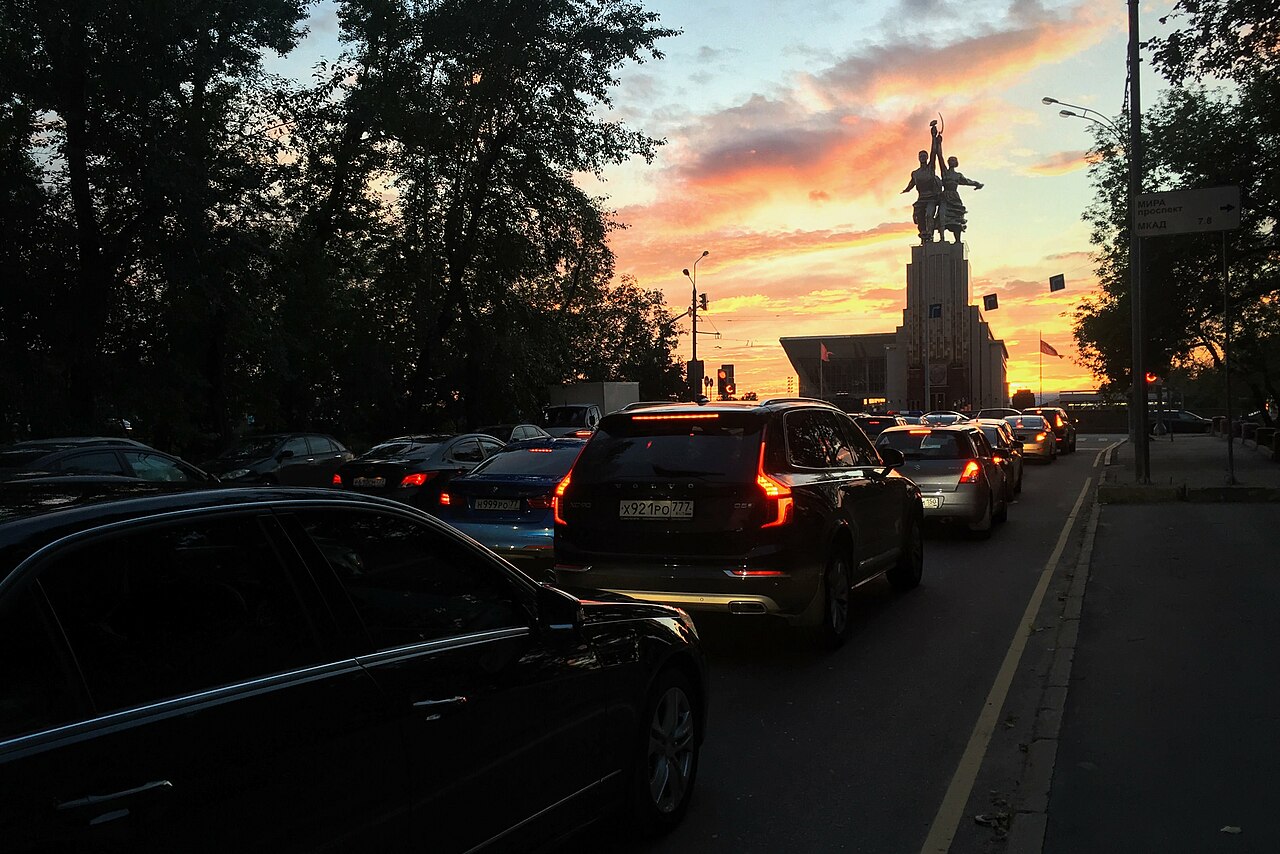
From the pavement, the sculpture feels less like a statue than a burst of motion caught mid-stride. Steel flashes in the light, traffic hums below, and the rebuilt pavilion base spreads out beneath the figures like the prow of a ship about to cut through the city.
Most visitors recognize it from the Mosfilm logo, then discover the real thing is larger, stranger, and more exposed. The figures rise about 24.5 meters on their own, roughly the height of an eight-story apartment block, and the pedestal lifts them higher still.
That setting matters. You are not looking at an isolated artwork in a museum hush, but at a survivor of world fairs, ideology, dismantling, and restoration, now folded into Moscow's daily life as an exhibition hall, a roof concert venue, and a place where the Soviet past keeps being argued with in public.
01 What to see.
The North-Entrance Approach
The shock comes from how fast the monument stops looking like a postcard and starts behaving like theater. From the north entrance of VDNKh on Prospekt Mira 123B, Vera Mukhina's 1937 steel pair rises over the reconstructed pavilion like a frozen charge, the worker and the kolkhoz woman striding forward with the hammer and sickle lifted high, their silver skin catching Moscow's pale light with the hard gleam of a train yard in winter.
Stand far enough back to see what Boris Iofan intended: sculpture and architecture fused into one upward thrust, not a statue dumped on a pedestal. Then the details begin to bite, the long scarf snapping behind them, the diagonal bodies pulling against the sky, and the uncomfortable fact that this was built for the 1937 Paris World's Fair as political theater across from Nazi Germany, which means the elegance and the menace arrive together.
The Rooftop Under the Steel
The real secret sits above your head. If the roof is open, go up, because this is where the monument stops being an emblem and turns into engineering: seams in the stainless-steel skin, folds of metal catching wind, and that famous scarf revealed as a 30-meter ribbon, about as long as three city buses nose to tail, weighing around five tons.
Up here you hear the city differently. Wind skims the platform, concerts sometimes spill music into the evening air, and the figures loom so close that the propaganda softens into craft, weld by weld, reflection by reflection, until you understand why Mosfilm borrowed this silhouette for its logo: from below it is power, from the roof it is cinema.
Take the Monument in Three Acts
02 In pictures.




Plan and listen to Worker And Kolkhoz Woman with Audiala.
Audio guide in your pocket, itinerary in your browser. Built for the way you actually visit.
03 Visitor logistics.
The practical scaffolding for a good visit — kept short.
Getting There
The statue stands at 123B Prospekt Mira, beside the northern entrance to VDNKh. From VDNKh metro station on the Kaluzhsko-Rizhskaya line, take the north vestibule exit toward VDNKh and the Museum of Cosmonautics, then walk about 10 minutes along Prospekt Mira; that is roughly the length of two Moscow city blocks stitched together. Drivers can use free parking near the complex or the larger 999-space multi-level car park at 18 Khovanskaya Street.
Opening Hours
As of 2026, the outdoor monument can be seen at any time because the wider VDNKh grounds are open 24/7. The pavilion inside the pedestal is generally open Tuesday to Sunday, 11:00-22:00, closed Monday, with ticketed entry until 21:15; the current exhibition runs on the tighter schedule of 11:00-21:00, with entry until 20:15, through May 17, 2026. Management can close halls or change hours for technical or weather reasons, so late arrivals should check the VDNKh page first.
Time Needed
Give the exterior 15-25 minutes if you only want the full sweep of the figures and a few photographs. Add the pavilion and you are looking at 45-60 minutes, while the current exhibition takes 60-90 minutes at a normal pace; a thorough visit can stretch to two hours, about the length of a feature film at Mosfilm, which borrowed the statue for its logo.
Accessibility
The approach is easy by Moscow standards: paved, broad, and mostly flat from the metro and VDNKh paths. Inside, the pavilion has several elevators, an inter-floor ramp, and priority entry outside the main queue for visitors with limited mobility. Accessible toilets are available across the VDNKh grounds.
Cost & Tickets
As of 2026, the exterior is free, while the current exhibition costs 500 RUB Tuesday to Friday and 700 RUB on weekends and public holidays; reduced tickets are 250 and 350 RUB, and a family ticket is 1,200 RUB. Children under 6 and several other categories enter free with documents, but older public free-entry windows from 2019 are not confirmed for 2026. Buy online at vdnh.ru if you want to avoid cash-desk friction.
04 Tips for visitors.
Small things that change the day.
Shoot It Early
Go in the morning or late afternoon if you want the steel to read as sculpture rather than glare. Midday light can flatten the figures into a bright silver cutout, while lower sun pulls out the folds, muscles, and that hard forward stride.
Pack Light
The pavilion cloakroom accepts only small hand luggage up to 38 x 75 x 45 cm, about the size of a compact cabin bag laid on its side. Bigger bags belong in the automated lockers at VDNKh's South Entrance, open daily from 10:00 to 22:00.
Eat Nearby
For a quick stop, use Russkiy Kolosok or Ponchiki VDNKh on the grounds rather than hunting farther afield while hungry. If you want a sit-down meal, Ricci Capricci on Mira Ave. 119 стр. 523 is the more solid nearby choice; Tripadvisor's long list around the monument is broad, but not all of it is worth the detour.
Skip Ticket Lines
Buy your pavilion ticket online at vdnh.ru, especially on weekends when the price rises to 700 RUB and the queue can eat into your visit. Aim to arrive by 19:30 if you want the current exhibition without rushing the last rooms.
Know The Rules
Amateur photography and video are allowed, so your phone or small camera is fine. Professional equipment needs prior approval, and recording guided tours is not allowed without permission.
Pair It Well
Combine the statue with the Museum of Cosmonautics or a longer walk into VDNKh, because the route naturally stitches them together along Prospekt Mira. That pairing makes sense historically too: one monument sells the Soviet future in steel, the other turns that promise into rockets.
05 A Propaganda Triumph That Outlived Its Script
Documented records show that Worker and Kolkhoz Woman was created for the Soviet pavilion at the 1937 Paris World's Fair, where it faced the Nazi German pavilion across the main axis like a steel argument staged for the whole world. This was architecture as political theater, and Vera Mukhina's sculpture was the line everyone was meant to remember.
Moscow did not receive the monument as you see it now. After Paris, it was taken apart, brought home, installed on a reduced pedestal near the exhibition grounds, then left for decades in a form that blunted Boris Iofan's original vertical drama until a major restoration and reconstruction campaign returned it to something closer to its intended height.
Vera Mukhina's Race Against Paris
At first glance, the story seems simple: the Soviet state commissions a monument, Vera Mukhina makes it, Paris applauds, Moscow keeps it. That version is tidy, flattering, and incomplete.
The doubt starts with the names. Boris Iofan, the architect of the Soviet pavilion, developed the concept and first model, while Mukhina won the competition to shape the final sculptural solution; what visitors often read as a single heroic act was actually a tense collaboration in which authorship, prestige, and the image of the Soviet future were all at stake.
For Mukhina, the stakes were personal as well as political. This was her chance to prove that a woman sculptor could define the visual language of an era, and the turning point came when her soaring, forward-thrusting pair was chosen and then engineered in stainless steel for Paris in 1937, a material so modern it must have looked like frozen light; documented accounts describe the work arriving at a fair where the Soviet and Nazi pavilions stared each other down, turning her sculpture into a public declaration, not a neutral artwork.
Once you know that, the monument changes. You stop seeing a fixed Soviet emblem and start seeing a contested performance: Iofan's stage, Mukhina's leap, the fairground duel with Germany, and the long afterlife of a work that outlived the country that sent it abroad.
Paris Before Moscow
The Long Detour Home
Listen to the full story in the app
The whole Worker And Kolkhoz Woman,
told well.
Audio guides for 1,100+ cities across 96 countries. History, stories, and local insight — offline ready.

06 Frequently asked.
The questions travellers send us most about Worker And Kolkhoz Woman.
Is Worker and Kolkhoz Woman worth visiting?
Yes, if you care about 20th-century architecture, Soviet visual culture, or the odd thrill of standing under a monument that looks ready to step off its pedestal. From the ground, it reads as propaganda in stainless steel; from the roof, it turns into seams, wind, and engineering. The pairing of Vera Mukhina's sculpture with the recreated 1937 pavilion gives you more than a photo stop.
How long do you need at Worker and Kolkhoz Woman?
Give it 15 to 25 minutes for the exterior, or 60 to 90 minutes if you want the current exhibition inside the pedestal. A quick stop works for photos and the long frontal approach from Prospekt Mira. If the roof is open and you like reading labels, plan closer to 1.5 to 2 hours.
How do I get to Worker and Kolkhoz Woman from Moscow?
The easiest route is the Moscow Metro to VDNKh station, then a 5 to 10 minute walk along Prospekt Mira to 123B. Official VDNKh directions say to leave through the north vestibule toward VDNKh and the Museum of Cosmonautics, then walk against the traffic flow. Buses and trams stop nearby too, but the metro is the cleanest option.
What is the best time to visit Worker and Kolkhoz Woman?
Late afternoon into sunset is the best time, especially if the rooftop platform is open. The stainless-steel skin catches low light the way a knife catches a window, and the scarf behind the figures starts to make visual sense. For the interior pavilion, go Tuesday to Sunday and arrive before 20:00 if you want time inside before last entry.
Can you visit Worker and Kolkhoz Woman for free?
Yes for the monument outside, no for the current exhibition unless you qualify for a free category. The exterior stands on the VDNKh grounds, which are open 24/7, so you can see the sculpture at any hour. As of April 8, 2026, the exhibition inside costs 500 RUB on Tuesday to Friday and 700 RUB on weekends and public holidays, with free entry for categories such as children under 6, some disabled visitors, veterans, and large families.
What should I not miss at Worker and Kolkhoz Woman?
Don't miss three things: the long frontal approach, the rooftop view if it is open, and the scarf. From far away, the scarf looks like a flourish; up close, it is the balancing act that keeps the whole composition airborne. Stay long enough to notice the steel skin too, because this is not a solid block but a reflective shell stitched together with seams and light.
Verified, and shown.
Researched and written by the Audiala editorial team from historical records, architectural archives, and local expertise.
General background on the monument, creators, Paris 1937 context, and Mosfilm association.
Russian-language details on history, materials, dimensions, restoration, and the scarf.
Official location, venue description, opening hours, and current use of the pavilion.
City background on the monument's history, symbolism, and makers.
Interpretive profile covering design, Paris 1937, and the sculpture's formal details.
Tentative List entry for VDNKh as a wider architectural ensemble.
Official visitor information for the VDNKh grounds, including general access.
Official opening information for the VDNKh site and grounds.
Current exhibition dates, opening hours, ticket prices, free categories, and holiday closures.
Official rules on tickets, photography, cloakroom, queue access, and possible temporary closures.
Older VDNKh news mentioning historical free-entry periods.
Older VDNKh news mentioning historical free-entry periods.
Official directions from VDNKh metro and nearby transport stops.
Metro station reference for VDNKh and line information.
Official list of buses and trams serving the VDNKh area.
Visitor reviews and practical notes on walking time, nearby food, and benches.
Official information on the 24/7 multi-level parking facility.
Official parking information around the VDNKh complex.
Official paid parking rates on VDNKh territory.
Official guidance on free access and parking for eligible disabled visitors and drivers.
Official accessibility information for VDNKh.
Local visitor reviews mentioning ramps, elevators, and circulation inside the pavilion.
Official information on toilets, accessible stalls, and lockers across VDNKh.
Official hours for the Russkiy Kolosok kiosk near the site.
Official listing for a nearby cafe option.
Official listing for a nearby donut cafe.
Map listing and practical details for a nearby restaurant.
Third-party estimate of visit duration.
Official page for automated lockers at VDNKh.
VDNKh news item with locker pricing and service details.
Official page for the automated left-luggage facility.
Museum-style entry on the monument, its history, and installation at VDNKh.
Official cultural portal entry on the museum-exhibition center and its layout.
Official description of the pavilion as an exhibition, lecture, and rooftop event venue.
Official news on rooftop concerts and seasonal programming.
Official material on rooftop viewing and events beneath the monument.
Program page describing the rooftop experience and close views of the sculpture.
Russian source used for material details about chromenickel stainless steel.
Moscow publication with rooftop and viewpoint references.
Article about the rooftop viewing platform and its atmosphere.
Program page showing how rooftop events shifted with weather and season.
Rooftop jazz program page used for seasonal and experiential detail.
Image source used for winter visual character of the monument.
Third-party seasonal photo context for winter impressions in Moscow.
Article tied to an autumn art project using the roof and VDNKh views.
Official page for the current exhibition and related tours.
Official event page for a sculpture-themed tour on April 25, 2026.
Official lecture and public program listings for the pavilion.
ARTEFACT entry used to check for audio-guide style interpretation.
Cultural news confirming the dates of the current exhibition.
Official anniversary article on the monument's biography and commemorations.
Moscow restoration publication used for the 1939 installation and restoration history.
Moscow publication used for installation and historical context.
Official VDNKh area page describing the pavilion's role as an active public venue.
News report on the 85th anniversary program and witness testimony.
Coverage of the VDNKh anniversary exhibition staged in the pavilion.
Official news on the VDNKh anniversary exhibition in the pavilion.
Visual coverage of the pavilion's role in VDNKh anniversary programming.
Coverage of the 2025 Vdokhnovenie arts festival using the pavilion as a venue.
Festival listing confirming pavilion use during Vdokhnovenie 2025.
Official news about a performance imagining the monument's figures coming alive.
Official news on rooftop concert programming in 2022.
Official news on earlier rooftop concert programming.
Official news on recurring rooftop and public event use.
Coverage of the 2022 gala performance for the monument's 85th anniversary.
Coverage of the anniversary stage work built around the monument's story.
Lecture page discussing the monument's image in public memory and metaphor.
Program listing for music and cultural events tied to Soviet memory.
Program listing for cultural performances in the pavilion.
Program listing for performances and public culture in the pavilion.
Official news on exhibitions staged inside the pavilion.
Coverage of recent exhibitions linked to the pavilion.
Coverage of recent exhibitions and cultural reuse of the site.
Russian-language exhibition material on the monument's contested meanings and reinterpretation.
Scholarly article on memory politics, symbolic shifts, and museum framing of the monument.
Program page connected to eyewitness testimony and legacy keepers.
Article showing the pavilion's role in wider civic lectures and urban culture.
Article cited for the monument's continuing design influence in nearby development.
Researched from Wikidata, Wikipedia & official sources · fact-checked · How we make our guides →