An introduction.
Researched by the Audiala editorial team from historical records, architectural archives, and local expertise.
WWhy does a private house in central Moscow have sixty hexagonal windows, while another sixty sit bricked shut behind its curved walls? The Melnikov House at 10 Krivoarbatsky Lane is an architectural riddle — two interlocking white cylinders with a honeycomb brick skin — and it's worth visiting in Moscow, Russia precisely because it refuses to behave like any Soviet building around it.
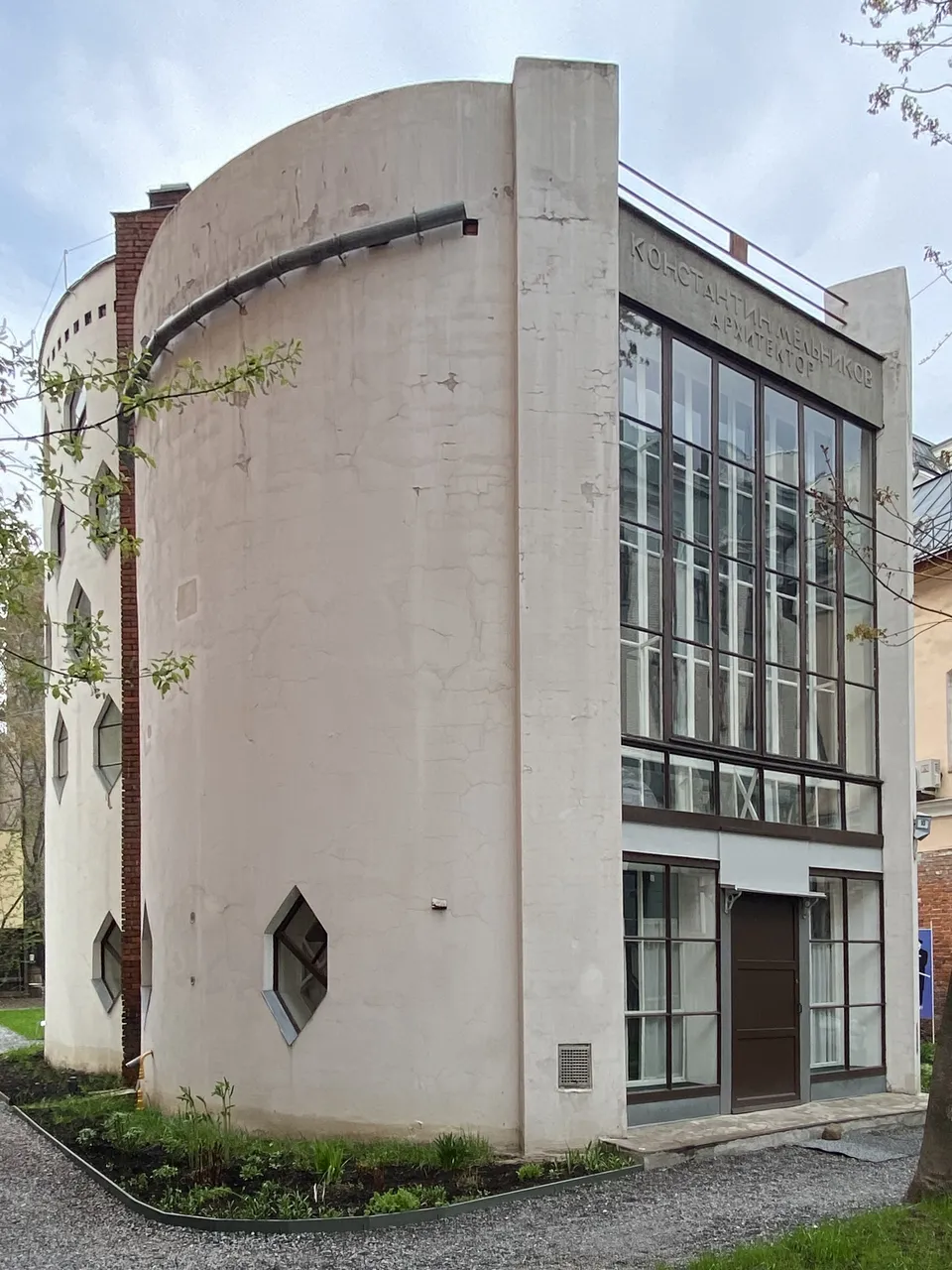
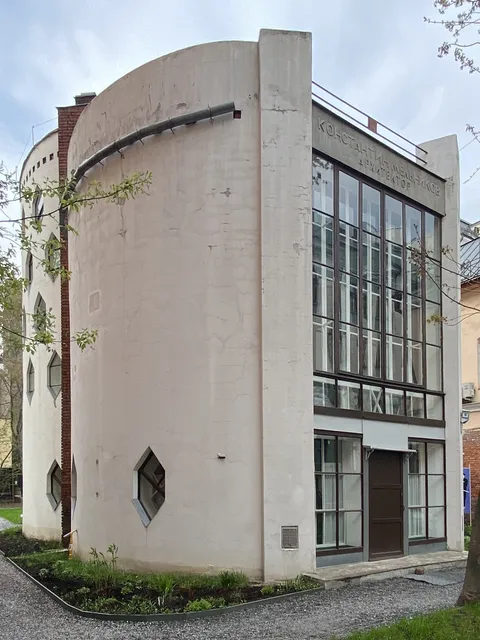
Today you find it down a quiet lane off the Arbat, a pale tower pockmarked with diamond-shaped openings. From the courtyard, the taller front cylinder rises three storeys, its plaster chipped just enough to reveal the hand-laid brick lattice beneath. No columns interrupt the interior — Melnikov's floors are self-supporting wooden membranes that creak underfoot like a ship's deck.
Restoration has kept the fragile wooden interiors closed for several years, but the building's exterior still rewards a slow walk around its curved walls. Above the massive south-facing window, a plaster band still reads 'KONSTANTIN MELNIKOV ARCHITECT' — in 1920s Moscow, that was a declaration of war.
You visit not for comfort but for the argument. This house is a built manifesto: cylindrical geometry saving bricks, sixty openings arranged to catch light from dawn to dusk, a private family shelter disguised as a communal housing experiment. Walk the lane twice — once to see the puzzle, once to feel the silence that followed Melnikov's fall from favour.
01 What to see.
The Double Cylinder on Krivoarbatsky Lane
The Top Studio, Shadowless and Vertical
Exterior View from Krivoarbatsky Lane
02 In pictures.


Plan and listen to Melnikov House with Audiala.
Audio guide in your pocket, itinerary in your browser. Built for the way you actually visit.
03 Visitor logistics.
The practical scaffolding for a good visit — kept short.
Getting There
Metro is the move. Smolenskaya (lines 3 or 4) leaves you a 7–10 minute, 600m walk away; Arbatskaya is about 900m. From Old Arbat, turn south into Krivoarbatsky Lane at the Tsoi Wall and look for the white cylinder behind the gate at No. 10. Driving is not practical — the lane has no visitor parking.
Opening Hours
As of 2 September 2026, the Melnikov House and courtyard remain closed to visitors for restoration. The work was reported complete in August, with reopening expected by the end of 2026, but no routine visitor hours should be assumed until the Shchusev Museum posts an official reopening notice. The exterior is visible from public Krivoarbatsky Lane.
Time Needed
Allow 15–30 minutes for the current exterior-only view from Krivoarbatsky Lane and nearby Old Arbat. Interior and courtyard tours are unavailable during the closure; future tour duration and booking rules should be checked after reopening.
Accessibility
The present visit is an exterior view from a public lane. The historic house itself has narrow stairs and no lift, but its post-restoration access arrangements have not yet been published because the museum remains closed.
Cost & Tickets
Viewing the facade from public Krivoarbatsky Lane is free. There are no legitimate interior or courtyard tickets while the museum is closed; wait for booking information from the official Shchusev Museum site.
04 Tips for visitors.
Small things that change the day.
Submit to shoe covers
Interior visits require felt overshoes, or bakhily, to protect the original 1920s pine flooring. Leave bulky bags and umbrellas behind because the stairwells barely fit a person, let alone luggage.
No flash, no tripods
Handheld photos without flash are allowed on interior tours, but tripods, monopods, selfie sticks, and lighting gear are banned. Drones are a hard no across central Moscow, so shoot the honeycomb facade from Krivoarbatsky Lane instead.
Skip the scalpers
Fake skip-the-line vouchers still circulate on third-party sites because interior slots are tiny. Only muar.ru sells real timed entry. On nearby Old Arbat, avoid costumed actors and people with doves or hawks who demand cash after you photograph them.
Go on a quiet weekday
Choose early or late daylight for the strongest shadows across the hexagonal facade, which is visible from the public lane. Do not rely on older reports of courtyard hours while the museum is closed.
Pair it with the Tsoi Wall
The graffiti-covered Viktor Tsoi memorial sits exactly where Krivoarbatsky Lane meets Old Arbat, about 50m from Melnikov's gate. See both for a sharp contrast between 1920s avant-garde geometry and 1990s rock nostalgia.
05 A Brick Manifesto Disguised as a Communal Experiment
Konstantin Melnikov was the Soviet avant-garde's most dazzling export. By 1925, his timber-and-glass pavilion had made Paris gasp, and he had already designed Vladimir Lenin's first glass sarcophagus. Moscow rewarded him with land in a crooked Arbat lane and a state loan to build an 'experimental residential prototype' from 1927 to 1929.
What rose at number 10 looked like the future: two interlocking cylinders, no internal columns, a honeycomb of 124 hexagonal openings. But the official story — a model for collective living — was a strategic fiction.
The Trojan Cylinder
The appearance: in the late 1920s, Soviet housing policy wanted communal workers' cells, not private villas. Records show Melnikov persuaded the Moscow City Planning Department to fund this site by presenting it as a cylindrical dom-kommuna — a material-saving prototype for collective housing. Most visitors still accept that story.
But the details don't add up. A communal prototype should have shared kitchens, shared bathrooms, standardized sleeping rooms. Melnikov House has none of these. It has one family's bedrooms, a private third-floor painting studio lit by 38 hexagonal windows, and a speaking-tube system linking the floors for household chatter. The man who pitched collectivism carved his own name above the door.
The revelation: Melnikov never intended to build for the masses. He tailored every niche to his wife Anna, son Viktor and daughter Lyudmila, used traditional peasant masons rather than industrial crews, and kept a private Orthodox icon corner in the family bedroom. The communal rhetoric was his Trojan Horse — the price of permission. When the Stalinist crackdown on avant-garde 'formalism' came, officials dismissed him from teaching in 1936 and blacklisted him from practice. This cylinder was always a solo act.
Now look again at the facade. The 124 hexagonal openings are not a communal grid; they're a reconfigurable private system — more than half were bricked up with clay and rubble, ready to be knocked out whenever Melnikov wanted to move a desk or add a window. The name above the lintel is not decoration. It's a taunt.
The Son Who Held the Line
The Bomb That Bent Around Brick
Listen to the full story in the app
The whole Melnikov House,
told well.
Audio guides for 1,100+ cities across 96 countries. History, stories, and local insight — offline ready.
06 Frequently asked.
The questions travellers send us most about Melnikov House.
Is Melnikov House worth visiting?
Yes for architecture enthusiasts passing through Old Arbat, but the current visit is exterior-only. The house and courtyard remain closed after restoration, with reopening expected by the end of 2026 but not yet announced as routine public access.
How long do you need at Melnikov House?
Allow 15–30 minutes to study the facade from Krivoarbatsky Lane and combine it with Old Arbat. Do not plan time for the courtyard or interior until the museum publishes a reopening schedule.
How do I get to Melnikov House from Moscow centre?
Take Moscow Metro Line 3 or 4 to Smolenskaya and walk about 600 metres, or get off at Arbatskaya for a 10-12 minute walk. From Old Arbat, turn down Krivoarbatsky Lane beside the Tsoi Wall and look for the white cylinders at No. 10. Don't drive; the lane has almost no visitor parking.
What is the best time to visit Melnikov House?
Early or late daylight gives the best exterior shadows on the cylinders and hexagonal windows. Because the house and courtyard remain closed, visit as part of an Old Arbat walk rather than making a timed museum trip.
Can you visit Melnikov House for free?
You can see and photograph the facade from public Krivoarbatsky Lane for free. The house and courtyard are currently closed, so there are no valid on-site interior tickets.
What should I not miss at Melnikov House?
From the lane, look for the architect's Cyrillic name above the large south window and trace the honeycomb pattern of open and infilled cells. Interior details such as the speaking tubes and top studio must wait for an official reopening.
Why is Melnikov House shaped like two cylinders?
Melnikov built the double cylinder partly to use brick efficiently: the self-supporting honeycomb walls eliminated internal columns and saved material. He also wanted a small private world that broke from boxy Soviet communal housing, and he got state land and financing by pitching it as an experimental cylindrical housing prototype. The rear cylinder contains the taller studio; the front one has living spaces and a roof terrace.
Is Melnikov House open to the public?
No, the interior has been closed for restoration since 1 October 2022, and the courtyard closed on 13 November 2023. The museum announced restoration completion in August 2026 and expects visitor access to resume later that year. Check muar.ru before going.
Verified, and shown.
Researched and written by the Audiala editorial team from historical records, architectural archives, and local expertise.
Official museum page for visitor access, tours, and the house's status as a branch of MUAR.
Museum announcement of the completed restoration and planned reopening timeline.
Construction dates, 1941 bomb blast, Viktor Melnikov's custodianship, and the house's structural history.
Details on the honeycomb brick cells, facade inscription, and the house's approval and construction.
Dates, location, museum status, and architectural description.
Visitor logistics, studio light and window counts, and access restrictions.
Closure dates for the interior and courtyard, and restoration timeline details.
Visitor reports on garden access, tour booking, and exterior viewing.
Room layout, materials, honeycomb construction, and the facade inscription.
Local nicknames, potato chute detail, and the 'Lenin card' survival lore.
Inheritance dispute, groundwater threats, and the 2006 World Monuments Watch listing.
Official museum page and current restoration closure status.
August 2026 report that restoration was complete and reopening was expected by year-end.
Researched from Wikidata, Wikipedia & official sources · fact-checked · How we make our guides →