Sibiu
Romania Updated Apr 2026
Roof windows shaped like half-closed eyelids watch you from every direction in Sibiu, Romania, giving the old city a faintly suspicious expression. Then the bells start, footsteps ring on stone, and the whole place feels less like a postcard than a stage set that never stopped being used. Sibiu surprises because its beauty is organized, almost military: squares linked by towers, bridges, passages, and a sudden drop from the polished Upper Town into the steeper streets below.
 Photo: Christopher Politano / Pexels
- Attractions
- 12
- Audio
- 1 h 28 min
- Trip length
- 2-3 days
- Best season
- Late spring to early autumn (May-September)
Why Sibiu
Built from cited sources · see the method · How we make our guides →
Most cities sell you a monument. Sibiu sells you a plan. The historic core, about 80 hectares inside the last ring of fortifications, still reads clearly as a fortified Saxon city, with Piața Mare as the formal public room, Piața Mică bending along the old defensive line, and Piața Huet holding the oldest, most vertical part of town around the Evangelical Cathedral.
That clarity gives the city its character. You climb the Council Tower and understand the roofscape at once: church spires, red tiles, dormer eyes, and streets that fall toward the Lower Town in a series of stairways and retaining walls. Walk the Stairs Passage and the idea becomes physical under your shoes.
Sibiu would be easy to dismiss as a preserved medieval set if it were not so alive after dark. Theatre, film, and music spill through the old center, the Brukenthal Palace keeps its Habsburg poise on Piața Mare, and the ASTRA Museum in the Dumbrava forest expands the story far beyond the walls. What stays with you is not one building. It is the way Saxon, Romanian, Catholic, Orthodox, mercantile, and theatrical Sibiu all fit inside a city you can still read at street level.
Roofs With Eyes
Sibiu’s dormer windows look half awake, half suspicious, and once you notice them you see them everywhere: along Piața Mică, across Piața Mare, and from the Council Tower. They give the whole roofscape a watchful expression that feels slightly theatrical, which suits a city built on merchants, guilds, and rumor.A Fortified City You Can Still Read
Many old towns keep the postcard and lose the logic. Sibiu still shows you the whole machine: Upper Town and Lower Town, walls, towers, passageways, and the 13th-century Stairs Passage dropping between levels like a stone hinge.ASTRA Beyond the Center
The ASTRA open-air museum changes the scale of the visit completely. Its 96 hectares, 10 kilometers of alleys, and more than 400 vernacular buildings turn folk architecture into something you walk through with the smell of timber, lake water, and woodsmoke in the air.More Than a Medieval Set
Sibiu performs. Between the Radu Stanca National Theatre, Astra Film Festival, and concerts in Sala Thalia on Strada Cetății, the city keeps using its old buildings instead of treating them like relics under glass.
Neighborhoods
Where to wander, by quarter — each with its own rhythm.
Upper Town
This is the Sibiu most first-time visitors imagine, and for once the expectation is justified. The Upper Town gathers the grand squares, patrician facades, museums, and church towers into a compact plateau where the city feels formal, composed, and slightly self-satisfied in the best way.Lower Town
The Lower Town is where Sibiu loosens its collar. Streets pitch downward, walls rise unexpectedly beside you, and the old houses feel less polished than those above, which is exactly the point; this is the part of the city that still carries texture, quiet, and some of its best evening addresses.Piața Mare
Sibiu's Great Square works as the city's ceremonial room, broad enough for markets and festivals, framed by Baroque facades and anchored by Brukenthal Palace. Come for the architecture, then stay long enough to watch how the square changes with the light, especially when the stone starts reflecting the late afternoon sun.Piața Mică
More intimate and more revealing than Piața Mare, this curved square follows the old fortification line and preserves arcaded ground floors from its market past. The famous roof eyes gather thickly here, and so do wine bars, small restaurants, and the sense that Sibiu is best when it feels a little compressed.Piața Huet
Piața Huet is the oldest urban nucleus, gathered around the Evangelical Cathedral and the first fortified precinct. The slope, the stone, and the cathedral's mass give it a sterner mood than the other central squares, which makes it one of the few places where Sibiu still feels defensive rather than decorative.Strada Cetății Fortifications Quarter
If you care about how cities were built to survive, walk Strada Cetății. Towers, bastions, and fragments of the defensive system line the street, while the Thalia Hall and the Natural History Museum show how Sibiu kept reusing military space instead of embalming it.Piața Cibin and the Market Area
The area around Piața Cibin pulls you away from polished heritage and back toward daily life. Market stalls, produce, cheeses, bread, and the smell of cooked food make this one of the better places to understand what Sibiu eats, not just what it restores.Dumbrava Sibiului and the ASTRA Zone
A few kilometers southwest of the center, Dumbrava changes the pace completely. Forest, lakes, the 96-hectare ASTRA open-air museum, and the zoo turn this into Sibiu's long-breath district, where the city's story opens outward into village houses, watermills, and wooden architecture gathered from across Romania.
Plan your trip
Before you go
- Getting There
- Sibiu International Airport (SBZ) sits about 6 km west of the center, with direct 2026 flights including Vienna, Munich, Nuremberg, Hamburg, Madrid, Rome Fiumicino, London Luton, Birmingham, Dortmund, Memmingen, Karlsruhe/Baden-Baden, and Milan Bergamo. Sibiu railway station is Gara Sibiu, linked by Tursib lines 2, 3, 5, 13, 15, 18, 19, 21 and 22; drivers usually arrive via the A1 motorway, then connect on DN1 or DN7 toward the city.
- Getting Around
- Sibiu has no metro and no working city tram network in 2026; daily transport is bus-based through Tursib, with route 3 as the electric Green Line for the center and route 13 for the ASTRA Museum and zoo. A 60-minute urban ticket costs 3.5 lei, a day pass 7 lei, and a weekly pass 24 lei; tickets work through street machines, onboard contactless machines, the SibiuBus app, or 24Pay. BikeCity is cheap too, from 1 leu for 1 hour or 10 lei for a day.
- Climate & Best Time
- Spring usually runs from about 4 to 21 C, summer from 12 to 27 C, autumn from roughly 0 to 22 C, and winter from about -7 to 5 C. Rain peaks in June and July, while January and February are drier but cold; August is the busiest month, and the sweet spot for most visitors is April to May or September to October, when the light is softer and the squares breathe a little easier.
- Language & Currency
- Romanian is the official language, but English works well in hotels, museums, transport, and airport services. Romania uses the leu (RON); cards are widely accepted in 2026, though carrying some cash still helps at markets and smaller shops, and banks or authorized exchange offices give better rates than airport counters.
- Safety
- Sibiu does not carry a reputation for dangerous districts, but the usual weak points are the train station, buses, airport, crowded festival zones, and cash-exchange areas. Keep an eye on bags, use ATMs inside banks when possible, do not leave drinks unattended at night, and remember that Romania’s emergency number is 112.
A Frontier City That Learned to Watch
From Neolithic settlement to Saxon stronghold, Habsburg capital, and Romanian cultural stage
- c. 5000 BCE
First Fires on the Plateau
Most scholars trace settlement in the Sibiu area back to the Neolithic period, long before walls, guilds, or church towers. People chose this high ground for the same reason later cities did: water, defensible terrain, and routes through southern Transylvania. The story starts in smoke, clay, and cut stone.
- 1191
Sibiu Enters the Record
Pope Celestine III confirmed the free provostship of the Germans in Transylvania, seated at Cibinium, and Sibiu stepped into documented history. That dry church formula mattered. It shows a community important enough to organize, tax, defend, and pray as a regional center.
- 1241
The Mongols Burn the Town
The Mongol invasion smashed Sibiu so thoroughly that later accounts say only around 100 inhabitants escaped. Timber houses, stores of grain, and early defenses went up in smoke. The city rebuilt with harder edges after that, and its later obsession with walls makes immediate sense.
- 1366
Hermannstadt Takes Shape
By 1366 the city appears in documents as Hermannstadt, the German name that would define it for centuries. Around this time the third fortification belt was completed, and the urban form still visible today began to lock into place. Squares, gates, and defended streets turned a settlement into a statement.
- 1411
Great Square Becomes Market
Piața Mare is first documented as a grain market in 1411, which tells you what kind of power a square really held. This was where carts rattled in, sacks split, prices were argued, and authority made itself visible. Cities don't just grow upward; they grow around places where everyone has to show up.
- 1486
Seat of the Saxon Nation
King Matthias Corvinus confirmed the Universitas Saxonum, the chief administrative body of the Transylvanian Saxons, with Sibiu at its center. That made the city more than fortified and prosperous. It became the political brain of a whole community spread across southern Transylvania.
Show the full timeline (26 moments)
- 1493
Nicolaus Olahus Is Born
Nicolaus Olahus, later a humanist scholar, archbishop, and regent of Hungary, was born in Sibiu on 10 January 1493. His life carried the city's mixed world with him: Latin learning, Hungarian politics, Saxon urban culture, and Romanian ancestry. Sibiu produced borderland minds before anyone used that phrase.
- 1525
Printing Press Starts Talking
The first attested printing press in Sibiu began working in 1525, the earliest known in Transylvania. Ink changed the city's reach. A sermon, school text, or political argument could now travel farther than a preacher's voice in a cold stone nave.
- 1543
Lutheran Sibiu Emerges
By 1543 Sibiu had become a focal point of the Lutheran Reformation in Transylvania. The change was theological, but you can still read it in brick and ritual: altars simplified, preaching sharpened, schools strengthened, and civic identity tied even more tightly to the church. Faith here had administrative consequences.
- 1551
Conrad Haas Draws Rockets
Military engineer Conrad Haas arrived in Sibiu in 1551 to work on weapons and artillery. In manuscripts later found in the city archives, he sketched multistage rockets centuries before spaceflight became an industry. Sibiu keeps that secret well: behind the medieval roofs sits one of Europe's stranger science stories.
- 1585
Earthquake Breaks the Tower
On 17 February 1585 an earthquake brought down the upper part of the Council Tower. That mattered beyond repair bills. The tower was the hinge between Sibiu's two main squares, so when it failed, the city lost one of its visual anchors and had to rebuild its skyline almost immediately.
- 1610
Báthory Occupies the City
Prince Gabriel Báthory seized Sibiu in 1610 and filled it with soldiers, turning a wealthy urban republic into an occupied place. Local memory treats the years that followed as one of the city's darkest stretches. Prosperity can vanish fast when barracks replace bargaining tables.
- 1692
Habsburg Capital of Transylvania
Sibiu became the provincial capital and seat of the governor in 1692, after Habsburg power settled over Transylvania. The city shifted from frontier stronghold to administrative capital. Baroque facades, Catholic institutions, and imperial ceremony began pressing against the older Saxon fabric.
- 1721
Samuel von Brukenthal Arrives
Samuel von Brukenthal was born in 1721 and would become the Habsburg governor most closely identified with Sibiu. He collected paintings, books, minerals, and status with equal discipline. The palace he built here still tells the story: power in this city liked to hang oil paintings over polished stone.
- 1777
A Governor Builds in Stone
During Brukenthal's governorship, the late Baroque Brukenthal Palace rose on Piața Mare between the late 1770s and 1780s. Its measured symmetry announced Vienna's taste in a city of steeper roofs and older anxieties. Sibiu did not stop being Saxon; it learned to wear imperial clothes.
- 1817
Museum Doors Open
The Brukenthal Museum opened to the public in 1817, widely regarded as the first museum in present-day Romania. That date matters because it marks a shift from private collection to civic display. Paintings and cabinets of curiosities were no longer only for governors and guests with gloves.
- 1850
Andrei Șaguna Builds Institutions
Andrei Șaguna turned Sibiu into the beating center of Orthodox Romanian education and publishing in the 1850s. He founded a diocesan printing house and theological institute here, then used print the old way: to shape a nation before it had full political power. Ink again. Different cause.
- 1859
Bridge of Lies in Iron
The Bridge of Lies was rebuilt in iron in 1859, its date still cast into the structure. Locals gave it a theatrical name, and the setting encourages gossip: arcades below, eyes in the roofs above, footsteps ringing on metal. But the bridge is more than a legend machine; it marks Sibiu's turn toward modern materials without losing its old drama.
- 1861
ASTRA Is Founded
The Transylvanian Association for Romanian Literature and the Culture of the Romanian People, known as ASTRA, was founded in Sibiu in 1861. That gave the city a new role in Romanian cultural politics inside the Habsburg world. Libraries, journals, lectures, and museums became tools of argument.
- 1894
Hermann Oberth Is Born
Hermann Oberth, one of the founding minds of modern rocketry, was born in Sibiu in 1894. The fact feels almost mischievous. A city famous for watchful roof windows also produced a man who spent his life thinking beyond the atmosphere.
- 1906
Orthodox Cathedral Consecrated
The Holy Trinity Metropolitan Cathedral was consecrated on 30 April 1906 after construction that began in 1902. Its neo-Byzantine domes changed the city's silhouette and made Romanian Orthodox presence impossible to treat as secondary. Step inside and the light shifts from Saxon restraint to gold, incense, and painted vaults.
- 1918
Union Brings a New Capital
After the union of Transylvania with Romania on 1 December 1918, Sibiu became the seat of the Transylvanian governing bodies through 1919. Political language changed, official names changed, and the city entered a Romanian state after centuries of other frameworks. The paperwork was enormous. So was the symbolism.
- 1940
Lucian Blaga Finds Wartime Sibiu
When the University of Cluj took refuge in Sibiu during the war years, Lucian Blaga followed and worked here from 1940 onward. The city became a shelter for displaced scholars and a pressure chamber for Romanian literature. Some of the century's sharpest minds were thinking under blackout conditions and old Saxon roofs.
- 1945
Saxons Are Deported East
In 1945 the deportation of Sibiu's Germans to the Soviet Union began, with local records giving 2,800 deportees. This was one of the city's deepest breaks. A community that had shaped Sibiu for roughly eight centuries was suddenly torn from workshops, schools, and family tables.
- 1967
Village Romania Moves In
The ASTRA open-air museum opened to the public in Dumbrava in 1967 after several years of planning and land allocation. Houses, mills, churches, and workshops from across Transylvania were rebuilt among trees and water. It is one of Sibiu's cleverest cultural moves: a city preserving the countryside inside its own orbit.
- 2007
Europe Comes to the Squares
In 2007 Sibiu served as European Capital of Culture, the same year Romania joined the European Union. The city hosted 337 cultural projects and 2,062 events, turning its squares into stages again. That year did not invent Sibiu's cultural confidence. It made the rest of Europe look up and notice it.
Who lived here
-
Statesman and art collector · 1721–1803
Samuel von Brukenthal
Lived here; died here; built Brukenthal Palace
Samuel von Brukenthal gave Sibiu one of its grandest facades and then filled it with ambition. His palace on Piața Mare still feels like an argument in stone: that a provincial city in Transylvania could collect, display, and think on a European scale.
-
Physicist and rocket pioneer · 1894–1989
Hermann Julius Oberth
Born here
Oberth was born in Sibiu long before rockets became a modern obsession, which gives the city an unlikely place in the history of spaceflight. He would probably recognize the old roofs at once, then smile at the thought that one of the men who helped imagine space travel began under these watchful dormers.
-
Poet and philosopher · 1895–1961
Lucian Blaga
Lived and worked here from 1940; edited Saeculum here
Blaga arrived in Sibiu during wartime dislocation, when the city became a shelter for displaced intellectual life. He helped turn it into more than a preserved Saxon backdrop; for a few charged years, Sibiu was a place where Romanian literary thought regrouped and sharpened itself.
-
Poet, playwright, and theatre director · 1920–1962
Radu Stanca
Studied and worked here; member of the Sibiu Literary Circle
Radu Stanca belongs to the Sibiu that speaks after dark, when rehearsal halls and performance spaces take over from museum labels. The city's main theatre bears his name now, which feels right: he helped give Sibiu a cultural afterlife beyond its medieval stone.
-
Politician · born 1959
Klaus Werner Iohannis
Born here; mayor of Sibiu 2000–2014
Before he became Romania's president, Iohannis was the schoolteacher-mayor who reshaped how many outsiders saw Sibiu. He inherited a city with deep historical capital and pushed it toward a cleaner, more outward-facing present, without scrubbing away the old bones that made it matter in the first place.
Where to Eat
Where locals actually book dinner — not the tourist menus.
Insider tips
Small things that change how the city treats you.
Start Early
Climb the Council Tower when it opens, before tour groups gather on Piața Mare. The roofscape reads best in the morning light, when the dormer "eyes" look sharp instead of washed out.Use The Passage
Take Pasajul Scărilor between Upper Town and Lower Town instead of circling on main streets. It is the quickest way down, and it explains Sibiu's split-level plan better than any map.Half-Day Escape
Set aside half a day for the ASTRA open-air museum in Dumbrava Sibiului, 4 km southwest of the center. The site covers 96 hectares with 10 km of alleys, so treat it like an outing, not a quick stop.Market Over Souvenirs
Go to Cibin Market for Sibiu salami, local cheese, and seasonal fruit instead of buying food gifts in the central squares. Prices are usually kinder, and you will hear the city talking to itself.Cool Off Here
Head to Sub Arini Park on hot afternoons. Its 22 hectares and 150-year-old trees give more shade than the stone squares, which can feel bright and exposed by mid-day.Museum Strategy
Pick one big museum inside the center and pair it with ASTRA, rather than trying to do every collection in a day. Brukenthal alone can absorb hours, and museum fatigue hits fast on cobblestones.
Gallery
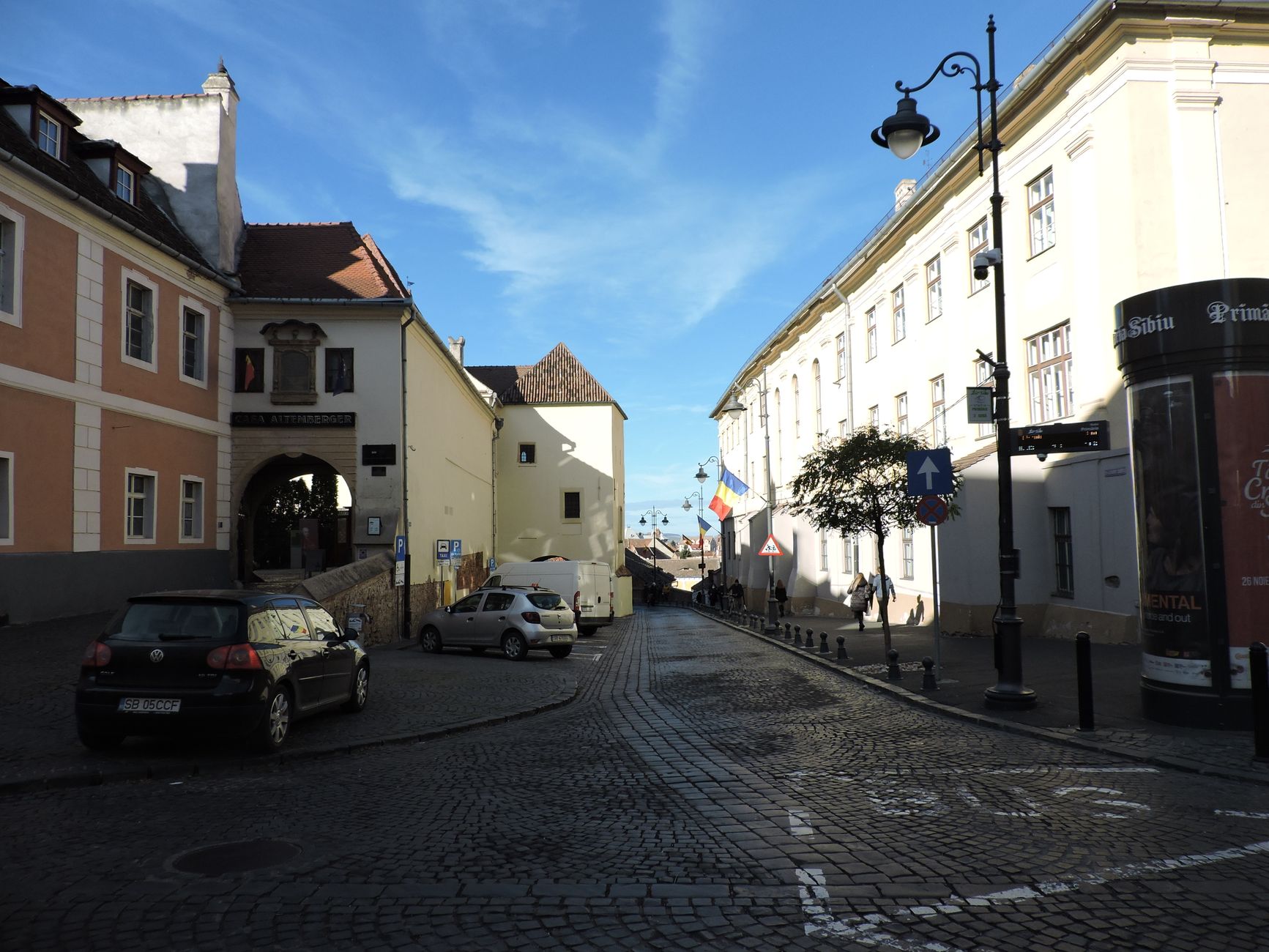
The city, as it actually looks.



Frequently asked
Is Sibiu worth visiting?
Yes, especially if you want a compact city with real historical depth instead of a checklist capital. Sibiu's pull comes from its layered old town, the drop from Upper Town to Lower Town, and the ASTRA museum, which makes it stronger than a one-square photo stop.
How many days in Sibiu?
Two to three days works well. One day covers the historic center, one day gives you time for ASTRA Museum and Dumbrava, and a third day lets you slow down or take a trip toward Păltiniș or the fortified churches.
How do you get around Sibiu without a car?
You can cover the historic center on foot. The core is compact, but the level changes matter, so use Pasajul Scărilor and the lanes off Piața Mică to move between Upper and Lower Town without wasting energy.
Is Sibiu safe for tourists?
Sibiu is generally considered a safe city for visitors, with the usual old-town cautions around crowded events and late-night drinking zones. Watch your footing as much as your wallet: polished stone, steep passages, and winter ice are the real hazards here.
Is Sibiu expensive?
No, not by western European city standards, though prices rise around Piața Mare during festivals and peak weekends. You can keep costs down by staying a few streets off the main squares, eating at lunch menus, and buying snacks at Cibin Market.
What is the best time to visit Sibiu?
Late spring through early autumn is the sweet spot, especially May to September. Warm weather suits the squares, fortification walk, and ASTRA's outdoor alleys, while December is atmospheric if you want lights and cold air with your rooftops.
Pick up where you left off
Saved and recently read places — kept on this device only.
Photo credits (10)
- Christopher Politano — Pexels License (https://www.pexels.com/license/) — Source: https://www.pexels.com/photo/33402111/
- Christopher Politano — Pexels License (https://www.pexels.com/license/) — Source: https://www.pexels.com/photo/33402149/
- Design Diva — Pexels License (https://www.pexels.com/license/) — Source: https://www.pexels.com/photo/30621324/
- Mosquito — Pexels License (https://www.pexels.com/license/) — Source: https://www.pexels.com/photo/33319463/
- GirlvsGlobe86 — Pexels License (https://www.pexels.com/license/) — Source: https://www.pexels.com/photo/13760434/
- Teodor Costachioiu — Pexels License (https://www.pexels.com/license/) — Source: https://www.pexels.com/photo/28456591/
- Adriana Coman — Pexels License (https://www.pexels.com/license/) — Source: https://www.pexels.com/photo/14340590/
- Studio Phothograhy — Pexels License (https://www.pexels.com/license/) — Source: https://www.pexels.com/photo/16752617/
- Design Diva — Pexels License (https://www.pexels.com/license/) — Source: https://www.pexels.com/photo/30621318/
- Sopterean Raul — Pexels License (https://www.pexels.com/license/) — Source: https://www.pexels.com/photo/18428124/
Photos may have been resized or cropped.