Destinations

Republic of the Congo

"Republic of the Congo packs Central Africa’s biggest contrasts into one map: river capitals, Atlantic coast, old kingdoms, and deep Congo Basin forest where wildlife still sets the rhythm."

location_city

Capital

Brazzaville

translate

Language

French

payments

Currency

Central African CFA franc (XAF)

calendar_month

Best season

June-September

schedule

Trip length

7-12 days

badge

EntryVisa required in advance; yellow fever certificate required

Introduction

Republic of the Congo travel guide: come for rainforest and river, stay for a country where Atlantic surf, gorillas, and rumba share the same map.

Republic of the Congo rewards travelers who want the Central African story in full scale: Congo River frontage in Brazzaville, Atlantic air in Pointe-Noire, and rainforest that keeps swallowing the horizon. The surprise is how much terrain fits inside one country of 342,000 square kilometers. South of the Equator, the dry season from June to September sharpens skies and makes overland travel easier; farther north, the forest keeps its own calendar. That matters because a trip here is rarely about one postcard view. It is about moving between river cities, coast, savanna, and the dense green north without crossing a single border.

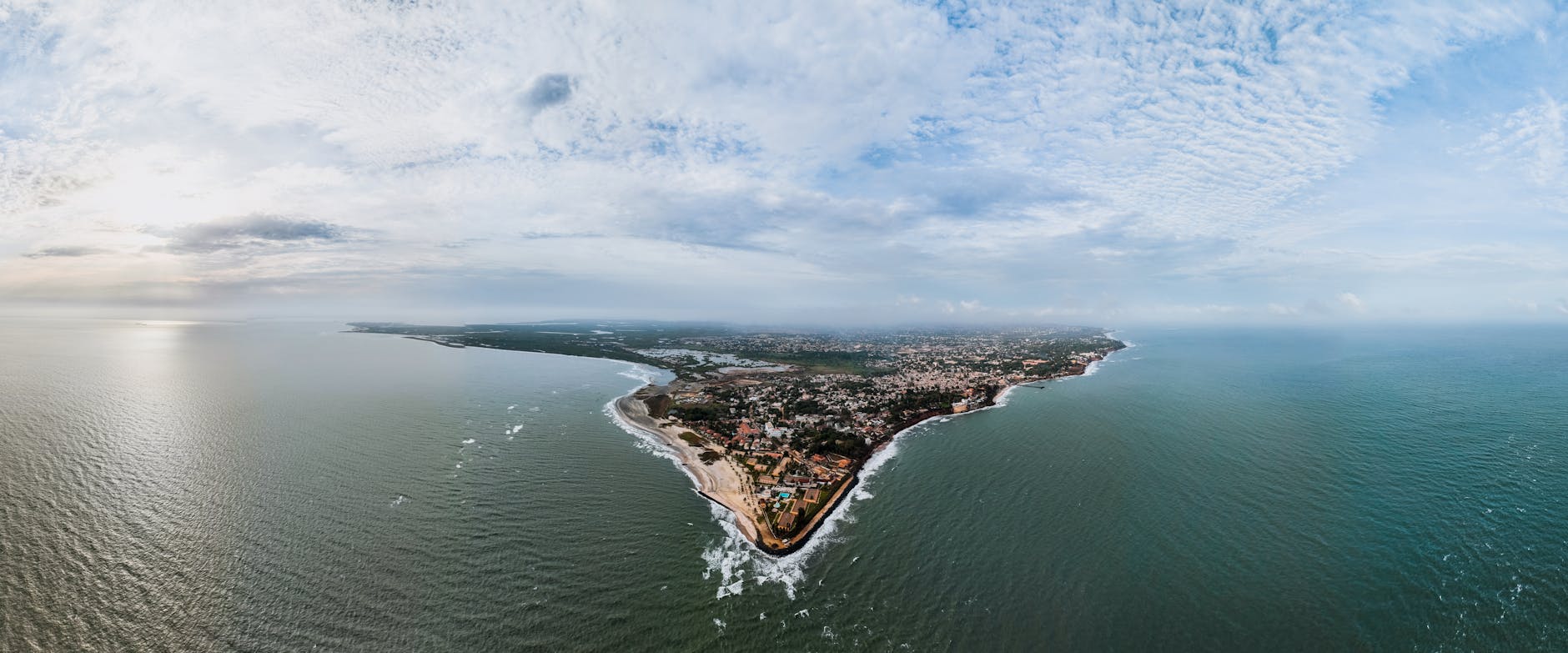
Start in Brazzaville, where the Congo River widens toward Malebo Pool and Kinshasa sits shockingly close on the opposite bank. Then head west to Pointe-Noire for beaches, fishing boats, and the humid edge where the country opens to the Atlantic. Inland, Dolisie and Sibiti sit on routes that show another Republic of the Congo entirely: red earth, rail history, market towns, and long distances that teach patience fast. Travelers chasing the country’s oldest political history should keep Loango on the list. That stretch of coast was once tied to one of Central Africa’s most powerful kingdoms, and the past still hangs in the sand and lagoons.

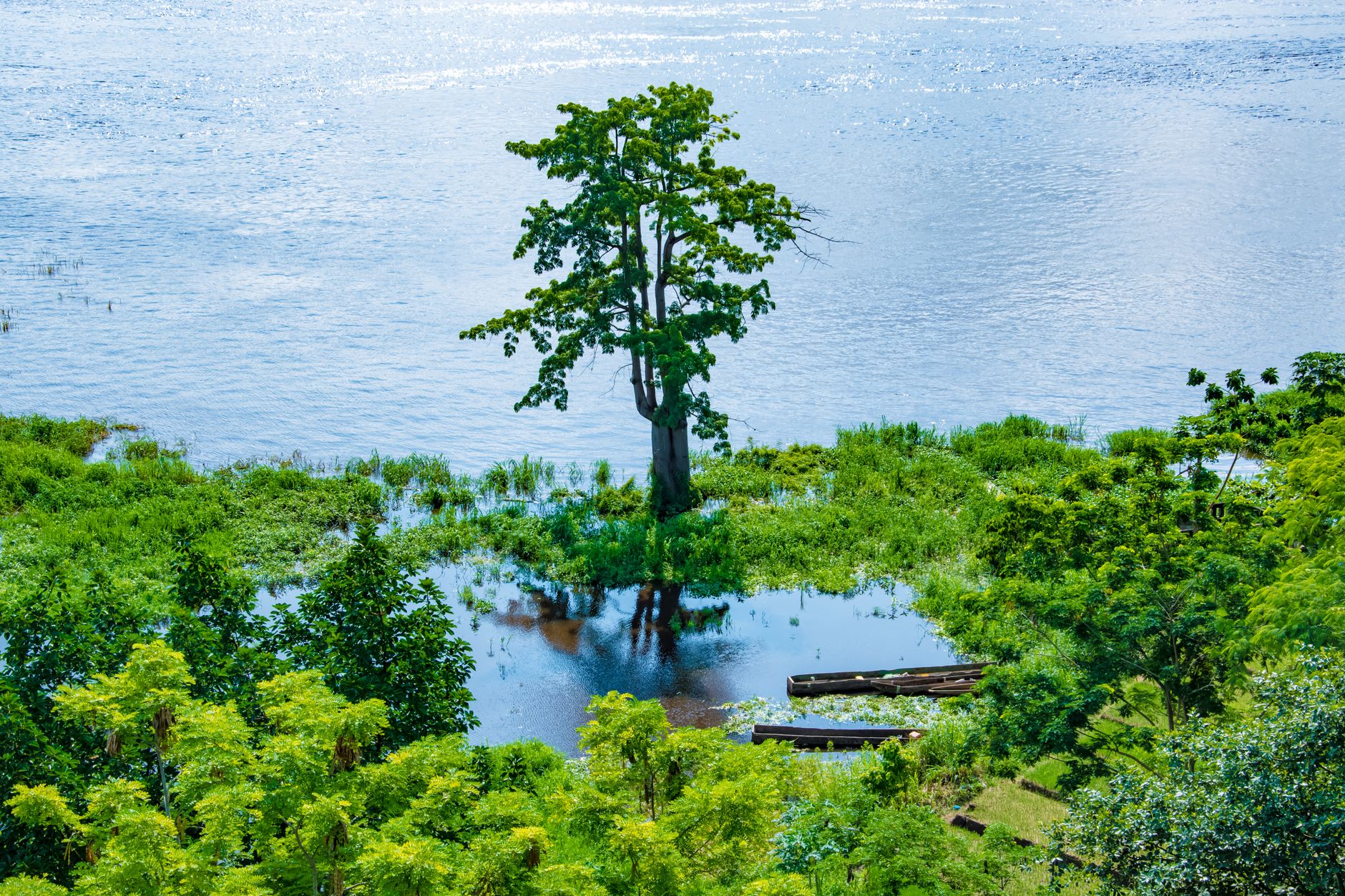
The north changes the scale again. Ouesso and Impfondo are gateways to the Congo Basin world of rivers, swamp forest, and wildlife habitats that make the country one of Central Africa’s most serious nature destinations. Odzala-Kokoua National Park draws travelers for western lowland gorillas, forest elephants, and bais where the forest suddenly opens and everything seems to breathe at once. Food grounds the experience back in daily life: chikwangue unwrapped by hand, saka-saka cooked down until it tastes dark and earthy, grilled river fish hit with pili-pili. This is not a polished circuit. That is the point. Republic of the Congo still feels discovered in real time.

A History Told Through Its Eras

Before the Maps, the Forest Already Had Its Courts

Forest Kingdoms, c. 1000 BCE-1482

Dawn in the equatorial forest comes with mist hanging between trunks and the sound of voices you cannot place at first. Ce que l'on ignore souvent, c'est que long before any European wrote "Congo" on a chart, the region was already organized by memory, ritual, and trade. Ba'Aka communities knew the medicinal bark, the flooded paths, the seasons of fish and fruit with a precision no archive could match.

Then came Bantu-speaking farmers and ironworkers over many centuries, bringing furnaces, pottery, and new political worlds. Along the river corridors, iron tools changed the balance of power, and settlements grew where trade could be taxed. The forest did not disappear. It was negotiated with.

By the late first and early second millennium, the Bateke had turned the plateau above the great widening of the Congo River into a realm of tolls, ceremony, and careful distance. The Makoko, ruler of the Teke world, was not merely a chief with a larger hut; he sat inside a system so charged with symbolism that even eating in public could be forbidden. To see the sovereign swallow was to see the body of the state reduced to flesh. Courts fear that sort of thing.

Farther west, toward Loango and the Atlantic edge, other kingdoms took shape around salt, copper, raffia cloth, and the coastal routes. What mattered was not empty territory but movement: canoes, porters, marriage alliances, tribute. That is the thread that leads, in time, to Brazzaville and Loango, where later empires would imagine they were discovering something new.

The Makoko of the Teke world appears less as a warrior than as a sovereign of ritual, protected by etiquette so strict that power itself became theatre.

Ba'Aka polyphonic singing puzzled early recordists so much that some thought the equipment had failed; the melody seemed to belong to the forest, not to any single singer.

Loango, the River, and the Price of a Human Body

Atlantic Kingdoms and Captive Shores, 1482-1880

A Portuguese ship appears off the coast in the late 15th century, all canvas, timber, and appetite. On shore, kings already rule in Loango and in the wider Kongo sphere, and they do not greet the newcomers as children before civilization, but as rival merchants with dangerous habits. The first meetings are diplomatic. They do not stay innocent.

The Kingdom of Loango became one of the Atlantic coast's great brokers, with a court, a nobility, and a ruler, the Maloango, wrapped in ceremony so dense that foreign visitors sometimes mistook sacred distance for weakness. They were wrong. Loango's elite understood exchange perfectly well: ivory, copper, cloth, and, increasingly, people. That last commodity poisoned everything it touched.

The other great drama unfolded through the Kingdom of Kongo, which reached into the southwest of what is now the Republic of the Congo. Its rulers corresponded with Lisbon, converted, argued theology, and tried to control a trade they never truly mastered. King Afonso I wrote in 1526 that traders were carrying off "sons of this land" and even the relatives of nobles. One hears, in that line, not an abstraction but panic in a royal hand.

By the 17th and 18th centuries, the Loango coast had become one of the major export zones of the Atlantic slave trade. Chiefs who controlled inland routes grew rich; royal authority frayed; coastal politics hardened into bargains made under duress and greed alike. The sea enriched Loango and hollowed it out. When later French agents arrived, they found not untouched kingdoms but courts already scarred by three centuries of commerce.

Afonso I of Kongo remains one of the most tragic royal voices in Central African history: a Christian king who understood too late that letters and baptism would not restrain the slave trade.

In Loango, the crowned ruler was expected to remain within the palace compound after coronation, as if sovereignty required a kind of ceremonial captivity.

Brazza's White Suit, the Treaties, and the Silence Behind Them

French Conquest and Colonial Congo, 1880-1944

In 1880, Pierre Savorgnan de Brazza arrived on the river in a white suit that has survived in legend almost better than the people who received him. He met Teke authorities linked to the Makoko and secured the treaty that allowed France to claim a foothold on the north bank of the Congo. The scene is often told as a gentlemanly triumph. Ce que l'on ignore souvent, c'est what came after the signatures: concessionary companies, forced labor, punishment, and extraction on a scale that mocked the softness of Brazza's image.

Brazzaville was founded that same year and soon became more than an outpost. It turned into the administrative heart of French ambition in Central Africa, then the capital of French Equatorial Africa in 1910. Across the water stood Léopoldville, under Belgian rule, making the Pool a mirror of two imperial systems facing each other at scandalous proximity.

The colonial economy was built with porters' backs, rubber quotas, timber, and the railway to Pointe-Noire. The Chemin de Fer Congo-Océan, constructed from 1921 to 1934, remains one of the bleakest chapters in the country's built landscape. Thousands of African laborers died carving a line through the Mayombe for a train that would serve empire first and Congo last.

Even Pierre de Brazza, recalled as the humane colonizer, returned in 1905 deeply shaken by what French rule had become. His investigation documented abuses so grave that Paris preferred embarrassment to reform. He died the same year, ill and disillusioned. But Brazzaville kept growing, and by 1940 it would take on a role no one in 1880 could have predicted: the political capital of Free France.

Pierre Savorgnan de Brazza is remembered as the gentle conqueror, yet the cruelest irony is that the colony bearing his name exposed the limits of gentleness inside an empire built to extract.

The railway from Brazzaville to Pointe-Noire was so lethal that it entered memory not as a technical feat but as a graveyard stretched along the tracks.

From Brazzaville's Conference Halls to the Wars of the Republic

Free France, Independence, and the Long Republic, 1944-present

In January 1944, officials gathered in Brazzaville for a conference called by Charles de Gaulle, and the city briefly became one of the political centers of the French wartime world. The setting was formal, the language elevated, the uniforms impeccable. Yet no African delegates sat there as equals to decide their own fate. That omission tells you nearly everything about late empire.

Independence came on 15 August 1960, and with it the delicate, combustible question that always follows liberation: who now owns the state? Fulbert Youlou, a former priest in a white cassock, became the first president and quickly discovered that charisma is not a constitution. He fell in 1963, swept away by protest, unions, and a city that had already learned how to bring power into the street.

Then the country moved through coups, socialist experiments, military rule, and ideological fashion with unnerving speed. Marien Ngouabi proclaimed the People's Republic of the Congo in 1969, making it the first Marxist-Leninist state in Africa, and was himself assassinated in 1977. Denis Sassou Nguesso emerged, left office after the 1991 National Conference opened a multiparty chapter, then returned by force during the civil war of 1997. Republics, you see, also have dynastic instincts.

Modern Congo cannot be told only through presidents and uniforms. It also lives in Brazzaville's rumba and La Sape elegance, in Pointe-Noire's oil wealth, in Loango's haunted coast, and in the forests near Ouesso and Impfondo, where conservation now competes with old habits of extraction. The story has not settled. It has merely changed rooms.

André Matsoua, dead before independence, became something stranger than a politician: a martyr, a rumor of return, almost a secular saint for many Congolese.

The 1991 National Conference reduced the sitting president to an ordinary participant for a moment, one of those rare African political scenes when ceremony cracked and the room changed sides.

The Cultural Soul

A Greeting Takes the Measure of a Soul

In the Republic of the Congo, speech begins before information. A shop counter in Brazzaville is not a place where you ask for batteries; it is a place where you first prove that you have noticed another human being on earth. French handles the official surface, crisp and ironed. Then Lingala or Kituba enters, and the room softens by one degree, which is enough to change the century.

This matters because language here is not only vocabulary. It is rank, tenderness, strategy, mischief. You hear French at a ministry desk, Lingala in a bar where the beer arrives already sweating, Kituba along the road toward Pointe-Noire where trade and kinship have spoken to each other for generations without asking Paris for permission. A country reveals itself in code-switches.

The greetings are long because haste is vulgar. "Mbote" does not merely say hello; it acknowledges your body, your mood, your safe arrival, your right to stand there. Older women become mama, older men papa, and the title is not sentimental. It is architecture. Society holds because people keep naming the beams.

A traveler learns one lesson fast: nouns are easy, relations are hard. If you open with your request, you sound efficient in the worst possible way. Begin with the ritual instead. The answer comes more quickly after that.

Palm Oil, Cassava, and the Seriousness of Appetite

Congolese food does not flirt. It sits down, looks you in the eye, and asks whether you have come to eat or to perform delicacy. Cassava leaves cooked into saka-saka taste dark, mineral, faintly smoky, as if the forest had agreed to become sauce. Chikwangue arrives wrapped in leaves like a private thought. You unwrap it, tear it, dip it, and understand that starch can be an instrument of intelligence.

Meals depend on texture as much as flavor. Fingers pinch, roll, scoop, pause. The hand knows before the tongue does whether a sauce has reached its correct thickness. In Brazzaville, at noon, with a plate of maboké opened at the table, steam carries tomato, chile, river fish, leaf, and the tiny bitterness that keeps pleasure from becoming childish.

Palm oil gives many dishes their red authority. Smoked fish contributes depth, not decoration. Goat from a grill in Pointe-Noire requires patience, teeth, and conversation; nobody should eat ntaba in a hurry, any more than one should read poetry during a fire drill. A country is a table set for strangers.

The best meals are often repetitive. That is not a defect. Repetition is how a cuisine proves that it means what it says. Cassava, fish, beans, plantain, peanuts, smoke, heat: the grammar is small, the sentences infinite.

Rumba in a Pressed Collar

Music in the Republic of the Congo has excellent manners and very dangerous hips. The first surprise is elegance. Even before the body yields, the shirt has been chosen, the shoe polished, the entrance rehearsed by instinct. In Brazzaville, rumba does not crash into the evening; it seeps under the door, takes the chair beside you, and waits until resistance becomes ridiculous.

Congolese rumba belongs to both banks of the river, yet each city keeps its own accent of seduction. Across from Kinshasa, Brazzaville answers not with volume but with poise, with guitar lines that seem to smile while remaining fully aware of bills, heartbreak, and politics. Lingala carries song superbly because it can sound velvet one second and brass the next.

Then there is the forest music of the north, where the Ba'Aka vocal traditions make Western categories look underfed. Polyphony here does not feel composed so much as grown. Near Ouesso or Impfondo, the idea that one singer owns a melody begins to seem like a selfish invention.

A bar can tell you more than a museum. One speaker, one old song, one man tapping the table with two fingers, and suddenly the whole country becomes legible: urban vanity, river memory, church harmony, heartbreak with excellent tailoring.

Dressed as an Argument

In the Republic of the Congo, clothes can be a moral position. This is most visible in Brazzaville, where La Sape turned fabric into rhetoric long ago. A man in a plum jacket, cream trousers, and oxblood shoes is not merely well dressed. He is declaring that poverty may govern his budget but not his imagination. The distinction is enormous.

Foreigners often misunderstand elegance here. They assume fashion means luxury, labels, expense, vanity. Not at all. The point is composition. Color must converse. Trousers must stop at the right instant above the shoe. A pocket square can behave like a small, disciplined revolution.

This aesthetic has roots in colonial mimicry, yes, but mimicry is too weak a word for what happened. The borrowed suit was not copied; it was conquered, exaggerated, mocked, perfected, and turned into a code of dignity under pressure. That is why the look survives every economic insult. Splendor, once mastered, becomes stubborn.

In Pointe-Noire the atmosphere loosens, salt enters the wardrobe, the coast edits the formality. But the principle remains. Presence is work. You do not simply appear before others. You compose yourself for them.

Ceremony Before the Question

Etiquette in the Republic of the Congo is less about rules than about sequence. First the greeting. Then the inquiry after health. Then perhaps the matter at hand, if the world still seems stable enough to deserve business. This order is not ornamental. It prevents brutality disguised as efficiency, which is one of modernity's cheapest tricks.

You see it in markets, in family compounds, in roadside exchanges, in offices where the paperwork may sleep but politeness remains fully awake. A person who greets badly announces a kind of social illiteracy. A person who greets well can be forgiven many things, including mediocre French and imperfect change.

Respect is audible in titles. Mama, papa, grand frère, grande soeur: kinship terms spill beyond blood and organize temporary belonging. They reduce friction. They also remind you that individualism is not the only available operating system. One understands, with some relief, that society can still be spoken into place.

And yes, time moves differently inside this etiquette. Malembe malembe. Slowly, gently, without forcing the world into a schedule it never signed. Impatient travelers call this delay. Wiser ones call it education.

Sunday White and River Faith

Religion in the Republic of the Congo is visible long before you enter a church. It is in the white garments carried carefully on Saturday afternoon, in the polished shoes, in the serious laundering of collars, in the fact that Sunday is prepared almost like a state visit. Faith here has fabric. It also has percussion.

Christianity dominates the public landscape, especially Roman Catholic and Protestant forms shaped by mission history, urban life, and local invention. But no honest observer mistakes this for a simple import. A hymn may arrive by Europe and leave as something entirely Congolese, changed by rhythm, call-and-response, and the bodily conviction that prayer should use the lungs fully.

Traditional cosmologies have not vanished because a census prefers cleaner categories. Ancestors remain near. Protection, healing, misfortune, dreams, all still circulate through explanations larger than official doctrine. Along the old kingdom zones around Loango, and deep in forest regions as well, the unseen world has never accepted retirement.

The result is not confusion. It is abundance. A sermon in Brazzaville, a vigil in a neighborhood courtyard, a whispered consultation about illness, a song that makes the line between worship and endurance disappear: all of it belongs to the same human refusal to live in a mute universe.

What Makes Republic of the Congo Unmissable

forest

Congo Basin Forest

Northern Republic of the Congo holds one of the great rainforest systems on earth. Odzala-Kokoua and the Sangha landscape draw travelers for western lowland gorillas, forest elephants, and clearings where wildlife steps into view.

water

Riverfront Brazzaville

Brazzaville gives the country its defining first impression: the Congo River spread wide at Malebo Pool, with Kinshasa visible across the water. Few capitals feel this geographically dramatic, or this historically loaded.

beach_access

Atlantic Edge

Pointe-Noire and the southwest coast add a different Republic of the Congo altogether: ocean light, beaches, lagoons, and access toward Conkouati-Douli. Few countries fold rainforest and surf into the same itinerary this neatly.

castle

Loango Kingdom Legacy

Loango is more than a coastal stop. It places travelers inside the history of one of equatorial Africa’s major kingdoms and the brutal Atlantic trade that reshaped this coast between the 17th and 19th centuries.

restaurant

Cassava and River Fish

Congolese food is built on cassava, palm, smoke, and slow-cooked sauces. Look for saka-saka, maboké wrapped in leaves, chikwangue, and grilled fish with pili-pili in Brazzaville, Pointe-Noire, and market towns inland.

route

Rail and Red-Earth Routes

The Brazzaville to Pointe-Noire corridor, with Dolisie on the line, shows the country beyond capitals and parks. Trains, long roads, and market stops reveal how geography still shapes everyday movement here.

Cities

Cities in Republic of the Congo

Brazzaville

"Across the river from Kinshasa — the world's closest capital pair — Brazzaville moves at a slower pulse, where La Sape devotees iron their lapels on Saturday morning and rumba drifts off the Congo waterfront before noon."

Pointe-Noire

"The oil city that built itself on Atlantic money: a working port where offshore rigs sit on the horizon, grilled barracuda is sold at plastic tables on the beach, and the train from Brazzaville arrives exhausted after tw"

Dolisie

"The third-largest city sits in the Niari valley where the CFCO railway pauses long enough for passengers to buy smoked fish through the window, a market town that functions as the country's inland crossroads."

Ouesso

"A river town in the far north where the Sangha meets the forest, the last real urban stop before pirogues push into the Congo Basin wilderness toward Odzala-Kokoua."

Impfondo

"Reachable most reliably by river or small aircraft, this remote northeast town on the Ubangi is the gateway to Likouala swamp forest, one of the least-visited landscapes on Earth."

Owando

"Capital of the Cuvette department, where the road north begins to lose its confidence and the equatorial forest closes in on both sides with genuine intent."

Sibiti

"A small plateau town in the Lékoumou valley ringed by hills and waterfalls, largely unknown to outside travelers yet used by Congolese as a cool-season retreat from the capital's heat."

Loango

"The name carries five centuries of weight — once the royal seat of the Kingdom of Loango, now a coastal village near a national park where forest elephants walk to the Atlantic shore."

Nkayi

"An industrial sugar-town on the Niari River that most guidebooks skip entirely, yet its surrounding valley holds some of the country's most accessible savanna landscape."

Mossendjo

"A quiet town near the Gabon border in the Niari basin, surrounded by forest that the logging industry has not yet finished arguing over, and a useful base for reaching the Mayombe highlands."

Kinkala

"Only seventy kilometres south of Brazzaville, the Pool department capital sits on red-earth plateau where the city dissolves fast into cassava fields and the weekend market runs on Kituba and barter."

Makoua

"A small equatorial town on the Alima River corridor between Owando and Ouesso, where the forest canopy is unbroken in every direction and the concept of a tourist infrastructure has not yet arrived."

Regions

Brazzaville

Congo River Capital Belt

Brazzaville is the country's front room: government offices, music bars, river views and the strange intimacy of facing Kinshasa across the water. The farther you move toward Kinkala and the Pool hinterland, the more the city rhythm gives way to a road culture of checkpoints, church compounds and market towns.

placeBrazzaville placeMalebo Pool placeDjoue Rapids placeKinkala

Pointe-Noire

Atlantic Coast and Loango

Pointe-Noire runs on port money, beach weather and a sharper commercial tempo than the capital. North along the coast, Loango brings in older layers: kingdom history, slave-trade memory and a shoreline that feels beautiful and uneasy at the same time.

placePointe-Noire placeLoango placeDiosso Gorge placeCôte Sauvage

Dolisie

Niari Transport Corridor

This is the practical south-west: freight, rail lines, truck stops and the road-and-rail axis that ties the coast to the interior. Dolisie is the anchor, Nkayi is part sugar town and part rail stop, and Mossendjo pulls you closer to the forested folds of the Mayombe side of the map.

placeDolisie placeNkayi placeMossendjo placeCongo-Ocean Railway

Sibiti

Southern Plateaus

Around Sibiti, the country opens out into plateau country with a quieter, slower feel than the coast or the capital. You come here for road journeys, market days and the texture of provincial Congo rather than for a checklist of monuments.

placeSibiti placeLékoumou plateau roads placelocal markets around Sibiti

Owando

Cuvette and Alima Country

Owando and Makoua sit in the long transition between the southern transport spine and the wetter north, where river systems start to matter more and distances stretch out. This is a region of administrative towns, broad skies and onward routes rather than headline sights, but it gives you a better sense of the country's middle than a fly-in trip ever will.

placeOwando placeMakoua placeAlima basin routes

Ouesso

Sangha and Likouala Rainforest

Northern Congo feels different from the moment you arrive: denser forest, wetter air and travel that depends on rivers, rough roads or small aircraft. Ouesso is the practical gateway, while Impfondo pushes you into the swamp-forest world of the Likouala, where the map turns greener and movement gets slower.

placeOuesso placeImpfondo placeSangha River placeLikouala wetlands placeOdzala-Kokoua approaches

Suggested Itineraries

3 days

3 Days: Pointe-Noire and Loango Coast

This is the shortest route that still gives you the Atlantic face of the country: city streets, old port energy and the memory-heavy coast around Loango. Base yourself in Pointe-Noire, then make a day trip north for the old kingdom sites and shoreline history that shaped this part of Central Africa.

Pointe-NoireLoango

Best for: short breaks, first-time visitors, history with sea air

7 days

7 Days: Brazzaville to the Southern Highlands

Start with riverfront Brazzaville, then move into the quieter interior through Kinkala and on to Sibiti for a slower, road-trip view of southern Congo. This route suits travelers who want markets, churches, roadside meals and a sense of how the country changes once the capital falls away behind them.

BrazzavilleKinkalaSibiti

Best for: travelers who like overland routes, local life and fewer formal sights

10 days

10 Days: Rail Corridor and Mayombe Edge

Use the old transport spine of the south-west to move between Nkayi, Dolisie and Mossendjo, where rail history, forest edge landscapes and trade-town life sit close together. It is not polished travel, which is part of the point. You come for the long distances, the station platforms and the sense of the country working rather than posing.

NkayiDolisieMossendjo

Best for: rail fans, repeat Africa travelers, anyone curious about the inland economy

14 days

14 Days: Northern Forest Arc to the Likouala

This is the ambitious northern route: savanna gives way to forest as you move through Owando and Makoua to Ouesso, then deeper into the wetter river country around Impfondo. Distances are long, logistics can be blunt, and that is exactly why the trip works best if you have two full weeks and some patience built into the schedule.

OwandoMakouaOuessoImpfondo

Best for: wildlife-minded travelers, photographers, travelers comfortable with remote logistics

Notable Figures

Pierre Savorgnan de Brazza

1852-1905 · Explorer and colonial founder
Founded Brazzaville and negotiated the 1880 treaty with Teke authorities

He gave Brazzaville his name and, for decades, his legend: the civilized Frenchman in white linen, less brutal than his rivals. The truth is harder and more interesting. He ended his life investigating atrocities committed under the very colonial system his treaties had helped install.

Makoko Iloo I

19th century · Teke ruler
Signed the 1880 treaty that opened the way for French control on the north bank of the Congo River

He was not a passive extra in a European drama but a sovereign making a calculation in a world already crowded with threats and brokers. That treaty near present-day Brazzaville changed the fate of the country, though not in the manner either side could fully control.

King Afonso I of Kongo

c. 1456-1543 · Christian king of Kongo
Ruled a kingdom whose influence extended into the southwest of today's Republic of the Congo

Afonso tried to use Christianity, diplomacy, and literacy to strengthen his realm. Instead, he became one of the earliest African rulers to leave written testimony of the slave trade's devastation, pleading with Portugal while the trade kept eating into his world.

Fulbert Youlou

1917-1972 · First president of the Republic of the Congo
Led the country at independence in 1960

A former Catholic priest in a striking white cassock, Youlou understood stagecraft before he understood durable institutions. He personified the theatrical uncertainty of the first years of independence, then fell with startling speed in the uprising of August 1963.

André Matsoua

1899-1942 · Anticolonial activist and religious-political symbol
Born in French Congo and became a lasting icon of resistance

Matsoua founded an association meant to defend Africans under French rule, but memory transformed him into something larger. After his death in detention, many followers refused to believe he was gone at all. In Congo, politics sometimes slips into devotion.

Marien Ngouabi

1938-1977 · President and revolutionary officer
Declared the People's Republic of the Congo in 1969

Ngouabi recast the country in Marxist-Leninist colors and made Congo-Brazzaville a political exception on the continent. His rule promised discipline and revolution, yet his assassination in 1977 left the republic with another wound and another myth.

Denis Sassou Nguesso

born 1943 · President and long-dominant political figure
Has shaped Congolese politics across multiple eras since 1979

Few men have marked the modern Republic of the Congo more deeply. He governed under socialism, lost power in the democratic opening of the 1990s, then returned after the 1997 civil war and built the long, familiar architecture of contemporary rule.

Tchicaya U Tam'si

1931-1988 · Poet and writer
One of the country's great literary voices, born in what is now the Republic of the Congo

He wrote with anger, elegance, and an eye for the moral damage left by colonial and postcolonial power alike. If politicians built the loud facades of the republic, Tchicaya described the cracks running through the walls.

Maaloango Moe Poaty III

20th-21st century · Traditional ruler of Loango
Embodies the surviving royal tradition of the Loango kingdom on the Atlantic coast

His presence is a reminder that Congo's history did not begin with governors and presidents. On the coast near Loango, royal memory still survives in titles, ceremonies, and the stubborn dignity of a monarchy that outlived the ships that once crowded its shore.

Practical Information

passport

Visa

Almost all travelers need a visa in advance for the Republic of the Congo, and there is no visa on arrival at Brazzaville or Pointe-Noire. Your passport should be valid for at least 6 months, and you should carry proof of accommodation or an invitation letter. Yellow fever vaccination proof is required for entry.

payments

Currency

The currency is the Central African CFA franc, or XAF, fixed to the euro at 655.957 XAF to €1. Cash still runs the country outside a handful of large hotels in Brazzaville and Pointe-Noire, and ATMs can fail without warning. Budget roughly €35 to €55 a day for simple travel, €90 to €140 for mid-range comfort, and far more in business hotels.

flight_takeoff

Getting There

Most international arrivals land at Maya-Maya Airport in Brazzaville or Agostinho Neto Airport in Pointe-Noire. Paris, Addis Ababa and Nairobi are the usual long-haul gateways, with no direct flights from North America. If you are crossing from Kinshasa to Brazzaville by ferry, expect paperwork, queues and multiple document checks even on a short crossing.

train

Getting Around

The Congo-Ocean railway links Brazzaville, Nkayi, Dolisie and Pointe-Noire, and it is still one of the country's most memorable overland journeys. Domestic flights can save huge amounts of time on northern routes to Ouesso or Impfondo, but schedules shift often and online booking is thin. On roads outside the main south-west corridor, a 4WD and daylight driving are the sensible minimum.

wb_sunny

Climate

June to September is the easiest window for most first trips, especially for Brazzaville, Pointe-Noire and the rail corridor, because roads are drier and the air is less punishing. Northern forest country around Ouesso and Impfondo follows a different rhythm, with heavier rain for much of the year and muddier access in the wettest months. Pack for heat and humidity even in the drier season.

wifi

Connectivity

Mobile data works reasonably well in Brazzaville, Pointe-Noire and larger regional towns, but coverage thins fast once you head toward forest routes or river transport. WhatsApp is the practical tool for drivers, guides and guesthouses, and offline maps matter more here than they do in Europe. Hotel Wi-Fi can be usable for messages, then collapse when you try to upload anything larger than a boarding pass.

health_and_safety

Safety

Travel is manageable with caution, but you should keep plans conservative: avoid night driving, keep passport copies on you, and do not photograph police, military sites or airports. Petty theft is the routine risk in Brazzaville, while road conditions and checkpoints are the bigger strain outside the cities. The Pool region has a more troubled security history than the coast, so check current advice before any detour south-west of the capital.

Taste the Country

restaurantSaka-saka with chikwangue

Cassava leaves, palm oil, smoked fish. Family lunch in Brazzaville; fingers tear chikwangue, scoop the leaves, pause for water, begin again.

restaurantMaboké de poisson

River fish, tomato, onion, chile, banana leaf. The packet opens at the table; steam rises, spoons dip, bread or cassava follows the broth.

restaurantNtaba with pili-pili

Grilled goat, onion, mustard, beer. Evening ritual in Pointe-Noire; friends talk, hands work, bones pile up.

restaurantPoulet à la moambé

Chicken, palm-nut sauce, rice or plantain. Sunday meal, family house, long cooking, quiet at first bite.

restaurantMakayabu with fried plantain

Salt cod, tomato, onion, plantain. Lunch plate, market stall, office break; fork if necessary, fingers if possible.

restaurantBeans and rice, madesu na loso

Beans, rice, oil, patience. Weekday food in every direction; workers eat, children eat, nobody wastes words.

restaurantGrilled river fish on the Congo

Whole fish, charcoal, pili-pili, lime. Riverside table near Brazzaville; fingers strip the flesh, tongue tests for bones, beer waits nearby.

Tips for Visitors

euro
Carry Cash

Bring enough cash for the stretch beyond Brazzaville or Pointe-Noire, then break larger notes whenever you can. Card acceptance drops sharply once you leave top-end hotels.

train
Use The Railway

The Brazzaville to Pointe-Noire line can save money and show you more of the country than a flight, but build slack into the day. Timetables are better treated as intentions than promises.

handshake
Greet First

A quick greeting before a question matters in Congo. Start with bonjour or bonsoir, and take a beat before asking for a fare, a room or directions.

event_available
Reserve Flights Early

Domestic flights to places like Ouesso and Impfondo have limited seats and shifting schedules. Confirm the booking again the day before, ideally by phone or WhatsApp.

health_and_safety
Keep Paper Copies

Carry printed copies of your passport, visa, yellow fever card and hotel booking. Checkpoints are common, and a paper copy can end an argument faster than a phone screen with 4 percent battery.

directions_car
Skip Night Roads

Road hazards here are not abstract: trucks without lights, animals, washed-out edges and checkpoint confusion all get worse after dark. Plan intercity drives for morning starts.

wifi
Download Offline Maps

Do it before leaving Brazzaville or Pointe-Noire. Coverage fades on long road sections, and even when you have signal, data speed may not be enough for live navigation.

Explore Republic of the Congo with a personal guide in your pocket

Your Personal Curator, in Your Pocket.

Audio guides for 1,100+ cities across 96 countries. History, stories, and local insight — offline ready.

smartphone

Audiala App

Available on iOS & Android

download Download Now

Join 50k+ Curators

Frequently Asked

Do I need a visa for the Republic of the Congo? add

Yes, in almost every case you need a visa before you travel. The Republic of the Congo does not generally issue visas on arrival, so you should apply through the nearest Congolese embassy or consulate and leave enough time for processing.

Is yellow fever vaccination required for Congo-Brazzaville? add

Yes, proof of yellow fever vaccination is required for entry. Airlines may check the certificate before boarding, so keep the original card with your passport rather than buried in checked luggage.

Is Brazzaville or Pointe-Noire better for first-time travelers? add

Brazzaville is better if you want political history, river geography and the fastest sense of national identity. Pointe-Noire works better if you want the coast, easier beach weather and a more commercial city rhythm.

Can you travel around the Republic of the Congo without speaking French? add

You can, but it is harder than in many African capitals geared to tourism. French is the language that smooths transport, hotel check-ins, police checkpoints and small practical misunderstandings.

Is the Congo-Ocean railway worth taking? add

Yes, if you have time and realistic expectations. It is slow, sometimes uncomfortable and much more revealing than a domestic flight, especially if you want to understand how Brazzaville, Nkayi, Dolisie and Pointe-Noire connect.

What is the best month to visit the Republic of the Congo? add

July is usually the safest bet for a broad first trip through the south-west. It sits in the long dry season for Brazzaville and Pointe-Noire, while keeping roads and rail travel easier than they are in the wetter months.

Is Republic of the Congo expensive to travel? add

It can be, especially in Brazzaville and Pointe-Noire, where oil-economy pricing pushes hotel and restaurant bills above what many travelers expect. Costs drop once you move into local transport and modest guesthouses, but remote logistics in the north can push the budget back up again.

Can I use cards and ATMs in Congo-Brazzaville? add

You can in parts of Brazzaville and Pointe-Noire, but you should not build the whole trip around that assumption. Cash is still the dependable tool, and ATM outages are common enough that a backup stash matters.

Sources

Last reviewed: