Plan and listen to Workplace And House Exhibition with Audiala.
Audio guide in your pocket, itinerary in your browser. Built for the way you actually visit.
Introduction
Located in the heart of Wrocław, Poland, the Workplace and House Exhibition—known as WuWA—is a celebrated modernist housing estate and a remarkable example of early 20th-century architectural and social innovation. Conceived in 1929 by the Silesian branch of the Deutscher Werkbund, WuWA was established to address the challenges posed by rapid urbanization and housing shortages. Its pioneering approach to affordable, functional, and healthy living environments, rooted in Modernist ideals, has made it one of Europe’s most important and best-preserved modernist urban ensembles (Bright Nomad, WroclawGuide).
With 32 unique buildings designed by renowned architects such as Hans Scharoun, Adolf Rading, and Paul Heim, WuWA’s layout and architectural forms reflect the era’s progressive thinking about community, urban planning, and integration with nature (In Your Pocket). Today, WuWA serves as both a living neighborhood and a protected heritage site, offering visitors a glimpse into the evolution of modern urban living.
This comprehensive guide covers WuWA’s history, cultural importance, visiting hours, ticketing, accessibility, travel tips, and recommended attractions nearby, ensuring you have all the information needed for a memorable visit.

Historical Context and Cultural Significance
Origins and Purpose
WuWA (Wohnungs- und Werkraumausstellung) was inaugurated in 1929 as part of a series of international exhibitions organized by the Deutscher Werkbund, an influential association of architects, artists, and industrialists. The exhibition responded to the pressing needs of the interwar period—housing shortages, economic instability, and changing social norms—by showcasing cost-effective, functional, and healthy living and working spaces in line with Modernist principles (Bright Nomad).
The estate included 32 buildings, ranging from single-family homes to apartment blocks and communal facilities, all designed to demonstrate rational planning, the integration of green spaces, and an emphasis on light, air, and hygiene (In Your Pocket).
Socio-Political Backdrop
Emerging after World War I, WuWA was both an architectural and a social experiment, seeking to redefine urban life and address the needs of a rapidly modernizing society. Its innovative approach had a lasting influence on European housing developments, both before and after World War II (Bright Nomad).
WuWA and the Modernist Movement
WuWA exemplifies the Modernist Movement, characterized by geometric forms, flat roofs, open floor plans, large windows, and the use of prefabricated materials. Architects like Hans Scharoun and Adolf Rading brought Bauhaus influences and Werkbund philosophies to WuWA, creating a “city within a city” that balanced communal and private spaces (Medium, WroclawGuide).
The estate’s urban plan, designed by Ludwig Moshamer, maximized sunlight and ventilation, separated pedestrian and vehicular traffic, and provided communal green spaces—features that remain central to contemporary urban design (WroclawGuide).
Key Features and Notable Buildings
WuWA’s architectural diversity includes:
- Single-family houses with private gardens.
- Row houses and duplexes maximizing land use and providing green spaces.
- Apartment blocks designed for various household sizes.
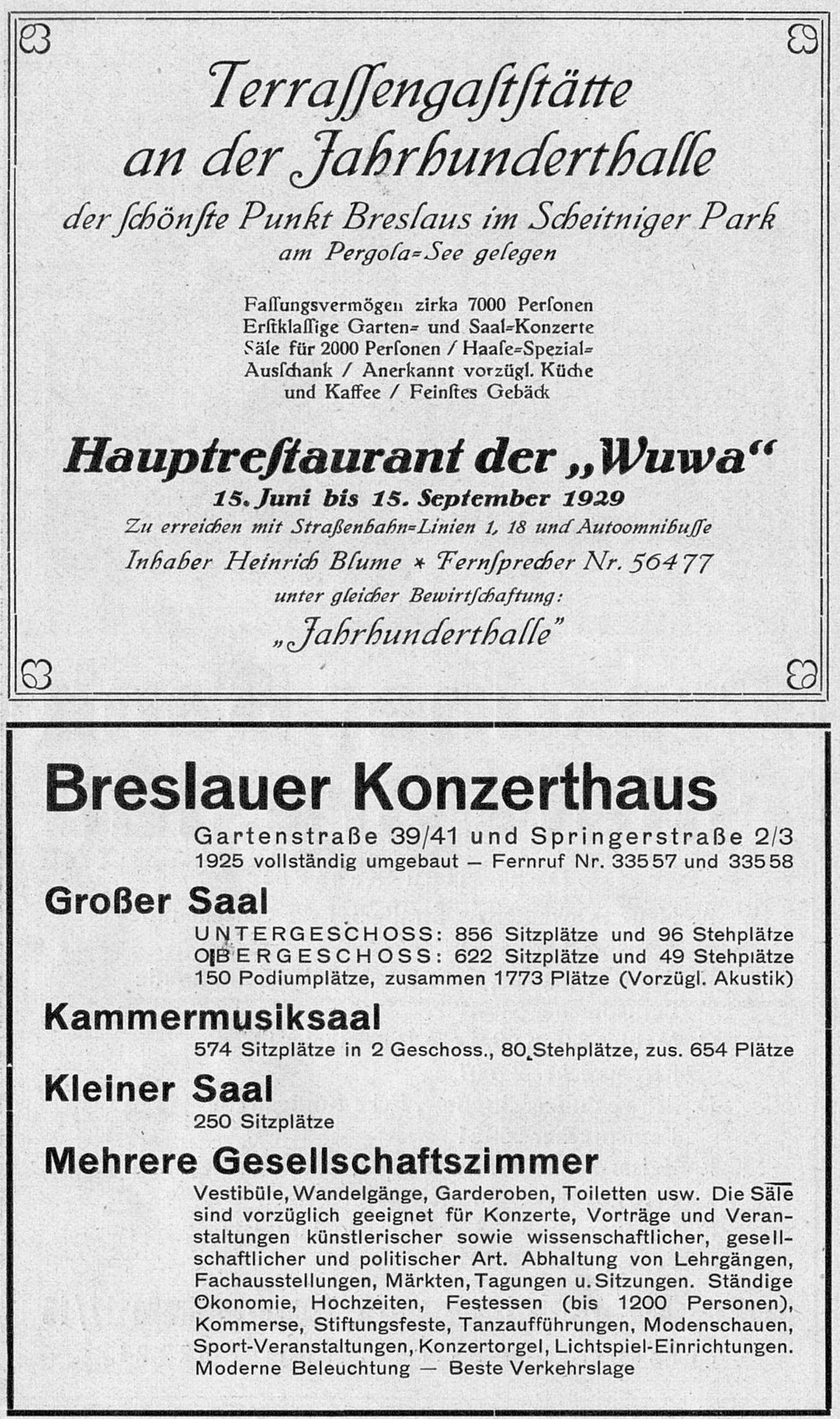
- Communal facilities such as a kindergarten, community center, and restaurant, emphasizing the importance of social infrastructure (Bright Nomad).
Noteworthy buildings include:
- Hans Scharoun’s House for Singles and Young Married Couples: An early example of co-housing (visitwroclaw.eu).
- Paul Heim’s Kindergarten: A child-centered design with direct access to gardens.
- Adolf Rading’s Row Houses: Adaptable, modular homes for families.
The estate’s curving streets and park-like landscape foster community while preserving privacy, embodying garden city principles.
Visiting WuWA: Practical Information
Visiting Hours & Ticketing
- Estate Access: The WuWA estate is an open residential district, accessible 24/7. There is no admission fee to walk the grounds (visitwroclaw.eu).
- Interiors & Guided Tours: Some buildings, such as the former kindergarten and House for Singles, are occasionally open for guided tours or exhibitions. Tickets for these can typically be purchased on-site or via official platforms, with prices ranging from 5–10 PLN (halastulecia.pl).
- WUWA Café: The informal visitor center and café (Tramwajowa 2) is generally open daily from morning to early evening, but hours may vary seasonally.
Location & Access
WuWA is located in the Dąbie district of Wrocław, bordered by Tramwajowa, Dembowskiego, Mikołaja Kopernika, and Zielonego Dębu Streets (visitwroclaw.eu). It is easily accessible by tram or bus from the city center; the nearest tram stop is “Tramwajowa.” Street parking is available but limited; cycling and public transport are recommended.
Accessibility
- Paths: Mostly flat and suitable for wheelchairs and strollers, though some sidewalks may be uneven.
- Facilities: The WUWA Café and public restrooms are accessible. The InfoWuWA Tourist Information Point provides assistance in multiple languages (visitwroclaw.eu).
Visitor Experience & Guided Tours
- Self-Guided Tours: Downloadable maps are available online or at the WUWA Café. Informational plaques and QR codes provide insights in several languages.
- Guided Tours: Offered seasonally by architectural organizations and local guides (in English and German); booking in advance is recommended (Wroclaw City Tour).
Tips for Visitors
- Visit in spring or early autumn for the best weather.
- Combine WuWA with nearby attractions like Centennial Hall and Szczytnicki Park.
- Use public transport apps such as “iMPK” or “Jak dojade” for seamless navigation (mywanderlust.pl).
- Respect resident privacy; entry into private homes is only permitted on guided tours.
- The area is safe and family-friendly; wear comfortable shoes and carry water.
Nearby Attractions & Travel Tips
- Centennial Hall: A UNESCO World Heritage Site offering exhibitions and VR experiences.
- Four Domes Pavilion: Museum of Contemporary Art.
- Szczytnicki Park: One of Europe’s largest urban parks.
- Wrocław Zoo: Including the renowned Afrykarium.
Maps, brochures, and expert advice are available at city Tourist Information Centers (Wroclaw Tourist Information Center).
Frequently Asked Questions (FAQ)
Q: Are tickets needed to visit WuWA?
A: No, there is no fee to access the estate grounds. Tickets may be required for select tours or exhibitions.
Q: What are WuWA’s visiting hours?
A: The estate is accessible at any time. The WUWA Café and guided tours have specific hours—check their websites for details.
Q: Is WuWA accessible for wheelchairs and strollers?
A: Yes, most paths are flat and suitable, though some may be uneven.
Q: Can I enter the buildings?
A: Entry into private homes is not permitted unless you join an organized guided tour.
Q: Where can I get maps and information?
A: Maps are available online, at the WUWA Café, and at Wrocław Tourist Information Centers.
Listen to the full story in the app
The whole Workplace And House Exhibition,
told well.
Audio guides for 1,100+ cities across 96 countries. History, stories, and local insight — offline ready.
Verified, and shown.
Researched and written by the Audiala editorial team from historical records, architectural archives, and local expertise.
Researched from Wikidata, Wikipedia & official sources · fact-checked · How we make our guides →