Plan and listen to Pawłowice Park, Palace And Folwark In Wrocław with Audiala.
Audio guide in your pocket, itinerary in your browser. Built for the way you actually visit.
Introduction: The Historical and Cultural Significance of Pawłowice Park, Palace, and Folwark
Situated on the northeastern edge of Wrocław, Poland, the Pawłowice Park, Palace, and Folwark comprise a remarkable historical and cultural ensemble. Evolving from monastic agricultural lands in the 18th century into an elegant neo-Renaissance estate under the patronage of the von Korn family, Pawłowice today stands as a testament to the layered history of Silesia. The estate’s centerpiece, the Korn Palace—designed by August Orth—displays striking architectural features blended seamlessly with an English-style landscape park and a historic folwark complex.
Currently managed by the Wrocław University of Environmental and Life Sciences, Pawłowice serves as a hub for education, culture, and community engagement. Visitors can wander through the arboretum, admire the tranquil pond and "Temple of Reflection" pavilion, and explore restored outbuildings now used for conferences, workshops, and accommodation. With free park entry, convenient public transport, and guided tours available, Pawłowice welcomes history enthusiasts, nature lovers, and families alike.
This guide delivers comprehensive insights into the estate's history, architecture, natural features, visitor information, and its continued cultural relevance. Whether your goal is a peaceful stroll, participation in a festival like the Cheese and Wine Festival, or discovery of educational programs, this resource will help you make the most of your visit (Visit Pawłowice, Palac Pawlowice, Wrocław University of Environmental and Life Sciences).
- Introduction
- History of Pawłowice Estate
- Architectural Features
- Natural Features and Attractions
- Educational and University Functions
- Cultural and Community Role
- Visitor Experience and Practical Information
- Frequently Asked Questions (FAQ)
- Conclusion
- Plan Your Visit and Useful Links

History of Pawłowice Estate
Early Origins and Monastic Ownership
First mentioned in 1785, the Pawłowice estate belonged to the Abbey of St. Vincent in Wrocław. It functioned as a monastic farm—combining spiritual retreat with productive agriculture.
Secularization and Private Ownership
Following the secularization of Silesian church properties in 1810, Pawłowice became privately owned, initiating a period of significant landscape and architectural transformation.
The von Korn Family Era
Acquired by the von Korn family in 1886, the estate was profoundly reshaped. In 1891, the Korn Palace was constructed—an impressive neo-Renaissance residence designed by August Orth. The surrounding park was also redesigned in the English landscape style, featuring meandering paths, water features, and rare trees.
The Schweinichen Family and Park Expansion
Marie von Korn and Constantin von Schweinichen further enlarged the park between 1890 and 1913, introducing wooded areas, additional ponds, and the iconic "Temple of Reflection" pavilion.
World War II and Postwar Transition
Remarkably, the estate survived WWII undamaged. It was nationalized in 1945 and assigned to the Agricultural Academy (now the Wrocław University of Environmental and Life Sciences).
Modern Restoration and Public Access
Registered as a historic monument in 1996, Pawłowice underwent extensive restoration in the early 21st century. It now serves as an educational, cultural, and research center, with a well-maintained arboretum and modern visitor facilities.
Architectural Features of the Estate
The Korn Palace
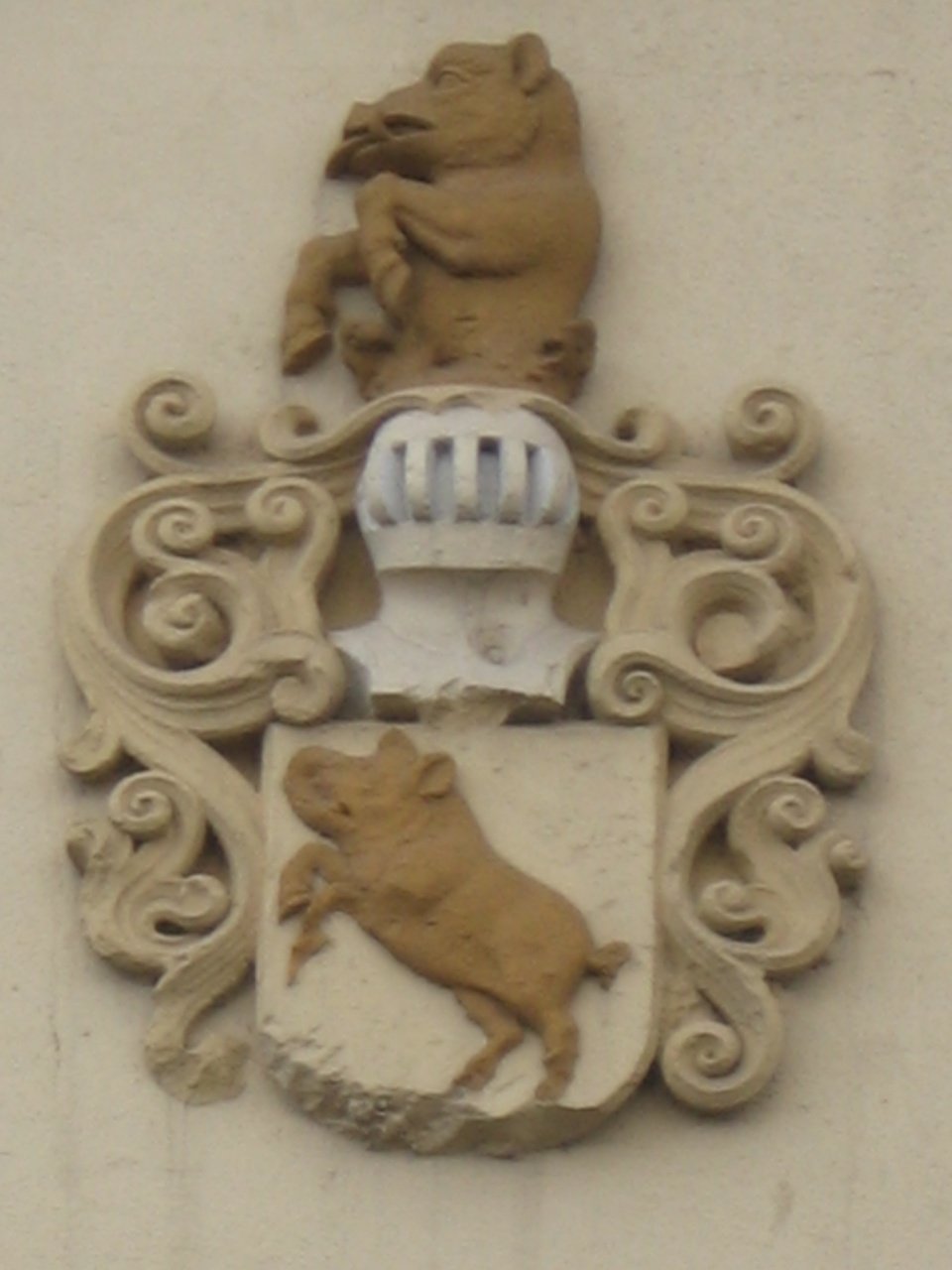
The Korn Palace is the estate’s focal point, constructed between 1891 and 1895 and attributed to August Orth. Commissioned by Heinrich Korn and his wife Helena von Eichborn, the palace exhibits northern Renaissance and French neorenaissance styles. The three-winged building features a central risalit, a southern “kawaliera” wing, and a central tower. Its distinctive façade showcases red brick with light stone trim, ornate dormers, and the Korn family’s coat of arms and motto "Candide Et Caute" ("Nobly and Prudently") (tuwroclaw.com, wroclaw-info.pl).
Inside, the entrance hall features statues of the Korn couple, echoing the estate’s deep historical roots (ahojprzygodo.com).
Folwark: Historic Outbuildings
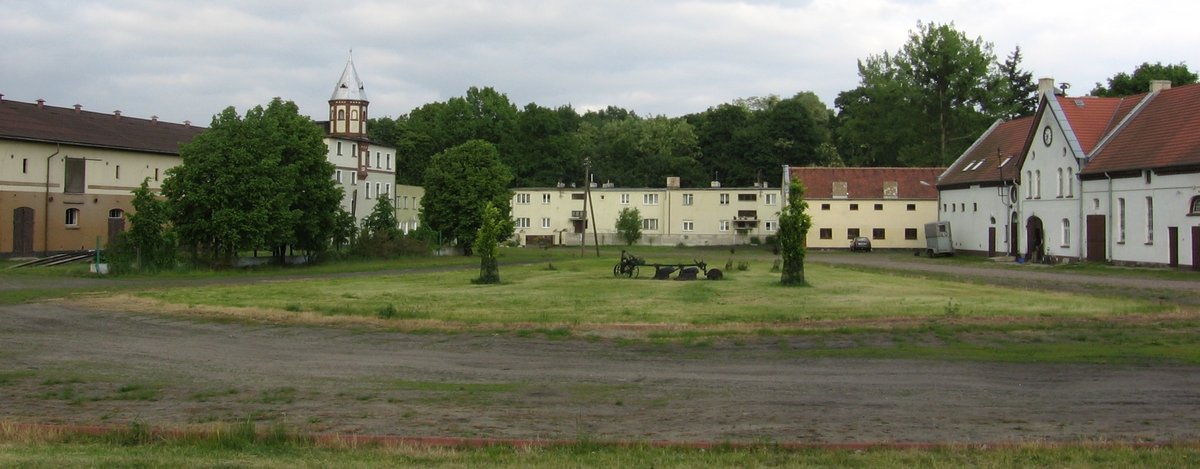
Adjacent to the palace, the historic folwark includes:
- Steward’s House
- Granary
- Mill (with preserved equipment)
- Stables and barns
- Former cowshed (adapted for events)
- Gardener’s and forester’s houses
- Water tower
These buildings, largely constructed or modernized by the Korn and Schweinichen families, form a cohesive architectural ensemble. Many have been repurposed for educational, conference, and hospitality functions (palacpawlowice.pl).
Restoration and Adaptive Reuse
After postwar nationalization, extensive restoration—particularly after a 1975 fire—was carried out, culminating in major renovations in 2005 and 2012. Today, the estate houses the Continuing Education Center, hotel, conference halls, and the “Dąbrowa” restaurant (palacpawlowice.pl).
Natural Features and Attractions
English Landscape Park and Arboretum
The estate’s English landscape park, designed and expanded in the 19th and early 20th centuries, covers 7.2 hectares, with an arboretum extending to 72 hectares. The park features winding paths, open lawns, mature trees, and over 200 species of trees and shrubs—including rare oaks, beeches, and conifers (palaceslaska.pl).
Water Features and Garden Architecture
A central pond (Staw Pawłowicki) is a focal point, enhanced by a stream and crossed by decorative bridges. The early 20th-century glorieta (“Temple of Reflection”) offers a scenic viewpoint by the water (tuwroclaw.com).
Notable Trees, Memorials, and Trails
The park is home to Wrocław’s thickest oak, “Paweł,” and several memorial stones commemorating past owners. The estate’s educational trail features informational boards about local flora and history, making it ideal for families and school groups (ahojprzygodo.com). The “Koncertuś” dwarf statue, celebrating the tradition of musical evenings, greets visitors at the palace entrance (matkawmiescie.pl).
Educational and University Functions
Managed by the Wrocław University of Environmental and Life Sciences, Pawłowice serves as the Wrocław-Pawłowice Educational and Development Center (UPWr). The estate supports:
- National and international conferences
- Workshops and professional training
- Doctoral and continuing education programs
Facilities include hotel accommodations, modern conference halls, and catering services, ensuring a balance between heritage conservation and modern utility (UPWr).
Cultural and Community Role
Festivals and Events
The estate hosts:
- Cheese and Wine Festival (Święto Sera i Wina): Celebrating local culinary traditions (Wikipedia)
- Pawłowice Evenings: Monthly music and poetry sessions
- Community gatherings, holiday celebrations, and sports events—including support for the local football club Orzeł Pawłowice
Community Integration and Accessibility
Educational outreach programs engage schools and youth, while the park remains open for public enjoyment. The district is easily accessed by public transport (buses 151 and 936) and has ample on-site parking (Wikipedia).
Visitor Experience and Practical Information
Location and Access
- Address: ul. Pawłowicka 85-101, Wrocław
- Public Transport: Bus lines 151 and 936 stop nearby
- By Car: Accessible via the A8 bypass, with two parking lots
Visiting Hours and Tickets
- Park: Open daily from dawn to dusk, free entry
- Palace: Public access during events or by prior arrangement; guided tours available with advance booking (palacpawlowice.pl)
- Events/Tickets: Special event tickets available via the official website or by contacting administration at +48 781 80 80 87
Amenities
- Restaurant: “Dąbrowa” in the palace basement
- Conference and event spaces
- Accessible paths, restrooms, and seating
- Educational trail and guided tours
Practical Tips
- Best visiting times: Spring and autumn for vibrant foliage
- Bring comfortable shoes and a camera
- Picnics are welcome; follow park rules for waste disposal
- For groups/guided tours, book in advance
Nearby Attractions
- Wrocław Old Town
- Szczytnicki Park
- Centennial Hall
- Wrocław Zoo
Frequently Asked Questions (FAQ)
Is entry to Pawłowice Park free?
Yes, the park is open daily and free to enter.
Are guided tours available?
Yes, for both the park and palace, by prior arrangement.
How do I buy event tickets?
Via the official website or administration (+48 781 80 80 87).
Is the site accessible for people with disabilities?
Yes, most paths and facilities are accessible.
Is on-site parking available?
Yes, two parking lots are provided for visitors.
Discover More
Discover the timeless charm and vibrant present of Pawłowice Park, Palace, and Folwark in Wrocław. Whether you seek history, nature, or cultural events, this destination offers a unique and enriching experience. For updates, tickets, and event schedules, visit the official Pawłowice website or the Wrocław tourism portal. Download the Audiala app for guided tours and stay connected via social media.
Summary: Key Tips for Visiting Pawłowice Park, Palace, and Folwark
Pawłowice is a unique destination blending historical depth, striking architecture, and lush natural surroundings. Its transformation from monastic estate to a neo-Renaissance masterpiece and modern educational center ensures a rich visitor experience. Take advantage of the free-entry park, diverse events, accessible amenities, and convenient transport links. Plan your visit to enjoy the estate’s heritage, participate in festivals, and immerse yourself in one of Wrocław’s most treasured landmarks (Official Pawłowice Website, Wrocław Tourism Portal, Wrocław University of Environmental and Life Sciences).
Listen to the full story in the app
The whole Pawłowice Park, Palace And Folwark In Wrocław,
told well.
Audio guides for 1,100+ cities across 96 countries. History, stories, and local insight — offline ready.
Verified, and shown.
Researched and written by the Audiala editorial team from historical records, architectural archives, and local expertise.
Researched from Wikidata, Wikipedia & official sources · fact-checked · How we make our guides →