Plan and listen to Grabiszyński Cemetery with Audiala.
Audio guide in your pocket, itinerary in your browser. Built for the way you actually visit.
Introduction
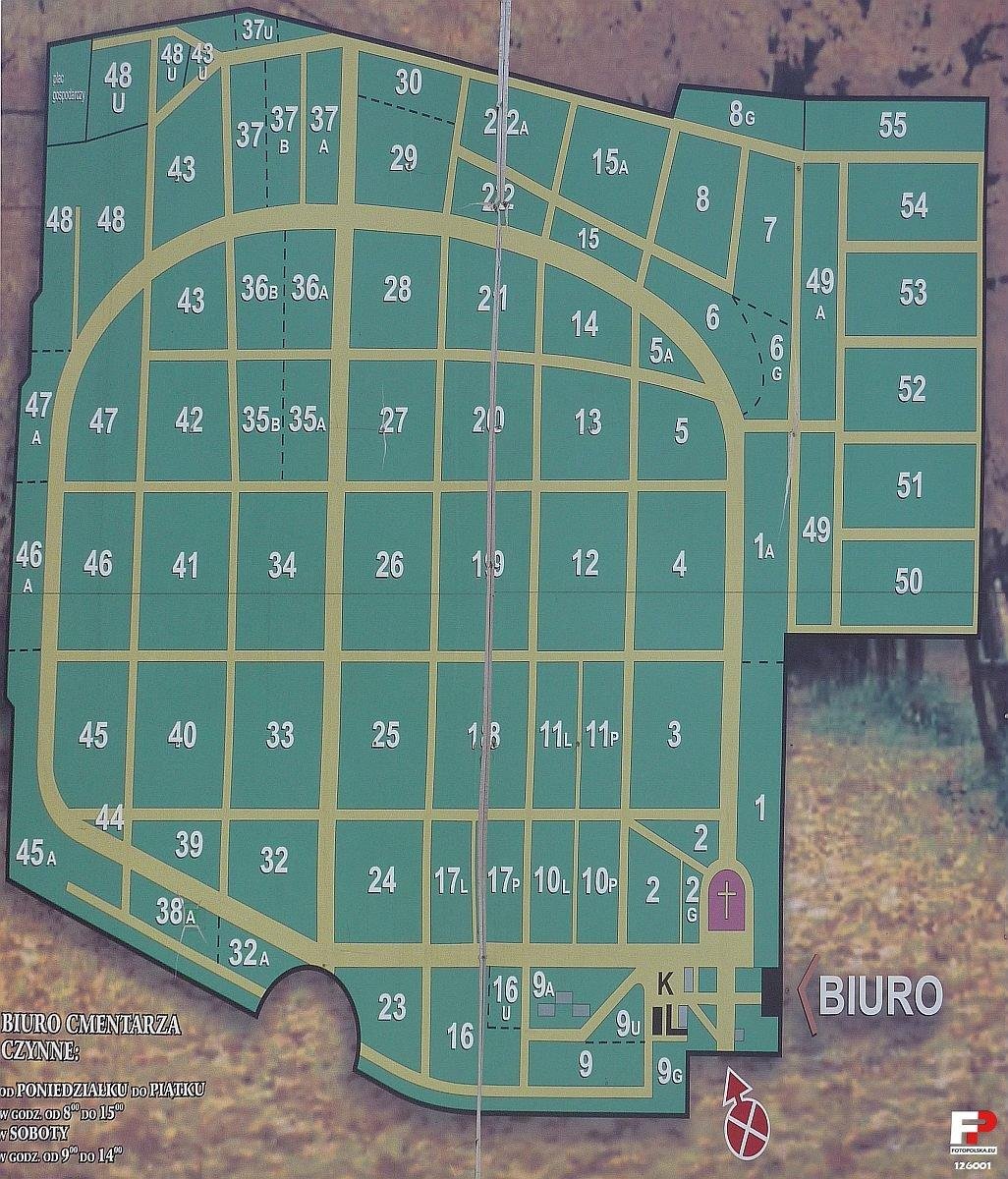
Grabiszyński Cemetery (Cmentarz Grabiszyński) stands as one of Wrocław’s most significant historical sites, encapsulating the city’s rich multicultural heritage, its turbulent past, and its transformation into a modern European metropolis. Established in the late 19th century, this expansive necropolis not only serves as a final resting place for thousands but also offers visitors a unique glimpse into Wrocław’s layered identity. From its origins during the Kingdom of Prussia to its present role as both an active cemetery and urban green space, Grabiszyński Cemetery reflects the evolution of funerary customs, urban planning, and the city’s diverse religious landscape (wroclawskiecmentarze.pl; wikipedia).
This comprehensive guide covers the cemetery’s historical development, architectural highlights, cultural significance, practical visitor information, and its integration within Wrocław’s urban fabric. Whether you are a history enthusiast, architecture lover, or simply seeking a peaceful location for reflection, Grabiszyński Cemetery offers an evocative journey through Wrocław’s past and present.

Origins and Early Development (1867–1914)
Grabiszyński Cemetery was established in 1867 as part of a city-wide initiative to move burial grounds outside the densely populated center, in line with 19th-century European urban planning and public health trends. The first section (Grabiszyński I) was designed to serve Wrocław’s diverse population, accommodating Old Catholics, Evangelical Lutherans, Roman Catholics, and religious orders such as the Bonifratres. Its layout featured rectangular plots and a central chapel in the Italian Renaissance style, designed by architect Zimmermann (wroclawskiecmentarze.pl; wikipedia).
Expansion and Architectural Features (1881–1939)
As Wrocław’s population expanded, so did the cemetery. In 1881, Grabiszyński II was opened, featuring a neo-Romanesque brick chapel with a copper-clad dome, designed by Johann Robert Mende. By the early 20th century, additional Catholic parishes and religious orders used the cemetery, and a modern crematorium was built in 1926 in Grabiszyński III, reflecting evolving funerary practices (wikipedia). By 1938, the cemetery complex spanned over 73 hectares (wroclawskiecmentarze.pl).
Wartime Destruction and Postwar Transformation (1945–1963)
The Siege of Breslau in 1945 resulted in significant destruction, particularly in the oldest section. Following World War II and the transfer of Wrocław from Germany to Poland, many graves—especially those of German citizens—were removed in accordance with national policies. The oldest sections were closed by 1963 and largely transformed into Grabiszyński Park, while only Grabiszyński II remains active as a cemetery (polishnews.com; wikipedia).
Contemporary Role and Site Layout
Surviving and Active Section
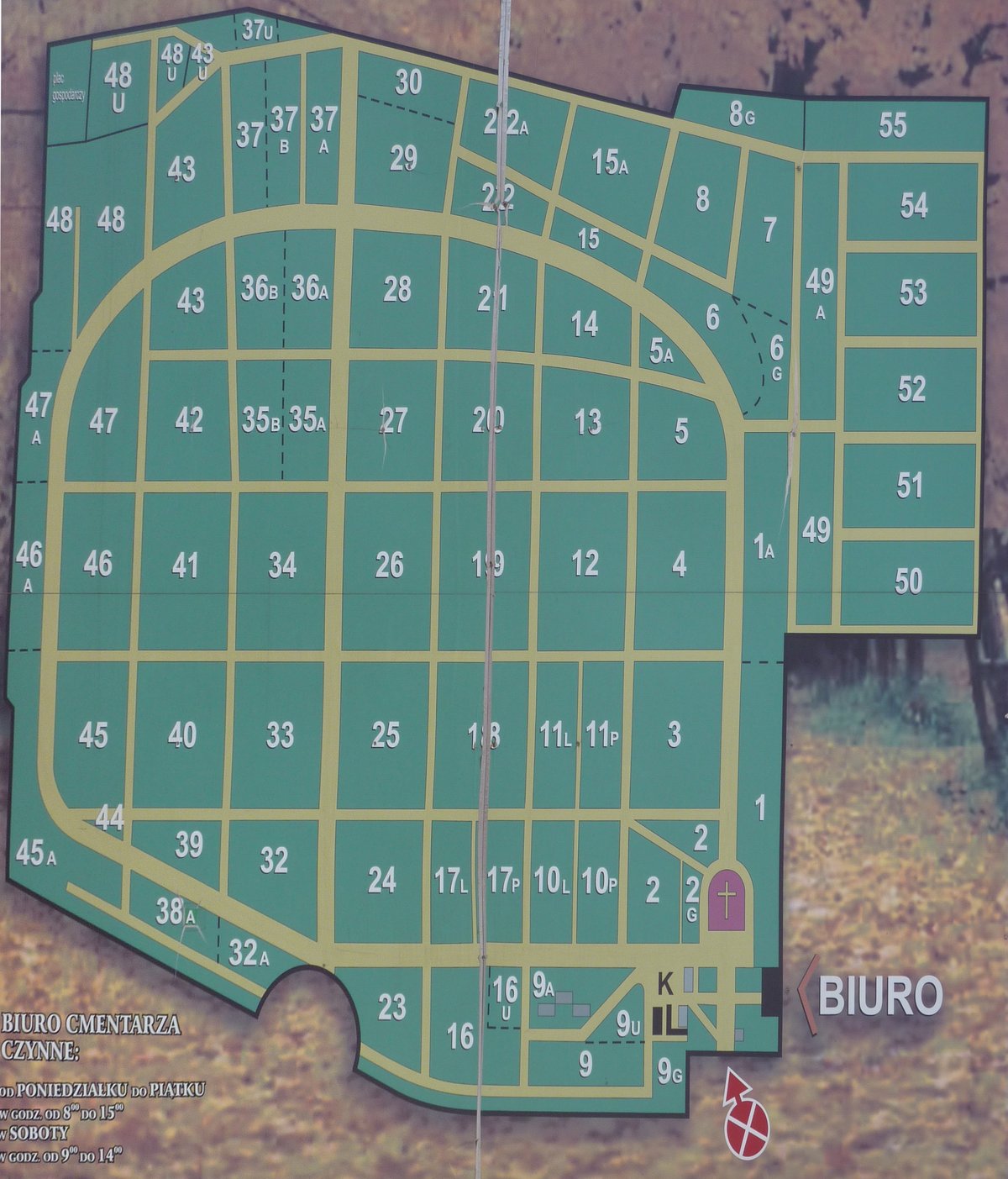
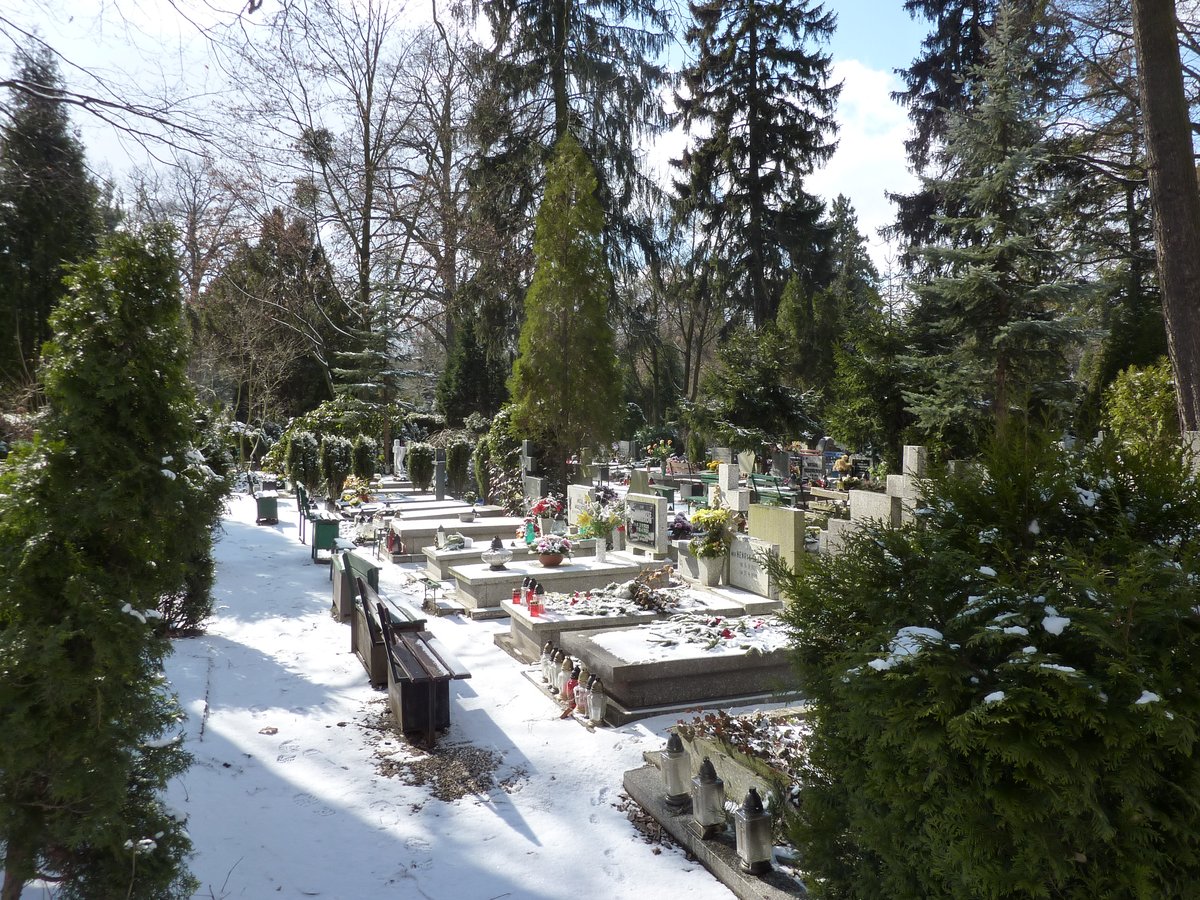
Today, Grabiszyński Cemetery II is the sole remaining active section, covering 29 hectares with over 60,000 graves. It continues to serve as a municipal burial ground, with new burials mainly limited to family plots and urn interments due to space constraints. The cemetery maintains designated areas for Orthodox Christians and other groups, reflecting Wrocław’s enduring religious diversity (wroclawskiecmentarze.pl; wikipedia).
Park Grabiszyński
The former cemetery sections (Grabiszyński I and III) have been transformed into Grabiszyński Park—a nearly 48-hectare green space featuring playgrounds, sports facilities, and walking paths while retaining elements of the original cemetery layout and scattered gravestone fragments. The park provides a balance between remembrance and recreation (wanderlog.com).
Architectural and Memorial Highlights
- Neo-Romanesque Chapel: Built in 1882 near the main entrance, this brick structure with a Greek cross plan and copper dome remains a central architectural feature (wikipedia).
- Notable Graves: The cemetery is the final resting place for many distinguished local figures, including conductor Rafał Maszkowski, actress Vilma Illing, architect Prof. Marcin Bukowski, and resistance figure Kazimierz Michalczyk (Wroclawski Portal).
- War Memorials: Includes a preserved section for Italian soldiers who died in German captivity during World War I (established in 1927), and the nearby Cemetery of Polish Soldiers with a monumental hussar-wing sculpture (wroclaw.pl - Park Grabiszyński).
- Remnants and Monuments: Scattered original gravestones, remnants of the neorenaissance chapel destroyed during WWII, and memorials highlighting the city’s multiethnic past.
Cultural and Historical Significance
Grabiszyński Cemetery is more than a burial site; it is a living chronicle of Wrocław’s social, religious, and political transformations. The cemetery mirrors the city’s multiculturalism, with graves and memorials for Protestants, Catholics, Jews, Italian and French soldiers, and members of religious orders. The Pomnik Wspólnej Pamięci ("Monument of Common Memory"), constructed from gravestones of various faiths and nationalities, underscores the shared history of Wrocław’s inhabitants (wroclaw.pl).
The conversion of cemetery sections into parkland reflects broader trends in urban redevelopment and raises ethical questions about memory, identity, and historical preservation (wroclawskiecmentarze.pl).
Visitor Information
Opening Hours and Tickets
- Cemetery: Open daily from 8:00 AM to 6:00 PM; free entry.
- Park Grabiszyński: Open from dawn to dusk; no entrance fee.
Getting There
- Location: Southwest of Wrocław city center, along Grabiszyńska Street.
- Public Transport: Accessible by tram lines 3, 10, 31 and bus lines 106, 107. Disembark at "Grabiszyńska" stop (Bright Nomad).
- Cycling: The area is bike-friendly with city bike stations nearby (Destination Abroad).
- Parking: Limited parking near the main entrance.
Accessibility
- Cemetery: Main paths are paved and wheelchair accessible; some older sections may have uneven ground.
- Park: Fully accessible with multiple entry points.
Facilities
- Restrooms are available near the main entrance.
- Information boards and maps (mainly in Polish) are placed at key locations.
- Benches are scattered throughout.
Guided Tours and Special Events
- Guided tours are occasionally offered by local historical societies and Wrocław cultural organizations. Check the official city calendar or Wroclawski Portal for schedules.
- Special events: All Saints’ Day (November 1st) is a particularly moving time to visit, with the cemetery illuminated by candles and flowers.
Visitor Etiquette
- Dress modestly and maintain a quiet demeanor.
- Photography is allowed for personal use; avoid photographing mourners or ceremonies.
- Remain on designated paths to preserve the grounds.
Photographic and Noteworthy Spots
- Neo-Romanesque chapel, historic graves, and lush greenery offer excellent photographic opportunities, especially during early morning or late afternoon.
Nearby Attractions
- Park Grabiszyński: Adjacent, ideal for walks and relaxation.
- Wrocław Old Town: A short tram ride away with major landmarks such as Market Square and Ostrów Tumski.
- Centennial Hall and other historical sites nearby for extended exploration (Visit Wroclaw).
Frequently Asked Questions (FAQ)
Q: What are the opening hours?
A: Cemetery: 8:00 AM–6:00 PM daily. Park: dawn to dusk.
Q: Is there an entrance fee?
A: No, both the cemetery and park are free to enter.
Q: Are guided tours available?
A: Occasionally, via local organizations; check event listings.
Q: Is the site wheelchair accessible?
A: Main cemetery paths and park alleys are accessible; some older cemetery sections may be uneven.
Q: Can I take photographs?
A: Yes, for personal use, with respect for visitors and ceremonies.
Q: How do I get there by public transport?
A: Tram lines 3, 10, 31 and bus lines 106, 107 stop nearby.
Q: Where can I park?
A: Limited spaces at the main entrance; recommend public transport during peak times.
Q: When is the best time to visit?
A: Spring and summer for greenery; All Saints’ Day for cultural experience.
Integration with Wrocław’s Urban Landscape
Grabiszyński Cemetery and Park exemplify Wrocław’s approach to urban evolution—preserving memory while adapting spaces for contemporary use. The transformation from necropolis to green space reflects the city’s layered history and ongoing dialogue between heritage and modernity. Ethical challenges remain, especially concerning unmarked graves and historical memory, but the site continues to invite reflection and community engagement (wroclawskiecmentarze.pl).
Final Tips and Summary
Grabiszyński Cemetery is a living testament to Wrocław’s complex history, architectural heritage, and multicultural spirit. Its park-like setting, notable monuments, and accessible location make it a meaningful destination for visitors seeking to understand the city’s evolution. Plan your visit for quiet reflection or during local commemorative events, and consider exploring nearby attractions to gain a fuller appreciation of Wrocław’s heritage.
For ongoing updates, travel tips, and event information, download the Audiala app or consult official city resources.
Listen to the full story in the app
The whole Grabiszyński Cemetery,
told well.
Audio guides for 1,100+ cities across 96 countries. History, stories, and local insight — offline ready.
Verified, and shown.
Researched and written by the Audiala editorial team from historical records, architectural archives, and local expertise.
Researched from Wikidata, Wikipedia & official sources · fact-checked · How we make our guides →