Introduction
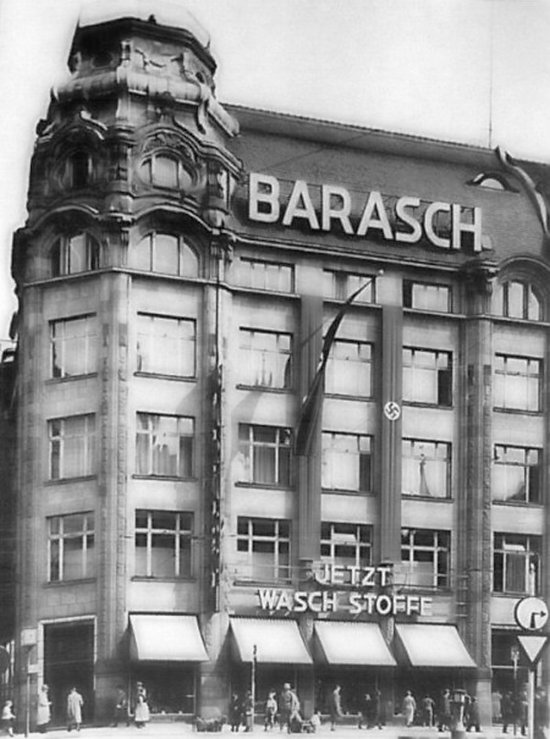
Situated in the vibrant heart of Wrocław’s historic Market Square, the Barasch Brothers Department Store—today known as Dom Handlowy Feniks—is one of the city’s most significant architectural and cultural landmarks. Originally built between 1902 and 1904 by the Barasch family, visionary Jewish entrepreneurs, the store stands as a testament to Wrocław’s multicultural heritage, early 20th-century urban innovation, and enduring spirit of resilience. With its distinctive Art Nouveau design, storied past, and central location, the department store attracts visitors interested in history, architecture, shopping, and the dynamic narrative of Wrocław itself (Culture.pl, Wroclaw Guide, Jewish Heritage Europe).
This guide will provide detailed information on the department store’s history, visiting hours, ticketing, accessibility, architectural highlights, and visitor tips, as well as a curated overview of nearby historical attractions in Wrocław.
Founding and Early Years (1902–1904)
The Barasch Brothers Department Store—originally Warenhaus Gebrüder Barasch—was established by Artur and Georg Barasch, prominent members of Wrocław’s Jewish merchant elite. Designed by Berlin architect Georg Schneider, the store was conceived as a “temple of commerce,” aiming to rival the grand department stores of Berlin and Vienna. Construction commenced in 1902, and the store opened to the public on October 4, 1904, quickly becoming the commercial centerpiece of Breslau (now Wrocław) (zydowskiwroclaw.pl, wikipedia).
Architectural Features and Innovations
The building is celebrated as a masterpiece of Art Nouveau (Jugendstil) architecture, with its flowing organic façades, floral ornamentation, and the iconic glass dome topped by a lantern and sun emblem—reflecting the store’s motto “Under the Sun of Barasch.” The ground floor’s plate-glass windows were innovative for their time, while the interior featured an open-plan atrium, grand staircase, and some of the city’s earliest passenger elevators. These features positioned the department store at the forefront of modern retail design (reddit, Wroclaw Guide).
Expansion and Interwar Transformations
The store rapidly established itself as the “ornament of the Market Square,” expanding its product range and attracting Wrocław’s growing middle class. In 1929, renovations streamlined the façade in line with contemporary tastes, removing the elaborate glazing and globe after lightning damage. The Wertheim Department Store (now Renoma) introduced new competition, and the Barasch Brothers responded by modernizing their flagship (zydowskiwroclaw.pl, wikipedia).
Nazi Persecution and Aryanization
The rise of the Nazi regime in 1933 brought persecution to the Barasch family and other Jewish entrepreneurs. Subjected to boycotts and expropriation, the Barasch family sold their business and emigrated by 1935–1936, before formal Aryanization was implemented. The building was transferred to non-Jewish ownership, and the family’s fate diverged, with Georg Barasch fleeing to Ecuador (wikipedia, zydowskiwroclaw.pl).
Wartime Destruction and Postwar Reconstruction
The department store was severely damaged during the Siege of Breslau in 1945. Following Wrocław’s transition to Polish administration, the building was rapidly reconstructed, with the ground floor reopening in August 1946. The store’s resilience became a symbol of the city’s recovery and transformation (wikipedia).
The Feniks Era: Postwar to Present
Renamed “Feniks” in 1965 to symbolize rebirth, the department store became a state-run shopping center during the communist era. It transitioned to private ownership in 1995 and operates today as Dom Handlowy Feniks, housing a diverse range of shops and services that blend historic ambiance with modern retail convenience (inyourpocket.com).
Visiting Information
Location and Access
Address: Rynek 31–32 (also listed as Rynek 39), 50-116 Wrocław, Poland
Located centrally in Wrocław’s Market Square, the department store is easily reachable on foot from major city landmarks. Public transport stops at Galeria Dominikańska and Świdnicka Street are within 5–10 minutes’ walk. Parking is available at nearby garages, but may be limited at peak times (WroclawGuide.com).
Visiting Hours and Entry
- Monday–Saturday: 9:00 AM – 8:00 PM
- Sunday: 10:00 AM – 6:00 PM
Admission to the retail area is free; no ticket is required for general entry. Hours may vary during holidays or special events—check the official website for updates.
Guided Tours and Events
- Guided tours: Available seasonally through local agencies and focus on the building’s architecture and Jewish heritage. Advance booking is recommended; tours typically cost 20–30 PLN.
- Cultural events: The store hosts exhibitions, lectures, and special displays, particularly during the Wrocław Christmas Market and city festivals (Visit Wroclaw).
Accessibility and Visitor Amenities
- Wheelchair accessible: Elevators and ramps serve all floors.
- Restrooms: Available on multiple levels.
- Information desk: Multilingual staff can assist with directions and questions.
- Wi-Fi: Complimentary throughout the building.
- ATM and currency exchange: Located on the ground floor.
Photography Guidelines
Photography is permitted in public areas; for photos inside individual shops, ask staff for permission. The glass dome, staircase, and façade are popular photographic subjects.
Architectural Highlights
- Art Nouveau façade: Characterized by flowing lines, floral motifs, and the “B” monogram.
- Iconic dome and lantern: Restored copper-clad dome with sun motif, visible from Market Square.
- Central atrium: Illuminated by a glass skylight, featuring mosaic floors and Art Nouveau ironwork.
- Grand staircase: Notable for its ornate balustrades and structural elegance.
- Stained glass and mosaics: Decorative panels and flooring evoke the building’s original grandeur.
Nearby Attractions
- Wrocław Market Square (Rynek): The city’s lively centerpiece, surrounded by historic townhouses.
- Old Town Hall: Gothic architecture and museum displays.
- St. Elizabeth’s Church: Tower with panoramic views of the city.
- Renoma Department Store: Another historic retail landmark.
- Wrocław Dwarfs Trail: A family-friendly walking adventure throughout the city.
Cultural and Social Significance
The department store is both a living monument to Wrocław’s Jewish heritage and a beacon of urban modernity. Its layered history—spanning entrepreneurial triumph, wartime devastation, and postwar renewal—mirrors the broader story of the city. Today, it serves as a hub for social gatherings, cultural events, and responsible tourism, fostering a deeper appreciation for Wrocław’s diverse past (Culture.pl, Jewish Heritage Europe).
Tips for Visitors
- Arrive early for a quieter experience and better photo opportunities.
- Combine your visit with a walking tour of Market Square and nearby attractions.
- Check for seasonal events like the Christmas Market or art exhibitions.
- Support local shops and artisans within the building.
- Use public transport to avoid parking challenges in the city center.
Frequently Asked Questions (FAQ)
Q: What are the visiting hours?
A: Monday to Saturday 9:00 AM – 8:00 PM, Sunday 10:00 AM – 6:00 PM.
Q: Is there an entrance fee?
A: General entry is free. Guided tours may require tickets.
Q: Are guided tours available?
A: Yes, seasonally and by appointment. Book in advance via local tourist offices or the official website.
Q: Is the store wheelchair accessible?
A: Yes, with modern elevators and ramps throughout.
Q: Can I take photographs inside?
A: Photography is allowed in public areas; please ask before photographing inside shops.
Q: What other attractions are nearby?
A: Market Square, Old Town Hall, St. Elizabeth’s Church, Renoma Department Store, and the Wrocław Dwarfs trail.
Listen to the full story in the app
Your Personal Curator, in Your Pocket.
Audio guides for 1,100+ cities across 96 countries. History, stories, and local insight — offline ready.
Audiala App
Available on iOS & Android
Join 50k+ Curators
Sources
- verified
- verified
- verified
- verified
- verified
- verified
- verified
- verified
- verified
- verified
Last reviewed: