Plan and listen to Fort Iii Twierdzy Warszawa with Audiala.
Audio guide in your pocket, itinerary in your browser. Built for the way you actually visit.
Introduction
Fort III Twierdzy Warszawa, also known as Fort III "Blizne," stands on the western outskirts of Warsaw as an enduring symbol of Poland’s military and architectural heritage. Built in the late 19th century as part of the Warsaw Fortress under Russian imperial rule, the fort showcases sophisticated military engineering and offers a compelling but challenging destination for history enthusiasts. While regular public access to Fort III is restricted due to private ownership and preservation concerns, its historical context and architectural features make it a focal point for those interested in Warsaw’s layered past. This guide presents a detailed overview of Fort III’s history, architecture, current status, and practical information for visitors, and highlights accessible alternatives for exploring Warsaw’s military heritage.
Historical Background of Fort III Twierdzy Warszawa
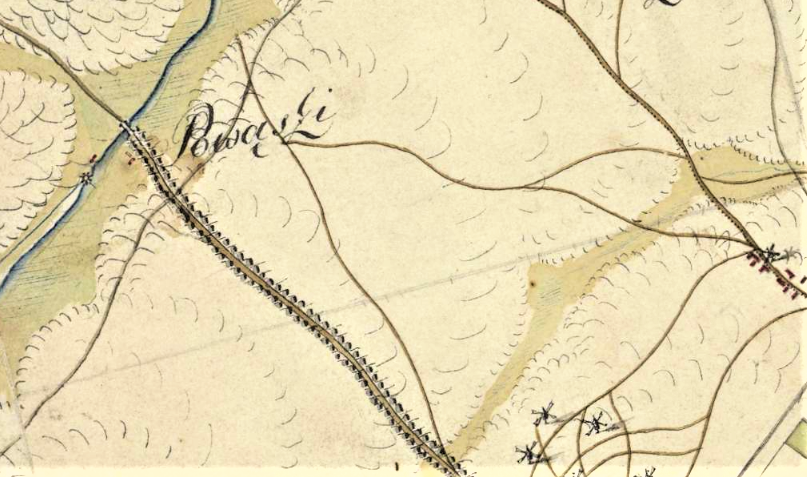
Fort III was constructed between 1883 and 1890 as part of the Warsaw Fortress, a defensive system encircling the city to strengthen Russian control after the November Uprising. Designed to resist contemporary siege warfare, the fort formed a critical point in the outer defensive ring west of Warsaw. Its strategic placement enabled coordination with neighboring forts, emphasizing Warsaw’s importance in regional military planning (forty.waw.pl, Wikipedia).
Architectural Features and Evolution
Fort Design and Layout
Fort III exhibits a trapezoidal plan with characteristic elements of late 19th-century fortification:
- Brick barracks: Seventeen earth-embanked, reinforced chambers for troops and supplies.
- Four internal courtyards: Allowed efficient movement and logistics.
- Five sets of casemates: Initially brick, later reinforced with concrete.
- Earthen ramparts and wet moat: Defensive features that remain visible, especially the moat, which still retains water.
- Carnot wall: The only preserved wall of its type among the Modlin forts, protecting the moat’s rear section.
- Rear caponier: Flanking structure for entrance defense.
Modernization
Over time, the fort was adapted to changing military tactics:
- Ramparts were optimized for infantry.
- Artillery positions moved outside main defensive structures.
- Concrete replaced brick in some defensive elements.
- Barracks largely preserved in their original form.
Surviving and Lost Elements
- Some caponiers were demolished before WWI.
- Postwar adaptations included military hotels, garages, and recreational allotments.
- The main architectural layout remains visible, though parts are overgrown or ruined (forty.waw.pl, Wikipedia).
Cultural and Historical Significance
Fort III is part of an extensive network of Warsaw’s fortifications, representing Poland’s turbulent history and shifting political landscape. As a witness to both military activity and community adaptation, the fort reflects the evolution from imperial defense to peacetime reuse. While Fort III itself is associated primarily with its military origins, nearby forts such as Pomiechówek serve as sites of WWII remembrance (forttrzecipomiechowek.org).
Current State and Preservation Challenges
Legal Status and Ownership
- Fort III is a registered historic monument (“Fort III Blizne-Groty”).
- It is privately owned, which limits restoration funding and public access (Wikipedia).
Condition
- The fort’s main structures are partially intact, but many elements are overgrown or in disrepair.
- No active restoration is underway as of 2025.
- Community or institutional initiatives for preservation are limited, in contrast to other Warsaw forts that have been repurposed as public spaces.
Visitor Information
Visiting Hours and Tickets
- Access: Fort III Twierdzy Warszawa is not open to the public. There are no official visiting hours or tickets due to private ownership and safety concerns.
- Guided Tours: There are no regular guided tours. Any access would require explicit permission from the owner, which is rarely granted (Obieżyświaty4).
- Viewpoints: The fort can be observed from nearby public roads, but entry is prohibited.
Accessibility
- Location: ul. Lazurowa 187, western Warsaw.
- Transport: Accessible by car (S8 expressway), bicycle, or public transport to Lazurowa Street. No dedicated parking or visitor signage.
- Safety: The site is overgrown, with unstable ruins—do not attempt to enter.
Facilities
- There are no visitor amenities or facilities at Fort III.
Alternative Accessible Sites
- Warsaw Citadel: Open to the public, includes museums and exhibitions.
- Fort Sokolnickiego: Reused as a cultural center.
- Fort III Pomiechówek: Near Warsaw, offers guided tours and accessible facilities (castana.eu, forttrzecipomiechowek.org).
Special Events and Experiences
- Fort III does not host public events.
- Occasionally, special historical walks or community events may be organized in the broader Warsaw Fortress area; check warsawtour.pl for updates.
Practical Travel Tips and Nearby Attractions
- What to Bring: If observing from public roads, bring binoculars or a good zoom camera.
- Combine Your Visit: Explore nearby accessible forts, the Warsaw Citadel, or local parks.
- Dress Appropriately: Wear comfortable shoes and be prepared for outdoor conditions.
Fort III Pomiechówek: A Recommended Alternative
For those interested in accessible military sites, Fort III Pomiechówek—part of the Modlin Fortress complex—offers guided tours, memorial exhibits, and wheelchair-friendly amenities. Tours are available on specific dates and must be booked in advance online (forttrzecipomiechowek.org, castana.eu). Facilities include parking, restrooms, and a visitor center. The fort is located approximately 40 km from central Warsaw and is accessible by car or public transport.
Frequently Asked Questions (FAQ)
Q: Can I visit Fort III Twierdzy Warszawa?
A: No, the fort is privately owned and closed to the public.
Q: Are there official tours or tickets?
A: No, there are no tours or tickets available for Fort III.
Q: How can I find the fort?
A: The site is at ul. Lazurowa 187. You can view it from public roads, but entry is not permitted.
Q: Are there any similar sites I can visit?
A: Yes, you can explore the Warsaw Citadel, Fort Sokolnickiego, and Fort III Pomiechówek, which are open to visitors.
Q: Is the area safe to explore?
A: Do not enter the fort property. Observe only from public areas for safety.
Q: Is Fort III Pomiechówek wheelchair accessible?
A: The main entrance and key areas are accessible, though some historic sections may be challenging for visitors with limited mobility.
Listen to the full story in the app
The whole Fort Iii Twierdzy Warszawa,
told well.
Audio guides for 1,100+ cities across 96 countries. History, stories, and local insight — offline ready.

Verified, and shown.
Researched and written by the Audiala editorial team from historical records, architectural archives, and local expertise.
Researched from Wikidata, Wikipedia & official sources · fact-checked · How we make our guides →