An introduction.
Researched by the Audiala editorial team from historical records, architectural archives, and local expertise.
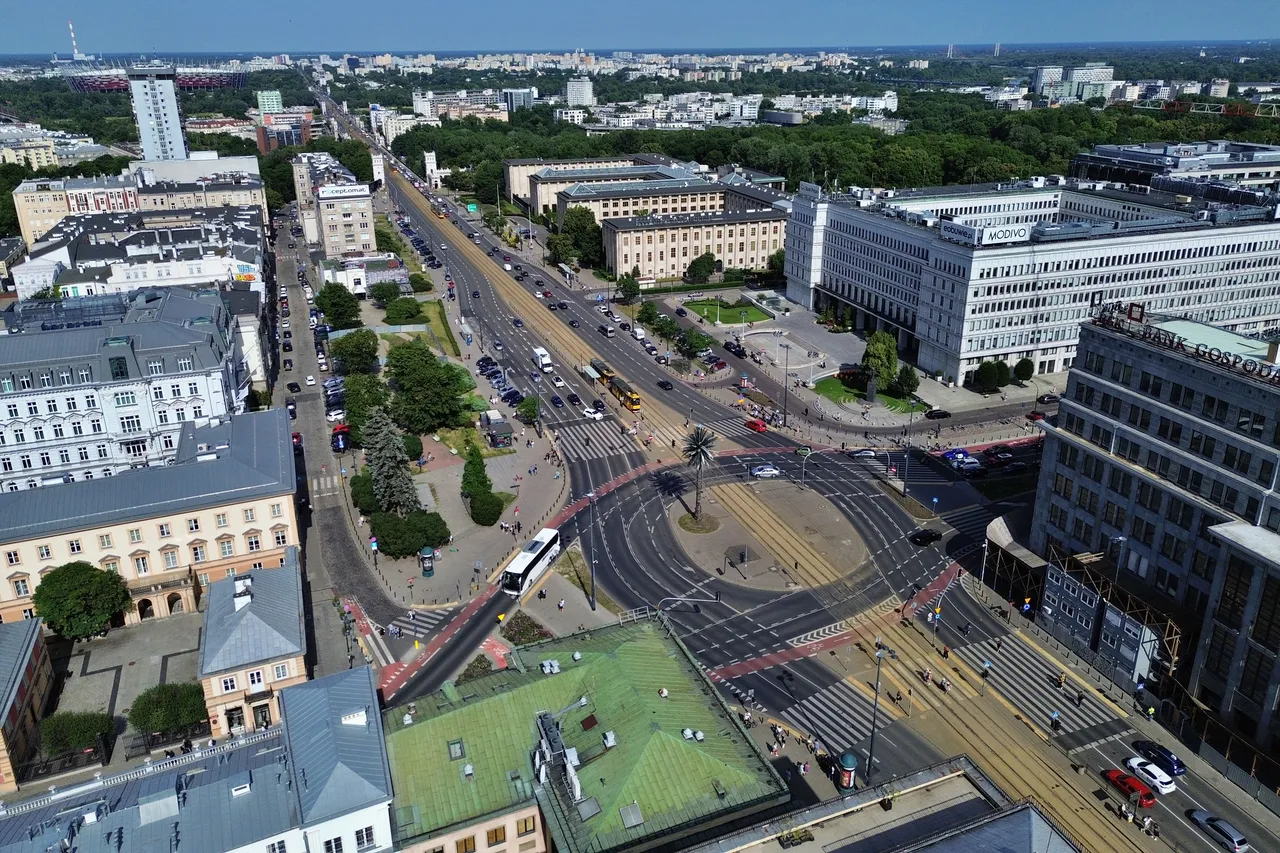
AAn artificial palm tree and a bronze French general share a traffic island in the middle of Warsaw, Poland — and somehow it works. Rondo Generała Charles'a de Gaulle'a sits at the crossroads of Nowy Świat and Aleje Jerozolimskie, two of the city's most storied arteries, and the collision of symbols planted here tells you more about Warsaw's layered identity than most museums manage in a full afternoon.
The roundabout itself is unremarkable infrastructure — asphalt, lane markings, a steady churn of trams and taxis. What makes it worth stopping for is everything standing on it. A 4-meter bronze de Gaulle in full military dress gazes southward. Fifteen meters away, a tropical date palm — entirely fake, entirely deliberate — rises taller than a four-story building. One honors a French war hero who once lived on the street you're standing on. The other mourns an entire community that vanished from it.
This is a place where Warsaw argues with itself in public. The palm provokes. The statue reassures. Traffic flows around both, indifferent. And if current city plans hold, the roundabout won't exist by 2030 — slated for demolition as part of the New Center of Warsaw redevelopment. So the argument has an expiration date.
You can reach it easily from the Muzeum Narodowe tram and bus stops, and it functions as a natural starting point for walking the Royal Route northward toward the Old Town. But linger here first. The intersection has things to confess.
01 What to see.
The Charles de Gaulle Statue
Greetings from Jerusalem Avenue (The Palm Tree)
Starting Point for the Royal Route
02 In pictures.


Plan and listen to Charles De Gaulle Roundabout In Warsaw with Audiala.
Audio guide in your pocket, itinerary in your browser. Built for the way you actually visit.
03 Visitor logistics.
The practical scaffolding for a good visit — kept short.
Getting There
The roundabout sits where Nowy Świat meets Aleje Jerozolimskie — two of Warsaw's main arteries. Take any tram or bus to the "Muzeum Narodowe" stop complex, which drops you within 50 meters. From Centrum metro station, it's a 10-minute walk south along Nowy Świat; from Nowy Świat-Uniwersytet metro (Line 2), walk about 8 minutes south.
Opening Hours
As of 2026, this is a public traffic roundabout — open 24 hours, every day, no ticket required. The de Gaulle statue and the palm tree are visible at all times from the surrounding pavements. Be aware the roundabout is scheduled for demolition and conversion into a standard intersection between 2027 and 2030 as part of the New Centre of Warsaw project.
Time Needed
A quick look at the statue and palm tree takes 5–10 minutes. If you want to read the plaques, photograph the surreal pairing of a bronze French general and a 15-meter artificial date palm, and absorb the context, allow 15–20 minutes. Most visitors fold this into a walk along the Royal Route or a visit to the nearby National Museum.
Accessibility
The surrounding pavements are flat and paved, fully accessible by wheelchair. Reaching the central island where the statue stands requires using pedestrian crossings with lowered curbs and signal lights. An underground passage also connects the corners of the intersection, though not all entrances have step-free access — check for the ramp on the Nowy Świat south side.
04 Tips for visitors.
Small things that change the day.
Frame the Absurdity
The best photo angle captures both the stern bronze de Gaulle and the tropical palm in a single shot — stand on the southwest pavement near the National Museum entrance. Late afternoon light hits the statue's face and makes the palm leaves glow an almost believable green.
Stay on the Pavement
Do not attempt to walk across the roundabout's traffic lanes to reach the central island directly. Use the marked pedestrian crossings or underground passages — Warsaw drivers treat this junction with the urgency of a Formula 1 pit lane.
Eat on Nowy Świat
Walk one block north on Nowy Świat for dense cafe options. Café Blikle (mid-range, famous doughnuts since 1869) is a five-minute stroll. For budget pierogi, try Zapiecek on the same street — expect to pay around 30–40 PLN for a full plate.
Start the Royal Route
This roundabout marks a natural launching point for walking north along the Trakt Królewski toward the Old Town, passing the Tadeusz Kościuszko Monument and eventually the Pomnik Powstania Warszawskiego. The full walk is about 4 km — roughly an hour without stops.
Visit Before It Vanishes
The roundabout is slated for removal by 2030 as part of a major railway tunnel modernization. The palm tree will reportedly be relocated nearby, but this specific composition — de Gaulle standing guard over a fake tropical tree in a traffic circle — has an expiration date. See it while the absurdity is intact.
The Palm's Real Meaning
Most passersby assume the 15-meter artificial palm is decorative whimsy. It's not — artist Joanna Rajkowska installed it in 2002 as a pointed reference to Aleje Jerozolimskie's name, which traces back to an 18th-century Jewish settlement. The palm marks an absence, not a presence.
Where to Eat
Don't Leave Without Trying
Smolna Hideout Café & Bar
local favoriteOrder: A quality espresso or specialty coffee while settling into this hideaway—locals come here to escape the roundabout rush.
This is where actual Warsaw residents hang out: a proper café-bar hybrid on a quiet street just off the main drag. No tourist menu, just honest coffee and a genuine neighborhood vibe.
Win Casino Warszawa
quick biteOrder: A drink and some bar snacks—this is the place for late-night sustenance when everything else has closed.
Open around the clock with nearly 220 reviews, this is Warsaw's reliable 24-hour spot for when you need food and drinks at 3 AM or any other ungodly hour.
ELEMENTY MARKET
cafeOrder: Fresh pastries and coffee in a space that doubles as a curated marketplace—grab something quick and browse the local goods.
This is Warsaw's modern take on the neighborhood café: part coffee shop, part cultural hub. Perfect for a quick bite between exploring the city.
Good Taste
local favoriteOrder: Whatever's on the daily lunch special—this is honest Polish cooking done right, the kind of place where locals actually eat.
Small, focused, and perfectly rated by people who know what they're talking about. This is the real deal: traditional Polish food without pretension or tourist markup.
Dining Tips
- check Look for daily lunch specials (obiad) at local restaurants—they're cheap, authentic, and where Poles actually eat.
- check Traditional Polish dishes are hearty and meat-heavy; come hungry and don't skip the soups.
- check Cafés in Warsaw are social hubs, not just coffee stops—locals linger, work, and meet here.
- check The area around de Gaulle Roundabout is centrally located; most restaurants are walkable from nearby neighborhoods.
Restaurant data powered by Google
05 A General, a Palm, and a Street Named Jerusalem
Aleje Jerozolimskie — Jerusalem Avenue — takes its name from an 18th-century Jewish settlement called Nowa Jerozolima that once stood along its western stretch. By the time the roundabout was completed in August 1961, replacing a standard intersection during the postwar reconstruction of eastern Warsaw, that origin had been quietly buried under decades of ideology and concrete. The name survived. The community did not.
The roundabout spent its first three decades as an anonymous traffic circle. Then 1990 arrived, and with it, the freedom to rename things. On September 28 of that year, the city council christened it after Charles de Gaulle — a choice that seemed safe, diplomatic, and European. What nobody anticipated was that twelve years later, an artist would plant something on it that made the whole city uncomfortable.
De Gaulle's Warsaw Years and a Statue Decades Late
Charles de Gaulle arrived in Warsaw in 1919, a 28-year-old captain attached to the French military mission advising the newly independent Polish army. He lived on ulica Nowy Świat — the very street that feeds into the roundabout now bearing his name — and spent two years training Polish officers, including a stint near the front during the Polish-Soviet War of 1920. Poland awarded him the Virtuti Militari, its highest military decoration. He went home to France and eventually became the man history remembers.
When the roundabout was named for him in 1990, there was talk of a statue. It didn't materialize for another fifteen years. On May 15, 2005, French Foreign Minister Michel Barnier unveiled a 4-meter bronze sculpted by Jean Cardot — a copy of the one standing near the Grand Palais in Paris. The figure wears a military uniform and kepi hat, striding forward with the posture of a man who expects the world to get out of his way. The bronze was cast not in France but in Bielsko-Biała, a Polish city better known for its Fiat factory. A small Franco-Polish irony.
The city council later fussed over the grammar of the roundabout's name, passing a corrective resolution on November 8, 2012, to fix the Polish declension of "Charles." Warsaw takes its apostrophes seriously.
The Palm That Wouldn't Leave
A Roundabout with an Expiration Date
Listen to the full story in the app
The whole Charles De Gaulle Roundabout In Warsaw,
told well.
Listen to sourced travel stories with local history and practical context — ready offline.
06 Frequently asked.
The questions travellers send us most about Charles De Gaulle Roundabout In Warsaw.
Is Rondo de Gaulle'a worth visiting in Warsaw?
Yes, though not for the reasons most visitors expect. The bronze statue of de Gaulle is fine, but the real draw is the 15-meter artificial palm tree beside it — a politically charged art installation that has quietly become one of Warsaw's most argued-over landmarks. Give it ten minutes and you'll leave with a completely different read on what Jerusalem Avenue's name actually means.
How long do you need at Rondo de Gaulle'a?
Fifteen to twenty minutes is enough to take in both the statue and the palm tree and read their context. The roundabout sits at the start of the Royal Route along Nowy Świat, so most visitors fold it into a longer walk rather than treating it as a standalone stop.
What is the palm tree at Rondo de Gaulle'a?
It's an art installation called 'Pozdrowienia z Alej Jerozolimskich' (Greetings from Jerusalem Avenue), erected on December 12, 2002 by artist Joanna Rajkowska. The palm was designed as an 'anti-monument' — a deliberate provocation to make Varsovians ask why a major city avenue is named Jerusalem Avenue, pointing to the 18th-century Jewish settlement that once stood nearby and the community that no longer does. In 2023, engineers from the Warsaw University of Technology replaced its leaves using composite glass fabrics and polyurethane matrix to keep it standing against wind.
Is the de Gaulle statue in Warsaw an original?
No — it's a cast of a statue that stands in Paris, where the original was unveiled in 2000. The Warsaw version, sculpted by Jean Cardot and manufactured in Bielsko-Biała, was unveiled on May 15, 2005 by French Foreign Minister Michel Barnier. At 4 meters tall — roughly the height of a double-decker bus roof — it shows de Gaulle in full military uniform and kepi.
Why is the roundabout named after Charles de Gaulle?
De Gaulle served with the French military mission in Poland between 1919 and 1921 and lived on Nowy Świat, the very street that meets this roundabout. The roundabout itself was built in August 1961 but only received his name on September 28, 1990 — the name was then formally corrected by city council resolution on November 8, 2012 to include the proper French apostrophe construction.
Is Rondo de Gaulle'a going to be demolished?
Yes, as of current city plans. The roundabout is scheduled for removal between 2027 and 2030 as part of the 'New Center of Warsaw' project and the modernization of the cross-city railway tunnel, converting it back into a standard intersection. The palm tree is expected to be relocated nearby rather than removed.
How do I get to Rondo de Gaulle'a in Warsaw?
The roundabout sits at the intersection of Nowy Świat and Aleje Jerozolimskie in central Warsaw. The nearest public transport stop is 'Muzeum Narodowe,' served by multiple tram and bus lines. Do not try to walk across the roundabout itself — use the designated pedestrian crossings and underground passages.
What is near Rondo de Gaulle'a worth seeing?
The roundabout marks the southern end of Nowy Świat, Warsaw's most cafe-dense street, and serves as the starting point for the Royal Route heading north. The National Museum is a two-minute walk east. For other Warsaw monuments, the Tadeusz Kościuszko Monument and the Pomnik Powstania Warszawskiego are both reachable on foot.
Verified, and shown.
Researched and written by the Audiala editorial team from historical records, architectural archives, and local expertise.
Statue unveiling date, sculptor Jean Cardot, manufacturing location, and statue dimensions.
Roundabout construction date (August 1961), naming date (September 28, 1990), official name correction (November 8, 2012), and planned demolition timeline.
Palm tree installation date (December 12, 2002), artist Joanna Rajkowska, conceptual background as anti-monument, and materials.
2023 renovation details: replacement of palm leaves using composite glass fabrics and polyurethane matrix for wind resistance.
Confirmed plans to remove the roundabout between 2027–2030 and relocate the palm tree as part of the New Center of Warsaw project.
Built from cited sources · see the method · How we make our guides →