Plan and listen to Bródno Cemetery with Audiala.
Audio guide in your pocket, itinerary in your browser. Built for the way you actually visit.
Introduction
Bródno Cemetery (Cmentarz Bródnowski) is Warsaw’s largest and one of Europe’s most extensive cemeteries, covering approximately 114 hectares. Established in the late 19th century, it is the final resting place for over 1.2 million people, reflecting the rich social, multicultural, and turbulent history of Warsaw. The cemetery also neighbors the historically significant Bródno Jewish Cemetery, founded in 1780, which stands among Poland’s largest surviving Jewish burial sites and is central to Jewish heritage restoration in the city.
This guide provides comprehensive details for visitors, including opening hours, ticket and entry policies, accessibility features, transportation options, and practical travel tips. It also delves into the cemetery’s historical context, from its origins and evolution through pivotal events such as World War II, to ongoing preservation and restoration efforts. Special attention is given to the Bródno Jewish Cemetery’s revival, educational role, and its place in Warsaw’s collective memory.
Whether you are a history enthusiast, genealogist, or a traveler eager to connect with Warsaw’s past, this guide equips you with the knowledge to appreciate and respectfully experience this profound necropolis.
For the latest updates and additional insights, refer to resources like Timenote.info, Jewish Heritage Europe, and Find a Grave.

Visiting Bródno Cemetery: Practical Information
Visiting Hours
Bródno Cemetery is open daily from 8:00 AM to 6:00 PM, with extended hours until 8:00 PM during the summer months (April–September). On major religious holidays and commemorative events, hours may vary; it’s best to confirm current times before your visit.
Tickets and Entry
Entry is free for all visitors. Donations for cemetery maintenance and restoration are appreciated and can be made at the cemetery office. Guided tours and special exhibitions may require prior registration or a nominal fee.
Accessibility
The main paths are wheelchair-accessible and suitable for strollers. However, some older sections have uneven or unpaved terrain, so visitors with mobility concerns should check with the cemetery office for assistance.
How to Get There
Bródno Cemetery is located at ul. Św. Wincentego 15, in the Targówek district of northeastern Warsaw. Public transport options:
- Tram: Lines 1, 3, 4, 17, and 25 stop at “Bródno-Cmentarz.”
- Bus: Several lines, including 135 and 512, serve the area.
- Car: Limited parking is available near the main entrance, especially crowded during holidays.
Nearby Attractions and Tours
Nearby, you can visit the Old Town, the Praga district, or the Museum of Warsaw Praga. Guided tours of Bródno Cemetery are occasionally organized by local historical societies and tourism groups; check in advance for schedules.
Special Events and Photographic Spots
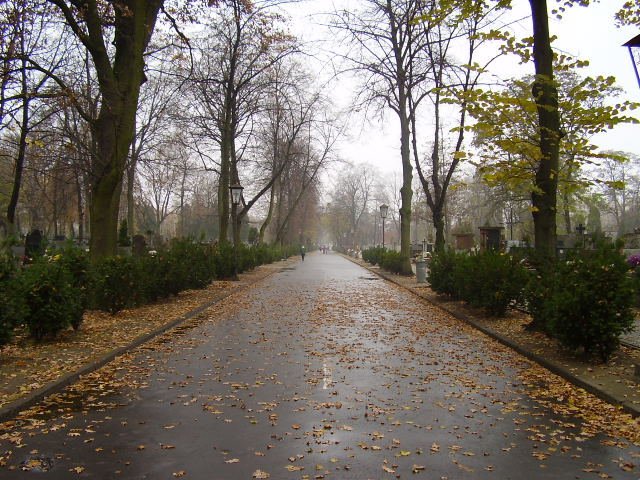
All Saints’ Day (November 1st) is a major event, with thousands gathering to light candles, creating a stunning visual effect. The cemetery’s tree-lined avenues and varied monuments are ideal for photography, especially in autumn.
Origins and Establishment
Bródno Cemetery was established in 1884 to address overcrowding in Warsaw’s existing cemeteries. Consecrated by Archbishop Wincenty Teofil Popiel, it opened in January 1885, initially serving mainly Praga residents but soon becoming available to all Warsaw citizens (Timenote.info, Find a Grave).
Early Development and Social Role
Originally designated for the city’s poor, Bródno Cemetery contrasted with the prestigious Powązki Cemetery. Its simple layout reflected this purpose, but by the 1920s, more affluent citizens began to choose Bródno as their final resting place (Timenote.info).
Expansion and Physical Characteristics
By 1934, the cemetery had expanded to its current 114 hectares, making it one of Europe’s largest. It is divided into religious and non-religious sections, reflecting Warsaw’s multicultural fabric.
Interwar Period and Changing Status
During the interwar period, the cemetery’s prestige grew, evidenced by more elaborate monuments and burials of prominent individuals (Find a Grave).
World War II and Resistance Activities
During WWII, Bródno Cemetery became a hiding place and weapons depot for the Polish resistance, as well as a refuge for those fleeing Nazi persecution (Timenote.info).
Postwar Developments and Modern Use
After the war, the cemetery continued to serve all Warsaw residents, expanding its inclusivity and adapting to urban growth.
Cultural and Historical Significance
Bródno Cemetery is a microcosm of Warsaw’s history, with burials of resistance fighters, artists, scholars, and notable figures like Roman Dmowski (British Poles). Its multifaith sections reflect the city’s diverse communities.
Role in Commemoration and Memory
All Saints’ Day transforms the cemetery into a site of collective remembrance, with thousands of candles honoring the departed.
Architectural and Artistic Features
The grounds showcase a variety of tombstones, from modest markers to ornate sculptures and chapels, creating a unique landscape for reflection.
Preservation and Contemporary Challenges
Ongoing restoration efforts, especially in Jewish sections, are supported by local authorities and heritage organizations (Jewish Heritage Europe).
Bródno Jewish Cemetery: History, Visiting Information, and Restoration
Origins and Historical Development
Established in 1780, Bródno Jewish Cemetery is the oldest surviving Jewish burial ground in Warsaw and one of Poland’s largest. Over 250,000 individuals were buried here, mirroring the vibrance of pre-war Jewish life (Jewish Heritage Europe).
Architectural and Artistic Features
The cemetery features avenues of silver birch and an array of matzevot (tombstones), with approximately 20,000 still visible. Tombstones bear Hebrew, Yiddish, Polish, and Russian inscriptions, often adorned with Jewish symbols (Lonely Planet).
Impact of War and Neglect
The cemetery suffered extensive destruction during WWII and under communist rule, with many gravestones removed and the grounds neglected. By the late 20th century, much of the cemetery was overgrown and forgotten (Jewish Heritage Europe).
Restoration and Preservation Efforts
Since 2012, ownership returned to the Jewish community, enabling restoration projects funded by international and local organizations. Key initiatives involve reconstructing boundaries, restoring gravestones, and establishing the Bet Almin – House of Eternity visitor center (Jewish Heritage Europe). Digital documentation aids genealogy and research (Foundation for the Documentation of Jewish Cemeteries in Poland’s database).
Visiting Hours, Tickets, and Accessibility
- Visiting Hours: Tuesday–Sunday, 10:00 AM–4:00 PM; closed Mondays and major holidays.
- Tickets: Free entry; donations welcome. Exhibitions or tours may require a fee.
- Accessibility: Main paths and visitor center are wheelchair-accessible, but much of the terrain is uneven.
Guided Tours and Events
Guided tours are available by appointment and provide historical and cultural context. The Bet Almin center hosts exhibitions and workshops.
Travel Tips and Nearby Attractions
The cemetery is accessible by trams and buses. Combine your visit with the POLIN Museum or Praga district for a comprehensive heritage experience.
Educational and Cultural Role
The Bet Almin visitor center (opened 2018) offers exhibitions on Jewish funerary customs and Warsaw’s Jewish history, with bilingual displays (Jewish Heritage Europe).
Symbolism and Memory
Bródno Jewish Cemetery stands as a testament to both the tragedy and resilience of Warsaw’s Jewish community, with restoration efforts symbolizing broader reconciliation and remembrance.
Documentation and Digital Heritage
Digitization projects allow descendants and researchers worldwide to access information about the cemetery (Jewish Heritage Europe).
Challenges and Future Prospects
Challenges include environmental degradation, vandalism, and the scale of restoration needed. Community involvement and international support remain vital.
Visitor Experience and Practical Tips
Location, Access, and Opening Hours
Bródno Cemetery is at ul. Św. Wincentego 15. Easily reached by public transport, it is open Sundays 10:00 AM–4:00 PM (Jewish Community of Warsaw). Always check current hours before visiting.
Navigating the Grounds
Given its size, obtain a map or use a digital version. The cemetery is divided into Catholic, Orthodox, and Jewish sections.
Visitor Conduct and Etiquette
- Speak quietly, avoid disturbing ceremonies.
- Do not walk over graves.
- Photography is allowed, but be discreet.
- Observe all posted rules.
Accessibility and Facilities
The main entrance is wheelchair-accessible; most main paths are suitable for strollers. Some older areas may be more challenging. Restrooms are near the main gate; flower stalls and kiosks are nearby.
Safety and Security
The cemetery is safe, with security staff present. Standard precautions are advised, particularly during busy periods (The Thorough Tripper).
Best Times to Visit
Autumn (All Saints’ Day) and spring offer the best atmosphere and weather. Weekdays and mornings are quieter.
Language and Communication
Polish is the primary language, but English is increasingly understood. Basic phrases are appreciated (The Thorough Tripper).
Special Events and Tours
Guided tours are available by arrangement. All Saints’ and All Souls’ Days are especially notable for the candlelit atmosphere.
Environmental Considerations
Respect the green environment; do not disturb plants or wildlife. Dispose of litter in provided bins.
Practical Tips
- Plan your route in advance.
- Dress for the weather and wear sturdy shoes.
- Bring water and consider purchasing candles or flowers at the entrance.
- Confirm opening hours and tour availability (Jewish Community of Warsaw).
FAQ
Q: Are tickets required?
A: General entry is free; guided tours or exhibitions may require a ticket.
Q: What are the visiting hours?
A: Typically Sundays, 10:00 AM–4:00 PM; always confirm before your visit.
Q: Is the cemetery wheelchair accessible?
A: Yes, main entrances and primary paths are accessible.
Q: Is photography allowed?
A: Yes, for personal use; professional photography requires permission.
Q: What else can I visit nearby?
A: Museum of Warsaw Praga, Vistula Boulevards, Kamionkowski Park.
Internal and External Links
For further reading, explore related articles on Warsaw historical sites, city tours, and Polish culture. Key external resources:
- Jewish Community of Warsaw
- The Thorough Tripper
- Timenote.info
- Jewish Heritage Europe
- Find a Grave
- British Poles
Listen to the full story in the app
The whole Bródno Cemetery,
told well.
Audio guides for 1,100+ cities across 96 countries. History, stories, and local insight — offline ready.
Verified, and shown.
Researched and written by the Audiala editorial team from historical records, architectural archives, and local expertise.
Researched from Wikidata, Wikipedia & official sources · fact-checked · How we make our guides →