Poznan
Poland Updated Apr 2026
At noon and again at 3 p.m., two mechanical goats butt heads above the Renaissance town hall while espresso cups rattle across a 141-meter square below. Poznań, Poland, has that rare gift of being playful and heavy with history at the same time: a city where a pastry can carry civic pride, and an island cathedral can pull you back to the first chapters of the Polish state.
 Photo: Egor Komarov / Pexels
- Attractions
- 12
- Trip length
- 2-3 days
- Best season
- Late spring to early autumn (May-September)
Why Poznan
Built from cited sources · see the method · How we make our guides →
The Old Market gives Poznań its bright face, but the city makes more sense when you follow its seams. One line runs east to Ostrów Tumski, where brick, river light, and tombs of early rulers turn national history into something almost tactile; another runs west through the former Imperial District, where Prussian ambition left behind stone façades now filled with Polish culture, protest memory, films, concerts, and students hurrying for trams.
Food tells the truth here. Order pyry z gzikiem, the local potato-and-curd-cheese staple, and you taste Greater Poland's old habit of making plain ingredients carry real weight; bite into a licensed St. Martin's croissant stuffed with white poppy seeds, nuts, and dried fruit, and you understand why Poznań treats pastry with near-liturgical seriousness.
What stays with you is the city's refusal to flatten into one mood. Jeżyce serves third-wave coffee under Art Nouveau façades, Śródka compresses mural art and old streets into a pocket-sized district, and Malta Lake opens out into rowing water, bike paths, and broad sky; Poznań keeps changing register, which is exactly why it doesn't blur by morning.
Where Poland Begins
Ostrów Tumski feels older than the rest of the city for a reason. The cathedral, early ramparts, and Mieszko I's palatium tie Poznań to the first chapters of the Polish state, and Porta Posnania gives that story a clear, modern frame instead of leaving you with a blur of dates.Goats and Renaissance Stone
The Old Market Square has been the city's stage since 1253, a 141-meter square ringed with merchant houses and anchored by the 16th-century Town Hall. Show up at 12:00 or 15:00 and the mechanical goats butt heads above the clock while the crowd below does the same thing every traveler does: look up and grin.Codes, Empire, and Reinvention
Poznań is unusually good at turning difficult history into rooms you want to stay in. The Enigma Cipher Centre, the Imperial Castle, and the June 1956 memorial zone show a city shaped by Prussian power, Polish resistance, and some very sharp minds.A City That Escapes to Water
Malta Lake and the Warta riverbanks keep Poznań from feeling sealed in stone. Wartostrada runs along both banks of the river, while the 64-hectare Malta reservoir adds rowing lanes, long paths, and enough open sky to reset your head after a museum-heavy morning.
Neighborhoods
Where to wander, by quarter — each with its own rhythm.
Stary Rynek and Old Town
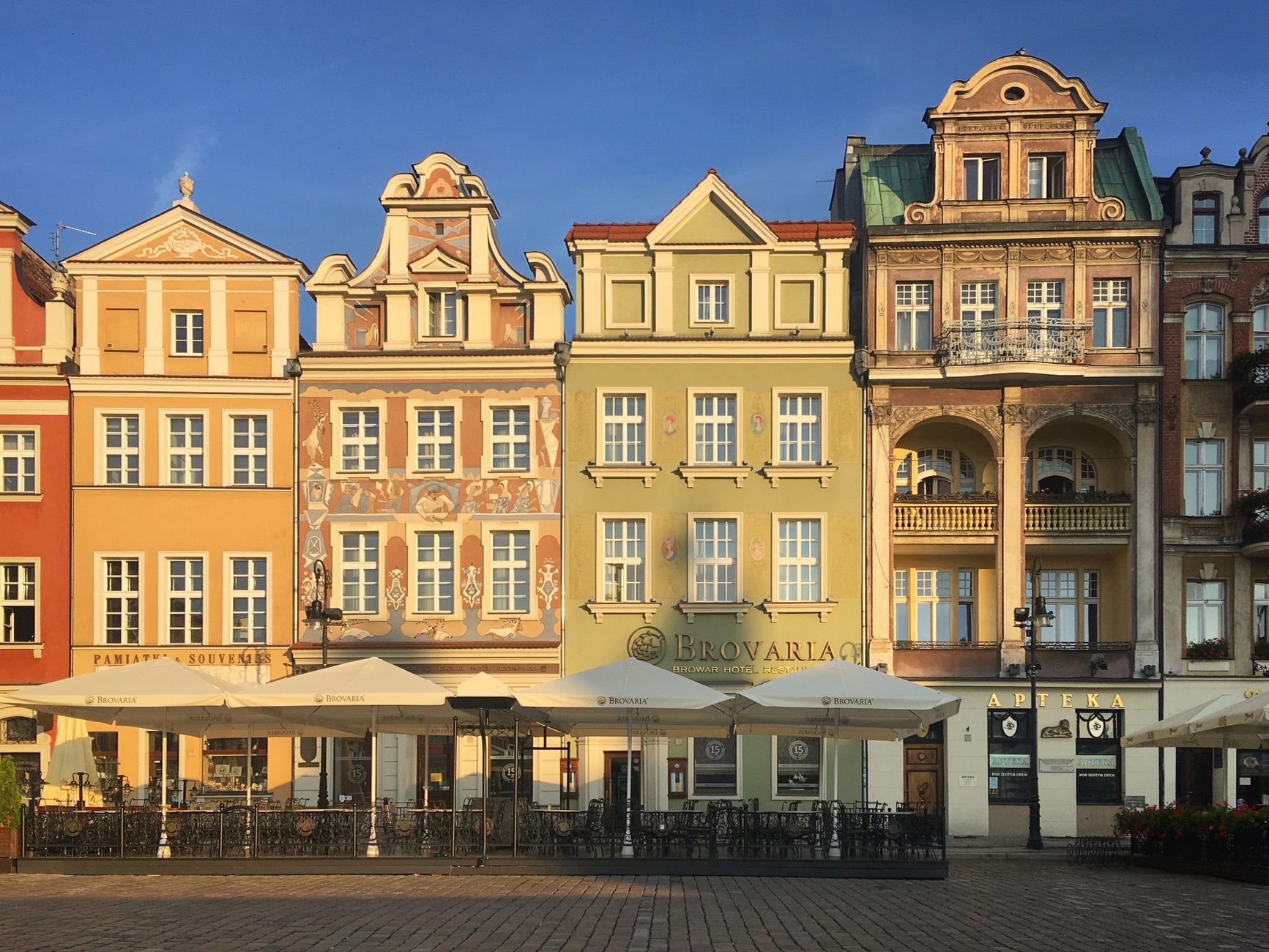
This is postcard Poznań, and for once the postcard earns its keep: merchant houses painted in sherbet colors, the 16th-century town hall, and the daily goat show that still pulls people into the square at noon and 3 p.m. Come early if you want the arcades and façades before the café terraces wake up, and duck into side streets when the center starts feeling too self-aware.Ostrów Tumski
Poznań began here, on Cathedral Island, and the mood shifts the moment you cross the water. The cathedral, burial place of Mieszko I and Bolesław the Brave, shares the island with archaeological traces, old ramparts, and Porta Posnania, which gives this origin story a sharp modern frame instead of leaving it trapped behind glass.Śródka
Śródka sits just beyond Cathedral Island and rewards anyone who doesn't rush through it. The famous mural folds absent buildings back into the street wall, the scale turns intimate after the grander center, and the whole district feels like a place locals still use rather than a set dressed for visitors.Jeżyce
Jeżyce is where to go when you want Poznań to feel lived in. Art Nouveau townhouses, Jeżyce Market, specialty coffee at places like Mówish Mash or UNO, and restaurants that take regional food seriously without turning it into folklore all give the district a calm confidence the center sometimes lacks.Łazarz
Łazarz feels rougher at the edges than Jeżyce, which is part of its appeal. Around Rynek Łazarski and the surrounding streets, you'll find market life, breakfast spots, older tenement blocks, and a neighborhood rhythm that belongs to residents first and visitors second.Imperial District
The former Castle Quarter shows Poznań at its most politically layered. The Imperial Castle, Adam Mickiewicz Square, the university buildings, the opera house inaugurated in 1910, and the June 1956 memorial zone stand close enough to read as one argument about power, occupation, culture, and who gets to remake a city after empire leaves.Wilda
Wilda doesn't perform for outsiders, which makes it interesting. Walk it for the mixed architecture, everyday shops, and the sense that central Poznań thins into something more local, less polished, and often more revealing.Malta
Around Malta Lake, Poznań opens into recreation without turning bland. The 64-hectare reservoir, 2,190-meter regatta course, bike paths, seasonal crowds, and the little Maltanka train give this district a different pulse from the brick and stucco of the center; on a clear evening, the water and big sky do a lot of the talking.
Plan your trip
Before you go
- Getting There
- Poznań-Ławica Henryk Wieniawski Airport (POZ) sits about 7 km west of the center; in 2026, airport buses 159, 148, and night bus 222 connect the terminal to town in roughly 20-25 minutes. Long-distance trains arrive at Poznań Główny, the main rail hub, with additional city connections through stations such as Poznań Wschód and Poznań Garbary. Drivers usually reach the city via the A2 motorway, with S5 and S11 providing the main north-south links.
- Getting Around
- Poznań has no metro in 2026; the city moves on trams and buses, with daytime tram lines 1-19 and 97, night trams 201-203, and a broad bus network run by ZTM. Single tickets cost 5 zł for 15 minutes, 7 zł for 45 minutes, and 9 zł for 90 minutes; a 24-hour Zone A pass is 18 zł, and a 7-day Zone A pass is 59 zł. The Poznań City Card adds transport plus museum entry from 59 zł for 24 hours, and cyclists should know Wartostrada runs along both banks of the Warta.
- Climate & Best Time
- Spring usually runs about 8-19°C, summer 22-25°C by day, autumn 7-19°C, and winter often hovers between -5°C and 3°C. Rain peaks in July and August, while May, June, and September tend to give you the kindest balance of light, temperature, and crowds. July and August are busiest; November through March feels quieter, grayer, and better suited to museums than long outdoor rambles.
- Language & Currency
- Polish is the local language, but English is widely available in the airport, tourist information offices, museums, and most central hotels and restaurants. Poland uses the złoty (PLN, zł), and Poznań is very card-friendly in 2026, including on trams and buses where contactless payment terminals are standard. If you need cash, look for ATMs or a kantor exchange office rather than changing money informally.
- Safety
- Poznań is manageable for most travelers, but late-night common sense matters more than heroic confidence. Keep phones and wallets out of outer pockets, use licensed taxis, and stay alert around nightlife streets, Poznań Główny, and quiet park or riverside stretches after dark. For emergencies, call 112; official police guidance says English support is available.
Where Poland First Learned Its Name
From river-island stronghold to stubborn modern metropolis
- c. 930
A Stronghold Rises
Most scholars date Poznań's first major stronghold to the early 10th century on Ostrów Tumski, the island cradled by the Warta and Cybina rivers. Timber ramparts, wet earth, smoke from hearths: this was less a picturesque beginning than a hard practical one. Control the crossing here, and you controlled trade, tribute, and movement across western Poland.
- 966
Baptism and Statehood
Poznań stood at the center of Mieszko I's realm when Poland entered Latin Christendom in 966. Whether the baptism itself took place here or nearby still invites argument, but the city's role is beyond dispute. The decision tied this river fortress to Rome rather than the pagan frontier, and the consequences echoed for a thousand years.
- 968
The First Bishopric
The first Polish bishopric was established in Poznań under Bishop Jordan in 968. That made the city one of the earliest places where Christianity in Poland had walls, clergy, and stone ambition. The first cathedral began to rise here, above graves and river mist.
- 1038
Bretislaus Burns the City
Czech duke Bretislaus I invaded in 1038 and left Poznań shattered. Churches were plundered, buildings burned, and the early Piast center lost its grip as political weight shifted toward Kraków. Cities remember fire for centuries.
- 1138
Capital of Greater Poland
When Bolesław III's testament broke Poland into competing duchies, Poznań became the capital of the Duchy of Greater Poland. Fragmentation sounds dry on paper. In practice, it meant courts, rival claims, and a city learning how to survive politics by making itself useful to every new ruler.
- 1253
The Chartered City
Duke Przemysł I granted Poznań Magdeburg rights in 1253 and shifted the urban center to the left bank of the Warta. A planned market square, a council, guild structures, and measurable plots replaced the looser rhythms of the old stronghold. Medieval Poznań did not simply grow. It was laid out with intent.
Show the full timeline (29 moments)
- 1295
A King Crowned Here
Przemysł II was crowned king of Poland in 1295, binding Poznań to the dream of a reunited kingdom. The coronation mattered well beyond ceremony. In a fractured land, this city briefly held the sound of royal trumpets and the possibility of political repair.
- 1510
Josephus Struthius Arrives
Josephus Struthius, born in 1510, became one of Poznań's sharpest Renaissance minds: physician, scholar, and later mayor. He studied the human pulse with unusual precision, then brought that learning back to civic life in the city. Poznań has always liked practical intelligence more than grand posturing.
- 1518
Lubrański Academy Opens
The Lubrański Academy began teaching in 1518, giving Poznań a serious humanist institution before many cities north of the Alps could claim one. Latin texts, disputations, ink, cold classrooms. Education here was never ornamental; it was a tool for building status and influence.
- 1536
Fire Scours the Market
A great fire tore through Poznań in 1536 and destroyed much of the medieval city, including the earlier town hall. Flames redraw a city faster than any planner can. What rose afterward gave Poznań the Renaissance face people now assume was always there.
- c. 1550
Di Quadro Recasts the Center
Around the middle of the 16th century, Giovanni Battista di Quadro left his mark on Poznań with the confidence of an imported Italian master who knew exactly what this city lacked. He rebuilt the town hall in Renaissance form and gave the square its disciplined elegance. The place still carries his accent.
- 1560
Goats Above the Clock
By 1560 the rebuilt Renaissance town hall had become the square's defining piece of theater, complete with the mechanical goats that still butt heads above the clock. The device is playful, almost absurd. Good cities allow themselves a little absurdity.
- 1655
The Deluge Hits Poznań
Swedish forces occupied Poznań during the Deluge, and the city paid in money, manpower, and nerves. Trade slackened, buildings suffered, and the old prosperity of the Polish-Lithuanian Commonwealth began to look fragile. Decline rarely arrives in one dramatic gesture. It leaks in through war taxes and empty stalls.
- 1704
War Returns to the Streets
During the Great Northern War, fighting around Poznań in 1704 deepened the city's exhaustion. Armies treated the region as a corridor to be used and drained. Residents heard hoofbeats, shouted orders, and then the long silence that follows looting.
- 1710
Plague Cuts the Population
Plague struck in 1710 and helped drive Poznań's population down with brutal speed. Numbers tell part of the story; the rest lives in shuttered workshops, empty houses, and churchyards filling too quickly. The city survived, but thinner.
- 1793
Prussia Takes Posen
The Second Partition of Poland handed Poznań to Prussia, which renamed it Posen and folded it into a foreign state. Administrative language changed, loyalties were tested, and the city entered a century of pressure dressed as order. This is where Poznań's stubbornness hardened into habit.
- 1813
Hipolit Cegielski's City
Hipolit Cegielski, born in 1813, came to embody 19th-century Poznań's style of resistance: work hard, build institutions, and keep Polish life intact under Prussian rule. His industrial enterprise later helped turn the city into a manufacturing center with soot on its windows and ambition in its machine halls. Patriotism here often wore an apron.
- 1828
A Fortress of Distrust
Prussia began building the Poznań Fortress in 1828, surrounding the city with a vast ring of defenses. Forts and earthworks promised security for the rulers and frustration for the residents, who found urban growth hemmed in by military logic. Stone can feel paranoid.
- 1842
The Bazar Opens
The Bazar Hotel opened in 1842 and became far more than a place to sleep. Polish merchants, activists, and professionals used it as a civic engine under partition, proving that a hotel lobby can carry more political charge than a barracks. Some buildings whisper. This one organized.
- 1918
Paderewski Sparks the City
Ignacy Jan Paderewski arrived in Poznań in December 1918 to a welcome thick with flags, songs, and nerves. His visit helped ignite the Greater Poland Uprising, because crowds sometimes need a face before they become a force. A pianist walked in. A province rose.
- 1918–1919
The Uprising Wins
The Greater Poland Uprising broke out on 27 December 1918 and succeeded where many Polish risings had failed. Poznań returned to the reborn Polish state by force of local organization, military skill, and timing. The city did not wait politely for freedom to arrive.
- 1919
A University for the New Poland
A new university opened in 1919, later becoming Adam Mickiewicz University. Lecture halls filled as the city shifted from borderland outpost to intellectual center of western Poland. After a century of pressure from Berlin, Polish scholarship now spoke here in its own voice.
- 1929
Poland Shows Off Here
The General National Exhibition of 1929 turned Poznań into a grand stage for the Second Polish Republic's ambitions. Pavilions, electric light, industrial displays, crowds in their best coats: the city became a showroom for a country rebuilding itself after partitions. Confidence can be architectural.
- 1931
Komeda Hears the City's Rhythm
Krzysztof Komeda was born in Poznań in 1931, and the city still claims him with reason. He would become the great poet of Polish jazz, but the beginning matters: provincial streets, postwar tension, and a place serious enough to produce irony. His music carries that mix.
- 1939
Occupation Begins Again
Nazi Germany invaded Poland in September 1939, annexed Poznań, and folded it into Reichsgau Wartheland. Deportations, executions, and the destruction of Jewish and Polish life followed with bureaucratic efficiency. The city had seen foreign rule before. This was something darker.
- 1945
Festung Posen Falls
From 1 to 23 February 1945, Soviet forces fought German defenders street by street in the Battle of Poznań. The old town was devastated, with the town hall and royal castle badly damaged amid shellfire, brick dust, and winter smoke. Liberation came through ruin.
- 1956
Workers Break the Silence
On 28 June 1956, workers in Poznań marched against low wages, shortages, and the dead language of communist power. The regime answered with tanks and gunfire, killing dozens. Modern Polish dissent did not begin in comfort.
- 1999
Regional Capital Again
Administrative reform in 1999 made Poznań the capital of the Greater Poland Voivodeship. The change confirmed what the city had long acted like anyway: a regional center with its own gravity, not merely a provincial stop between Berlin and Warsaw. Some titles arrive late.
- 2012
A Modern Stage Opens
Poznań's stadium, rebuilt for UEFA Euro 2012, showed how the city now sells itself: efficient, confident, outward-looking, but still faintly skeptical of spectacle for spectacle's sake. New glass and steel joined a place built from timber forts and Renaissance brick. The timeline bends, yet the local temperament hardly changes.
Who lived here
-
Pianist, composer, statesman · 1860–1941
Ignacy Jan Paderewski
Historically linked to Poznań through the independence struggle
Paderewski did not belong to Poznań by birth, but the city folded him into its political memory the moment his arrival helped ignite the uprising against German rule. He would probably recognize the theatrical instinct of the place at once: a square built for display, then a crowd that turned spectacle into history.
-
Jazz pianist and film composer · 1931–1969
Krzysztof Komeda
Born here
Komeda began in Poznań before his music drifted into darker, stranger rooms and onto film soundtracks heard far beyond Poland. He might still like the city's quieter edges today, the late coffee in Jeżyce, the sense that intelligence here rarely needs to raise its voice.
-
Writer, poet, translator · 1811–1885
Stanisław Egbert Koźmian
Lived and worked here; died here
Koźmian helped shape Poznań's intellectual life through the Poznań Review and the Society of Friends of Learning, bringing Shakespeare into Polish without sanding off the drama. He would find the modern city more informal, less stiff at the collar, but he would still recognize its old habit of treating ideas as civic business.
Where to Eat
Where locals actually book dinner — not the tourist menus.
Insider tips
Small things that change how the city treats you.
Catch The Goats
Stand in Stary Rynek a few minutes before noon if you want Poznań's clockwork ritual. The Town Hall goats are reliably confirmed at 12:00 daily; the extra 15:00 showing appears in one source only, so don't plan your day around it.Use The Weekend Ticket
A 24-hour ZTM ticket validated between Friday 20:00 and Saturday 24:00 stays valid until Sunday 24:00. For a weekend stay, that is one of the cleanest money-saving tricks in the city.Tap For Transit
Poznań runs on trams and buses, not a metro, and bank-card terminals are available on all vehicles. For short hops, a PEKA tPortmonetka fare can cost less than time tickets, but you need to tap in and tap out.Airport Bus First
Poznań-Ławica Airport sits about 7 km west of the center, and buses 159, 148, and night bus 222 reach town in about 20 to 25 minutes. If you buy at the stop machine outside the terminal, bring coins; that machine is coin-only.Buy The Real Croissant
If you want rogal świętomarciński, buy from a licensed bakery rather than the first souvenir-minded pastry window you see. The official version uses the protected white poppy-seed filling, and places on Stary Rynek or Święty Marcin take it seriously.Eat Beyond Old Town
Stary Rynek works for a first drink, but better everyday eating sits in Jeżyce and Łazarz. Go there for specialty coffee, modern Polish cooking, and a city that feels lived in rather than staged.
Gallery
The city, as it actually looks.


Frequently asked
Is Poznań worth visiting?
Yes, especially if you like cities with real texture instead of polished theater. Poznań gives you Poland's early state history on Ostrów Tumski, a deeply photogenic Old Market Square, sharp museums like Porta Posnania and Enigma, and a food scene that leans proudly local.
How many days in Poznań?
Two to three days works well for most travelers. One day covers Stary Rynek and Ostrów Tumski, while a second lets you slow down in Jeżyce, museums, CK Zamek, or the Warta riverbank.
How do I get from Poznań Airport to the city center?
Take bus 159, 148, or night bus 222 from outside the terminal. The ride to the center takes about 20 to 25 minutes, and the airport also keeps a 24/7 official taxi rank if you arrive late.
Does Poznań have a metro?
No. Poznań's public transport runs on trams and buses, and the tram network does most of the heavy lifting for visitors moving between the center, Jeżyce, and major sights.
Is Poznań safe for tourists?
Generally, yes. The practical caution is the usual city one: use official taxi ranks, especially at the airport, and stick to licensed transport late at night rather than improvising with random drivers.
Is Poznań expensive?
No by big European city standards. Public transport is cheap, with a 24-hour zone A ticket at 18 zł, and local food can stay affordable if you swap Old Town tourist menus for neighborhood spots in Jeżyce or Łazarz.
What is the best way to get around Poznań?
Use trams for longer hops and walk the center. The Royal-Imperial Route links many of the historic sights, and Jakdojade is the local tool people use to check routes and timetables.
When is the best time to visit Poznań?
Late spring to early autumn is the sweet spot, especially from May to September. Warm weather brings the Warta riverbank to life, and June packs major cultural events like Malta Festival.
What food should I try in Poznań?
Start with pyry z gzikiem and a licensed rogal świętomarciński. Then go further into the local canon with szare kluchy, goose or duck dishes, and the deadpan joke of ślepe ryby, a fishless potato soup with a name that still confuses outsiders.
Pick up where you left off
Saved and recently read places — kept on this device only.
Photo credits (11)
- Egor Komarov — Pexels License (https://www.pexels.com/license/) — Source: https://www.pexels.com/photo/11618610/
- Sergei Gussev — Pexels License (https://www.pexels.com/license/) — Source: https://www.pexels.com/photo/20068457/
- Egor Komarov — Pexels License (https://www.pexels.com/license/) — Source: https://www.pexels.com/photo/11692268/
- Jakub Zerdzicki — Pexels License (https://www.pexels.com/license/) — Source: https://www.pexels.com/photo/20098975/
- Sergei Gussev — Pexels License (https://www.pexels.com/license/) — Source: https://www.pexels.com/photo/19564143/
- Jakub Zerdzicki — Pexels License (https://www.pexels.com/license/) — Source: https://www.pexels.com/photo/20277367/
- Leszek Czyzewski — Pexels License (https://www.pexels.com/license/) — Source: https://www.pexels.com/photo/30967332/
- Meri Verbina — Pexels License (https://www.pexels.com/license/) — Source: https://www.pexels.com/photo/15959778/
- Egor Komarov — Pexels License (https://www.pexels.com/license/) — Source: https://www.pexels.com/photo/11618611/
- Egor Komarov — Pexels License (https://www.pexels.com/license/) — Source: https://www.pexels.com/photo/12476880/
- Jakub Zerdzicki — Pexels License (https://www.pexels.com/license/) — Source: https://www.pexels.com/photo/16032291/
Photos may have been resized or cropped.