Lublin
Poland Updated Apr 2026
Church bells, tram brakes, and the smell of onion bread hit you almost at once in Lublin, Poland. A cebularz still warm from the bakery tastes humble until you remember that this flat round of onion and poppy seeds carries the memory of the city’s Jewish bakers. Then you walk through Kraków Gate and the place shifts again: medieval lanes, a prison-turned-castle museum, and one of Poland’s most extraordinary painted chapels all within a few minutes on foot.
 Photo: Piotr Arnoldes / Pexels
- Attractions
- 12
- Trip length
- 2-3 days
- Best season
- Late spring to early autumn (May-September)
Why Lublin
Built from cited sources · see the method · How we make our guides →
Lublin works because it never settles into one identity for long. The Old Town keeps more than 70 percent of its original buildings, but the city’s real character lies in the layers pressed against each other: the Romanesque keep, the Gothic Holy Trinity Chapel with its 1418 Byzantine-Ruthenian murals, the Baroque cathedral, and the empty ground of Podzamcze, where a Jewish quarter once stood before the war erased it.
Memory shapes the city as much as architecture. Grodzka Gate now serves as a threshold between the preserved Christian town and the absent Jewish one, while Majdanek on the edge of Lublin refuses any easy old-town romance; you can spend the morning under painted vaults and the afternoon confronting one of Europe’s starkest wartime memorial landscapes.
Students keep Lublin from becoming a museum piece. Nine universities feed the cafés on Narutowicza, the bars around the Perła brewery, and the performance venues near Plac Teatralny, where a night out might mean jazz in a courtyard, experimental theater, or just a beer under brick walls that once belonged to an industrial plant. That mix is the point. Lublin is a city where history is never finished speaking, but it doesn’t get the last word.
Castle and Chapel
Lublin Castle holds the city’s sharpest contrast: a Romanesque keep on one side, and the Holy Trinity Chapel on the other, where Gothic walls carry Byzantine-Ruthenian frescoes completed in 1418. The chapel changes your sense of Poland’s east; this was never a borderland afterthought, but a meeting point painted in lapis, red, and gold.A City of Layers
The Old Town packs more than 110 monuments into less than 1 square kilometer, with over 70% of its buildings surviving in original form. Then the mood shifts fast: Grodzka Gate leads toward the erased Jewish quarter of Podzamcze, where absence itself becomes part of the map.Memory at the Edge
Majdanek sits within the city, not out in some abstract elsewhere, which makes the visit harder and more honest. Much of the route is open to wind and weather, and that exposure matters; the memorial is not sealed off from daily Lublin life.Culture After Dark
Lublin isn’t a museum city that goes quiet at dusk. Venues like Centrum Kultury and the Grodzka Gate - NN Theatre Centre keep the place intellectually restless, and summer festivals such as Night of Culture and Carnival Sztukmistrzów spill into streets that were laid out in the Middle Ages.
Neighborhoods
Where to wander, by quarter — each with its own rhythm.
Old Town
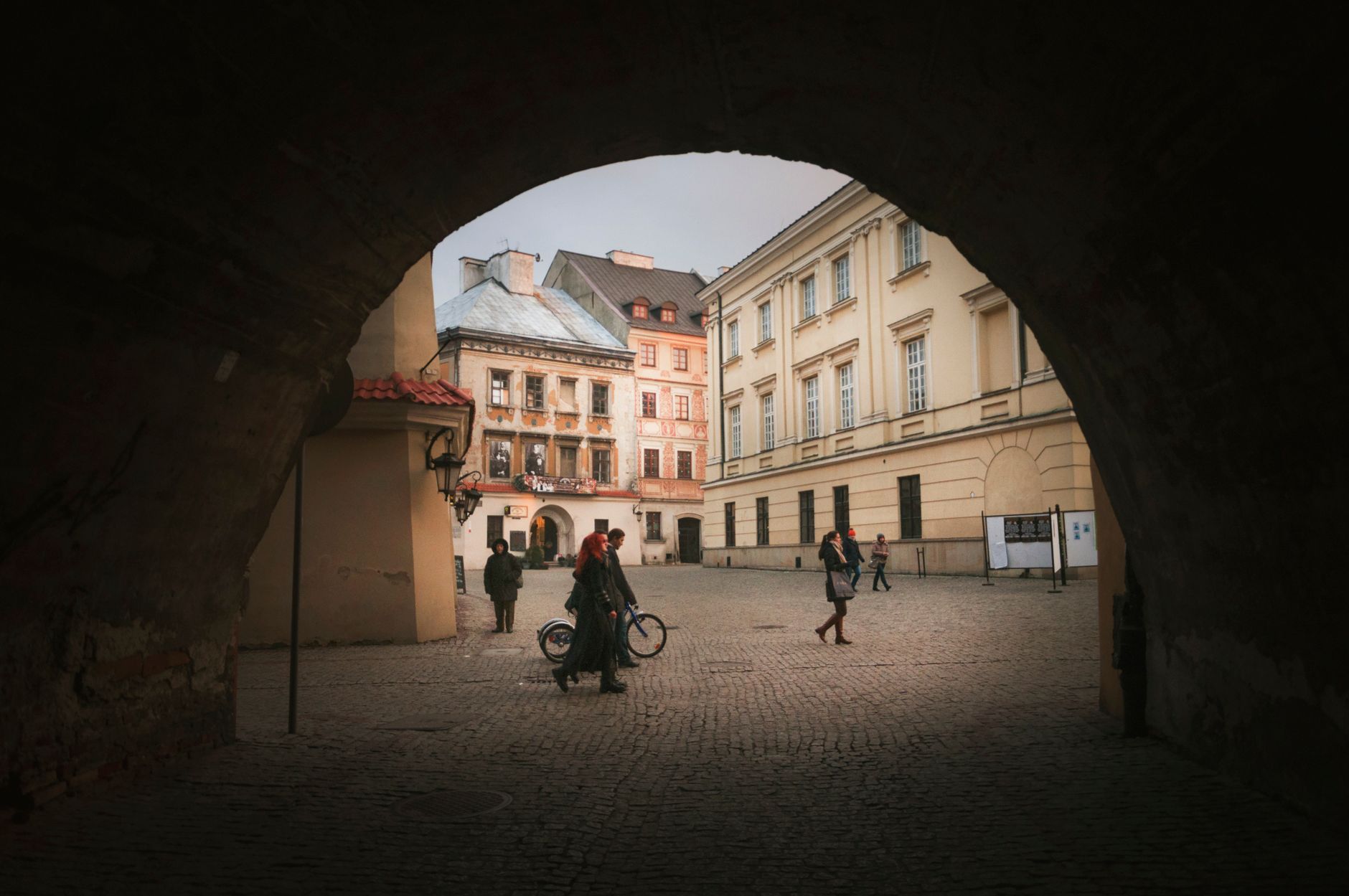
Lublin’s Old Town is compact enough to cross in minutes and dense enough to occupy a full day. Market Square, Grodzka Gate, Po Farze Square, Hartwig Alley, and the Underground Trail all sit inside a medieval street plan that still feels irregular underfoot, with church bells bouncing off plastered facades and cellar restaurants disappearing below street level.Podzamcze
Around the castle hill, Podzamcze tells the hardest story in the city. This was once the heart of Jewish Lublin; now the absences matter as much as the surviving fragments on Lubartowska, Kowalska, Furmańska, and Cyrulicza Streets, and a walk here changes the way you read the castle, the roads, and the open spaces around them.Krakowskie Przedmieście and Litewski Square
Outside the old walls, Krakowskie Przedmieście and Litewski Square show Lublin in civic mode rather than medieval costume. The street carries confectioneries, bars, and steady foot traffic, while the square opens into monuments, fountain shows in season, and the long after-work drift of people who are not sightseeing at all.Peowiaków and Plac Teatralny
This is the culture corridor, where the Centre for Culture and the Centre for the Meeting of Cultures pull the city into the present. Come here for terraces before a performance, late conversations after one, and the kind of modern public space that feels used rather than merely designed.Bernardyńska and the Perła Brewery Area
Bernardyńska has a looser, more local evening rhythm than the Rynek. The historic Perła brewery complex anchors the area with beer halls, summer events, brick industrial architecture, and enough room to linger without the old-town squeeze.University District
The university district around UMCS is where Lublin’s postwar ambitions still show. Socialist-realist compositions, later modernist housing, student canteens, and newer glass-fronted buildings sit side by side, which makes this one of the best walks in town if you care how cities reinvent themselves after catastrophe.LSM
LSM, the large housing estate south-west of the center, is worth a detour if you want everyday Lublin rather than postcard Lublin. Cafés such as The Optimist give the district a quiet social life, and the wide residential layout offers a useful contrast to the tight stone streets of the center.
Plan your trip
Before you go
- Getting There
- In 2026, the direct airport is Lublin Airport (LUZ) in Świdnik, about 25 to 30 minutes from the center; the airport rail link reaches Lublin Główny in 16 minutes, and official city information lists the fare at PLN 7.80. Main rail access runs through Lublin Główny and Lublin Północny, while road arrivals usually use the S12, S17, and S19 expressways; if you fly via Warsaw, direct Contbus and FlixBus services connect Warsaw Chopin and Modlin with Lublin.
- Getting Around
- Lublin has no metro and no tram; in 2026 the city runs on 13 trolleybus lines, 58 bus lines, and 3 night lines, with bus 005 useful for the airport, Dworzec Lublin, Brama Krakowska, and the castle. Standard Zone 1+2 fares start at PLN 3.00 for 15 minutes and PLN 13.20 for 24 hours, while tourist public transport tickets in LUBIKA cost PLN 10 for 24 hours, PLN 16 for 48 hours, and PLN 40 for 120 hours; the separate city Tourist Ticket card package costs more but adds small visitor perks.
- Climate & Best Time
- Lublin has a moderately continental climate: spring usually runs about 3 to 14 C, summer 17 to 19 C on monthly averages, autumn 3 to 14 C, and winter often drops from around -2.5 to -1 C. Rain peaks from May to September, with July the wettest month at about 80 mm, so June and September are the sweet spot in 2026 if you want long daylight without the heaviest summer crowds or thunderstorms.
- Language & Currency
- Polish is the local language, and English is common in hotels, museums, and younger-facing cafes, but less dependable in small kiosks or with older taxi drivers. Poland uses the zloty (PLN), cards and NFC payments are standard across the center, and restaurant tipping around 10% is normal when service has been good.
- Safety
- For 2026, Poland remains a generally low-risk destination, and the practical risks in Lublin are the usual urban ones: pickpocketing, late-night overconfidence, and transport-hub carelessness. Use licensed taxis, keep phones and wallets close around stations and nightlife streets, and remember that 112 is the national emergency number, free even without a SIM card.
Lublin, Where Frontiers Turned Into Ideas
From a hilltop stronghold to a city that carried unions, tribunals, yeshivas, camps, and dissent
- c. 600
Settlers Choose the Hills
Most scholars date Lublin's first Slavic settlement to the 6th or 7th century, when people built timber houses on Czwartek Hill above the Bystrzyca valley. The choice was practical and revealing: dry ground, a broad view, and defensible slopes. Long before charters and seals, the city began as a place that watched the roads.
- 1198
Lubelnia Enters the Record
A church document names the place as "de Lubelnia," the oldest surviving written mention of Lublin. Ink can feel cold, but this one matters: once a settlement appears in the record, it joins politics, taxation, and the church's map of power. The city had become legible.
- 1241
The Mongols Break the Town
Mongol forces swept through Lesser Poland and devastated Lublin during the first invasion. Timber walls and clustered houses burned fast; smoke, panic, and the crack of collapsing roofs would have carried across the hills. Rebuilding after that shock pushed the town toward stronger defenses and a harder urban shell.
- 1317
A Royal Charter Changes Everything
King Wladyslaw I Lokietek granted Lublin Magdeburg rights, giving the town a legal framework for self-government and trade. That sounds administrative. It was city-making. Markets grew more regular, plots more valuable, and local elites gained a reason to build in brick rather than hope for the best.
- 1341
Casimir Builds in Stone
After a Tatar attack, King Casimir III the Great strengthened Lublin with a masonry castle and stone walls. His mark still defines the city's silhouette: the hill, the gate, the sense that Lublin learned early to mistrust open ground. Brick and limestone replaced wishful thinking.
- 1418
The Chapel Learns Two Languages
Royal painters finished the Byzantine-Ruthenian frescoes in the Holy Trinity Chapel inside Lublin Castle. Gothic walls carry eastern saints there, and the effect is still a jolt: Poland, Ruthenia, and the Jagiellonian world meeting under one vault. Few rooms explain the city's position better.
Show the full timeline (25 moments)
- 1474
Capital of a Voivodeship
The creation of the Lublin Voivodeship made the city its administrative center. Offices followed authority, and authority follows roads. Officials, clerks, nobles, litigants, merchants, and petitioners all began arriving with their papers, grudges, and ambitions.
- 1569
The Union Is Signed
On 28 June 1569, delegates signed the Union of Lublin, binding the Kingdom of Poland and the Grand Duchy of Lithuania into the Polish-Lithuanian Commonwealth. This was no dusty legal tweak. In halls thick with candle smoke and argument, one of Europe's largest states was hammered into political form here.
- 1575
Fire Eats the City
A major fire tore through Lublin in May 1575 and nearly gutted the town. Medieval cities burned with terrifying efficiency: beams, workshops, storehouses, roofs, then whole streets. The rebuilding left Renaissance details across the Old Town, which means part of Lublin's beauty arrived through catastrophe.
- 1578
The Crown Tribunal Arrives
King Stephen Bathory established the Crown Tribunal in Lublin, making the city the highest court of appeal for much of the Polish Crown. Lawyers, nobles, and clients filled inns and hired scribes by the armful. Justice, slow and theatrical, became part of the local economy.
- 1594
Klonowic Gives the City a Voice
Poet and composer Sebastian Klonowic became mayor of Lublin in 1594. He belonged to that rare civic species who could hear both rhetoric and street noise, and his career ties the city to the Polish Renaissance in more than a ceremonial way. Lublin was not merely administered here. It was written.
- 1613
Meir of Lublin Teaches Here
By the early 17th century, Rabbi Meir of Lublin was leading one of the city's most influential yeshivas. His fame drew students into streets already dense with trade, prayer, and argument. Jewish Lublin was becoming a scholarly capital, not just a commercial one.
- 1655
War Tears Podzamcze Apart
During the wars that ravaged the Commonwealth, Russian and Cossack forces struck Lublin and devastated the Jewish quarter below the castle. Contemporary accounts describe killing, fire, and looting on a scale that altered the district's memory for generations. A city can survive a sack and still never sound quite the same.
- c. 1790
The Seer Makes Lublin a Hasidic Center
Around the 1790s, Yaakov Yitzchak Horowitz, known as the Seer of Lublin, established himself in the city and drew followers from across the region. His court turned Lublin into one of the great addresses of early Hasidism. Mysticism, rumor, devotion, and hard travel all converged on Szeroka Street.
- 1795
Poland Vanishes from the Map
The Third Partition placed Lublin under Habsburg rule and ended the Commonwealth that the city had helped shape in 1569. Borders changed on paper first. Daily life changed after. Officials spoke for a different empire, and Lublin had to learn the humiliating art of continuity without sovereignty.
- 1815
Russian Rule Begins
The Congress of Vienna shifted Lublin into the Russian-controlled Kingdom of Poland. Imperial rule brought tighter supervision, new bureaucratic habits, and recurring tension between local society and distant power. The city kept its memory of self-importance. Empires rarely enjoy that in their provinces.
- 1877
The Railway Opens the Horizon
The opening of Lublin Glowny station tied the city more firmly to imperial networks of trade and movement. Steam changed the rhythm of urban life: grain, goods, newspapers, and strangers arrived faster than horse traffic ever allowed. Industry followed the tracks.
- 1918
A Government Declares Itself Here
In November 1918, as empires collapsed, Lublin became the seat of the Provisional People's Government of the Republic of Poland. The moment was brief and messy, which is how statehood often begins. For a few charged days, the city stood near the center of Poland's return to political life.
- 1930
Meir Shapiro Opens Chachmei Lublin
Rabbi Meir Shapiro opened the Chachmei Lublin Yeshiva, one of the most ambitious Jewish academies in interwar Europe. The building itself made a statement in brick and proportion: scholarship deserved grandeur. Students came to a city that still believed learning should occupy prime urban real estate.
- 1941
Majdanek Rises at the Edge
German occupiers built the Majdanek concentration camp on the outskirts of Lublin. The location still unsettles because it is so close, almost indecently close, to ordinary streets and houses. Mass murder did not happen somewhere abstract. It happened within sight of the city.
- 1942
The Ghetto Is Liquidated
In March 1942, the liquidation of the Lublin Ghetto began, and deportations to Belzec marked the opening phase of Operation Reinhard. Families were driven through familiar streets into the machinery of extermination. Jewish Lublin, built over centuries in prayer houses, shops, schools, and courtyards, was nearly annihilated in months.
- 1944
Liberation and a New Regime
Soviet forces entered Lublin in July 1944, and the Polish Committee of National Liberation set up its seat here soon after. Liberation ended one terror and introduced another political order. The city became an early stage for communist Poland before Warsaw resumed the lead.
- 1980
Strikes Shake the System
Workers in Lublin launched strikes in July 1980, weeks before the better-known upheaval on the Baltic coast. Factories stopped, negotiations began, and the communist state discovered that obedience had limits. Lublin's role is often overshadowed. It should not be.
- 2004
Europe Opens the Purse and the Border
Poland's entry into the European Union brought Lublin access to restoration money, infrastructure funding, and a wider civic horizon. Facades were repaired, public spaces rethought, and the Old Town gained polish without losing its scars. That balance matters.
- 2023
A Young City Claims the Stage
Lublin served as European Youth Capital in 2023, a title that fit better than the slogan-heavy versions of civic branding usually do. This is a university city with a long memory and a restless present, where medieval gates and student festivals share the same evening air. The old frontier town still knows how to reinvent its voice.
Who lived here
-
Rabbi and Talmudist · 1558–1616
Meir ben Gedaliah of Lublin
Born here; later rabbi in Lublin
Meir of Lublin helped turn the city into one of the great centers of Jewish learning in the Polish-Lithuanian world. Students came for argument sharpened into art. He would still recognize the old pull of this place, even after the quarter that held that scholarship was shattered.
-
Hasidic rebbe · c. 1745–1815
Yaakov Yitzchak HaLevi Horowitz
Lived here; known as the Seer of Lublin
The city kept him so completely that history remembers him by its name: the Seer of Lublin. Thousands of followers gathered around him in the Jewish quarter, and his grave in the Old Jewish Cemetery still pulls pilgrims. He would find the streets altered almost beyond belief, but not the hunger for meaning.
-
Rabbi and founder of Daf Yomi · 1887–1933
Yehuda Meir Shapiro
Rabbi in Lublin; founder of Chachmei Lublin Yeshiva
Shapiro gave Lublin one of prewar Poland’s boldest intellectual addresses when he founded the Chachmei Lublin Yeshiva. He thought at scale: his Daf Yomi program turned daily Talmud study into a shared global rhythm. Today he would probably grieve what was destroyed, then ask whether the city still knows how to study seriously.
Insider tips
Small things that change how the city treats you.
Plan Majdanek Properly
Majdanek sits on the city’s edge, not out in the countryside, but it still needs time. Admission to the State Museum is free, the visit takes about 3 hours, and much of it is outdoors, so bring water and a layer even on mild days.Buy Cebularz Early
Start with cebularz lubelski, the onion-and-poppy-seed flatbread that belongs to Lublin as much as the castle does. Piekarnia Kuźmiuk at Furmańska 4 has baked it to the same family recipe since 1944, and it makes more sense as breakfast or a mid-morning snack than a sit-down meal.Choose Your View
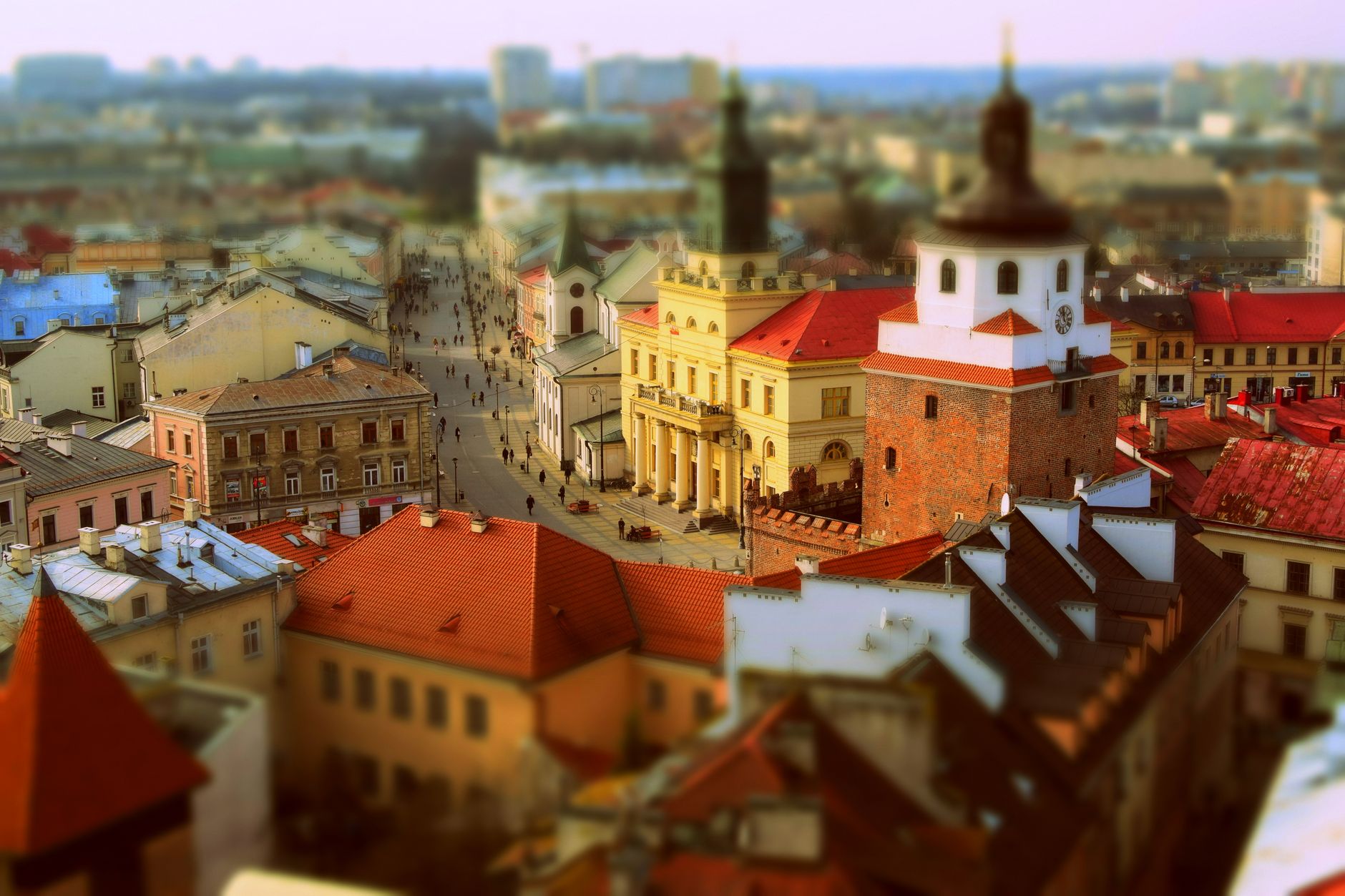
Trinitarian Tower gives the classic Old Town panorama, but it comes with more than 200 steps. If you want a view without making the climb your whole personality for the afternoon, use the castle keep as your second skyline stop.Keep A Rain Plan
When the weather turns, head underground instead of abandoning the center. The Lublin Underground Trail runs for nearly 280 meters beneath the Old Town and makes a good bad-weather swap for wandering the square.Check Festival Dates
Lublin changes character during Night of Culture, Carnival Sztukmistrzów, and East of Culture - Different Sounds. Rooms and tables go fast on those weekends, so check the city events calendar before you lock in your dates.Eat Beyond Pierogi
Pierogi are everywhere, but Lublin’s food story is wider than that. For Jewish-Lublin culinary memory, book Mandragora; for regional dishes like piróg biłgorajski or carp, look at the city’s 'Places of Inspiration' restaurants such as Perliczka.
Gallery
The city, as it actually looks.


Frequently asked
Is Lublin worth visiting?
Yes, especially if you like cities with layers instead of polish. Lublin packs a medieval Old Town, a Romanesque keep, Byzantine-Ruthenian chapel murals, erased Jewish history, and Majdanek into one compact city. It feels more lived-in than performative.
How many days in Lublin?
Two to three days works well for most travelers. One day covers the Old Town, castle, and chapel; another gives you Majdanek and the Jewish memory sites around Grodzka Gate and Podzamcze. Add a third if you want museums, viewpoints, or a slower food-and-cafes pace.
How do you get around Lublin?
The center is easy on foot once you reach it. Old Town, Krakowskie Przedmieście, Lithuanian Square, and the castle sit close together, while Majdanek needs a ride out because it is on the city’s edge rather than inside the historic core.
Is Lublin safe for tourists?
Yes, Lublin is generally a comfortable city for visitors. The main caution is emotional rather than physical: Majdanek is one of the city’s defining sites, and it deserves time and a steady frame of mind. Treat it as a memorial first, an attraction second.
Is Lublin expensive?
No, by big-city European standards Lublin is fairly gentle on the wallet. One of the city’s major sites, Majdanek, has free admission, and its signature food is a bakery buy rather than a formal dinner. The student population helps keep cafes, bars, and casual meals grounded.
What is Lublin famous for?
Lublin is famous for the 1569 Union of Lublin, its layered Old Town, and the Holy Trinity Chapel inside the castle. Food matters too: cebularz lubelski is the local edible emblem, tied to the city’s Jewish baking tradition.
What should I not miss in Lublin?
Start with the castle and the Holy Trinity Chapel, then walk the Old Town through Kraków Gate and Grodzka Gate. Make time for Majdanek, because it changes the way the city reads afterward. And buy a cebularz before noon.
Pick up where you left off
Saved and recently read places — kept on this device only.
Photo credits (8)
- Piotr Arnoldes — Pexels License (https://www.pexels.com/license/) — Source: https://www.pexels.com/photo/34159150/
- Piotr Arnoldes — Pexels License (https://www.pexels.com/license/) — Source: https://www.pexels.com/photo/6663315/
- P G — Pexels License (https://www.pexels.com/license/) — Source: https://www.pexels.com/photo/32668687/
- Piotr Arnoldes — Pexels License (https://www.pexels.com/license/) — Source: https://www.pexels.com/photo/34159148/
- Ch Jawad — Pexels License (https://www.pexels.com/license/) — Source: https://www.pexels.com/photo/36933230/
- Anna Holodna — Pexels License (https://www.pexels.com/license/) — Source: https://www.pexels.com/photo/12960988/
- Anna Holodna — Pexels License (https://www.pexels.com/license/) — Source: https://www.pexels.com/photo/12487858/
- Mikołaj Kołodziejczyk — Pexels License (https://www.pexels.com/license/) — Source: https://www.pexels.com/photo/4106605/
Photos may have been resized or cropped.