Gdansk
Poland Updated Apr 2026
Church bells roll over the Motława, a shipyard crane cuts into the sky, and somewhere between the smell of river water and fresh rye bread Gdańsk, Poland starts making sense. Few cities wear so many lives at once: a Hanseatic merchant capital rebuilt from ruin, the place where the first shots of World War II were fired at Westerplatte, and the city where Solidarity turned dockyard strikes into political history. The surprise is how naturally those layers sit together.
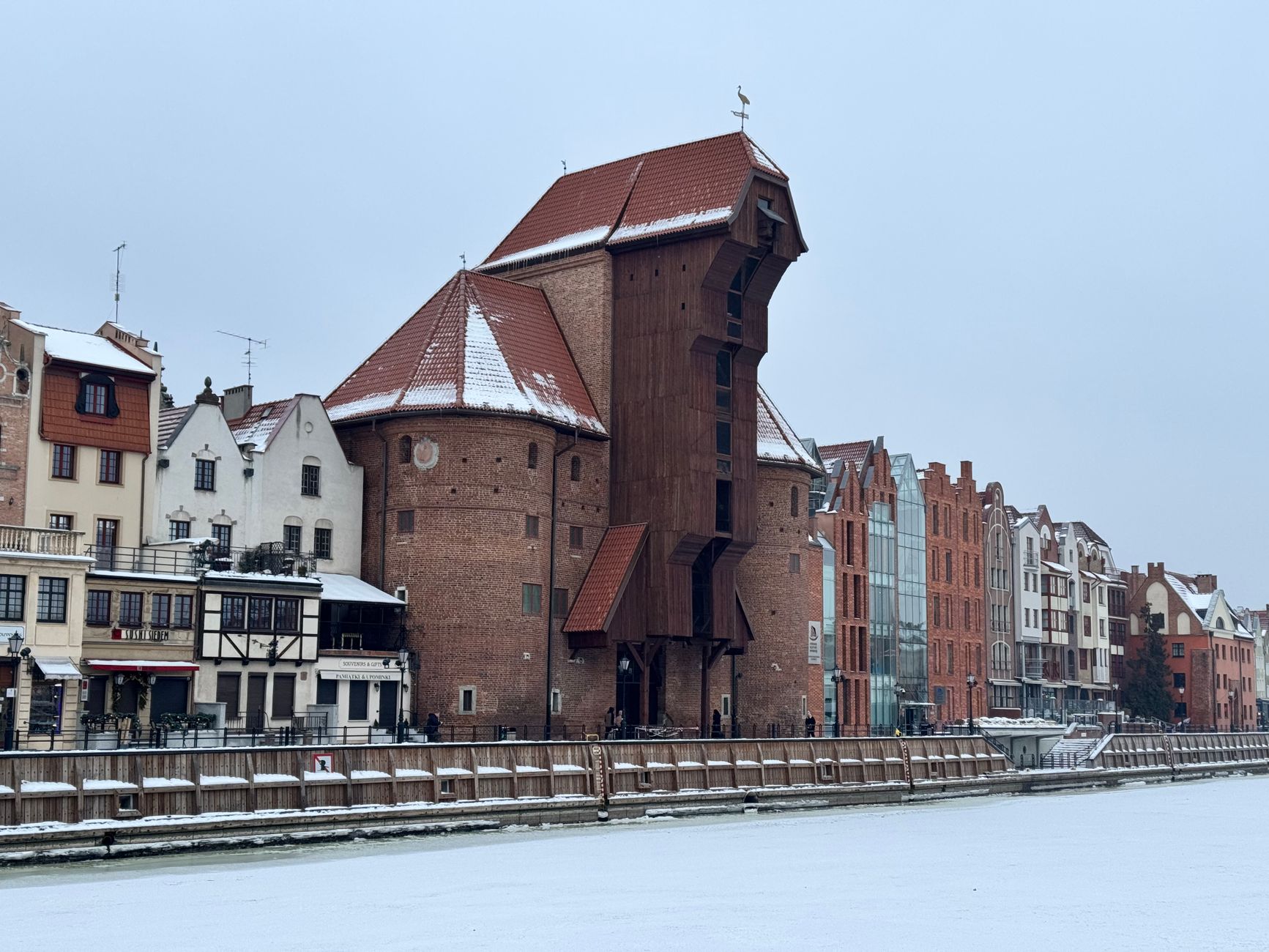 Photo: Radoslaw Sikorski / Pexels
- Attractions
- 18
- Trip length
- 2-3 days
- Best season
- Late spring to early autumn (May-September)
Why Gdansk
Built from cited sources · see the method · How we make our guides →
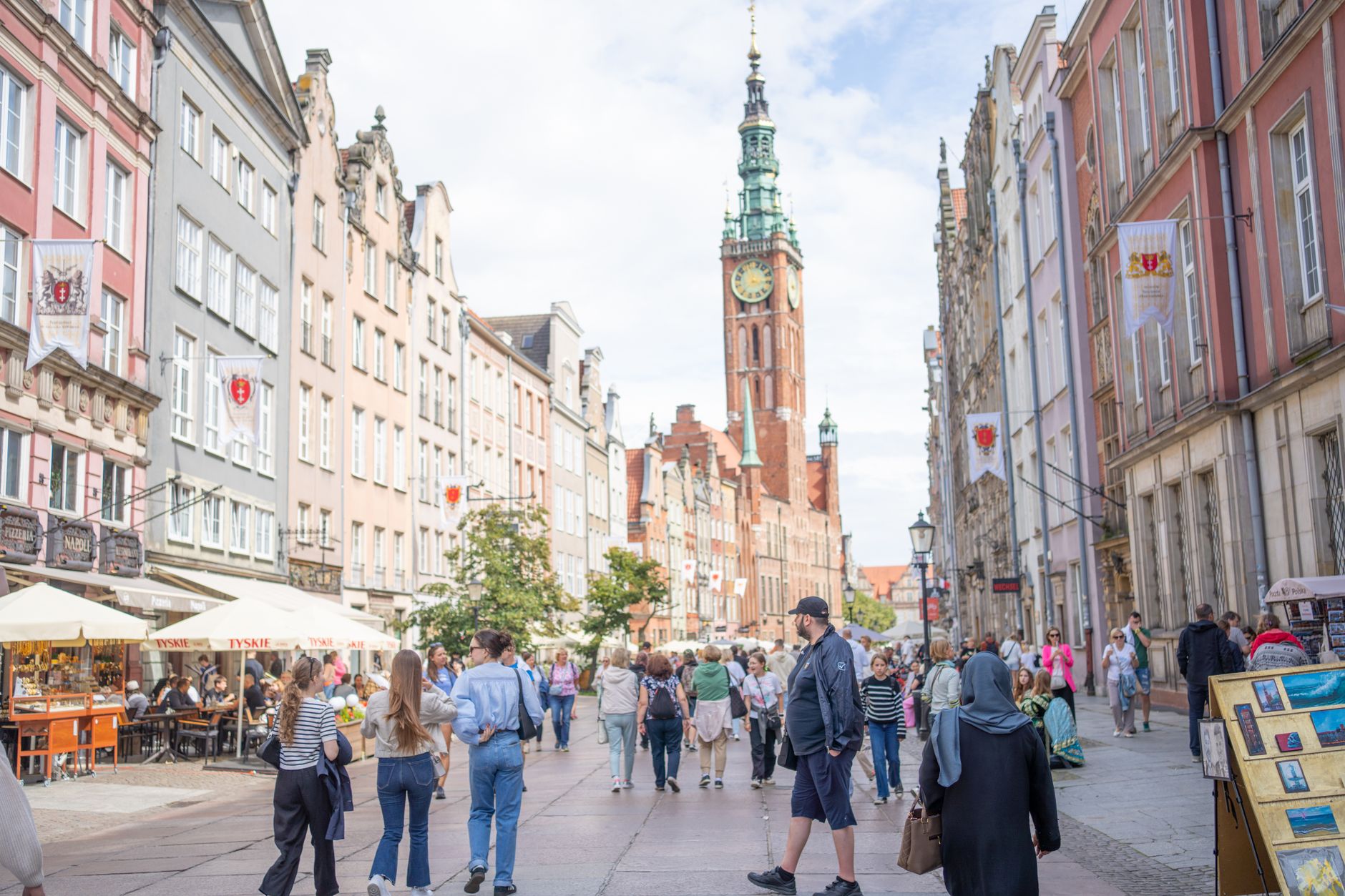
The postcard stretch is real, and yes, Długa and the Long Market deserve the slow walk. Gabled facades rise like stage scenery, Neptune leans into his fountain, and St. Mary’s Church looms over everything with the blunt confidence of the world’s largest brick church. But Gdańsk is better when you look past the perfect frontage and notice what made it rich: grain, amber, cranes, docks, and a riverfront built for hard bargaining rather than pretty views.
Then the tone changes. The European Solidarity Centre and the old shipyard do not feel like ornamental heritage; they still carry the weight of argument, labor, and risk, and that gives Gdańsk a political charge many beautiful old cities lack. A night out near Elektryków or 100cznia makes the point clearly: rusted steel, beer tables, club lights, and former industrial ground now used for concerts, food halls, and the kind of conversations that run late.
And the city keeps widening. Oliwa offers organ music, old trees, and the cooler air of parkland; Wrzeszcz trades ceremony for cafés, bakeries, and streets where locals actually linger; Sobieszewo Island gives you reeds, wide beaches, and Baltic wind instead of another museum label. Gdańsk changes your understanding of what a historic city can be, because memory here is not sealed behind glass. It is still out on the street.
Memory With Teeth
Gdańsk carries three histories at once: a Hanseatic trading city, the place where World War II began at Westerplatte, and the shipyard where Solidarity cracked communist Poland open. Few cities make politics feel this physical.Brick, Water, Gables
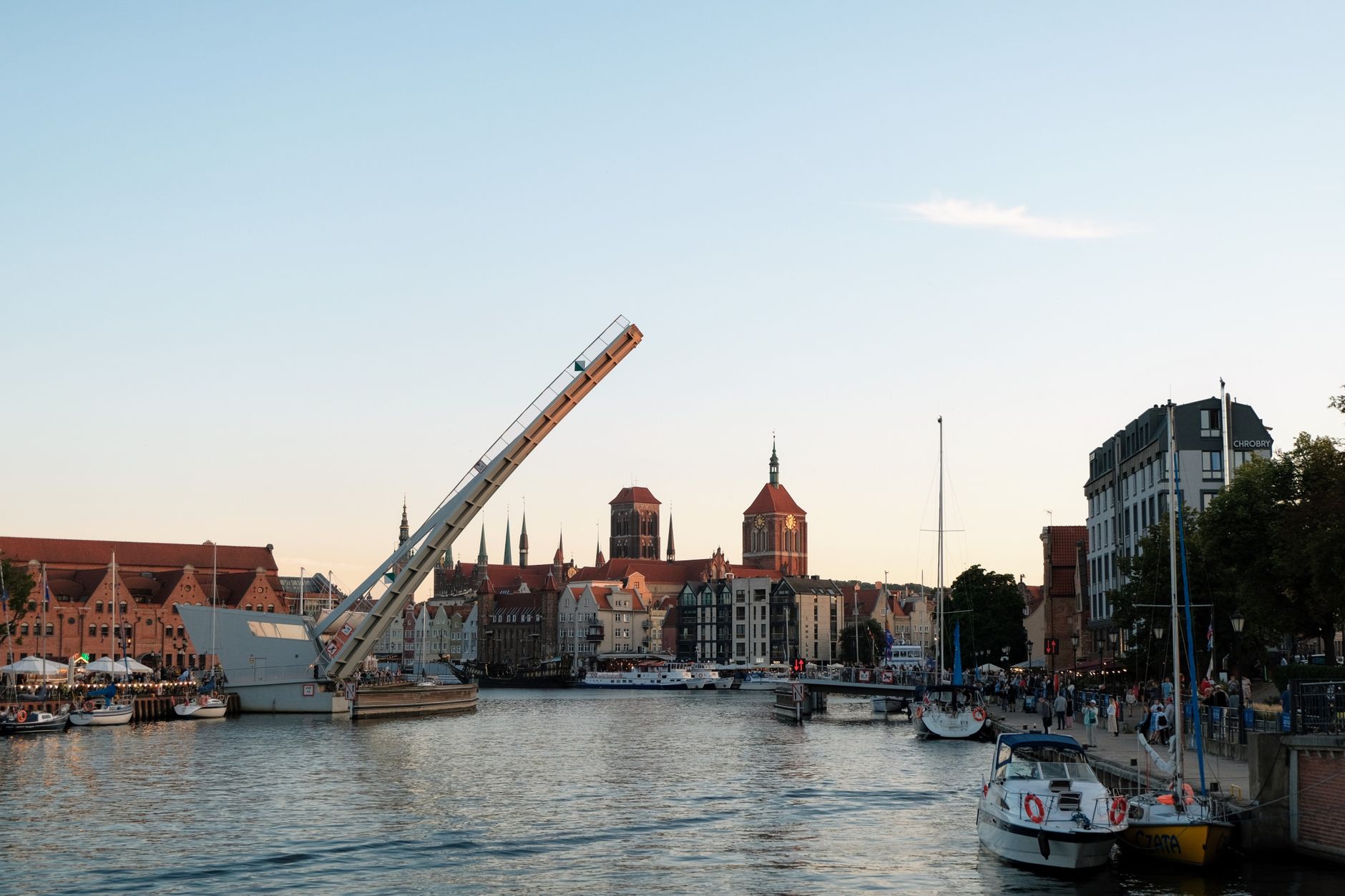
The Royal Route and the Motlawa riverfront give you the city in one sweep: the Green Gate, Artus Court, Neptune Fountain, St. Mary's vast brick mass, and the Crane crouched over the water like a machine from another century. Rebuilt after 1945, the ensemble still feels earned rather than staged.Shipyard After Dark
The old shipyard no longer belongs only to memory. Around the European Solidarity Centre and the post-industrial yards, you get bars, clubs, art spaces, and concert venues in a district where rust, steel, and neon do most of the decorating.Baltic Breathing Room
Gdańsk has a second mood beyond the old center: Oliwa's formal park and cathedral, then Sobieszewo Island with bird reserves, broad beaches, and wind off the Baltic. The city can turn from church bells to reeds and salt air in under an hour.
Neighborhoods
Where to wander, by quarter — each with its own rhythm.
Main Town
This is the ceremonial Gdańsk of the Royal Route: the Upland Gate, Golden Gate, Długa, Long Market, Neptune Fountain, Artus Court, and Green Gate lined up with almost suspicious precision. Go early or late if you can. Morning light catches the painted facades before the tour groups thicken, and after dark the brick, stone, and river reflections make the whole quarter feel less like a checklist and more like a city that once priced grain shipments by the ton.Old Town
North of the postcard core, the Old Town feels slightly rougher and more lived-in, which is part of the appeal. St. Catherine’s Church and its 76-meter tower shift the skyline, the Great Mill reminds you that medieval Gdańsk invested in industry as seriously as in beauty, and St. Nicholas Basilica offers a calmer church stop than St. Mary’s. This is where the city’s merchant machinery starts to show through the pageantry.Granary Island
Granary Island sits across the water from the Main Town and gives you one of Gdańsk’s sharpest contrasts: historic river setting, contemporary hotels, footbridges, bars, and food halls built into a district once packed with storehouses. Some of it can feel polished to the point of calculation. Still, the waterfront views are excellent, and it works well for an evening when you want dinner, a drink, and the lit facades of the old city across the Motława.Shipyard and Młode Miasto
This is the Gdańsk that explains the rest. Around the European Solidarity Centre, Elektryków, 100cznia, Montownia, and the post-shipyard blocks, the city trades Renaissance elegance for steel, murals, container bars, concert venues, and the memory of strikes that changed Europe. Come here by day for Solidarity history, then stay after sunset when the industrial skeleton fills with music and people.Wrzeszcz
Wrzeszcz is where you go when you want Gdańsk at normal volume. Late-19th-century townhouses, bakery windows, bars, students, office workers, and a café scene that feels local rather than posed give the district its pulse, especially around Wajdeloty Street and nearby Garnizon. If the center shows you where visitors stroll, Wrzeszcz shows you where people in this city actually meet for coffee and stay for one more drink.Oliwa
Oliwa slows everything down. The cathedral draws visitors for its organ concerts, but the real pleasure is the pairing of sacred scale and green quiet: Oliwa Park’s old trees, water channels, glasshouses, and long paths make this part of Gdańsk feel almost monastic even when the city is busy elsewhere. Add Pacholek Hill or the Olivia Star viewpoint if you want to see how quickly parkland, suburb, and bay fold into one another.Nowy Port and Westerplatte
Most visitors treat this area as a historical errand, which is too narrow a reading. Westerplatte matters because the war began here on September 1, 1939, but the surrounding port districts give that memory a physical setting of channels, fortifications, working waterfront, and wind off the Baltic. Guardhouse No. 1 adds military detail; nearby Nowy Port keeps the atmosphere grounded in maritime life rather than memorial abstraction.Sobieszewo Island
Sobieszewo Island feels like a correction to anyone who thinks Gdańsk ends at church towers and waterfront bars. This is the city’s wild edge: broad beaches, bird reserves, pine woods, amber hunters scanning the sand after storms, and enough open sky to reset your pace completely. Go if you need a day with fewer façades and more weather.
Plan your trip
Before you go
- Getting There
- In 2026, most visitors arrive through Gdańsk Lech Wałęsa Airport (GDN), about 20 minutes from the center by taxi or roughly 40 minutes by bus line 210. Main rail hubs are Gdańsk Główny, Gdańsk Wrzeszcz, and Gdańsk Śródmieście; the airport rail station sits by the terminal, with trains toward Wrzeszcz and onward connections into the center. Drivers usually reach the city via the S6 expressway, the A1 motorway corridor to southern Poland, and national road 7/S7 toward Warsaw.
- Getting Around
- Gdańsk has no metro in 2026; the city runs on 13 tram lines, a dense ZTM bus network, and SKM urban rail for the Tri-City run to Sopot and Gdynia. A ZTM single fare costs 4.80 PLN, a 75-minute ticket 6.00 PLN, and a 24-hour city ticket 22.00 PLN; for wider Tri-City travel, the 24-hour metropolitan rail-plus-urban ticket costs 34 PLN and the 72-hour version 68 PLN. Cycling makes sense here: the city reports more than 860 km of bike routes, and the MEVO system offers bikes from 0.15 PLN per minute for standard bikes or a 48-hour pass for 59 PLN.
- Climate & Best Time
- Gdańsk's Baltic climate stays cooler than inland Poland. As a practical 2026 guide, expect roughly 5 to 15 C in spring, 17 to 24 C in summer, 7 to 16 C in autumn, and -2 to 4 C in winter, with wind off the water making cold days feel sharper than the numbers suggest. July and August bring the heaviest visitor traffic; late May through September usually gives the best balance of long light, walkable weather, and parks that smell alive rather than soaked.
- Language & Currency
- Polish is the official language, and English works well at the airport, museums, hotels, and most central restaurants in 2026, though station names and street signs reward careful spelling. Poland uses the złoty (PLN), cards are widely accepted, and keeping a little cash helps for small kiosks, markets, or the odd place that still prefers notes over tap-to-pay.
- Safety
- Poland remains a low-friction destination in 2026, but Gdańsk follows the usual port-city rules: watch your bag at Gdańsk Główny, on crowded trams, and in late-night bar zones. Use official taxis from the airport, validate public-transport tickets at the start of the trip, and treat inflated bar tabs with suspicion rather than surprise.
A Port Built on Grain, Fire, and Defiance
From a Piast stronghold on the Motlawa to the city where empires cracked and workers changed Europe
- c. 930
Timbers on the Motlawa
Most scholars date Gdańsk's earliest fortified settlement to around 930, when timber structures rose beside the Motlawa marshes. This was not a picturesque fishing village. It was a hard-edged trading post, built where river traffic, amber routes, and Baltic weather met in the same wet air.
- c. 980
Mieszko Claims the Coast
Mieszko I pulled the settlement into the early Polish state in the late 10th century, securing a Baltic outlet that no ruler could afford to ignore. Salt, furs, wax, and slaves moved through places like this. Gdańsk mattered because power follows water.
- 997
Adalbert Names the Town
The first written mention of Gdańsk appears in the life of Saint Adalbert, who came here on his mission to convert Prussians and, according to the record, baptized locals near the settlement. One text changed everything. A place on the edge of the realm stepped into documented history.
- c. 1060
Ramparts Rise in Timber
By the 1060s a substantial stronghold stood on the site, enclosed by wooden-and-earth defenses and housing a population in the low thousands. You can almost smell it: tar, smoke, fish, wet planks, and animal hides. Gdańsk was already a working port, not a frontier afterthought.
- 1116
Piast Rule Tightens
Bolesław III Wrymouth brought Pomerelia firmly back under Polish control in the early 12th century, and the older fortifications were reshaped in the process. Rule here was never abstract. It meant who collected tolls, who guarded the river, and whose language carried authority in the market.
- 1308
Teutonic Knights Take Gdańsk
The Teutonic Order seized the city in 1308, a violent turning point still argued over in detail but never in consequence. The takeover reordered the town's political life and pushed it into the orbit of a militarized trading state. Brick replaced timber. German law and Hanseatic discipline followed.
Show the full timeline (29 moments)
- 1346
St. Mary's Begins to Climb
Construction began on St. Mary's Church in the mid-14th century, and the building would keep growing for generations. This was civic ambition in brick. Its vast interior, cool as a cellar even in summer, announced that Gdańsk intended to pray and trade on a grand scale.
- 1361
A Hanseatic Power Joins
By 1361 Gdańsk had entered the Hanseatic League, binding the city to the commercial network that stitched together the Baltic and North Sea. Grain shipments made fortunes here. So did timber, beer, cloth, and the relentless arithmetic of port dues.
- 1454
The City Backs Rebellion
Gdańsk joined the Prussian Confederation's revolt against the Teutonic Order and placed itself under the protection of the Polish crown. This was not romantic patriotism. Merchants wanted room to breathe, and the Order had become expensive, rigid, and bad for business.
- 1466
Autonomy Under the Crown
The Second Peace of Thorn confirmed Gdańsk's return to the Polish realm while preserving broad autonomy, commercial privileges, and a political swagger few cities could match. It became a city that obeyed kings in theory and negotiated with them in practice. That balance enriched the port for centuries.
- 1568
Green Gate Frames Arrival
The Green Gate rose at the end of the Royal Route in a Dutch-inflected style that looked north to Amsterdam as much as south to Kraków. Arriving rulers were meant to understand the message at once. Gdańsk was loyal, wealthy, and perfectly willing to show off.
- 1611
Hevelius Studies the Sky
Johannes Hevelius was born in Gdańsk in 1611 and built his career above its roofs, observing the heavens from private observatories on town houses. Few cities can claim an astronomer who mapped the Moon while casks rolled through the streets below. Gdańsk gave him both money and horizon.
- 1633
Neptune Takes the Market
By the 1630s Neptune Fountain stood before Artus Court, bronze god of the sea planted in the city's ceremonial heart. The placement was cheeky and exact. A maritime city put its patron in the square where merchants, magistrates, and gossip all crossed paths.
- 1686
Fahrenheit Is Born Here
Daniel Gabriel Fahrenheit was born in Gdańsk in 1686, in a city already fluent in precision, trade, and practical science. His later thermometer scale feels very Danzig, if we're honest. Merchants love exact measures almost as much as scientists do.
- 1788
Schopenhauer Starts in Danzig
Arthur Schopenhauer was born here in 1788, in a patrician merchant household that embodied the city's cosmopolitan habits. He left young, but Danzig marked him first: a port of trade, discipline, and uneasy belonging. That doesn't explain his philosophy. It does sharpen the outline.
- 1793
Prussia Ends the Old Freedom
The Second Partition of Poland brought Gdańsk into the Kingdom of Prussia and stripped away the old semi-independent order. A city used to bargaining from strength now answered to a centralized state. The harbor remained, but the political temperature dropped.
- 1807
Napoleon's Free City Returns
Napoleon turned Danzig into a Free City after his campaign against Prussia, though the freedom came with French bayonets and strategic calculations. The arrangement lasted only a few years. Even so, it proved how often this port became a prize in someone else's continental argument.
- 1871
City Joins the German Empire
When the German Empire was proclaimed in 1871, Danzig entered a new national frame without losing its old port instincts. Railways, docks, and bureaucracies thickened around the harbor. The city looked more industrial, more ordered, and less inclined to sentimental memory.
- 1920
League Creates the Free City
The Treaty of Versailles made Danzig a Free City under League of Nations protection, tied economically to Poland but populated mostly by Germans. It was an awkward constitutional machine from the start. Every customs rule and railway right carried the charge of a future crisis.
- 1927
Grass Inherits a Divided City
Gunter Grass was born in Danzig in 1927, and the city's mixed languages, loyalties, and bruised memory never stopped feeding his work. He did not write postcard nostalgia. He wrote the grit under the cobblestones.
- 1939
War Opens at Westerplatte
On 1 September 1939 the German battleship Schleswig-Holstein fired on the Polish garrison at Westerplatte, and the Second World War began at Gdańsk's edge. The date is famous. The place is smaller than people expect, which makes the opening violence feel even colder.
- 1945
Fire Eats the Old City
In March 1945 Soviet assault, artillery fire, and urban combat destroyed roughly 90 percent of the historic center. Facades collapsed into ash and brick dust; church shells stood black against the spring sky. The Gdańsk people admire today is, in large part, a patient act of reconstruction.
- 1945
Polish Gdańsk Begins Again
After the war the city returned to Poland, its German population largely fled or expelled, and new settlers arrived from other parts of the country and from territories lost in the east. Few European cities had to rebuild both streets and identity so completely. Gdańsk did both at once.
- 1970
Shipyard Blood on the Street
In December 1970 workers protesting price rises were met with gunfire, and more than ten people were killed in the Gdańsk area. The memory stayed raw. Steel gates and cranes no longer meant only labor; they meant the state could turn on its own workers.
- 1980
Walesa and the August Strike
Lech Wałęsa vaulted the shipyard wall in August 1980 and emerged as the face of a strike that became Solidarity. The demands began with wages and union rights, then widened into something larger and riskier. In the salt air of the Lenin Shipyard, communist power started to crack.
- 1989
Solidarity Changes Europe
The negotiated end of communist rule in Poland owed an enormous debt to what had started in Gdańsk nine years earlier. This city did not topple the Eastern Bloc alone. But it gave the century one of its decisive rehearsals for freedom.
- 2004
Europe Reopens the Port
Poland's entry into the European Union in 2004 folded Gdańsk into a new political and economic map, one built less on partitions than on borders you can cross without drama. Money followed, then renovation, then argument about what kind of city should rise from the shipyard lands. Fair enough.
- 2014
Solidarity Gets Its Museum
The European Solidarity Centre opened beside the shipyard with rust-colored walls that look half industrial relic, half warning. Inside, the story is not polished into comfort. It keeps the paper banners, cramped rooms, and dangerous improvisation that made the movement real.
- 2024
The Crane Turns Back On
After a major restoration, the medieval Crane reopened with renewed galleries and a sharper telling of Gdańsk's maritime past. The building still looks slightly improbable, half gateway and half machine. That is exactly why it works as the city's emblem.
Who lived here
-
Astronomer · 1611–1687
Johannes Hevelius
Born and worked here
Hevelius watched the sky from Gdańsk when rooftop astronomy still felt half science, half audacity. Standing in a city built on trade winds and open horizons, he probably wouldn't be surprised that people still come here to look up.
-
Physicist and instrument maker · 1686–1736
Daniel Gabriel Fahrenheit
Born here
Fahrenheit was born in Gdańsk before his name became the scale people argue with during heatwaves. A port city obsessed with measurement, weather, and distance was a fitting start for someone who turned temperature into something exact.
-
Philosopher · 1788–1860
Arthur Schopenhauer
Born here
Schopenhauer entered the world in Danzig, a city already practiced in living with political tension and commercial ambition. He might look at today's polished façades, then notice the stubborn undertow of history and feel oddly at home.
-
Novelist · 1927–2015
Günter Grass
Born here
Grass carried Danzig through his fiction like a splinter he refused to pull out. Walk Gdańsk long enough and you see why: the city keeps changing governments, languages, and street names, yet never stops sounding like itself.
-
Labor leader and former president · born 1943
Lech Wałęsa
Led Solidarity here in August 1980
Wałęsa's Gdańsk is the shipyard, the gates, the strike, the moment workers forced the state to listen. The cranes still stand over the skyline like iron punctuation marks, and they make his story feel less like memory than unfinished business.
-
Politician · born 1957
Donald Tusk
Born here
Tusk was born in Gdańsk, a city where borders and loyalties were never abstract ideas. That background helps explain the cast of his politics: Baltic, European, argumentative, and keenly aware of what history costs when ignored.
Where to Eat
Where locals actually book dinner — not the tourist menus.
Insider tips
Small things that change how the city treats you.
Use SKM Smartly
For Sopot or Gdynia, take the SKM rather than a taxi; Gdańsk Główny to Sopot is about 20 minutes and to Gdynia Główna about 30. Buy from station machines and validate counter-bought tickets on the platform.Skip Airport Taxis
Bus 210 links the airport with central Gdańsk in about 40 minutes for 4.80 PLN, while an airport taxi to the center is about 70 PLN. Late arrival? Night bus N3 runs between Gdańsk Główny, the airport, and Wrzeszcz.Book Big Museums
Give the European Solidarity Centre and the Museum of the Second World War real time, not a rushed hour. ECS in particular works best as a half-day visit if you want the shipyard story to make sense.Climb For Context
Go up St. Mary's Church or the Main Town Hall tower early in your stay. From above, the rebuilt gables, shipyard cranes, and flat Baltic light show you how war, trade, and politics sit in the same frame.Escape To Oliwa
When the Main Town feels crowded, head to Oliwa Park and the cathedral area. Old trees, water channels, and the quieter streets around the park give the city room to breathe.Check Closures First
War-memory sites change with renovation schedules, so verify museum pages before you set out. The Museum of the Polish Post Office is closed for renovation and is scheduled to reopen in September 2026.
Gallery
The city, as it actually looks.



Frequently asked
Is Gdansk worth visiting?
Yes, especially if you want a city with beauty and weight behind it. Gdańsk gives you a reconstructed Hanseatic center, the opening chapter of World War II at Westerplatte, and the shipyard where Solidarity changed Europe in August 1980.
How many days in Gdansk?
Two to three days works well for a first trip. One day covers the Main Town and waterfront, a second lets you choose between the European Solidarity Centre and the Museum of the Second World War, and a third opens up Oliwa, Wrzeszcz, or Sobieszewo Island.
How do I get from Gdansk Airport to the city center?
The cheapest route is bus 210, which takes about 40 minutes from central Gdańsk to the airport corridor and costs 4.80 PLN. By rail, use the airport station and change at Gdańsk Wrzeszcz for Gdańsk Główny or Gdańsk Śródmieście.
Does Gdansk have a metro or subway?
No, Gdańsk does not have a classic metro. The city runs on trams, buses, and urban rail, with SKM handling the easiest trips between Gdańsk, Sopot, and Gdynia.
Is Gdansk expensive for tourists?
No, by northern European standards it is fairly manageable. Public transport is cheap, with a 24-hour ZTM ticket at 22 PLN and airport buses at 4.80 PLN, though waterfront restaurants and private transfers can raise the bill fast.
Is Gdansk safe for tourists?
Yes, Gdańsk is generally comfortable for visitors, especially in the central districts most travelers use. Use the usual city habits at night around bars and transport hubs, and keep an eye on your route if you head into the large shipyard area after dark.
What is the best time to visit Gdansk?
Late spring to early autumn is the sweet spot, with May to September giving long light and easy walking weather. June and September usually feel more breathable than the height of summer, when the Royal Route and waterfront get crowded.
Can you do Gdansk without a car?
Yes, and most visitors should. The historic center, shipyard museums, airport link, and Tri-City rail connections make public transport the easier choice unless you plan to spend serious time on outer coastal or nature routes.
Pick up where you left off
Saved and recently read places — kept on this device only.
Photo credits (12)
- Radoslaw Sikorski — Pexels License (https://www.pexels.com/license/) — Source: https://www.pexels.com/photo/36052867/
- Aliaksei Lepik — Pexels License (https://www.pexels.com/license/) — Source: https://www.pexels.com/photo/17530646/
- Szymon Shields — Pexels License (https://www.pexels.com/license/) — Source: https://www.pexels.com/photo/13323450/
- Maksym Harbar — Pexels License (https://www.pexels.com/license/) — Source: https://www.pexels.com/photo/14809337/
- Mateusz Popek — Pexels License (https://www.pexels.com/license/) — Source: https://www.pexels.com/photo/18367119/
- Shakir Mohamed — Pexels License (https://www.pexels.com/license/) — Source: https://www.pexels.com/photo/35759531/
- Shakir Mohamed — Pexels License (https://www.pexels.com/license/) — Source: https://www.pexels.com/photo/35759527/
- Oleksiy Konstantinidi,🌻🇺🇦🌻 — Pexels License (https://www.pexels.com/license/) — Source: https://www.pexels.com/photo/35727709/
- Shakir Mohamed — Pexels License (https://www.pexels.com/license/) — Source: https://www.pexels.com/photo/35759511/
- Sławomir Narloch — Pexels License (https://www.pexels.com/license/) — Source: https://www.pexels.com/photo/33922724/
- Piotr Jachowicz — Pexels License (https://www.pexels.com/license/) — Source: https://www.pexels.com/photo/31015541/
- Piotr Kalinowski — Pexels License (https://www.pexels.com/license/) — Source: https://www.pexels.com/photo/35829196/
Photos may have been resized or cropped.