An introduction.
Researched by the Audiala editorial team from historical records, architectural archives, and local expertise.
TThe walls of Majayjay's church are nearly three metres thick — wide enough to park a car inside — because they contain a second, older church entombed within them. This mountain municipality in Laguna province, Philippines, sits where the Sierra Madre foothills crumple into gorges so steep that its very name, according to local tradition, comes from the exhausted sighs of people climbing its hills: "hay, hay, hay." Majayjay rewards the effort. Its Spanish-era stone bridges outnumber those of any other town in Laguna, its waterfalls drop into volcanic rock pools, and its church hides four centuries of fire, rebellion, and reconstruction behind a single coral-stone façade.
Getting here requires commitment. From Manila, the drive south through Laguna takes roughly three hours, the last stretch winding through the neighboring town of Nagcarlan before the road tilts upward into Majayjay's green, rain-heavy terrain. The elevation — about 300 metres above sea level — keeps the air cooler than the lowland towns around Laguna de Bay, and the surrounding mountains trap moisture that feeds Taytay Falls, Botocan Falls, and a network of rivers that Spanish friars spanned with at least ten stone bridges in the 18th and 19th centuries. Seven of those bridges still stand.
What makes Majayjay worth the climb is not any single attraction but the density of history packed into a town of roughly 30,000 people. The Botocan Hydroelectric Plant — one of the oldest operational hydroelectric facilities in the Philippines, though sources dispute whether it dates to 1913 or 1930 — still generates power from the same river gorge. The Saint Gregory the Great Parish Church, declared a National Cultural Treasure, anchors the town plaza with walls that tell a story of repeated destruction and stubborn rebuilding. And in the foothills above, the ghost of Emilio Jacinto — the 22-year-old intellectual who wrote the moral code of the Philippine Revolution — once hid among cattle traders, wounded and stateless, refusing to surrender.
Majayjay does not advertise itself. No tour buses line its plaza, no hawkers work the church steps. The quiet is part of the point.
01 What to see.
Minor Basilica of Saint Gregory the Great
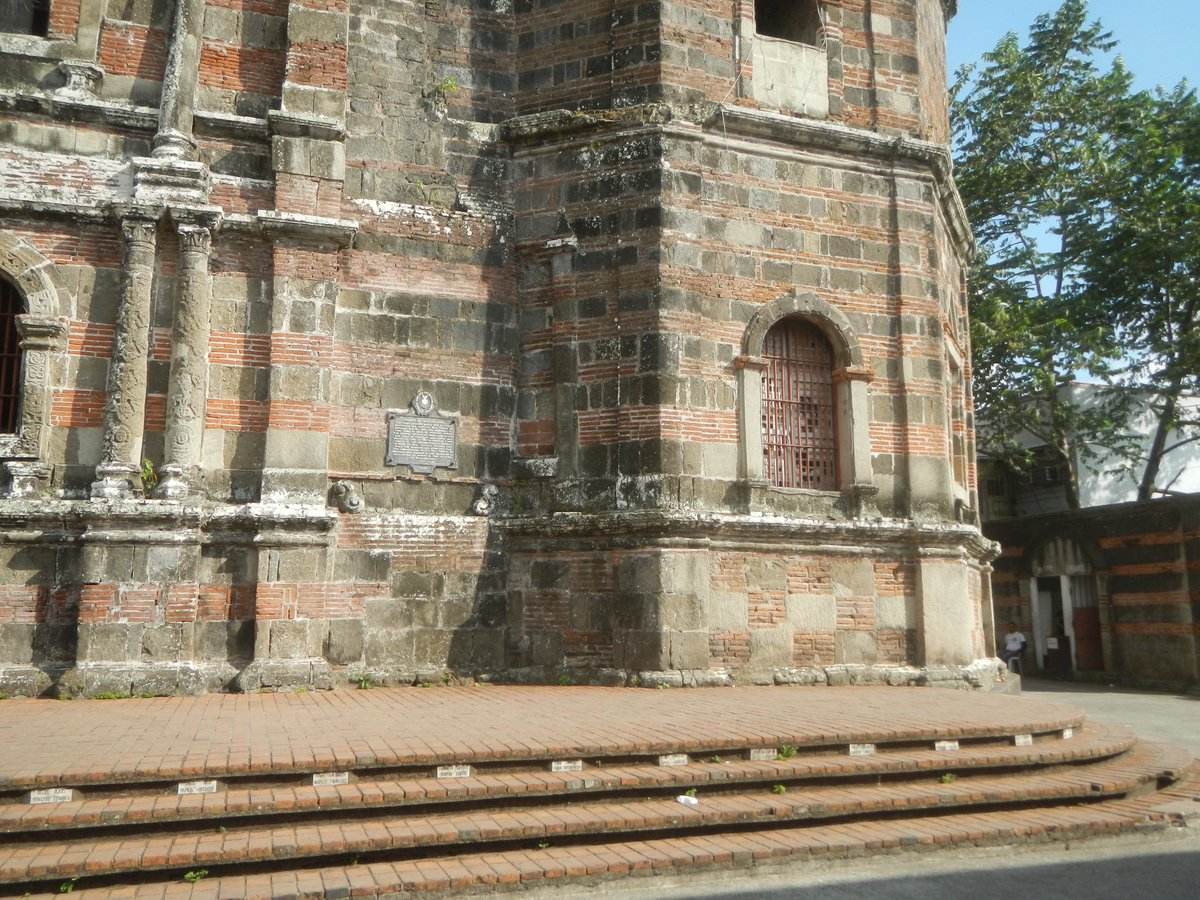
The walls are three metres thick — wider than a minivan is long — and they hold a secret. When Franciscan friars rebuilt this church after a 1660 fire, they didn't demolish the charred ruins. They entombed them, sandwiching the burned stone between two fresh layers of brick. Press your palm against the nave wall and you're touching the outermost skin of a triple-layered structure with a 360-year-old catastrophe sealed inside it. No sign explains this.
The church took from 1616 to 1649 to build, with forced indigenous labor hauling volcanic tuff from the surrounding hills. Filipino workers cut, carried, and stacked every block of the dark, porous stone that now sprouts moss and ferns along the buttresses. Step inside and the scale silences you: 60 metres long, 16.5 metres to the ceiling, the floor paved in blue-and-white azulejo tiles that send your footsteps ricocheting off the walls. The smell is candle wax, damp stone, and four centuries of incense residue. Light enters softly through plain windows — no stained glass theatrics, just diffused glow that makes you lower your voice without thinking about it.
Pope Francis elevated this to a Minor Basilica in January 2025, the first in the Diocese of San Pablo. But the real reward is the bell tower. Ask the parish priest for permission to climb the five storeys — be polite, be patient — and from the top you'll see Laguna de Bay glinting on the horizon, framed by the same view that has oriented this town since the Spanish arrived in 1571. Five centuries-old bells hang up there. When the main one rings, you feel it in your ribs before you hear it.
Puente de Capricho — The Bridge That Refused to Be Finished
José Rizal wrote this bridge into Chapter 1 of El Filibusterismo, his 1891 novel that helped ignite a revolution. Friar Camorra mocks it by name while steaming across Laguna de Bay. The real thing is stranger than fiction: a single stone arch jutting from the bank of the Olla River, going precisely nowhere. Franciscan Fr. Victorino del Moral ordered its construction in 1851, and Filipino workers built the central span before they stopped showing up. Manila authorities ridiculed it as the "Bridge of Whims." Locals gave it a blunter name — Tulay ng Pigi, "Bridge of Buttocks" — because the friar ordered latecomers beaten on the backside. The workers' refusal to return was quiet, effective resistance. The bridge stayed unfinished.
Finding it requires effort. Ask for "Tulay Pigi" rather than the Spanish name — most residents know it that way. You'll pass a dumpsite and descend a steep incline to the riverbank. The arch is massive, dark with moisture and age, jungle creeping in from every side. Whatever wooden extensions once completed the span were destroyed during the filming of Apocalypse Now in the 1970s; crude concrete slabs replace them now. Stand on the stone and look down at the Olla River sliding beneath you. This is one of at least ten Spanish-era bridges scattered across Majayjay — more than any other town in Laguna — but this is the only one that tells you something true about the people who built it by what they chose not to build.
A Half-Day Walk: Church, Ermita Chapel, and the River's Edge
02 In pictures.


Plan and listen to Majayjay with Audiala.
Audio guide in your pocket, itinerary in your browser. Built for the way you actually visit.
03 Visitor logistics.
The practical scaffolding for a good visit — kept short.
Getting There
From Manila, take a DLTB or HM Transport bus from Cubao or Buendia terminal to Sta. Cruz, Laguna (₱150–₱180, 2–3 hours), then a jeepney to Majayjay town proper (₱35–₱50, 45–60 minutes). For Taytay Falls, catch another jeepney toward Lucban and ask the driver for the Brgy. Gagalot drop-off, then a tricycle to the registration site (₱50–₱80). By car, take SLEX to Calamba, then head through Nagcarlan — budget 3–4 hours total, and know the final 10 km are winding mountain roads with blind curves.
Opening Hours
As of 2026, Taytay Falls opens daily 6:00 AM–5:00 PM except Tuesday mornings (closed 6:00 AM–12:00 noon for maintenance). The Minor Basilica of St. Gregory the Great is open roughly 6:00 AM–6:00 PM as an active parish — expect restricted tourist access during Mass times. The Nagcarlan Underground Cemetery (20 minutes away in Nagcarlan) was under NHCP restoration as of late 2023; call +63 915 770 1007 to confirm it has reopened before making the trip.
Time Needed
A focused visit to Taytay Falls plus the Minor Basilica takes 4–5 hours once you arrive. Add Dalitiwan Resort or the Puente de Capriccio and you have a full day. To combine Majayjay with Nagcarlan's Underground Cemetery and the shoe shops of Liliw, plan an overnight — trying to rush the circuit from Manila in a single day leaves you exhausted and seeing nothing properly.
Cost & Tickets
As of 2026, Taytay Falls charges ₱30 entrance plus ₱20 environmental fee — ₱50 total per person, cash only. Parking runs ₱50 for cars, ₱20 for motorcycles. Dalitiwan Resort is ₱150 per adult for a day visit. The Minor Basilica and Nagcarlan Underground Cemetery are both free. No ATMs, no GCash, no card readers exist near the falls — bring small bills, especially ₱20s and ₱50s.
Accessibility
Majayjay sits at roughly 500 meters elevation, and most attractions involve uneven terrain. The trail to Taytay Falls is rocky, steep in places, and slippery after rain — wheelchair access is not possible. The Minor Basilica's ground floor is accessible, but the surrounding streets are narrow and cobbled. Dalitiwan Resort is the most accessible option, with paved paths to its riverside cottages and pool area.
04 Tips for visitors.
Small things that change the day.
Arrive Before Nine
The falls are calmest and least crowded before 9:00 AM, and morning light hits the cascade directly. Catch the 5:00 AM DLTB bus from Buendia to reach Majayjay by mid-morning, or drive the night before and stay at Dalitiwan or Costales Nature Farm.
Skip Rainy Mornings
If heavy rain fell overnight, don't go to Taytay Falls — the resort may refuse entry because the river turns murky and the current becomes dangerously strong. Call ahead during the May–October wet season; temporary closures happen without notice.
Respect the Basilica
Pope Francis elevated St. Gregory the Great to a Minor Basilica in January 2025 — the first in the Diocese of San Pablo — so pilgrim traffic is rising. Cover your shoulders, avoid flash photography near the altar, and step outside during Mass if you're visiting as a tourist rather than a worshipper.
Eat at Costales Farm
Costales Nature Farm in Brgy. Gagalot (same barangay as Taytay Falls, about 2.8 km away) serves farm-to-table meals from its own organic produce — mid-range pricing, ₱200 entrance. Samkara Restaurant on the Majayjay–Lucban highway is another solid option with garden seating. Skip the overpriced sari-sari snacks near the falls registration.
Combine Three Towns
Majayjay, Nagcarlan, and Liliw form a tight triangle — each about 15–20 minutes apart. Hit Liliw's cobblestone streets and leather sandal shops in the morning, the Nagcarlan Underground Cemetery at midday (if reopened), and Taytay Falls in the afternoon. This is the classic Laguna highlands circuit.
Download Offline Maps
Mobile data drops to near zero around Taytay Falls and the mountain roads leading to it. Download your Google Maps or Waze route offline before leaving Sta. Cruz or Nagcarlan, and don't rely on ride-hailing apps — tricycles are your only option for the last stretch.
05 A history of reinvention.
Five Churches, Ten Bridges, and a Revolution That Hid in the Hills
Majayjay's recorded history begins in 1571, when Spanish soldiers and their Cebuano-Visayan reinforcements marched south from Nagcarlan after sacking that town. They found Majayjay's defenders waiting at the Olla River — and retreated. The Spanish attacked before dawn with guns and war drums. The townspeople fled into the mountains, a pattern they would repeat for centuries. Only a man named Liraw and a pregnant woman remained behind. By October 2, 1571, Majayjay became an encomienda — a grant of indigenous labor and tribute to a Spanish colonizer — and the long, combustible relationship between the town and its occupiers began.
What followed was not a single story of colonial rule but a cycle of construction, fire, and reconstruction that left physical layers in the town's architecture. Franciscan friars Juan de Plasencia and Diego Oropesa took over evangelization from the Augustinians in 1578 and built the first of several churches from nipa palm and bamboo. Spanish engineers forced local laborers to quarry stone and lay bridges across the gorges. The town burned, rebuilt, burned again. Each time, something new was buried inside the old.
Pingkian in the Mountains: Emilio Jacinto's Last Stand
Emilio Jacinto was 22 years old, shot in the thigh, and carrying a dead man's identity papers. It was approximately February 1898, and the young general — known by his Katipunan alias "Pingkian," meaning flint — had just fought Spanish troops near the Maimpis River in Magdalena, the town northwest of Majayjay. Spanish soldiers captured him, dragged him to the Santa Maria Magdalena Parish Church, and according to local accounts, threw him down the church staircase. His blood stained the wooden floorboards. The town of Magdalena still preserves those stains under glass, though National Artist Virgilio Almario once observed: "One must have faith to see them."
What the Spanish did not know was who they had. Jacinto carried a salvoconducto — an identity pass — belonging to Florencio Reyes, a Spanish spy he had previously captured. Speaking fluent Spanish from his years at San Juan de Letran and the University of Santo Tomas, Jacinto convinced his interrogators he was Reyes, a loyal informant wounded by "bandits." The officers treated his wounds at the military hospital in Santa Cruz, Laguna. Once recovered, Jacinto escaped. He was the second-highest official of the Katipunan, the secret society that launched the revolution, and the Spanish let him walk out the door.
Jacinto retreated into the foothills above Majayjay, where he ran a cattle-trading operation as cover while organizing guerrilla resistance with General Miguel Malvar in Batangas. He was by then the last significant Katipunan commander who refused to join Emilio Aguinaldo's government — the men who had ordered the execution of his mentor Andrés Bonifacio, a man Jacinto's own mother had nursed at her breast. Penniless, stateless, and weakened by malaria, Jacinto died on April 16, 1899, at the age of 23. His wife was pregnant. His revolution was unfinished. The mountains of Majayjay — the ones that made everyone sigh "hay, hay, hay" — were among the last places that sheltered him.
A Church Inside a Church
The Bridge Rizal Knew
Listen to the full story in the app
The whole Majayjay,
told well.
Audio guides for 1,100+ cities across 96 countries. History, stories, and local insight — offline ready.

06 Frequently asked.
The questions travellers send us most about Majayjay.
Is Majayjay Laguna worth visiting?
Yes — if you care about Philippine history layered into actual stone, not just museum displays. The church alone (elevated to Minor Basilica by Pope Francis in January 2025) has walls nearly 3 metres thick that entomb the fire-damaged ruins of an earlier structure inside them, like a building swallowed by its own successor. Pair that with Taytay Falls, an unfinished Spanish bridge that José Rizal wrote into his novel, and air noticeably cooler than Manila at 500 metres elevation, and you have a full day that rewards attention.
How do I get to Majayjay from Manila?
By bus, take a DLTB or HM Transport service from Cubao or Buendia to Sta. Cruz, Laguna (₱150–₱180, about 2–3 hours), then a jeepney to Majayjay town proper (₱35–₱50, another 45–60 minutes). By car, drive SLEX to Calamba, then south through Bay and Calauan to Nagcarlan and on to Majayjay — roughly 3–4 hours depending on traffic, with tolls around ₱250–₱350 round trip. The last stretch is winding mountain road with blind curves, so budget extra time and patience.
What is the best time to visit Majayjay?
November through April gives you dry trails, clear water at Taytay Falls, and the least chance of rain closures. Arrive before 9:00 AM on a weekday — the falls get genuinely overcrowded on weekends and holidays, and one reviewer described a Good Friday visit as so packed they turned around immediately. If you visit during rainy season (May–October), call ahead: both Taytay Falls and Dalitiwan Resort close after heavy rain when currents become dangerous.
Can you visit Majayjay Church for free?
The Minor Basilica of Saint Gregory the Great is free to enter, open roughly 6:00 AM to 6:00 PM daily. Taytay Falls charges ₱50 per person (₱30 entrance plus ₱20 environmental fee), and the Nagcarlan Underground Cemetery — 20 minutes away in the next town — is also free, though it was under NHCP restoration as of September 2023, so confirm it has reopened before you go.
How long do you need at Majayjay?
A full day covers the three essentials: the church and its convento in the morning, Taytay Falls after that, and the Puente de Capricho if you're willing to scramble down a steep path. Add the Nagcarlan Underground Cemetery on your way in or out and you've got a packed but satisfying circuit. Overnight stays at Dalitiwan Resort or Costales Nature Farm let you slow down to the town's actual rhythm, which is the whole point of a place Spaniards once called the Summer Capital of the Philippines.
What should I not miss at Majayjay Laguna?
Don't skip the church interior — stand inside the nave and know that the walls around you are a triple-layer sandwich of 1730 brick encasing the burned ruins of a 1660 structure, wider than a car is long. Ask at the adjacent Liceo de Majayjay school about climbing the bell tower; the parish priest sometimes grants access, and the five century-old bells and the view toward Laguna de Bay are worth the polite persistence. The Puente de Capricho, the unfinished 1851 bridge Rizal mentioned in El Filibusterismo, sits off the tourist route near a dumpsite — locals know it as 'Tulay ng Pige' (Bridge of Buttocks) because Spanish friars beat workers on the thighs for slow progress.
Is Taytay Falls in Majayjay open during rainy season?
Taytay Falls stays open May through October, but the site closes temporarily after heavy overnight rain — the river turns murky and the current becomes too strong for safe swimming. The trail down to the basin gets slippery in wet months, so wear proper footwear, not flip-flops. Call ahead at +63 910 630 8603 if rain fell the night before, and note the standing Tuesday morning closure (6:00 AM to noon) for maintenance year-round.
Is the Nagcarlan Underground Cemetery open in 2025?
The NHCP closed the cemetery for restoration in September 2023, and as of early 2025 its reopening status remained unconfirmed. Before making the trip, contact curator Sarah Jane Estubo at +63 915 770 1007 or email [email protected]. When open, the cemetery is free to enter, runs Tuesday through Sunday from 8:00 AM to 4:00 PM, and closes on Mondays.
Verified, and shown.
Researched and written by the Audiala editorial team from historical records, architectural archives, and local expertise.
Foundational data on municipality history, etymology, geography, festivals, and the Botocan hydroelectric plant date dispute.
Detailed church construction timeline (1575–1730), architectural details, wall thickness, langit-langitan, Ermita chapel, and film appearances.
Biography of Emilio Jacinto, his role in the Katipunan, the Kartilya authorship, and his connection to Laguna.
Detailed account of Jacinto's battle near Majayjay, the spy pass ruse, his cattle-trading cover, and death from malaria.
Confirms the Magdalena church wound site, bloodstains under glass, and Virgilio Almario's wry comment about them.
2024 heritage survey of Majayjay's 10+ Spanish-era bridges, Puente de Capricho construction details, Fr. Victorino del Moral's tenure, and Valentín Marín's 1901 description.
Puente de Capricho's 1851 date, Rizal's Chapter 1 reference in El Filibusterismo, and current condition of the bridge.
2025 visitor guide with entrance fees, opening hours, Tuesday closure, trail description, and rainy-season warnings.
Local cultural values, the 'culture of slowness,' bajo de campana layout, ancestral houses, and community preservation ethos.
Official hours, contact details for curator Sarah Jane Estubo, and September 2023 closure announcement for restoration.
January 25, 2025 elevation to Minor Basilica by Pope Francis, first in the Diocese of San Pablo.
News coverage of the basilica designation and Bishop Maralit's response.
Local barangay officials' plans for the bridge, the buttocks-whipping oral history, and SK Chairperson Jascha Russelle Cangas's tourism ambitions.
Sensory descriptions of the Olla River, Ermita chapel, Botocan Gorge, and the Puente de Capricho approach.
Detailed church interior photography and descriptions of retablos, azulejo tiles, and the convento.
2025 itinerary with transport logistics, fee breakdowns, and trail timing for Taytay Falls.
May 2025 Dalitiwan Resort room rates, cottage fees, check-in/check-out times, and rainy-season closure policy.
History and format of Nagcarlan's Ana Kalang Festival, including the Kalang-Kalang figures and Sunduan ritual.
Tagalog-language etymology confirmation of the 'hay, hay, hay' exhaustion origin story.
Confirms Jacinto's hiding in the Majayjay foothills and his cattle-trading cover with General Miguel Malvar.
Description of the Feast of St. Gregory the Great celebrations and the Hermana Mayor tradition.
Visitor reviews including overcrowding complaints during peak holidays.
Researched from Wikidata, Wikipedia & official sources · fact-checked · How we make our guides →