Type 2+ letters to search all countries, cities, and places
/Ctrl KEsc
travel_explore
Type 2+ letters to search all countries, cities, and places
Press Enter to open the top result
Filoil Ecooil Centre
Metro Manila·Philippines·14° N · 121° E·Updated Apr 2026
Home to a nine-consecutive-championship basketball dynasty, Filoil EcoOil Centre fits 7,500 fans into a San Juan campus arena smaller than most Metro Manila malls.
On game nights, the noise inside Filoil EcoOil Centre reaches you a full block before the entrance — five thousand voices compressed into a concrete box barely larger than a high school gymnasium, generating a sound pressure you feel in your ribs. This indoor arena in San Juan City, Metro Manila, Philippines, serves as the home court of NCAA Philippine collegiate basketball and rewards the curious visitor with something no 20,000-seat mega-arena can replicate: a crowd close enough to make eye contact with the point guard. Come during finals season, and you'll grasp within ninety seconds why Filipinos treat basketball the way Brazilians treat football.
The arena sits on the campus of San Beda University, a Benedictine institution founded in 1901, along Rizal Avenue at the corner of N. Domingo Street. There is no grand plaza, no sweeping approach. You arrive through the dense urban grain of inner Metro Manila — past sari-sari stores, tricycle stands, and vendors threading fish balls onto bamboo skewers — and then the arena is simply there, wedged between school buildings like a secret everyone already knows.
Filipinos call it "FilOil" regardless of whatever corporate rebrand is currently painted on the facade. The venue has cycled through names — San Juan Arena, FilOil Flying V Centre, and now Filoil EcoOil Centre — but its identity has never wavered. This is where collegiate basketball dynasties are built and broken, where eighteen-year-olds become folk heroes, and where the line between sport and civic devotion dissolves entirely.
For visitors from outside the Philippines, attending an NCAA game here is less a sporting event than an anthropological experience. The choreographed cheering sections, the decibel levels that would trigger noise ordinances in most European cities, the sheer communal intensity — none of it translates on television. You have to be inside the box.
Researched by the Audiala editorial team from historical records, architectural archives, and local expertise.
What to see
An NCAA Philippines Game
The regular season runs roughly June through October, with finals toward the end of that window. Tickets are available through SM Tickets or at the venue on game day, and they remain remarkably affordable — historically in the ₱100 to ₱500 range, which at current exchange rates means you can watch championship-caliber basketball for less than the price of a London coffee. Arrive early. The choreographed cheering sections begin their routines well before tip-off, and the coordinated chanting of two thousand students — complete with synchronized hand gestures and call-and-response patterns — is as much a performance as the game itself. The atmosphere peaks during San Beda home games, when the Red Cubs fill the upper deck and turn the arena into something closer to a concert hall than a sports venue. Earplugs are not a joke.
The Rizal Avenue Street Food Corridor
On game days, the stretch of Rizal Avenue outside the arena transforms into an open-air food market that operates with the efficiency of a pit crew. Vendors set up portable grills and deep fryers to serve the pre-game and halftime crowds: fish balls skewered on bamboo sticks and dunked in sweet or spicy vinegar sauce, kwek-kwek — quail eggs coated in bright orange batter and fried until crisp — and pork barbecue glazed in a soy-and-banana-ketchup marinade that caramelizes over charcoal. A full meal costs less than ₱100. The smell of charcoal smoke and frying batter hangs in the humid evening air, mixing with diesel exhaust and the distant bass thump of the arena's sound system. This is not curated food tourism.
Pinaglabanan Shrine
A ten-minute walk from the arena, this monument marks the site of one of the first major Filipino victories against Spanish colonial forces during the Philippine Revolution. The shrine commemorates the Battle of San Juan del Monte, where Andrés Bonifacio and Katipunan revolutionaries overran a Spanish waterworks station on August 30, 1896. Most visitors to Filoil EcoOil Centre walk right past it without a second glance, which is a shame — standing at a site where a colonial empire first began to lose its grip on an archipelago of over seven thousand islands puts a basketball game into a certain perspective. The shrine is free to enter and quiet even on game days, which in San Juan City qualifies as a minor miracle.
Plan your visit
Getting There
The arena sits on Rizal Avenue corner N. Domingo Street in San Juan City. Grab or taxi from Makati or Ortigas takes 20–40 minutes depending on Manila's famously unpredictable traffic. LRT-2 stations Legarda and Pureza are the closest rail options — from either, a tricycle ride of roughly 10–15 minutes drops you at the gates. Jeepney routes run along EDSA to Cubao with transfers toward San Juan; tell the driver "San Beda" and they'll know the stop.
Opening Hours
As of 2026, the Filoil EcoOil Centre opens only on event days — there are no standalone visiting hours. NCAA Philippines games typically run from June through October, with finals late in the season. Concerts, university graduations, and special events fill the calendar outside basketball season, but check SM Tickets or the venue's social media before heading over.
Time Needed
An NCAA basketball game runs about two hours, but plan for three once you factor in the pre-game street food ritual and the post-game crowd surge. If you're combining the visit with the nearby Pinaglabanan Shrine and a walk around the San Beda campus, budget half a day.
Tickets
NCAA game tickets have historically been among the cheapest live sports experiences in Manila — in the range of ₱100–₱500 (roughly $2–$9 USD), though 2026 pricing should be confirmed via SM Tickets (SMTickets.com). Tickets are also sold at the venue on game days, but finals and San Beda rivalry matches sell out. Buy online for anything that matters to you.
Photo Gallery
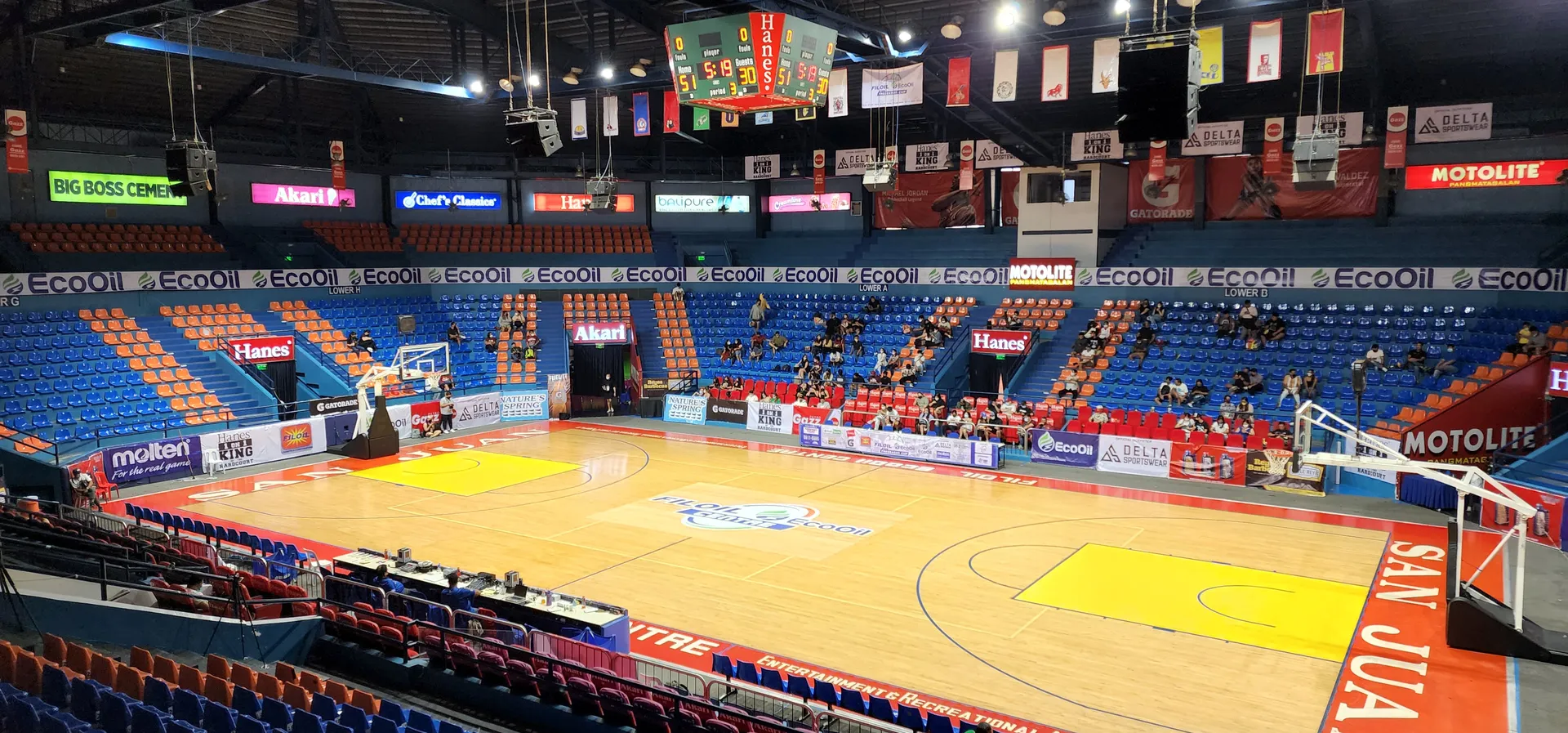
The entrance area of the Filoil Ecooil Centre in Metro Manila, Philippines, showing the facility's exterior architecture and signage. · SwarmChengAn interior view of the Filoil Ecooil Centre in San Juan, Metro Manila, featuring the basketball court and tiered arena seating. · dann_garciaAn entrance directional sign and environmental compliance notice displayed on the perimeter fence of the Filoil Ecooil Centre in San Juan, Philippines. · SwarmChengA wide-angle view of a basketball game inside the Filoil Ecooil Centre in Metro Manila, Philippines, featuring the arena's distinctive architecture and crowd. · LMP 2001A low-angle view of the Filoil Ecooil Centre in Metro Manila, showcasing its distinctive modern architectural design and textured brown exterior. · SwarmChengThe Filoil Ecooil Centre in San Juan, Metro Manila, is a premier indoor sports arena featuring a professional basketball court and tiered spectator seating. · dann_garciaThe Filoil Ecooil Centre in Metro Manila showcases a striking contrast between its textured red exterior and a modern, angular silver architectural feature. · SwarmCheng
History
Where Red Lions Roared and Dynasties Were Forged
Philippine collegiate basketball predates the NBA by over a decade. The NCAA Philippines, founded in 1924, is one of the oldest collegiate athletic associations in Asia, and for much of its modern history, Filoil EcoOil Centre has been the stage where its fiercest rivalries play out. The arena's exact construction date is poorly documented — a common fate for functional buildings in a city that has rebuilt itself many times over — but by the early 2000s it had become the league's anchor venue.
San Beda University's relationship with the arena is both landlord and protagonist. The Benedictine school owns the ground it stands on, and its basketball program has dominated inside it with a consistency that borders on the implausible.
The turning point
Coach Fernandez and the Dynasty That Wouldn't End
Under coach Boyet Fernandez, the San Beda Red Lions assembled what is widely regarded as the most dominant run in NCAA Philippines history — a streak of consecutive championship titles through the 2010s that, depending on the source, reached nine or ten straight. The exact count is debated with the fervor that other countries reserve for constitutional amendments.
Fernandez's teams were built on defensive discipline and an almost monastic work ethic that fit the Benedictine institution's character. His players — many recruited from provinces far from Manila — lived in dormitories on the same campus where they practiced, studied, and then walked across to the arena to play in front of crowds that already knew their names, their stats, and their girlfriend's name. The intimacy of the venue made every home game feel like a family argument: loud, personal, and impossible to ignore.
The dynasty turned Filoil EcoOil Centre into something more than a basketball venue. It became proof of concept — evidence that a small Benedictine college could, through sheer organizational will and one very good coach, dominate a league that included schools with ten times its enrollment. The Red Lions' banners still hang from the rafters. Opposing teams still hate playing here.
The Name on the Door Keeps Changing
The arena's naming rights tell a parallel story about Philippine sports marketing. Originally known simply as the San Juan Arena, it was rebranded as FilOil Flying V Centre when FilOil — a lubricants and fuel additives company with roots in Philippine motorsports — acquired sponsorship rights. When the parent company rebranded to Filoil EcoOil Inc., the arena followed suit. Locals ignored every transition. Ask for directions to the "Filoil EcoOil Centre" and you'll get blank stares; ask for "FilOil" and every tricycle driver within earshot will point the way.
A Campus Arena in a Concrete City
Unlike purpose-built sports complexes with generous parking lots and corporate hospitality suites, Filoil EcoOil Centre grew organically within San Beda's urban campus. The arena is hemmed in by classrooms, a chapel, and the residential streets of San Juan City — one of Metro Manila's smallest municipalities at roughly 5.9 square kilometers, about the size of Gibraltar. This claustrophobic setting is precisely what gives the venue its character. There is no buffer zone between daily life and game day. The barbecue smoke from Rizal Avenue vendors drifts into the lobby, and students walk from their last class directly into the bleachers.
Tips for visitors
Sit Near Red Cubs
San Beda's organized student section, the "Red Cubs," generates noise levels that feel physically impossible for a 5,000-seat arena. For the full sensory assault, grab upper bleacher seats on their side — it's the closest thing to a European football ultras experience you'll find in a Philippine university gym.
Street Food Before Tipoff
On game days, vendors line Rizal Avenue with fish balls, kwek-kwek (deep-fried quail eggs in orange batter), and barbecue skewers — all for ₱15–₱50 per serving. Arrive 30–45 minutes early and eat your way to the entrance. The roasted peanuts sold in twisted newspaper cones are the arena's unofficial snack.
Watch Your Belongings
The post-game exit crush on Rizal Avenue packs bodies tight along narrow sidewalks — keep phones and wallets in front pockets. The surrounding San Juan streets are generally safe but poorly lit at night, so grab a ride rather than wandering on foot after evening games.
Pair With Pinaglabanan
The Pinaglabanan Shrine, commemorating an 1896 battle of the Philippine Revolution, sits a short walk from the arena and is overlooked by almost everyone who comes here for basketball. It adds genuine historical weight to what might otherwise be a purely sports-focused outing.
Skip Driving
On-site parking is minimal and surrounding street parking fills fast on game nights. San Juan City traffic on weekday evenings rivals anything Manila throws at you — which is saying something. Grab or taxi is the move; you'll save an hour of circling and swearing.
Where to Eat
local_dining
Don't Leave Without Trying
Sisig — sizzling chopped pork cheek with calamansi and chili, a Metro Manila stapleKare-Kare — oxtail or tripe in rich peanut sauce with shrimp paste (bagoong)Crispy Pata — deep-fried pork knuckle, crispy outside and tender insideSilog meals — garlic rice (sinangag) + fried egg (itlog) + protein (tapa, longganisa, or tocino)Halo-Halo — shaved ice dessert with beans, ube, leche flan, and evaporated milkBalut — fertilized duck egg, an adventurous local street food icon
Sicilian Roast Santolan Town Plaza
local favorite
Italian Rotisserie€€star4.9(1185)
Order: The roasted chicken is the hero here — crispy skin, juicy meat, and perfectly seasoned. Pair it with their sides for a no-fuss, satisfying meal that locals keep coming back for.
With nearly 1,200 reviews and a 4.9 rating, Sicilian Roast has earned serious credibility in the San Juan food scene. This is the kind of place where quality consistency matters, and they deliver it every time.
Order: Go for their signature tonkotsu ramen — the pork bone broth is rich and deeply flavored, with noodles cooked to the perfect texture. The chashu is tender enough to melt on your tongue.
Over 780 reviews and a 4.8 rating prove this isn't just another ramen spot. Hanamaruken has mastered the craft of authentic Japanese ramen in San Juan, drawing a loyal crowd of noodle enthusiasts.
Order: The premium meat platters are the main event — thinly sliced wagyu and pork that cook in seconds in the bubbling broth. Don't skip the dipping sauces; they're essential to the experience.
This is the kind of interactive, communal dining experience that turns a meal into an event. A1 Premium offers quality ingredients and a fun atmosphere that's perfect for groups or a special night out.
Order: Perfect for a quick coffee and pastry before or after your visit to Filoil. Their cafe offerings are ideal for a casual breakfast or afternoon break.
A perfect pit stop in Santolan Town Plaza with a perfect 5.0 rating. While small in review count, it's the kind of neighborhood spot locals trust for reliable coffee and a quiet moment.
checkMost restaurants in San Juan accept both cash and card, but always have cash on hand for street food vendors and small eateries.
checkLunch rush (12:00–1:30 PM) can get crowded at popular spots like Sicilian Roast and Hanamaruken — arrive early or go mid-afternoon to avoid the queue.
checkMany local restaurants have split lunch and dinner service hours (11 AM–2 PM, then 5–9 PM), so plan accordingly.
checkTipping is not mandatory in the Philippines, but rounding up or leaving 5–10% is appreciated for good service.
Food districts:Santolan Town Plaza — clustered dining hub with multiple cuisines in one location, convenient for Filoil visitorsCol. Bonny Serrano Avenue corridor — local dining spine with ramen, shabu-shabu, and Italian options within walking distance
Restaurant data powered by Google
Watch & Explore Filoil Ecooil Centre.
Explore Metro Manila
Best Things To Do in Manila Philippines 2026 4K
Island Hopper TV17 min148K
Explore Metro Manila
TOP 15 Must-Visit Tourist Spots in MANILA CITY Philippines | Best and NEW Places to Explore!
HG Virtual Tour15 min98K
Frequently asked
Is Filoil EcoOil Centre worth visiting?
Only if you're there for a game — the arena itself has no standalone tourist appeal. But catch an NCAA Philippines game, especially a San Beda Red Lions match, and the compact arena turns into something genuinely electric: roughly 5,000 to 7,500 people packed into a space smaller than most provincial malls, making noise that has nowhere to go but back at you.
How long do you need at Filoil EcoOil Centre?
Budget 3 to 4 hours for a full game day experience — about 2 hours for the game itself, plus time for pre-game street food on Rizal Avenue and the inevitable post-game traffic crawl. There's nothing to see here outside of event days, so don't build a half-day around it.
How do I get to Filoil EcoOil Centre in San Juan City?
Grab or taxi from Ortigas or Quezon City takes 20 to 40 minutes depending on traffic, and is the least stressful option. LRT-2 to Pureza or Legarda stations gets you close, then a 10- to 15-minute tricycle or jeepney ride to San Beda; for jeepneys, ask for 'San Beda' or 'N. Domingo.' Parking on-site is extremely limited — don't drive unless you know the side streets.
How much do NCAA Philippines tickets cost at Filoil EcoOil Centre?
Historically, NCAA game tickets have run between ₱100 and ₱500 — roughly the price of a sit-down lunch. Tickets are sold through SM Tickets online or at the venue on event days. Finals tickets sell out faster than regular season games, so buy in advance if San Beda is in the championship.
What is Filoil EcoOil Centre used for?
Primarily as the home court for NCAA Philippines basketball, making it the most consistently used collegiate sports venue in Metro Manila. San Beda University also uses it for graduations and university events, and occasional concerts are held there — though its acoustics favor crowd noise over musical performance.
What NBA or PBA events are held at Filoil EcoOil Centre?
The venue is NCAA Philippines territory, not PBA or NBA. The PBA plays at larger arenas like the Smart Araneta Coliseum and Mall of Asia Arena. Filoil's identity is entirely collegiate — that intimacy is the point, and it's what distinguishes the atmosphere from a professional game.
What is the capacity of Filoil EcoOil Centre?
Approximately 5,000 to 7,500 spectators, depending on the configuration — closer in size to a large high school gymnasium in the US than to a professional arena. That compactness is why it's so loud: the noise has nowhere to dissipate.
Sources & attribution4
Researched and written by the Audiala editorial team from historical records, architectural archives, and local expertise. Last updated April 2026.
Saved and recently read places — kept on this device only.
Photo credits (12)
Filoil EcoOil Centre San Juan 2025-04-11 — LMP 2001 — CC BY-SA 4.0 (https://creativecommons.org/licenses/by-sa/4.0/) — Source: https://commons.wikimedia.org/wiki/File:Filoil_EcoOil_Centre_San_Juan_2025-04-11.jpg
Filoil EcoOil Centre San Juan 06 — SwarmCheng — CC BY-SA 4.0 (https://creativecommons.org/licenses/by-sa/4.0/) — Source: https://commons.wikimedia.org/wiki/File:Filoil_EcoOil_Centre_San_Juan_06.jpg
Filoil EcoOil Centre - Interior - 2022 — dann_garcia — CC BY-SA 2.0 (https://creativecommons.org/licenses/by-sa/2.0/) — Source: https://commons.wikimedia.org/wiki/File:Filoil_EcoOil_Centre_-_Interior_-_2022.jpg
Filoil EcoOil Centre San Juan 09 — SwarmCheng — CC BY-SA 4.0 (https://creativecommons.org/licenses/by-sa/4.0/) — Source: https://commons.wikimedia.org/wiki/File:Filoil_EcoOil_Centre_San_Juan_09.jpg
Filoil EcoOil Centre San Juan 08 — SwarmCheng — CC BY-SA 4.0 (https://creativecommons.org/licenses/by-sa/4.0/) — Source: https://commons.wikimedia.org/wiki/File:Filoil_EcoOil_Centre_San_Juan_08.jpg
Filoil Flying V Centre - Interior - 2018 — dann_garcia — CC BY-SA 2.0 (https://creativecommons.org/licenses/by-sa/2.0/) — Source: https://commons.wikimedia.org/wiki/File:Filoil_Flying_V_Centre_-_Interior_-_2018.jpg
Filoil EcoOil Centre San Juan 07 — SwarmCheng — CC BY-SA 4.0 (https://creativecommons.org/licenses/by-sa/4.0/) — Source: https://commons.wikimedia.org/wiki/File:Filoil_EcoOil_Centre_San_Juan_07.jpg
SEA Games 2019 at Filoil Center - basketball 3x3 men final (San Juan; 12-02-2019) 3 — patrickroque01 — CC BY-SA 4.0 (https://creativecommons.org/licenses/by-sa/4.0/) — Source: https://commons.wikimedia.org/wiki/File:SEA_Games_2019_at_Filoil_Center_-_basketball_3x3_men_final_(San_Juan;_12-02-2019)_3.jpg
Filoil EcoOil Centre San Juan 04 — SwarmCheng — CC BY-SA 4.0 (https://creativecommons.org/licenses/by-sa/4.0/) — Source: https://commons.wikimedia.org/wiki/File:Filoil_EcoOil_Centre_San_Juan_04.jpg
Filoil EcoOil Centre San Juan 14 — SwarmCheng — CC BY-SA 4.0 (https://creativecommons.org/licenses/by-sa/4.0/) — Source: https://commons.wikimedia.org/wiki/File:Filoil_EcoOil_Centre_San_Juan_14.jpg
Filoil EcoOil Centre San Juan 13 — SwarmCheng — CC BY-SA 4.0 (https://creativecommons.org/licenses/by-sa/4.0/) — Source: https://commons.wikimedia.org/wiki/File:Filoil_EcoOil_Centre_San_Juan_13.jpg
Filoil EcoOil Centre San Juan 12 — SwarmCheng — CC BY-SA 4.0 (https://creativecommons.org/licenses/by-sa/4.0/) — Source: https://commons.wikimedia.org/wiki/File:Filoil_EcoOil_Centre_San_Juan_12.jpg
Strictly necessary cookies keep the site working. Analytics (PostHog, Google Analytics) measures how each visitor uses our pages. Marketing loads YouTube videos and walking-route maps without a tap and lets Google Analytics set advertising cookies. We never sell your data. You can change this any time from the footer.
Analytics and marketing cookies are optional and only load if you agree. Details under Customize.
Privacy
Cookie preferences
Pick what you're okay with. You can change this any time from the footer.
Strictly necessary
Always on
Sign-in, language, navigation. Always on.
Product analytics
PostHog (EU) and Google Analytics record which pages you view and how you use them, under a random identifier stored in your browser. Helps us see which pages work and which need fixing. Google's ad personalisation stays off. No selling.
Marketing
Loads YouTube videos and the walking-route maps (OpenFreeMap) without a tap; without it, they load only when you tap them. If analytics is also on, Google Analytics may set advertising cookies. Ad personalisation stays off.