Introduction
The Walls of Lima, or "Las Murallas de Lima," stand as a testament to Peru’s colonial history and the evolving story of its capital. Built in the late 17th century to protect the city from pirate incursions and rival colonial powers, these fortifications have not only shaped Lima’s urban landscape but also serve as enduring symbols of social, cultural, and architectural heritage. Today, they invite visitors to explore both preserved remnants and the complex narratives of Lima’s past and present (SouthAmerica.cl; Wikipedia).
This guide offers a comprehensive overview, including the origin and evolution of the walls, architectural details, practical visitor information, cultural significance, and the impact of modern divisions such as the "Wall of Shame." Whether you’re a history enthusiast, traveler, or student of urban dynamics, this resource will help you make the most of your visit to Lima’s historic walls.
Historical Background
Origins and Purpose
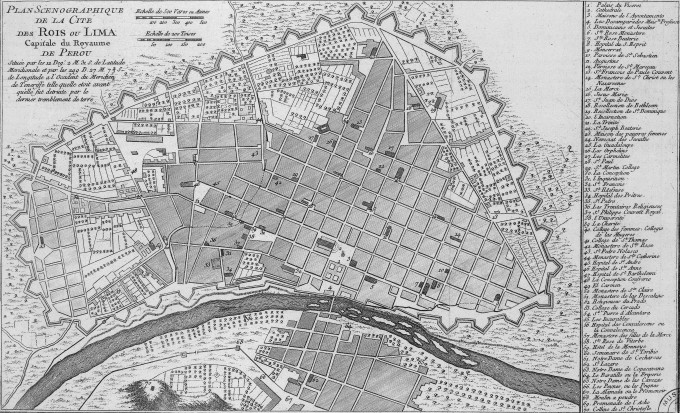
Built between 1684 and 1687 under Viceroy Melchor de Navarra y Rocafull, the Walls of Lima encircled the city to defend it from pirates and foreign threats. The imposing structure featured about 11 kilometers of fortifications, including 34 bastions and 10 main gates, each named after nearby destinations or saints (Wikipedia; SouthAmerica.cl).
The walls reflected a broader strategy of urban defense common in Spanish colonial cities in the Americas. Lima’s prominence as the capital of the Viceroyalty of Peru made it a prime target, and its walls symbolized both security and the social hierarchy of the colonial order.
Evolution and Demolition
Despite their formidable appearance, the walls never endured a significant siege and were described by historian Raúl Porras Barrenechea as having "died a virgin of gunpowder." By the mid-19th century, as Lima expanded, the walls were viewed as obsolete obstacles to urban development. Large sections were demolished in 1868 to make way for new avenues and city growth (Wikipedia).
Today, only fragments remain, most notably at Parque de la Muralla and the Santa Lucía bastion, offering tangible links to the city’s colonial origins (WorldHeritageSite.org).
Architectural Features
Design and Layout
The walls followed the Rímac River and the old colonial street grid, forming an irregular polygon around Lima’s core. Built primarily from adobe, with reinforcements of stone and lime mortar, the fortifications stood up to 5 meters high and 2.5 meters thick (SouthAmerica.cl). Defensive features included bastions for artillery, watchtowers, and moats in strategic areas.
Surviving Sections and Restoration
- Parque de la Muralla: The most accessible preserved section, featuring restored walls, an archaeological museum, and green spaces for public use (Wikipedia; Moleskine Arquitectonico).
- Santa Lucía Bastion: Another significant remnant, showcasing original defensive architecture and situated at the edge of Barrios Altos and El Agustino (Wikipedia).
- Interpretive Signage and Museums: Informative displays at these sites provide context on colonial Lima and the evolution of its defenses.
Cultural and Social Significance
Symbol of Colonial Heritage
The Walls of Lima are more than architectural relics; they represent the city’s colonial past and the social hierarchies embedded in its urban design. For centuries, the walls demarcated the space of the Spanish elite from indigenous and mestizo populations, reinforcing social divides (LAC Geo; Academia.edu).
Preservation efforts in recent decades have transformed these remnants into sites of historical memory, education, and civic pride. Parque de la Muralla now serves as a venue for cultural events, educational programs, and community gatherings (Moleskine Arquitectonico).
The Modern "Wall of Shame"
Distinct from the colonial walls, the "Wall of Shame" (El Muro de la Vergüenza) was built in the late 20th century as a barrier between wealthy and impoverished neighborhoods. Up to 10 kilometers long and three meters high, it is a stark symbol of Lima’s continuing social and economic divisions (The Conversation; Safe Homes Movement).
Legal action in recent years has led to partial demolition of the wall, sparking debate about urban segregation and the challenges of building a more inclusive city (Safe Homes Movement; The New Humanitarian).
Visiting the Walls of Lima: Practical Information
Visiting Hours and Tickets
- Parque de la Muralla:
- Hours: Daily, 9:00 AM – 6:00 PM
- Admission: Free; museum entry may require a nominal fee (approx. 5 PEN)
- Santa Lucía Bastion:
- Access: Occasional access during special events or guided tours
It's advisable to check current hours or fees before your visit, as they may vary by season or event (Moleskine Arquitectonico).
Tours and Experiences
- Guided Walking Tours:
Offered by local operators, often tip-based or fee-based ($10–$30 USD). Tours provide historical context and insider perspectives (Destinationless Travel; FreeWalkingToursPeru.com). - Thematic Tours:
Some tours combine the Walls of Lima with other attractions such as the Magic Water Circuit or Huaca Pucllana. - Self-Guided Visits:
Informational signage and maps are available at Parque de la Muralla for independent exploration.
Accessibility and Travel Tips
- Accessibility:
Main paths are wheelchair- and stroller-accessible. Some uneven surfaces exist near the wall remains. - Safety:
The historic center is generally safe during the day. Exercise caution in less-traveled areas and after dark. Use rideshare apps for reliable transportation (Lonely Planet). - Best Visiting Time:
December–April offers clear skies and warm temperatures; May–November is cooler with occasional fog (Touropia). - Visitor Etiquette:
Do not climb the walls. Dispose of litter properly. Commercial photography requires permission.
Nearby Attractions
- Plaza Mayor: Lima’s main square, surrounded by the Government Palace and Cathedral.
- Convent of San Francisco: Renowned for its catacombs and colonial architecture.
- Museo de Arte de Lima (MALI): Offers insights into Peruvian art and history.
- Barranco District: Famous for its bohemian atmosphere, art galleries, and cafes.
- Huaca Pucllana: A pre-Incan archaeological site in Miraflores.
Frequently Asked Questions
Q: What are the Walls of Lima visiting hours?
A: Parque de la Muralla is open daily from 9:00 AM to 6:00 PM.
Q: Do I need a ticket?
A: General park access is free; museum entry may require a small fee.
Q: Are guided tours available?
A: Yes, both free tip-based and paid tours are available in Spanish and occasionally in English.
Q: Is the site accessible for visitors with mobility issues?
A: Main pathways are accessible, but some areas near wall remains have uneven terrain.
Q: What’s the best time to visit?
A: December to April for better weather; visit in the morning or late afternoon for optimal lighting and comfort.
Q: Can I visit the modern "Wall of Shame"?
A: The wall is publicly visible in districts like La Molina and Santiago de Surco. Guided tours are recommended for context and safety (The Conversation).
Listen to the full story in the app
Your Personal Curator, in Your Pocket.
Audio guides for 1,100+ cities across 96 countries. History, stories, and local insight — offline ready.
Audiala App
Available on iOS & Android
Join 50k+ Curators
Sources
- verified
- verified
- verified
- verified
- verified
- verified
- verified
- verified
Last reviewed: