diversity_3
800-plus languages
Papua New Guinea is one of the most linguistically diverse countries on earth. That is not a trivia fact; it is the living shape of markets, ceremonies, kinship, and daily conversation from Port Moresby to Tari.
Papua New Guinea is one of the last places where geography still dictates the journey: mountains, rivers, reefs, and languages shape the trip more than any tourist trail ever could.
EntryPassport valid 6+ months; many travelers must arrange visa before arrival
PPapua New Guinea travel guide starts with a shock: one country, 800-plus languages, active volcanoes, and highland valleys where farming began 10,000 years ago.
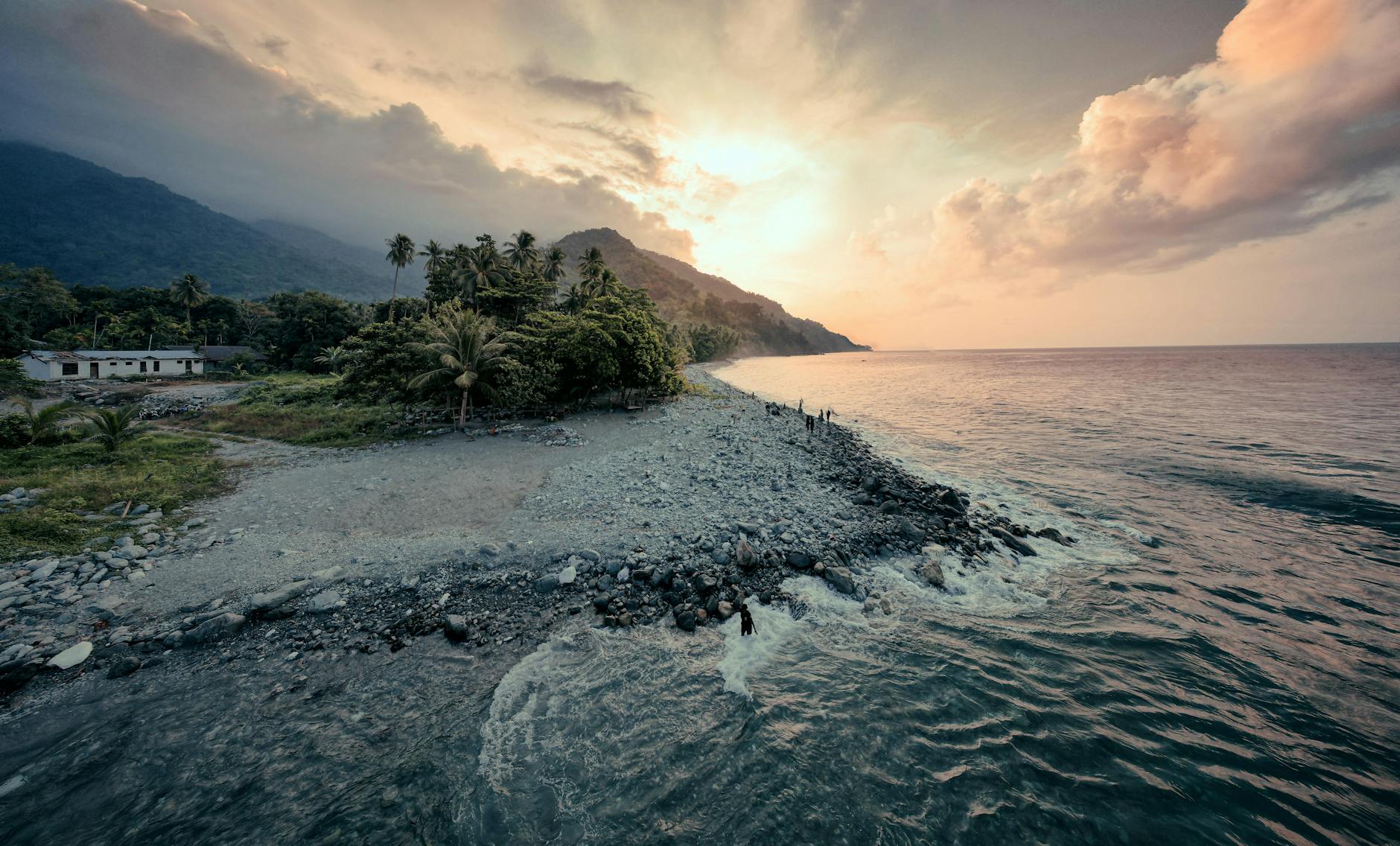
Papua New Guinea does not behave like a tidy beach destination. It sprawls across the eastern half of New Guinea and island chains scattered through the Bismarck and Solomon seas, with mountains rising to 4,509 meters on Mount Wilhelm and rivers like the Sepik running for roughly 1,100 kilometers. That geography shapes every trip. Port Moresby is the gateway, but it is only the doorway to a country where a morning in the humid capital can end with a cold night in Mount Hagen or Goroka, and where reaching Rabaul or Kavieng means watching the land break into reefs, volcanoes, and deep harbors.
Culture is the reason many travelers remember Papua New Guinea differently from anywhere else. Tok Pisin carries daily conversation across markets and airports, yet the country still holds more than 800 local languages, each tied to its own histories, ceremonies, and obligations. In Madang and Wewak, coastal life runs to fish, sago, and river trade. In Tari and Kokoda, the ground tells harder stories: exchange, endurance, warfare, survival. Even the idea of a single national culture feels too neat here. Papua New Guinea makes more sense as a dense patchwork held together by trade, kinship, church, and stubborn local pride.
First Settlers and Gardeners, c. 50000 BCE-1500 BCE
Morning mist sits low over the Wahgi Valley, and your feet sink into black mud at Kuk long before you understand what lies beneath it. Under that wet ground, archaeologists found drainage ditches, mounded beds, and the patient geometry of cultivation dating back about 10,000 years. Ce que l'on ignore souvent, c'est que Papua New Guinea was not a late receiver of agriculture. It invented farming on its own.
That changes the scale of the story at once. While much of the ancient world was still improvising its relationship with plants and seasons, communities in what is now the Highlands were cutting channels through swamp land and turning water into a tool. This was not a lost Eden. It was work, repeated generation after generation, in a place whose mountains still make travel feel like negotiation rather than entitlement.
The first settlers had reached Sahul, the great Ice Age landmass linking New Guinea and Australia, roughly 50,000 to 60,000 years ago. Imagine the courage of that movement: sea crossings without maps in the modern sense, then millennia of adaptation in forests, coasts, and high valleys that would grow into some of the most linguistically diverse societies on earth. Eight hundred languages did not appear by accident. They are the trace left by human groups living close, separate, inventive lives for a very long time.
Then came one of history's most consequential newcomers: the sweet potato, arriving from South America through Pacific exchange in the 16th century. The Highlands were ready for it. The crop moved fast, fed more people, supported denser settlement, and sharpened the social world of pigs, gardens, bridewealth, and ceremonial exchange that later Europeans would mistake for timeless tradition. Nothing timeless about it. A new plant had altered the balance of power.
The emblematic figure of this era is anonymous: a Kuk gardener whose name is lost, but whose drainage ditch outlived empires.
Kuk's early wetland engineering is so old that it stands in the same conversation as the first agricultural experiments in Mesopotamia and the Nile world.
Lapita Coasts and Ceremonial Seas, c. 1500 BCE-1526 CE
A canoe noses onto a beach on Manus or along the Bismarck Archipelago, and in its hull are pigs, pots, obsidian, and a different idea of the sea. Around 3,200 years ago, Austronesian-speaking Lapita voyagers reached these coasts and islands with stamped ceramics whose geometric faces still look uncannily alive. The Pacific did not begin at Tahiti. In many ways, it began here.
These newcomers did not erase the older worlds inland. They joined them, traded with them, married into them, and helped create the layered cultural map that still makes Papua New Guinea feel less like a single nation than an argument among many nations. On the coast and through the islands, exchange became an art form. Prestige moved with shell valuables, with marriage, with ritual obligations, with the dangerous beauty of long-distance voyaging.
Nowhere is that clearer than in the Massim world around Alotau, where the Kula Ring sent shell armbands and necklaces circling from island to island over hundreds of kilometers. A European merchant would have called it irrational. Bronislaw Malinowski, stranded there during the First World War, understood that he was watching politics, reputation, and trust made visible. A necklace was never just a necklace. It carried names, risks, memories, and the vanity of men who wished to be remembered.
Far to the north, along the Sepik River near Wewak, spirit houses rose like painted declarations of ancestry. Their carved facades were not ornament. They were archives. In a land where memory was performed, sung, initiated, and guarded, art did the work of a library and a parliament at once. That is the bridge to the next era: when European ships finally appeared, they entered a world that was already ancient, connected, and perfectly capable of judging strangers.
Bronislaw Malinowski became the accidental witness who showed Europe that the Kula exchange was not a curiosity but a complete social order.
One Lapita pottery shard from Manus bears a stylized face that may be the oldest known human image in Oceanian art.
Foreign Flags and Partition, 1526-1941
A cross is planted on a shore in 1545, a formal declaration is read, and the wind carries the words away. Yñigo Ortiz de Retez named the island Nueva Guinea because the coast reminded him of West Africa. It was a classic imperial gesture: a stranger sees, names, claims, and sails on. The people already there, of course, had no reason to treat that ceremony as binding.
For centuries, Europe knew the coastline better than the interior. Traders, missionaries, and adventurers circled, guessed, and embellished. Then the 19th century arrived with its fatal appetite for maps. In 1884, the southeastern mainland became British New Guinea while the northeast and the Bismarck Archipelago fell under German control. The island was partitioned on paper by men who had not walked its mountain tracks, sat in its haus tambaran, or understood the obligations carried by a single exchange pig.
And yet empire was never merely abstract here. In Port Moresby, named in 1873 by Captain John Moresby after his father, administration took material form in wharves, offices, mission schools, and the routines of surveillance. In Rabaul, German colonial ambition found one of the finest harbors in the Pacific and built for commerce with impressive confidence, as if volcanoes had signed a peace treaty. They had not.
Ce que l'on ignore souvent, c'est that colonial rule in New Guinea depended as much on intermediaries as on officials: interpreters, police, missionaries, local big-men, women who traded across cultural lines, and children educated into a system that presumed its own permanence. It did not last. Australia took German New Guinea in 1914, then governed it under League of Nations mandate, binding together territories that had never been one polity before. The structures of the future state were being assembled, but under foreign supervision and for foreign priorities.
Hubert Murray, lieutenant-governor for more than երեք decades, governed with paternal conviction and left behind both administrative continuity and the familiar colonial illusion that benevolence cancels domination.
Emma Coe, the mixed-heritage trader later nicknamed 'Queen Emma,' built a commercial empire in the Bismarck Archipelago so formidable that European businessmen treated her with the wary respect usually reserved for governors.
War, Patrols, and the Slow Birth of a Nation, 1942-1975
Rain, mud, leeches, exhausted men bent under ammunition, and mountain tracks that seem designed to punish ambition: this is the image that still grips foreign memory of Papua New Guinea in the Second World War. The Kokoda Track became legend because Australians nearly lost it, Japanese forces pushed hard across the Owen Stanley Range, and Papuan carriers kept wounded soldiers alive under conditions that would have broken better-equipped armies. The phrase 'Fuzzy Wuzzy Angels' survives, affectionate and patronizing in the same breath. The carriers deserved better than sentiment. They deserved history.
The war rearranged everything. Lae, Madang, Wewak, Rabaul, Manus, and other places became military names in a global conflict, their harbors and airstrips suddenly central to imperial survival. Rabaul was occupied by Japan and transformed into a vast base. When Allied bombing came, the landscape itself seemed enlisted. Volcanoes, jungle, coral, and disease fought on all sides.
Peace did not restore the old order. It exposed how thin colonial certainty had become. Patrol posts pushed deeper into the Highlands, and Mount Hagen and Goroka entered the Australian administrative imagination as if they had just been discovered, though millions had lived in those valleys long before any patrol officer arrived with notebook and flag. Schools expanded. So did political expectation.
Now the human faces sharpen. Albert Maori Kiki wrote a national self-portrait from inside the system. John Guise, Julius Chan, John Momis, and above all Michael Somare began to speak the language of self-government with very different accents but a common destination. On 16 September 1975, Papua New Guinea became independent. The flags were new, the suits were formal, the ceremony was exact. But the real drama was quieter: hundreds of peoples, languages, and colonial jurisdictions agreeing, however precariously, to share one state.
Michael Somare, schoolteacher turned nation-builder, had the gift every founder needs: he could sound larger than his own region without pretending differences did not exist.
The famous wartime image of Kokoda often centers Australian soldiers, but many stretcher rescues that made survival possible were carried out by Papuan carriers whose names were rarely recorded.
Independence, Upheaval, and Unfinished Nationhood, 1975-present
Independence did not arrive as a neat ending. It arrived like a family inheritance with debts attached. The new state had to govern mountains, swamps, islands, mining enclaves, mission legacies, clan loyalties, and urban settlements growing faster than institutions could keep up. Port Moresby became the capital of that experiment, ambitious and brittle at once, while places like Tari, Kokoda, Kavieng, and Alotau kept reminding the center that the country has never moved to a single rhythm.
Then came Bougainville, the wound that changed the republic. What began around the Panguna mine as a conflict over land, revenue, and dignity deepened into a civil war from 1988 that cost thousands of lives and isolated communities for years. This is where pious language about development collapses. Villagers paid the price. Women carried food through blockades, churches negotiated where politicians failed, and the state learned, painfully, that a nation held together by law on paper still has to persuade people to remain in it.
The peace process was one of the country's great acts of political intelligence. The Bougainville Peace Agreement of 2001 did not erase grief, but it created room for autonomy and for a future referendum. When Bougainville voted overwhelmingly for independence in 2019, the result did not settle everything. It did something more honest. It stated, in numbers, how history had been felt.
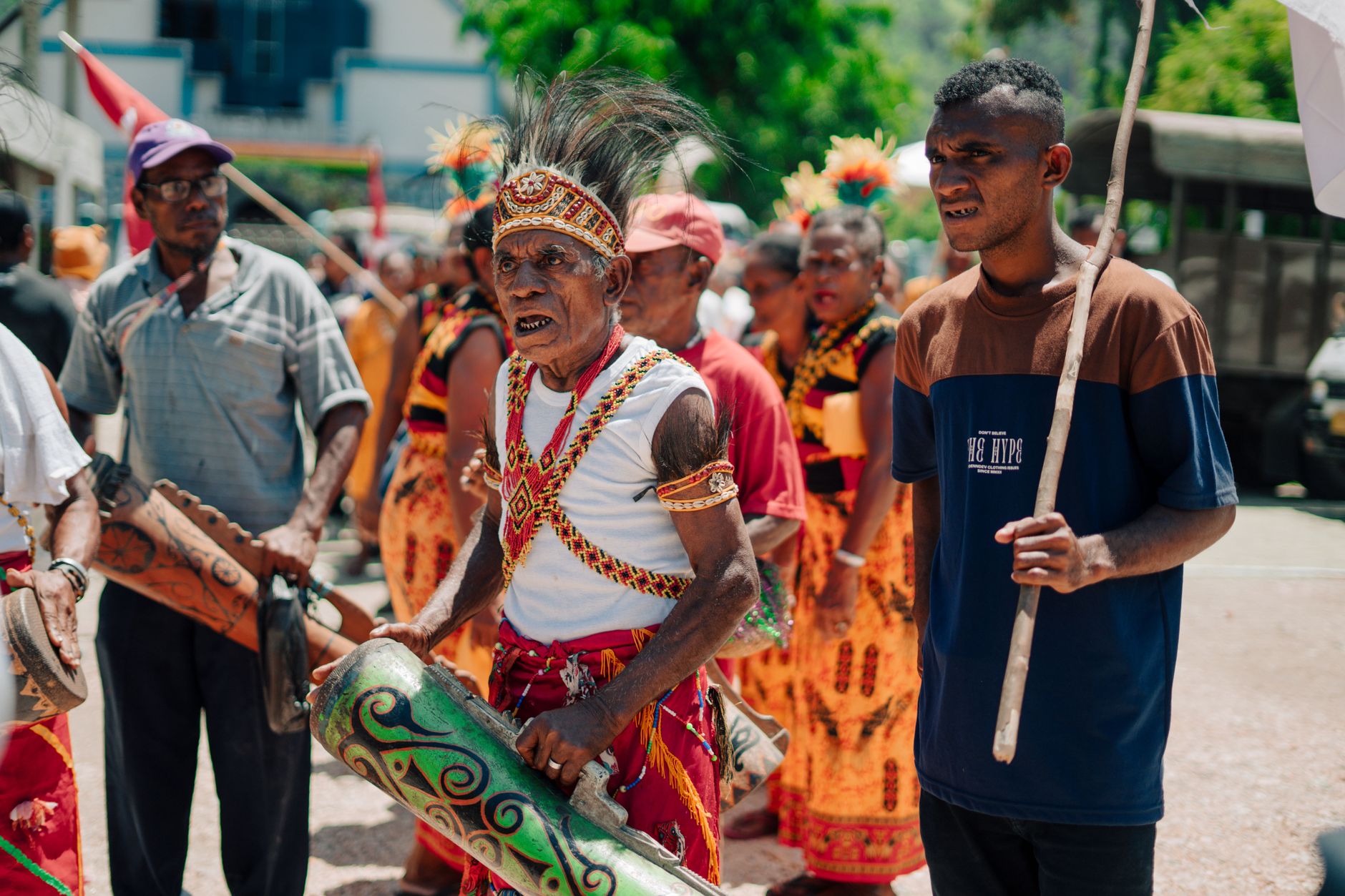
Meanwhile Papua New Guinea kept producing national rituals of its own: Highlands sing-sings in Goroka and Mount Hagen, literary voices, constitutional arguments, resource booms, church choirs, urban frustration, and the quiet daily force of Tok Pisin holding conversation together where policy often cannot. Ce que l'on ignore souvent, c'est that the country's modernity does not look unfinished because it lacks a past. It looks unfinished because so many pasts are still in the room, still speaking. That is why the story remains open.
John Momis, priest, constitutional thinker, and later Bougainville president, spent a lifetime trying to turn grievance into institutions rather than revenge.
When the 2019 Bougainville referendum returned a near-unanimous vote for independence, the sheer scale of the result turned a long, disputed history into an unmistakable public verdict.
Papua New Guinea speaks the way a forest grows: by multiplication, not by order. In Port Moresby, a market exchange can begin in English, slide into Tok Pisin, turn toward Motu, then vanish into a village language you will never identify, which is part of the lesson. A nation with more than 800 languages does not treat speech as decoration. It treats speech as kinship, territory, memory, debt.
Tok Pisin is the great seduction. Its words look simple, then they open. "Wantok" seems to mean someone who shares your language; then you discover it also means obligation, refuge, social gravity, the person who may ask for help at the worst moment and the right one. "Sem" can mean embarrassment, modesty, exposure, the sudden wish to hide your face because attention has become too bright. One word, three blushes.
Listen in Lae or Madang long enough and you hear a moral system hidden in greetings. People do not always fling a hello while walking past as if courtesy were a tennis ball. They stop. They look. They ask. Language here does not merely move information from one mouth to another. It proves that the other person exists. A country is a table set for strangers; Papua New Guinea sets it with verbs.
What passes for good manners in Papua New Guinea can unsettle travelers trained by clocks and transactions. You do not always approach the point at once. You greet first. You ask after family. You allow the air to become human before business enters. This is not delay. It is architecture.
Elders receive a degree of attention that feels almost liturgical. So do mourners. A haus krai, the mourning period after a death, makes grief public on purpose: people come, sit, cry, bring food, bring money, bring their presence, which may be the heaviest gift and the most useful. Sorrow is not hidden in a private room and managed with brave little smiles. It is given chairs.
Affection follows rules that a foreigner can misread in ten seconds. A man and woman touching too freely in public may draw disapproval; two male friends walking hand in hand may draw none at all. Criticism often travels sideways, through an intermediary, because bluntness can wound more than it clarifies. In Goroka or Mount Hagen, as elsewhere, courtesy is less about polished phrases than about sensing where another person's dignity begins. Miss that, and you will be perfectly fluent in the wrong language.
Papua New Guinea begins at the mouth with starch. In the Highlands, kaukau governs the plate with the authority of bread in France. Along the coast and through swamp country, that office belongs to sago, scraped from palm pith with labor so physical that the resulting meal tastes faintly of effort even before the coconut arrives. A people reveals itself by its staple. Here the staple says: survival first, ceremony close behind.
The mumu is less a recipe than a social event conducted underground. Hot stones. Banana leaves. Pork, chicken, taro, kaukau, greens, sometimes coconut milk, then more leaves, then time, the most underrated ingredient in any serious cuisine. When the pit opens in Tari or near Mount Hagen, steam leaves the earth like a revelation, and what appears is food that tastes of leaves, smoke, animal fat, and patient heat. No one who eats this with a plastic fork has understood the occasion.
Then come the quieter seductions: saksak glossy with coconut milk, galip nuts toasted in island regions, marita sauce in the Highlands with its red sheen so theatrical it looks invented by a baroque painter, pitpit cooked with greens until the pot tastes like a garden after rain. The cuisine does not seek elegance in the European sense. It seeks truth. Usually with your hands.
Art in Papua New Guinea has very little interest in being pretty. It wants force. Along the Sepik, near Wewak and deep into river country, carved figures do not smile for the visitor. They confront, warn, memorialize, negotiate with spirits, frighten children, protect men, and hold stories that were never written because wood had a better memory. A haus tambaran is not a quaint structure. It is a theology with a roof.
Sepik carving knows how to disturb the eye. Elongated faces, crocodile jaws, ribs, hooks, shell inlay, paint that once seemed ceremonial and now can seem almost modernist, which says more about modernism than about the Sepik. Europe called this "primitive" before quietly stealing half its visual courage. Quite right. Great civilizations often borrow with terrible manners.
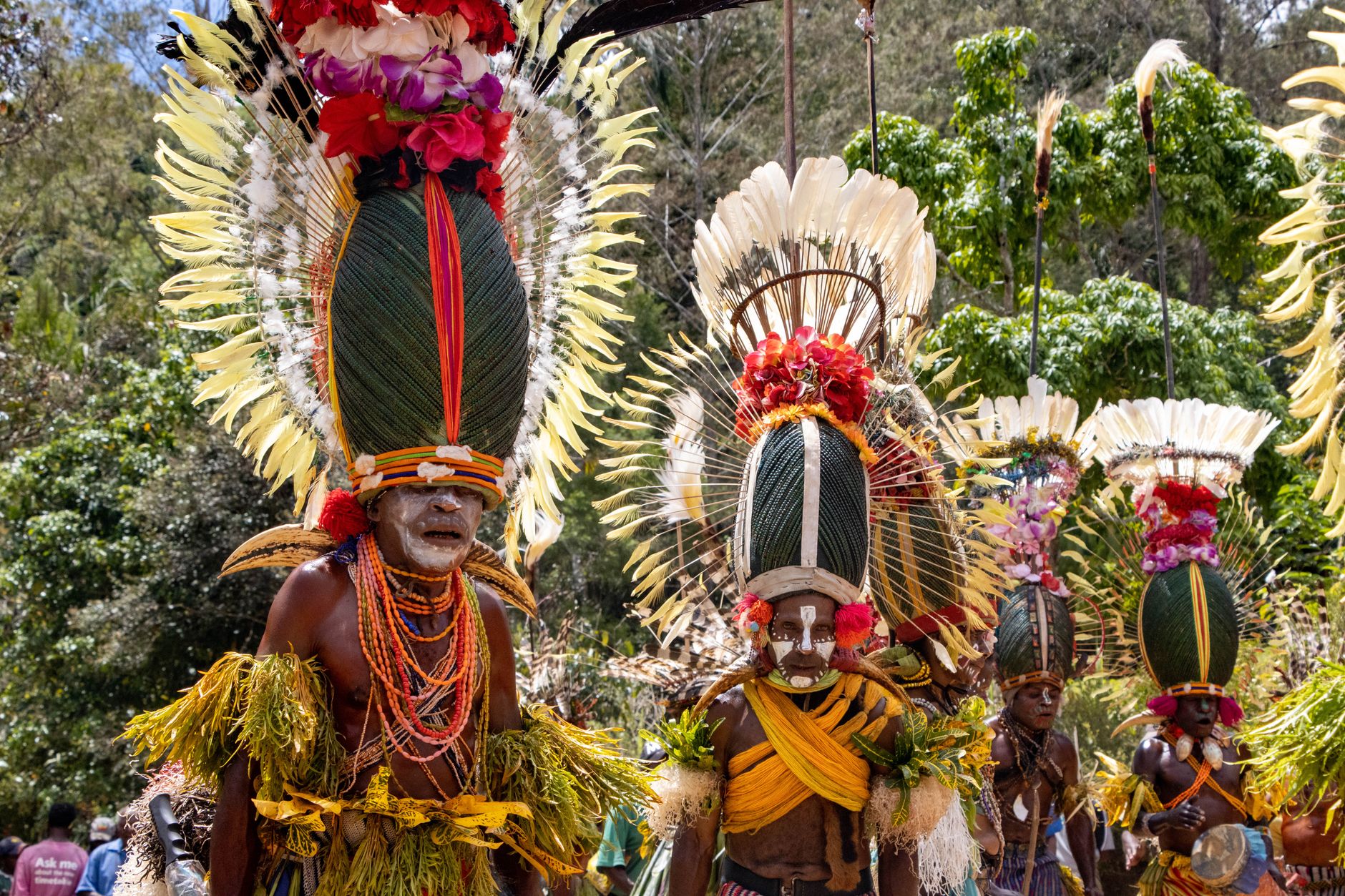
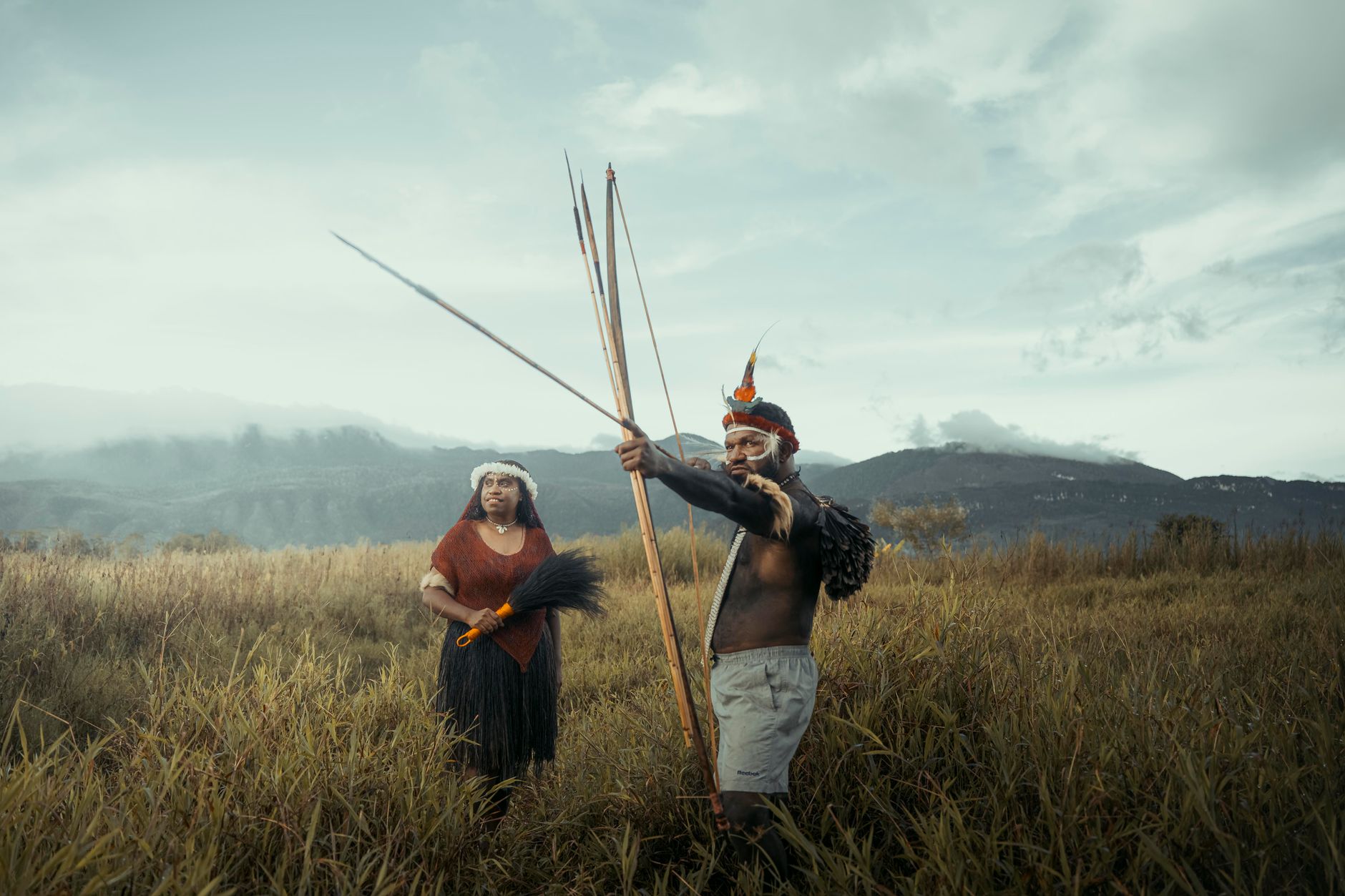
Body decoration belongs in the same sentence as sculpture. Feathers, shells, ochre, boar tusks, bilas assembled for singsing in places like Goroka are not accessories. They are statements about clan, region, exchange, status, ancestors, birds, debt, seduction. The body becomes a moving archive. In many countries clothes express the self. Here adornment can express a people older than the wearer.
Papua New Guinea is deeply Christian and stubbornly older than Christianity at the same time. Church bells, hymns, Bible study, and Sunday clothes shape town and village life from Port Moresby to Rabaul, yet the older frameworks never withdrew politely into a museum. They remained in the etiquette, the exchange systems, the handling of death, the moral force of land, the sense that the visible world has neighbors.
This is why the word "kastom" matters so much. It means custom, yes, but also the inherited order of things: who owes pigs, who may speak first, what a feast repairs, what a marriage binds, what a taboo protects. Christianity entered this world and found not emptiness but structure. So the result is rarely a clean replacement. It is coexistence, argument, adaptation, and, from the outside, a kind of practical metaphysics.
Attend a church service, then a feast, then a haus krai if you are invited, and you begin to see the pattern. Prayer may be Christian. Obligation may be ancestral. The dead remain socially active. Food still carries theology. In many places religion is what people say they believe. In Papua New Guinea it is also what they cook, bury, inherit, and owe.
Papua New Guinea had epics, genealogies, ritual speech, and oral histories long before it had a printed canon, which means its literature arrived on paper carrying a particular charge: it was not inventing a voice but changing the material that held it. This matters. A culture used to memory, performance, and spoken authority does not write as a pale imitation of speech. It writes like a challenge issued to the page.
Albert Maori Kiki's "Ten Thousand Years in a Lifetime" still lands with unusual force because it turns the colonial gaze around. The country ceases to be a patrol report and becomes a self-description. Vincent Eri's "The Crocodile" did something equally dangerous: it proved that Papua New Guinea could enter the form of the novel without asking permission from Europe. That kind of first act has the voltage of independence.
The oral world remains the deeper library. Stories around a fire in Kokoda or in a Highlands hamlet carry genealogy, land law, warning, flirtation, and metaphysics in one movement. Printed literature came late. Authority did not. A people that kept hundreds of languages alive without centralization did not lack imagination. It lacked only paper, which is a much smaller problem.
Papua New Guinea is one of the most linguistically diverse countries on earth. That is not a trivia fact; it is the living shape of markets, ceremonies, kinship, and daily conversation from Port Moresby to Tari.
Rabaul sits inside one of the Pacific's most dramatic volcanic settings, while Kavieng and the island regions open onto coral reefs, wrecks, and clear water. Few countries pack active geology and serious diving into the same frame this tightly.
The Highlands are not just cooler scenery. Around Mount Hagen, Goroka, and Tari, altitude changes food, clothing, architecture, and the rhythm of daily life, while Kokoda remains one of the Pacific's defining long-distance walks.
Ceremonial exchange, carving traditions, haus tambaran cultures, and sing-sing festivals give Papua New Guinea unusual cultural depth. This is a place where tradition is not staged as background decor; it still organizes social life.
The Sepik and Fly are not decorative waterways on a map. They are transport corridors, artistic regions, and whole cultural worlds where villages remain tied more closely to water than to roads.
Papua New Guinea still demands planning, patience, and local knowledge. That difficulty filters the experience: you get fewer polished circuits, more unpredictability, and a stronger sense that you have arrived somewhere real.
12 cities — start with the ones we'd send you to first.
The capital that confounds every expectation: a city of steep ridges, colonial-era bungalows, and the National Museum's extraordinary collection of Sepik carvings, all held together by Tok Pisin and the constant smell of
Gateway to the Highlands and home of the Hagen Show, where clans arrive in full sing-sing regalia — bird-of-paradise plumes, ochre, and cassowary feathers — in a display of competitive pride that has no equivalent anywhe
PNG's second city sits at the mouth of the Markham Valley, where the Kokoda logistics trail ended and where today the country's busiest port moves the kina-earning cargo that the rest of the economy depends on.
A harbor town on the north coast ringed by volcanic islands, where German colonial-era trees still shade the waterfront and the reef diving directly off town is consistently ranked among the clearest water in Melanesia.
Sitting at 1,600 metres in the Eastern Highlands, Goroka is cool enough for a jacket at night and home to the Goroka Show, the oldest and most photographed of the Highlands cultural festivals, running since 1957.
The Sepik's coastal outlet, a low-slung town facing the Bismarck Sea where Japanese forces made their last stand in 1945 and where river boats still load cargo for the six-day push upstream into the heart of the Sepik wo
Most of the old town lies under volcanic ash from the 1994 eruption of Tavurvur, and the half-buried colonial streets and Japanese war tunnels that remain make Rabaul the most visually dramatic record of the 20th century
A village at the northern end of the 96-kilometre Kokoda Track, where the 1942 campaign between Australian and Japanese forces through Owen Stanley Range mud is still walked as an act of deliberate remembrance by thousan
The capital of New Ireland province is a quiet, salt-bleached town whose real life happens on the water: world-class surf breaks on outer reefs, WWII wrecks in the channel, and the extraordinary Malagan funerary carvings
This is the administrative front door of Papua New Guinea, but it is not just paperwork and airport roads. Port Moresby sits where state institutions, Motuan history, and the long pull of the Kokoda country meet, and the landscapes change quickly once you move east toward Kokoda and southeast toward Alotau.
The Highlands are cooler, denser, and socially intense in a way the coasts are not. Mount Hagen, Goroka, and Tari anchor a region of market towns, ceremonial exchange, coffee country, and mountain valleys where travel distances look short on a map and take longer than expected on the ground.
The north coast runs on ports, weather, and old trade connections rather than neat inland grids. Lae and Madang are practical jumping-off points, but Wewak is the key threshold if the real draw is the Sepik region, where river journeys, carving traditions, and haus tambaran culture start to replace the logic of the highway.
Rabaul is one of the country's great geological settings: a town rebuilt in the shadow of a caldera that proved, more than once, that volcanoes do not care about human schedules. Add Kokopo and nearby islands, and this region becomes a sharp mix of ash, reef, wartime tunnels, and some of the most dramatic harbor scenery in the Pacific.
This maritime region feels stretched out by sea rather than tied together by land. Kavieng, Manus, and the islands beyond reward travelers who care about diving, fishing, surf breaks, and the slower logistics of boats and light aircraft, with a very different pace from the Highlands or Port Moresby.
Alotau opens into one of Papua New Guinea's most layered sea regions, where canoe traditions, island exchange systems, and wartime history still sit close to everyday life. This is the Massim world described in so much classic anthropology, though on the ground it is less theory than weather, boats, markets, and the long memory of the Kula Ring.
Papua New Guinea's history begins in deep prehistory and stays stubbornly human all the way to the present.
Ancestors of today's Papuan peoples move into the combined Ice Age landmass of New Guinea and Australia. Their arrival places the region among the earliest theaters of long-distance human migration anywhere on earth.
Wetland drainage and cultivation begin at Kuk in the Highlands. The site later forces historians to admit that agriculture was invented here independently, not borrowed secondhand from some imperial center.
Austronesian-speaking seafarers arrive along island and coastal zones with pottery, pigs, and advanced voyaging traditions. Their movement helps set in motion the later peopling of much of the wider Pacific.
River societies along the Sepik refine the artistic and ritual traditions that will later astonish outsiders. Spirit houses, carvings, masks, and initiation systems turn memory into architecture.
In the Massim world of the southeast, shell valuables circulate through long-distance exchange voyages. The Kula Ring binds islands through prestige, diplomacy, and obligation rather than conquest.
The Portuguese navigator becomes the first European known to document contact with parts of the region. The encounter produces a name, 'Papua,' but not control.
Sailing the north coast, the Spanish explorer compares the shoreline to Guinea in West Africa and gives the island the name that will endure in altered form. Imperial naming arrives long before effective rule.
Captain John Moresby charts the harbor and names it after his father. What will become the capital enters the imperial record under a British naval signature.
The southeast becomes British New Guinea while Germany claims the northeast and nearby archipelagos. Borders are drawn with confidence and very little understanding of the societies they cut across.
Trader Emma Coe expands her commercial power in the Bismarck Archipelago, moving through a colonial world dominated by men with unusual ease. Her legend survives because it rests on real nerve and real money.
Hubert Murray becomes lieutenant-governor and remains the central colonial administrator for decades. His long tenure gives the territory bureaucratic continuity and a deeply paternal style of rule.
At the start of the First World War, Australian forces occupy German territory in New Guinea. A wartime operation becomes the prelude to a new imperial order under Australian control.
After fieldwork in the Trobriand Islands, Bronislaw Malinowski publishes the study that makes the Kula Ring famous. Papua New Guinea enters modern anthropology not as a footnote, but as a challenge to European assumptions.
Japanese forces advance across the Owen Stanley Range and the Kokoda Track becomes one of the defining campaigns of the Pacific War. Papuan carriers keep wounded Allied soldiers moving through appalling conditions.
Rabaul is occupied and transformed into a major Japanese base. Its superb harbor makes it strategically priceless and turns the town into one of the war's great targets.
The Japanese defeat ends the military emergency but leaves Papua and New Guinea transformed. Airstrips, roads, wartime memory, and political expectation reshape the postwar decades.
Papua and New Guinea holds elections for the House of Assembly, a cautious but decisive step toward self-government. Colonial rule is still in place, yet the political class of the future state begins to form in public.
Somare helps found Pangu Pati and becomes the most recognizable voice of the independence movement. He speaks in a register broad enough to imagine a nation where none had existed before.
The country achieves independence from Australia and Michael Somare becomes the first prime minister. A state is born from multiple colonial jurisdictions, hundreds of languages, and an audacious act of political stitching.
Tensions around the Panguna mine, land rights, and political exclusion escalate into a brutal conflict. The war exposes how fragile the young nation can be when local grievances are ignored for too long.
After years of conflict, the peace agreement creates an autonomous Bougainville government and sets the path toward a future referendum. It is one of the country's most serious achievements in negotiated peace.
The ancient fields of Kuk gain World Heritage recognition. A place once dismissed as remote mud enters the global canon of early human ingenuity.
Voters in Bougainville choose independence by an overwhelming margin. The referendum is non-binding, but politically it speaks with startling clarity.
The country's founding prime minister dies, and Papua New Guinea pauses to measure what one patient political voice had meant. Founders are often simplified in death; Somare remained more interesting than the myth.
First Settlers and Gardeners
The emblematic figure of this era is anonymous: a Kuk gardener whose name is lost, but whose drainage ditch outlived empires.
Morning mist sits low over the Wahgi Valley, and your feet sink into black mud at Kuk long before you understand what lies beneath it. Under that wet ground, archaeologists found drainage ditches, mounded beds, and the patient geometry of cultivation dating back about 10,000 years. Ce que l'on ignore souvent, c'est que Papua New Guinea was not a late receiver of agriculture. It invented farming on its own.
That changes the scale of the story at once. While much of the ancient world was still improvising its relationship with plants and seasons, communities in what is now the Highlands were cutting channels through swamp land and turning water into a tool. This was not a lost Eden. It was work, repeated generation after generation, in a place whose mountains still make travel feel like negotiation rather than entitlement.
The first settlers had reached Sahul, the great Ice Age landmass linking New Guinea and Australia, roughly 50,000 to 60,000 years ago. Imagine the courage of that movement: sea crossings without maps in the modern sense, then millennia of adaptation in forests, coasts, and high valleys that would grow into some of the most linguistically diverse societies on earth. Eight hundred languages did not appear by accident. They are the trace left by human groups living close, separate, inventive lives for a very long time.
Then came one of history's most consequential newcomers: the sweet potato, arriving from South America through Pacific exchange in the 16th century. The Highlands were ready for it. The crop moved fast, fed more people, supported denser settlement, and sharpened the social world of pigs, gardens, bridewealth, and ceremonial exchange that later Europeans would mistake for timeless tradition. Nothing timeless about it. A new plant had altered the balance of power.
Kuk's early wetland engineering is so old that it stands in the same conversation as the first agricultural experiments in Mesopotamia and the Nile world.
Lapita Coasts and Ceremonial Seas
Bronislaw Malinowski became the accidental witness who showed Europe that the Kula exchange was not a curiosity but a complete social order.
A canoe noses onto a beach on Manus or along the Bismarck Archipelago, and in its hull are pigs, pots, obsidian, and a different idea of the sea. Around 3,200 years ago, Austronesian-speaking Lapita voyagers reached these coasts and islands with stamped ceramics whose geometric faces still look uncannily alive. The Pacific did not begin at Tahiti. In many ways, it began here.
These newcomers did not erase the older worlds inland. They joined them, traded with them, married into them, and helped create the layered cultural map that still makes Papua New Guinea feel less like a single nation than an argument among many nations. On the coast and through the islands, exchange became an art form. Prestige moved with shell valuables, with marriage, with ritual obligations, with the dangerous beauty of long-distance voyaging.
Nowhere is that clearer than in the Massim world around Alotau, where the Kula Ring sent shell armbands and necklaces circling from island to island over hundreds of kilometers. A European merchant would have called it irrational. Bronislaw Malinowski, stranded there during the First World War, understood that he was watching politics, reputation, and trust made visible. A necklace was never just a necklace. It carried names, risks, memories, and the vanity of men who wished to be remembered.
Far to the north, along the Sepik River near Wewak, spirit houses rose like painted declarations of ancestry. Their carved facades were not ornament. They were archives. In a land where memory was performed, sung, initiated, and guarded, art did the work of a library and a parliament at once. That is the bridge to the next era: when European ships finally appeared, they entered a world that was already ancient, connected, and perfectly capable of judging strangers.
One Lapita pottery shard from Manus bears a stylized face that may be the oldest known human image in Oceanian art.
Foreign Flags and Partition
Hubert Murray, lieutenant-governor for more than երեք decades, governed with paternal conviction and left behind both administrative continuity and the familiar colonial illusion that benevolence cancels domination.
A cross is planted on a shore in 1545, a formal declaration is read, and the wind carries the words away. Yñigo Ortiz de Retez named the island Nueva Guinea because the coast reminded him of West Africa. It was a classic imperial gesture: a stranger sees, names, claims, and sails on. The people already there, of course, had no reason to treat that ceremony as binding.
For centuries, Europe knew the coastline better than the interior. Traders, missionaries, and adventurers circled, guessed, and embellished. Then the 19th century arrived with its fatal appetite for maps. In 1884, the southeastern mainland became British New Guinea while the northeast and the Bismarck Archipelago fell under German control. The island was partitioned on paper by men who had not walked its mountain tracks, sat in its haus tambaran, or understood the obligations carried by a single exchange pig.
And yet empire was never merely abstract here. In Port Moresby, named in 1873 by Captain John Moresby after his father, administration took material form in wharves, offices, mission schools, and the routines of surveillance. In Rabaul, German colonial ambition found one of the finest harbors in the Pacific and built for commerce with impressive confidence, as if volcanoes had signed a peace treaty. They had not.
Ce que l'on ignore souvent, c'est that colonial rule in New Guinea depended as much on intermediaries as on officials: interpreters, police, missionaries, local big-men, women who traded across cultural lines, and children educated into a system that presumed its own permanence. It did not last. Australia took German New Guinea in 1914, then governed it under League of Nations mandate, binding together territories that had never been one polity before. The structures of the future state were being assembled, but under foreign supervision and for foreign priorities.
Emma Coe, the mixed-heritage trader later nicknamed 'Queen Emma,' built a commercial empire in the Bismarck Archipelago so formidable that European businessmen treated her with the wary respect usually reserved for governors.
War, Patrols, and the Slow Birth of a Nation
Michael Somare, schoolteacher turned nation-builder, had the gift every founder needs: he could sound larger than his own region without pretending differences did not exist.
Rain, mud, leeches, exhausted men bent under ammunition, and mountain tracks that seem designed to punish ambition: this is the image that still grips foreign memory of Papua New Guinea in the Second World War. The Kokoda Track became legend because Australians nearly lost it, Japanese forces pushed hard across the Owen Stanley Range, and Papuan carriers kept wounded soldiers alive under conditions that would have broken better-equipped armies. The phrase 'Fuzzy Wuzzy Angels' survives, affectionate and patronizing in the same breath. The carriers deserved better than sentiment. They deserved history.
The war rearranged everything. Lae, Madang, Wewak, Rabaul, Manus, and other places became military names in a global conflict, their harbors and airstrips suddenly central to imperial survival. Rabaul was occupied by Japan and transformed into a vast base. When Allied bombing came, the landscape itself seemed enlisted. Volcanoes, jungle, coral, and disease fought on all sides.
Peace did not restore the old order. It exposed how thin colonial certainty had become. Patrol posts pushed deeper into the Highlands, and Mount Hagen and Goroka entered the Australian administrative imagination as if they had just been discovered, though millions had lived in those valleys long before any patrol officer arrived with notebook and flag. Schools expanded. So did political expectation.
Now the human faces sharpen. Albert Maori Kiki wrote a national self-portrait from inside the system. John Guise, Julius Chan, John Momis, and above all Michael Somare began to speak the language of self-government with very different accents but a common destination. On 16 September 1975, Papua New Guinea became independent. The flags were new, the suits were formal, the ceremony was exact. But the real drama was quieter: hundreds of peoples, languages, and colonial jurisdictions agreeing, however precariously, to share one state.
The famous wartime image of Kokoda often centers Australian soldiers, but many stretcher rescues that made survival possible were carried out by Papuan carriers whose names were rarely recorded.
Independence, Upheaval, and Unfinished Nationhood
John Momis, priest, constitutional thinker, and later Bougainville president, spent a lifetime trying to turn grievance into institutions rather than revenge.
Independence did not arrive as a neat ending. It arrived like a family inheritance with debts attached. The new state had to govern mountains, swamps, islands, mining enclaves, mission legacies, clan loyalties, and urban settlements growing faster than institutions could keep up. Port Moresby became the capital of that experiment, ambitious and brittle at once, while places like Tari, Kokoda, Kavieng, and Alotau kept reminding the center that the country has never moved to a single rhythm.
Then came Bougainville, the wound that changed the republic. What began around the Panguna mine as a conflict over land, revenue, and dignity deepened into a civil war from 1988 that cost thousands of lives and isolated communities for years. This is where pious language about development collapses. Villagers paid the price. Women carried food through blockades, churches negotiated where politicians failed, and the state learned, painfully, that a nation held together by law on paper still has to persuade people to remain in it.
The peace process was one of the country's great acts of political intelligence. The Bougainville Peace Agreement of 2001 did not erase grief, but it created room for autonomy and for a future referendum. When Bougainville voted overwhelmingly for independence in 2019, the result did not settle everything. It did something more honest. It stated, in numbers, how history had been felt.
Meanwhile Papua New Guinea kept producing national rituals of its own: Highlands sing-sings in Goroka and Mount Hagen, literary voices, constitutional arguments, resource booms, church choirs, urban frustration, and the quiet daily force of Tok Pisin holding conversation together where policy often cannot. Ce que l'on ignore souvent, c'est that the country's modernity does not look unfinished because it lacks a past. It looks unfinished because so many pasts are still in the room, still speaking. That is why the story remains open.
When the 2019 Bougainville referendum returned a near-unanimous vote for independence, the sheer scale of the result turned a long, disputed history into an unmistakable public verdict.
Papua New Guinea speaks the way a forest grows: by multiplication, not by order. In Port Moresby, a market exchange can begin in English, slide into Tok Pisin, turn toward Motu, then vanish into a village language you will never identify, which is part of the lesson. A nation with more than 800 languages does not treat speech as decoration. It treats speech as kinship, territory, memory, debt.
Tok Pisin is the great seduction. Its words look simple, then they open. "Wantok" seems to mean someone who shares your language; then you discover it also means obligation, refuge, social gravity, the person who may ask for help at the worst moment and the right one. "Sem" can mean embarrassment, modesty, exposure, the sudden wish to hide your face because attention has become too bright. One word, three blushes.
Listen in Lae or Madang long enough and you hear a moral system hidden in greetings. People do not always fling a hello while walking past as if courtesy were a tennis ball. They stop. They look. They ask. Language here does not merely move information from one mouth to another. It proves that the other person exists. A country is a table set for strangers; Papua New Guinea sets it with verbs.
What passes for good manners in Papua New Guinea can unsettle travelers trained by clocks and transactions. You do not always approach the point at once. You greet first. You ask after family. You allow the air to become human before business enters. This is not delay. It is architecture.
Elders receive a degree of attention that feels almost liturgical. So do mourners. A haus krai, the mourning period after a death, makes grief public on purpose: people come, sit, cry, bring food, bring money, bring their presence, which may be the heaviest gift and the most useful. Sorrow is not hidden in a private room and managed with brave little smiles. It is given chairs.
Affection follows rules that a foreigner can misread in ten seconds. A man and woman touching too freely in public may draw disapproval; two male friends walking hand in hand may draw none at all. Criticism often travels sideways, through an intermediary, because bluntness can wound more than it clarifies. In Goroka or Mount Hagen, as elsewhere, courtesy is less about polished phrases than about sensing where another person's dignity begins. Miss that, and you will be perfectly fluent in the wrong language.
Papua New Guinea begins at the mouth with starch. In the Highlands, kaukau governs the plate with the authority of bread in France. Along the coast and through swamp country, that office belongs to sago, scraped from palm pith with labor so physical that the resulting meal tastes faintly of effort even before the coconut arrives. A people reveals itself by its staple. Here the staple says: survival first, ceremony close behind.
The mumu is less a recipe than a social event conducted underground. Hot stones. Banana leaves. Pork, chicken, taro, kaukau, greens, sometimes coconut milk, then more leaves, then time, the most underrated ingredient in any serious cuisine. When the pit opens in Tari or near Mount Hagen, steam leaves the earth like a revelation, and what appears is food that tastes of leaves, smoke, animal fat, and patient heat. No one who eats this with a plastic fork has understood the occasion.
Then come the quieter seductions: saksak glossy with coconut milk, galip nuts toasted in island regions, marita sauce in the Highlands with its red sheen so theatrical it looks invented by a baroque painter, pitpit cooked with greens until the pot tastes like a garden after rain. The cuisine does not seek elegance in the European sense. It seeks truth. Usually with your hands.
Art in Papua New Guinea has very little interest in being pretty. It wants force. Along the Sepik, near Wewak and deep into river country, carved figures do not smile for the visitor. They confront, warn, memorialize, negotiate with spirits, frighten children, protect men, and hold stories that were never written because wood had a better memory. A haus tambaran is not a quaint structure. It is a theology with a roof.
Sepik carving knows how to disturb the eye. Elongated faces, crocodile jaws, ribs, hooks, shell inlay, paint that once seemed ceremonial and now can seem almost modernist, which says more about modernism than about the Sepik. Europe called this "primitive" before quietly stealing half its visual courage. Quite right. Great civilizations often borrow with terrible manners.
Body decoration belongs in the same sentence as sculpture. Feathers, shells, ochre, boar tusks, bilas assembled for singsing in places like Goroka are not accessories. They are statements about clan, region, exchange, status, ancestors, birds, debt, seduction. The body becomes a moving archive. In many countries clothes express the self. Here adornment can express a people older than the wearer.
Papua New Guinea is deeply Christian and stubbornly older than Christianity at the same time. Church bells, hymns, Bible study, and Sunday clothes shape town and village life from Port Moresby to Rabaul, yet the older frameworks never withdrew politely into a museum. They remained in the etiquette, the exchange systems, the handling of death, the moral force of land, the sense that the visible world has neighbors.
This is why the word "kastom" matters so much. It means custom, yes, but also the inherited order of things: who owes pigs, who may speak first, what a feast repairs, what a marriage binds, what a taboo protects. Christianity entered this world and found not emptiness but structure. So the result is rarely a clean replacement. It is coexistence, argument, adaptation, and, from the outside, a kind of practical metaphysics.
Attend a church service, then a feast, then a haus krai if you are invited, and you begin to see the pattern. Prayer may be Christian. Obligation may be ancestral. The dead remain socially active. Food still carries theology. In many places religion is what people say they believe. In Papua New Guinea it is also what they cook, bury, inherit, and owe.
Papua New Guinea had epics, genealogies, ritual speech, and oral histories long before it had a printed canon, which means its literature arrived on paper carrying a particular charge: it was not inventing a voice but changing the material that held it. This matters. A culture used to memory, performance, and spoken authority does not write as a pale imitation of speech. It writes like a challenge issued to the page.
Albert Maori Kiki's "Ten Thousand Years in a Lifetime" still lands with unusual force because it turns the colonial gaze around. The country ceases to be a patrol report and becomes a self-description. Vincent Eri's "The Crocodile" did something equally dangerous: it proved that Papua New Guinea could enter the form of the novel without asking permission from Europe. That kind of first act has the voltage of independence.
The oral world remains the deeper library. Stories around a fire in Kokoda or in a Highlands hamlet carry genealogy, land law, warning, flirtation, and metaphysics in one movement. Printed literature came late. Authority did not. A people that kept hundreds of languages alive without centralization did not lack imagination. It lacked only paper, which is a much smaller problem.
Michael Somare did not invent Papua New Guinea, but he gave its improbable unity a voice calm enough to be trusted. A schoolteacher from East Sepik, he spoke of nationhood without pretending the country's differences could be ironed flat, and that restraint is part of why he endured.
Kiki matters because he wrote the country from the inside, not as a patrol report, a missionary file, or an anthropologist's case study. His memoir, 'Ten Thousand Years in a Lifetime,' gave the emerging nation a first-person political memory.
Julius Chan brought Chinese-Papua New Guinean mercantile confidence into the highest reaches of state power. Brilliant, controversial, and never dull, he embodied the modern state's mix of pragmatism, ambition, and political risk.
Few men stood with one foot so firmly in state-building and the other in dissent. Momis helped draft Papua New Guinea's constitutional order, then spent decades wrestling with the Bougainville question that exposed its limits.
Josephine Abaijah unsettled a male political class that preferred women decorative and regional dissent quiet. She argued fiercely over the terms of self-government and forced the young nation to hear Papuan anxieties it might have preferred to dismiss.
Queen Emma is one of those colonial Pacific figures who sounds invented until you read the ledger books. Of mixed Samoan and American descent, draped in silk and strategy, she ran plantations and shipping interests with a skill that made European rivals deeply uneasy.
Malinowski arrived because war stranded him in the Pacific, then stayed long enough to change social science. His work on the Kula Ring showed Europe that exchange could be about prestige, obligation, and alliance rather than simple profit.
With 'The Crocodile,' Vincent Eri took village life, colonial disruption, and wartime pressure and made literature carry their emotional weight. He matters because he proved the country's history could be narrated not only in speeches and archives, but in fiction with bite.
Murray ruled long enough to mistake continuity for legitimacy, as colonial administrators often do. Yet his name still clings to institutions because he shaped so much of the machinery later inherited by the independent state.
This short route works for travelers with limited time who still want a sharper sense of Papua New Guinea than an airport hotel can provide. Start in Port Moresby for museums, markets, and the country's modern political center, then continue to Kokoda for the first taste of the trail country that shaped so much war memory.
Fly straight into the cooler interior where the country feels different in the bones: morning mist, sweet potato gardens, trade stores, and mountain air. Mount Hagen, Goroka, and Tari make a coherent Highlands route with strong cultural weight and much better chances of seeing how regional life actually works beyond the coast.
This route follows the northern arc from industrial gateway to coastal town to river country. Lae gives you the transport reality of modern Papua New Guinea, Madang brings the gentler seafront rhythm, and Wewak opens the door to the Sepik world, where the river matters more than the road.
This trip leans toward the maritime side of the country: active geology, island airstrips, and long blue stretches between ports. Rabaul, Kavieng, Manus, and Alotau fit travelers who want reefs, wartime layers, and a version of Papua New Guinea shaped less by roads than by sea lanes and weather.
Hot stones. Banana leaves. Pork, chicken, kaukau, taro, greens. Wedding, exchange, church feast, family visit. Hands, smoke, silence, appetite.
Boiled or roasted sweet potato. Breakfast, lunch, roadside stop, market snack. Family, schoolchildren, everyone.
Sago starch, banana, leaf wrap, steam, coconut milk. Afternoon, feast table, shared plate. Spoon or fingers.
Aibika or pumpkin tips, pot, coconut cream. Side dish beside kaukau, taro, rice, fish. Home meal, guest meal, mourning meal.
Pitpit cane shoot, chopped greens, coconut, pot. Garden lunch, village table, weekday meal. Soft talk, slow chewing.
Toasted nuts from island regions near Kavieng and Manus. Market snack, travel snack, beer companion. Shell, crack, salt, conversation.
Red pandanus fruit cooked into oil-rich sauce in the Highlands near Goroka and Mount Hagen. Poured over kaukau or pork. Feast food, clan food, memory food.

Papua New Guinea requires a passport valid for at least 6 months beyond arrival. Since 1 October 2025, all arrivals must complete the free Digital Arrival Card before travel; it is not a visa. UK and Canadian passport holders are on the current Visa on Arrival list, while U.S. travelers should apply before departure.
The local currency is the Papua New Guinean kina, abbreviated PGK and written with the symbol K. Cash still does most of the work outside Port Moresby, Lae, and larger hotels, so carry enough for transport, meals, and market purchases. Tipping is not standard; round up or leave 5 to 10% only for genuinely strong service.
Most international arrivals land at Jacksons International Airport in Port Moresby. The practical gateways are Brisbane, Sydney, Cairns, Singapore, Manila, Hong Kong, and a few Pacific hubs, then a domestic connection onward. Papua New Guinea has no useful passenger rail network, so every longer trip is planned around flights.
Domestic flights are the backbone of travel, linking Port Moresby with places such as Mount Hagen, Goroka, Madang, Wewak, Rabaul, and Kavieng. Roads exist, but not all major centers connect cleanly, and long stretches are unsealed or slow after rain. Boats matter in island regions, though weather, overloading, and open-water security make them a choice to assess carefully.
May to October is the easier window for most trips, with June to September usually the most comfortable months. Coastal Papua New Guinea stays hot and humid year-round, while the Highlands around Mount Hagen, Goroka, and Tari are cooler, especially at night. Regional exceptions matter: Lae, for example, can be wetter during the country's usual dry season.
Mobile coverage is decent in larger towns and weak to nonexistent once you leave main corridors or fly into smaller airstrips. Hotel Wi-Fi in Port Moresby and business-oriented properties can be workable, but speeds are uneven and outages are normal. Download maps, booking emails, and flight details before you leave the airport or your hotel.
Papua New Guinea rewards planning, not improvisation. Use prearranged airport transfers, avoid local PMVs and street-hailed taxis, and move by day when possible, especially in Port Moresby and Lae. Remote trekking, river travel, and island hops are best done with established operators who know current road, weather, and community conditions.
Domestic air tickets shape your budget more than meals do. Book Port Moresby, Mount Hagen, Goroka, Rabaul, or Kavieng legs early if your dates are fixed, because last-minute changes can get expensive fast.
Papua New Guinea does not have a passenger rail fallback when a flight is canceled. Build slack into the plan, especially before an international departure or a liveaboard connection.
Book airport pickups with your hotel or operator before you land in Port Moresby or Lae. It costs more than improvising, but it saves time and cuts the security guesswork.
Bring enough kina in smaller notes for market food, local guides, and short transfers. Cards are useful in larger hotels, but they stop being reliable as soon as you move into smaller towns or island departures.
Greetings matter, and rushing straight to the transaction can read badly. Take the extra minute to greet people properly, especially in smaller places where relationships carry more weight than schedules.
May to October is the easier planning window for trekking, road journeys, and domestic connections. Wet-season travel can still work, but delays hit harder when your next flight is only twice a week.
Do not assume the next town has stable data. Save boarding passes, hotel confirmations, and maps before leaving Port Moresby, Madang, or any property with decent Wi-Fi.
Road trips, airport transfers, and town-to-town drives are better done in daylight. Distances look manageable on paper, but weather, checkpoints, and road conditions can change the day quickly.
Explore Papua New Guinea with a personal guide in your pocket
Audio guides for 1,100+ cities across 96 countries. History, stories, and local insight — offline ready.

Usually yes, though the process depends on your passport. UK and Canadian travelers are on the current Visa on Arrival list, while U.S. travelers should arrange permission before departure; everyone also needs to complete the free Digital Arrival Card before arrival.
Yes, more than many travelers expect. Meals and basic lodging can stay moderate, but domestic flights, organized transfers, dive logistics, and security-conscious transport push the budget up quickly.
June to September is the safest broad answer for a first trip. Those months usually bring easier weather for trekking, cultural travel, and domestic connections, though places like Lae can behave differently from the national pattern.
Only in limited parts of the country. Roads do connect some corridors such as Lae to Goroka and Mount Hagen, but many major destinations including Rabaul, Kavieng, Manus, and Alotau are most practically reached by air or boat.
Port Moresby is worth at least a short stay if you choose your time well. It gives you the National Museum and Art Gallery, the city's coastal setting, and a clear sense of modern Papua New Guinea before you head to the Highlands or islands.
Seven to ten days is the minimum for a trip that feels like more than airport transfers. With two weeks, you can combine one mainland region such as Mount Hagen or Wewak with one island region such as Rabaul, Kavieng, or Alotau.
For most foreign visitors, no. PMVs are normal local transport, but official travel advice is much more cautious, so prearranged cars, hotel transfers, and known operators are the better choice.
Yes, but only reliably in larger hotels, some airlines, and business-oriented venues in bigger towns. For markets, smaller guesthouses, local transport, and many provincial stops, cash in kina still matters.
Port Moresby, Mount Hagen, Goroka, Rabaul, and Alotau make a strong first shortlist because each shows a different face of the country. Pick one Highlands route and one coastal or island route rather than trying to cross everything in a single week.
Last reviewed