directions_boat
The Canal In Motion
The Panama Canal is not a museum piece. At Miraflores near Panama City, you watch container ships and tankers climb through locks that still shape global trade and everyday national life.
Panama is the rare country where the headline attraction is a canal, yet the real story is compression: rainforest, empire, islands, and highland coffee packed into one narrow strip between two seas.
 Panama
EntryVisa-free for many travelers; carry onward ticket and proof of funds
PA Panama travel guide starts with one odd fact: you can breakfast by the Pacific, sleep near the Caribbean, and cross the country in a day.
Panama looks small on a map, then starts bending distance. In Panama City, glass towers rise a few minutes from the stone streets of Casco Viejo and the ruins of Panamá Viejo, the first Spanish city on the Pacific coast of the Americas, founded in 1519. Forty-five minutes away in Gamboa, Pipeline Road cuts through rainforest with the kind of bird list that keeps serious birders awake at night. Then the country splits its personality again: north toward Portobelo and the old silver route to the Caribbean, west toward Boquete, where coffee farms climb cool green slopes below Volcán Barú.
That contrast is the real reason to come. You can watch a Neopanamax ship enter the locks in the morning, eat a cup of corvina ceviche for lunch, and end the day with mist sliding across the hills in El Valle de Antón or Boquete. Bocas del Toro trades the capital's sharp edges for docks, reefs, and Afro-Caribbean cooking; David works as the practical gateway most travelers skip too quickly. Panama rarely asks you to choose between city, sea, history, and forest. It stacks them close together, almost rudely so.
First Peoples and the Isthmus Before Empire, c. 9000 BCE-1501
A burial pit opens at Sitio Conte, and the first thing that glints is not a crown but a cascade of hammered gold: breastplates, cuffs, pendants shaped like eagles and crocodiles, all laid beside a dead ruler who did not go alone. When archaeologists worked here in the 1930s, they found one elite grave surrounded by more than 60 other bodies, companions sent into death with him. Splendor, yes. Also terror.
Long before any Spaniard named this strip of land, Panama was already a passage between worlds. Traders, families, ideas, and styles moved across the isthmus for millennia, which is why the old societies here never fit the lazy fantasy of one lost kingdom waiting to be discovered. Coclé goldwork, in particular, was not mere decoration. It was theology in metal.
Ce que l'on ignore souvent, c'est que Panama's most remarkable continuity may not be royal at all, but social. Among the Guna, whose communities later anchored themselves in what is now Guna Yala, descent and property flow through women; a husband enters his wife's household, not the reverse. The sahila may speak in public, but authority begins elsewhere, in the women's consensus that steadies the whole house.
That matters, because conquest did not arrive in a vacuum. It crashed into societies with rules, memory, trade networks, and their own fierce sense of rank. When Europeans later came hunting for gold and sea routes, they were not entering emptiness. They were stepping into a crowded human world that already knew the value of power, ceremony, and the price attached to both.
Olonibiginya is usually remembered for a revolt in 1925, but he stood inside a much older Guna tradition in which political authority had always depended on a social order shaped by women.
Many of the finest Coclé gold pieces left Panama in the early 20th century and ended up in foreign museums, a reminder that looting did not end with the conquistadors.
Conquest and the Spanish Pacific, 1501-1595
Picture the scene on September 25, 1513: wet heat, torn brush, exhausted men, and then Vasco Nunez de Balboa staring at a sheet of blue no European from his world had seen before. A few days later he walked into the Pacific in armor, sword raised, claiming the so-called South Sea for the Crown. It was absurd theatre. It changed history anyway.
Balboa himself was not born for greatness in the official sense. He reached the mainland as a bankrupt adventurer, very likely hidden aboard ship to escape his creditors. But he had one talent the empire prized when it suited it and punished when it feared it: he knew how to make alliances, including with Indigenous leaders whose intelligence made his exploits possible. The route to the Pacific was not a miracle of Spanish genius. Local knowledge led him there.
Then came Pedro Arias Davila, better known as Pedrarias, a man with the patience of a spider and the mercy of a bookkeeping knife. He arrived in 1514 with rank, soldiers, and royal authority, then spent years tightening the net around Balboa. In January 1519, after a hurried trial in Acla, Balboa was beheaded with four companions. His head was displayed in public. A neat lesson in imperial gratitude.
That same year, Pedrarias founded Panama City, the first permanent European city on the Pacific coast of the Americas. Ce que l'on ignore souvent, c'est that the city's birth and Balboa's death are almost the same story: one man opened the road, another claimed the title. From that moment on, Panama ceased to be merely a crossing and became an imperial machine, built to move treasure, orders, and bodies from one ocean to the other.
Balboa knew how to stage glory, but he was also a debtor, a political gambler, and a man whose fame depended on Indigenous allies the chronicles too often push to the margins.
Balboa's war dog Leoncico was so prized in battle that official ledgers treated him like a soldier and paid him a share of the spoils.
The Treasure Road and the Caribbean Forts, 1595-1821
Open a ledger in Portobelo at fair time and the numbers begin to look delirious. Silver from Peru and Upper Peru crossed the isthmus on mule trains, rolled through mud and fever on the Camino Real, then piled up on the Caribbean coast while merchants, sailors, smugglers, and crown officials circled like gulls around a carcass. For a few dazzling weeks, this small harbor became one of the richest trading points on earth.
Portobelo was never a polite colonial town. It was humid, unhealthy, crowded, and permanently in danger, which is why Spain ringed it with batteries and fortifications whose stones still hold the smell of salt and gunpowder. The empire needed this port to function, and that dependence made it terribly fragile. One missed convoy, one pirate raid, one epidemic, and the whole system shuddered.
The English, naturally, noticed. Francis Drake haunted the isthmian story long after his death in 1596 off the Panamanian coast, and Henry Morgan made the wound much deeper when he sacked Panama City in 1671 after crossing from the Caribbean side. Flames finished what cannon fire began. The old city was abandoned, and the capital rose again a few kilometers away in the walled quarter now known as Casco Viejo in Panama City.
Ce que l'on ignore souvent, c'est that empire here rested not only on Spanish officials and treasure fleets, but on enslaved Africans, free Black communities, muleteers, boatmen, and Indigenous routes older than Spain's maps. By the 18th century the old silver machine was already losing coherence. Trade patterns shifted, contraband flourished, and the isthmus began to imagine that Madrid might not be eternal after all.
Henry Morgan is often cast as a swaggering pirate, yet his raid mattered because it exposed how thin Spain's hold on the isthmus really was.
Drake's body, according to English accounts, was sealed in a lead coffin and buried at sea near Portobelo, which turned his grave into one more Caribbean treasure legend.
Transit Republic, Canal Dreams, and a Country Remade, 1821-present
A railway carriage rattles through jungle in the 1850s, packed with California-bound travelers too impatient to sail around Cape Horn. Mosquitoes swarm, mud swallows boots, fortunes vanish in card games before the Atlantic crossing is even finished. Panama, newly separated from Spain in 1821 and then folded into Gran Colombia before remaining tied to Colombia, discovered that transit could be more than geography. It could be destiny.
The French tried first to carve that destiny into earth. Ferdinand de Lesseps arrived with Suez on his reputation and disaster in his future. The tropical rains, landslides, corruption, and above all disease broke the company; thousands died, and the grand civilizing enterprise collapsed in scandal. Ce que l'on ignore souvent, c'est that the later American success was built not on superior romance but on sanitation, bureaucracy, and ruthless political timing.
That timing came in 1903, when Panama broke from Colombia with open support from the United States, which wanted the canal more than it wanted subtlety. Philippe-Jean Bunau-Varilla, a French engineer with no democratic mandate from Panamanians, helped negotiate the treaty that gave Washington sweeping control over the Canal Zone. A nation was born. So was a grievance.
When the canal finally opened in 1914, just as Europe was sliding into war, Panama found itself owning the symbol but not the sovereign power around it. The 20th century turned on that wound: student protests over the flag in 1964, Omar Torrijos bargaining with Jimmy Carter in 1977, the long transfer that ended on December 31, 1999, when Panama took full control. Modern Panama City, Gamboa, Colón, and the locks themselves still live inside that inheritance. The canal made the republic rich, unequal, strategic, and perpetually aware that the whole world has business passing through its front room.
Omar Torrijos understood that the canal was not just infrastructure; it was a national humiliation waiting to be turned into a political creed.
The man who signed the 1903 Hay-Bunau-Varilla Treaty for Panama, Philippe Bunau-Varilla, was not Panamanian and had not even lived there as a citizen; he negotiated the country's founding canal terms from a hotel room in Washington.
Panama begins with a greeting. In Panama City, in David, in the market lanes of Chitré, a person who walks in without a "buenos días" resembles someone who has entered church in swimwear: technically possible, socially reckless.
Panamanian Spanish moves fast, but courtesy slows the first step. You hear "¿Qué xopa?" tossed between friends with the ease of a mango pit thrown into grass, then "usted" appears at once when age, respect, or irritation enters the room.
The vocabulary is a cabinet of practical miracles. "Vaina" can mean object, disaster, annoyance, marvel; one word performs the labor of six, which is what a transit country should demand from its language.
And Panama refuses monolingual vanity. In Bocas del Toro, Guari Guari still carries the memory of docks, islands, English, Spanish, Patois, and Ngäbere in the same mouth; in Guna territory, language is not folklore but jurisdiction.
Panama cooks as if feeding were a moral duty. The first lesson arrives in a bowl of sancocho: chicken, ñame, culantro, steam, and a seriousness that makes fashionable soup look like gossip.
Culantro changes everything. Its smell is sharper than cilantro, greener, less polite, and once you know it, you start finding the country by the nose before the eyes catch up.
On the Caribbean side, especially in Bocas del Toro and Colón, the pot turns toward coconut, plantain, pepper, and fish. Rondón does not ask whether sea and root vegetables belong together; it knows they do, and that certainty tastes better than theory.
Then breakfast arrives and reveals the national temperament with indecent clarity. Hojaldres, thick tortillas de maíz, carimañolas, white cheese, coffee: Panama understands that appetite is not a detail of life but one of its organizing principles.
Panama's music never forgot that the country was built by arrivals. You hear that fact in the drum before you understand it in history: Afro-Antillean cadence in Colón, Spanish strings in the interior, Caribbean swing in Bocas del Toro, and the whole thing refusing to stand still long enough for a curator.
Tamborito is the national proof that elegance and percussion can share a body. A singer calls, the chorus answers, the drums insist, and courtship becomes public architecture.
In the Azuero towns near Chitré, accordion and betterana do not perform quaintness for outsiders. They accompany patron saint days, family gatherings, heat, beer, and the durable local conviction that a festival without noise is merely administration.
Even Panama City's nightlife tells the same story with louder bass. Reggaetón, salsa, plena, calypso, tipico: genres do not queue here. They overlap like traffic at the canal, and somehow the locks still open.
Panama takes dress personally. The pollera is the clearest example: lace, embroidery, gold, ribbons, head ornaments, labor measured not in hours but in acts of devotion, and the result is so elaborate that calling it costume feels vulgar.
A pollera does not decorate the body. It stages it.
Then come the molas of the Guna, and fabric becomes argument. Layered reverse appliqué, cut and stitched until geometry turns hypnotic, they carry birds, labyrinths, fish, myths, and the kind of precision that shames people who speak loosely about craft.
Elsewhere, the sombrero pintado keeps the country's dry wit intact. Panama knows the famous so-called Panama hat belongs to Ecuador; it answers the confusion not with complaint but with a better hat of its own.
Panama can feel intimate in under five minutes. A shopkeeper asks where you are from, a taxi driver offers a verdict on the government, somebody's aunt places food in front of you as if you had always belonged there.
Trust takes longer. This is not contradiction. It is social intelligence in a country where ports, borders, free zones, and passing strangers have trained people to welcome quickly and judge carefully.
Appearances matter less than manners, but manners matter a great deal. You greet first, you shake hands, you acknowledge the room, and if you are invited to eat, you do not inspect the plate like a customs officer.
A country is a table set for strangers. Panama sets the table generously, then watches to see whether you know how to sit at it.
Panama builds like a country that never had the luxury of innocence. In Casco Viejo, the old quarter of Panama City, balconies lean over narrow streets with that old Spanish-Caribbean talent for combining grace and surveillance; beauty and caution share the same railing.
Panamá Viejo says the quieter part aloud. Founded in 1519, burned after Henry Morgan's attack in 1671, it remains a city of stone lessons: empires do not merely rise and fall, they leave masonry behind for the humidity to judge.
Then Portobelo appears on the Caribbean coast with its fortifications and its heavy military geometry, built to protect silver and repeatedly disproved by history. Cannons age badly in salt air. Greed ages worse.
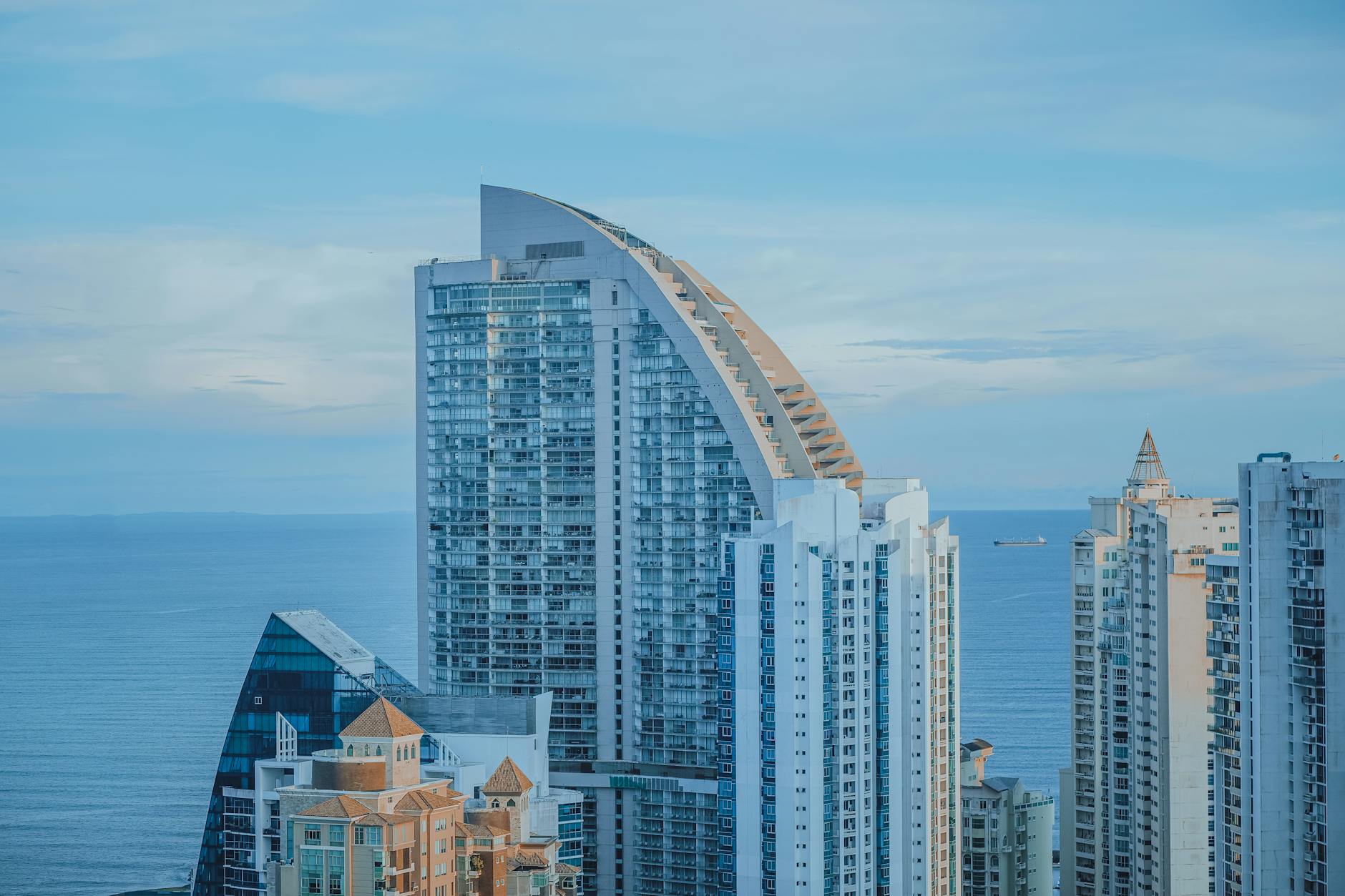
Modern Panama City does not bother with modesty. Glass towers, bank logos, the Biomuseo's improbable planes of color, and the canal nearby: the skyline admits that commerce is one of the national arts, then lets the tropical light soften the confession.
The Panama Canal is not a museum piece. At Miraflores near Panama City, you watch container ships and tankers climb through locks that still shape global trade and everyday national life.
Portobelo, Casco Viejo, and Panamá Viejo tell the sharper version of empire: silver convoys, pirate attacks, slave routes, and walls built because the money passing through was obscene.
Gamboa puts sloths, toucans, monkeys, and 1,000-plus recorded bird species within easy reach of the capital. Few countries make serious wildlife this accessible without a charter flight.
Boquete trades heat for cool air, steep trails, and Geisha coffee that has broken auction records worldwide. The mornings smell of wet earth, roasting beans, and cloud forest.
Bocas del Toro leans Caribbean with reefs, coconut-heavy cooking, and water taxis; the Pacific side runs drier, broader, and better for long beach drives and island detours.
Panama's table makes its history visible: sancocho with culantro, thick corn tortillas at breakfast, peppery patties in Colón and Bocas del Toro, and ceviche served cold in a cup.
12 cities — start with the ones we'd send you to first.
A skyline of glass towers rises directly behind a crumbling 16th-century colonial quarter, making the capital feel like two cities that never agreed to stop arguing.
Coffee pickers move through mist-draped highlands at 1,200 metres while resplendent quetzals hunt avocados in the cloud forest just above the town's single main street.
A Caribbean archipelago where the local creole — Guari Guari — blends English, Spanish, Patois, and Ngäbere, and the buildings stand on stilts above water the colour of a swimming pool.
The Atlantic mouth of the Canal, a port city that has handled the wealth of two hemispheres for 500 years and kept almost none of it, which gives the streets a raw, unvarnished honesty.
Panama's second-largest city functions as the working capital of Chiriquí province — cattle ranches, hardware stores, border crossings — and most travellers pass through without stopping, which is their loss.
An entire town sits inside the caldera of an extinct volcano, surrounded by a Sunday market selling golden frogs in ceramic and orchids wrapped in newspaper.
The Spanish once shipped so much Andean silver through this Caribbean bay that English pirates kept coming back to burn it down, and the ruins of those fort walls still stand in the water.
A small Pacific town where the dry-season wind is strong enough to make the fishing boats lean at anchor and the surf at Playa Venao draws riders from three continents to a beach most maps still spell wrong.
The last town before the ferry to Coiba, a former penal colony turned marine reserve where hammerhead sharks patrol seamounts in water so clear the depth is disorienting.
Panama City is the country at full speed: container ships queued offshore, glass towers by the bay, and the stone remains of Panamá Viejo a short ride away. Gamboa and El Valle de Antón sit close enough to turn this region into more than a city break, which is useful because the capital makes more sense once you see the jungle and mountains pressing in around it.
This stretch of coast was built by imperial money and then battered by humidity, war, and neglect. Colón is the canal's Atlantic gateway; Portobelo, 49 kilometers east, still carries the broken masonry of the Spanish treasure system, plus one of the country's strongest Afro-Panamanian cultural currents.
Boquete sits in a valley of coffee farms, rivers, and cloud-shadowed slopes below Volcán Barú. David, down on the plain, is the practical gateway rather than a postcard stop, which is exactly why the pairing works: land in heat, climb into cool air, then spend your money where the altitude improves the cup.
Bocas del Toro runs on boats, weather windows, and a Caribbean rhythm that owes as much to Afro-Antillean history as to beach tourism. Expect mangroves, patty shops, humid nights, and water that changes color by the hour; do not expect strict timetables once you leave the main docks.
The Azuero Peninsula feels more provincial and more rooted than the capital, with cattle country, festival towns, and some of the best stretches of Pacific coast road in the country. Chitré gives you the commercial center, Pedasi gives you sea air and access to Isla Iguana, and Santa Catalina adds a rougher surf-town finish farther west.
La Palma is not polished, and that is the point. It is the river-facing administrative town at the edge of the Darién world, where logistics matter more than style and where travel starts depending on boats, local knowledge, and weather rather than clean highway lines.
Panama's history moves by crossings: peoples, empires, treasure, rail, and the canal that made the whole world pass through.
Archaeological evidence shows human communities living on the Panamanian isthmus thousands of years before empire and conquest. The crossing between continents was already a human reality long before it became a geopolitical obsession.
In central Panama, Cocle elites commission brilliant gold regalia and elaborate burials that reveal wealth, hierarchy, and ritual violence. The graves at Sitio Conte still unsettle because beauty and brutality lie side by side.
Vasco Nunez de Balboa crosses Darien and becomes the first European recorded as seeing the Pacific from the Americas. The act is remembered as discovery, though it depended entirely on routes and knowledge already held by local peoples.
Pedrarias founds Panama City on the Pacific coast, creating Spain's key urban hinge for traffic between Peru and the Caribbean. The same year, Balboa is executed, which gives the city's birth a distinctly bloodstained curtain rise.
The Spanish Crown strengthens imperial administration on the isthmus by establishing a high court and governing apparatus. Panama is no longer an outpost alone; it is becoming an office of empire.
Drake attacks the Caribbean side of the isthmus and helps fix Panama in the English imagination as the place where Spain's silver might be intercepted. The treasure road now has an audience of enemies.
Spain shifts its main Caribbean treasure port to Portobelo, whose harbor and fortifications seem easier to defend. Soon the fairs there will turn this humid outpost into one of the richest markets in the Atlantic world.
Morgan's men cross the isthmus and destroy old Panama City, exposing the vulnerability of Spain's Pacific capital. The city will be rebuilt nearby in the district now known as Casco Viejo in Panama City.
The isthmus declares independence from Spain without a grand battlefield climax. It then joins Gran Colombia, choosing union over immediate solitude.
Tomas Herrera leads a brief experiment in separate statehood during the turbulence of the post-independence era. It lasts barely over a year, but the idea of Panamanian distinctness refuses to disappear.
The railroad links ocean to ocean and transforms transit into industry. Gold Rush travelers, merchants, laborers, and speculators pour through, proving that speed itself can be a national asset.
Ferdinand de Lesseps launches the French canal project with enormous prestige and catastrophic optimism. Disease, engineering miscalculation, and scandal bring the venture to ruin.
With decisive backing from the United States, Panama separates from Colombia and declares independence. The canal question sits at the center from the first day, shaping sovereignty before the republic has even learned its own posture.
The canal begins operation in August 1914, just as Europe descends into world war. A narrow tropical republic suddenly finds itself sitting at the mechanical heart of global trade.
Guna communities rise against forced assimilation, and after violence and mediation, Panama recognizes a degree of Indigenous autonomy. It remains one of the most striking Indigenous political victories in modern Latin America.
Clashes over the right to fly Panama's flag in the Canal Zone leave students and civilians dead, then harden national anger against the old treaty order. The canal becomes not just an economic issue but a moral one.
Omar Torrijos and Jimmy Carter agree on the gradual transfer of the canal to Panamanian control. For many Panamanians, this is the first time diplomacy sounds like restitution.
Operation Just Cause topples Manuel Noriega and leaves deep scars in neighborhoods such as El Chorrillo. The event is still argued over in strategic language abroad and remembered in human terms at home.
On December 31, Panama assumes full control of the canal, ending a century of foreign administration over the Zone. It is one of those midnight moments when paperwork and emotion finally become the same thing.
A third set of locks begins operation, allowing larger Neopanamax ships to cross. The republic proves that the canal is not a relic it inherited, but a system it can enlarge and run on its own terms.
First Peoples and the Isthmus Before Empire
Olonibiginya is usually remembered for a revolt in 1925, but he stood inside a much older Guna tradition in which political authority had always depended on a social order shaped by women.
A burial pit opens at Sitio Conte, and the first thing that glints is not a crown but a cascade of hammered gold: breastplates, cuffs, pendants shaped like eagles and crocodiles, all laid beside a dead ruler who did not go alone. When archaeologists worked here in the 1930s, they found one elite grave surrounded by more than 60 other bodies, companions sent into death with him. Splendor, yes. Also terror.
Long before any Spaniard named this strip of land, Panama was already a passage between worlds. Traders, families, ideas, and styles moved across the isthmus for millennia, which is why the old societies here never fit the lazy fantasy of one lost kingdom waiting to be discovered. Coclé goldwork, in particular, was not mere decoration. It was theology in metal.
Ce que l'on ignore souvent, c'est que Panama's most remarkable continuity may not be royal at all, but social. Among the Guna, whose communities later anchored themselves in what is now Guna Yala, descent and property flow through women; a husband enters his wife's household, not the reverse. The sahila may speak in public, but authority begins elsewhere, in the women's consensus that steadies the whole house.
That matters, because conquest did not arrive in a vacuum. It crashed into societies with rules, memory, trade networks, and their own fierce sense of rank. When Europeans later came hunting for gold and sea routes, they were not entering emptiness. They were stepping into a crowded human world that already knew the value of power, ceremony, and the price attached to both.
Many of the finest Coclé gold pieces left Panama in the early 20th century and ended up in foreign museums, a reminder that looting did not end with the conquistadors.
Conquest and the Spanish Pacific
Balboa knew how to stage glory, but he was also a debtor, a political gambler, and a man whose fame depended on Indigenous allies the chronicles too often push to the margins.
Picture the scene on September 25, 1513: wet heat, torn brush, exhausted men, and then Vasco Nunez de Balboa staring at a sheet of blue no European from his world had seen before. A few days later he walked into the Pacific in armor, sword raised, claiming the so-called South Sea for the Crown. It was absurd theatre. It changed history anyway.
Balboa himself was not born for greatness in the official sense. He reached the mainland as a bankrupt adventurer, very likely hidden aboard ship to escape his creditors. But he had one talent the empire prized when it suited it and punished when it feared it: he knew how to make alliances, including with Indigenous leaders whose intelligence made his exploits possible. The route to the Pacific was not a miracle of Spanish genius. Local knowledge led him there.
Then came Pedro Arias Davila, better known as Pedrarias, a man with the patience of a spider and the mercy of a bookkeeping knife. He arrived in 1514 with rank, soldiers, and royal authority, then spent years tightening the net around Balboa. In January 1519, after a hurried trial in Acla, Balboa was beheaded with four companions. His head was displayed in public. A neat lesson in imperial gratitude.
That same year, Pedrarias founded Panama City, the first permanent European city on the Pacific coast of the Americas. Ce que l'on ignore souvent, c'est that the city's birth and Balboa's death are almost the same story: one man opened the road, another claimed the title. From that moment on, Panama ceased to be merely a crossing and became an imperial machine, built to move treasure, orders, and bodies from one ocean to the other.
Balboa's war dog Leoncico was so prized in battle that official ledgers treated him like a soldier and paid him a share of the spoils.
The Treasure Road and the Caribbean Forts
Henry Morgan is often cast as a swaggering pirate, yet his raid mattered because it exposed how thin Spain's hold on the isthmus really was.
Open a ledger in Portobelo at fair time and the numbers begin to look delirious. Silver from Peru and Upper Peru crossed the isthmus on mule trains, rolled through mud and fever on the Camino Real, then piled up on the Caribbean coast while merchants, sailors, smugglers, and crown officials circled like gulls around a carcass. For a few dazzling weeks, this small harbor became one of the richest trading points on earth.
Portobelo was never a polite colonial town. It was humid, unhealthy, crowded, and permanently in danger, which is why Spain ringed it with batteries and fortifications whose stones still hold the smell of salt and gunpowder. The empire needed this port to function, and that dependence made it terribly fragile. One missed convoy, one pirate raid, one epidemic, and the whole system shuddered.
The English, naturally, noticed. Francis Drake haunted the isthmian story long after his death in 1596 off the Panamanian coast, and Henry Morgan made the wound much deeper when he sacked Panama City in 1671 after crossing from the Caribbean side. Flames finished what cannon fire began. The old city was abandoned, and the capital rose again a few kilometers away in the walled quarter now known as Casco Viejo in Panama City.
Ce que l'on ignore souvent, c'est that empire here rested not only on Spanish officials and treasure fleets, but on enslaved Africans, free Black communities, muleteers, boatmen, and Indigenous routes older than Spain's maps. By the 18th century the old silver machine was already losing coherence. Trade patterns shifted, contraband flourished, and the isthmus began to imagine that Madrid might not be eternal after all.
Drake's body, according to English accounts, was sealed in a lead coffin and buried at sea near Portobelo, which turned his grave into one more Caribbean treasure legend.
Transit Republic, Canal Dreams, and a Country Remade
Omar Torrijos understood that the canal was not just infrastructure; it was a national humiliation waiting to be turned into a political creed.
A railway carriage rattles through jungle in the 1850s, packed with California-bound travelers too impatient to sail around Cape Horn. Mosquitoes swarm, mud swallows boots, fortunes vanish in card games before the Atlantic crossing is even finished. Panama, newly separated from Spain in 1821 and then folded into Gran Colombia before remaining tied to Colombia, discovered that transit could be more than geography. It could be destiny.
The French tried first to carve that destiny into earth. Ferdinand de Lesseps arrived with Suez on his reputation and disaster in his future. The tropical rains, landslides, corruption, and above all disease broke the company; thousands died, and the grand civilizing enterprise collapsed in scandal. Ce que l'on ignore souvent, c'est that the later American success was built not on superior romance but on sanitation, bureaucracy, and ruthless political timing.
That timing came in 1903, when Panama broke from Colombia with open support from the United States, which wanted the canal more than it wanted subtlety. Philippe-Jean Bunau-Varilla, a French engineer with no democratic mandate from Panamanians, helped negotiate the treaty that gave Washington sweeping control over the Canal Zone. A nation was born. So was a grievance.
When the canal finally opened in 1914, just as Europe was sliding into war, Panama found itself owning the symbol but not the sovereign power around it. The 20th century turned on that wound: student protests over the flag in 1964, Omar Torrijos bargaining with Jimmy Carter in 1977, the long transfer that ended on December 31, 1999, when Panama took full control. Modern Panama City, Gamboa, Colón, and the locks themselves still live inside that inheritance. The canal made the republic rich, unequal, strategic, and perpetually aware that the whole world has business passing through its front room.
The man who signed the 1903 Hay-Bunau-Varilla Treaty for Panama, Philippe Bunau-Varilla, was not Panamanian and had not even lived there as a citizen; he negotiated the country's founding canal terms from a hotel room in Washington.
Panama begins with a greeting. In Panama City, in David, in the market lanes of Chitré, a person who walks in without a "buenos días" resembles someone who has entered church in swimwear: technically possible, socially reckless.
Panamanian Spanish moves fast, but courtesy slows the first step. You hear "¿Qué xopa?" tossed between friends with the ease of a mango pit thrown into grass, then "usted" appears at once when age, respect, or irritation enters the room.
The vocabulary is a cabinet of practical miracles. "Vaina" can mean object, disaster, annoyance, marvel; one word performs the labor of six, which is what a transit country should demand from its language.
And Panama refuses monolingual vanity. In Bocas del Toro, Guari Guari still carries the memory of docks, islands, English, Spanish, Patois, and Ngäbere in the same mouth; in Guna territory, language is not folklore but jurisdiction.
Panama cooks as if feeding were a moral duty. The first lesson arrives in a bowl of sancocho: chicken, ñame, culantro, steam, and a seriousness that makes fashionable soup look like gossip.
Culantro changes everything. Its smell is sharper than cilantro, greener, less polite, and once you know it, you start finding the country by the nose before the eyes catch up.
On the Caribbean side, especially in Bocas del Toro and Colón, the pot turns toward coconut, plantain, pepper, and fish. Rondón does not ask whether sea and root vegetables belong together; it knows they do, and that certainty tastes better than theory.
Then breakfast arrives and reveals the national temperament with indecent clarity. Hojaldres, thick tortillas de maíz, carimañolas, white cheese, coffee: Panama understands that appetite is not a detail of life but one of its organizing principles.
Panama's music never forgot that the country was built by arrivals. You hear that fact in the drum before you understand it in history: Afro-Antillean cadence in Colón, Spanish strings in the interior, Caribbean swing in Bocas del Toro, and the whole thing refusing to stand still long enough for a curator.
Tamborito is the national proof that elegance and percussion can share a body. A singer calls, the chorus answers, the drums insist, and courtship becomes public architecture.
In the Azuero towns near Chitré, accordion and betterana do not perform quaintness for outsiders. They accompany patron saint days, family gatherings, heat, beer, and the durable local conviction that a festival without noise is merely administration.
Even Panama City's nightlife tells the same story with louder bass. Reggaetón, salsa, plena, calypso, tipico: genres do not queue here. They overlap like traffic at the canal, and somehow the locks still open.
Panama takes dress personally. The pollera is the clearest example: lace, embroidery, gold, ribbons, head ornaments, labor measured not in hours but in acts of devotion, and the result is so elaborate that calling it costume feels vulgar.
A pollera does not decorate the body. It stages it.
Then come the molas of the Guna, and fabric becomes argument. Layered reverse appliqué, cut and stitched until geometry turns hypnotic, they carry birds, labyrinths, fish, myths, and the kind of precision that shames people who speak loosely about craft.
Elsewhere, the sombrero pintado keeps the country's dry wit intact. Panama knows the famous so-called Panama hat belongs to Ecuador; it answers the confusion not with complaint but with a better hat of its own.
Panama can feel intimate in under five minutes. A shopkeeper asks where you are from, a taxi driver offers a verdict on the government, somebody's aunt places food in front of you as if you had always belonged there.
Trust takes longer. This is not contradiction. It is social intelligence in a country where ports, borders, free zones, and passing strangers have trained people to welcome quickly and judge carefully.
Appearances matter less than manners, but manners matter a great deal. You greet first, you shake hands, you acknowledge the room, and if you are invited to eat, you do not inspect the plate like a customs officer.
A country is a table set for strangers. Panama sets the table generously, then watches to see whether you know how to sit at it.
Panama builds like a country that never had the luxury of innocence. In Casco Viejo, the old quarter of Panama City, balconies lean over narrow streets with that old Spanish-Caribbean talent for combining grace and surveillance; beauty and caution share the same railing.
Panamá Viejo says the quieter part aloud. Founded in 1519, burned after Henry Morgan's attack in 1671, it remains a city of stone lessons: empires do not merely rise and fall, they leave masonry behind for the humidity to judge.
Then Portobelo appears on the Caribbean coast with its fortifications and its heavy military geometry, built to protect silver and repeatedly disproved by history. Cannons age badly in salt air. Greed ages worse.
Modern Panama City does not bother with modesty. Glass towers, bank logos, the Biomuseo's improbable planes of color, and the canal nearby: the skyline admits that commerce is one of the national arts, then lets the tropical light soften the confession.
He entered legend by wading into the Pacific with a sword in his hand, but the theatrical pose hides the more interesting man: indebted, ambitious, and dependent on Indigenous alliances. Panama made Balboa famous, then Panama also staged his fall when Pedrarias had him executed at Acla.
Pedrarias had the gift every court survivor knows well: he let other men gather glory, then took the structure they built. His Panama was administrative, brutal, and efficient, less a dream than a machine for moving imperial wealth.
Tradition presents Anayansi as the Indigenous woman who became Balboa's interpreter and companion, the human bridge between Spanish ambition and local knowledge. Whether every detail can be documented or not, her place in Panamanian memory matters because she exposes the conquest as negotiation as much as conquest.
Morgan crossed the isthmus from the Caribbean and reduced old Panama City to ruin, a blow so severe the capital had to be rebuilt elsewhere. He is part villain, part instrument of imperial rivalry, and wholly inseparable from the city's second birth.
Herrera belongs to one of those episodes nations half-forget because it did not last. For thirteen months he tried to prove that the isthmus could stand apart from the political chaos around it, a rehearsal for the sovereignty Panama would claim later.
He is one of the strangest founding figures in the hemisphere: a Frenchman who helped midwife Panama's independence while defending French financial interests and American canal ambitions. Few men have shaped a country's first treaty while belonging to it so little.
Porras gave the young republic roads, schools, public buildings, and a sense that independence had to look like something concrete. If the canal made Panama strategic, Porras tried to make it governable.
Torrijos ruled with the instincts of a caudillo and the rhetoric of national dignity. He understood that the canal question could unite peasants, students, and elites in a single demand: that Panama stop renting out its own history.
Moscoso had the rare fortune and burden of presiding over a symbolic ending. When Panama assumed full control of the canal on December 31, 1999, the ceremony closed a century-long argument about who truly held the keys to the isthmus.
This short route works for travelers who want the canal, city energy, and a cooler mountain break without losing half the trip to transit. Start in Panama City, trade towers for monkeys and bird calls in Gamboa, then sleep in El Valle de Antón, a town folded into an extinct volcanic crater.
This eastbound week leaves behind the capital and follows the old Atlantic trade corridor before reaching the humid edge of the Darién. Colón gives you the canal's Caribbean mouth, Portobelo brings ruined bastions and Afro-Panamanian memory, and La Palma is the point where roads thin out and river travel starts to feel real.
This is the classic west Panama contrast done in the right order: fly or bus into David, climb into Boquete for coffee farms and cool mornings, then cross to Bocas del Toro for mangroves, surf, and slow boat days. The route saves the longest transfer for the middle, when the change in climate feels earned rather than exhausting.
Two weeks gives the southern Pacific coast time to open properly. Base first in Chitré for museums, handicrafts, and inland market towns, continue to Pedasi for beaches and small-town Azuero life, then finish in Santa Catalina, where the road runs out and Coiba-bound boats leave before the heat gets serious.
Lunch tables. Family tables. White rice enters the broth. Silence follows the first spoon.
Breakfast counters. Fingers tear. Coffee chases oil and salt.
Morning streets. Cassava cracks. Meat falls, shirts suffer.
Markets and counters. Spoon first, saltines after. Friends stand and argue.
Bocas del Toro bowls. Fish, coconut, plantain, tubers simmer. Evening gathers around the pot.
Birthdays. Baptisms. Office parties. Folding chairs appear, then second helpings.
Banana leaf opens. Olives and raisins surprise. Grandmothers supervise.



Panama is outside Schengen. US and Canadian passport holders are generally admitted visa-free for up to 180 days, while UK, Australian, and most EU passport holders are usually admitted for up to 90 days; immigration may ask for an onward ticket, an address, and proof of funds, so travel with documents ready and at least six months left on your passport.
Panama uses the balboa at a 1:1 peg with the US dollar, but notes in circulation are US dollars. Cards work well in Panama City, Boquete, and Bocas del Toro, though buses, market stalls, and smaller guesthouses still reward travelers who carry small bills.
Most international arrivals land at Tocumen International Airport in Panama City. For western Panama, David has domestic links and some regional service, while Albrook handles many domestic flights to places such as Bocas del Toro and Chitré.
Albrook is the country's main long-distance bus hub, and buses are still the cheapest way to move between Panama City, David, Chitré, and the Caribbean side. Inside Panama City, the Metro, MiBus, Uber, and inDrive do the heavy lifting; rental cars make more sense on the Azuero Peninsula, around Santa Catalina, and in parts of Chiriquí than in the capital.
On the Pacific side, December through April is the dry season, with the clearest skies and the easiest road conditions. May through November brings afternoon rain and lower room rates, while Bocas del Toro and the Caribbean coast stay wet most of the year and the highlands around Boquete and El Valle de Antón run cooler.
Mobile coverage is solid in Panama City, David, Boquete, and most of the Azuero Peninsula, then thins out on island transfers and in the Darién direction. Buy an eSIM or local SIM early if you will use maps and ride apps, and do not assume fast Wi-Fi on boats, in remote beach lodges, or on smaller islands in Bocas del Toro.
Panama is one of the easier countries in the region for independent travel, but city theft, late-night road hazards, and rough sea conditions still matter. Use registered transport after dark, keep cash split between bags, and do not treat the Darién or isolated beaches as casual day-trip territory without local advice.
A taxi driver in Chitré or a café in Portobelo may not want to break a $50 note. Keep a stack of $1, $5, and $10 bills for buses, snacks, and boat departures.
Panama has a useful Metro inside Panama City, but no national passenger rail network you can build a trip around. Between cities, think bus, domestic flight, rental car, or boat.
Bocas del Toro and holiday-week beach towns fill faster than mainland Panama, especially from December to April. Reserve island stays and weekend rooms before you lock the rest of the route.
In restaurants, 10% for good service is standard, especially in Panama City and better-known beach areas. Round up for taxis and leave a dollar or two per night for housekeeping.
Signal can vanish on island crossings and on roads beyond the bigger towns. Save maps, hotel contacts, and ferry details before leaving Panama City, David, or Boquete.
Albrook is the country's bus nerve center, but it is large, busy, and easier in the morning than late at night. Buy snacks, know your platform, and leave extra time on weekends and before national holidays.
Fast boats to islands and snorkeling spots do not run on wishful thinking. If operators delay a departure because of swell or wind, believe them and move the day around.
Explore Panama with a personal guide in your pocket
Audio guides for 1,100+ cities across 96 countries. History, stories, and local insight — offline ready.

Usually no, for short tourist stays. US and Canadian passport holders are generally admitted visa-free for up to 180 days, while UK, Australian, and most EU passport holders are usually admitted for up to 90 days, but immigration can still ask for onward travel, an address, and proof of funds.
Panama can be moderate or pricey depending on where you sleep and how often you fly. A realistic planning range is about USD 40-65 a day on a budget, USD 80-220 mid-range, and much more in Panama City high season, overwater stays, and island lodges in Bocas del Toro.
Yes, in much of the country. Buses connect Panama City with David, Chitré, and other major hubs, domestic flights save time on longer legs, and boats handle island access, though a rental car becomes useful on the Azuero Peninsula and around Santa Catalina.
Yes, because the city is not just a canal stop. Panama City gives you Casco Viejo, Panamá Viejo, one of the strongest skylines in Central America, and quick access to Gamboa, which means you can go from rooftop bars to toucans and monkey calls in under an hour.
January through March is the safest bet for first-time travelers on the Pacific side. Those months usually bring the driest weather for Panama City, Pedasi, and Santa Catalina, while Boquete stays cooler year-round and Bocas del Toro keeps its own wetter Caribbean pattern.
The fastest way is usually a domestic flight; the cheaper overland route is bus to Almirante and then boat. The bus-and-boat combination saves money, but it eats a full day and works better if you travel light.
Usually yes, with normal urban and transport precautions. Panama is easier than many neighbors for solo travel, but you still need to watch phones and wallets in bus terminals, avoid isolated areas after dark, and treat remote zones such as the Darién with more seriousness than a casual day trip.
Yes, and in practice you will. Panama's currency is pegged 1:1 to the US dollar, US banknotes circulate everywhere, and the main difference you will notice is that some coins are Panamanian balboas rather than US cents.
Last reviewed