
Western Wall Tunnels Tour! Go Under Jerusalem, Discover Ancient Secrets! Jews' Holiest Site, Kotel!
HolyLandSite
15 min
21K
JerusalemPalestine 31° N · 35° E Updated May 2026
The Western Wall isn't a Temple wall — it's the retaining wall Herod built to hold up the Mount, and 17 of its courses lie buried below the street.
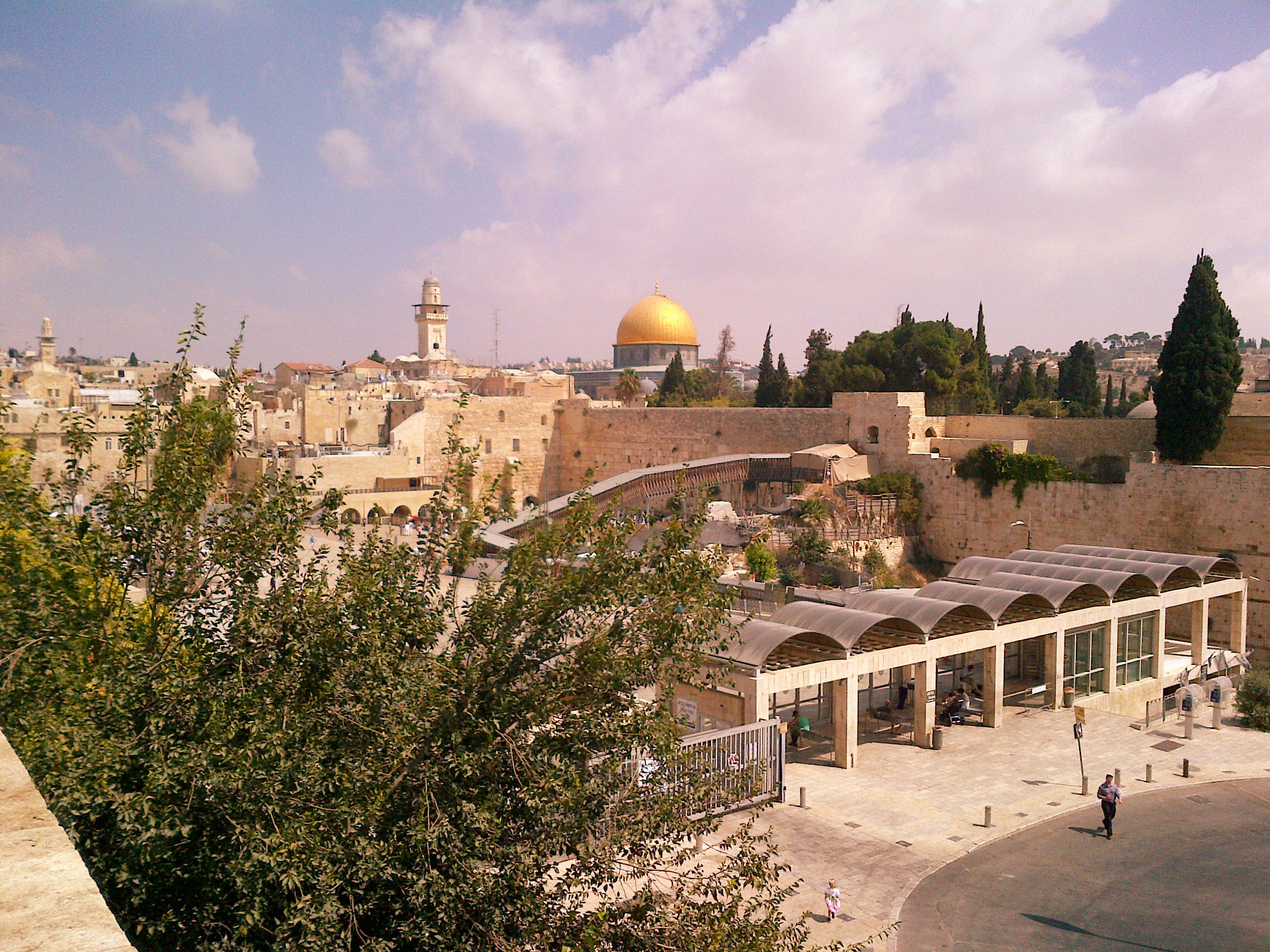 Photo: Alex Romo / Pexels
Why does the holiest accessible site in Judaism press against a wall built by a king the Temple priests distrusted? Walk into the plaza in the Old City of Jerusalem on a Friday evening and you'll hear it before you see it — the murmur of Hebrew prayers folding into the Arabic call drifting down from the Haram al-Sharif above, and the soft thud of palms on limestone polished smooth by two thousand years of touch. The Western Wall — HaKotel to Jews, Ḥā'iṭ al-Burāq to Muslims, the Wailing Wall to nineteenth-century European travellers — anchors the southwestern foot of the Temple Mount in Jerusalem, a city Israel has administered since 1967 and which the State of Palestine also claims as capital. Two thousand years of continuous prayer have polished a 488-metre retaining wall into the most contested sixty metres of stone on earth.
Most visitors expect a temple wall. They get a foundation: Herod's masons cut these limestone blocks — some longer than a London bus and weighing more than a fully loaded Boeing 747 — to widen the platform of the Second Temple, not to enclose it. The temple above lasted ninety years before Roman legions under Titus tore it down in 70 CE; the retaining wall stayed only because the earthworks holding up the platform had buried it.
The prayer plaza is the one square of stone in Old Jerusalem where this many traditions meet in plain view. Hasidim in black hats sway at the men's section while women on the other side of the mechitza press kvittelach — folded paper prayers — into gaps in the lower courses, and IDF recruits swear oaths of allegiance under floodlights at night. Above on the same platform, the Dome of the Rock and the Al-Aqsa Mosque catch the late sun — three faiths sharing one air column.
No other site on earth holds two thousand years of continuous Jewish prayer, Islamic pilgrimage memory, and modern political fault lines in sixty metres of exposed stone. Come early — before 8am — for quiet. On Tisha B'Av you'll hear the Book of Lamentations read aloud while mourners sit on the ground; during the Birkat HaKohanim ceremony at Passover and Sukkot, thousands of Kohanim raise their hands in blessing over tens of thousands of pilgrims at once.
You arrive expecting a wall and find a basin of pale limestone open to the sky. The exposed prayer section runs about 70 meters — a sliver of a 488-meter retaining wall that Herod's masons raised to hold up the expanded Temple Mount platform. Most of the wall stays buried in the city above and the bedrock below; what you see is the public face of something much larger.
Look for the drafted margins — the precise incised borders carved around each of the giant lower blocks. Those grooves are the visual fingerprint of Herodian masonry, late first century BCE, cut by quarry workers whose names nobody recorded. Above them, the masonry shrinks: medium stones from the Umayyad centuries, then small Ottoman-era courses near the top. The wall is a stratigraphy of who held Jerusalem and when.
The emotional center is tactile, not visual. People press palms and foreheads to the stone, and folded paper notes bristle from every crack within reach. The plaza functions as an open-air synagogue and never closes; come at 3 a.m. and someone will be praying. Come during Selichot or Birkat Kohanim and tens of thousands fill the basin, the chanting bouncing off stone that has heard this sound, in some form, for over a thousand years.
Step through the northern entrance and the wall keeps going — for hundreds of meters, under the houses of the Muslim Quarter, in a corridor of cool air and hard echoes. The Great Stone Route takes you past arches, cisterns, an aqueduct, and the Strouthion Pool, ending near the point closest to where the Holy of Holies once stood. Above ground, sun and crowd. Down here, compression and stone mass.
The payoff is the Master Course. One Herodian block stretches roughly 13.6 meters — longer than a city bus — and weighs an estimated several hundred tons. Quarried, dragged, and lifted into place by hand, two thousand years ago, with no margin for error. Standing beside it rearranges your sense of what ancient labor could do.
The newer Great Bridge Route, opened on Chanukah 2021, drops you a level deeper into rooms tied to the bridge that once carried priests across the valley to the Mount. A glass floor lets you look straight down into the steps of an ancient ritual bath. Book ahead — both routes are guided, and slots fill out weeks in advance during high season.


History
For more than a thousand years, this stretch of limestone has done the same job: it holds up Jewish prayer for what is no longer there. Empires changed — Romans, Byzantines, Umayyads, Crusaders, Mamluks, Ottomans, British, Israelis. The prayer didn't.
What endures here also wasn't built to endure. Herod's engineers laid these stones to hold up a platform; they expected the temple above to be the monument that lasted. The temple lasted ninety years past Herod's death. The foundation has lasted nearly two thousand.
The turning point
Most pilgrims arrive believing the giant lower stones are remnants of Solomon's Temple — that ancient Israelite kings raised this Wall as sacred precinct. They have the right wall. They have the wrong builder.
The lowest visible courses — neat dressed margins, bossed centres, some weighing more than a fully loaded Boeing 747 — carry the unmistakable signature of Herodian masonry. Herod the Great, the Roman client king who reigned 37–4 BCE, ordered this expansion around 19 BCE, and the rabbis of his generation hated him: an Idumean convert installed by Rome's armies, a man who murdered his own wife Mariamne and three of his sons, who taxed Judea brutally to pay for his building schemes. When he proposed to rebuild the Second Temple, the priests refused to begin demolition until he had quarried every replacement stone first — they didn't trust him not to leave the sanctuary in ruins for years.
Records show Jews praying at this stretch of stone by the 10th century CE, almost a thousand years after Roman legions destroyed the temple itself in 70 CE. The site grew sacred under Mamluk and then Ottoman rule because it was both accessible and as close as Jews were permitted to come to the former Holy of Holies. Press your palm to the limestone now and the boss-and-margin cuts are still there under your fingers — the same drafted edges that once held up Herod's temple, then a Roman shrine to Jupiter, then nothing at all; the foundation became sacred not because Herod built it, but because everything above it fell.
Yes, even if you're not religious — it's the closest accessible point to the ancient Temple's Holy of Holies and one of the most emotionally charged public spaces on earth. The plaza functions 24/7 as an open-air synagogue, and weekday mornings bring bar mitzvah brass bands, Selichot crowds, and IDF ceremonies that turn the limestone basin into living theatre. Skip it only if crowds and security checks genuinely put you off.
Plan 30-45 minutes for the plaza alone, or 2-3 hours if you add the Western Wall Tunnels. The Great Stone Route tour runs about 1 hour 10 minutes; the Chain of Generations Center adds another 40 minutes. Allow extra time for security screening at Dung Gate during festivals or state ceremonies.
Walk it — the official estimate is 15-20 minutes through the Old City lanes, mostly downhill toward the plaza. Buses 1, 2, 3, and 83 stop near Dung Gate if you'd rather skip the cobblestones. Wheelchair users should approach via Dung Gate only; Jaffa Gate's stone alleys aren't accessible.
Early morning before 9am gives you the closest thing to stillness, with light hitting the limestone and prayer services in quiet rotation. Mondays and Thursdays bring bar mitzvah ceremonies — chaotic but unforgettable for atmosphere. Avoid Friday afternoons through Saturday night unless you want Shabbat restrictions: no phones, no photos, no writing.
Yes — the main prayer plaza is free, open 24/7, and requires no booking. You'll only pay for separate attractions: the Great Stone Route tunnel tour costs 38 NIS adult / 25 NIS child, and the Chain of Generations Center is 30 NIS / 15 NIS. Book those ahead, since walk-up tunnel slots often sell out.
Beyond the plaza, find the Small Western Wall (Kotel HaKatan) about 170 meters north in a Muslim Quarter alley — it's the same sacred stone but quieter, tighter, and rarely crowded. In the tunnels, look for the Master Course: a single Herodian block measuring 13.6 meters long and weighing several hundred tons, longer than a London double-decker bus. The Southern Section near Robinson's Arch shows paving stones still cracked from blocks Roman soldiers threw down in 70 CE.
Cover shoulders and knees; men must cover their heads in the prayer area, and paper kippot are stocked at the entrance. Modest clothing matters more than formal — think long skirt or trousers and a t-shirt with sleeves. On Shabbat and Jewish holidays the rules tighten: no phones, no photography, no writing of any kind, including notes to slip into the cracks.
Yes — writing a kvittel (prayer note) and pressing it into a crack is one of the site's defining rituals, open to anyone of any faith. Bring your own paper and pen, since neither is supplied. Notes are collected twice a year by the rabbinate, given a ritual burial in a Jewish cemetery, and never read.
Built from cited sources · see the method · How we make our guides →
Saved and recently read places — kept on this device only.
Photos may have been resized or cropped.

