Exactly 2,400 feet above sea level, Daman-e-Koh hangs over Islamabad, Pakistan like a public balcony cut into the Margalla Hills. You come for the view, yes, but the real reason to visit is stranger: this is where the planned geometry of the capital, the older foothill villages, and the dark ridge behind them all fit into one frame. Few places explain Islamabad faster. Fewer still do it with monkeys in the trees and evening light sliding across Faisal Mosque below.
Daman-e-Koh is a hilltop garden rather than an ancient monument, and that difference matters. The ridge is old; the lookout is modern, a state-built perch that lets you read a capital city that began rising in 1961 as clean lines, sectors, and intention.
Stand here near sunset and the city looks almost too orderly, as if someone set it out with a ruler on a drafting table the size of 220 square miles, roughly the area of Chicago. Then you turn your head and the Margallas take over again: pine scent, dust, sharp bird calls, a road curling upward toward Pir Sohawa.
That tension is the whole point. Daman-e-Koh is worth your time because it isn't just scenic; it shows you what Islamabad has been arguing with for decades, the pull between development, preservation, and the stubborn fact that hills do not care about master plans.
Researched by the Audiala editorial team from historical records, architectural archives, and local expertise.
What to see
South Viewpoint Terrace
Daman-e-Koh makes its argument in one sudden reveal: the Margalla road coils through pines, then Islamabad drops away beneath you in a grid so clean it looks drafted with a ruler. Stand at the south terrace and you'll see Faisal Mosque spread below like a white tent pinned to the city, Seventh Avenue cutting south in a hard line, and Rawal Lake glinting in clear weather; at roughly 2,400 feet above sea level, about 500 feet above the capital, you're high enough to read the city's logic without losing the smell of wet earth and resin on the wind.
The Map, the Telescopes, and the Monkey Railings
Most people walk straight to the railing, take the wide shot, and miss the sly part of the place: the big guide map and the viewing telescopes that turn a pretty overlook into a decoding device. Use them. The map helps you name what your eyes are doing, the binoculars pull the mosque and avenues close enough to feel almost arranged by hand, and somewhere behind you a monkey will rattle the guardrail like a stagehand reminding you that this polished viewpoint still belongs to the hills.
Trail 2 to Daman-e-Koh
If you want the place to confess something, don't drive the whole way. Come up via Trail 2 and let the city disappear first among dry leaves, bird calls, and the steady scrape of shoes on stone; then the trees break, the air cools, and Islamabad appears all at once, less like a skyline than a plan finally exposed. That's the real trick here: Daman-e-Koh works best as a transition, from forest to geometry, from chatter to distance.
Plan your visit
Getting There
Most people go by car or taxi via Daman-e-Koh Road above sector E-7, on the climb toward Pir Sohawa; from central Islamabad it is a short hill drive, and the last bends feel like the city has been folded up behind you. As of 2026, CDA's ST-01 bus runs from PIMS to Daman-e-Koh about once an hour, with departures listed from 09:10 and returns from 15:10; hikers can come up via Trail 2 in about 1 to 1.5 hours or take the steep path behind the old Marghzar Zoo in about 30 minutes.
Opening Hours
As of 2026, the strongest public listings show daily hours around 9:00 AM to 11:00 PM, though a few live platforms still show 10:00 PM closing or even 7:00 AM opening. Plan for 09:00-23:00, but confirm the final hour the same day if you're chasing sunset, holiday evenings, or a late drive up.
Time Needed
Give it 30 to 45 minutes for a quick stop: park, ride or walk up, stare out over Islamabad, leave before the snack stalls start calling your name. One hour suits most visits, while 1.5 to 2 hours makes sense if you linger for sunset, tea, photos, or pair it with the uphill walk.
Accessibility
Access is partial, not seamless. As of 2026, CDA says golf carts run from the parking area to the viewpoint, and public listings mention wheelchair-accessible entry and parking, but the site still has slopes, uneven outdoor surfaces, and a hilltop gradient that can feel longer than it looks.
Cost & Tickets
As of 2026, entry appears to be free, and I found no sign of official online booking, timed entry, or skip-the-line tickets for Daman-e-Koh itself. You pay, if at all, for transport, snacks, or a private city tour that includes the stop.
Photo Gallery
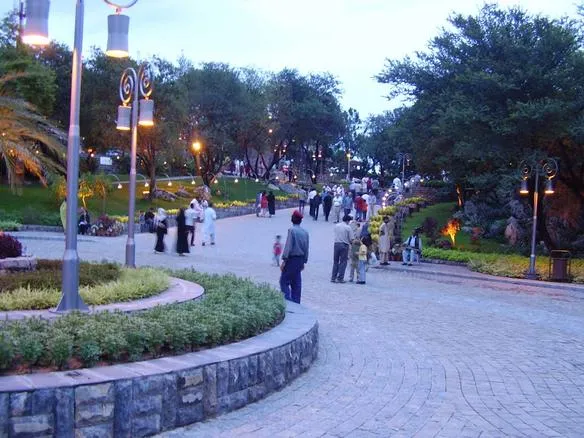
A breathtaking panoramic view of the capital city of Islamabad, Pakistan, captured from the elevated vantage point of Daman-e-Koh. · Althof19Visitors enjoy a scenic sunset stroll at the Daman-e-Koh viewpoint, nestled in the beautiful Margalla Hills of Islamabad, Pakistan. · Xubayr MayoA delicate yellow flower bud begins to bloom amidst the vibrant greenery of Daman-e-Koh, a popular hilltop garden in Islamabad, Pakistan. · Muhammad Owais KhanA peaceful, tree-lined stone pathway winds through the scenic Daman-e-Koh park in Islamabad, Pakistan. · Najamuddin ShahwaniA panoramic view from Daman-e-Koh overlooking the sprawling landscape and urban skyline of Islamabad, Pakistan. · BilalnaqeebRows of vibrant ornamental cabbage plants decorate the garden area at Daman-e-Koh, a popular scenic viewpoint in Islamabad, Pakistan. · Najamuddin ShahwaniThe scenic Daman-e-Koh viewpoint in Islamabad offers a breathtaking elevated perspective of the city's lush landscape and urban layout. · Azam Ishaque
History
The Balcony That Kept Its Job
Daman-e-Koh has kept the same function through every redesign, argument, and headline: it gives Islamabad a place to look at itself from above. Documented sources tie its meaning to the modern capital rather than to deep antiquity; Britannica records that Islamabad's site was chosen in 1959 and construction began in 1961, while the lookout appears to have followed as part of the city's recreational edge in the Margallas.
The exact opening year remains uncertain. Most modern summaries date Daman-e-Koh to the early 1970s, while a weaker single-source claim pushes it into the early 1980s, but the continuity is clearer than the inauguration date: people have come here for decades to test the same view, tracing the city grid below, the foothill villages beside it, and the protected hills rising behind.
The turning point
Kamran Lashari and the View That Had to Stay the Same
By the mid-2000s, Daman-e-Koh had become personal for Kamran Lashari, the Capital Development Authority chairman who wanted Islamabad to feel less like a bureaucratic filing cabinet and more like a capital with a pulse. Business Recorder documented him on 27 August 2004 saying the site was being reshaped "without bringing in the new structure," which tells you exactly what was at stake: he needed to refresh a public icon without destroying the reason people came in the first place.
That balancing act was the turning point. Dawn later credited Lashari with the remodelling of Daman-i-Koh and the widening of Daman-i-Koh Road by 7 October 2008, but by 29 January 2010 the same beautification works had entered parliamentary reporting as projects that, according to Dawn's account of a National Assembly reply, moved ahead without proper environmental procedure.
The irony is almost too neat. Lashari changed the paths, the polish, and the civic prestige of Daman-e-Koh, yet the old job survived the facelift: people still arrived to stand at the railing and measure Islamabad against the hills.
What Changed
The built setting kept shifting. Documented reporting shows mid-2000s remodelling, road widening, later proposals for a chairlift first conceived in 2002 and revived in 2013, and even a 2019 PTDC motel plan. Each scheme tried to turn a lookout into a bigger machine for leisure and revenue, and each one ran into the same hard edge: Margalla Hills National Park, grounded in the 19 December 1979 Islamabad Wildlife Ordinance, does not welcome every bright idea.
What Endured
The ritual stayed simple. Families still drive up from the city, step into thinner, cooler air roughly 500 feet above Islamabad, and look for the familiar anchors below: Faisal Mosque, the long sectors, the spread of a planned capital at the foot of a wild ridge. Even after the 28 July 2010 Airblue Flight 202 disaster turned this corridor into a route of smoke, sirens, and grief, Daman-e-Koh kept serving as a threshold where the city comes into focus and, sometimes, into question.
Tips for visitors
Go Early Late
Early morning is calmer and cooler; sunset gives you the city at its theatrical best, with Faisal Mosque and Islamabad's grid turning gold below. Weekend evenings are a different animal entirely, more family outing than quiet lookout.
Watch Monkeys
The monkeys here are not comic relief. Keep food out of your hands, don't feed them, and don't edge in for a photo unless you want your snack grabbed faster than a waiter can bring chai.
Camera Yes Drone No
Ordinary photography appears fine, and the whole place is built around looking and pointing lenses. Drones are another matter: Pakistan tightened drone rules in 2024, Islamabad imposed local bans in 2025, and by February 2026 a nationwide security ban was reported, so assume no drone unless you have written clearance.
Eat Nearby
For budget, stick to the snack stalls near the site for chai, pakora, and samosa. For a proper meal, Des Pardes in Saidpur Village is a solid mid-range stop, Andaaz is the splurge pick if you want atmosphere with your dinner, and The Carnivore in F-6 works well if you want meat and no village theatrics.
Pair With Saidpur
Daman-e-Koh makes more sense when you combine it with nearby Saidpur Village. One gives you Islamabad from above, all geometry and green belt; the other gives you foothill texture, old lanes, pottery, and dinner tables tucked against the slope.
Holiday Rules Shift
As of 2026, authorities have temporarily declared Daman-e-Koh a family-only park during Eid periods, so don't assume the usual access rules hold on holiday weekends. Check local notices the same day if your visit lands near Eid or another public holiday.
Where to Eat
local_dining
Don't Leave Without Trying
Chicken or mutton karahi — a wok-cooked meat and tomato curry that's pure comfortSeekh kebab and tikka — charred meat skewers that are a staple of Islamabad street foodChapli kebab — a spiced, flattened beef patty that's Pashtun in origin and addictiveKabuli pulao — fragrant rice with chickpeas and meat, a regional showstopperHalwa puri — semolina-based sweet with deep-fried bread, the classic breakfastKarak chai — strong, milky tea that's the social glue of IslamabadKahwa — cardamom and saffron-infused green tea, especially good in the hills
The Dome
quick bite
Pakistani & Continental Cafe€€star4.4(3245)directions_walkAt the viewpoint
Order: Fried chicken, pulled beef sandwich, or pasta — but honestly, you're here for the sunset view as much as the food. The hilltop setting is the real draw.
Right at the viewpoint itself, so you don't have to leave the panorama to eat. It's the easiest no-detour option if you want mixed Pakistani and continental fare without abandoning the view.
checkSaidpur Village, about 0.8 miles (1.3 km) from Daman-e-Koh, is the nearest restaurant cluster — technically walkable but hilly; most visitors take a short ride instead.
checkIf you want to stay right at the viewpoint, The Dome and PTDC Restaurant are your only on-site options; both prioritize the view over the food.
checkFor a proper evening out with atmosphere and local food, head to Saidpur Village — the heritage setting is as much part of the meal as what's on the plate.
checkMeat-heavy dishes (karahi, seekh kebab, chapli kebab) are the local specialty; vegetarian options exist but aren't the draw.
Food districts:Saidpur Village — the heritage food cluster 0.8 mi from Daman-e-Koh, with multiple restaurants gathered in one atmospheric areaKohsar Market — a short drive away, better for cafes and upscale casual dining than traditional village-style food
Restaurant data powered by Google
Frequently asked
Is Daman-e-Koh worth visiting?
Yes, if you want to understand Islamabad in one glance. The terrace sits about 2,400 feet above sea level, roughly 500 feet above the city, like standing on a 45-story balcony cut into the Margalla Hills. Go for the view of Faisal Mosque and the city grid, but stay long enough to notice the other layer too: this lookout is tied to the memory of the Airblue Flight 202 disaster nearby, which gives the place more weight than a quick photo stop suggests.
How long do you need at Daman-e-Koh?
Give it about 1 hour for a normal visit. That covers the ride or walk up from parking, time at the viewpoint, and a tea stop without rushing. Stretch it to 1.5 or 2 hours if you come at sunset, or much longer if you hike up via Trail 2, which takes about 1 to 1.5 hours each way, more like turning the visit into a half-day outing.
How do I get to Daman-e-Koh from Islamabad?
The easiest way is by car, taxi, or ride-hailing app via Daman-e-Koh Road in sector E-7. From central Islamabad and the Faisal Mosque side, the drive is about 6 kilometers, roughly the length of 75 football fields laid end to end, climbing into the Margalla Hills toward Pir Sohawa. Public transport exists too: CDA lists bus route ST-01 from PIMS to Daman-e-Koh, but route data has shown mismatches, so check the same day if you're relying on it.
What is the best time to visit Daman-e-Koh?
Early morning on a clear weekday or late afternoon into sunset gives you the best version of the place. Morning brings cooler air, thinner crowds, and a sharper read of Islamabad's geometry; evening gives warm light on Faisal Mosque and the city's lights flickering on below. Skip hazy days if you can, because smog can flatten the whole panorama into a pale blur.
Can you visit Daman-e-Koh for free?
Yes, current visitor sources say entry is free. You should still expect small spending temptations once you're there: snacks, tea, and possibly transport help from the parking area by golf cart. Hours are less clear than the ticket policy, with public listings ranging from 6:00 AM to 8:00 PM and 9:00 AM to 11:00 PM, so confirm locally if you're aiming for an early or late visit.
What should I not miss at Daman-e-Koh?
Don't miss the south viewpoint, the guide map near the overlook, and the view line toward Faisal Mosque. Most people take the photo and leave; the smarter move is to use the map and telescopes to read the city below, because Daman-e-Koh works like Islamabad's own viewing platform for its planned geometry. Keep an eye on the quieter emotional detail too: this hilltop sits close to the memorial geography of the 2010 Airblue crash, which changes the mood if you know the story.
Sources & attribution109
Researched and written by the Audiala editorial team from historical records, architectural archives, and local expertise. Last updated April 2026.
Wikidata — Identified Daman-e-Koh as a viewing point and hilltop garden in Islamabad Capital Territory.
Wikipedia — Provided overview facts including elevation, city view, route toward Pir Sohawa, telescopes, and general visitor orientation.
The Express Tribune — Used for popularity, elevation, visitor patterns, and sunset appeal.
UNESCO World Heritage Centre — Confirmed that Daman-e-Koh is not a UNESCO World Heritage site or tentative-list entry.
Chakor Ventures — Used for the unconfirmed claim that Daman-e-Koh was developed in the early 1970s.
A Soul Window — Used for the unconfirmed early-1970s development claim and free-entry visitor notes.
History of Pakistan — Used for the alternate unconfirmed claim that the site dates to the early 1980s.
Business Recorder — Provided the dated 27 August 2004 reference to CDA chairman Kamran Lashari reshaping Daman-i-Koh.
Dawn — Used for Lashari's legacy, remodelling of Daman-i-Koh, and road widening with streetlights.
Pakistan Traveler — Used for the unconfirmed 2007 renovation claim and mention of telescopes and facilities.
Dawn — Reported that beautification of Daman-i-Koh was cited in a National Assembly reply as having bypassed environmental procedures.
Encyclopaedia Britannica — Provided the capital-planning context: site chosen in 1959 and construction begun in 1961.
Pakistan Code — Provided the legal basis for Islamabad Wildlife Ordinance, 1979.
Pakistan Code PDF — PDF text of the Islamabad Wildlife Ordinance used for the 19 December 1979 legal date.
Wikipedia — Used for secondary confirmation of Margalla Hills National Park dating and setting.
National Tourism Portal — Provided official-style tourism summary, seasonal note, and attraction basics for Daman-e-Koh.
Scribd — Used cautiously for a planning-text excerpt about early development context.
Scribd — Used for the 28 July 2010 Airblue Flight 202 crash date and context.
The Express Tribune — Used for rescue access and the Daman-e-Koh/Pir Sohawa road corridor during the 2010 crash response.
The Express Tribune — Confirmed memorial planning near Daman-e-Koh and personal testimony from victims' families.
The Express Tribune — Used for the 2013 revival of the chairlift project and environmental objections.
The Express Tribune — Used for the revived consultant process around the chairlift proposal.
The Express Tribune — Used for the claim that the chairlift project was first conceived in 2002 and later revived.
Dawn — Confirmed that Prime Minister Nawaz Sharif rejected the proposed chairlift route in September 2016.
The Express Tribune — Reported the March 2018 fire in parts of the Margalla Hills near Daman-e-Koh.
Pakistan Today — Reported the April 2018 fire in the Margalla Hills.
The Express Tribune — Reported PTDC board plans in 2019 to build a motel at Daman-e-Koh.
Tony Ashai — Used to verify that a redesign linked to Daman-e-Koh was presented as a concept rather than an executed project.
Dawn — Provided additional confirmation and reporting context on the Airblue crash.
Dawn — Used for the idea of the wider zone as a meeting point of wildlife, villages, and the modern city.
Dawn — Provided background on Bari Imam in the foothill cultural setting.
Dawn — Used for the description of Bari Imam as Islamabad's patron saint.
Dawn — Used for Saidpur village traditions and layered religious history.
Dawn — Used for Shah Allah Ditta and Sadhu ka Bagh historical associations.
The Express Tribune — Used for the 2018 Daman-e-Koh intersection crash and aftermath.
The Express Tribune — Provided reporting on the funeral of Ateeq Baig after the 2018 road crash.
The Express Tribune — Reported the May 2018 robberies on the road near Daman-e-Koh.
Dawn — Used for later criticism of development and restaurants in the Margalla Hills area.
BOL News — Provided background on Kamran Lashari's wider preservation work and public image.
Capital Development Authority — Provided official destination information including golf carts, restaurants, and basic site profile.
Capital Development Authority — Mirrored official destination notes and linked the site to hiking access and recreation.
Tripadvisor — Used for current visitor hours, free-entry notes, visit length, reviews, and warnings about monkeys and haze.
WorldOrgs — Provided listing data for hours, address, and wheelchair-accessible entrance and parking.
InstaHop — Used for hours, free-entry note, visit duration, terrain notes, and restroom mention.
Waze — Provided mapped destination pin, address details, and one public hours listing.
Damn-e Koh Park in Islamabad — Xeyn — CC BY-SA 1.0 (https://creativecommons.org/licenses/by-sa/1.0/) — Source: https://commons.wikimedia.org/wiki/File:Damn-e_Koh_Park_in_Islamabad.jpg
Blue Sky in Daman E Koh — Althof19 — CC BY 3.0 (https://creativecommons.org/licenses/by/3.0/) — Source: https://commons.wikimedia.org/wiki/File:Blue_Sky_in_Daman_E_Koh.jpg
Daman-E-Koh — Xubayr Mayo — CC BY-SA 3.0 (https://creativecommons.org/licenses/by-sa/3.0/) — Source: https://commons.wikimedia.org/wiki/File:Daman-E-Koh.jpg
A flower about to blossom in Daman-e-Koh, Islamabad — Muhammad Owais Khan — CC BY-SA 3.0 (https://creativecommons.org/licenses/by-sa/3.0/) — Source: https://commons.wikimedia.org/wiki/File:A_flower_about_to_blossom_in_Daman-e-Koh,_Islamabad.JPG
Daman e Koh - panoramio — Najamuddin Shahwani — CC BY 3.0 (https://creativecommons.org/licenses/by/3.0/) — Source: https://commons.wikimedia.org/wiki/File:Daman_e_Koh_-_panoramio.jpg
A view of Damn-e-Koh and Islamabad from Margalla Hills — Bilalnaqeeb — CC BY-SA 4.0 (https://creativecommons.org/licenses/by-sa/4.0/) — Source: https://commons.wikimedia.org/wiki/File:A_view_of_Damn-e-Koh_and_Islamabad_from_Margalla_Hills.jpg
Daman e Koh, Islamabad - panoramio — Najamuddin Shahwani — CC BY 3.0 (https://creativecommons.org/licenses/by/3.0/) — Source: https://commons.wikimedia.org/wiki/File:Daman_e_Koh,_Islamabad_-_panoramio.jpg
Aerial View of Islamabad from Daman-e-Koh Park — Azam Ishaque — CC BY-SA 3.0 (https://creativecommons.org/licenses/by-sa/3.0/) — Source: https://commons.wikimedia.org/wiki/File:Aerial_View_of_Islamabad_from_Daman-e-Koh_Park.jpg
Dancing monkey at the Daman i Koh park, Margalla Hills near Islamabad — Rangbaz — CC BY-SA 4.0 (https://creativecommons.org/licenses/by-sa/4.0/) — Source: https://commons.wikimedia.org/wiki/File:Dancing_monkey_at_the_Daman_i_Koh_park,_Margalla_Hills_near_Islamabad.jpg
Daman-e-Koh, whole city of Islamabad can be seen from here — Talha Malik — CC BY-SA 4.0 (https://creativecommons.org/licenses/by-sa/4.0/) — Source: https://commons.wikimedia.org/wiki/File:Daman-e-Koh,_whole_city_of_Islamabad_can_be_seen_from_here.jpg
Strictly necessary cookies keep the site working. Analytics (PostHog, Google Analytics) measures how each visitor uses our pages. Marketing loads YouTube videos and walking-route maps without a tap and lets Google Analytics set advertising cookies. We never sell your data. You can change this any time from the footer.
Analytics and marketing cookies are optional and only load if you agree. Details under Customize.
Privacy
Cookie preferences
Pick what you're okay with. You can change this any time from the footer.
Strictly necessary
Always on
Sign-in, language, navigation. Always on.
Product analytics
PostHog (EU) and Google Analytics record which pages you view and how you use them, under a random identifier stored in your browser. Helps us see which pages work and which need fixing. Google's ad personalisation stays off. No selling.
Marketing
Loads YouTube videos and the walking-route maps (OpenFreeMap) without a tap; without it, they load only when you tap them. If analytics is also on, Google Analytics may set advertising cookies. Ad personalisation stays off.