volcano
Lakes and Volcanoes
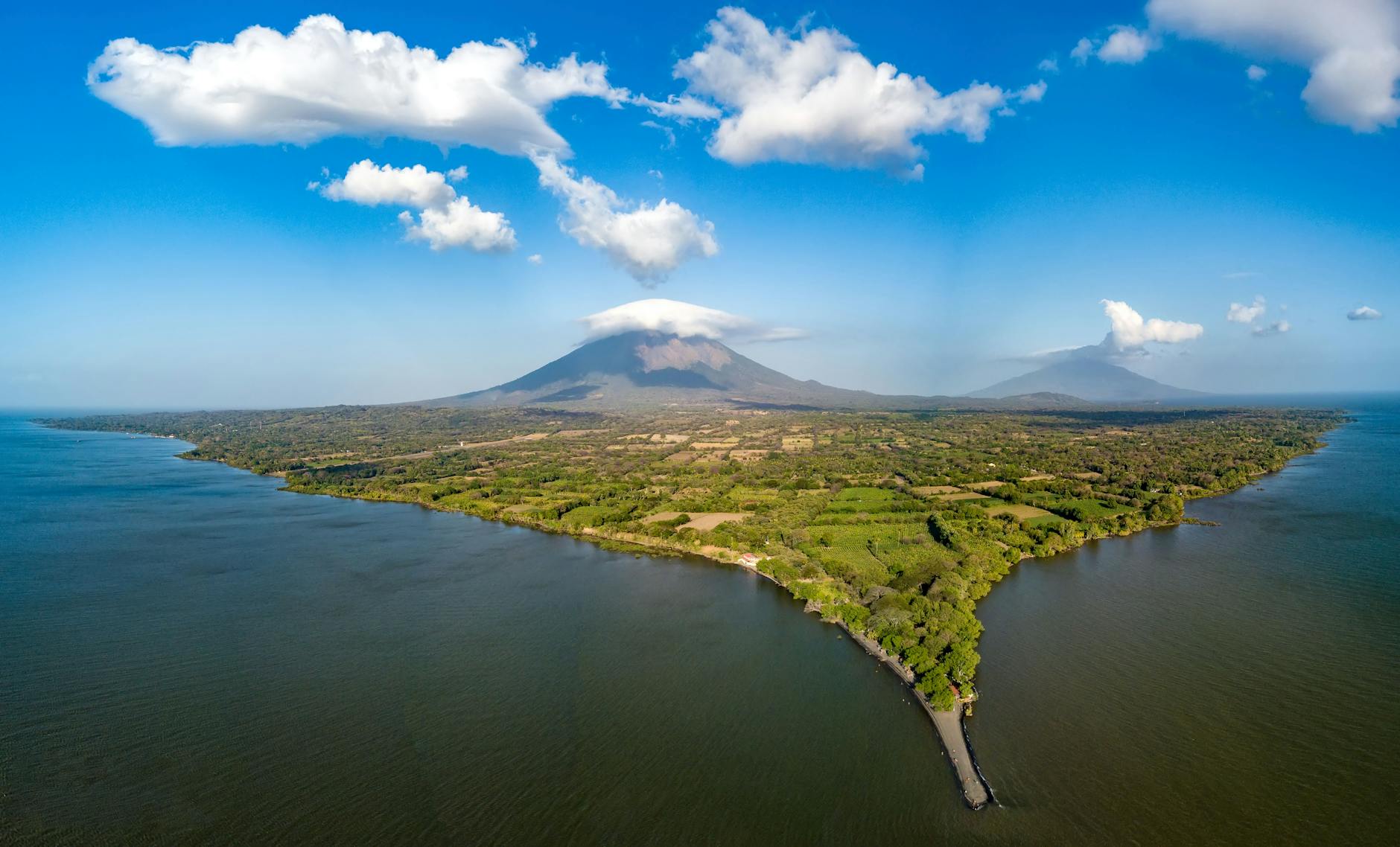
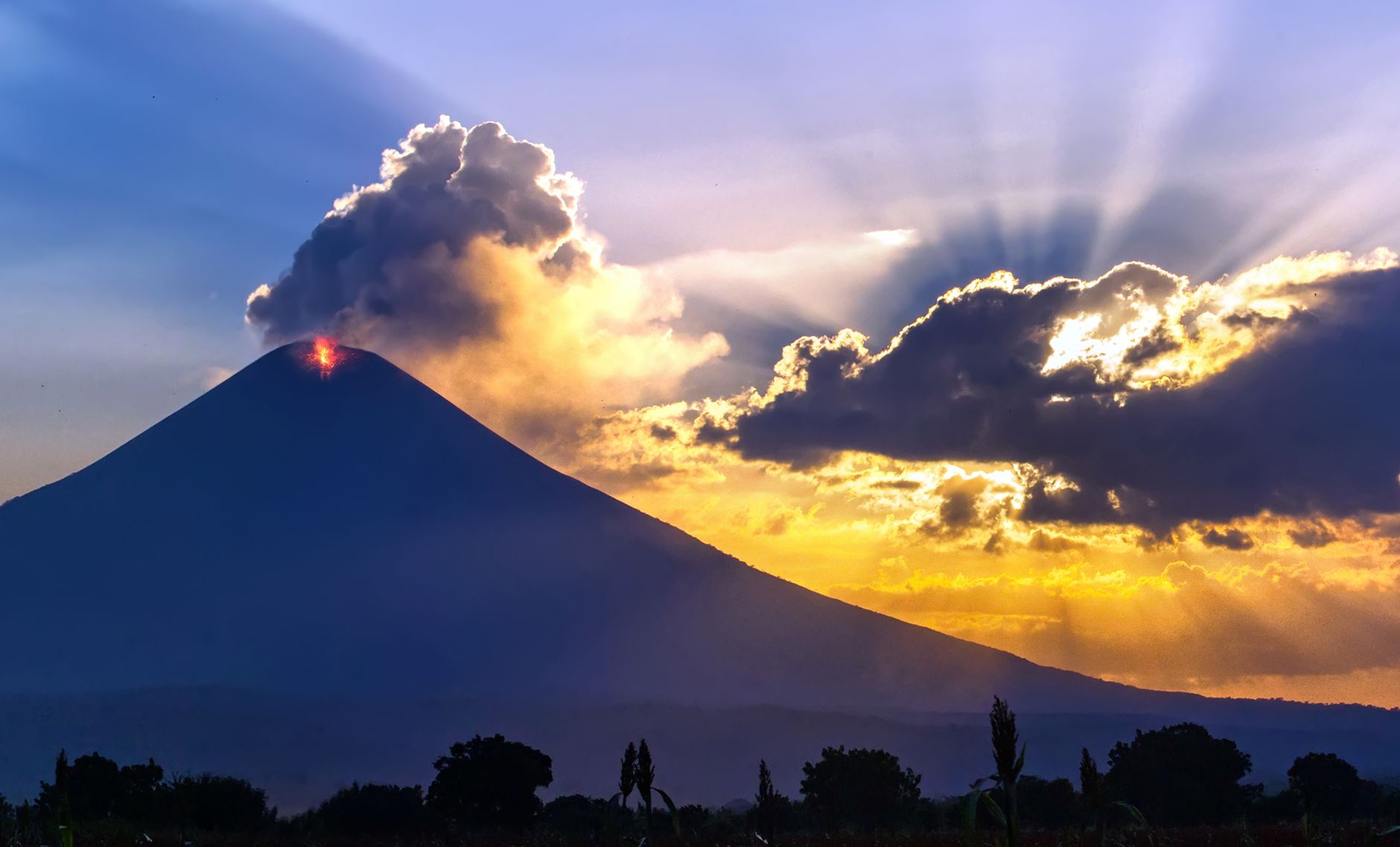
Nicaragua earned its nickname honestly. You can look into the glowing crater at Masaya, then cross Lake Nicaragua toward Ometepe, where two volcanoes rise straight out of the water.
Nicaragua is the rare country where a colonial square, an active volcano, a freshwater island, and a reef-fringed Caribbean shore can all belong to the same itinerary without feeling stitched together.
Entry90-day C-4 stay for many travelers; visa rules changed in February 2026
NA Nicaragua travel guide starts with the obvious surprise: this is Central America’s largest country, yet you can move from lava lakes to Caribbean reefs in a single trip.
Nicaragua runs on a dramatic axis of fire and water. In the west, Granada faces Lake Nicaragua, where colonial facades sit within reach of Ometepe and its twin volcanoes, Concepción and Maderas; farther north, León gives you the country’s sharpest collision of politics, poetry, and ash, with the UNESCO-listed cathedral and the buried ruins of León Viejo not far beyond. Masaya adds the rare thrill of an active crater you can approach without a multiday expedition, while Managua makes sense less as a postcard capital than as the country’s air hub, market city, and practical starting point.
Then the map opens out. San Juan del Sur draws surfers and sunset drinkers, but the stronger argument for staying longer is range: coffee hills around Matagalpa and Jinotega, cigar country near Estelí, river frontier history around San Carlos, and the Creole-Caribbean turn of Bluefields and Corn Island on the eastern side. Nicaragua still works for travelers who want prices below Costa Rica, but it rewards curiosity more than checklist tourism. Come for volcanoes if you like. You’ll remember the nacatamales at dawn, the smell of wood smoke, and the sense that whole regions remain only lightly narrated.
Worlds Before the Spanish, c. 900-1524
Morning light struck the western shore of Lake Nicaragua when Gil Gonzalez Davila came ashore in April 1522, expecting submission and gold. Instead he found Chief Nicarao waiting with interpreters, nobles, and questions that went straight past diplomacy and into theology: what is thunder, where do souls go, who made the God who made everything else. It is one of the great scenes in Central American history, almost theatrical in its poise.
Ce que l'on ignore souvent, c'est que western Nicaragua was never some empty prelude to conquest. Nahua-speaking migrants had moved south centuries earlier, settling the lake basin and the Pacific plain, while Chorotega communities held their own political and ritual worlds nearby. They traded cacao, wore jade, kept memory in ceremony, and looked north as much as inland, toward ideas coming down from Mesoamerica and then remade beside volcanoes and water.
The Spanish heard answers they could not fully understand because they arrived with a ledger in one hand and a crucifix in the other. Nicarao seems to have understood them more clearly than they understood him. He accepted baptism, according to the chroniclers, but not before bargaining over tribute and gold like a man who knew power when he saw it and knew theater even better.
Then disease came, faster than government, faster than catechism, faster than any treaty. Chiefs died, lineages broke, and names survived in altered form. Nicaragua itself almost certainly keeps the memory of Nicarao in its very name, while the deeper world that produced him was pushed into fragments, place names, pottery, food, and the stubborn endurance of indigenous communities far from the colonial plaza.
Chief Nicarao survives in the record not as a defeated relic but as a ruler who made a conquistador defend his own cosmology.
One chronicler claimed Gonzalez Davila baptized tens of thousands in a single campaign, a number so inflated it tells you more about imperial vanity than evangelization.
Conquest and Colonial Foundations, 1524-1780
In 1524 Francisco Hernandez de Cordoba founded Granada on the edge of Lake Nicaragua and Leon near the Pacific, and with those two acts he gave the country its most durable rivalry. Granada would lean conservative, mercantile, and lake-facing; Leon would grow argumentative, clerical, and politically restless. Even now, if you move between Granada and León, you can feel an old family quarrel still humming under the cobblestones.
The founder did not get to enjoy his creation for long. Cordoba entered the usual early colonial game of ambition, private negotiation, and bad timing, and Governor Pedrarias Davila answered with exemplary cruelty. In 1526 Cordoba was beheaded in Leon's main square, a founding scene as brutal as any in the Spanish Americas: the city-maker executed by the empire he had extended.
Ce que l'on ignore souvent, c'est how unstable these first colonial cities really were. Leon's original site, now Leon Viejo, stood too close to seismic fury and the great cone of Momotombo. Earthquakes and eruptions made the place untenable, and around 1610 the city shifted west, leaving behind a buried colonial grid that archaeologists would only recover centuries later like a courtroom reopened after everyone thought the case was closed.
Granada faced a different torment. Because the Rio San Juan connects Lake Nicaragua to the Caribbean, pirates could sail inland to attack what looked, on paper, like a sheltered Spanish city. Raids in the 17th century left ash, ransom, and panic in their wake, and the Spanish answer was stone: the Fortress of the Immaculate Conception upriver toward present-day San Carlos, guarding the watery door to the kingdom.
Colonial Nicaragua was never only baroque facades and bells. It was also forced labor, indigenous decline, African presence, smuggling, and a society organized around race and land with the Church close at hand. The two cities survived, but not innocently. Their rivalry and their hierarchies would outlast the empire that built them.
Francisco Hernandez de Cordoba founded Nicaragua's two great colonial poles and then lost his head before his project had even settled into stone.
Excavations at Leon Viejo uncovered what is identified as Cordoba's skull, turning a remote archaeological site into one of the most intimate crime scenes in colonial Latin America.
Independence, Rival Cities, and Foreign Appetites, 1780-1912
In 1780 a 21-year-old Horatio Nelson pushed up the Rio San Juan to take the fortress that protected Spain's inland route. He managed the capture, then nearly died of fever in the swampy campaign, leaving Nicaragua with one of those delightful historical ironies: before Trafalgar, before the statues, the future British hero was already learning that Central America could humiliate empires.
Independence came in 1821 as part of the wider collapse of Spanish rule, but freedom did not bring calm. Nicaragua lurched between federations, coups, caudillos, and the increasingly bitter competition between Granada and León, each city imagining itself as the proper heart of the nation. Managua, set between them, became capital in 1852 less because everyone loved it than because neither side wanted the other to win. A compromise can found a capital too.
Then came William Walker. In 1855 this Tennessee adventurer arrived with a small band of North American filibusters, inserted himself into Nicaragua's civil war, and within a year declared himself president. He restored slavery, tried to rewire the country for his own Anglo-American fantasy, and plunged Nicaragua into one of the strangest episodes in 19th-century history: a republic briefly hijacked by a private foreign conqueror with legal stationery.
Ce que l'on ignore souvent, c'est that one of the central heroes of Walker's defeat was a 29-year-old woman, Rafaela Herrera, half a century earlier the heroine of the Rio San Juan fortress, whose example still haunted national memory whenever foreigners came armed with ambition. By 1857 Walker was driven out by a Central American coalition. He returned to the region anyway. Men like that rarely learn the right lesson.
Coffee expanded, export wealth concentrated, and outside powers kept circling. By the early 20th century the United States was no longer merely interested in Nicaragua's route and resources; it was ready to occupy the country outright. The old rivalry of Granada and León had prepared the ground for a larger intrusion.
William Walker remains the foreign interloper Nicaraguan history never stopped resenting: a self-invented president who treated a sovereign country as a private audition.
Managua became capital partly because it sat between León and Granada, a political middle seat chosen to prevent either rival city from claiming the crown.
Occupation, Revolution, and the Family State, 1912-1990
By 1912 United States Marines were on Nicaraguan soil, officially to stabilize, in practice to shape the republic to Washington's liking. Out of that occupation rose Augusto Cesar Sandino, a slight, stubborn figure with a broad hat and a gift for turning mountain warfare into political myth. From the northern hills he fought the Marines and, more dangerous still, offered Nicaragua an image of dignity that outlived his army.
He also walked into a trap. In February 1934, after negotiations in Managua, Sandino was seized and murdered on the orders of Anastasio Somoza Garcia, head of the National Guard. The killing cleared the stage for the Somoza dynasty, which would rule Nicaragua as a family enterprise for more than four decades, mixing modern statehood with patronage, censorship, and a kind of dynastic vulgarity that would have fascinated every court historian for the wrong reasons.
Then the earth itself intervened. The 1972 earthquake shattered Managua, killing thousands and exposing the rot of the regime when relief money and reconstruction became another occasion for enrichment. Ce que l'on ignore souvent, c'est how often revolutions begin not only with ideology but with indecency made visible. When a government steals amid rubble, even fear starts to loosen.
The Sandinista Revolution triumphed in 1979. Young commanders entered the capital, Somoza fled, literacy brigades spread across the countryside, and Nicaragua became a global symbol, depending on who was looking, of hope or menace. The 1980s brought civil war with the U.S.-backed Contras, funerals in provincial towns, rationing, exhaustion, and a generation forced to grow up at political full volume.
In 1990 Nicaraguans voted the Sandinistas out. That result mattered because it showed a country bruised by dictatorship and war still capable of handing power over through ballots rather than bullets. It did not end the argument over Sandino, Somoza, or the revolution. Nicaragua is still arguing. That, too, is part of the inheritance.
Augusto Cesar Sandino became immortal partly because he died before power could diminish him, leaving the nation a martyr instead of a ruler.
The 1972 Managua earthquake did more than destroy buildings; it destroyed what remained of the Somoza regime's claim to legitimacy when corruption around relief became impossible to hide.
Nicaragua speaks Spanish as if the language had been left in the sun to soften. The consonants relax, the final s thins into air, and then comes vos, that magnificent little act of equality. In Managua, in León, in Granada, you hear it everywhere: not as slang, not as rebellion, but as grammar with its jacket off.
A country reveals itself by the pronoun it trusts. Vos says: I will not kneel, and I do not require that you kneel either. Usted still exists, of course, but when it appears it has ceremony in it, or frost. The rest of the time speech moves with diminutives and delays, cafecito, momentito, ahorita, each word promising immediacy while keeping one eye on eternity.
Then come the local treasures. Chunche for any object whose true name has fled. No me des paja for the national allergy to empty talk. Suave for traffic, arguments, seduction, panic. A language can be a hammock or a machete. Here it knows how to be both.
Nicaraguan food does not flirt. It receives you with corn, beans, yuca, pork, cream, plantain, and the serene conviction that these are sufficient materials for civilization. In Granada, vigoron arrives on a banana leaf with boiled yuca, curtido, and chicharron so crisp it sounds like breaking porcelain. It is peasant food with the arrogance of a crown.
Breakfast explains the country better than any museum. Gallo pinto at seven in the morning, with fried plantain, white cheese, eggs, and coffee from Matagalpa or Jinotega, tells you that appetite here is not a private weakness but a civic virtue. The beans stain the rice; the rice calms the beans. A nation is a plate arranged against hunger.
Then Sunday appears with nacatamales, huge and damp in their plantain leaves, tied with string like gifts from a stern aunt. You untie one and a perfume rises: masa, mint, pork, tomato, steam. It asks for company. Solitary luxury is for colder countries.
Even the drinks speak in the old grammar of maize and cacao. Pinolillo is not fashionable and does not care. Grainy, faintly bitter, almost stubborn, it tastes like a civilization declining refinement on principle.
Nicaraguan politeness is warm, but it is not limp. People greet, ask after your day, soften requests with little verbal cushions, and still preserve a core of steel about time, respect, and ridicule. Someone will call you mi amor while refusing to move an inch. I admire this enormously.
You see it in markets and bus terminals, in the choreography of paying, waiting, yielding, insisting. Nobody needs a speech. A glance, a raised chin, a suave, and the entire social temperature changes. Courtesy here is not decorative. It is how friction becomes music.
Also, vanity is watched with precision. The word fachento exists for a reason. A person who displays wealth too loudly is not envied so much as examined, which is healthier for the soul than applause. Nicaragua likes elegance better when it has dust on its shoes.
Visitors do well to understand one thing quickly: kindness is abundant, but dignity is not for sale. Ask directly. Thank properly. Do not perform superiority, especially if you are sunburned and carrying a reusable water bottle the size of a fire extinguisher.
Nicaraguan architecture has the decency to admit that earthquakes exist. In León and Granada, the grand colonial churches sprawl low and broad rather than aspiring too recklessly toward heaven, as if piety had signed a contract with geology. Thick walls, inner courtyards, shadow, arcades, tiled roofs. Devotion, yes, but with practical shoes.
León Cathedral is the grand argument in white. Its domes and terraces look almost weightless in the sun, yet the whole structure is a lesson in how to survive tremors, heat, politics, and centuries of human ambition. You climb to the roof and the city becomes a chessboard of faith, laundry, and volcanoes.
Granada performs another register. Courtyard houses with painted facades, grilled windows, carved doors, and cool interiors say that beauty is best enjoyed from shade. The streets keep their grid like a stubborn old family keeps its silver. Then a horse cart passes, or a motorcycle, and the century blurs.
Even on Ometepe, where the twin volcanoes Concepcion and Maderas dominate the imagination, domestic architecture remains eloquent in smaller ways: hammocks, breezeways, verandas, mango trees positioned like household gods. The house does not conquer the climate. It negotiates.
Religion in Nicaragua is Roman Catholic on the surface and much older underneath, which is often where the interesting things happen. Saints process through streets lined with fireworks, brass bands, sweat, and plastic chairs; meanwhile the older instincts endure with botanical patience, in offerings, in healing, in the way water, hills, caves, and volcanoes continue to attract a seriousness that predates any catechism.
You feel this most strongly in Masaya, where Catholic ritual and older forms of awe seem to watch each other without blinking. The volcano itself, active and sulfurous, has long invited interpretation. Hellmouth, sacred opening, tourist stop, geological fact. Human beings are fully capable of believing all four at once.
Semana Santa turns public space into theater with a conscience. Purple cloth, candles, drums, sawdust carpets, long hours under heat that would make a less committed people abandon redemption until dusk. But endurance is part of the point. Ritual must cost something or it becomes decor.
And yet devotion here is rarely pompous. It eats after mass. It carries children, fans itself, gossips, pays for flowers, complains about the priest, and still kneels when the image passes. Faith, like good cooking, survives best when it lives among ordinary appetites.
Nicaragua takes poetry far more seriously than many richer countries take politics. Rubén Darío, born in Metapa in 1867, did not merely write verses; he altered the music of Spanish itself, filling it with swans, pagan splendor, blue silk, and an almost indecent ear for cadence. A poet can become a national climate. Darío did.
Then the tradition refused to stay ornamental. Ernesto Cardenal wrote with psalms in one pocket and revolution in the other. Gioconda Belli brought sensuality, politics, and female intelligence into the same room and locked the door behind them. Here literature has often behaved less like a library than like an uprising with line breaks.
León carries this inheritance openly. You feel it in murals, bookstores, university air, conversations that turn unexpectedly literary, as if metaphor were a public utility. A country with volcanoes will always be tempted by grand language. Nicaragua has the taste to make some of it good.
What matters is not only that poets are admired. It is that language itself is treated as something consequential, capable of seduction, mockery, prayer, and offense. Words still have blood pressure here.
Nicaragua earned its nickname honestly. You can look into the glowing crater at Masaya, then cross Lake Nicaragua toward Ometepe, where two volcanoes rise straight out of the water.
Granada and León are not interchangeable pretty towns. Granada leans lakeward and mercantile; León feels more argumentative, with murals, revolution, and the largest cathedral in Central America.
The food stays close to the land: gallo pinto at breakfast, nacatamales on Sundays, vigorón in Granada, quesillo in León. In the highlands around Matagalpa and Jinotega, coffee is not a souvenir but a landscape.
San Juan del Sur is the base, not the whole story. From there, travelers fan out to Pacific breaks, quieter beaches, and a dry-season coast that works as well for first-timers as for serious surfers.
Nicaragua still has room on the map. Estelí, Jinotega, and the northern highlands bring cooler air, canyon country, tobacco valleys, and trails that feel far removed from the standard Central America circuit.
Bluefields and Corn Island shift the country’s rhythm completely. Spanish gives way to Creole cadences, the sea turns clear and warm, and the Caribbean side feels less packaged than almost anywhere else in the region.
12 cities — start with the ones we'd send you to first.
Spain's colonial grid transplanted beside a freshwater sea full of sharks — the cathedral's ochre facade turns the color of embers at dusk, and vigorón on a banana leaf costs less than a bus ticket.
The city that buried its own cathedral roof under volcanic ash and still produced the most ferocious poets and revolutionaries in Central American history.
A capital that refused to rebuild its downtown after the 1972 earthquake, leaving the old cathedral a roofless shell beside the lake while the city sprawled outward into a permanent improvisation.
Two volcanoes rising straight from Lake Nicaragua form a figure-eight island where pre-Columbian basalt statues still stand in the fields and the ferry crossing feels genuinely oceanic.
A horseshoe bay where the Pacific swell bends around the headland and delivers consistent breaks at Playa Maderas, drawing surfers who arrived for a week and stayed for a year.
A town whose market sells the best hammocks, ceramics, and leather in the country, and whose volcano — twenty minutes away — holds an active lava lake you can peer into after dark.
Cool highland air, coffee fincas on every slope, and a German immigrant legacy that left behind a chocolate tradition and surnames that still confuse Managua taxi drivers.
A northern city with more murals per block than almost anywhere in the country, a cigar industry rolling some of the world's most respected puros, and a revolutionary memory that hasn't been painted over.
Higher and quieter than Matagalpa, ringed by cloud forest and reservoirs, it is where Nicaraguan specialty coffee actually grows — and where almost no tourist goes to drink it at the source.
This is the Nicaragua most travelers meet first: lake light, church facades, market smoke, and roads that still make overland planning plausible. Granada and Masaya sit close enough to combine without strain, while Managua handles the arrivals, departures, and practical chores nobody writes poems about.
León has sharper edges than Granada and is better for it. Politics, poetry, and ash all sit close together here, from the white roof of León Cathedral to the volcanic slopes that shape the horizon and the day's heat.
The air cools once you climb into Matagalpa, Jinotega, and Estelí, and the country's agricultural backbone comes into focus. Coffee, tobacco, cloud, and pine replace beach humidity; distances look short on the map, but these roads ask for patience.
Southern Nicaragua lives between ferry schedules and water. Ometepe turns two volcanoes into one of the country's strangest silhouettes, and San Juan del Sur, a short haul away, swaps lake crossings for surf breaks and Pacific sunsets that earn their reputation.
The Caribbean side is not an extension of the Pacific route. Bluefields and Corn Island speak with a different accent, cook with coconut, and move according to weather, boats, and regional flights rather than the bus grid that ties together western Nicaragua.
San Carlos feels like a threshold town, where Lake Nicaragua narrows into the river route that once drew pirates, soldiers, merchants, and imperial schemes. Come here for water, history, and the sense that Nicaragua opens outward in a direction many travelers never see.
A Nicaraguan story of indigenous diplomacy, rival cities, foreign interventions, and stubborn reinvention
Migrants moving south from Mesoamerica reshape the Pacific and lakeshore world with new languages, trade patterns, and religious ideas. The western half of what becomes Nicaragua turns into a frontier of exchange rather than an isolated edge.
On the Pacific shore, the Spanish encounter one of the most intellectually famous scenes of the conquest. Nicarao questions the invaders about creation, divinity, and the afterlife before accepting baptism on negotiated terms.
Francisco Hernandez de Cordoba establishes the two Spanish cities that will dominate Nicaragua's colonial and republican life. Their rivalry soon becomes political doctrine, family habit, and regional identity all at once.
Governor Pedrarias Davila accuses the founder of treason and has him beheaded in the main square. Nicaragua's colonial order begins with a warning: service to empire offers no protection from ambition above you.
Earthquakes and volcanic danger force settlers to leave León Viejo and rebuild farther west. The original city sinks into silence until archaeology brings its streets, churches, and graves back into view centuries later.
Spain fortifies the river route between the Caribbean and Lake Nicaragua after repeated raids. The fortress above today's San Carlos becomes the stone answer to pirates, smugglers, and imperial anxiety.
Still in her teens, Rafaela Herrera helps repel a British assault after the death of her father, the commander. Her defense enters Nicaraguan memory because it is military, theatrical, and unmistakably personal.
A young Nelson joins the British push into Nicaragua and captures the fortress, but disease ravages the campaign. Long before Trafalgar, he learns that tropical victory can feel very close to defeat.
Nicaragua separates from Spanish rule as the empire collapses across Central America. Independence, however, opens the door to regional unions, local rivalries, and a long argument over who should govern the new republic.
Chosen as a compromise between León and Granada, Managua inherits the crown neither rival city would concede to the other. The capital is born less from romance than from political necessity.
The American filibuster arrives with private soldiers and astonishing audacity, inserting himself into Nicaraguan politics. His intervention turns a domestic conflict into an international alarm.
Within a year Walker seizes the presidency and restores slavery, revealing the colonial fantasies behind his project. Central American resistance hardens from local opposition into regional survival.
A coalition of Central American forces drives Walker from Nicaragua. The episode leaves a durable national reflex: foreign saviors usually arrive looking suspiciously like occupiers.
Zelaya launches a Liberal era of state-building, secular reform, and centralized ambition. He also sharpens the pattern of modern Nicaraguan politics, where reform and authoritarianism often travel together.
The United States intervenes directly, claiming stability while shaping the country to its own strategic needs. The occupation changes institutions, armies, and the scale of resentment.
Augusto Cesar Sandino rejects the political settlement backed by Washington and retreats into guerrilla war. In the northern hills, resistance becomes legend before it becomes victory.
After peace talks, Sandino is detained and killed on the orders of Anastasio Somoza Garcia. The assassination clears the path for a family dictatorship and turns Sandino into a martyr beyond retrieval.
Anastasio Somoza Garcia turns command of the National Guard into personal rule. Nicaragua enters a long era in which the republic remains on paper while power settles inside one family.
A catastrophic earthquake destroys much of Managua and kills thousands. Corruption in the handling of aid and reconstruction gravely weakens the Somoza regime's remaining legitimacy.
The murder of the opposition newspaper editor shocks the country and accelerates the collapse of the dictatorship. Grief moves from the press room into the street.
The Somoza regime falls and the Sandinistas enter Managua promising social transformation. Nicaragua becomes one of the central symbolic battlegrounds of the late Cold War.
After a decade of war and exhaustion, voters choose Violeta Barrios de Chamorro over the incumbent Sandinistas. The transfer of power by ballot gives Nicaragua a rare and fragile democratic turning point.
Worlds Before the Spanish
Chief Nicarao survives in the record not as a defeated relic but as a ruler who made a conquistador defend his own cosmology.
Morning light struck the western shore of Lake Nicaragua when Gil Gonzalez Davila came ashore in April 1522, expecting submission and gold. Instead he found Chief Nicarao waiting with interpreters, nobles, and questions that went straight past diplomacy and into theology: what is thunder, where do souls go, who made the God who made everything else. It is one of the great scenes in Central American history, almost theatrical in its poise.
Ce que l'on ignore souvent, c'est que western Nicaragua was never some empty prelude to conquest. Nahua-speaking migrants had moved south centuries earlier, settling the lake basin and the Pacific plain, while Chorotega communities held their own political and ritual worlds nearby. They traded cacao, wore jade, kept memory in ceremony, and looked north as much as inland, toward ideas coming down from Mesoamerica and then remade beside volcanoes and water.
The Spanish heard answers they could not fully understand because they arrived with a ledger in one hand and a crucifix in the other. Nicarao seems to have understood them more clearly than they understood him. He accepted baptism, according to the chroniclers, but not before bargaining over tribute and gold like a man who knew power when he saw it and knew theater even better.
Then disease came, faster than government, faster than catechism, faster than any treaty. Chiefs died, lineages broke, and names survived in altered form. Nicaragua itself almost certainly keeps the memory of Nicarao in its very name, while the deeper world that produced him was pushed into fragments, place names, pottery, food, and the stubborn endurance of indigenous communities far from the colonial plaza.
One chronicler claimed Gonzalez Davila baptized tens of thousands in a single campaign, a number so inflated it tells you more about imperial vanity than evangelization.
Conquest and Colonial Foundations
Francisco Hernandez de Cordoba founded Nicaragua's two great colonial poles and then lost his head before his project had even settled into stone.
In 1524 Francisco Hernandez de Cordoba founded Granada on the edge of Lake Nicaragua and Leon near the Pacific, and with those two acts he gave the country its most durable rivalry. Granada would lean conservative, mercantile, and lake-facing; Leon would grow argumentative, clerical, and politically restless. Even now, if you move between Granada and León, you can feel an old family quarrel still humming under the cobblestones.
The founder did not get to enjoy his creation for long. Cordoba entered the usual early colonial game of ambition, private negotiation, and bad timing, and Governor Pedrarias Davila answered with exemplary cruelty. In 1526 Cordoba was beheaded in Leon's main square, a founding scene as brutal as any in the Spanish Americas: the city-maker executed by the empire he had extended.
Ce que l'on ignore souvent, c'est how unstable these first colonial cities really were. Leon's original site, now Leon Viejo, stood too close to seismic fury and the great cone of Momotombo. Earthquakes and eruptions made the place untenable, and around 1610 the city shifted west, leaving behind a buried colonial grid that archaeologists would only recover centuries later like a courtroom reopened after everyone thought the case was closed.
Granada faced a different torment. Because the Rio San Juan connects Lake Nicaragua to the Caribbean, pirates could sail inland to attack what looked, on paper, like a sheltered Spanish city. Raids in the 17th century left ash, ransom, and panic in their wake, and the Spanish answer was stone: the Fortress of the Immaculate Conception upriver toward present-day San Carlos, guarding the watery door to the kingdom.
Colonial Nicaragua was never only baroque facades and bells. It was also forced labor, indigenous decline, African presence, smuggling, and a society organized around race and land with the Church close at hand. The two cities survived, but not innocently. Their rivalry and their hierarchies would outlast the empire that built them.
Excavations at Leon Viejo uncovered what is identified as Cordoba's skull, turning a remote archaeological site into one of the most intimate crime scenes in colonial Latin America.
Independence, Rival Cities, and Foreign Appetites
William Walker remains the foreign interloper Nicaraguan history never stopped resenting: a self-invented president who treated a sovereign country as a private audition.
In 1780 a 21-year-old Horatio Nelson pushed up the Rio San Juan to take the fortress that protected Spain's inland route. He managed the capture, then nearly died of fever in the swampy campaign, leaving Nicaragua with one of those delightful historical ironies: before Trafalgar, before the statues, the future British hero was already learning that Central America could humiliate empires.
Independence came in 1821 as part of the wider collapse of Spanish rule, but freedom did not bring calm. Nicaragua lurched between federations, coups, caudillos, and the increasingly bitter competition between Granada and León, each city imagining itself as the proper heart of the nation. Managua, set between them, became capital in 1852 less because everyone loved it than because neither side wanted the other to win. A compromise can found a capital too.
Then came William Walker. In 1855 this Tennessee adventurer arrived with a small band of North American filibusters, inserted himself into Nicaragua's civil war, and within a year declared himself president. He restored slavery, tried to rewire the country for his own Anglo-American fantasy, and plunged Nicaragua into one of the strangest episodes in 19th-century history: a republic briefly hijacked by a private foreign conqueror with legal stationery.
Ce que l'on ignore souvent, c'est that one of the central heroes of Walker's defeat was a 29-year-old woman, Rafaela Herrera, half a century earlier the heroine of the Rio San Juan fortress, whose example still haunted national memory whenever foreigners came armed with ambition. By 1857 Walker was driven out by a Central American coalition. He returned to the region anyway. Men like that rarely learn the right lesson.
Coffee expanded, export wealth concentrated, and outside powers kept circling. By the early 20th century the United States was no longer merely interested in Nicaragua's route and resources; it was ready to occupy the country outright. The old rivalry of Granada and León had prepared the ground for a larger intrusion.
Managua became capital partly because it sat between León and Granada, a political middle seat chosen to prevent either rival city from claiming the crown.
Occupation, Revolution, and the Family State
Augusto Cesar Sandino became immortal partly because he died before power could diminish him, leaving the nation a martyr instead of a ruler.
By 1912 United States Marines were on Nicaraguan soil, officially to stabilize, in practice to shape the republic to Washington's liking. Out of that occupation rose Augusto Cesar Sandino, a slight, stubborn figure with a broad hat and a gift for turning mountain warfare into political myth. From the northern hills he fought the Marines and, more dangerous still, offered Nicaragua an image of dignity that outlived his army.
He also walked into a trap. In February 1934, after negotiations in Managua, Sandino was seized and murdered on the orders of Anastasio Somoza Garcia, head of the National Guard. The killing cleared the stage for the Somoza dynasty, which would rule Nicaragua as a family enterprise for more than four decades, mixing modern statehood with patronage, censorship, and a kind of dynastic vulgarity that would have fascinated every court historian for the wrong reasons.
Then the earth itself intervened. The 1972 earthquake shattered Managua, killing thousands and exposing the rot of the regime when relief money and reconstruction became another occasion for enrichment. Ce que l'on ignore souvent, c'est how often revolutions begin not only with ideology but with indecency made visible. When a government steals amid rubble, even fear starts to loosen.
The Sandinista Revolution triumphed in 1979. Young commanders entered the capital, Somoza fled, literacy brigades spread across the countryside, and Nicaragua became a global symbol, depending on who was looking, of hope or menace. The 1980s brought civil war with the U.S.-backed Contras, funerals in provincial towns, rationing, exhaustion, and a generation forced to grow up at political full volume.
In 1990 Nicaraguans voted the Sandinistas out. That result mattered because it showed a country bruised by dictatorship and war still capable of handing power over through ballots rather than bullets. It did not end the argument over Sandino, Somoza, or the revolution. Nicaragua is still arguing. That, too, is part of the inheritance.
The 1972 Managua earthquake did more than destroy buildings; it destroyed what remained of the Somoza regime's claim to legitimacy when corruption around relief became impossible to hide.
Nicaragua speaks Spanish as if the language had been left in the sun to soften. The consonants relax, the final s thins into air, and then comes vos, that magnificent little act of equality. In Managua, in León, in Granada, you hear it everywhere: not as slang, not as rebellion, but as grammar with its jacket off.
A country reveals itself by the pronoun it trusts. Vos says: I will not kneel, and I do not require that you kneel either. Usted still exists, of course, but when it appears it has ceremony in it, or frost. The rest of the time speech moves with diminutives and delays, cafecito, momentito, ahorita, each word promising immediacy while keeping one eye on eternity.
Then come the local treasures. Chunche for any object whose true name has fled. No me des paja for the national allergy to empty talk. Suave for traffic, arguments, seduction, panic. A language can be a hammock or a machete. Here it knows how to be both.
Nicaraguan food does not flirt. It receives you with corn, beans, yuca, pork, cream, plantain, and the serene conviction that these are sufficient materials for civilization. In Granada, vigoron arrives on a banana leaf with boiled yuca, curtido, and chicharron so crisp it sounds like breaking porcelain. It is peasant food with the arrogance of a crown.
Breakfast explains the country better than any museum. Gallo pinto at seven in the morning, with fried plantain, white cheese, eggs, and coffee from Matagalpa or Jinotega, tells you that appetite here is not a private weakness but a civic virtue. The beans stain the rice; the rice calms the beans. A nation is a plate arranged against hunger.
Then Sunday appears with nacatamales, huge and damp in their plantain leaves, tied with string like gifts from a stern aunt. You untie one and a perfume rises: masa, mint, pork, tomato, steam. It asks for company. Solitary luxury is for colder countries.
Even the drinks speak in the old grammar of maize and cacao. Pinolillo is not fashionable and does not care. Grainy, faintly bitter, almost stubborn, it tastes like a civilization declining refinement on principle.
Nicaraguan politeness is warm, but it is not limp. People greet, ask after your day, soften requests with little verbal cushions, and still preserve a core of steel about time, respect, and ridicule. Someone will call you mi amor while refusing to move an inch. I admire this enormously.
You see it in markets and bus terminals, in the choreography of paying, waiting, yielding, insisting. Nobody needs a speech. A glance, a raised chin, a suave, and the entire social temperature changes. Courtesy here is not decorative. It is how friction becomes music.
Also, vanity is watched with precision. The word fachento exists for a reason. A person who displays wealth too loudly is not envied so much as examined, which is healthier for the soul than applause. Nicaragua likes elegance better when it has dust on its shoes.
Visitors do well to understand one thing quickly: kindness is abundant, but dignity is not for sale. Ask directly. Thank properly. Do not perform superiority, especially if you are sunburned and carrying a reusable water bottle the size of a fire extinguisher.
Nicaraguan architecture has the decency to admit that earthquakes exist. In León and Granada, the grand colonial churches sprawl low and broad rather than aspiring too recklessly toward heaven, as if piety had signed a contract with geology. Thick walls, inner courtyards, shadow, arcades, tiled roofs. Devotion, yes, but with practical shoes.
León Cathedral is the grand argument in white. Its domes and terraces look almost weightless in the sun, yet the whole structure is a lesson in how to survive tremors, heat, politics, and centuries of human ambition. You climb to the roof and the city becomes a chessboard of faith, laundry, and volcanoes.
Granada performs another register. Courtyard houses with painted facades, grilled windows, carved doors, and cool interiors say that beauty is best enjoyed from shade. The streets keep their grid like a stubborn old family keeps its silver. Then a horse cart passes, or a motorcycle, and the century blurs.
Even on Ometepe, where the twin volcanoes Concepcion and Maderas dominate the imagination, domestic architecture remains eloquent in smaller ways: hammocks, breezeways, verandas, mango trees positioned like household gods. The house does not conquer the climate. It negotiates.
Religion in Nicaragua is Roman Catholic on the surface and much older underneath, which is often where the interesting things happen. Saints process through streets lined with fireworks, brass bands, sweat, and plastic chairs; meanwhile the older instincts endure with botanical patience, in offerings, in healing, in the way water, hills, caves, and volcanoes continue to attract a seriousness that predates any catechism.
You feel this most strongly in Masaya, where Catholic ritual and older forms of awe seem to watch each other without blinking. The volcano itself, active and sulfurous, has long invited interpretation. Hellmouth, sacred opening, tourist stop, geological fact. Human beings are fully capable of believing all four at once.
Semana Santa turns public space into theater with a conscience. Purple cloth, candles, drums, sawdust carpets, long hours under heat that would make a less committed people abandon redemption until dusk. But endurance is part of the point. Ritual must cost something or it becomes decor.
And yet devotion here is rarely pompous. It eats after mass. It carries children, fans itself, gossips, pays for flowers, complains about the priest, and still kneels when the image passes. Faith, like good cooking, survives best when it lives among ordinary appetites.
Nicaragua takes poetry far more seriously than many richer countries take politics. Rubén Darío, born in Metapa in 1867, did not merely write verses; he altered the music of Spanish itself, filling it with swans, pagan splendor, blue silk, and an almost indecent ear for cadence. A poet can become a national climate. Darío did.
Then the tradition refused to stay ornamental. Ernesto Cardenal wrote with psalms in one pocket and revolution in the other. Gioconda Belli brought sensuality, politics, and female intelligence into the same room and locked the door behind them. Here literature has often behaved less like a library than like an uprising with line breaks.
León carries this inheritance openly. You feel it in murals, bookstores, university air, conversations that turn unexpectedly literary, as if metaphor were a public utility. A country with volcanoes will always be tempted by grand language. Nicaragua has the taste to make some of it good.
What matters is not only that poets are admired. It is that language itself is treated as something consequential, capable of seduction, mockery, prayer, and offense. Words still have blood pressure here.
He enters the record at the moment of collision, seated before the Spanish and asking questions about God, thunder, and the soul that sounded less like surrender than cross-examination. Whatever was lost in translation, his name endured, which is more than can be said for many conquerors.
He planted the two cities that still frame Nicaragua's political and cultural imagination, then paid for his ambition with his life. His execution in León made the country's early colonial history feel personal, vindictive, almost dynastic from the start.
Old, suspicious, and brutally experienced, Pedrarias governed as if every capable subordinate were a future traitor. He had Hernandez de Cordoba executed and left behind the kind of reputation that survives without statues.
In 1762, still a teenager, she took command after her father's death and helped repel a British assault on the river fortress. Nicaragua remembers her because she did not behave as women were expected to behave in imperial war, and because she won.
Walker arrived from Tennessee with private soldiers and the staggering confidence of a man who mistook another country for a vacancy. For a brief, alarming moment he became president and restored slavery, which explains why his name still lands in Nicaragua like an insult.
Zelaya modernized the state, pushed central control, and dreamed on a large scale, which in Central America usually means railways, ambition, and enemies. He is remembered as both builder and strongman, a combination Nicaragua knows too well.
Sandino turned the mountains into a political stage and made defiance look elegant enough to become legend. His murder in Managua fixed him forever in the national imagination: hat, silhouette, unfinished cause.
He understood better than most that modern dictatorship can wear a suit, speak the language of order, and still operate like a family estate. After arranging Sandino's death, he built a system his sons would inherit as if Nicaragua itself were property.
Widowed by the assassination of journalist Pedro Joaquin Chamorro, she moved from grief into public authority with a calm that unsettled men who preferred power noisier. Her 1990 victory mattered because it gave Nicaragua a democratic exit from war when many thought only force could do that.
This short Pacific route works when you have one long weekend and want places that repay slow walking rather than heroic transit. Base yourself between Granada and Masaya, with Managua as the practical air gateway rather than the emotional center of the trip.
León gives you cathedral roofs, student politics, and nearby volcano country; Ometepe slows the pulse without turning soft. This route links the country's western drama to its inland lake landscape, and the transfer only really overlaps in Managua, where most domestic connections make sense.
The north and southeast show a different Nicaragua: cooler air, coffee farms, pine ridges, then river history at the edge of the rainforest. Matagalpa, Jinotega, Estelí, and San Carlos fit together for travelers who care more about landscapes and local production than beach time.
This is the long contrast route: Pacific beach culture in San Juan del Sur, then the humid east through Bluefields to Corn Island. It works best for travelers who can afford one domestic flight, because Nicaragua's two coasts live on different clocks and the Caribbean rewards time more than speed.
Rice, red beans, fried egg, plantain, crema, white cheese. Dawn meal, family table, black coffee from Matagalpa or Jinotega.
Plantain leaf, masa, pork, potato, mint, tomato, steam. Sunday morning, shared kitchen, many hands, stronger coffee.
Boiled yuca, curtido, chicharron, banana leaf. Market snack, standing up, fingers, vinegar, noon heat.
Corn tortilla, soft cheese, pickled onion, liquid cream in a plastic bag. Roadside ritual, late afternoon, no dignity, total pleasure.
Shredded beef, masa, tomato, achiote, herbs. Lunch dish, spoon, fresh tortillas, talk that takes its time.
Beef, green plantain, yuca, banana leaves, sour orange. Weekend meal, family crowd, long wait, full silence at first bite.
Toasted corn, cacao, water or milk, sugar. Midmorning drink, gourd or plastic cup, market bench, slow conversation.

Entry rules changed on February 16, 2026, so old blog posts are unreliable. US, UK, Canadian, and Australian passport holders are generally visa-exempt for up to 90 days, while five EU nationalities - Croatia, Slovakia, Slovenia, Estonia, and Lithuania - now need prior authorization; all travelers should carry a passport valid for 6 months, proof of onward travel, and about US$10 cash for entry formalities.
The local currency is the córdoba (NIO), but US dollars are widely accepted in Managua, Granada, León, Ometepe, and San Juan del Sur. Count on cash for buses, markets, ferry tickets, and small comedores; cards work better in city hotels and mid-range restaurants, and a 10% service charge is often already added.
Most travelers arrive through Augusto C. Sandino International Airport in Managua. From North America or Europe, the usual pattern is a connection through Miami, Houston, Panama City, San Salvador, San José, Guatemala City, or Mexico City, then a short regional flight into Nicaragua.
Long-distance buses are the cheapest way to move between León, Managua, Granada, and Rivas, but tourist shuttles save time on the standard Pacific route. Ferries are essential for Ometepe, domestic flights matter for Bluefields and Corn Island, and night driving is a poor idea once you leave the main paved corridors.
The dry season runs roughly from late November to April and is the easiest window for first-time trips. The Pacific side gets hot fast, often 28-35°C, the highlands around Matagalpa and Jinotega stay cooler, and the Caribbean coast is wet for much of the year, with heavier rain and storm risk from June to November.
Wi-Fi is routine in hotels and many cafes in Managua, Granada, León, and San Juan del Sur, but speed drops in rural areas and on the Caribbean side. WhatsApp is how hotels, shuttle operators, guides, and drivers actually confirm things, so set it up before arrival and do not expect every business to answer email.
Nicaragua still requires more caution than the old backpacker myth suggests. Stick to daylight intercity travel, use official or app-booked taxis in Managua, avoid displaying phones or cash at bus terminals, and check current government advisories before departure because political and consular conditions can shift faster than transport logistics.
Bring clean US$1, $5, $10, and $20 bills. They are useful for border fees, shuttles, tips, and guesthouses that price in dollars but hate damaged notes.
Nicaragua has no passenger rail network. If an itinerary looks simple on a map, check bus, shuttle, ferry, or flight times rather than assuming a rail option exists.
Use public buses for short, daylight hops and tourist shuttles for longer links where time matters. The money saved on a cheap late bus can disappear fast if you arrive after dark and need an expensive taxi.
Beach towns and lake stays fill quickly during Semana Santa and around Christmas to New Year. San Juan del Sur and Ometepe are the places where procrastination gets expensive.
Many hotels, drivers, dive shops, and guides answer WhatsApp faster than booking platforms. Save screenshots of confirmations because signal can fade when you need it most.
Read the bill before tipping. Tourist-facing restaurants often add 10% already, while market stalls and small comedores usually expect cash payment without formal service included.
In Managua especially, use official taxis or app-based rides and agree the fare first if it is not booked through an app. Random street pickups late at night are a bad gamble for very little savings.
One trip can mean dusty León streets, wet Ometepe trails, and humid Caribbean docks. Quick-dry clothes, a waterproof phone pouch, and proper shoes are worth more than an extra outfit.
Explore Nicaragua with a personal guide in your pocket
Audio guides for 1,100+ cities across 96 countries. History, stories, and local insight — offline ready.

Usually no, for stays up to 90 days. US passport holders remain visa-exempt, but rules changed on February 16, 2026, so you should still check current entry notices, carry a passport valid for 6 months, proof of onward travel, and cash for the entry fee.
Five do: Croatia, Slovakia, Slovenia, Estonia, and Lithuania now require prior authorization under the February 16, 2026 changes. Many other EU passports remain visa-exempt, but this is no longer a case where you can safely say 'all EU travelers are visa-free.'
No, by Central American standards it is still one of the cheaper countries for independent travel. A realistic 2026 budget is about US$25-50 a day if you use buses, sleep in dorms or basic rooms, and eat mostly in markets or comedores.
Yes, especially in Managua, Granada, León, Ometepe, and San Juan del Sur. You will still need córdobas for buses, local eateries, market snacks, and plenty of small transactions, so do not rely on dollars alone.
January through March is the easiest answer for most travelers. Those months sit in the dry season, roads are more reliable, beach weather is better on the Pacific, and first-time routes between León, Granada, Ometepe, and San Juan del Sur run with fewer weather complications.
It can be traveled, but caution is part of the planning, not an afterthought. Keep to daylight overland journeys, use official taxis or apps in cities, avoid showing valuables at transport hubs, and read your government's current advisory before you book.
You get there by road to San Jorge, then by ferry to Moyogalpa or San José del Sur. From Granada or Managua, many travelers either take a shuttle the whole way or combine bus segments with a taxi for the last stretch because ferry timing matters more than road distance.
Yes, if you want a Caribbean side that feels culturally different from the Pacific route. The flight or Bluefields connection costs more than a bus itinerary, but Corn Island gives you reef water, Creole food, and a pace that makes western Nicaragua feel very far away.
Yes, and many travelers do. The Pacific and central routes are manageable by bus and shuttle, while the Caribbean side often works better with a domestic flight because road and boat logistics consume time fast.
Last reviewed