Queenstown

New Zealand

Queenstown

Lake Whakatipu gives Queenstown the look of a resort town and the pulse of an alpine launch pad, with steamships, ski roads, wineries, and hard hikes close by.

location_on 12 attractions
calendar_month Autumn (March-April)
schedule 3-5 days

Introduction

Coal smoke from a 1912 steamship can still drift across the water here, and that tells you something about Queenstown, New Zealand straight away: beneath the bungee footage and ski posters, this town keeps a grip on its older selves. Lake Whakatipu does the heavy visual work, all cold blue light and long mountain shadows, but the real surprise is how quickly Queenstown shifts mood. One block holds burger queues and cocktail bars; ten minutes later you're on a lakeside path with gulls, wet stones, and silence.

Queenstown sells adrenaline, and yes, the town has earned that reputation. The stranger, better truth is that it works because three different places overlap here: a resort town pressed against a deep glacial lake, a gold-rush district whose history survives in fragments and side roads, and a small arts scene that has grown up in old classrooms, community venues, and the serious Frankton hub of Te Atamira.

Its geography shapes your day more than any itinerary will. Bob's Peak rises almost absurdly close to the center, Ben Lomond turns a morning stroll into a 1,438-meter climb, and the shore keeps pulling you back with views toward Cecil Peak, Walter Peak, and The Remarkables, whose name sounds like marketing copy until the late light hits them and proves otherwise.

Queenstown makes more sense once you stop treating the center as the whole story. The lakefront is only the front room; the deeper character sits out in Arrowtown's 1860s main street, in Gibbston's cellar doors, in Arthur's Point breweries, in Kiwi Park's conservation work, and on quiet detours like Sunshine Bay or Bob's Cove, where the town's noise drops away and the basin starts to feel large again.

Places to Visit

The Most Interesting Places in Queenstown

What Makes This City Special

Lake Whakatipu Drama

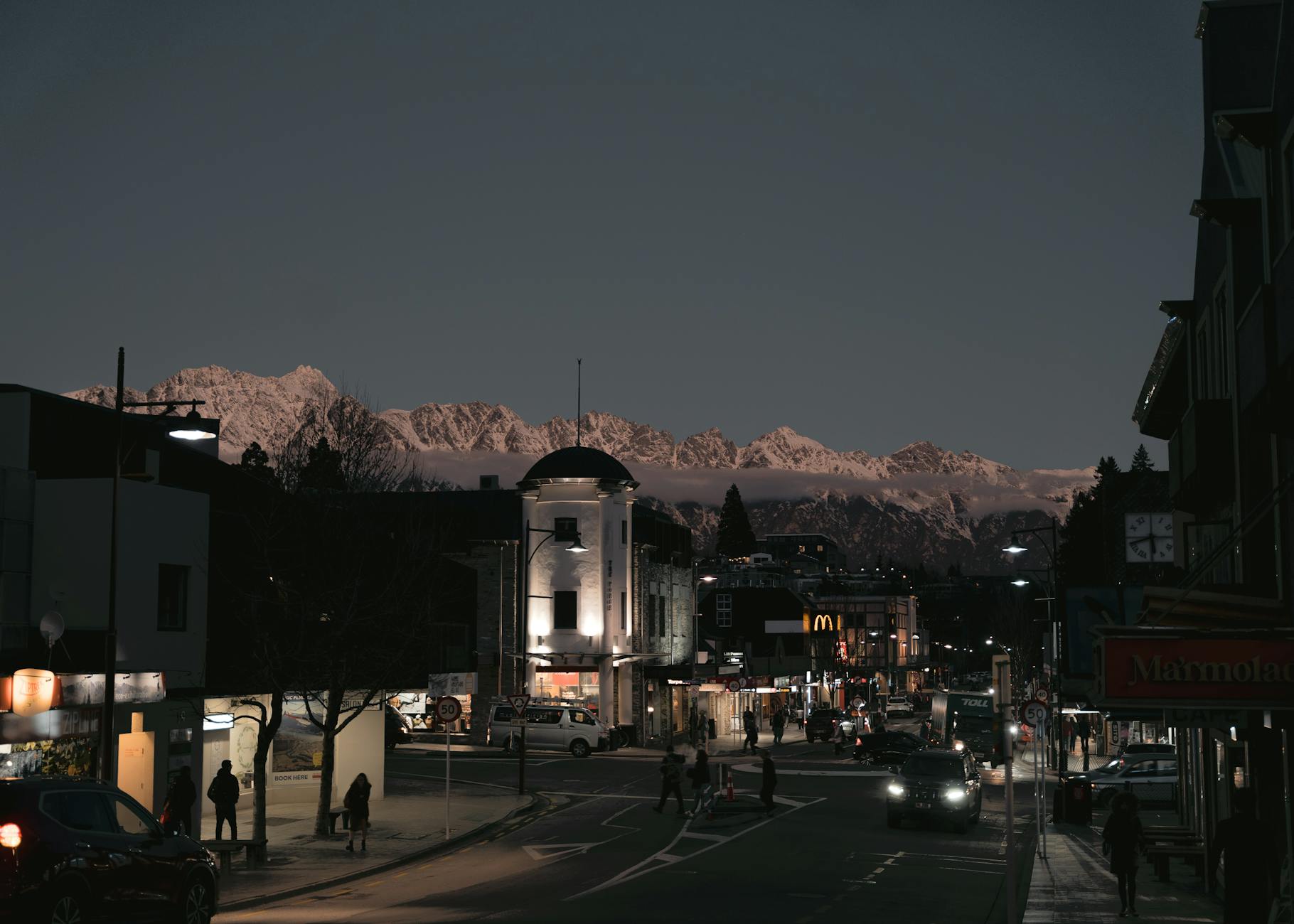
Queenstown lives by the water, and Lake Whakatipu gives the town its whole emotional pitch: long blue light, sudden wind, The Remarkables rising behind the roofs like a stage set that forgot to be subtle. Ride the gondola to Bob's Peak, walk Queenstown Hill, or just stand by the wharf at dusk and watch the mountains turn from steel to ash.

Gold-Rush Fragments

The place sells adrenaline, but its older story still shows through in useful, stubborn pieces: the 1912 TSS Earnslaw, Eichardt's lakefront history, Arrowtown's 1860s main street, and the Kawarau Suspension Bridge where transport history and bungy mythology now share the same river gorge. Queenstown's architecture isn't grand. It survives in precincts, reused buildings, stone ruins, and the odd structure that kept working long enough to become heritage.

A Real Arts Pulse

For a town this size, Queenstown has more cultural muscle than first glance suggests. Te Atamira in Frankton has become the clearest sign of that shift, with gallery, performance rooms, studios, and a year-round program, while Arrowtown's museum and galleries give the district its historical and visual depth.

Beyond the Adrenaline Brand

The better secret is how quickly Queenstown turns quiet once you leave the waterfront script. Bob's Cove, Mt Crichton, Sunshine Bay, Wilson Bay, and Moke Lake all sit close enough for a half-day detour, and each swaps helicopter noise for birdsong, wet schist, and the sound of water moving through old mining ground.

Historical Timeline

Queenstown: Gold, Steam, Snow, and a Lake Older Than Memory

From Mฤori seasonal camps on Tฤhuna to a global resort balanced between heritage and speed

public
c. 15,000 BCE

Ice Carves the Basin

Long before anyone named this place, glaciers cut the trench that became Lake Whakatipu and the Wakatipu Basin. The shape of modern Queenstown begins here: steep walls, cold blue water, and a shoreline that still feels too dramatic to be accidental.

public
c. 1200

Seasonal Camps at Tฤhuna

Most scholars place Mฤori use of the basin centuries before Europeans, with Tฤhuna, Te Kirikiri, and Puahuru serving as seasonal camps rather than a dense permanent town. People came inland for eels, birds, mountain plants, and routes toward pounamu country. Smoke from cooking fires would have lifted into air far cleaner than the lakefront traffic haze of summer.

person
1853

Reko Leads the First Crossing

Chief Reko guided Nathanael Chalmers through the interior in September 1853, making him the Mฤori figure most closely tied to the first documented European sighting of Lake Whakatipu. That detail matters. Queenstown's colonial story did not begin with heroic isolation; it began with Indigenous knowledge showing outsiders where to look.

factory
1860

Pastoralists Reach the Bay

William Gilbert Rees and Nicholas von Tunzelmann pushed into the Wakatipu Basin and established the first permanent European footholds here. Rees set up a sheep station on the future town site, where fleece, mud, and hard weather mattered more than scenery. The postcard came later.

person
1860

William Gilbert Rees Arrives

Rees is Queenstown's founding character, and unlike many founders he left traces you can still point to. His station and woolshed anchored European settlement at Queenstown Bay, turning open shore into private enterprise, then into town streets. He came for sheep, not romance.

factory
1862

Gold Sparks the Boom

On 15 November 1862, Thomas Arthur and Harry Redfern discovered gold on the Shotover River while working from Rees's station. That strike changed everything in a season. Tents, supply stores, drays, arguments, and speculation crowded in so fast that a sheep run became a boomtown before anyone had time to pretend otherwise.

gavel
1863

Queenstown Gets Its Name

The settlement adopted the name Queenstown on 5 January 1863, probably after Queenstown in Ireland, though the local tale about a place fit for Queen Victoria refuses to die. Either way, the name arrived while canvas still flapped in the wind and mud still ruled the streets. The polish was verbal before it was architectural.

church
1863

Wharf and Churches Rise

A private timber wharf went up at the waterfront in 1863, ancestor of today's Steamer Wharf, and the first Anglican and Catholic churches followed in the same raw boom period. That combination tells you how early Queenstown worked: transport first, salvation close behind. Timber, coal smoke, wet wool, and river money were the town's opening scent.

local_fire_department
1863

Floods Tear Through the Diggings

On 26 July 1863, catastrophic floods and slips hit the Arrow and Shotover diggings, killing about 25 miners. Goldfields always sold the dream and hid the arithmetic. One night of water and moving earth could erase a season's luck, a camp, and a man with equal efficiency.

gavel
1866

Borough Government Begins

Queenstown Borough Council was constituted in 1866, giving the gold-rush settlement a formal civic frame. James William Robertson became the first mayor that July. A place built in haste had decided it intended to last.

person
1867

Bendix Hallenstein Builds Here

Merchant Bendix Hallenstein opened Otago's first inland flour mill at Kawarau Falls in 1867 and later served as mayor from 1869 to 1872. He gave Queenstown something steadier than prospecting fever: milling, public works, and a sense that trade could outlive the rush. Flour lacks the glamour of gold. It feeds a town better.

castle
1880

Kawarau Bridge Spans the Gorge

The Kawarau Gorge Suspension Bridge opened in 1880, replacing a difficult river crossing on the route toward Cromwell. Engineering New Zealand treats it as a heritage landmark for good reason: it turned a dangerous choke point into a hanging ribbon of timber and iron above hard green water. A century later, people would jump from it for fun.

church
1898

St Joseph's Takes Shape

The present St Joseph's Catholic Church rose in 1898 from local schist and rimu, giving Queenstown one of its clearest late-19th-century silhouettes. The materials matter. Schist ties the church to the region's broken mountainsides, while the timber softens the interior against the cold bite of inland winters.

public
1912

TSS Earnslaw Enters Service

TSS Earnslaw was launched on 24 February 1912 and began service on 18 August that year. Coal-fired, iron-hulled, and stubbornly alive, it became the lake's working backbone long before it turned into a heritage icon. When you hear its engines now, you are hearing transport history, not decoration.

swords
1922

War Dead Are Named

Queenstown's war memorial was unveiled on 25 April 1922, listing 35 district dead from the First World War and, unusually, naming those who returned as well. That choice gives the monument more moral texture than the usual stone roll call. It remembers grief, but it also remembers survival.

flight
1935

The Airport Gets Licensed

Queenstown Airport received its operating licence on 14 August 1935 at Frankton. Remote towns become different creatures once aircraft can reach them. Distance stops being fate and starts becoming a timetable.

swords
1940

War Grounds Civil Flying

By early 1940, the Second World War had halted civilian flying at Queenstown. The interruption matters because it shows how fragile the town's modern connections still were. One global conflict, and the runway went quiet.

public
1947

Coronet Peak Opens

Coronet Peak opened in 1947 with a single rope tow, widely described as New Zealand's first commercial skifield. This is the hinge on which modern Queenstown turns. Gold had built the town fast; snow taught it how to sell winter.

castle
1967

Skyline Claims Bob's Peak

Skyline Queenstown opened in 1967, lifting visitors above town to Bob's Peak by gondola. Few projects announce a new era more clearly. Queenstown had started packaging its own view, turning altitude into infrastructure.

person
1988

AJ Hackett Jumps First

In November 1988, AJ Hackett and Henry van Asch opened the world's first commercial bungy operation at Kawarau Bridge. Hackett's link to Queenstown isn't a footnote; it remade the town's global reputation. After that, Queenstown was no longer just a ski and lake town. It was where people came to test their nerve in public.

flight
1995

International Flights Begin

Air New Zealand's service from Sydney landed on 1 July 1995 as Queenstown Airport's first international flight. A route map changed the town almost as much as any bridge or mine. Australia was now one direct flight away, and Queenstown's visitor economy stepped onto a larger stage.

local_fire_department
1999

The Lake Invades Town

In November 1999, Lake Wakatipu reached about 312.77 to 312.78 metres above sea level, beating the old 1878 benchmark and flooding parts of central Queenstown for days and, in some spots, weeks. Roughly 5 hectares of town went under. The pretty waterfront suddenly looked like what it has always been: a bargain struck with water.

gavel
2022

Te Pฤ Tฤhuna Returns Mana

The first stage of Te Pฤ Tฤhuna was completed in 2022, bringing a major Ngฤi Tahu Property housing development close to central Queenstown. The project answers a housing crisis, but it says more than that. Kฤi Tahu presence in Tฤhuna is being expressed in built form again, on valuable urban ground rather than in heritage wording alone.

science
2025

Runway Safety Gets a New Edge

In March 2025, Queenstown Airport completed an engineered materials arresting system, the first installation of its kind in Australasia. That sounds technical because it is technical: crushable material at the runway end designed to stop an overrunning aircraft. Modern Queenstown still lives with its old constraint, a narrow basin where every metre of flat ground has to earn its keep.
schedule
Present Day

Notable Figures

William Gilbert Rees

1827โ€“1898 ยท Founder and pastoralist
Founded the settlement here in 1860

Rees came to this basin in 1860 and set up a high-country farm on the ground that became central Queenstown. Before the bars, before the gondola, before anyone marketed the view, he saw pasture, water, and a place worth staking a life on. He'd probably be startled by the helicopter traffic and quietly pleased that the lake still runs the show.

Sir Sam Neill

born 1947 ยท Actor
Has a home here

Neill's Queenstown connection isn't a publicity stunt; he has a home here and deep ties to Central Otago through wine as well as film. You can imagine him approving of the place when it drops the adrenaline poster and leans into pinot, weather, and long views instead.

Tim Bevan

born 1957 ยท Film producer
Born here

Working Title producer Tim Bevan was born in Queenstown on 20 December 1957, back when the town was far smaller and far less polished. His career helped shape a generation of English-language cinema; Queenstown, for its part, now looks like the sort of dramatic setting a producer would reject for seeming overdesigned.

Jaime Passier-Armstrong

born 1981 ยท Actor
Born here

Jaime Passier-Armstrong was born in Queenstown in 1981, carrying a link between this resort town and New Zealand screen culture. Her connection matters because Queenstown often gets framed as scenery first, community second. People born here keep ruining that lazy theory.

Teneale Hatton

born 1990 ยท Olympic canoe sprinter
Born here

Hatton was born in Queenstown in 1990 and went on to become an Olympian and world champion in canoe sprint. That feels right for a town built around water and motion, though her discipline asks for a different kind of nerve than the bungy crowd down the road.

Adam Barwood

born 1992 ยท Olympic alpine skier
Born here

Barwood was born in Queenstown in 1992 and learned his craft locally at Coronet Peak before reaching two Winter Olympics. His story fits the town better than any slogan does: a place where the ski field is close enough to shape real athletes, not just holiday memories.

Plan your visit

Practical guides for Queenstown โ€” pick the format that matches your trip.

Practical Information

flight

Getting There

Queenstown Airport (ZQN) in Frankton is the main gateway, with direct 2026 domestic flights from Auckland (AKL), Wellington (WLG), and Christchurch (CHC), plus Australian links from Sydney (SYD), Melbourne (MEL), Brisbane (BNE), and the Gold Coast (OOL). Queenstown has no passenger rail and no main train station, so arrivals are by air or road. The town sits on State Highway 6, with State Highway 6A serving Frankton and the airport; most self-drivers arrive via Cromwell on SH6, Glenorchy Road from the west, or the Crown Range route toward Wฤnaka.

directions_transit

Getting Around

Queenstown has no metro, tram, or passenger rail in 2026; local transport runs on the Orbus network, with six bus routes and one scheduled ferry connection centered on Stanley Street downtown and the Frankton Bus Interchange. The Bee Card is the smart buy: NZ$5 for the card, then adult bus fares drop to NZ$2 instead of NZ$10 cash, with free bus-to-bus transfers within 45 minutes; the ferry is separate at NZ$10 with Bee Card or NZ$14 by bank card. Walking works well in the center, and the 150 km Queenstown Trail network plus the completed Arthurs Point to Queenstown shared path make cycling a serious option, not just a holiday extra.

thermostat

Climate & Best Time

Queenstown's 2026 visitor guidance breaks the year into clear bands: summer runs about 20-30C, autumn 5-25C, winter -4 to 8C, and spring 8-22C. NIWA and MetService describe an inland climate with relatively low rainfall, roughly 900 mm a year, plenty of sunshine, and dry spells that can stretch through summer; weather still turns fast once you head uphill. December to February is peak for lake days and long evenings, July to August for ski traffic, and the sweet spots are March to April for autumn color or late September to November for lighter crowds and mixed hiking-bike-snow conditions.

translate

Language & Currency

English is the everyday language, though you'll hear and see te reo Maori in greetings and place names; 'kia ora' never sounds out of place. New Zealand's currency is the New Zealand dollar (NZD), card payment is standard, and displayed prices already include 15 percent GST. Tipping isn't expected, and if you pay cash the total is rounded to the nearest 10 cents because 1c, 2c, and 5c coins are gone.

shield

Safety

Queenstown's main risks are topographic, not urban: steep hikes, sudden weather, winter roads, and visitors who mistake a scenic drive for an easy one. Ben Lomond is the classic example, with 1,438 meters of ascent from town, rapid exposure changes, and no water beyond the Skyline complex; the Glenorchy road and Crown Range need extra care in winter. For 2026, one date-specific caution matters: Skippers Bridge has been closed to all users since January 12, 2026, despite older tourism material still mentioning the area.

Tips for Visitors

directions_bus
Get Bee Card

If you'll use buses more than once, get a Bee Card. Adult fares drop from NZ$10 cash to NZ$2, and one bus-to-bus transfer within 45 minutes counts as a single fare if you tag on and off both rides.

hiking
Respect Ben Lomond

Ben Lomond is a full-day climb with 1,438 m of elevation gain from town, and DOC warns weather can turn fast even in summer. Carry layers, food, and enough water; beyond the Skyline complex, you won't find any.

schedule
Use Early Hours

Queenstown's center gets crowded by late morning, especially around the waterfront and Shotover Street. Walk Queenstown Gardens, ride the gondola, or photograph the lake early, then leave the center for Arrowtown, Gibbston, or Frankton.

bakery_dining
Dodge Burger Lines

If the Fergburger queue is snaking down the block, step next door to Fergbaker instead of losing half your lunch hour. The venison and portobello pie has a loyal local following for a reason.

local_taxi
Airport by Bus

The cheapest airport transfer is the Orbus public bus, with service running from about 6 a.m. to midnight. Buses usually come every 15 minutes during the day, then roughly every 30 minutes in the evening.

wine_bar
Tip Lightly

Tipping isn't expected in New Zealand. Leave something for great service if you want, but nobody is waiting for 20 percent.

warning
Mind Open Alcohol

Parts of Queenstown, Frankton, and Arrowtown have year-round alcohol-free public areas from 6 p.m. to 6 a.m. Save the lakefront beers for licensed venues unless you want an expensive lesson.

Explore the city with a personal guide in your pocket

Your Personal Curator, in Your Pocket.

Audio guides for 1,100+ cities across 96 countries. History, stories, and local insight โ€” offline ready.

smartphone

Audiala App

Available on iOS & Android

download Download Now

Join 50k+ Curators

Frequently Asked

Is Queenstown worth visiting? add

Yes, if you like dramatic scenery with real range. Queenstown gives you a lakefront town, serious hikes, ski access, wineries, heritage side trips, and a compact center you can cross on foot. The catch is crowds and prices in peak periods, so it rewards people who get out to Frankton, Arrowtown, Gibbston, and Glenorchy.

How many days in Queenstown? add

Three to five days works well for most travelers. That gives you time for the lakefront and Skyline, one big nature day such as Ben Lomond or Glenorchy, and one slower day for Arrowtown or Gibbston. Stay longer if skiing or bike trails are the point of the trip.

Do you need a car in Queenstown? add

No, not for the basics. Central Queenstown is walkable, the Orbus network links the airport, Frankton, Arrowtown, Jacks Point, Kelvin Heights, and Lake Hayes Estate, and ferries, shuttles, taxis, and rideshare fill gaps. A car helps for flexible day trips and winter mountain driving, but it isn't mandatory.

How do you get from Queenstown Airport to town? add

The cheapest option is the Orbus public bus from Queenstown Airport in Frankton. Airport information says buses run about every 15 minutes during the day and usually every 30 minutes in the evening, with service from around 6 a.m. to midnight. Taxis, rideshare, shuttles, rental cars, and campervans are the other official options.

Is Queenstown expensive? add

Yes, Queenstown is one of New Zealand's pricier destinations, especially for central accommodation, cocktails, and peak-season dining. You can cut costs by using buses with a Bee Card, eating in Frankton or at bakeries and takeaway spots, and choosing free scenery such as Queenstown Gardens, Sunshine Bay, and lakefront walks.

Is Queenstown safe for tourists? add

Generally yes, and the bigger risks are weather, roads, and outdoor conditions rather than any no-go neighborhood. DOC and local tourism guidance repeatedly warn about fast-changing mountain weather, no water on upper hikes, avalanche season from roughly May to November in the wider area, and careful winter driving on roads like the Crown Range.

Can you get around Queenstown without a train? add

Yes, because Queenstown doesn't have passenger rail in the first place. People arrive by air or road, then get around by bus, ferry, shuttle, taxi, rideshare, walking, and cycling. For visitors, that matters less than you'd think because the center is compact and the bus network does a decent amount of the heavy lifting.

What is the best time to visit Queenstown? add

March and April are the sweet spot for many travelers. Autumn brings cooler air, sharp light, and strong color in Arrowtown, with fewer peak-summer crowds. Winter is better if skiing is the goal, while December to February suits lake days and long evenings.

Is Queenstown good for families? add

Yes, especially if you mix the big views with easier outings. Queenstown Gardens, Kiwi Park, the TSS Earnslaw, Walter Peak, and short lake walks work well for families, and you don't need to commit to a hard hike to get a payoff. Just keep mountain weather and road conditions in mind if you go farther out.

Sources

  • verified Destination Queenstown โ€” Used for current visitor information on attractions, seasons, nightlife, biking, walking, and practical transport guidance.
  • verified Queenstown Airport โ€” Used for airport access, bus frequency, transfer options, and cycling facilities.
  • verified Otago Regional Council Orbus โ€” Used for current Queenstown bus routes, fares, Bee Card rules, ferry pricing, and transfer details.
  • verified Department of Conservation New Zealand โ€” Used for Ben Lomond safety advice, elevation gain, weather warnings, and outdoor risk guidance.
  • verified Queenstown Lakes District Council โ€” Used for public alcohol restrictions and active travel infrastructure details.

Last reviewed:

All Places to Visit

1 place to discover

photo_camera

Queenstown Money-Saving Passes & Cards