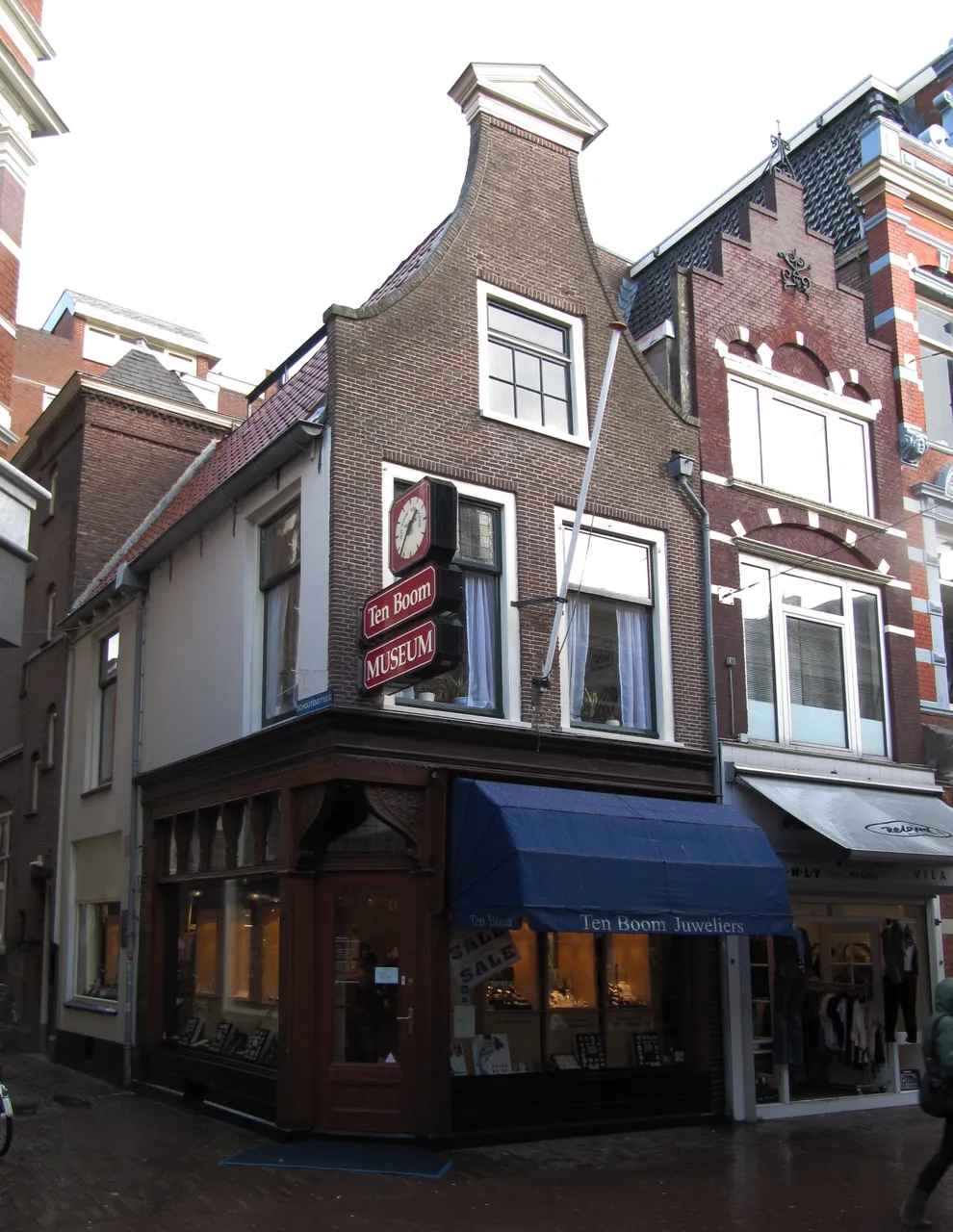
An introduction.
Researched by the Audiala editorial team from historical records, architectural archives, and local expertise.
SSix people once spent 47 hours sealed inside a brick cavity no deeper than a wardrobe, sharing one bucket and a tin of crackers, while German security police pulled the rooms below them apart. They were never found. That cavity is still upstairs at the Corrie ten Boom House on Barteljorisstraat in Haarlem, Netherlands, tucked behind a false wall in a watchmaker's home where three generations of one family sold clocks from 1837 onward. Come for the hiding place. Stay because this house shows, room by narrow room, what it cost an ordinary elderly shopkeeper to keep saying yes.
Most visitors arrive expecting a Dutch Christian echo of the Anne Frank House. That comparison falls apart within about ten minutes of walking in. The Frank family's annex was a sealed refuge behind a bookcase; the ten Boom house was an open shop on a busy street, with customers coming and going, forged ration cards moving through the kitchen, couriers arriving at odd hours, and unannounced alarm drills that gave whoever was hiding roughly seventy seconds to vanish and erase the evidence — bedding stripped, cups cleared, mattresses flipped so the warmth wouldn't show.
The family called the place "de Beje," a contraction of the street name, and the house earned its nickname the way houses do: by being lived in hard. Four levels, none of them agreeing with each other. Stairs that twist so tightly you'll want a free hand. That structural awkwardness is not a quirk to be endured on the way to the good part — it's the reason the hiding place worked at all.
The museum has run out of the family's rooms since 15 April 1988, opened deliberately on what would have been Corrie's ninety-sixth birthday. Entry is through Schoutensteeg, the alley beside the shop, and tours are guided and free, with a donation box and no pressure. The Grote Markt and St. Bavo, where the family worshipped, sit one block away. That proximity matters more than any exhibit label: this was not a farmhouse on some far edge of the country. It was resistance conducted in the middle of town, within sight of the authorities.
How Christians Saved Jews During The Holocaust | The Story Of Corrie Ten Boom
Hananya Naftali01 What to see.
The False Wall in Corrie's Bedroom
The Watch Shop and the Triangle in the Window
The Alley, the Plaque, and the Stairs
02 In pictures.


Watch & Explore Corrie Ten Boom House.
Plan and listen to Corrie ten Boom House with Audiala.
Audio guide in your pocket, itinerary in your browser. Built for the way you actually visit.
03 Visitor logistics.
The practical scaffolding for a good visit — kept short.
Getting There
From Haarlem Centraal it's a 12-15 minute walk straight south: Kruisweg, then Kruisstraat, then Barteljorisstraat — all pedestrianised shopping street, no turns to remember. Amsterdam Centraal is only 15-20 minutes away by direct train, so this works as a half-day trip. The door is not the shopfront at number 19: you enter through Schoutensteeg, the alley alongside. Coming from Grote Markt and St Bavo, it's a two-minute walk. Buses stop at Centrum/Verwulft (lines 2, 3, 73, 300 and others), 4-5 minutes away; drivers should use Parkeergarage De Appelaar or Raaks, and cyclists get free guarded parking at Smedestraat 43.
Opening Hours
As of 2026 the house opens Tuesday to Saturday only, closed Sunday and Monday — Mondays are reserved for Dutch school groups. English tours run at 10:00, 12:00 and 14:00; Dutch tours at 11:00, 13:00 and 15:00, with German offered regularly and French occasionally. One language per tour, no translation, so book the one you actually speak. The booking calendar is the real authority on holiday closures; assume Koningsdag on 27 April, Christmas and New Year are blocked and check before you commit to a date.
Time Needed
Budget 80 minutes minimum: arrive 10 minutes early as instructed, then 60-70 minutes of tour, though volunteer guides regularly run to 90. Add 20-30 more if you want the shop and a few minutes at the display panels. There's no browse-at-your-own-pace mode — the guide moves the group room to room, and the tour is the only way in. Recommended from about age 10 up; the stairs are dangerous for small children and the subject matter is unsparing.
Cost & Booking
Admission is free, every day, with no ticket price and no paid queue-jump — the museum runs on the donation box at the exit and the shop in the old watch premises. Give something; the guides are volunteers. Booking is mandatory, online, on corrietenboom.com only, and tours cap at 12 people. Open the calendar 4-6 months before you travel. There is no waiting list and the museum will not add English tours when they sell out.
Accessibility
The house is not wheelchair accessible and has no lift — two 17th-century houses knocked together give four levels linked by steep, twisting Dutch stairs, the tightest flight being the last one up to the hiding place. The museum states guide dogs can't practically be accommodated. Anyone with knee, hip or balance trouble, vertigo or claustrophobia should think hard: the hiding place is a dark crawl space roughly 30cm deep, narrower than a kitchen counter, and visitors step into it. The official free virtual tour is the substitute, not a partial step-free visit.
04 Tips for visitors.
Small things that change the day.
Book Months Ahead
The museum's own advice is four to five months in advance, and Lonely Planet's suggestion of five days is simply wrong. English slots go first because of Amsterdam day-trippers; if the calendar shows nothing, that's a genuine no, and people still stand hopefully in Schoutensteeg waiting for no-shows.
There Is No Toilet
The house has none, and you can't slip out mid-tour — that's 70 to 90 minutes across four floors with no exit. Free toilets at the guarded bike station on Smedestraat 43, two minutes away, or paid ones on Grote Markt.
Phone Stays Pocketed
Photography, video and audio recording are banned throughout the tour, with one reported exception in the hiding place itself. That exception comes from a single source, so ask your guide rather than raising the camera and finding out.
Dump Your Bag First
No cloakroom, no lockers, and twelve people on a 1600s staircase leaves no room for a suitcase. Self-service lockers sit at the far end of platform 4 at Haarlem Centraal — easy to walk past — or use Radical Storage near the station at around €5 a day.
Shoes That Grip
No dress code — this is a memorial rather than a place of worship — but the stairs are near-vertical and twist. Heels and flip-flops are a genuinely bad idea. Neat casual, quiet voices, and follow the guide; the tone inside is reflective, not chatty.
Coffee After, Not Before
The pre-tour wait is standing in an alley in whatever weather, so the Grote Markt terraces are your de facto waiting room — Grand Café Brinkmann faces St Bavo, mid-range. Afterwards head to Native on Breestraat or La Maru on Koningstraat for serious coffee and sourdough, both budget to mid-range, or Jopenkerk on Gedempte Voldersgracht for Haarlem beer in a converted church.
Walk To St Bavo
Casper ten Boom worshipped at the Grote Kerk on Grote Markt, one block from his front door, and it's the obvious next stop while the story is still sitting in your chest. Frans Hals and Teylers museums are both a short walk further if you want a full day.
Watch For Cyclists
Barteljorisstraat is a pedestrian shopping lane, and Haarlem runs a recurring campaign — 'Winkels open, fietsers lopen' — precisely because riders keep cutting through anyway. Step out of the alley looking both ways rather than straight into the street.
05 The Watchmaker Who Wouldn't Bargain
Willem ten Boom opened a clock and watch shop at this address in 1837, and the family stayed for more than a century. Museum records also place something stranger here in 1844: a prayer group Willem started in these rooms devoted to the Jewish people. That detail rests on the museum's own timeline alone, so treat it lightly — but if it holds, the house carried a pro-Jewish devotional habit for nearly a hundred years before it mattered most.
The building itself resists a tidy story. The museum dates it to around 1600, built for Haarlem's schout, the bailiff who gave the side alley its name. The national monument listing instead emphasizes an 18th-century clock gable on the front. Both can be true of an old Dutch shop-house rebuilt in layers, but no clean building history exists in the public record. What is documented beyond argument is what happened inside it across eleven months of 1943 and 1944.
Casper ten Boom, 84, and the Offer He Turned Down
Casper ten Boom was born on 18 May 1859 and had been repairing watches on this street since taking over from his father around 1891. Haarlem called him the grand old man of the city. By 1943 he was eighty-four, visible, respected, and one of the most easily arrested people in the province — a man who could have chosen caution with everyone's blessing. He chose the opposite. According to tradition preserved in Dutch memorial records, when Haarlem's Jews were ordered to collect yellow stars, Casper wanted one for himself, to wear.
On 28 February 1944 a man walked into the shop asking for Corrie and for money to help a Jewish woman in trouble. It was a trap. The Sicherheitsdienst raided within the hour, the warning system fired, six people ran for the wall in Corrie's bedroom, and more than thirty were arrested in the house that day — including customers and couriers who kept arriving, not knowing.
The turning point came afterward, at the police station. Officials reportedly offered to send the old man home on account of his age, if he would stop. His answer, repeated in every account since, was that he would open his door to anyone in need. He died in custody at Scheveningen on 9 March 1944, ten days after his arrest. Betsie died at Ravensbrück that December. Corrie was released at the end of December 1944 through what later accounts describe as a clerical error, and spent the next thirty-nine years telling people what her father had said.
Bricks in a Briefcase
The BeJe Group
Listen to the full story in the app
The whole Corrie ten Boom House,
told well.
Audio guides for 1,100+ cities across 96 countries. History, stories, and local insight — offline ready.
06 Frequently asked.
The questions travellers send us most about Corrie ten Boom House.
Is the Corrie ten Boom House worth visiting?
Yes, and it's free — but only if you can get a reservation, because there's no other way in. The hour with a volunteer guide in the family's own living room, ending in a brick-walled slot 70 cm wide where six people hid for 47 hours, lands harder than most war museums three times the size. Reviewers who came expecting a quick stop routinely leave shaken.
How long do you need at the Corrie ten Boom House?
Budget 80 to 120 minutes total. The tour itself runs 60 to 90 minutes, you must arrive 10 minutes early and wait outside in Schoutensteeg alley, and the shop plus donation box takes a few more. There's no browse-at-your-own-pace mode — the guide moves the group room to room.
Do you need to book the Corrie ten Boom House in advance?
Yes, and far earlier than you'd think — the museum itself advises 3 to 6 months ahead. Groups cap at 12 people, English tours run at 10:00, 12:00 and 14:00 Tuesday to Saturday, and Dutch tours at 11:00, 13:00 and 15:00. There's no waiting list and no extra tours get added, so if the calendar shows nothing in English, the answer is genuinely no.
Can you visit the Corrie ten Boom House for free?
Admission is free, every day it's open, with no ticket and no city-pass needed. The museum runs on the donation box at the exit and the shop in the old watch premises — give something, because volunteer guides and a 400-year-old house aren't cheap to keep. Beware third-party listings selling "Ten Boom Museum" tours; those are Haarlem walking tours that pass the door without going in.
How do I get to the Corrie ten Boom House from Amsterdam?
Take a direct train from Amsterdam Centraal to Haarlem, roughly 15 to 20 minutes, then walk under 15 minutes down Kruisweg into Kruisstraat and Barteljorisstraat. The door isn't the shopfront at number 19 — turn into the narrow Schoutensteeg alley beside it. Driving is the worst option; if you must, use Parkeergarage De Appelaar and walk 10 minutes.
What should I not miss at the Corrie ten Boom House?
The false wall in Corrie's bedroom, and specifically what it's made of. Resistance builders carried real bricks in one by one, hidden in briefcases and under folded newspapers, posing as customers collecting watches — so that when the Sicherheitsdienst rapped their knuckles on it during the 28 February 1944 raid, it rang solid instead of hollow. Also read the plaque outside before you go in: the names on it are Casper, Betsie, Willem and Christiaan, the four who died, not Corrie, who survived.
Is the Corrie ten Boom House wheelchair accessible?
No. Two old houses were knocked together into four mismatched levels linked by steep, twisting Dutch stairs, there's no lift, and the museum states guide dogs can't practically be accommodated either. It also has no toilets — go at Haarlem Centraal or the guarded bike station on Smedestraat before you arrive. The free official virtual tour is the accessible substitute.
Can you take photos inside the Corrie ten Boom House?
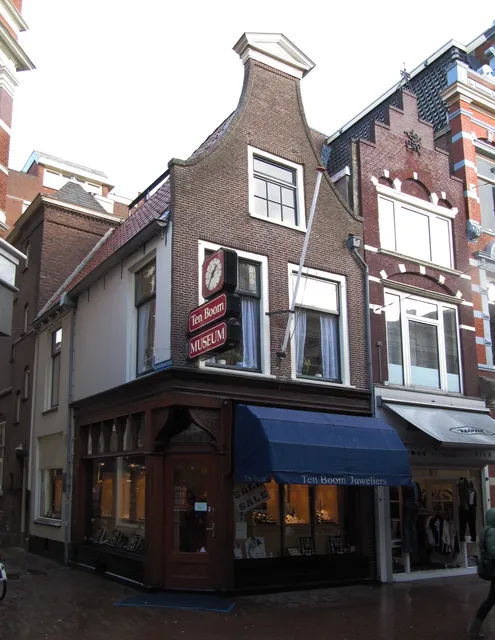
Only in the hiding place — photography, video and audio recording are prohibited everywhere else during the tour. The best exterior shot is from across Barteljorisstraat with the neck gable and shopfront in one frame, and Schoutensteeg looking back toward the shopping street is the more atmospheric one. Ask your guide if you're unsure; policies shift and the fabric is original.
Verified, and shown.
Researched and written by the Audiala editorial team from historical records, architectural archives, and local expertise.
Official booking rules: guided tours only, max 12 per group, tour times by language, arrive 10 minutes early, no wheelchair access, no toilets, minimum age 10, photography allowed only in the hiding place.
Opening days Tuesday–Saturday, free admission, tour languages, museum shop in the former watch shop, and the multi-level layout of the house.
House origins around 1600 for Haarlem's schout, the 1837 watch shop, the BeJe network estimate of roughly 800 people helped, and the six who survived behind the wall.
Walking route from Haarlem Centraal via Kruisweg and Kruisstraat, parking at De Appelaar, free guarded bike parking on Smedestraat, and the nearest public toilets.
Family chronology: Willem's 1837 shop, the 1943 building of the hiding place, the 28 February 1944 raid, the 47 hours, and the museum opening on 15 April 1988.
Independent confirmation of the 1943 decision to hide people full-time, the resistance architect known as 'Mr. Smit', the alert buzzer, and the house's role as a node in a wider network.
National war-monument record: dimensions of the hiding place (about 2.5 m by 70 cm), the memorial plaque text and its 15 April 1988 unveiling, and the family members commemorated.
The 17th-century neck-gable building, the Alpina triangle signal in the shop window, the bricks smuggled in a few at a time, and the 1983 purchase and restoration.
Visitor reports on actual tour length running to 90 minutes, booking six months ahead, the guided pace, donations, and the tone of the faith-inflected narration.
Museum email confirming no self-guided visits, no waiting list, no extra English tours added, and the 4–5 month booking recommendation.
Researched from Wikidata, Wikipedia & official sources · fact-checked · How we make our guides →