temple_buddhist
Sacred Valley Cities
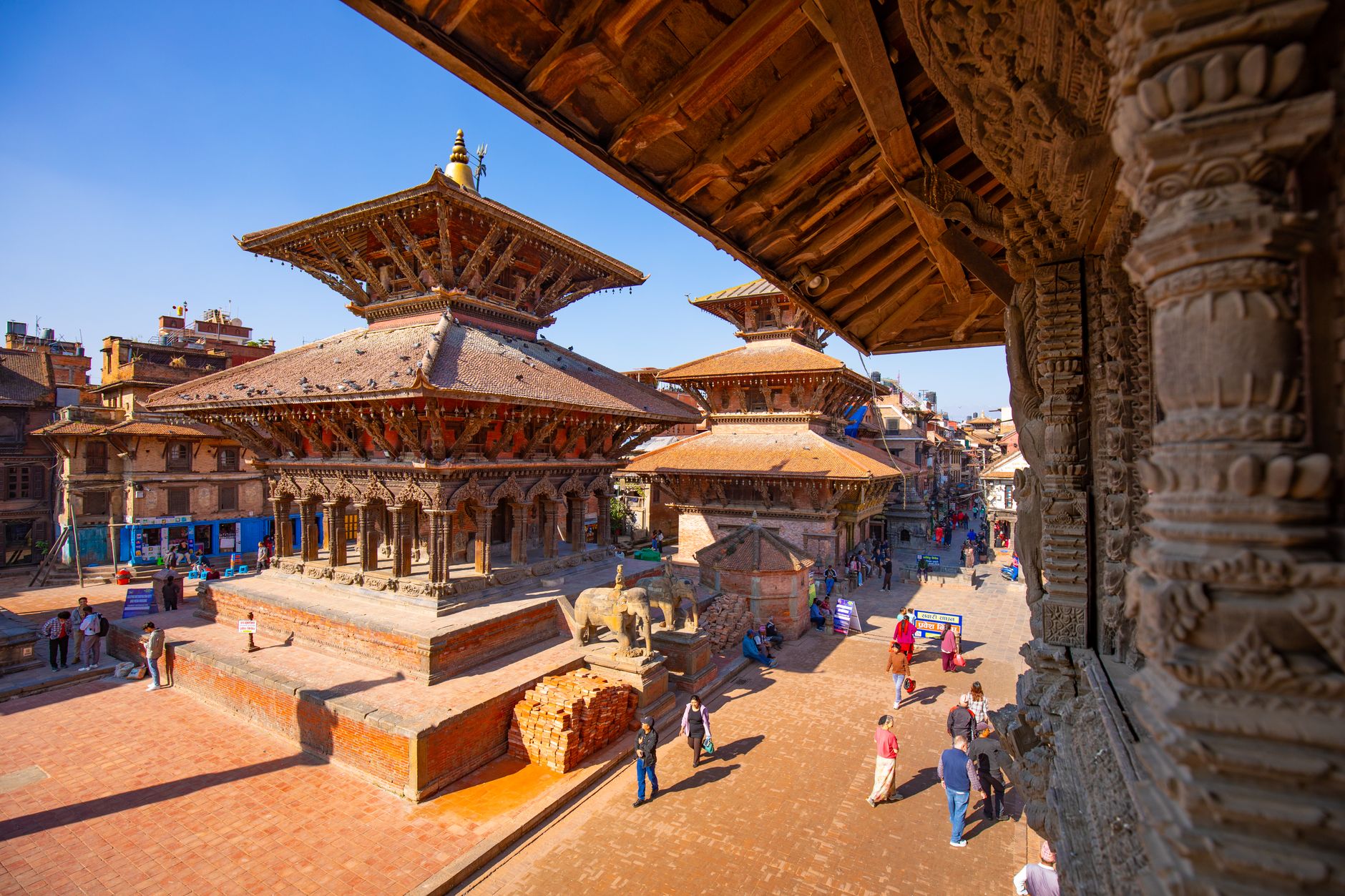
Kathmandu, Bhaktapur, and Patan hold palace squares, stupas, and courtyards shaped by rivalry, devotion, and 500 years of Newar craftsmanship.
Nepal is not one trip but three stacked on top of each other: temple cities in the hills, jungle plains in the south, and the highest mountains on earth rising behind them.
 Nepal
Nepal
EntryVisa on arrival for many travelers
NNepal travel guide: a country where eight of the world's ten highest peaks rise above temple squares, jungle grasslands, and cities built from carved brick.
Nepal compresses absurd distances into a single itinerary. In Kathmandu, prayer wheels spin beneath aircraft descending toward Tribhuvan International Airport, while 14 kilometers east in Bhaktapur, brick lanes and timber windows still hold the drama of the Malla courts. Patan turns metalwork into a civic art form, and the valley's sacred geography keeps folding Hindu shrines and Buddhist stupas into the same map. That's the first surprise here: Nepal is not only about altitude. It is also about density, ritual, and cities that reward slow attention.
Then the country opens outward. Pokhara sits beside Phewa Tal with the Annapurna range hanging beyond it when the post-monsoon air clears, while Chitwan drops you into sal forest, one-horned rhinos, and elephant grass taller than a jeep. North of the rain line, Mustang trades jungle humidity for wind-cut desert and monasteries the color of dried blood. East in Ilam, tea gardens climb the hills in clipped green bands. South in Lumbini and Janakpur, pilgrimage shapes the rhythm of entire towns.
Valley of Origins, prehistory-879
Morning mist still hangs over the Kathmandu Valley as if the water never fully left. Geologists say a lake once filled this basin; Newar memory gives the miracle a sharper image, with Manjushri cutting the southern ridge and the waters rushing out, leaving black soil fit for temples, rice, and ambition. That double inheritance matters in Kathmandu: sediment below, legend above.
Ce que l'on ignore souvent, c'est que Nepal enters history not with a palace but with a stone inscription. At Changu Narayan, above Bhaktapur, King Manadeva I left 5th-century Sanskrit carved into a pillar so precise and so proud that it reads like a ruler arguing with time itself. Records show he campaigned, dedicated shrines, and ruled with the sort of energy that founders mistake for permanence.
The Licchavi courts were not provincial. Far from it. Craftsmen from the valley worked gilt copper and wood with such finesse that their influence travelled north into Tibet and far beyond, while traders and monks moved through passes that turned this hill kingdom into a meeting point between the Gangetic plains and the high plateau.
And already the human drama is there. Kings die, successors blur, dynasties thin out, but the temples remain in use, alive with bells and butter lamps. That continuity becomes Nepal's oldest habit: power changes hands, yet the sacred geography of Kathmandu, Patan and Bhaktapur keeps pulling history back into the valley.
Manadeva I emerges not as a marble abstraction but as a young ruler who wanted his victories, piety and grief fixed in stone before rivals could rewrite them.
The Changu Narayan inscription is Nepal's oldest surviving dated document, and its language was already old-fashioned when it was carved.
The Malla Courts, 1200-1768
A bronze bell rings in Patan, a conch sounds in Bhaktapur, and somewhere in Kathmandu a king is commissioning another window simply because his brother-cousin-rival has built one finer. The Malla centuries gave the valley its carved struts, brick squares and tiered pagodas, but the engine behind so much beauty was not serenity. It was competition, almost operatic in its vanity.
After Yaksha Malla, the valley fractured into three courts: Kathmandu, Patan and Bhaktapur. A prudent division, perhaps, on parchment. In practice it produced generations of border quarrels, diplomatic marriages, wounded honor and architectural one-upmanship. Each city prayed fervently and spied on the others with equal devotion.
Pratap Malla of Kathmandu understood spectacle better than most baroque princes in Europe. He wrote poems, claimed a gift for languages, and set up his own image before Hanuman Dhoka in perpetual prayer, as if the king's body itself ought to remain on duty. Local accounts describe him slipping into rival Patan to worship at Kumbheshwar by night, seeking blessings from a city he could not politically possess.
Bhaktapur answered with mass and altitude. Under Bhupatindra Malla, Nyatapola rose over Taumadhi Square in 1702, five stories of confidence anchored by stone guardians whose hierarchy of strength reads like theology translated into engineering. The valley we admire today was shaped by devotion, yes, but also by envy sharpened into art. Then came the fatal weakness: three splendid courts, impossible to unite when a patient conqueror in Gorkha began watching the passes.
Pratap Malla was not only a king; he was a performer who turned kingship into theater and made Kathmandu his stage set.
Pratap Malla kept animals inside the palace complex and is said to have written verses after the death of a favorite elephant, whose loss he treated like a court bereavement.
The Shah Unification, 1743-1846
A bowl of yogurt, according to tradition, sat before the young Prithvi Narayan Shah when an astrologically charged omen was read into the way he ate it. Nepalese history does not lack for battles, but it also relishes such intimate scenes: a future conqueror in a room, watched by courtiers, destiny condensed into a household object. Then the campaigning began.
Prithvi Narayan Shah inherited Gorkha in 1743, a small hill kingdom with large appetites. He failed first at Kirtipur and paid dearly; relatives died, soldiers fell, prestige cracked. He learned from humiliation, tightened supply lines, cut trade routes into Kathmandu Valley, recruited information from exiles and merchants, and waited with a patience more dangerous than bravado.
The turning point came when the valley courts looked outward for help. In 1767 Captain Kinloch marched north with an East India Company relief force, and the campaign collapsed in mud, heat and miscalculation before it could save Kathmandu. Ce que l'on ignore souvent, c'est que this defeat did more than clear a road for Gorkha: it convinced Prithvi Narayan that European commercial power was a threat to be kept at arm's length. His famous warning about Nepal as a "yam between two boulders" was not a metaphor for schoolbooks. It was statecraft born from watching empires press in.
Kathmandu fell in 1768 during Indra Jatra, when the city was distracted by festival. Patan and Bhaktapur followed soon after. A kingdom was forged, but not into peace. The new Shah state had unified the valley and much of the hills, yet its expansion would soon collide with the East India Company, and the victory of unification would lead directly to the compromises of empire.
Prithvi Narayan Shah appears less as a romantic liberator than as a cold, observant strategist who knew how to turn geography, scarcity and timing into weapons.
The capture of Kathmandu during Indra Jatra gave the conquest a theatrical edge: drums, masks and festival crowds became the backdrop to the fall of a capital.
Rana Splendor, Rana Fear, 1846-1951
One night in September 1846, courtiers hurried into the Kot arsenal in Kathmandu under torchlight, summoned into confusion, suspicion and panic. Before dawn, the courtyard had become a killing ground. The Kot Massacre opened the door for Jung Bahadur Rana, and with him began a century in which kings wore the crown while the Ranas kept the keys.
Jung Bahadur understood appearances. He visited Britain and France in 1850, studied parade-ground power, returned with a taste for neoclassical facades, uniforms and protocol, and then stamped Kathmandu with palaces that looked less Himalayan than imperial-cosmopolitan. Wander past the old Rana residences and you can still feel the performance: stucco, columns, grand staircases, a ruling clan determined to look modern while governing through family monopoly and fear.
Yet this was not only a story of glitter. Peasants paid, soldiers marched, and whole districts remained poor while a narrow elite lived among Belgian mirrors and imported chandeliers. Nepal stayed formally independent while much of South Asia fell under the British Raj, but independence for the state did not mean liberty for its subjects.
The dynasty eventually created the forces that would weaken it. Education spread slowly, exiles organized from India, and the monarchy found new use in opposing the hereditary prime ministers who had once confined it. By 1951 King Tribhuvan returned from exile in triumph, and the Rana century ended almost as melodramatically as it had begun.
Jung Bahadur Rana mixed audacity, vanity and administrative talent in proportions that made him both state-builder and family autocrat.
After his European tour, Jung Bahadur filled Kathmandu with ballrooms and reception halls modeled on what he had seen abroad, as if chandeliers themselves could certify power.
From Crown to Republic, 1951-present
Kathmandu in the 1950s was a capital waking from a long confinement. Palace gates opened, political parties argued, newspapers found their voice, and the old certainty that Nepal belonged to one family began to dissolve. But the monarchy did not retreat gracefully. Kings Mahendra and then Birendra tried to preserve royal authority by recasting it, first through the partyless Panchayat system, later through compromise when the streets left no other choice.
In 1990 the Jana Andolan forced constitutional monarchy into being. It looked, for a moment, like balance. Then came the Maoist insurgency in 1996, drawing its force from neglected districts, caste injustice, land hunger and the distance between Kathmandu's rhetoric and village life. Never flatter the regime, you said. Nepalese history does not permit it. The kingdom's elegance in ceremony sat beside immense social exclusion.
Then the unthinkable, almost too brutal for fiction. On 1 June 2001, inside Narayanhiti Palace, Crown Prince Dipendra was accused of killing King Birendra, Queen Aishwarya and other royals before dying himself. The massacre stunned Nepal because it struck at the one institution many still imagined as sacred, or at least stable. A dynasty that had survived sieges, coups and revolts was undone in a dining room.
The monarchy never recovered its aura. A second mass movement in 2006 forced royal power aside; the Constituent Assembly abolished the crown in 2008. Nepal became a federal democratic republic, and the center of gravity shifted from palace ritual to constitutional argument. That argument continues through earthquake, migration, coalition politics and reinvention, while places like Lumbini, Janakpur and Chitwan remind the country that its future still speaks in many regional voices, not only from Kathmandu.
King Birendra remains, for many Nepalese, the tragic face of a monarchy that seemed humane yet proved unable to reform the system around it quickly enough.
The Narayanhiti Palace, once the guarded theater of royal life, was later opened as a museum, turning the scene of dynastic intimacy into a public archive of collapse.
In Nepal, politeness is conjugated. A verb changes its spine depending on whom it addresses: timi for intimacy, tapaaī for respect, hajur when respect rises almost to incense. Grammar becomes ethics. One wrong pronoun and you have announced not ignorance but character.
This is what struck me in Kathmandu: people do not rush to fill silence. They let it stand between two cups of milk tea like a third guest. Speech in the valley often arrives after consideration, and that delay is not hesitation. It is form.
Then comes Newari, the old pulse of Kathmandu, Bhaktapur, and Patan. You hear it in courtyards, in market quarrels, in temple squares where pigeons behave like hereditary officials. The language sounds like a city remembering itself. Nepal has 123 languages, which is another way of saying that one mountain is never one mountain, and one country is never one country.
Nepal explains itself through a steel plate. Dal bhat arrives with rice, lentils, vegetables, achar, and sometimes a piece of meat, but this inventory misses the point. The point is the hand. You mix the rice and lentils with your fingers until they reach the correct softness, then lift the food with the precision of a jeweler setting a stone. Appetite becomes technique.
Refills matter. So does the rhythm of the meal. In a trekking lodge above Pokhara, in a family kitchen near Bandipur, in the restless neighborhoods of Kathmandu, the promise is the same: you will be fed again. A country is a table set for repetition.
And then the side dishes begin their small rebellions. Gundruk smells of fermentation and winter survival. Tomato-sesame achar stings, then flatters. Sel roti at festival time tastes of rice batter, hot oil, and the fact that ritual often chooses sugar as its preferred language.
Momo receives too much foreign attention and still deserves it. The dumpling is pinched shut like a secret, steamed, dipped, bitten with caution so the broth does not escape, and discussed with absurd seriousness. Nations have gone to war for less.
Nepalese etiquette is neither cold nor demonstrative. It is exact. You remove your shoes before entering temples and many homes. You hand over money, food, and gifts with the right hand, or with the left supported by the right, because a gesture can be clean or careless and everyone notices the difference.
The greeting namaste is not decoration. Palms together, slight inclination, enough gravity to show you understand that bodies also speak. In Janakpur, where ritual saturates ordinary movement, this can feel almost architectural. The day is built from small acts of respect.
Do not point your feet at people or shrines. Do not touch someone else's plate or taste from communal dishes with the wrong end of your cutlery. Do not expect a direct refusal when a softer answer will preserve the dignity of both parties. Nepal has elevated indirection into a civic art. Bluntness is often only clumsiness wearing boots.
Nepal does not keep Hinduism and Buddhism in separate rooms. It lets them breathe the same air. In Kathmandu Valley, a stupa can stand near a Shiva shrine without any sense of contradiction, as if the divine had long ago grown bored with Western filing systems.
At Swayambhunath, monkeys conduct themselves like unruly clergy while prayer flags fray in the wind and butter lamps give off that thick, fatty sweetness which always smells to me like devotion made edible. At Pashupatinath, the Bagmati moves past cremation ghats with complete indifference. Fire, ash, river. Theology reduced to elements.
Then Lumbini changes the temperature. The birthplace of the Buddha has a quieter force, less theatrical than the valley's shrines, more severe. Pilgrims walk slowly, as though speed itself would be discourteous. Sacred places reveal national temperament. Nepal's says: the visible world is busy, but eternity is patient.
Even festivals refuse purity. Dashain blesses, Tihar illuminates, Indra Jatra intoxicates the old streets of Kathmandu with masks, chariots, and the conviction that gods prefer crowds. Religion here is not private belief. It is public choreography.
The great architecture of Nepal often looks devotional and is, in part, competitive malice. The Malla kings of Kathmandu, Bhaktapur, and Patan spent centuries trying to outbuild one another, which is one of the more useful forms of vanity ever recorded. Rivalry gave the valley its carved windows, tiered roofs, palace courtyards, and temple squares with the density of a dream.
Bhaktapur's Nyatapola rises in five storeys of disciplined ambition. The guardians on its staircase ascend in a hierarchy of force: wrestlers, elephants, lions, griffins, goddesses. Even the logic is theatrical. Stone becomes arithmetic.
Patan prefers refinement. Its durbar square has the composure of someone who knows exactly how beautiful they are and sees no need to insist. Kathmandu is less serene and more feverish, especially once traffic, incense, electric wires, old brick, and motorbike horns begin arguing in the same frame. Cities reveal their souls in facade lines. Nepal often reveals its soul in rooflines.
After the 2015 earthquake, reconstruction became an argument with time. Timber was measured again, bricks laid again, joints studied again. Heritage stopped being nostalgia. It became labor.
Nepalese art has an intimacy with metal that feels almost scandalous. Gilded copper, repoussé work, bronze figures with half-smiles and impossible calm: these are not objects made to be glanced at. They were made to hold gaze, smoke, butter-lamp soot, and centuries of touch.
The old workshops of the Kathmandu Valley taught Tibet what sanctity could look like in alloy. Craftsmen from the valley were requested across the Himalaya because their deities possessed weight without heaviness, ornament without excess, serenity without boredom. It is hard to invent divinity. Nepal managed a method.
Thangka paintings in Kathmandu and Bhaktapur can seduce the inattentive buyer into decorative thinking. That would be a mistake. These works are diagrams of the sacred, disciplined fields of color and geometry meant for concentration, not merely admiration. Looking at one properly requires the humility of slowness.
And then there is lokta paper, handmade from mountain fiber, rough under the fingers, faintly animal, faintly vegetal. A page should have a body. Nepal remembers this.
Kathmandu, Bhaktapur, and Patan hold palace squares, stupas, and courtyards shaped by rivalry, devotion, and 500 years of Newar craftsmanship.
Nepal has eight 8,000-meter peaks, including Sagarmatha, and trekking routes that move from rice terraces to snow lines in a matter of days.
Chitwan swaps prayer flags for rhinos, crocodiles, and tiger country. Dry-season safaris are among South Asia's most rewarding wildlife experiences.
Lumbini, Pashupatinath, Boudhanath, and Janakpur are not museum pieces. They are active sacred landscapes where ritual still sets the tempo.
Dal bhat, momo, choila, sel roti, and Newari feasts tell you where you are with one bite. Kathmandu is the easiest place to start eating properly.
Mustang offers a different Nepal: ochre cliffs, walled villages, and dry high-altitude valleys that stay trek-ready even during parts of the monsoon.
2 cities — start with the ones we'd send you to first.
A medieval skyline of pagodas and power lines where Indra Jatra still stops traffic and the smell of incense from Pashupatinath drifts across a city of three million.
The Annapurna massif rises so abruptly from Phewa Tal that on clear October mornings the reflection in the lake is sharper than the sky.
Nepal's political center is also its densest knot of religion, trade, and old urban rivalry. Kathmandu, Patan, and Bhaktapur sit close enough for day trips, but each keeps its own texture: traffic and incense in Kathmandu, metalwork and courtyards in Patan, brick plazas and slower mornings in Bhaktapur.
Pokhara is where many travelers exhale after Kathmandu, but the region has more bite than a lakeside postcard suggests. Bandipur holds the old ridge-road trading mood, while roads west and north lead toward Tansen and Mustang, where the landscape dries out and the architecture starts speaking Tibetan.
Namche Bazaar is the practical hinge of the Everest region: acclimatization stop, market town, and the place where trekking logistics become real. Far to the southeast, Ilam offers a quieter eastern counterpoint with tea slopes, cooler air, and a softer hill landscape than the dramatic stone country of Khumbu.
The southern plains around Lumbini feel geographically and culturally separate from the hill country, flatter, hotter, and slower under the afternoon sun. This is where pilgrimage dominates the map, and where the contrast between monastic compounds and ordinary market towns is part of the point.
Chitwan belongs to the Terai rather than the Himalayas, which is exactly why it works so well as a counterweight in a Nepal trip. Instead of monasteries and passes, you get elephant grass, river fog, jeep tracks, and a decent chance of seeing one-horned rhino if you arrive in the drier months.
Janakpur sits close to the Indian border and feels tied as much to the wider plains as to the Kathmandu Valley state above it. Come here for Maithil culture, temple life, painted surfaces, and a Nepal itinerary that does not pretend the country begins and ends in the mountains.
A moustached Shiva rises from the pond at Nepalgunj's Bageshwari Temple, a working shrine where old-town faith feels closer than architecture.
A Nepal timeline shaped by sacred geography, court rivalry, conquest and democratic upheaval
The inscription of King Manadeva I becomes Nepal's oldest surviving dated text. It fixes the Licchavi court in history with unusual clarity and shows the Kathmandu Valley already linked to Sanskrit political culture.
The Chinese Buddhist pilgrim Xuanzang records a kingdom in the Himalayan foothills known for metalwork and Buddhist learning. His account places Nepal within wider Asian networks rather than at the edge of them.
The Nepal Sambat calendar era starts, a marker closely tied to Newar urban culture in the valley. A calendar is never just arithmetic; it is a declaration about whose time counts.
The Malla period emerges and gradually reshapes the political and artistic life of the Kathmandu Valley. Court patronage, temple building and urban competition intensify over the next centuries.
Arniko is born in the Kathmandu Valley and later carries Newar artistic traditions to Tibet and the Yuan court in China. His career proves how far valley craftsmanship travelled.
After Yaksha Malla's death, the valley is divided among rival courts centered on Kathmandu, Patan and Bhaktapur. The political split weakens unity but ignites an extraordinary burst of artistic rivalry.
Pratap Malla begins a reign famous for inscriptions, ritual display and courtly spectacle. Hanuman Dhoka and the city's ceremonial life still carry his fingerprints.
Bhupatindra Malla completes the five-tier Nyatapola Temple in Bhaktapur. It is both an act of devotion and a declaration that one valley court intends to outshine the others.
A young ruler inherits a small hill kingdom and begins the long campaign that will create modern Nepal. He studies the valley, its trade routes and its divisions with ruthless patience.
A British East India Company force sent to aid the Kathmandu Valley kingdoms fails in difficult terrain and poor conditions. The collapse clears the way for Gorkha's advance and sharpens Nepali suspicion of outside power.
Prithvi Narayan Shah captures Kathmandu during Indra Jatra, then moves on Patan and Bhaktapur. The conquest unifies the valley under Shah rule and marks the birth of the Nepali state in its recognizable form.
After war with the East India Company, Nepal signs the Treaty of Sugauli and loses territory while preserving sovereignty. The map shrinks, but the state survives.
A bloody night in Kathmandu destroys rivals and elevates Jung Bahadur Rana. Kings remain on the throne, but real power passes to hereditary Rana prime ministers for more than a century.
Jung Bahadur tours Britain and France, studies imperial ceremony, and returns with ideas that reshape elite Kathmandu architecture and court culture. Rana modernity arrives wearing borrowed grandeur.
King Tribhuvan returns and the century-long Rana order ends after pressure from political movements and exile networks. Nepal enters a turbulent constitutional age.
Democratic experiment gives way to royal centralization under the partyless Panchayat system. The crown reasserts authority while promising guided national unity.
Mass protests push the monarchy to accept multiparty democracy and a constitutional order. The palace survives, but no longer above political negotiation.
The civil war starts in neglected rural districts and exposes deep fractures of class, caste and region. Nepal's political crisis moves far beyond palace intrigue.
King Birendra, Queen Aishwarya and other royals are killed inside Narayanhiti Palace. The shock shatters public confidence in the monarchy and leaves a wound that never properly closes.
A new wave of mass protest forces King Gyanendra to surrender direct rule. Street politics, party bargaining and peace talks redraw the balance of power.
The Constituent Assembly abolishes the monarchy and declares a federal democratic republic. A kingdom of crowns and courtyards formally gives way to a republic of negotiation.
A devastating earthquake kills thousands and damages heritage across Kathmandu, Patan and Bhaktapur, while a new constitution restructures the state as a federation. Grief and state-making collide in the same year.
Valley of Origins
Manadeva I emerges not as a marble abstraction but as a young ruler who wanted his victories, piety and grief fixed in stone before rivals could rewrite them.
Morning mist still hangs over the Kathmandu Valley as if the water never fully left. Geologists say a lake once filled this basin; Newar memory gives the miracle a sharper image, with Manjushri cutting the southern ridge and the waters rushing out, leaving black soil fit for temples, rice, and ambition. That double inheritance matters in Kathmandu: sediment below, legend above.
Ce que l'on ignore souvent, c'est que Nepal enters history not with a palace but with a stone inscription. At Changu Narayan, above Bhaktapur, King Manadeva I left 5th-century Sanskrit carved into a pillar so precise and so proud that it reads like a ruler arguing with time itself. Records show he campaigned, dedicated shrines, and ruled with the sort of energy that founders mistake for permanence.
The Licchavi courts were not provincial. Far from it. Craftsmen from the valley worked gilt copper and wood with such finesse that their influence travelled north into Tibet and far beyond, while traders and monks moved through passes that turned this hill kingdom into a meeting point between the Gangetic plains and the high plateau.
And already the human drama is there. Kings die, successors blur, dynasties thin out, but the temples remain in use, alive with bells and butter lamps. That continuity becomes Nepal's oldest habit: power changes hands, yet the sacred geography of Kathmandu, Patan and Bhaktapur keeps pulling history back into the valley.
The Changu Narayan inscription is Nepal's oldest surviving dated document, and its language was already old-fashioned when it was carved.
The Malla Courts
Pratap Malla was not only a king; he was a performer who turned kingship into theater and made Kathmandu his stage set.
A bronze bell rings in Patan, a conch sounds in Bhaktapur, and somewhere in Kathmandu a king is commissioning another window simply because his brother-cousin-rival has built one finer. The Malla centuries gave the valley its carved struts, brick squares and tiered pagodas, but the engine behind so much beauty was not serenity. It was competition, almost operatic in its vanity.
After Yaksha Malla, the valley fractured into three courts: Kathmandu, Patan and Bhaktapur. A prudent division, perhaps, on parchment. In practice it produced generations of border quarrels, diplomatic marriages, wounded honor and architectural one-upmanship. Each city prayed fervently and spied on the others with equal devotion.
Pratap Malla of Kathmandu understood spectacle better than most baroque princes in Europe. He wrote poems, claimed a gift for languages, and set up his own image before Hanuman Dhoka in perpetual prayer, as if the king's body itself ought to remain on duty. Local accounts describe him slipping into rival Patan to worship at Kumbheshwar by night, seeking blessings from a city he could not politically possess.
Bhaktapur answered with mass and altitude. Under Bhupatindra Malla, Nyatapola rose over Taumadhi Square in 1702, five stories of confidence anchored by stone guardians whose hierarchy of strength reads like theology translated into engineering. The valley we admire today was shaped by devotion, yes, but also by envy sharpened into art. Then came the fatal weakness: three splendid courts, impossible to unite when a patient conqueror in Gorkha began watching the passes.
Pratap Malla kept animals inside the palace complex and is said to have written verses after the death of a favorite elephant, whose loss he treated like a court bereavement.
The Shah Unification
Prithvi Narayan Shah appears less as a romantic liberator than as a cold, observant strategist who knew how to turn geography, scarcity and timing into weapons.
A bowl of yogurt, according to tradition, sat before the young Prithvi Narayan Shah when an astrologically charged omen was read into the way he ate it. Nepalese history does not lack for battles, but it also relishes such intimate scenes: a future conqueror in a room, watched by courtiers, destiny condensed into a household object. Then the campaigning began.
Prithvi Narayan Shah inherited Gorkha in 1743, a small hill kingdom with large appetites. He failed first at Kirtipur and paid dearly; relatives died, soldiers fell, prestige cracked. He learned from humiliation, tightened supply lines, cut trade routes into Kathmandu Valley, recruited information from exiles and merchants, and waited with a patience more dangerous than bravado.
The turning point came when the valley courts looked outward for help. In 1767 Captain Kinloch marched north with an East India Company relief force, and the campaign collapsed in mud, heat and miscalculation before it could save Kathmandu. Ce que l'on ignore souvent, c'est que this defeat did more than clear a road for Gorkha: it convinced Prithvi Narayan that European commercial power was a threat to be kept at arm's length. His famous warning about Nepal as a "yam between two boulders" was not a metaphor for schoolbooks. It was statecraft born from watching empires press in.
Kathmandu fell in 1768 during Indra Jatra, when the city was distracted by festival. Patan and Bhaktapur followed soon after. A kingdom was forged, but not into peace. The new Shah state had unified the valley and much of the hills, yet its expansion would soon collide with the East India Company, and the victory of unification would lead directly to the compromises of empire.
The capture of Kathmandu during Indra Jatra gave the conquest a theatrical edge: drums, masks and festival crowds became the backdrop to the fall of a capital.
Rana Splendor, Rana Fear
Jung Bahadur Rana mixed audacity, vanity and administrative talent in proportions that made him both state-builder and family autocrat.
One night in September 1846, courtiers hurried into the Kot arsenal in Kathmandu under torchlight, summoned into confusion, suspicion and panic. Before dawn, the courtyard had become a killing ground. The Kot Massacre opened the door for Jung Bahadur Rana, and with him began a century in which kings wore the crown while the Ranas kept the keys.
Jung Bahadur understood appearances. He visited Britain and France in 1850, studied parade-ground power, returned with a taste for neoclassical facades, uniforms and protocol, and then stamped Kathmandu with palaces that looked less Himalayan than imperial-cosmopolitan. Wander past the old Rana residences and you can still feel the performance: stucco, columns, grand staircases, a ruling clan determined to look modern while governing through family monopoly and fear.
Yet this was not only a story of glitter. Peasants paid, soldiers marched, and whole districts remained poor while a narrow elite lived among Belgian mirrors and imported chandeliers. Nepal stayed formally independent while much of South Asia fell under the British Raj, but independence for the state did not mean liberty for its subjects.
The dynasty eventually created the forces that would weaken it. Education spread slowly, exiles organized from India, and the monarchy found new use in opposing the hereditary prime ministers who had once confined it. By 1951 King Tribhuvan returned from exile in triumph, and the Rana century ended almost as melodramatically as it had begun.
After his European tour, Jung Bahadur filled Kathmandu with ballrooms and reception halls modeled on what he had seen abroad, as if chandeliers themselves could certify power.
From Crown to Republic
King Birendra remains, for many Nepalese, the tragic face of a monarchy that seemed humane yet proved unable to reform the system around it quickly enough.
Kathmandu in the 1950s was a capital waking from a long confinement. Palace gates opened, political parties argued, newspapers found their voice, and the old certainty that Nepal belonged to one family began to dissolve. But the monarchy did not retreat gracefully. Kings Mahendra and then Birendra tried to preserve royal authority by recasting it, first through the partyless Panchayat system, later through compromise when the streets left no other choice.
In 1990 the Jana Andolan forced constitutional monarchy into being. It looked, for a moment, like balance. Then came the Maoist insurgency in 1996, drawing its force from neglected districts, caste injustice, land hunger and the distance between Kathmandu's rhetoric and village life. Never flatter the regime, you said. Nepalese history does not permit it. The kingdom's elegance in ceremony sat beside immense social exclusion.
Then the unthinkable, almost too brutal for fiction. On 1 June 2001, inside Narayanhiti Palace, Crown Prince Dipendra was accused of killing King Birendra, Queen Aishwarya and other royals before dying himself. The massacre stunned Nepal because it struck at the one institution many still imagined as sacred, or at least stable. A dynasty that had survived sieges, coups and revolts was undone in a dining room.
The monarchy never recovered its aura. A second mass movement in 2006 forced royal power aside; the Constituent Assembly abolished the crown in 2008. Nepal became a federal democratic republic, and the center of gravity shifted from palace ritual to constitutional argument. That argument continues through earthquake, migration, coalition politics and reinvention, while places like Lumbini, Janakpur and Chitwan remind the country that its future still speaks in many regional voices, not only from Kathmandu.
The Narayanhiti Palace, once the guarded theater of royal life, was later opened as a museum, turning the scene of dynastic intimacy into a public archive of collapse.
In Nepal, politeness is conjugated. A verb changes its spine depending on whom it addresses: timi for intimacy, tapaaī for respect, hajur when respect rises almost to incense. Grammar becomes ethics. One wrong pronoun and you have announced not ignorance but character.
This is what struck me in Kathmandu: people do not rush to fill silence. They let it stand between two cups of milk tea like a third guest. Speech in the valley often arrives after consideration, and that delay is not hesitation. It is form.
Then comes Newari, the old pulse of Kathmandu, Bhaktapur, and Patan. You hear it in courtyards, in market quarrels, in temple squares where pigeons behave like hereditary officials. The language sounds like a city remembering itself. Nepal has 123 languages, which is another way of saying that one mountain is never one mountain, and one country is never one country.
Nepal explains itself through a steel plate. Dal bhat arrives with rice, lentils, vegetables, achar, and sometimes a piece of meat, but this inventory misses the point. The point is the hand. You mix the rice and lentils with your fingers until they reach the correct softness, then lift the food with the precision of a jeweler setting a stone. Appetite becomes technique.
Refills matter. So does the rhythm of the meal. In a trekking lodge above Pokhara, in a family kitchen near Bandipur, in the restless neighborhoods of Kathmandu, the promise is the same: you will be fed again. A country is a table set for repetition.
And then the side dishes begin their small rebellions. Gundruk smells of fermentation and winter survival. Tomato-sesame achar stings, then flatters. Sel roti at festival time tastes of rice batter, hot oil, and the fact that ritual often chooses sugar as its preferred language.
Momo receives too much foreign attention and still deserves it. The dumpling is pinched shut like a secret, steamed, dipped, bitten with caution so the broth does not escape, and discussed with absurd seriousness. Nations have gone to war for less.
Nepalese etiquette is neither cold nor demonstrative. It is exact. You remove your shoes before entering temples and many homes. You hand over money, food, and gifts with the right hand, or with the left supported by the right, because a gesture can be clean or careless and everyone notices the difference.
The greeting namaste is not decoration. Palms together, slight inclination, enough gravity to show you understand that bodies also speak. In Janakpur, where ritual saturates ordinary movement, this can feel almost architectural. The day is built from small acts of respect.
Do not point your feet at people or shrines. Do not touch someone else's plate or taste from communal dishes with the wrong end of your cutlery. Do not expect a direct refusal when a softer answer will preserve the dignity of both parties. Nepal has elevated indirection into a civic art. Bluntness is often only clumsiness wearing boots.
Nepal does not keep Hinduism and Buddhism in separate rooms. It lets them breathe the same air. In Kathmandu Valley, a stupa can stand near a Shiva shrine without any sense of contradiction, as if the divine had long ago grown bored with Western filing systems.
At Swayambhunath, monkeys conduct themselves like unruly clergy while prayer flags fray in the wind and butter lamps give off that thick, fatty sweetness which always smells to me like devotion made edible. At Pashupatinath, the Bagmati moves past cremation ghats with complete indifference. Fire, ash, river. Theology reduced to elements.
Then Lumbini changes the temperature. The birthplace of the Buddha has a quieter force, less theatrical than the valley's shrines, more severe. Pilgrims walk slowly, as though speed itself would be discourteous. Sacred places reveal national temperament. Nepal's says: the visible world is busy, but eternity is patient.
Even festivals refuse purity. Dashain blesses, Tihar illuminates, Indra Jatra intoxicates the old streets of Kathmandu with masks, chariots, and the conviction that gods prefer crowds. Religion here is not private belief. It is public choreography.
The great architecture of Nepal often looks devotional and is, in part, competitive malice. The Malla kings of Kathmandu, Bhaktapur, and Patan spent centuries trying to outbuild one another, which is one of the more useful forms of vanity ever recorded. Rivalry gave the valley its carved windows, tiered roofs, palace courtyards, and temple squares with the density of a dream.
Bhaktapur's Nyatapola rises in five storeys of disciplined ambition. The guardians on its staircase ascend in a hierarchy of force: wrestlers, elephants, lions, griffins, goddesses. Even the logic is theatrical. Stone becomes arithmetic.
Patan prefers refinement. Its durbar square has the composure of someone who knows exactly how beautiful they are and sees no need to insist. Kathmandu is less serene and more feverish, especially once traffic, incense, electric wires, old brick, and motorbike horns begin arguing in the same frame. Cities reveal their souls in facade lines. Nepal often reveals its soul in rooflines.
After the 2015 earthquake, reconstruction became an argument with time. Timber was measured again, bricks laid again, joints studied again. Heritage stopped being nostalgia. It became labor.
Nepalese art has an intimacy with metal that feels almost scandalous. Gilded copper, repoussé work, bronze figures with half-smiles and impossible calm: these are not objects made to be glanced at. They were made to hold gaze, smoke, butter-lamp soot, and centuries of touch.
The old workshops of the Kathmandu Valley taught Tibet what sanctity could look like in alloy. Craftsmen from the valley were requested across the Himalaya because their deities possessed weight without heaviness, ornament without excess, serenity without boredom. It is hard to invent divinity. Nepal managed a method.
Thangka paintings in Kathmandu and Bhaktapur can seduce the inattentive buyer into decorative thinking. That would be a mistake. These works are diagrams of the sacred, disciplined fields of color and geometry meant for concentration, not merely admiration. Looking at one properly requires the humility of slowness.
And then there is lokta paper, handmade from mountain fiber, rough under the fingers, faintly animal, faintly vegetal. A page should have a body. Nepal remembers this.
Manadeva is the first Nepali ruler who speaks to us in his own voice, through the pillar inscription at Changu Narayan near Bhaktapur. He does not sound vague or legendary. He sounds like a man determined that conquest, filial duty and devotion should survive him in stone.
Arniko left the valley as a young Newar master and ended up shaping court art under the Yuan in China. Nepal exports labor today; in the 13th century, it exported genius, and Arniko is the proof.
Pratap Malla turned Kathmandu into a stage for his intellect and ego, leaving inscriptions, shrines and a royal image in permanent prayer before Hanuman Dhoka. He was devout, theatrical, curious and vain, which is to say perfectly suited to the 17th-century valley.
Bhupatindra Malla built as though time were short and posterity watching. Nyatapola and the palace complex in Bhaktapur still carry his taste for scale, order and symbolic bravado.
Prithvi Narayan Shah did not inherit Nepal; he assembled it through siege, patience and an almost pitiless reading of geography. His image as founder is deserved, but it should always be paired with the cost paid by the valley cities he subdued.
Jung Bahadur brought order, brutality and chandeliers in the same luggage. He kept Nepal independent from direct British rule, then ran it like a family estate guarded by soldiers and etiquette.
Tribhuvan spent years as a king in name, boxed in by hereditary prime ministers who feared the throne they controlled. His flight to India in 1950 turned a hesitant monarch into the symbol of a political rupture.
Tenzing Norgay's 1953 ascent of Everest with Edmund Hillary gave the high Himalaya a human face, weathered and smiling. Nepal's mountains had always inspired awe; Tenzing made them legible as a place of skill, labor and Sherpa knowledge rather than mere imperial conquest.
Pasang Lhamu Sherpa reached Everest's summit in 1993 after repeated attempts, then died on the descent. Her story is not tidy heroism; it is persistence against ridicule, bureaucracy and altitude, and that is why Nepal remembers her so fiercely.
This is the tightest first trip that still makes sense: royal squares, Buddhist stupas, temple smoke, and Newari brickwork packed into short transfers. Base yourself in Kathmandu, then make focused day trips to Patan and Bhaktapur instead of pretending the valley is one blurred metropolis.
Start in Bandipur for the old ridge-top trading town feel, drop to Pokhara for lake views and flight connections, then finish in Chitwan for grasslands, rhino safaris, and warmer air. It covers central Nepal in a neat westward arc without forcing you back over the same road twice.
Janakpur, Lumbini, and Tansen give you a different Nepal: Maithil culture in the southeast, Buddhist pilgrimage on the plains, and a hill town that still feels tied to the old trade routes. Distances are longer than they look on the map, so this route works best if you accept slower travel and sharper contrasts.
This is the ambitious Nepal trip: fly into Kathmandu, move up to Namche Bazaar for Sherpa country and altitude, then swing west through Pokhara into Mustang's dry, high-desert valleys. It trades simplicity for range, but few two-week routes show so clearly how one country can hold a medieval valley, an alpine amphitheater, and a Tibetan rain shadow.
Rice, lentils, vegetables, pickle. Right hand, midday or evening, family table, trekking lodge, roadside kitchen. Refills follow refusal.
Steam, pinch, dip, bite. Late afternoon, street corner, office break, bus stop, group appetite. Conversation begins with the first basket.
Beaten rice, buffalo, black-eyed peas, soybeans, egg, aila. Festival table, Newari home, courtyard gathering. Ritual first, hunger after.
Charcoal-grilled buffalo, mustard oil, garlic, fenugreek, beaten rice. Evening plate, raksi or aila, shared with friends. Fingers work fast.
Fermented rice ring, hot oil, cool curd. Dashain, Tihar, morning visit, family exchange. One piece becomes four.
Fermented greens, broth, sour depth. Winter meal, hill house, rice beside the bowl. The smell warns, then wins.
Steamed rice shell, molasses-sesame or milk solids. Yomari Punhi, Newari household, post-harvest table. Sweetness serves ceremony.



Nepal issues tourist visas on arrival for most EU, US, Canadian, UK, and Australian passport holders at Tribhuvan International Airport in Kathmandu and at designated land borders. The standard fees are USD 30 for 15 days, USD 50 for 30 days, and USD 125 for 90 days; fill the online form within 15 days of arrival, carry a passport with at least 6 months' validity, and keep cash as backup.
The local currency is the Nepalese rupee, and cash still runs the country once you leave the main tourist districts of Kathmandu and Pokhara. ATMs are easy to find in Kathmandu, Pokhara, and Chitwan, but remote trekking areas often run short of cash or stop working, so withdraw before you head uphill.
Most travelers enter through Kathmandu's Tribhuvan International Airport, still the practical international gateway even with airports open near Lumbini and Pokhara. Overland entry from India is common if you are linking Janakpur or the southern plains into a longer trip.
Tourist buses connect Kathmandu, Pokhara, Chitwan, and Lumbini at the lowest cost, but mountain roads are slow and delays are ordinary rather than exceptional. Domestic flights save a full day on routes such as Kathmandu to Pokhara or Kathmandu to mountain access points, though weather disruptions are frequent and buffer days matter.
October and November are the cleanest months for mountain views, stable trekking conditions, and dry roads. March and April work well for lower hills and rhododendron bloom, while June through September brings monsoon rain, landslides, leeches, and enough cloud to erase the Himalayas from view.
Wi-Fi is easy to find in Kathmandu, Pokhara, and most trekking hubs, but speed drops sharply once weather turns or power cuts hit. A local Ncell or Nepal Telecom SIM keeps maps, ride apps, and flight updates usable; download anything essential before heading to Namche Bazaar or Mustang.
Nepal is generally manageable for independent travelers, but the real risks are roads, mountain weather, altitude, and monsoon-triggered landslides rather than street crime. Use registered guides and porters for serious trekking, avoid night buses if you can, and treat extra days in your schedule as insurance, not luxury.
Budget roughly USD 25 to 45 a day for basic travel, USD 50 to 110 for mid-range comfort, and much more once domestic flights or guided trekking enter the plan. Keep small notes for taxis, tea stops, and local meals because change can become strangely theoretical outside city centers.
Tourist restaurants often add 13% VAT and sometimes a 10% service charge before the bill reaches your table. If service is already included, rounding up is enough; if it is not, 5 to 10% is normal in sit-down places.
Nepal does not have a useful passenger rail network for country-wide travel. The Janakpur line from the Indian border is a niche overland option, not a national transport strategy.
Domestic flights save time, but mountain weather cancels them with little respect for your spreadsheet. Buy tickets you can move, and never place an international departure on the same day as a Lukla, Jomsom, or other mountain flight.
If your route reaches Namche Bazaar or higher, build acclimatization days into the plan from the start rather than as a hopeful afterthought. Headache, nausea, and bad sleep are not badges of honor; they are warning lights.
Mobile data works well enough in Kathmandu and Pokhara, then becomes patchy or slow as soon as terrain and weather turn against you. Save maps, hotel details, permits, and ticket PDFs before long road journeys or treks.
A few words of Nepali go further than perfect English said impatiently. Start with respectful forms, keep your voice low in temples and family-run lodges, and ask before photographing rituals or older people.
Explore Nepal with a personal guide in your pocket
Listen to sourced travel stories with local history and practical context — ready offline.

Yes, but in most cases you can get it on arrival. US and UK passport holders can usually use visa on arrival at Kathmandu airport or designated land borders, or complete the online form shortly before travel and finish the process on entry.
Carry enough rupees to cover at least two or three days once you leave major cities. Kathmandu, Pokhara, and Chitwan have dependable ATMs, but trekking areas, smaller towns, and monsoon-hit roads can leave you with one broken machine and a long afternoon.
No, Nepal is still one of the cheaper long-haul destinations if you stay on the ground. Costs rise fast when you add domestic flights, private cars, permits, guides, or better trekking lodges, but everyday meals and basic rooms remain affordable by European, North American, and Australian standards.
October is usually the safest bet, with November close behind. These post-monsoon months bring the cleanest skies, the sharpest Himalayan views, and the steadiest trekking conditions, though they also bring the year's busiest trails and highest room prices.
Yes, but you need patience and a realistic map sense. Tourist buses and private cars can cover the main routes between Kathmandu, Pokhara, Chitwan, Lumbini, Bandipur, and Tansen, though mountain roads make even short distances feel longer than they look.
Kathmandu is better if your priority is history, temples, and access to Patan and Bhaktapur; Pokhara is easier if you want a calmer base with quick access to short hikes and Annapurna views. Many first trips work best by starting in Kathmandu and ending in Pokhara rather than forcing a choice.
For major treks, assume yes or at least check the latest permit rules before you go. Even where independent walking is allowed, a registered guide adds route judgment, safety backup, and a local contact when weather, altitude, or transport starts rearranging your plan.
Usually yes in the main travel circuits, provided you use the same caution you would use anywhere with long road journeys and uneven infrastructure. The bigger issues are transport safety, isolated roads, and trekking logistics rather than persistent violent crime against visitors.
Yes, Pathao and inDrive are both commonly used in and around the Kathmandu Valley. They are often easier than haggling curbside, though traffic still decides the final pace more than the app does.
Last reviewed