Introduction
This Nauru travel guide starts with the surprise most maps hide: the world’s smallest island republic is shaped less by beaches than by phosphate, memory, and a 30-kilometer road around the sea.
Nauru sits 42 kilometers south of the Equator, but it doesn’t play the usual Pacific-island role. The coast gives you the blue-water arc people expect, especially at Anibare, while the interior rises into a bleached field of limestone pinnacles left by a century of phosphate mining. That contrast is the point. In Yaren, where government offices make it the de facto capital, you feel how small the country really is: one airport, one ring road, one place where geology, politics, and daily life keep colliding in full view.
Travel here is less about ticking off sights than understanding scale. Buada offers the island’s quietest change of mood, with its inland lagoon and greener edges, while Aiwo and Meneng show the harder modern story: port activity, mining legacy, and the practical reality of life on a remote island of about 10,000 to 11,000 people. Then you climb toward Command Ridge and the whole logic of Nauru comes into focus. The island is tiny, exposed, and impossible to romanticize for long. That makes it memorable.
A History Told Through Its Eras
The Twelve Clans Beneath the Frigate Birds
Clan Nauru, c. 1000 BCE-1798
Morning on the reef: a canoe slides through the passage, the lagoon at Buada still dark as polished stone, and a woman decides which strip of land belongs to which child. That is where Nauru begins. The first Micronesian settlers, arriving roughly 3,000 years ago by stars and swell-patterns, organized the island into twelve matrilineal clans, each holding a slice from lagoon to reef.
Ce que l'on ignore souvent, c'est que descent ran through women. Land rights, fishing rights, even belonging itself came from the mother, which gave Nauruan society a quiet architecture of female authority long before any European captain bothered to write the island's name in a logbook.
Religion, too, had its aristocracy. Young men trained frigate birds almost like falcons, and a chief's prestige could be measured by the quality of the birds perched on his arm, those black princes of the Pacific with wingspans near two meters. The bird still survives on the national coat of arms, a heraldic ghost from a lost ceremonial world.
By the time later Polynesian arrivals added new chants, tattooing patterns, and canoe techniques, the island was already a layered society rather than a blank speck in the ocean. That matters, because when foreign ships finally appeared off Anibare and Ijuw, they did not meet an innocent Eden. They met a small, disciplined world with memory, rank, ritual, and plenty to lose.
Eigigu, half legend and half lawgiver, survives in land-dispute chants as the woman who first divided Nauru into clan territories.
Frigate-bird training was so distinctive that Nauru remains one of the very few places in the Pacific where high status was once displayed through birds kept and handled like aristocratic hunting companions.
Pleasant Island, Muskets, and a War That Devoured the Island
Pleasant Island Lost, 1798-1888
On 8 November 1798, the British captain John Fearn sailed past and wrote of a green island so lovely that he named it Pleasant Island. He did not know what he was really seeing. Under that lush surface lay phosphate deposits that would one day enrich foreigners, finance a republic, and leave the interior looking as if the moon had been dropped into the tropics.
The first outsiders to stay were not governors or missionaries but beachcombers: deserters, ex-convicts, cast-off sailors, men of the Pacific margins. They brought muskets and alcohol. In a place as small as Nauru, where every insult had a shoreline and every quarrel had cousins, firearms changed the scale of anger.
Then came the catastrophe. In 1878, a clan dispute swelled into a ten-year civil war that killed roughly a third of the population; villages burned, alliances collapsed, and the old balance between clans gave way to exhaustion and grief. One imagines the coast road through what are now Denigomodu, Uaboe, and Ewa not as a tidy loop, but as a chain of ambushes, mourning houses, and men who could no longer remember why the killing had started.
Germany ended it in the coldest possible way. When Imperial forces annexed Nauru on 16 October 1888, district officer Johann Knauer confiscated 765 rifles in a single day and dumped them into the sea. Brutal, yes. Effective, too. And that disarmament opened the door to something even more transformative than war: extraction.
William Harris, remembered in oral history as Denig, married into local society and became the beachcomber broker whose legacy was not commerce alone but the spread of alcohol and guns.
Nauruan memory kept the name of a last war chief, Karl Rhambao, and claimed his spear was buried with him so no one would be tempted to start the bloodshed again.
The Doorstop, the Fortune, and the Empire of White Dust
The Phosphate Kingdom, 1900-1968
The great twist in Nauru's history begins not in a palace or parliament, but with a doorstop in Sydney. Around 1900, Albert Ellis noticed that the odd rock propping open an office door was unusually heavy; analysis showed it was exceptionally rich phosphate. A doorstop, imagine it, decided the fate of an island.
Mining began in 1906, and the interior was slowly eaten alive. In Aiwo the ore was loaded onto ships, while inland the coral spine was stripped into limestone pinnacles so jagged that they looked less like hills than broken teeth. Wealth flowed outward with astonishing efficiency. The damage stayed home.
Ce que l'on ignore souvent, c'est that this was also an age of administration, classification, and paternalism. German rule gave way to Australian occupation in 1914, then to League of Nations mandate government, and Nauruans found themselves managed by distant officials who saw the island as a fertilizer reserve with inhabitants attached. Even the famous Angam Day of 1932, marking the recovery of the population after near-extinction, carried that double meaning: joy for the survival of a people, and proof of how close they had come to disappearing.
War made the drama harsher still. Japan occupied Nauru in 1942, fortified Command Ridge above Yaren and Meneng, and deported many Nauruans to Chuuk, where large numbers died before the survivors returned after 1945. By the time independence arrived in 1968, the republic inherited not a pastoral island but a wound, a treasury, and the dangerous temptation to believe that phosphate money might last forever.
Hammer DeRoburt entered public life as the young statesman who understood that political independence would mean little unless Nauruans also controlled the wealth under their feet.
Angam Day took its name from a word meaning homecoming or attainment, and the child born in 1932 to mark the recovery of the population was named Eidagaruwo, a living emblem rather than a mere statistic.
Independence, Sudden Riches, and the Price of Survival
Republic of Extremes, 1968-present
Independence on 31 January 1968 should have been the tidy happy ending. It was not. Nauru became sovereign, Yaren served as the de facto political center, and within a few years the republic gained control of its phosphate industry and briefly enjoyed one of the highest per-capita incomes on earth.
But money earned quickly can vanish with indecent speed. Palms, pensions, overseas investments, a national airline, ambitious purchases abroad: the small republic behaved, at moments, like a duchy that had mistaken a windfall for a dynasty. Meanwhile the island's interior remained a white ruin, and most people continued to live around the narrow coastal belt from Boe to Anibare because the center had been sacrificed to extraction.
Then came the age of legal fights and hard bargains. Nauru sued Australia in the International Court of Justice over the devastation left by phosphate mining and secured a settlement in 1993, one of those rare moments when a tiny state forced a former administrator to pay attention. In the 21st century, the island's name became entangled with Australia's offshore detention system, which brought revenue, controversy, and a fresh layer of dependence that many Nauruans viewed with ambivalence at best.
And yet Nauru endures, which is the real lesson. A republic of about 10,000 to 11,000 people, with no official capital, no rivers, and a landscape partly shattered by its own export history, still insists on itself. That insistence is not romantic. It is political, domestic, and daily. It is what carries the story from the phosphate century into whatever comes next.
Bernard Dowiyogo, who served repeatedly as president, embodied the republic's exhausting modern task: defending sovereignty while negotiating with larger powers that always seemed to want something from Nauru.
For a brief period in the late 20th century, phosphate wealth made Nauru so suddenly rich that the island acquired the aura of a Pacific mini-state with grand tastes and almost no room for error.
The Cultural Soul
An Island Speaks in Two Mouths
On Nauru, language is not a tool. It is a border crossing. Nauruan carries kinship, teasing, memory, the right way to say a name so it lands in the body of the person hearing it; English carries offices, invoices, airport counters, the sober face of the state in Yaren.
That double life changes the air of a conversation. A sentence may begin in one world and end in another, not for spectacle, simply because a small island keeps different drawers for different truths. The 2021 census figure matters here: more than 93 percent of residents over age five speak Nauruan. Numbers can be dry. This one is not.
Certain words refuse export. Angam is usually glossed as "coming home," which is much too small for it. The word contains survival after near-erasure, the return of a people to themselves, the strange fact that a nation can count its continued existence in a single birth. You hear such a word and understand that vocabulary can serve as a national archive.
Even greetings have weight. On an island of 21 square kilometers, silence is not neutral; it is a decision. A nod in Meneng, a hello near Aiwo, a quick acknowledgment outside a shop in Boe: these are not flourishes of politeness but proofs that you know other human beings are present.
The Courtesy of Being Seen
Nauru has perfected a form of etiquette that large countries have forgotten: you must register other people. Nothing theatrical. No baroque ceremony. Just the discipline of recognition.
Visitors sometimes mistake small islands for places where one can disappear. The opposite happens. In Denigomodu or Uaboe, your face travels ahead of you with indecent speed, and by the time you think you have arrived somewhere, you have already been noticed. This is not hostility. It is physics.
So the essential gesture is tiny. Greet first. Make eye contact. Do not behave as if a street were a hotel corridor designed for your private passage. On Nauru, bad manners do not begin with the wrong fork. They begin with acting as though no one else exists.
That is why local warmth can feel both generous and exacting. People are often helpful. They also know whether you have behaved like a person or like weather. The distinction matters. It may be the whole distinction.
Coconut, Tin, Fire
Nauruan food tells the truth more quickly than official history. One plate will give you tuna, coconut, rice, lime, and perhaps corned beef from a tin. That is not contradiction. That is biography.
The island's cuisine comes from fishing grounds, old Pacific starches, church gatherings, phosphate money, freight schedules, and the practical genius of making a meal from what the ship brought this month and what the sea yielded this morning. Anyone looking for a purified culinary essence will be disappointed. Good. Purity is usually a fantasy invented by people who do not have to eat.
Coconut fish is the phrase that returns again and again, and for good reason. Fish, often tuna, meets coconut milk in a union so calm it almost hides its authority. Then you taste the sea under the fat sweetness and understand why this dish survives every imported fashion. Rice nearby. Lime if available. Silence for a moment.
Modern Nauru also eats its history from a can. Corned beef and rice, Spam fried rice, takeaway habits shaped by Chinese kitchens and Australian supply chains: these are not culinary embarrassments but local grammar. A country is a table set for strangers. Nauru sets that table with reef fish and pantry logic.
Sunday in White Heat
Christianity on Nauru is not background decoration. It orders the week, the clothes, the voices, the public rhythm. Churchgoing is visible in the architecture of Sunday itself, when the island seems to tighten its posture and move with a touch more formality.
Yet older beliefs have not vanished so much as sunk below the floorboards. Before missionaries, Nauruan spiritual life revolved around ibo, a notion of personal force, and around the frigate bird, that black aristocrat of the sky with a wingspan of about two meters. Young men once caught and trained frigate birds with an attention that bordered on liturgy. The bird remains on the coat of arms. Symbols do not linger by accident.
This coexistence gives Nauru a particular tone. Biblical time and clan memory share the same room without speaking over one another. You feel it near Buada, where water and vegetation soften the island's hard mineral face, and again on Command Ridge above Yaren, where war relics sit in the heat like exhausted idols.
Religions on islands often become systems of weather reading: when to gather, when to refrain, how to appear before others, what kind of gratitude one owes for fish, rain, survival. Nauru understands this with unusual clarity. Belief here is never entirely abstract. It has salt on it.
Houses on the Ring, Ruin in the Middle
The architecture of Nauru begins with a wound. Most people live along the coastal belt because the interior was mined so aggressively that about 90 percent of the island became unfit for farming. Settlement, then, is not only a matter of taste or convenience. It is a forced composition: houses and roads arranged around an injured center.
Drive the ring road and the country reveals its structure with almost indecent frankness. The coast holds homes, churches, offices, schools, shops, the modest daily geometry of life in Ewa, Nibok, Anabar, Ijuw. Then the interior rises into phosphate pinnacles, white and jagged, as if a cathedral had been stripped of its walls and left with only the stone bones.
Yaren, the de facto capital, has government buildings rather than grand civic theater. Aiwo bears the industrial face more openly, because ports and phosphate history tend to prefer function over grace. Meneng gives you the Menen Hotel, one of those places that become more than a hotel simply because an island with so few institutions asks each building to play several roles at once.
Nauru's built world has no interest in seduction. It does something rarer. It explains the nation physically. The coast says survival. The center says extraction. Few countries let you read them so fast.
The Doctrine of Enough Land
A country of 21 square kilometers cannot afford certain illusions. Distance becomes comic. Scarcity becomes intimate. The national philosophy that emerges is neither grand nor solemn; it is a discipline of limits, learned early and practiced daily.
Traditional Nauruan society divided land into clan strips running from lagoon to reef, with rights passing through the mother. This is more than an anthropological detail. It reveals a moral imagination based on allocation, continuity, and the stubborn fact that land is never just land when there is almost none of it. Ownership becomes genealogy. Geography becomes family argument.
Modern Nauru knows another lesson as well: abundance can destroy. Phosphate made the island rich and disfigured it at the same time. That paradox sits under every conversation about the future, whether spoken aloud or not. Wealth is not innocence. A resource can behave like a curse while still paying the bills.
Perhaps that is why the country can feel both tender and unsentimental. People know what has been lost. They also know dinner must still be cooked, children must still be raised, and the sea remains at the edge of everything. Philosophy, on Nauru, is not a library subject. It is the art of living on a finite ring of coral after history has bitten into the middle.
Songs That Keep Count
Music on Nauru is less a performance industry than a vessel for continuity. Anthems, church singing, community songs, patriotic refrains: they do the work that a larger country might assign to institutions. A chorus can hold history more securely than an archive when archives are thin.
Listen to the title Nauru Bwiema, "Nauru, Our Homeland," and you hear possession without swagger. Homeland here is not an abstract noun. It is a coastline of about 30 kilometers, a reef, a mined interior, a set of names that recur across generations. Songs keep count of what remains.
Then there is eko dogin, often rendered as "forevermore." The phrase interests me because it sounds so calm for something so defiant. Only a people that has felt the possibility of disappearance would use permanence with such sobriety. No drumroll. No theatrical vow. Just the insistence that one intends to continue.
Church music adds another register: collective breath, formal dress, heat pressing against walls, voices rising anyway. On a small island, singing is a form of spatial expansion. The room does not get larger. The people do.
What Makes Nauru Unmissable
Phosphate Pinnacles
Nauru’s mined interior looks almost lunar, a forest of sharp limestone left behind by the phosphate boom that funded and damaged the island at once. Few countries wear their economic history this visibly.
Anibare Bay
Anibare is Nauru’s cleanest sweep of coastline, an east-coast curve of bright water, reef and surf. It’s the island’s most photogenic shore, though the currents deserve respect.
Command Ridge
At roughly 70 meters above sea level, Command Ridge is Nauru’s highest point and one of its clearest historical sites. Japanese WWII relics still sit here, with views that explain the whole island in a glance.
One-Road Island
You can circle Nauru in under an hour, which changes how travel feels. Places like Yaren, Aiwo, Boe and Meneng are less separate stops than connected chapters on one continuous coastline.
Buada Lagoon
Buada breaks the island’s hard edges with palms, gardens and its only true inland water body. After the exposed coast and mined plateau, the shift feels almost improbable.
Cities
Cities in Nauru
Yaren
"Nauru's de facto capital is a district rather than a city, where the parliament building, the island's only post office, and the phosphate-era administrative grid sit within walking distance of the reef."
Anibare
"The broad eastern bay that gives the island its only real beach arc also generates rip currents strong enough to kill, which tells you something honest about Pacific beauty."
Buada
"The inland district surrounding Buada Lagoon — Nauru's sole body of standing water — is where you find breadfruit trees, noddy terns, and the quiet that the coastal ring road cannot offer."
Aiwo
"The industrial heart of the island, where the phosphate cantilever loading facility juts into the sea and the machinery of Nauru's century-long extraction story is still visible in rusting steel."
Meneng
"The southeastern district holds Command Ridge, Nauru's highest point at roughly 70 metres, where Japanese gun emplacements and corroded WWII equipment sit in the open air without a fence or a sign."
Boe
"A small coastal district whose shoreline gives you the clearest unobstructed view of the fringing reef at low tide, when the coral shelf turns the water three distinct shades of green before the drop-off."
Denigomodu
"Home to the Nauru Phosphate Corporation's old operational infrastructure and the Location, a residential quarter built for imported workers that became one of the island's most demographically layered neighbourhoods."
Uaboe
"The narrow inland strip where the phosphate plateau meets the coastal belt, and where the lunar field of limestone pinnacles — stripped coral spires left by a century of mining — is closest to the road."
Ijuw
"The remote northeastern corner of the island, where the road thins, the population thins with it, and the reef is close enough that you can hear it before you see it."
Anabar
"A northern district whose bay was used as a Japanese anchorage during the occupation, and where concrete bunker foundations still interrupt the beach at irregular intervals."
Ewa
"One of the quieter western districts, where the Australian dollar economy of corner stores and Chinese-run takeaways gives you a more accurate picture of daily Nauruan life than any tourist site would."
Nibok
"The district that sits directly above the most heavily mined section of the central plateau, offering the starkest juxtaposition on the island: coconut palms on the coast road, white phosphate wasteland fifty metres inla"
Regions
Yaren
Government and South Coast
Yaren functions as the de facto capital even though Nauru has no official one, so this southern strip is where paperwork, politics, and visitor logistics tend to converge. It is also where the island first shows its odd proportions: ministries and airport access close to reef, sea glare, and neighborhoods that never feel far from one another.
Anibare
East Coast and Surf Edge
This is the photogenic side of Nauru, but not the soft-focus kind. Anibare Bay has the island's broadest beach curve, stronger surf, and a sense of exposure that makes the place feel larger than 21 square kilometers; farther north, Ijuw and Anabar stretch that same open-ocean mood into quieter districts.
Buada
Lagoon and Green Interior Fringe
Buada is where Nauru briefly stops looking like a phosphate parable and remembers it is a tropical island. The lagoon, gardens, and thicker vegetation create a softer pocket in the island's middle, with Nibok nearby as a useful base for seeing how inland life survives between coast road convenience and the mined plateau.
Aiwo
Western Working Coast
Aiwo, Denigomodu, Uaboe, and Ewa carry the industrial memory of modern Nauru more plainly than anywhere else. Port infrastructure, processing zones, and the hard contrast between inhabited coastal strip and damaged interior make this the region that explains the country fastest, though never gently.
Boe
Southwest Residential Belt
Boe and Meneng feel more lived than staged, which is exactly why they matter. This is a good part of Nauru to notice ordinary routines, church life, school traffic, corner stores, and the social fact that on an island this small, public life happens in plain view.
Suggested Itineraries
3 days
3 Days: Yaren, Anibare, and the Island's Bare Bones
This is the sharp, compact version of Nauru: government quarter, wartime ridge, and the island's cleanest arc of coast. Base yourself around Yaren or Meneng, then spend the next days tracing how a country this small still manages to feel layered, battered, and oddly self-contained.
Best for: first-timers with limited time
7 days
7 Days: Buada Lagoon to the Quiet West
This route slows down and stays away from the airport zone. It works well for travelers who want daily life rather than checklist sights, with inland greenery at Buada, residential districts in Nibok and Boe, and a longer look at the western side where the sea wall, reef, and mining scars sit close together.
Best for: slow travelers and repeat country collectors
10 days
10 Days: The Industrial Coast and North Shore Loop
Start on the working coast, where Aiwo and Denigomodu still carry the weight of phosphate history, then keep circling into the north. The appeal here is not polish. It is seeing how extraction, port life, reef edge, and ordinary neighborhoods fit together in a country you can cross in minutes but not absorb that quickly.
Best for: travelers interested in industry, infrastructure, and contemporary life
14 days
14 Days: East Coast, Lagoon, and the Far North
Two weeks gives you time to stop treating Nauru as a curiosity and start reading it properly. This route leans into the east and northeast, from the surf at Anibare to the inland hush of Buada and on to Ijuw and Anabar, where the coast feels longer than it should on an island with only 30 kilometers of shoreline.
Best for: writers, photographers, and travelers who like small places in detail
Notable Figures
Eigigu
legendary · Clan mother and land-dividerEigigu is not documented in the way a European queen would be, yet her shadow falls across the whole island. Land-dispute chants remembered her as the woman who first divided Nauru among the clans, which tells you exactly where authority was imagined to begin: with lineage, memory, and a woman whose decisions outlived her body.
John Fearn
1768-1837 · British sea captainFearn did what explorers so often do: he named a place after his own first impression and sailed on. That fleeting christening mattered for more than a century, because 'Pleasant Island' fixed Nauru in the foreign imagination as an idyll just before the guns, miners, and administrators arrived.
William Harris 'Denig'
c. 19th century · Beachcomber brokerDenig belongs to that disreputable but decisive class of Pacific history: the castaway who becomes indispensable. He traded between ships and clans, fathered children locally, and stands in memory as one of the men who helped normalize alcohol and firearms on an island too small to absorb either without damage.
Albert Ellis
1869-1951 · Phosphate prospectorEllis changed Nauru with an almost comic piece of detective work: he noticed that a rock used as a doorstop was too heavy to be ordinary stone. From that moment, the island ceased to be merely remote and became globally valuable, which for Nauruans turned out to be both fortune and sentence.
Timothy Detudamo
1883-1953 · Nauruan scholar and writerDetudamo did something precious in a colonized world: he wrote Nauruans into their own story. His work preserved clan traditions, migration memories, and local vocabulary that might otherwise have been flattened into administrative reports written by outsiders.
Paul Hambruch
1882-1933 · German ethnographerHambruch arrived as an outsider, but he had the luck, and the discipline, to speak with elders who still remembered the old tattooing rites. Through those interviews, fragments of pre-contact Nauru survive with texture: soot, fish oil, pain endured in silence, and designs that died when their last masters died.
Hammer DeRoburt
1922-1992 · Founding presidentDeRoburt was the commanding face of independent Nauru, and he understood that flags alone would not feed a republic. His political project was to turn sovereignty into economic control by bringing the phosphate industry under Nauruan ownership, even if the prosperity that followed proved more fragile than it first seemed.
Bernard Dowiyogo
1946-2003 · President and international advocateDowiyogo governed during the years when Nauru's easy phosphate future had already cracked. He is closely tied to the island's legal and diplomatic struggle to force recognition of environmental damage, which gave the tiny republic one of its rare moments of moral clarity on the world stage.
Photo Gallery
Explore Nauru in Pictures
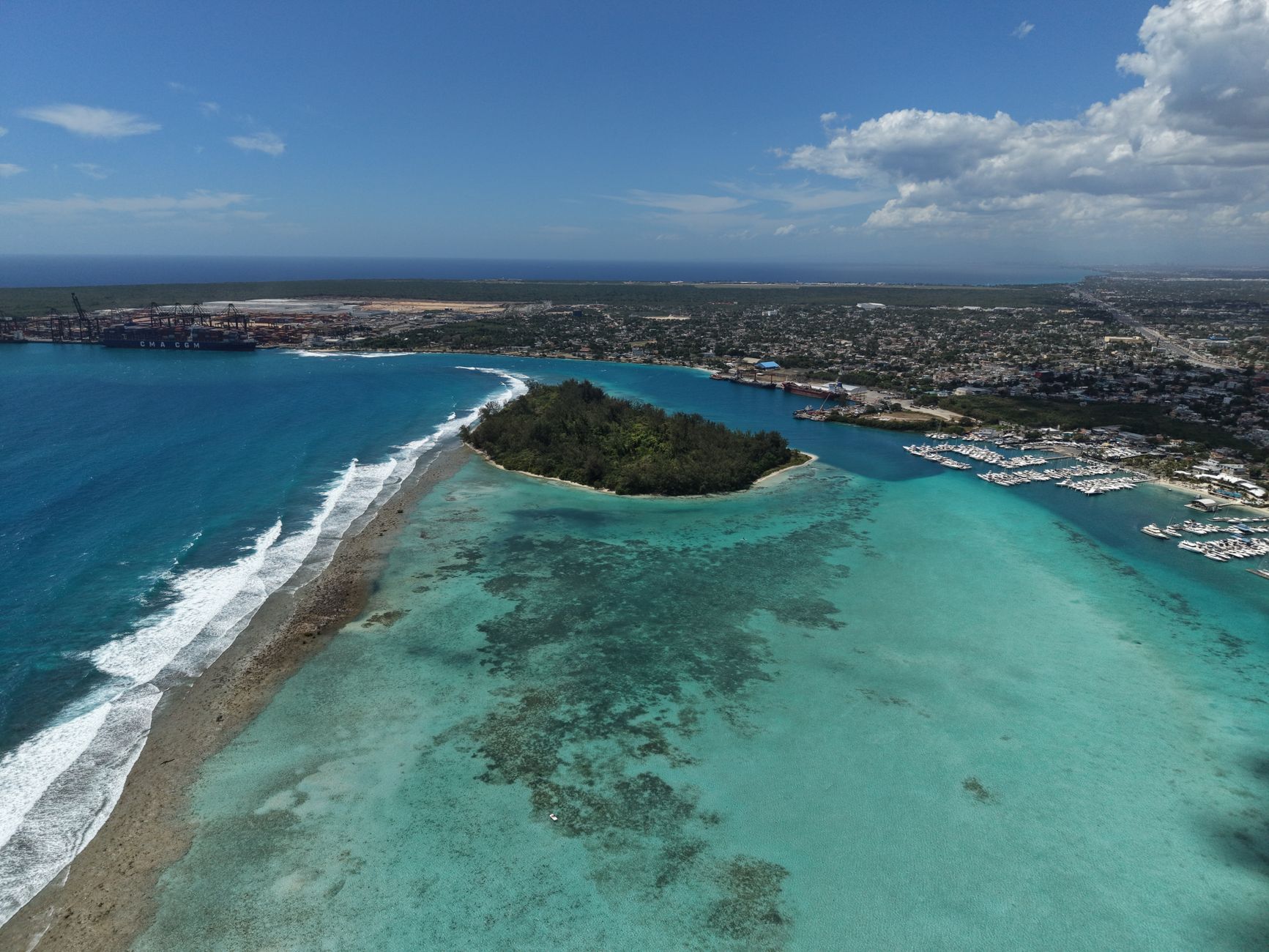
Stunning aerial shot of a turquoise lagoon and coast in Santo Domingo, Dominican Republic.
Photo by Arlin Raf on Pexels · Pexels License

A woman in a stunning golden gown poses gracefully on a tropical beach, under a vibrant blue sky.
Photo by Vika Glitter on Pexels · Pexels License

A group of children playing joyfully on a scenic tropical beach in Balabac, Philippines under clear blue skies.
Photo by Vishe Artiztry on Pexels · Pexels License

A serene view of a thatched-roof pier over calm ocean waters with waves and clear blue sky.
Photo by Mel Mariano on Pexels · Pexels License
Practical Information
Visa
Most travelers should assume they need a visa in advance, including visitors arriving on US, UK, EU, Canadian, or Australian passports. The practical route is to email Nauru Immigration with the application form, passport scan, and supporting documents before you fly; do not treat Nauru as a visa-on-arrival destination.
Currency
Nauru uses the Australian dollar. Cash matters more than cards here: official travel advisories say credit cards are generally not accepted, and the island's lone ATM at the Menen Hotel can run out, so arrive in Yaren or Meneng with enough notes for lodging, meals, and transport.
Getting There
You fly into Nauru International Airport, the island's only airport, usually on Nauru Airlines. Brisbane is the simplest gateway for most long-haul travelers, while Nadi works for South Pacific connections; schedules can shift, so keep extra buffer before onward flights.
Getting Around
Nauru is only 21 square kilometers, but that does not mean you can wing transport. Official guidance says not to count on taxis or public transport, so the sensible plan is a rental car, scooter, or hotel-arranged ride if you want to move between Yaren, Anibare, Buada, and the western districts without wasting time.
Climate
Expect heat all year, usually around 26 to 32 C, with thick humidity and little seasonal temperature swing. The wetter stretch runs roughly from November to February, while the drier months are easier for looping the coast road, climbing Command Ridge, and spending time outdoors around Anibare and Ijuw.
Connectivity
English is widely used for government and business, so basic visitor logistics are manageable, but mobile data and Wi-Fi are not something to take for granted. Download offline maps before arrival, keep hotel and driver contacts in WhatsApp, and treat internet speed as variable rather than guaranteed.
Safety
Nauru is usually more logistically awkward than dangerous, but the road and the sea both demand respect. Avoid night driving on poorly lit stretches, be cautious with stray dogs, and do not underestimate surf and rip currents at Anibare Bay just because the island looks small on a map.
Taste the Country
restaurantCoconut fish
Tuna meets coconut milk. Lunch, family table, rice, lime. Spoons move, talk pauses.
restaurantGrilled tuna with lime
Fish hits fire. Fingers tear flesh, lime runs, salt stays. Evening, veranda, relatives, friends.
restaurantWhole reef fish barbecue
Snapper or parrotfish arrives whole. Knives pause, hands work, bones demand patience. Weekend meal, shared plate, long conversation.
restaurantRaw fish with citrus
Morning catch meets lime and coconut. Heat asks for cool food. Noon meal, small group, little ceremony.
restaurantTaro with coconut cream
Taro boils, coconut softens. Fish juices follow. Family meal, church gathering, patient eating.
restaurantCorned beef and rice
Tin opens, pan heats, rice waits. Quick dinner, workday hunger, no nostalgia needed.
restaurantSpam fried rice
Rice fries, Spam browns, soy sauce clings. Takeaway box, late lunch, roadside stop in Yaren or Aiwo.
Tips for Visitors
Bring Cash
Treat Nauru as cash-first from the moment you land. Withdrawals are unreliable and cards may not help, so carry enough Australian dollars for your whole stay plus a buffer.
Pad Flight Days
Do not build a tight onward connection after Nauru. Flights are limited, schedules can move, and one change can cost you days rather than hours.
Book Transport Early
Reserve a rental car or confirm hotel transfers before arrival. The island is tiny, but transport options are thinner than the map suggests, especially outside Yaren and Meneng.
Walk Early
Heat and humidity build fast. If you want to walk around Anibare, Buada, or the coast road, do it early in the morning and leave the exposed stretches for later only if you like sweat as a personality test.
No Trains, No Buses
Nauru has no rail network and no dependable public bus system. Planning as if a cheap island shuttle will appear is how you lose half a day.
Greet People
A simple hello matters in a country of about 10,000 to 11,000 people. You are visible here, and basic courtesy lands better than polished travel performance.
Eat Simply
Imported food is expensive and choice is limited, so budget for plain meals rather than fantasy dining. Fish, rice, takeaway staples, and whatever has arrived on recent supply shipments are the realistic center of the plate.
Reserve Rooms Ahead
Accommodation stock is small and not especially flexible. If a flight is confirmed, your room should be confirmed too, ideally with direct contact rather than assumption.
Explore Nauru with a personal guide in your pocket
Your Personal Curator, in Your Pocket.
Audio guides for 1,100+ cities across 96 countries. History, stories, and local insight — offline ready.
Audiala App
Available on iOS & Android
Join 50k+ Curators
Frequently Asked
Do I need a visa for Nauru as a US or European traveler? add
Yes, you should assume you need a visa in advance. Official guidance does not offer a broad exemption for Western passports, so the safe move is to arrange approval with Nauru Immigration before booking yourself onto a tight itinerary.
Is Nauru expensive to visit? add
Yes, usually more expensive than travelers expect for such a small island. Remote air access, imported food, limited rooms, and weak competition push even modest trips into roughly AUD 180 to 380 a day for most visitors, with higher costs if transport or accommodation choices narrow.
How do you get to Nauru from Australia? add
The usual route is to fly from Brisbane on Nauru Airlines. Brisbane is the cleanest gateway for most international travelers, and it is smarter to build in slack than to assume the schedule behaves like a high-frequency regional route.
Can you use credit cards in Nauru? add
Do not rely on them. Recent official travel advice says credit cards are generally not accepted, and the island's single ATM can be out of cash, so Australian dollars in hand are far more useful than plastic.
How many days do you need in Nauru? add
Three days is enough to see the island, but a week lets it make sense. In a short stay you can cover Yaren, Anibare, and Command Ridge; with more time, places like Buada, Aiwo, Ijuw, and Anabar stop feeling like names on a ring road and start feeling distinct.
Is Nauru safe for tourists? add
Generally yes, but the practical risks are real. Poorly lit roads, stray dogs, heat, and dangerous surf around Anibare matter more than street crime, so the sensible traveler is cautious rather than alarmed.
What is the best time of year to visit Nauru? add
The drier months outside the November to February wet season are usually the easiest. Temperatures stay hot year-round, but lower rainfall makes walking, coastal driving, and outdoor time around Anibare and Buada less draining.
Can you get around Nauru without a car? add
Only with patience and luck. The island is small enough to understand quickly, but official advice says not to count on taxis or public transport, so a rental vehicle or arranged ride is the difference between a smooth visit and a stranded one.
Is English spoken in Nauru? add
Yes, English is widely used for government and business, and most travelers can manage daily logistics with it. But Nauruan is the national language and a core part of local identity, so even a respectful greeting goes a long way.
Sources
- verified Government of the Republic of Nauru — Official government source for visa procedures, country information, and public administration details.
- verified Nauru Airlines Timetable — Primary source for current flight routes, gateways, and schedule changes affecting access to Nauru.
- verified UK Foreign, Commonwealth & Development Office - Nauru Travel Advice — Authoritative traveler guidance on visas, cash access, local conditions, and safety risks.
- verified Government of Canada - Travel Advice and Advisories for Nauru — Useful practical source for entry rules, transport realities, health notes, and road safety.
- verified Nauru Meteorological Service — Primary climate reference for year-round temperatures, rainfall pattern, and weather context.
Last reviewed: