landscape
Dunes And Desert Light
Sossusvlei and Deadvlei turn raw geology into theater: 300-meter dunes, white clay pans and camelthorn skeletons preserved by aridity. Sunrise matters here because the color changes minute by minute.
Namibia is what happens when distance becomes the attraction: dunes, salt pans, shipwreck coast and rock art all stripped down to their strongest lines. Few countries feel this vast, and fewer still make emptiness so memorable.
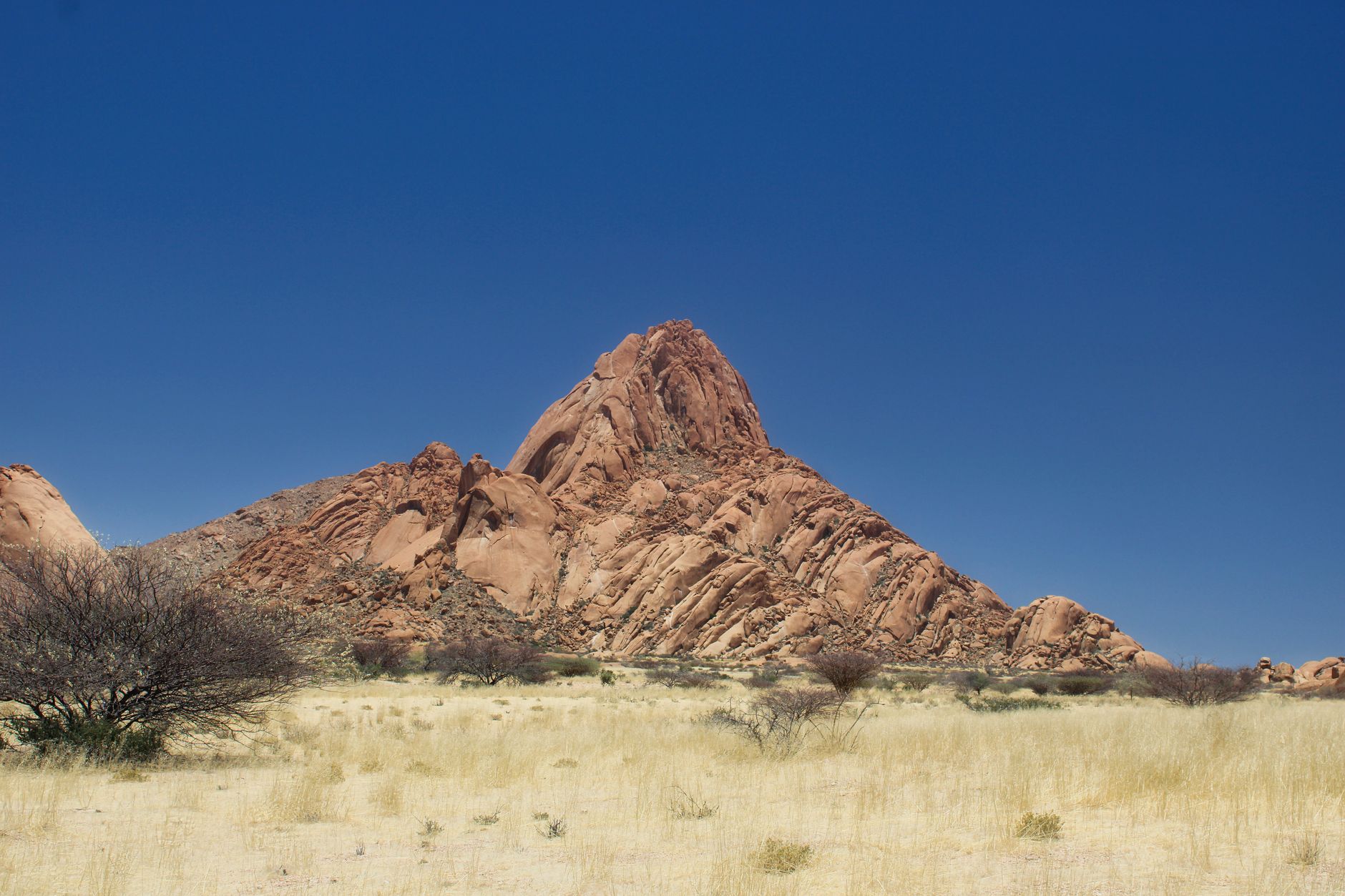 Namibia
EntrySchengen does not apply; many US, UK, EU and Canadian travelers now need eVisa or visa on arrival.
NThis Namibia travel guide starts with the fact that surprises most first-timers: a country larger than France and Germany combined holds barely 2.6 million people.
Space is the first thing Namibia changes in you. Roads run for hours through gravel plains, rust-red dunes and dry riverbeds before a town appears, and when it does, it feels earned. Windhoek is the practical hinge: rental cars, good restaurants, German colonial facades, and the country's modern pulse in one highland capital. From there, the classic route fans outward to Swakopmund for fog, oysters and Atlantic light, then inland to Sossusvlei where dunes rise 300 to 400 meters, taller than many city skyscrapers and older than most human monuments.
Namibia works because its contrasts are clean, not cluttered. One week can move from the white salt pan of Etosha, where elephants and black rhino gather at floodlit waterholes, to the engraved sandstone of Twyfelfontein, where San imagery turns desert rock into theology. Then the coast shifts the mood again: Walvis Bay brings flamingos and lagoon light, while Lüderitz feels like a German port town misplaced at the edge of Africa. A few kilometers away, Kolmanskop tells the harsher story, with diamond-boom houses slowly filling with sand room by room.
First Peoples and Desert Kingdoms, c. 26000 BCE-1884
At Twyfelfontein, the sandstone is scored with giraffes, lions, and tracks that do not belong to any ordinary animal. You stand in that hard light and understand at once that this was never casual decoration. San hunters and healers cut more than 2,000 engravings into the rock, and many scholars read them as records of trance, healing, and passage between worlds.
Ce que l'on ignore souvent, c'est que the lion with human-like feet is not a mistake. It is a vision. In San cosmology, the boundary between person, animal, and spirit could thin during ritual, and the rock keeps that theology in plain view, older than any church tower in Windhoek and far older than the harbor at Lüderitz.
Then came cattle, grain, and courts. From roughly the first millennium CE, Ovambo kingdoms took shape in the north around the oshana floodplains, where rainwater spread and withdrew with seasonal precision; further west and south, Nama and Damara pastoralists moved across enormous dry country with an eye for grass, wells, and survival. A king was measured not by marble but by herds, alliances, and the ability to feed dependants when the sky withheld rain.
This older Namibia was never empty. It was organized differently. The road that takes you toward Etosha or Opuwo now crosses land that long before any European map had already been named, traded, sung, and fought over, and that is the bridge to everything that follows: outsiders would arrive imagining vacancy, and build an empire on that lie.
Nehale lya Mpingana, king of Ondonga, understood before many others that Europeans were not simply traders with better cloth but political rivals with an appetite for control.
San ethnographic records describe hunters weeping after killing an eland, whose fat and blood held sacred meaning in ritual life.
Atlantic Contact and the Mission Frontier, 1486-1884
In 1486 Bartolomeu Dias planted a stone cross on the coast near present-day Lüderitz, naming the bay Angra Pequena and claiming, with a gesture all empire relies on, a shore he did not understand. The Portuguese came for sea routes, not for the interior. Yet that upright block of carved stone announced a habit that would outlast them: possession first, knowledge later.
The interior moved to another rhythm. Nama captains negotiated, traded firearms, and watched rivals with the same patience they watched the weather; Oorlam groups, mounted and armed, altered the balance of power across the south; in the north, Ovambo rulers kept their own diplomacy alive with Angola. Ce que l'on ignore souvent, c'est que missionaries were often invited not because souls were trembling for salvation, but because literacy, guns, and access to trade could tilt a political contest.
Johann Heinrich Schmelen is the name that survived in church records, but his wife Zara, later known as Johanna, did the work that made his mission possible. She was Nama, she translated, she interpreted codes no European could hear, and when scripture was put into local language, her mind was in the sentence even when her name was not on the page. One sees the pattern already: women holding the hinge of history while official documents look away.
By the middle of the 19th century, treaties, mission stations, and trade routes had stitched the land into a tense web. Firearms intensified old rivalries; debts multiplied; local leaders learned to use Europeans against one another and sometimes paid dearly for the experiment. The harbors at Lüderitz and Walvis Bay were still small doors into a vast country, but Berlin would soon decide they were enough to justify conquest.
Johanna Schmelen stands at the edge of the archive like a ghost with perfect diction: without her translations, the first mission texts in Nama would scarcely have existed.
Refusing a ceremonial cup of omagongo palm wine in the Ovambo north could read less like politeness and more like a deliberate insult.
German Colonial Rule, 1884-1915
The German chapter begins with a merchant, a contract, and a fiction. In 1883 Adolf Lüderitz acquired coastal land through a treaty so murky in language and scale that it would become infamous, and in 1884 Berlin declared a protectorate over German South West Africa. The map was imperial; the reality on the ground was a patchwork of Nama, Herero, Damara, San, and Ovambo worlds that had not consented to disappear.
Railways, forts, and settler farms followed. Swakopmund rose from the fog as Germany's engineered answer to the coast, Windhoek became an administrative center, and diamonds later turned places near Kolmanskop into feverish outposts where pianos arrived in the desert before justice did. Ce que l'on ignore souvent, c'est how quickly ordinary colonial paperwork became a machine of dispossession: grazing land surveyed, wells controlled, cattle seized, movement constrained.
Then came the catastrophe. In January 1904 the Herero rose in revolt under Samuel Maharero after years of land theft, debt, and humiliation; the Nama resistance under Hendrik Witbooi and others followed, and Berlin answered with exterminatory intent. General Lothar von Trotha's order after the battle of Waterberg drove Herero families into the Omaheke, where thirst finished what rifles began, and the concentration camps at Shark Island near Lüderitz completed the work with cold bureaucracy.
This is one of the first genocides of the 20th century. The bones, the prison labor, the medical experiments, the confiscated cattle, the children left with no inheritance but grief: all of it shaped the country that would later drive from Windhoek to Swakopmund on roads laid over unresolved memory. And from that violence came the next era, because the German empire that claimed eternity in the desert lasted barely three decades before another flag took its place.
Hendrik Witbooi wrote letters like a statesman and fought like a man who knew exactly what surrender would cost his people.
At Shark Island, prisoners were held in canvas shelters on a wind-lashed spit of land so exposed that cold and hunger did almost as much killing as armed guards.
Mandate, Apartheid, and Independence, 1915-1990
In 1915 South African troops took the colony from Germany, but liberation did not arrive with them. The League of Nations mandate after the First World War was supposed to be custodianship; in practice it became prolonged control, and after 1948 apartheid logic settled over the territory with familiar certainties: segregated space, pass laws, contract labor, and government by racial ranking. Windhoek grew, but it grew with walls inside it.
One of those walls burst into history on 10 December 1959 in the Old Location, when residents resisting forced removals were met with gunfire. The dead were not abstractions. They were workers, parents, churchgoers, people who understood that a planned township on the edge of town was not civic improvement but political containment, and that day helped turn grievance into national struggle.
SWAPO emerged from that atmosphere, as did the wider liberation movement that linked Namibia's future to exile, diplomacy, and guerrilla war. Sam Nujoma became its public face; Andimba Toivo ya Toivo its steely conscience; ordinary contract workers carried the movement in quieter ways, through strikes, collections, messages, and endurance. Ce que l'on ignore souvent, c'est how international the Namibian question became: argued at the United Nations, fought over by South Africa, Angola, Cuba, and the United States, while villagers in the north simply lived with raids, conscription, and fear.
Independence came on 21 March 1990. The flag rose in Windhoek, Nelson Mandela attended, and a republic was born not as a miracle but as the late settlement of a very old debt. From that day onward, Namibia could begin speaking in its own name, yet the road to Etosha, the German facades in Swakopmund, the ghost houses of Kolmanskop, and the graves near Lüderitz all remind you that independence did not erase the past; it finally gave the country authority to confront it.
Hosea Kutako, austere and persistent, spent decades petitioning the outside world to notice what South African rule preferred to hide.
The 1959 protest in Windhoek's Old Location began over forced removals and rents, yet it became one of the emotional starting points of the national liberation struggle.
In Namibia, language does not enter a room alone. It arrives with a handshake, a question about the night, a pause long enough to prove that you have seen the other person as a body and not an obstacle. In Windhoek, I have heard a shop counter conduct its little opera in three tongues: English for the formal surface, Afrikaans for price and speed, then Oshiwambo for the warmth that money cannot buy.
A greeting here is not ornament. It is the lock and key of social life. Wa lalapo? Did you sleep well? The question sounds domestic, almost indecent in its intimacy, and that is why it works. A country is a table set for strangers.
Then comes the pleasure of fracture. In Swakopmund and Lüderitz, German survives like jam sealed in a forgotten cupboard, thick and old-fashioned, still edible, still precise. Afrikaans slides through garages, butcheries, schoolyards, and roadside bars with a practical tenderness. Khoekhoegowab clicks in the air like a tongue remembering flint. You do not listen to Namibia as you would listen to a choir. You listen as you would watch light on metal: each angle gives another country.
Namibian food distrusts decoration. It prefers flame, fermentation, grain, salt, and the solemn happiness of being fed enough. At Katutura's Soweto Market in Windhoek, kapana smokes over open braziers and the air smells of beef fat, ash, and chili. People eat standing up. Hunger is handled directly.
Mahangu appears with the dignity of a staple that knows its own value. Oshithima, mahangu pap, oshikundu, omalodu: the syllables already contain the household. Millet is not trend food here, not a fashionable grain flown into a city to save the conscience of the rich. It is rain translated into survival.
Then the country turns carnivorous. Oryx on the braai. Kudu as biltong. Potjiekos under a cast-iron lid that no sane person lifts too early. Mopane worms in the north, sour milk in a Himba homestead near Opuwo, a sheep's head grinning from the grill with more honesty than many restaurant menus. Namibia eats with little hypocrisy. I admire that.
Even coffee carries geography. In Swakopmund, a pastry and a cup can feel absurdly Central European until the Atlantic fog presses its cold hand against the window and reminds you that this neat cake is being eaten on the edge of the Namib Desert. Nothing stays pure for long in Namibia. That is part of the appetite.
Namibian politeness has a curious rigor: it asks for calm before efficiency. Someone who rushes to the point announces not importance but bad breeding. You greet. You ask. You let the exchange widen by one or two human details. Only then do you move to the practical matter, which suddenly becomes much easier, as though language had first swept the floor.
This is visible in small gestures. The Herero handshake with its changing grips. The offered cup of oshikundu before any conversation of consequence. The way an elder's presence alters the temperature of a group, not through theater but through the old art of collective attention. Respect here is enacted with the hands as much as with words.
Visitors often confuse slowness with passivity. They are wrong. Namibian etiquette has the firmness of ritual. It knows that transaction without recognition leaves a stain. In Etosha, at a roadside fuel stop, in a courtyard in Rundu, in a shop in Keetmanshoop, the rule persists: first establish the person, then the purpose.
It is an elegant system. Brutal, too, for the impatient. Namibia does not hurry to flatter your schedule.
At Twyfelfontein, the rock surface behaves like skin. Giraffes stretch upward, elephants advance, and that famous lion with the uncanny feet steps out of ordinary zoology into theology. These engravings were not made to amuse us. They were made because someone entered a state beyond the usual border of the self and returned with images sharp enough to cut into sandstone.
I find this moving for a simple reason: desert cultures cannot afford decorative lies. Every line costs effort. Every mark must justify the body that made it. At Twyfelfontein, art is not separate from trance, hunting, animal knowledge, weather, fear, and the dangerous privilege of vision. The museum habit of isolating beauty in a white room would die quickly here.
The same logic persists elsewhere, though in altered forms. In Windhoek galleries, in woven baskets from the north, in carved utensils sold by the roadside, form keeps close to use. Even color seems to obey heat and dust. Ochre, black, hide, ash, copper, the chalk of the Etosha pan, the rust-red memory of dunes near Sossusvlei.
Namibia's great artistic lesson is severe and generous at once: make something only if it can survive sun, silence, and a second look.
Namibian architecture often looks as if two climates and three empires argued over the same drawing board. In Lüderitz, German colonial facades sit above the Atlantic in pastel defiance, all gables and ornament and stiff European ambition, while the wind outside behaves like a pirate. In Swakopmund, Jugendstil and seaside fog maintain an affair so improbable that it becomes persuasive.
Then the country shifts register. Vernacular compounds in the north answer flood, cattle, storage, kinship, and shade with an intelligence no imported style can fake. A homestead is not a pretty object. It is a grammar of movement: where grain sleeps, where elders sit, where fire speaks, where animals remain close enough to matter and far enough not to kill the night.
Windhoek complicates the picture further. Glass offices, German churches, apartheid-era planning scars, township improvisation, concrete ambition, tin survival. A capital always betrays the country, but here it betrays it honestly. You see how power tried to arrange bodies in space, and how daily life kept revising the plan.
Even abandoned places build an argument. Kolmanskop, filling with sand room by room, may be the best architecture lesson in Namibia. The desert is the final decorator, and it has no respect for ownership papers.
Namibia encourages a philosophy that would horrify a collector and console a monk. Space dominates first. Then distance. Then the recognition that human intention is real but not sovereign. Drive from Windhoek toward Sossusvlei, or north toward Etosha, and the road performs an education more rigorous than many universities: the land will not rearrange itself to flatter your drama.
This does not produce emptiness. It produces scale, and scale alters morals. Water becomes thought. Shade becomes politics. A working vehicle becomes a form of metaphysics. In a country with roughly three people per square kilometer, vanity has room to evaporate.
And yet the desert does not make people cold. The opposite. It makes hospitality exact. One shares information, fuel, directions, weather warnings, and cups of tea because abstraction can kill quickly out here. Civilization, in Namibia, often reveals itself as the practical management of exposure.
I suspect that is why the country lingers in the mind with such force. It offers no fantasy of abundance without cost. It teaches another form of riches: enough water, enough firewood, enough wit, enough people around the table to make the silence companionable.
Sossusvlei and Deadvlei turn raw geology into theater: 300-meter dunes, white clay pans and camelthorn skeletons preserved by aridity. Sunrise matters here because the color changes minute by minute.
Etosha is built for patient viewing rather than cinematic chasing. In the dry months, zebra, elephant, giraffe and predators come to fixed waterholes, which means the landscape does half the tracking for you.
Twyfelfontein holds one of Africa's great concentrations of San rock engravings, many linked to ritual and trance practice. Namibia's history does not begin with colonial maps; the stone makes that plain.
Swakopmund, Walvis Bay and Lüderitz sit beside an Atlantic shaped by the Benguela Current, where fog rolls in and the water stays cold. The result is a coast of oysters, flamingos, shipwreck stories and sharp marine light.
Namibia rewards anyone who notices form: a lone oryx on a dune ridge, Art Nouveau detail in Lüderitz, dead trees on white clay, thunderheads over gravel plains. The scale is enormous, but the best images often come from restraint.
This is one of the world's great self-drive countries, with long empty roads linking Windhoek, Sossusvlei, Swakopmund and Etosha. The journey is not filler between sights; it is the structure of the trip.
12 cities — start with the ones we'd send you to first.
A capital city of 430,000 where Herero women in Victorian-era dress pass German colonial facades on Independence Avenue, and the best kapana smoke rises from Katutura's Soweto Market before noon.
A town that looks like Bavaria was airlifted to the Namib coast, where the cold Benguela fog rolls in at dawn and quad bikes leave tracks across dunes that end, abruptly, at the Atlantic.
Namibia's most isolated town clings to a granite peninsula above a penguin colony, its art nouveau train station and diamond-era mansions slowly losing a war with salt air and wind.
The country's only deep-water port earns its keep on salt, fish meal, and flamingos — tens of thousands of them, pink against the grey lagoon, twelve months a year.
Not a city but the address that defines Namibia: a clay pan ringed by 300-metre orange dunes, where 900-year-old dead camelthorn trees still stand in Deadvlei because nothing here decomposes.
The Etosha Pan's 4,800 square kilometres of blinding white salt concentrate every lion, elephant, and black rhino in the north around a handful of waterholes you can watch from a floodlit hide at midnight.
A sandstone slope in the Kunene carries 2,000 San rock engravings — therianthropes, elephants in procession, lions with human feet — made by shamans recording visions, not artists seeking beauty.
A diamond-rush ghost town half-swallowed by dune sand, where the hospital ballroom and the skittle alley still stand, their floors drifted knee-deep in desert that has been reclaiming them since 1954.
The functional capital of Kunene Region is a frontier town of red dust and mobile-phone shops where Himba women in ochre and goat-skin walk the same streets as truck drivers fuelling for Angola.
Windhoek sits on the central plateau at roughly 1,650 meters, which explains the cooler evenings and the sense that the country radiates outward from here by road. This is the administrative core of Namibia, but it is also where German colonial planning, post-independence politics, and modern shopping malls rub against each other without pretending to blend.
The coast feels like a prank pulled by geography: icy Atlantic water, dense fog, and a German-looking town pinned beside a desert that keeps trying to reclaim it. Swakopmund is the polished base, while Walvis Bay handles birds, salt pans, and the practical business of the shoreline.
This is the Namibia people think they know before they arrive, then discover they had imagined it too small. Sossusvlei is not one dune stop but an entire grammar of light, wind, gravel plains, and pans where dead camelthorn trees still stand because the air is too dry to let them rot.
Southern Namibia is where the road becomes part of the story: feral horses near Aus, old diamond wealth, and a coast that looks expensive and unfinished at the same time. Lüderitz carries the strongest German colonial afterimage in the country, while Kolmanskop turns that history into a sand-filled warning about boomtown certainty.
Northwest Namibia feels provisional in the best way: long gravel roads, little shade, and sudden signs of life where you least expect them. Opuwo is the staging post for Kaokoland, while Twyfelfontein anchors a much older story, with San engravings cut into sandstone long before the first vehicle bounced across Damaraland.
Etosha is built around absence: a salt pan so vast it changes the scale of everything around it, then a handful of waterholes where the animals come because they have no better option. Push farther east to Rundu and the country shifts again, from dust and acacia into river towns and greener edges.
From San sacred landscapes to independence in Windhoek, the country’s history is older, harsher, and more intimate than the map suggests.
Archaeological evidence from Namibia shows human symbolic activity stretching deep into prehistory. The engravings and paintings later visible at places like Twyfelfontein are part of a cultural world so old that the modern state barely occupies its final page.
Bantu-speaking communities establish more permanent farming and cattle systems across northern Namibia. Power begins to gather around floodplains, grain storage, herds, and dynastic rule rather than only seasonal movement.
By the early modern period, Ovambo kingdoms are shaping trade, ritual, and kingship in the north. Their politics are local and regional at once, tied to Angola, cattle wealth, and the seasonal pulse of water.
The Portuguese navigator lands on the coast near present-day Lüderitz and plants a padrão, a stone cross of possession. It is Europe's first durable claim on Namibian soil and a very early example of naming before understanding.
The Nama woman later known as Johanna Schmelen would become one of the overlooked linguistic mediators of mission history. Her translations and cultural fluency made early Protestant work in the interior possible.
Mission stations spread into the interior through negotiation with local leaders, not simple European initiative. Literacy, trade access, and political leverage are as present in the bargain as religion.
A treaty around Angra Pequena gives the German merchant Adolf Lüderitz a foothold on the coast. The transaction becomes a prelude to annexation, and the port that bears his name still carries that memory.
Berlin proclaims German South West Africa, turning commercial footholds into imperial rule. The decision is made in Europe; its consequences fall on pastoralists, farmers, traders, and families across the territory.
While Germany claims most of the territory, Walvis Bay stays in British hands through the Cape Colony. This awkward coastal exception shows how imperial maps were stitched together with little regard for local coherence.
Under Samuel Maharero, Herero fighters rise against German rule after years of land loss, debt pressure, and abuse. Berlin answers with military ferocity that soon turns into exterminatory policy.
In the far north, King Nehale lya Mpingana's forces rout a Portuguese expedition. The victory preserves Ovambo autonomy for a time and reminds us that colonial advance was never uniform or uncontested.
The Nama captain, letter-writer, strategist, and rebel is killed during resistance to German rule. His death strips the conflict of one of its most lucid political minds, but not of its memory.
Diamond discoveries in the south generate sudden wealth, strict controls, and absurd luxury in the desert. Kolmanskop grows into a settlement where imported comforts sit beside coerced labor and colonial inequality.
During the First World War, South African troops defeat German colonial power in the territory. The imperial flag changes, but rule by outsiders does not end.
The former colony becomes a mandated territory under South African control. What is presented as international supervision steadily hardens into long-term domination.
After the National Party comes to power in South Africa, racial segregation deepens in Namibia as well. Urban planning, labor systems, and political rights are reorganized around exclusion.
Residents protesting forced removals in Windhoek's Old Location are met with police gunfire on 10 December. The shock of the killings turns a local injustice into a national political wound.
The South West Africa People's Organization emerges as the leading nationalist movement. From this point, Namibia's future will be argued in villages, prisons, exile offices, and international chambers at once.
The first major clash of the liberation war takes place in the north. The event is small in military scale, large in symbolism, and later remembered as the opening shot of independence.
The United Nations officially uses the name Namibia instead of South West Africa. Naming matters here: it is a diplomatic act of recognition long before sovereignty is secured on the ground.
A mass strike by Ovambo contract workers shakes the labor system that underpins the territory's economy. This is not a side note to nationalism but one of its engines: workers turn economic grievance into political force.
Regional agreements tied to the war in Angola finally open a credible path toward Namibian self-rule. Great powers talk strategy; Namibians wait for the chance to govern their own country.
Namibia becomes independent, with Sam Nujoma sworn in as first president in Windhoek. The ceremony is triumphant, but its deeper meaning lies in survival: a state now exists where empire, mandate, and apartheid had all claimed permanence.
First Peoples and Desert Kingdoms
Nehale lya Mpingana, king of Ondonga, understood before many others that Europeans were not simply traders with better cloth but political rivals with an appetite for control.
At Twyfelfontein, the sandstone is scored with giraffes, lions, and tracks that do not belong to any ordinary animal. You stand in that hard light and understand at once that this was never casual decoration. San hunters and healers cut more than 2,000 engravings into the rock, and many scholars read them as records of trance, healing, and passage between worlds.
Ce que l'on ignore souvent, c'est que the lion with human-like feet is not a mistake. It is a vision. In San cosmology, the boundary between person, animal, and spirit could thin during ritual, and the rock keeps that theology in plain view, older than any church tower in Windhoek and far older than the harbor at Lüderitz.
Then came cattle, grain, and courts. From roughly the first millennium CE, Ovambo kingdoms took shape in the north around the oshana floodplains, where rainwater spread and withdrew with seasonal precision; further west and south, Nama and Damara pastoralists moved across enormous dry country with an eye for grass, wells, and survival. A king was measured not by marble but by herds, alliances, and the ability to feed dependants when the sky withheld rain.
This older Namibia was never empty. It was organized differently. The road that takes you toward Etosha or Opuwo now crosses land that long before any European map had already been named, traded, sung, and fought over, and that is the bridge to everything that follows: outsiders would arrive imagining vacancy, and build an empire on that lie.
San ethnographic records describe hunters weeping after killing an eland, whose fat and blood held sacred meaning in ritual life.
Atlantic Contact and the Mission Frontier
Johanna Schmelen stands at the edge of the archive like a ghost with perfect diction: without her translations, the first mission texts in Nama would scarcely have existed.
In 1486 Bartolomeu Dias planted a stone cross on the coast near present-day Lüderitz, naming the bay Angra Pequena and claiming, with a gesture all empire relies on, a shore he did not understand. The Portuguese came for sea routes, not for the interior. Yet that upright block of carved stone announced a habit that would outlast them: possession first, knowledge later.
The interior moved to another rhythm. Nama captains negotiated, traded firearms, and watched rivals with the same patience they watched the weather; Oorlam groups, mounted and armed, altered the balance of power across the south; in the north, Ovambo rulers kept their own diplomacy alive with Angola. Ce que l'on ignore souvent, c'est que missionaries were often invited not because souls were trembling for salvation, but because literacy, guns, and access to trade could tilt a political contest.
Johann Heinrich Schmelen is the name that survived in church records, but his wife Zara, later known as Johanna, did the work that made his mission possible. She was Nama, she translated, she interpreted codes no European could hear, and when scripture was put into local language, her mind was in the sentence even when her name was not on the page. One sees the pattern already: women holding the hinge of history while official documents look away.
By the middle of the 19th century, treaties, mission stations, and trade routes had stitched the land into a tense web. Firearms intensified old rivalries; debts multiplied; local leaders learned to use Europeans against one another and sometimes paid dearly for the experiment. The harbors at Lüderitz and Walvis Bay were still small doors into a vast country, but Berlin would soon decide they were enough to justify conquest.
Refusing a ceremonial cup of omagongo palm wine in the Ovambo north could read less like politeness and more like a deliberate insult.
German Colonial Rule
Hendrik Witbooi wrote letters like a statesman and fought like a man who knew exactly what surrender would cost his people.
The German chapter begins with a merchant, a contract, and a fiction. In 1883 Adolf Lüderitz acquired coastal land through a treaty so murky in language and scale that it would become infamous, and in 1884 Berlin declared a protectorate over German South West Africa. The map was imperial; the reality on the ground was a patchwork of Nama, Herero, Damara, San, and Ovambo worlds that had not consented to disappear.
Railways, forts, and settler farms followed. Swakopmund rose from the fog as Germany's engineered answer to the coast, Windhoek became an administrative center, and diamonds later turned places near Kolmanskop into feverish outposts where pianos arrived in the desert before justice did. Ce que l'on ignore souvent, c'est how quickly ordinary colonial paperwork became a machine of dispossession: grazing land surveyed, wells controlled, cattle seized, movement constrained.
Then came the catastrophe. In January 1904 the Herero rose in revolt under Samuel Maharero after years of land theft, debt, and humiliation; the Nama resistance under Hendrik Witbooi and others followed, and Berlin answered with exterminatory intent. General Lothar von Trotha's order after the battle of Waterberg drove Herero families into the Omaheke, where thirst finished what rifles began, and the concentration camps at Shark Island near Lüderitz completed the work with cold bureaucracy.
This is one of the first genocides of the 20th century. The bones, the prison labor, the medical experiments, the confiscated cattle, the children left with no inheritance but grief: all of it shaped the country that would later drive from Windhoek to Swakopmund on roads laid over unresolved memory. And from that violence came the next era, because the German empire that claimed eternity in the desert lasted barely three decades before another flag took its place.
At Shark Island, prisoners were held in canvas shelters on a wind-lashed spit of land so exposed that cold and hunger did almost as much killing as armed guards.
Mandate, Apartheid, and Independence
Hosea Kutako, austere and persistent, spent decades petitioning the outside world to notice what South African rule preferred to hide.
In 1915 South African troops took the colony from Germany, but liberation did not arrive with them. The League of Nations mandate after the First World War was supposed to be custodianship; in practice it became prolonged control, and after 1948 apartheid logic settled over the territory with familiar certainties: segregated space, pass laws, contract labor, and government by racial ranking. Windhoek grew, but it grew with walls inside it.
One of those walls burst into history on 10 December 1959 in the Old Location, when residents resisting forced removals were met with gunfire. The dead were not abstractions. They were workers, parents, churchgoers, people who understood that a planned township on the edge of town was not civic improvement but political containment, and that day helped turn grievance into national struggle.
SWAPO emerged from that atmosphere, as did the wider liberation movement that linked Namibia's future to exile, diplomacy, and guerrilla war. Sam Nujoma became its public face; Andimba Toivo ya Toivo its steely conscience; ordinary contract workers carried the movement in quieter ways, through strikes, collections, messages, and endurance. Ce que l'on ignore souvent, c'est how international the Namibian question became: argued at the United Nations, fought over by South Africa, Angola, Cuba, and the United States, while villagers in the north simply lived with raids, conscription, and fear.
Independence came on 21 March 1990. The flag rose in Windhoek, Nelson Mandela attended, and a republic was born not as a miracle but as the late settlement of a very old debt. From that day onward, Namibia could begin speaking in its own name, yet the road to Etosha, the German facades in Swakopmund, the ghost houses of Kolmanskop, and the graves near Lüderitz all remind you that independence did not erase the past; it finally gave the country authority to confront it.
The 1959 protest in Windhoek's Old Location began over forced removals and rents, yet it became one of the emotional starting points of the national liberation struggle.
In Namibia, language does not enter a room alone. It arrives with a handshake, a question about the night, a pause long enough to prove that you have seen the other person as a body and not an obstacle. In Windhoek, I have heard a shop counter conduct its little opera in three tongues: English for the formal surface, Afrikaans for price and speed, then Oshiwambo for the warmth that money cannot buy.
A greeting here is not ornament. It is the lock and key of social life. Wa lalapo? Did you sleep well? The question sounds domestic, almost indecent in its intimacy, and that is why it works. A country is a table set for strangers.
Then comes the pleasure of fracture. In Swakopmund and Lüderitz, German survives like jam sealed in a forgotten cupboard, thick and old-fashioned, still edible, still precise. Afrikaans slides through garages, butcheries, schoolyards, and roadside bars with a practical tenderness. Khoekhoegowab clicks in the air like a tongue remembering flint. You do not listen to Namibia as you would listen to a choir. You listen as you would watch light on metal: each angle gives another country.
Namibian food distrusts decoration. It prefers flame, fermentation, grain, salt, and the solemn happiness of being fed enough. At Katutura's Soweto Market in Windhoek, kapana smokes over open braziers and the air smells of beef fat, ash, and chili. People eat standing up. Hunger is handled directly.
Mahangu appears with the dignity of a staple that knows its own value. Oshithima, mahangu pap, oshikundu, omalodu: the syllables already contain the household. Millet is not trend food here, not a fashionable grain flown into a city to save the conscience of the rich. It is rain translated into survival.
Then the country turns carnivorous. Oryx on the braai. Kudu as biltong. Potjiekos under a cast-iron lid that no sane person lifts too early. Mopane worms in the north, sour milk in a Himba homestead near Opuwo, a sheep's head grinning from the grill with more honesty than many restaurant menus. Namibia eats with little hypocrisy. I admire that.
Even coffee carries geography. In Swakopmund, a pastry and a cup can feel absurdly Central European until the Atlantic fog presses its cold hand against the window and reminds you that this neat cake is being eaten on the edge of the Namib Desert. Nothing stays pure for long in Namibia. That is part of the appetite.
Namibian politeness has a curious rigor: it asks for calm before efficiency. Someone who rushes to the point announces not importance but bad breeding. You greet. You ask. You let the exchange widen by one or two human details. Only then do you move to the practical matter, which suddenly becomes much easier, as though language had first swept the floor.
This is visible in small gestures. The Herero handshake with its changing grips. The offered cup of oshikundu before any conversation of consequence. The way an elder's presence alters the temperature of a group, not through theater but through the old art of collective attention. Respect here is enacted with the hands as much as with words.
Visitors often confuse slowness with passivity. They are wrong. Namibian etiquette has the firmness of ritual. It knows that transaction without recognition leaves a stain. In Etosha, at a roadside fuel stop, in a courtyard in Rundu, in a shop in Keetmanshoop, the rule persists: first establish the person, then the purpose.
It is an elegant system. Brutal, too, for the impatient. Namibia does not hurry to flatter your schedule.
At Twyfelfontein, the rock surface behaves like skin. Giraffes stretch upward, elephants advance, and that famous lion with the uncanny feet steps out of ordinary zoology into theology. These engravings were not made to amuse us. They were made because someone entered a state beyond the usual border of the self and returned with images sharp enough to cut into sandstone.
I find this moving for a simple reason: desert cultures cannot afford decorative lies. Every line costs effort. Every mark must justify the body that made it. At Twyfelfontein, art is not separate from trance, hunting, animal knowledge, weather, fear, and the dangerous privilege of vision. The museum habit of isolating beauty in a white room would die quickly here.
The same logic persists elsewhere, though in altered forms. In Windhoek galleries, in woven baskets from the north, in carved utensils sold by the roadside, form keeps close to use. Even color seems to obey heat and dust. Ochre, black, hide, ash, copper, the chalk of the Etosha pan, the rust-red memory of dunes near Sossusvlei.
Namibia's great artistic lesson is severe and generous at once: make something only if it can survive sun, silence, and a second look.
Namibian architecture often looks as if two climates and three empires argued over the same drawing board. In Lüderitz, German colonial facades sit above the Atlantic in pastel defiance, all gables and ornament and stiff European ambition, while the wind outside behaves like a pirate. In Swakopmund, Jugendstil and seaside fog maintain an affair so improbable that it becomes persuasive.
Then the country shifts register. Vernacular compounds in the north answer flood, cattle, storage, kinship, and shade with an intelligence no imported style can fake. A homestead is not a pretty object. It is a grammar of movement: where grain sleeps, where elders sit, where fire speaks, where animals remain close enough to matter and far enough not to kill the night.
Windhoek complicates the picture further. Glass offices, German churches, apartheid-era planning scars, township improvisation, concrete ambition, tin survival. A capital always betrays the country, but here it betrays it honestly. You see how power tried to arrange bodies in space, and how daily life kept revising the plan.
Even abandoned places build an argument. Kolmanskop, filling with sand room by room, may be the best architecture lesson in Namibia. The desert is the final decorator, and it has no respect for ownership papers.
Namibia encourages a philosophy that would horrify a collector and console a monk. Space dominates first. Then distance. Then the recognition that human intention is real but not sovereign. Drive from Windhoek toward Sossusvlei, or north toward Etosha, and the road performs an education more rigorous than many universities: the land will not rearrange itself to flatter your drama.
This does not produce emptiness. It produces scale, and scale alters morals. Water becomes thought. Shade becomes politics. A working vehicle becomes a form of metaphysics. In a country with roughly three people per square kilometer, vanity has room to evaporate.
And yet the desert does not make people cold. The opposite. It makes hospitality exact. One shares information, fuel, directions, weather warnings, and cups of tea because abstraction can kill quickly out here. Civilization, in Namibia, often reveals itself as the practical management of exposure.
I suspect that is why the country lingers in the mind with such force. It offers no fantasy of abundance without cost. It teaches another form of riches: enough water, enough firewood, enough wit, enough people around the table to make the silence companionable.
//Kabbo never ruled a kingdom, yet he carried a civilization in his memory. When linguists recorded his stories in the 1870s, they captured a world of tricksters, stars, and animal power that helps modern Namibia read places like Twyfelfontein as belief, not ornament.
In 1904 Nehale's forces defeated a Portuguese column at Pembe, an African victory Europe preferred not to advertise. That success mattered beyond the battlefield: it let Ovamboland bargain, for a time, without kneeling.
Witbooi was not the caricature of a 'tribal chief' found in colonial reports. He wrote, negotiated, doubted, changed alliances, and then took up arms when he saw where German rule was heading; his letters still read with unnerving clarity.
Maharero entered history at the moment when petitions and compromise had failed. His revolt was born from stolen land, cattle seizures, and the daily abrasion of humiliation, and the German response turned his people's resistance into one of the century's defining tragedies.
Mission archives preserved her husband's name more carefully than hers, which is usually how power behaves. Yet Johanna Schmelen was the person who could move between worlds, turn doctrine into living speech, and make Europeans legible to Nama communities and vice versa.
Mandume was young, proud, and cornered by empires advancing from two directions. His death in 1917 turned him into legend, but the important detail is simpler: he refused to behave as though colonial borders were more real than his own authority.
Kutako fought with letters as others fought with rifles. For decades he sent petitions abroad, insisting that what happened in Namibia was not internal administration but a political wrong the world had no excuse to ignore.
Ya Toivo's courtroom words in 1968 were calm, restrained, and devastating. South Africa could jail him on Robben Island, but it could not make him speak as a subject; he spoke as a future citizen of a country not yet born.
Nujoma spent years in exile turning Namibia's case into an international question no diplomat could easily shrug off. When independence arrived, he stepped from the rhetoric of liberation into the harder business of statehood, which is where many heroes become merely human.
This is the shortest Namibia trip that still feels like Namibia: Atlantic fog, pelicans, and a road into the oldest desert on earth. Start on the coast in Walvis Bay, sleep in Swakopmund, then head inland to Sossusvlei for the red dunes and the white clay pan at Deadvlei.
Southern Namibia rewards patience rather than speed: long drives, old rail towns, and the strange elegance of abandoned places. This route links Keetmanshoop, Lüderitz Hinterland — Aus, Lüderitz, and Kolmanskop in a clean southbound line that makes geographic sense and keeps backtracking to a minimum.
This route moves through Namibia's rougher, more spacious middle distance: the rock engravings of Twyfelfontein, the Himba gateway town of Opuwo, and the waterhole rhythm of Etosha. It feels less polished than the classic dune-and-coast circuit, which is exactly why it stays with people.
If you want to see how fast Namibia changes, start in Windhoek and drive northeast to Rundu, where the country softens into river life and greener air. This is the least desert-heavy itinerary here, built for travelers who want towns, cultural contrast, and a slower read on daily life beyond the postcard dunes.
Beef strips hiss over coals in Windhoek. Fingers, chili, salt, talk. Noon, dusk, friends, drivers, market regulars.
Right hand shapes millet into a scoop. Pot, bowl, family table, funeral, weekday supper. Grain, gravy, patience.
Calabash, cup, passing hands. Morning, heat, guests, courtyard. Millet ferments, mouths cool, conversation starts.
Cast-iron pot stands on coals for hours. Lid stays shut. Weekend, yard, waiting, beer, stories.
Oryx, kudu, springbok meet flame and smoke. Night fire, lodge deck, farm yard, long table. Knife, salt, bread, silence, then argument.
Dry worms crack between teeth or sink into stew. North, shop packet, home kitchen, bus snack. Protein, bark, memory.
Dough grills over a braai until the crust chars. Hands tear, butter melts, jam runs. Morning, roadside stop, coast fog, coffee.
Namibia is not in Schengen, and most travelers who once entered visa-free now need an eVisa or visa on arrival. Since 1 April 2025, that includes U.S., UK, Canadian, Australian, and many EU passport holders; carry a passport valid for at least 6 months, 3 blank pages, proof of accommodation, onward plans, and travel insurance.
The local currency is the Namibian dollar, shown as NAD or N$. South African rand is accepted at 1:1 almost everywhere, but cards work reliably only in places like Windhoek, Swakopmund, Walvis Bay, and larger lodges, so keep cash for fuel, park gates, and remote stops.
Most international arrivals land at Hosea Kutako International Airport, 45 km east of Windhoek. Walvis Bay also has useful international links for the coast, especially if your trip starts in Walvis Bay or Swakopmund instead of looping through the capital.
Namibia works best as a self-drive trip because distances are huge and public transport is thin. A 2WD is enough for the classic dry-season route between Windhoek, Sossusvlei, Swakopmund, and Etosha, but gravel roads demand slower speeds, and night driving is a bad idea because of livestock, wildlife, and limited lighting.
The dry season from May to October is the easiest time for wildlife and road conditions, with cool nights and clear skies. The coast stays mild and foggy, the interior swings hard between hot days and cold evenings, and the green season from December to March can turn northern roads muddy while making the desert oddly dramatic.
Mobile coverage is decent in towns and along major highways, then falls away fast once you leave them. Buy a local SIM in Windhoek or Walvis Bay, download offline maps before driving out, and do not assume your lodge, campsite, or national park gate will have fast or stable internet.
Namibia is manageable for independent travelers, but the real risks are practical rather than dramatic: long empty roads, punctures, dehydration, and petty theft in city parking lots. Do not leave bags visible in cars, refuel whenever you can, carry more water than you think you need, and treat every gravel-road estimate as optimistic.
Accommodation is not the only big cost here. A 4x4 can easily run around €100-195 a day in high season before fuel, extra drivers, or premium insurance.
Namibia has rail lines, but they are not how most travelers move around the country in 2026. Plan your trip around flights, shuttles, or a rental car, not a romantic train itinerary that collapses on day one.
For June to October, the best lodges around Etosha and Sossusvlei often fill 6 to 12 months ahead. Leave late booking to city hotels, not park-edge camps or small desert properties.
Do not treat fuel like you would in France or Germany. Once the tank drops below half in remote Namibia, the next station stops being theoretical.
Remote card machines fail often enough to matter. Keep small notes for fuel attendants, market food, park fees, and tips, especially once you leave Windhoek, Swakopmund, and Walvis Bay.
A quick greeting matters more here than travelers from big cities expect. In shops, lodges, and roadside stops, begin with hello and a few human seconds before you ask for help, prices, or directions.
Coverage drops fast outside towns, and even when a signal appears, it may not be strong enough for navigation. Save offline maps, booking confirmations, and your park reservations before leaving town.
A practical rule is 10% in restaurants if service is not already included. For guides, lodge staff, and drivers, cash tips are normal, with around N$100-150 per guide per day as a reasonable starting point for good service.
Explore Namibia with a personal guide in your pocket
Audio guides for 1,100+ cities across 96 countries. History, stories, and local insight — offline ready.
Probably yes. Since 1 April 2025, travelers from the U.S., UK, Canada, Australia, and many EU countries need an eVisa or visa on arrival, so check your passport nationality against Namibia's current visa portal before you fly.
No, Namibia is not in Schengen. A Schengen visa does not cover Namibia, and Namibian entry permission does nothing for Europe.
Yes, South African rand is accepted at 1:1 with the Namibian dollar almost everywhere. The reverse is the catch: Namibian dollars are much less useful once you cross back into South Africa, so spend them before you leave.
Yes, if you respect the distances and the roads. The main problems are fatigue, punctures, animals on the road after dark, and long gaps between services, not constant crime.
Not for every route. In dry conditions, many travelers manage the classic Windhoek, Sossusvlei, Swakopmund, and Etosha circuit in a 2WD, but 4x4 is the smarter choice for remote Damaraland, Kaokoland, deep sand, or rainy-season driving.
July to October is the easiest answer for wildlife, road conditions, and clear skies. April, May, and November can be better value, while December to March suits travelers who do not mind heat, storms, and greener but less predictable conditions.
In major towns, usually yes, but caution makes sense. In remote areas, camps, and on long drives, bottled or filtered water is the safer bet because heat and distance make stomach trouble much more annoying than usual.
Seven days is the minimum for a satisfying first road trip, and ten to fourteen days is much better. Namibia looks compact on a map until you start driving it, and the country punishes rushed itineraries.
It can be, mainly because of transport. You can keep daily costs modest in guesthouses or campsites, but car rental, fuel, domestic flights, and lodge rates push Namibia out of the bargain bracket fast.
Last reviewed