Plan and listen to Jewish Cemetery Of Marrakech with Audiala.
Audio guide in your pocket, itinerary in your browser. Built for the way you actually visit.
Introduction
Nestled in the historic Mellah district, the Jewish Cemetery of Marrakech—also known as the Miara or Miaara Cemetery—stands as one of Morocco’s most important Jewish heritage sites. Spanning over 52 hectares, it is not only the largest Jewish cemetery in the country but also a living testament to centuries of Jewish presence, resilience, and cultural exchange in Marrakech. This guide provides detailed insights into its history, cultural significance, visiting hours, ticketing, accessibility, and visitor etiquette to ensure a respectful and meaningful visit (New York Jewish Travel Guide; Morocco Travel Blog).

Origins and Development
The Miara Cemetery dates back to at least the 16th century, coinciding with the establishment of the Mellah, Marrakech’s Jewish quarter, in 1558 by Sultan Abdallah al-Ghalib. However, some burials predate this, reflecting the presence of Jews in Marrakech as early as the 14th century. The cemetery expanded significantly after the influx of Sephardic Jews fleeing the 1492 Spanish Inquisition. It became the final resting place for thousands, including revered rabbis, community leaders, and ordinary citizens (New York Jewish Travel Guide).
Sephardic Influence
The arrival of Sephardic Jews from Spain and Portugal brought distinct burial customs, Hebrew inscriptions, and artistic motifs that are still visible today. The cemetery’s division into sections for men, women, and children, as well as the presence of mausoleums for esteemed tzadikim (righteous individuals), highlights the community’s social and religious structure (Morocco Jewish Tours).
Cultural and Religious Significance
Miara Cemetery is a focal point of Jewish heritage in Marrakech. It is the burial site of prominent rabbis such as Hanania HaCohen and Isaak Delouya, making it a pilgrimage destination, especially during the annual Hiloula festivals. The ongoing maintenance by Jewish families and Muslim caretakers reflects Morocco’s tradition of religious coexistence and mutual respect (Springer Link; Silverbackpacker).
Cemetery Layout and Artistic Features
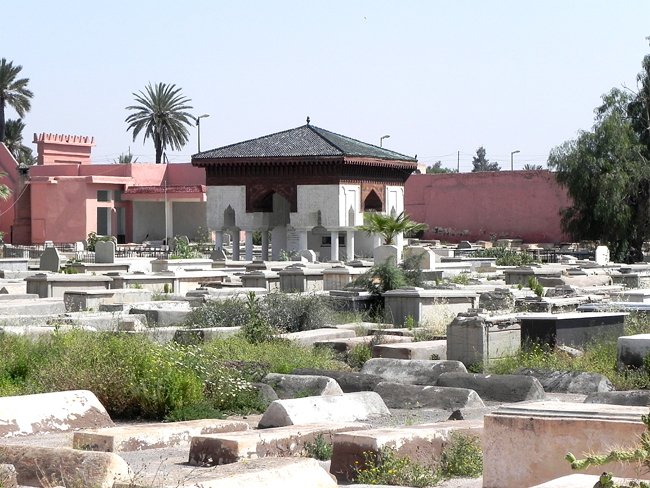
The cemetery’s layout adheres to traditional Jewish customs, with dedicated sections for men, women, and children. Most tombstones are whitewashed, with rounded tops and Hebrew inscriptions. Graves of Kohanim (Jewish priests) are marked with blue paint, believed to offer spiritual protection (Atlas Obscura; Visit Marrakech).
Artistic elements include:
- Mausoleums: Ornate structures with domed roofs, horseshoe arches, and colorful zellij tiles, blending Moroccan and Sephardic influences (World Jewish Travel).
- Tombstone Decorations: Hebrew calligraphy, Stars of David, menorahs, and geometric patterns symbolizing faith and identity.
- Spatial Organization: Narrow pathways and layered burials due to space constraints, with some graves stacked up to three deep (Albom Adventures).
Visiting Information
Location
- Address: Taoulat El Miara Street, Mellah district, southeastern edge of the medina, Marrakech.
- Proximity: Adjacent to the Lazama Synagogue and a 15-minute walk from Djemaa el Fna square (Wikipedia; Travelguide Marrakech).
Visiting Hours
- General: Open daily from 9:00 AM to 5:00 PM.
- Ramadan: Adjusted hours, typically 10:00 AM to 4:00 PM (Eternal Arrival).
- Last Entry: Usually 30 minutes before closing.
Tickets and Entrance Fees
- Adults: 100 dirhams (approx. $10 USD).
- Children under 12: 20 dirhams (approx. $2 USD).
- Donation: An additional voluntary donation of around 20 dirhams to the cemetery guardian is customary (Joao Leitão).
- Purchase: Tickets are available at the entrance from the guardian; no online ticket system.
Accessibility
- Terrain: Mostly flat but with some uneven areas due to the age and density of graves.
- Mobility: Limited wheelchair access; visitors with mobility challenges should plan accordingly.
- Transport: Accessible by foot, taxi, or public transport from the city center.
Guided Tours
- Informal tours: Offered by the cemetery guardian with valuable historical context.
- Organized tours: Available via agencies, often including the Mellah and Lazama Synagogue (Travelguide Marrakech; Albom Adventures).
Rituals and Visitor Etiquette
- Dress Code: Modest attire required. Men must cover their heads (kippahs are provided if needed); women should wear conservative clothing.
- Customs: Place a small stone on graves as a sign of respect. Wash hands at the fountain near the gate upon exiting to restore spiritual purity (Joao Leitão).
- Conduct: Keep conversations low, avoid touching graves, and seek permission before photographing revered tombs or during ceremonies.
- Photography: Generally permitted, but always check with the guardian.
Preservation and Community Involvement
Miara Cemetery’s upkeep is a joint effort between local Jewish families, Muslim caretakers, NGOs, and Moroccan authorities. Ongoing restoration focuses on stabilizing tombs, cleaning gravestones, and maintaining pathways, ensuring the site’s dignity and accessibility (Springer Link; Silverbackpacker).
Frequently Asked Questions (FAQ)
Q: What are the visiting hours?
A: Daily from 9:00 AM to 5:00 PM; during Ramadan, 10:00 AM to 4:00 PM.
Q: Is there an entrance fee?
A: Yes. 100 dirhams for adults, 20 dirhams for children under 12, plus a small donation for the guardian.
Q: How do I get there?
A: 15-minute walk from Djemaa el Fna or a short taxi ride. Located on Taoulat El Miara street in the Mellah.
Q: Are guided tours available?
A: Yes. The guardian provides informal tours; organized Jewish heritage tours can be booked through city agencies.
Q: Is the cemetery accessible to wheelchair users?
A: Accessibility is limited due to uneven terrain.
Q: Can I take photos?
A: Yes, but always ask before photographing sacred graves or ceremonies.
Tips for a Meaningful Visit
- Allocate 45 minutes to an hour for your visit.
- Respect all customs, including head covering and modest dress.
- Participate in traditions such as placing a stone on a grave.
- Combine your visit with the nearby Lazama Synagogue and a stroll through the Mellah for a fuller understanding of Jewish heritage in Marrakech.
- Wash your hands at the designated fountain before leaving the cemetery.
Listen to the full story in the app
The whole Jewish Cemetery Of Marrakech,
told well.
Audio guides for 1,100+ cities across 96 countries. History, stories, and local insight — offline ready.
Verified, and shown.
Researched and written by the Audiala editorial team from historical records, architectural archives, and local expertise.
Researched from Wikidata, Wikipedia & official sources · fact-checked · How we make our guides →