


Place
Marrakech
Morocco Updated Apr 2026
The first thing that hits you in Marrakech isn't the heat. It's the percussion. At dusk, as the Koutoubia's 77-meter sandstone minaret catches the last light, Jemaa el-Fnaa square transforms into something that shouldn't logically exist: gnawa drummers laying down trance rhythms, snake charmers coaxing cobras from baskets, and the sizzle of lamb-fat smoke rising from a hundred makeshift kitchens, all competing for the same patch of ground they've occupied since the 11th century. Morocco's most electrifying city doesn't just tolerate chaos — it built a civilization on it.
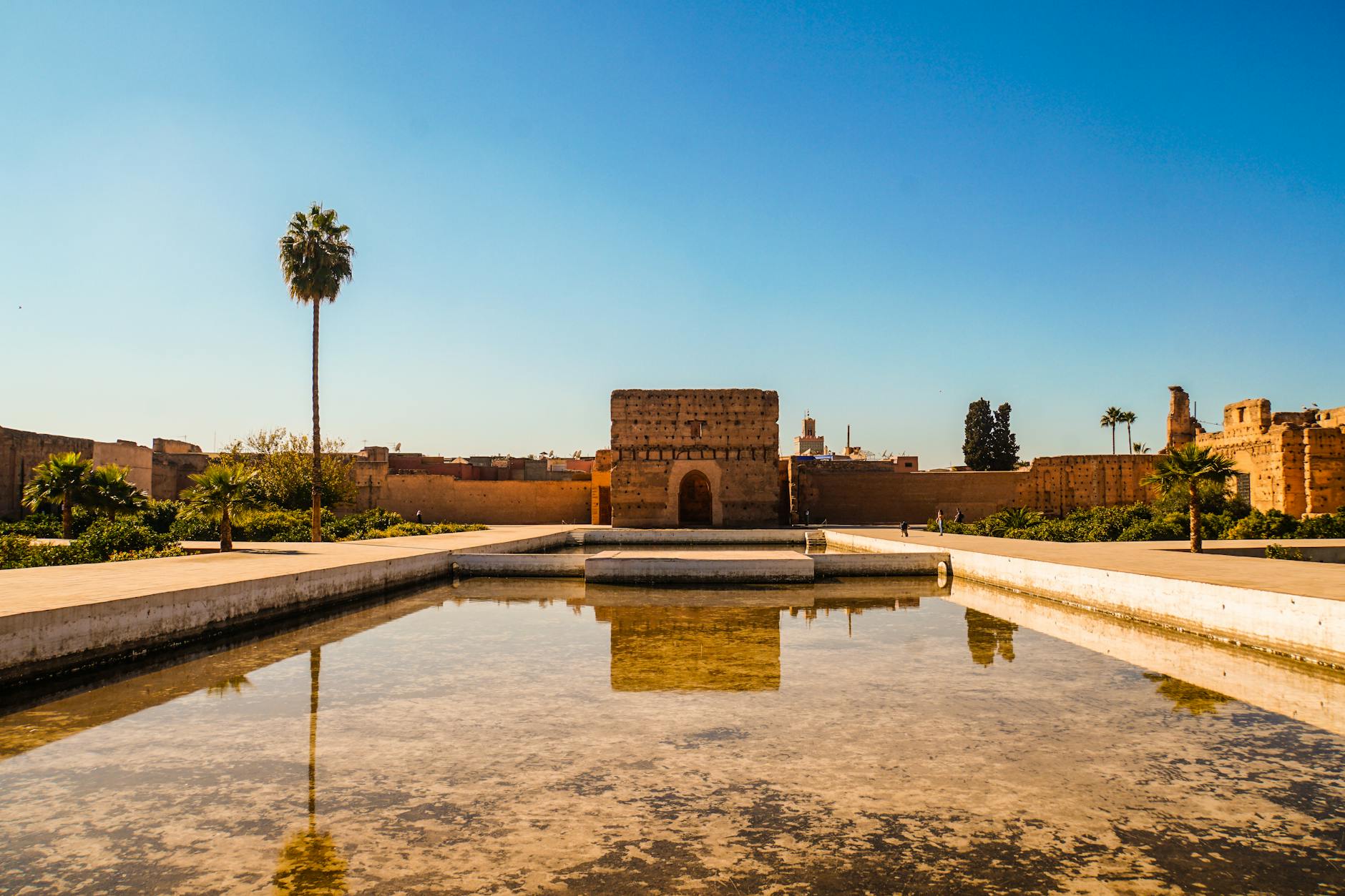 Photo: Domenico Bertazzo / Pexels
- Attractions
- 12
- Trip length
- 3-5 days
- Best season
- Spring (Mar-May) or Autumn (Sep-Nov)
Why Marrakech
Built from cited sources · see the method · How we make our guides →
Founded between 1070 and 1072 by the Almoravid dynasty, Marrakech spent centuries as the capital of an empire that stretched from sub-Saharan Africa to Andalusia. The 700-hectare medina still operates on that medieval logic — a labyrinth where donkeys haul goods past fondouks that haven't changed function in 600 years. But calling it a living museum misses the point: this is a city where 12th-century infrastructure still serves breakfast.
Step outside the rose-red ramparts and you hit Gueliz, the Ville Nouvelle laid out by the French in 1912. Here, the city sheds its costume. On Rue Mohammed El Beqal, you'll find Baromètre, a speakeasy that cracked the World's 50 Best Bars list, and Farmers, where Chef Driss Aloui plates vegetables grown at his farm 40 minutes outside town — the restaurant landed on MENA's 50 Best in 2026. The real Marrakech lives in this tension: ancient and hyper-contemporary, sometimes on the same block.
The city's signature dish, tanjia, tells you everything about its character. Unlike the better-known tagine, tanjia is an emphatically male tradition — lamb or beef sealed in an amphora-shaped clay urn and buried in the embers of a hammam furnace for five to eight hours. You find it in Mechoui Alley, a narrow white-tiled lane off Souk Semmarine where the lamb emerges from underground pits around noon and sells out by 2 PM sharp. Get there late and you get nothing. Marrakech does not wait for you.
Jemaa el-Fnaa: The Square That Refuses to Be a Monument
UNESCO didn't list a building here — it listed a performance. Snake charmers, henna artists, storytellers, and smoke rising from a hundred food stalls create something no museum can hold. Arrive at sunset, when the call to prayer from the Koutoubia collides with the first sizzle of merguez on the grill.The Geometry of Obsession
Marrakech perfected the art of turning constraint into transcendence. Because Islam prohibits figural representation, craftsmen poured their genius into zellij — thousands of hand-cut clay tiles assembled into eight-pointed stars and interlocking polygons — and into carved plaster so fine it looks like frozen lace. The palette tells its own story: cobalt for protection, saffron for light, emerald for paradise.Gueliz: The Other Marrakech
A few kilometers north of the medina, the French-built ville nouvelle has quietly become one of Africa's most serious contemporary art hubs. MACAAL's pan-African collection and the cluster of galleries around Gueliz operate in a different register entirely — less about what Marrakech was, more about what it's becoming. LE 18, a residency space in the medina, bridges both worlds.Forty-Five Minutes to Another Planet
The High Atlas rises so abruptly from the plain that you can be drinking mint tea in the medina at 9am and standing at 1,800 meters by 10. Ourika Valley's Berber villages and Setti Fatma waterfalls are the classic half-day fix. For the real thing, Imlil puts you at the trailhead of Jbel Toubkal — North Africa's highest peak at 4,167 meters.
Places to Visit
Not every monument, just the ones we'd walk you past ourselves.
Neighborhoods
Where to wander, by quarter — each with its own rhythm.
Medina
The old city is the reason you came. Seven hundred hectares of alleys too narrow for cars, where every turn confronts you with something — a mule loaded with cement bags, a 14th-century fountain still flowing, a carpet seller who's been on the same corner since 1973. Jemaa el-Fnaa anchors it all, but the real texture is in the souks radiating outward: metalworkers clanging in one lane, dyers up to their elbows in indigo vats two streets over. At night, rooftop terraces like Atay Café and Le Salama look out over a city that hasn't changed its skyline since the Almohads built the Koutoubia in the 12th century. The medina is also where you'll find the Ben Youssef Madrasa — once home to 900 students, its courtyard a riot of zellige geometry and carved cedar, reopened after restoration with an entrance fee of 50 MAD for foreigners.Kasbah
The southern end of the medina, calmer and more residential, anchored by two royal ruins that embody opposite extremes of display and decay. El Badi Palace, built by Sultan Ahmad al-Mansur in the 16th century, is now a vast sunken courtyard of ochre walls where storks nest on the ramparts — entry costs 70 MAD and late afternoon light turns the whole place to gold. A few minutes' walk away, the Saadian Tombs lay hidden behind a wall until aerial photography rediscovered them in 1917. Arrive at the 9 AM opening and you'll have the intricate cedar and Carrara-marble mausoleums almost to yourself. The green-tiled minaret of the Moulay El Yazid Mosque marks the neighborhood's center; follow the wall south for the least-touristed stretch of the ramparts.Mouassine
A 16th-century quarter deep in the medina, built by the Saadians as a self-contained religious and commercial complex around a mosque, a fountain, and a hammam. Today its crown jewel is Le Jardin Secret, a restored 19th-century riad with two gardens — one a formal Islamic char bagh, the other an exotic planting — and a working khettara irrigation system you can actually see channeling water underground. The tower gives you one of the best medina panoramas that doesn't require a café terrace. The surrounding streets hum with artisan workshops that have outlasted every dynasty.Gueliz
The Ville Nouvelle, plotted by the French Protectorate in 1912, is where Marrakech exhales. Avenue Mohammed V runs the spine — wide, tree-lined, drivable — past the 1925 Grand Café de la Poste, still pouring wine under ceiling fans a century later. This is where the city's creative class actually lives and drinks. Baromètre on Rue Mohammed El Beqal serves cocktails built around Moroccan ingredients (80–150 MAD), while Kechmara does a 50% happy hour from 6 to 7:30 PM on its rooftop. The Yves Saint Laurent Museum and the cobalt-blue Jardin Majorelle sit right at the district's edge. On Thursdays, Ladies Night takes over the bars; by Saturday, everything fills after 9 PM. Gueliz isn't an escape from Marrakech — it's Marrakech without the costume.Hivernage
The luxury district south of Gueliz, built around wide boulevards, five-star hotels, and the kind of nightlife that requires a dress code. La Mamounia's Le Bar Churchill pours old-world cocktails under the gaze of a pianist. Theatro, next to the casino, splits across two rooms — techno and rap in one, disco and house in the other — with entry around 250 MAD including a drink. Comptoir Darna has been doing the belly-dancer dinner-show circuit for decades. It's polished, international, and priced accordingly. If Gueliz is where Marrakech actually goes out, Hivernage is where it goes to be seen going out.Sidi Ghanem
This industrial zone north of the city center is the least touristy neighborhood on the list — and the one where Marrakech's design renaissance is actually happening. Ceramics studios, leather workshops, and concept stores have colonized the warehouses. LRNCE makes the hand-painted ceramics and textiles you'll later see on Instagram. Topolina and Chabi Chic run showrooms here too. There's no pedestrian charm, no ancient walls, no rooftop terraces. What there is: the source. Come on a weekday morning, bring cash, and expect to negotiate directly with the makers.Palmeraie
The palm grove stretching north of the city was planted by the Almoravids nearly a thousand years ago — 13,000 hectares of date palms that once made Marrakech an oasis in the plain. Today it's a spread-out resort zone of private villas, pool clubs, and higher-end riad conversions where the city's noise simply doesn't reach. It's not walkable, you'll need a taxi or driver, and restaurant options are thin compared to the center. But for a day of sun and silence after three days in the medina, the trade-off makes sense.
Plan your trip
Before you go
- Getting There
- Marrakech Menara Airport (RAK) sits just 6 km southwest of the medina — a 15-minute ride in light traffic. The L19 express bus runs every 20–30 minutes from roughly 6:30 to 23:30, connecting the airport to Jemaa el-Fnaa and Gueliz for 30 MAD return. Keep your ticket for the trip back. Petits taxis (beige) cluster at the rank; expect to pay 55–95 MAD to the medina, but agree the price before getting in — drivers at RAK are notorious for refusing the meter. No train station serves the airport directly; the main rail station, Marrakech Station, connects to Casablanca and Fes from a separate location in Gueliz.
- Getting Around
- No metro. No tram. Marrakech gets you around on foot, by petit taxi, or not at all. The medina is a 700-hectare pedestrian labyrinth where Google Maps will fail you — carry your riad's business card in Arabic and French, and accept that getting lost is the price of admission. Petits taxis (beige, max 3 passengers) are metered and cheap (10–30 MAD for short hops) but cannot enter the medina interior; they'll drop you at the nearest gate. ALSA city buses exist but are overcrowded and rarely worth the trouble. The Marrakech City Pass (sold via Ticketbar) bundles hop-on hop-off bus access with selected attractions, useful if you're shuttling between Majorelle, Menara Gardens, and Gueliz without haggling for taxis.
- Climate & Best Time
- Marrakech occupies a semi-desert basin at 460 meters, with day-night temperature swings that catch visitors off guard. March through May and September through November are the sweet spots — daytime highs of 20–30°C, nights cool but not cold, brief showers possible in March and November. Summer (June–August) is punishing: 35–37°C and often higher, with the hours between noon and 4pm best spent indoors or in a hammam. Winter days hover at 18–20°C but nights can drop to 5°C — pack layers. The city essentially shuts down for outdoor tourism in July and August; May and October are the best individual months. Brief rain falls October through May, almost never as an all-day event.
- Language & Currency
- Darija (Moroccan Arabic) and French dominate. French is your most reliable second language in restaurants, riads, and shops; English is growing but don't count on it in the souks. A firm 'La, shukran' (no, thank you) politely declines vendors better than silence ever will. The Moroccan dirham (MAD) is a closed currency — you cannot obtain it before arrival and cannot export significant amounts. Withdraw from ATMs at the airport or exchange cash on arrival. Cash is king: souks, taxis, street food, and small cafés are cash-only. Credit cards work at upscale hotels and restaurants. Always carry small denominations — no taxi driver ever has change for a 200 MAD note.
- Safety
- Marrakech is generally safe, but the scam economy is sophisticated and relentless. Fake guides will insist your street is closed and offer to redirect you — usually into a carpet shop. Jemaa el-Fnaa's snake charmers and henna artists will demand payment for photos you didn't ask for. In the souks, aim to bargain down to 30–50% of the opening price. Solo women should dress modestly (shoulders and knees covered), avoid eye contact with harassers, and stick to main arteries after dark. The medina's quiet alleyways at night are not for walking alone. Taxi meter refusal is common at the airport — fix the price first. Tourist police (dial 09) exist and speak some English, but you'll solve most problems by walking away firmly.
A City Shaped by Empire and Red Clay
From an Almoravid encampment to a global crossroads
- c. 1070
Almoravid Camp Becomes a Capital
On the dusty Haouz plain, Almoravid warriors pitch tents by the Tensift River. Abu Bakr ibn Umar orders the construction of Ksar el-Hajar, a stone fortress on the site where the Koutoubia will one day rise. Within a year, his cousin Yusuf ibn Tashfin seizes the reins and transforms the camp into Marrakech — a capital stitched together from red pisé clay and Saharan ambition. The city will lend its name to an entire country.
- 1071
Yusuf ibn Tashfin, the City's Iron Founder
A warrior emir from the Sahara, Yusuf ibn Tashfin was the real architect of Marrakech as a seat of power. Under his command, tents gave way to permanent earthen architecture and the dusty camp became the Almoravid capital. He would go on to unite Morocco and al-Andalus, halting the Christian Reconquista at the Battle of Sagrajas in 1086. His disciplined vision turned a military outpost into an imperial center.
- 1120
Ochre Walls Close Around the City
Emir Ali ibn Yusuf orders the first defensive ramparts for Marrakech, encircling the expanding settlement with walls of rammed red earth. Stretching roughly 19 kilometers and towering above the palm groves, these walls gave the city its enduring nickname — al-Hamra, 'the Red One.' They still define the medina's edge today, baked by centuries of sun.
- 1147
Almohad Swords Shatter the Almoravids
After a long siege, the Almohad army under Abd al-Mu'min storms Marrakech and puts the last Almoravid ruler, Ishaq ibn Ali, to the sword. The city is purged, its monuments partly razed, and a new Berber dynasty takes the throne. What follows is Marrakech's first true golden age as an imperial capital of the Islamic West.
- 1197
The Koutoubia Minaret Spears the Sky
Caliph Yaqub al-Mansur completes the Koutoubia Mosque, a sandstone giant whose 77-metre minaret dominates the Marrakech skyline. Its proportions are so perfect that sister towers will later rise in Seville and Rabat. Non-Muslims cannot enter, but the sound of the muezzin rolling across Jemaa el-Fna at sunset is a memory that clings to the skin.
- 1198
Averroes Breathes His Last in Marrakech
Ibn Rushd — known to Europe as Averroes — dies in Marrakech, where he served the Almohad court as physician and judge. His commentaries on Aristotle will ignite debates in Paris and Bologna for centuries. The philosopher's body is later moved to Córdoba, but the city of his final years remains a quiet intellectual crossroads of the medieval world.
Show the full timeline (27 moments)
- 1256
A Mathematician Is Born in the Shadow of the Minaret
Ibn al-Banna' al-Marrakushi enters the world as Almohad power crumbles. His texts on algebra and arithmetic — especially the Talkhīṣ aʿmāl al-ḥisāb — will be studied from Fez to Damascus. He is a reminder that even in decline, Marrakech could produce minds that rippled far beyond the red walls.
- 1269
The Marinids Steal the Crown for Fez
Berber Marinid forces capture Marrakech and immediately demote it. The capital moves north to Fez, and Marrakech slips into a long provincial slumber. For two centuries, the red city will be a secondary stage, its monuments neglected, its political weight dramatically diminished.
- 1558
The Mellah Takes Shape
The Saadian sultan formalizes the Jewish quarter — the Mellah — in the Kasbah district, concentrating the city's considerable Jewish community in a walled enclave near the royal palace. Synagogues, markets, and foundries hummed within, and the Mellah became an economic engine for Marrakech well into the 20th century.
- 1565
Ben Youssef Madrasa Reborn in Tile and Cedar
The Saadians rebuild the Ben Youssef Madrasa into the largest Quranic university in the Maghreb. Its central courtyard is a fever dream of zellige tilework, carved stucco, and dark cedar — 900 students once slept in the tiny cells that ring it. No tripods allowed, but the light alone is enough.
- 1578
Ransom Gold Builds 'The Incomparable'
At the Battle of Alcácer Quibir, Saadian Sultan Ahmad al-Mansur destroys the Portuguese army and kills King Sebastian. The ransom from captured nobles floods Marrakech with gold, and al-Mansur breaks ground on El Badi Palace — a pleasure dome of Italian marble, Sudanese gold, and sunken gardens. It will take 25 years and bankrupt the empire to finish.
- 1578
Ahmad al-Mansur, the Golden Sultan
Al-Mansur ascended the throne the same year he crushed the Portuguese, and he ruled Marrakech as a cultural colossus. He sent ambassadors to Elizabeth I of England, imported Italian marble by the ton, and in 1591 dispatched an army across the Sahara to sack Timbuktu. His Saadian Tombs remain the most exquisite royal necropolis in Morocco — sealed for centuries and rediscovered only in 1917.
- 1591
Caravans of Gold Arrive from Timbuktu
Judar Pasha's army crosses the Sahara and conquers the Songhai Empire, returning with camels heavy with gold, slaves, and ivory. The windfall finances al-Mansur's extravagant building spree and cements Marrakech's reputation as a city of impossible wealth. For a few decades, the red walls glittered.
- 1672–1675
Moulay Ismail Strips the Palaces
The Alaouite sultan Moulay Ismail crushes a rebellion in Marrakech and then methodically dismantles El Badi Palace. Marble columns, gold leaf, and carved cedar are carted north to decorate his new capital at Meknes. What remains is a haunting ruin — vast empty courtyards, storks nesting on ramparts, and the ghost of splendour.
- 1866
A Vizier's Dream: Bahia Palace Begins
Grand Vizier Si Moussa starts building a palace of intimate courtyards and painted ceilings in the medina. His son Ba Ahmed will expand it dramatically into the Bahia — 'the Brilliance.' The palace is a maze of zellige, stained glass, and cool marble, designed to house four wives and two dozen concubines. It opens at 8 a.m.; arrive early or lose it to the tour buses.
- 1910
Dar El Bacha Rises for the Glaoui
Thami El Glaoui, soon to be Pasha of Marrakech, builds a palace of dizzying tilework and painted wood. Dar El Bacha will host Winston Churchill, Charlie Chaplin, and a half-century of colonial intrigue. Today it's the Museum of Confluences — the carved doors alone are worth the 70-dirham entry.
- 1912
Thami El Glaoui: Lord of the Atlas
With the French protectorate established, Thami El Glaoui becomes Pasha of Marrakech for the next 44 years. He rules southern Morocco like a personal fiefdom, collaborating with the colonial power while entertaining the world's elite. His later complicity in exiling Sultan Mohammed V in 1953 would seal his disgrace.
- March 1912
The Treaty of Fez and the French Shadow
Sultan Abd al-Hafid signs the Treaty of Fez, handing Morocco to France as a protectorate. Marshal Lyautey soon enters Marrakech and commissions the Gueliz, a European ville nouvelle of wide boulevards and palm-lined squares outside the old walls. The medina and the new town still eye each other warily across Avenue Mohammed V.
- 1928
Jacques Majorelle Plants an Ultramarine Dream
French painter Jacques Majorelle acquires land near the palm grove and begins transforming it into a botanical garden of cacti, bamboo, and cobalt-blue walls. The garden becomes his life's work and, later, an obsession for Yves Saint Laurent. That particular shade — bleu Majorelle — is now trademarked, and impossible to forget.
- January 1943
Churchill Paints the Atlas from La Mamounia
After the Casablanca Conference, Winston Churchill retreats to Marrakech with Franklin Roosevelt in tow. Standing on the balcony of La Mamounia, Churchill sets up his easel and paints the snow-capped High Atlas at sunset, calling it 'the most lovely spot in the whole world.' The visit seals Marrakech's reputation as a winter playground for the powerful.
- March 1956
Independence and the Glaoui's Fall
Morocco regains its sovereignty after 44 years of French rule. Thami El Glaoui dies in disgrace just days before independence is formalized, his legacy as a collaborator tarnishing his memory. Marrakech, no longer a colonial capital, begins a slow reinvention as the country's cultural lodestar.
- 1966
Yves Saint Laurent Meets His Muse
The young French couturier visits Marrakech with Pierre Bergé and is overwhelmed by the light, the colour, the chaos of Jemaa el-Fna. He will return every year, eventually buying the neglected Majorelle Garden in 1980 and saving it from demolition. His ashes now rest there, scattered among bamboo and bougainvillea.
- 1985
UNESCO Crowns the Medina
The Medina of Marrakech is inscribed on the UNESCO World Heritage List, recognizing its labyrinth of souks, palaces, and mosques as an irreplaceable monument of human civilization. The designation brings global attention and a flood of visitors — for better and worse.
- 2001
Jemaa el-Fna Becomes a Masterpiece
UNESCO proclaims the oral traditions of Jemaa el-Fna a Masterpiece of the Oral and Intangible Heritage of Humanity. Storytellers, snake charmers, and Gnaoua musicians earn recognition not as tourist spectacle but as living culture — a rare triumph for a square that never stops performing.
- 28 April 2011
A Bomb Shatters Café Argana
A terrorist attack on a café overlooking Jemaa el-Fna kills 17 people, mostly foreign tourists, and wounds dozens more. It is the deadliest assault on Moroccan soil since 2003 and a brutal interruption of the square's nightly rhythm. The café was rebuilt, but the memory lingers in tightened security and lowered voices.
- November 2016
COP22 Brings the World to the Red City
Marrakech hosts the United Nations climate conference, with tens of thousands of diplomats descending on the Palmeraie. The summit, held in temporary structures near the Bab Ighli gate, underscores Morocco's ambition to be a bridge between continents — and Marrakech's ability to stage global events on short notice.
- 8 September 2023
The High Atlas Earthquake Shakes Marrakech
A magnitude-6.8 earthquake rips through the High Atlas 71 kilometres southwest of the city, killing nearly 3,000 people nationwide and damaging the Koutoubia minaret, the Kharbouch Mosque, and countless medina homes. The tremor is felt in Jemaa el-Fna, where panicked crowds scatter. Reconstruction is slow, but the red walls still stand.
Who lived here
-
Almoravid Emir · c. 1009–1106
Yusuf ibn Tashfin
Co-founded Marrakech around 1070
He laid the first stones of Marrakech as a desert camp in 1070, turning it into an imperial capital that controlled territory from Senegal to Spain. Walk the old medina walls and you're tracing the boundaries he drew. The city's still defined by the cross-continental ambition of a Berber dynasty that began with him.
-
Philosopher & Physician · 1126–1198
Averroes (Ibn Rushd)
Died here while serving the Almohad court
The greatest Islamic philosopher of the Middle Ages spent his final years in Marrakech, writing commentaries on Aristotle that would later ignite the European Renaissance. The city that served as his gilded exile now honors him with street names and a university—a quiet legacy for a thinker who transformed two civilizations.
-
Maliki Scholar & Saint · 1083–1149
Qadi Ayyad
One of the Seven Saints of Marrakech; venerated here
His tomb, part of the city's sacred geography, draws pilgrims who consider him the spiritual protector of Marrakech. The university bearing his name trains today's jurists a millennium after his book on the Prophet became a staple of Islamic scholarship.
-
Mathematician & Astronomer · 1256–1321
Ibn al-Banna al-Marrakushi
Born here; studied and taught in Marrakech
In a city of storytellers and spice merchants, he crunched numbers that advanced algebra and designed astronomical tables used for centuries. The 'Marrakech' in his name is a reminder that medieval science thrived not just in Baghdad but on these very streets.
-
Almohad Caliph · 1160–1199
Yaqub al-Mansur
Ruled from Marrakech; completed the Koutoubia Mosque
He stamped his ambition on three continents: the Koutoubia minaret you see today, the Giralda in Seville, the unfinished Hassan Tower in Rabat. A victor in battle, he turned Marrakech into the intellectual and architectural capital of the Almohad empire.
-
First Almohad Caliph · c. 1094–1163
Abd al-Mu'min
Conquered Marrakech in 1147 and made it his capital
He stormed the Almoravid stronghold, ordered its mosques purified, and turned Marrakech into the launchpad of a new empire. The city you walk today still bears the stamp of the Almohad transformation he initiated.
-
Almoravid Emir · c. 1084–1142
Ali ibn Yusuf
Ruled from Marrakech and enriched its architecture
Under his rule, Andalusian craftsmen flowed into Marrakech, weaving intricate zellij and stucco into the city's fabric. His reign saw the medina blossom as a courtly paradise, though his dynasty would fall soon after his death.
-
Last Almoravid Ruler · ?–1147
Ishaq ibn Ali
Died defending Marrakech during the Almohad siege
When the Almohad army breached the walls, he fought to the death in the palace his ancestors built. His final stand marked the end of the Almoravid experiment and the birth of a new imperial era—one that would give Marrakech its iconic minaret.
Where to Eat
Where locals actually book dinner — not the tourist menus.
-
Tanjia
Not a typo. Tanjia is the Marrakchi bachelor's answer to tagine — lamb, preserved lemon, cumin, and saffron sealed in a clay urn and slow-cooked for hours in the embers of a hammam furnace. It's a dish cooked almost exclusively by men, for men, and you'll find it at unmarked restaurants populaires far from the Jemaa el-Fnaa tourist strip. The meat collapses at the touch of a spoon.
-
Mechoui Alley (Rue Rmila)
Just off the main square, a narrow lane houses open-fronted stalls where whole lambs emerge from underground clay ovens. The countermen pull the meat apart with their hands, pile it onto brown paper with cumin and salt, and hand it over before you've finished paying. Go before 1pm — the best stalls sell out by early afternoon. Nothing else in Marrakech tastes this primal.
-
Harira at Sunset
During Ramadan, the cannon fires at sunset and the entire city breaks its fast with this chickpea, lentil, and tomato soup. But you'll find it year-round at stalls around the square, where it arrives steaming, often with a sticky date-and-honey pastry called chebakia on the side. The version at stall No. 14 (look for the queue) is worth whatever wait you endure.
-
Babbouche (Snail Soup)
Small carts around Jemaa el-Fnaa serve bowls of snails bobbing in a broth spiced with licorice root, thyme, and pennyroyal. It's earthy, slightly medicinal, and warmer than you expect. Locals swear by it as a digestive. Tourists either fall in love or recoil visibly. There's no middle ground, and that's the point.
-
Street-Food Forklore: Merguez & Fried Liver
Stall No. 31 in the Jemaa el-Fnaa evening encampment has been dishing spiced lamb sausages and cumin-dusted liver sandwiches for decades. The theatrics — skewers sizzling, smoke billowing, vendors shouting their stall numbers — are part of the meal. A sandwich costs around 25 MAD. You'll eat it standing, grease running down your wrist, surrounded by strangers who feel like co-conspirators.
-
The Mint Tea Pause
Calling it tea undersells it. Gunpowder green tea, fistfuls of fresh nana mint, and enough sugar to make a dentist weep — poured from height to produce a foamy head. It's the lubricant of every transaction in the medina, from buying a carpet to asking directions. Refusing a glass can genuinely cause offense. Accept it. The ceremony matters more than the caffeine.
-
Tagine, Done Right
Yes, tagine is the obvious recommendation. But most tourist restaurants serve sugary, one-dimensional versions. Seek out a home-cooked one through a riad dinner or find Chez Lamine Hadj Mustapha in the Mellah, where the chicken tagine with preserved lemon and olives has been honed over generations. The conical clay lid traps steam so the meat braises in its own juices — nothing dries out, nothing burns, and the olives melt into the sauce.
-
Sfenj (Moroccan Doughnuts)
Early mornings in the medina, you'll spot men frying rings of unsweetened yeast dough in bubbling oil, then stringing them onto palm fronds. Sfenj are crispy outside, airy inside, and cost about 1 MAD each. Eat them immediately, preferably while the morning light is still soft and the alleyways haven't filled with scooters. Dip in honey or just dust with sugar. Either way, order at least two.
Insider tips
Small things that change how the city treats you.
Gueliz Over Hivernage
For a real night out, head to Gueliz where locals drink. Cocktails cost 50-80 MAD vs 100+ MAD in Hivernage clubs.Eat Tanjia, Not Tagine
Tanjia is Marrakech's signature: beef or lamb slow-cooked in an urn buried in hammam embers. Find it in Mechoui Alley off Souk Semmarine.Friday is Couscous Day
Moroccan families serve couscous after Friday prayer. Most traditional restaurants only offer it that day—plan accordingly.Mechoui Alley Closes Early
The underground lamb roasts sell out by 2pm. Go for lunch, not dinner.Tip Cash, Not Card
Even if you pay by card, leave tips in dirhams. A few coins at street stalls or rounding up in cafés is standard.Cover Shoulders & Knees
In the medina, modest dress reduces hassle and shows respect. In Gueliz bars, casual is fine; Hivernage clubs demand elegance.Sunset Transforms the Square
Jemaa el-Fnaa shifts from snake charmers to sizzling food stalls as dusk falls. Arrive an hour before sunset to watch the metamorphosis.
Gallery
The city, as it actually looks.


Watch
-
Tales From The Road Traveling to MARRAKECH in 2025? You Need to Watch This Travel Guide!
-
Finding Gina Marie – Travel the World MARRAKECH: Things to know as a first-time visitor to Morocco
-
Sammy and Tommy Eating Our Way Through Marrakech, Morocco (the most unique food tour we've ever done)
-
Warsaw Daytrips Top 15 Thing to Do in Marrakech, Morocco (2026 Guide)
Frequently asked
Is Marrakech worth visiting?
Absolutely. Its UNESCO-listed medina is one of the world's great urban labyrinths, Jemaa el-Fnaa morphs into an open-air theatre each sunset, and the food—from slow-cooked tanjia to rooftop cafés in Gueliz—makes every meal an event. Few cities blend 900 years of history with such raw energy.
How many days do you need in Marrakech?
Three to five days lets you explore the medina, visit palaces, eat through the street food scene, and take a day trip to the Atlas Mountains or Essaouira. Any shorter and you'll miss the city's rhythm.
Is Marrakech safe for tourists?
Generally yes, but scams and petty theft are common. Keep valuables secure in the medina, ignore aggressive touts, and avoid poorly lit alleys at night. Dressing modestly also reduces unwanted attention.
What to eat in Marrakech?
Beyond tagine, seek out tanjia—Marrakech's signature slow-cooked meat dish sold in Mechoui Alley—and stroll Jemaa el-Fnaa for snail soup, merguez, and harira. Friday is couscous day; many restaurants only serve it then.
Can you drink alcohol in Marrakech?
Yes, in licensed bars, restaurants, and hotels. Gueliz has the best local bar scene; Hivernage offers pricier clubs. Alcohol is not sold in medina souks, and drinking in public is illegal.
What is the best time to visit Marrakech?
Spring (March–May) and autumn (September–November) bring pleasant temperatures. Summer is scorching; winter nights can be chilly. Ramadan transforms the city—restaurants close by day but nights buzz with festive energy.
How far is Marrakech from the beach?
The Atlantic coast town of Essaouira is a 2.5-hour drive west. It's a popular day trip for fresh seafood, a UNESCO-listed medina, and windsurfing.
All Places to Visit.
1 place to discover
Pick up where you left off
Saved and recently read places — kept on this device only.
Photo credits (7)
- Domenico Bertazzo — Pexels License (https://www.pexels.com/license/) — Source: https://www.pexels.com/photo/15260622/
- Maroc Marrakech Jemaa-el-Fna Luc Viatour — No machine-readable author provided. Lviatour assumed (based on copyright claims). — CC BY-SA 3.0 (https://creativecommons.org/licenses/by-sa/3.0/) — Source: https://commons.wikimedia.org/wiki/File:Maroc_Marrakech_Jemaa-el-Fna_Luc_Viatour.JPG
- MARROCOS-2015-Marraquexe-Safim,Marrakech — WIKINABO — CC BY-SA 4.0 (https://creativecommons.org/licenses/by-sa/4.0/) — Source: https://commons.wikimedia.org/wiki/File:MARROCOS-2015-Marraquexe-Safim,Marrakech.png
- Marrakech (1983) 30 — LBM1948 — CC BY-SA 4.0 (https://creativecommons.org/licenses/by-sa/4.0/) — Source: https://commons.wikimedia.org/wiki/File:Marrakech_(1983)_30.jpg
- Marrakech (1983) 29 — LBM1948 — CC BY-SA 4.0 (https://creativecommons.org/licenses/by-sa/4.0/) — Source: https://commons.wikimedia.org/wiki/File:Marrakech_(1983)_29.jpg
- Villa Marrakech - panoramio — Les jardins de Touhi… — CC BY-SA 3.0 (https://creativecommons.org/licenses/by-sa/3.0/) — Source: https://commons.wikimedia.org/wiki/File:Villa_Marrakech_-_panoramio.jpg
- Marrakech Prefecture (27938511663) — Thomas Woodtli from Zürich, Switzerland — CC BY-SA 2.0 (https://creativecommons.org/licenses/by-sa/2.0/) — Source: https://commons.wikimedia.org/wiki/File:Marrakech_Prefecture_(27938511663).jpg
Photos may have been resized or cropped.