
Dar Al-Makhzen Fez
FezMorocco 34° N · 5° W Verified Aug 2026
The 80-hectare royal palace of Fez still hides courtyards, gardens and a private mosque behind its famous golden gates—entirely closed to the general public.
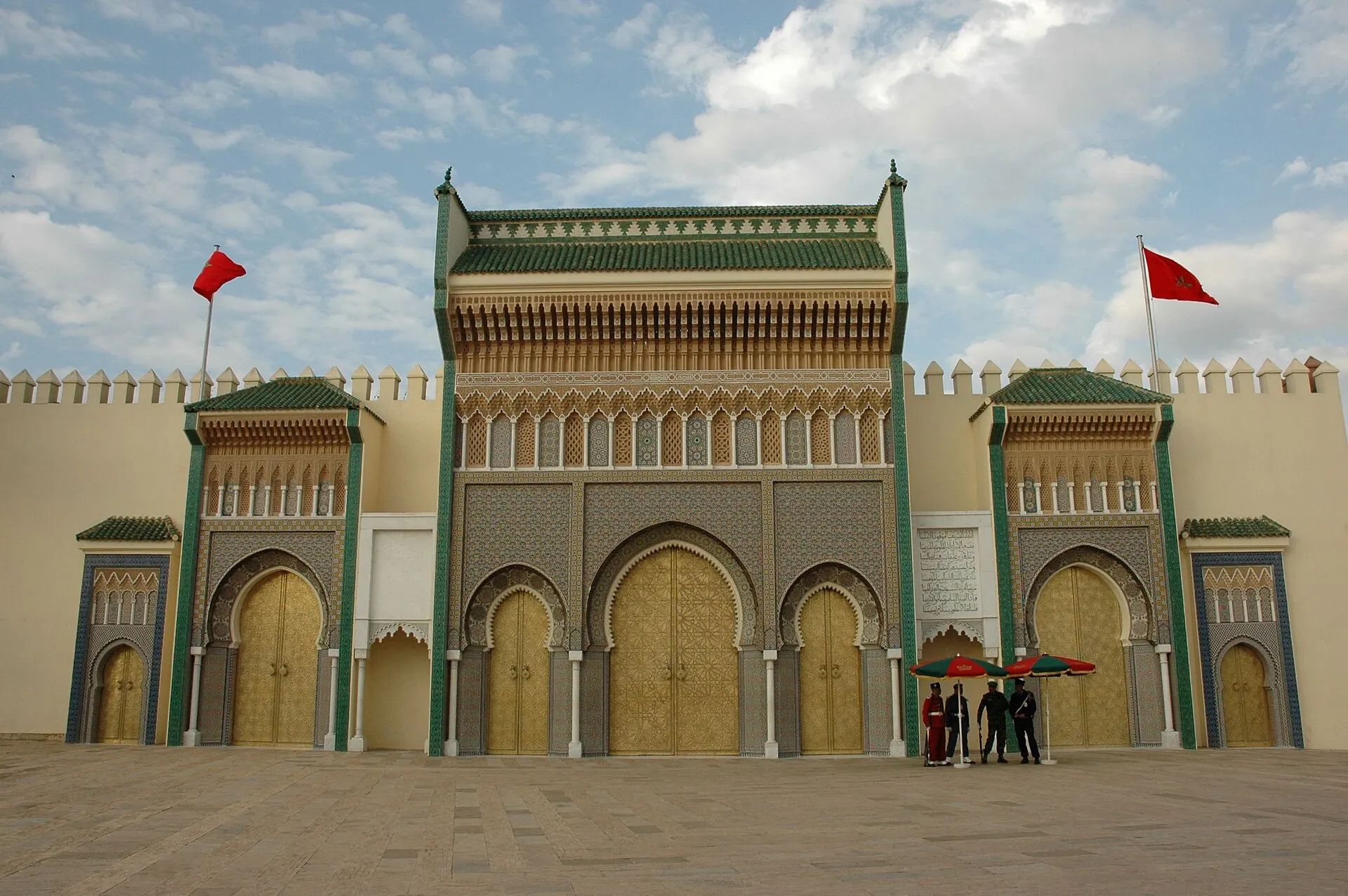 Photo: Josep Renalias · CC BY-SA 3.0
- Time needed
- 30 minutes
- Entry
- Free
The most dazzling gateway in Fez belongs to a palace you will never be invited through. Dar al-Makhzen, the Royal Palace of Fez in Morocco, has kept its courtyards out of public reach for nearly seven and a half centuries. You come for the gates, the walls, and the old question of what actually happens inside.
Records show that the palace began in 1276 as part of Fes el-Jdid, a new royal city built by the Marinid sultan Abu Yusuf Ya'qub ibn Abd al-Haqq. He wanted a fortified seat outside the old medina, Fes el-Bali, whose guilds and scholars were famously independent. That defensive instinct still shapes the blank ramparts and wide mechouar squares today.
What visitors actually see is mostly from later centuries, especially Alaouite rebuilding and 20th-century gates on the Place des Alaouites. The palace remains closed to the public, so the experience is entirely exterior: brass glinting against cedar, tilework set high above the crowd, and guards who let the silence do the talking.
What to see
-
The Golden Gates at Place des Alaouites
The first thing you notice isn't the gold — it's the silence. Place des Alaouites opens up after the medina's alleys, and the empty square makes the gates feel ceremonial, the brass doors shifting from deep bronze to blinding gold as the sun moves across blue and green zellige cut by hand with the occasional tile nudged a millimetre out of line. Run a thumb over the glaze — it stays cool even at noon — then return at late afternoon, when the low sun carves every knot of calligraphy into shadowy grooves. -
The Old Mechouar
Everyone photographs the gold. Almost no one walks around to the palace's older shoulder, the Old Mechouar — a broad walled yard that began in 1276 as a fortified bridge over the Oued Fes, not a ceremonial plaza. The walls are raw, eroded stone; run a palm across them and you'll feel centuries of wind, and in the relative quiet your footsteps echo like a slow drum on the old chokepoint. -
The Fes el-Jdid Loop: Palace to Mellah
Do the loop in the last hour before sunset: start at the gates, then drift east along the palace walls toward the Mellah, where balconies turn to wrought iron and the air carries mint and hot stone. Stop where the wall thickens near the Grand Mosque of Fes el-Jdid (founded 1276, same year as the palace) and imagine the private passage the sultan used to slip to prayers unseen — you can't enter, but the wall's mass tells you it's there. Look for the Lalla ez-Zhar minaret, marooned by Moulay Rashid's 1671 expansion, then double back to the square as the guards change and the brass gates go from bronze to burning in the low sun.
Plan your visit
- Getting There
- Aim for Place des Alaouites in Fes el-Jdid, just beside the Mellah. Tell a taxi driver 'Dar al-Makhzen' or 'Palais Royal'; from Bab Bou Jeloud it's a 25–35 minute walk through Fes el-Jdid. No direct city bus line shows up in current 2026 visitor research—taxi or guided tour is the reliable option.
- Opening Hours
- The palace interior is permanently closed—this is the King's working residence, not a museum. As of 2026 you can stand before the golden gates any time, day or night, though daylight hours make the zellige and bronze doors read clearly. Police may temporarily close the square during official royal visits.
- Time Needed
- A quick photo stop at Place des Alaouites takes 10–20 minutes. Give yourself 45–60 minutes to walk the Old Mechouar, circle the outer walls, and peek at the Mellah and Grand Mosque of Fes el-Jdid exterior. Tour buses often allocate just 15–30 minutes here.
- Accessibility
- Place des Alaouites and the Old Mechouar are flat and paved, manageable for wheelchairs. Walking from the Fes el-Bali medina means uneven stone lanes and hills—take a taxi if mobility is a concern. Tour buses often park at a distance, adding an unshaded stretch; no elevators or interior access apply since you can't enter.
- Cost / Tickets
- As of 2026, cost is zero dirhams—no entrance fee, no ticket, no booking. No free-day or skip-the-line angle exists because the palace never admits visitors. Guided Fez city tours include a 15–30 minute stop; prices vary widely by operator.
Photo Gallery


History
A Palace Built on Distrust
Fez had never been a simple city to rule from inside. Its old nucleus, Fes el-Bali, held artisans, scholars, and dynasties that did not always bow quickly to a sultan. So in 1276 the Marinid sultan Abu Yusuf Ya'qub ibn Abd al-Haqq began a new fortified quarter, Fes el-Jdid, with Dar al-Makhzen at its heart.
That split between the old medina and the palace city still organizes Fez today. Dar al-Makhzen has been rebuilt many times since, but the first decision, governing from a protected distance, remains written into the street plan.
The turning point
The Garden a Sultan Did Not Live to Build
Abu Yusuf Ya'qub had made himself ruler of a new royal city, but he wanted something softer to the north. According to tradition, he admired the pleasure gardens of Granada and planned a vast green ground outside Fes el-Jdid, a Moroccan echo of the Generalife.
He died in 1286 before the work began. His son and successor, Abu Ya'qub Yusuf, carried out the project in 1287, turning the unfinished garden into his own first mark on Fez.
Scholars date the garden, called the Mosara, to the son's order. The father's inspiration is less documented, but the change is certain: the palace was no longer only a keep. It had grounds for spectacle, shade, and display, extending royal power into the fields north of the walls.
The Sultan's Private Corridor
The Grand Mosque of Fes el-Jdid rose the same year as the palace and stood close enough for a private passage to link them. Records show the sultan could move from throne to prayer without passing through a public street. The short walk was a quiet demonstration: in Fez, even piety had its own royal entrance.
The Old Mechouar's Hidden Bridge
The open square now called the Old Mechouar began as something less ceremonial. It was a fortified bridge over the Oued Fes at the northern entrance to Fes el-Jdid, a checkpoint before the palace grounds. Over centuries the watercourse was absorbed beneath stone and parade ground, but the name preserves the original defensive engineering.
Tips for visitors
Shoot Gates, Not Guards
Exterior photography is allowed, but don't shove a lens into a ceremonial guard's face—ask first or shoot from a distance. Drone use is restricted around royal compounds, and aiming through the gate into the inner compound will earn a quick word from security.Beware the 'Closed' Redirect
Touts near the gates may announce the palace is closed, then offer a 'better' sight or a commission shop. The gates are exactly where you're supposed to be—reply 'la, shukran' and keep walking toward the bronze doors.Golden Hour, Golden Doors
Early morning or late afternoon light turns the gate's zellige and amber bronze into mirror pools. Come before 10am or after 4pm to avoid the harshest glare and the densest tour-bus lulls.Eat in the Mellah
Skip the limited cafes at Place des Alaouites and wander into the adjacent Mellah for small family-run spots—mint tea and pastries run $1–3, street stalls near the Old Mechouar sell grilled corn for under $2. For a fuller plate, Cafe Clock in the old medina is a 20–25 minute walk away.Walk the Whole Perimeter
Guidebook tourists see one gate and leave; you should trace the Old Mechouar and outer walls to feel the palace's 80-hectare scale—a walled city, not a single building. The route links naturally to the Mellah and the adjacent Grand Mosque of Fes el-Jdid, both worth an exterior look.Agree Taxi Fare First
If you're coming from the medina, agree a fare before climbing in or insist the meter runs; this short hop should be cheap, not a negotiation after arrival. A firm 'la, shukran' also shakes off touts who try to steer you to a paid 'special entrance'—none exists.
Watch & Explore Dar Al-Makhzen Fez.

Frequently asked
Is Dar al-Makhzen worth visiting?
Yes, but only as a 20-minute stop for the gates. The palace interior is closed, so set expectations: you're photographing the gilded brass doors and blue-green zellige from Place des Alaouites, not touring royal rooms. Pair it with the adjacent Mellah to make the trip feel worthwhile.
Can you go inside the Royal Palace of Fez?
No. The palace remains an active royal residence used during official visits to Fez, so the interior is permanently closed to the public. You can only view the walls, gates, and ceremonial guards from outside.
How long do you need at Dar al-Makhzen?
Budget 15 to 30 minutes. That's enough to photograph the gates, study the tilework up close, and walk the Old Mechouar courtyard. If you add the nearby Mellah, allow 45 to 60 minutes total.
How do I get to Dar al-Makhzen from Fes medina?
Take a taxi from Bab Bou Jeloud and tell the driver "Palais Royal" or "Dar al-Makhzen"; it's about a 10 to 15 minute ride. You can walk it in 25 to 35 minutes through Fes el-Jdid, but a taxi is easier in summer heat. Agree on the fare before getting in if the meter isn't running.
Can you visit Dar al-Makhzen for free?
Yes, viewing the exterior costs nothing and requires no ticket. You can stand in Place des Alaouites any time, though daylight is best. Guided city tours that include the palace stop will charge, but the gates themselves are free.
What should I not miss at Dar al-Makhzen Fez?
Don't miss the hand-cut zellige up close; slight irregularities in tile size and color reveal human craftsmanship the long shots hide. Also look for the Old Mechouar, a vast walled courtyard that was a fortified bridge over the Oued Fes in 1276. The green tiles on the exterior echo Sultan Moulay Rashid's 1671 courtyard inside.
What is the best time to visit Dar al-Makhzen?
Early morning or late afternoon. The brass gates shift from bronze to gold in low-angle light, and summer midday sun bleaches out the zellige colors. Autumn and spring offer 15 to 25°C, ideal for lingering in the exposed square.
Sources & attribution 7
- Wikipedia: Royal Palace of Fez — Marinid foundation in 1276, Old Mechouar history, private mosque passage, and Moulay Rashid's green zellij courtyard.
- Archiqoo — Confirms the 1276 founding and the palace complex's status within the Medina of Fez World Heritage Site.
- Airial Travel — Exterior-only access, free admission, recommended visit length, taxi directions, and photography tips.
- Egypt United Tours — Details on the golden gates, zellige materials, ceremonial guards, and the palace's status as a working royal residence.
- TripAdvisor — Visitor reviews noting the palace as a quick exterior stop and the 24-hour accessibility of the viewing area.
- Viator — Guided tour context, including typical 15-to-30-minute stops at the palace gates.
- UNESCO World Heritage Centre — Medina of Fez World Heritage inscription context for the palace and surrounding urban fabric.
Built from cited sources · see the method · How we make our guides →
Pick up where you left off
Saved and recently read places — kept on this device only.
Photo credits (10)
- Fes - Palau Reial - Porta principal — Josep Renalias — CC BY-SA 3.0 (https://creativecommons.org/licenses/by-sa/3.0/) — Source: https://commons.wikimedia.org/wiki/File:Fes_-_Palau_Reial_-_Porta_principal.JPG
- Fez (1983) 08 — LBM1948 — CC BY-SA 4.0 (https://creativecommons.org/licenses/by-sa/4.0/) — Source: https://commons.wikimedia.org/wiki/File:Fez_(1983)_08.jpg
- Bab L'Makhzen Royal Palace Fez Morocco - panoramio — Hiroki Ogawa — CC BY 3.0 (https://creativecommons.org/licenses/by/3.0/) — Source: https://commons.wikimedia.org/wiki/File:Bab_L'Makhzen_Royal_Palace_Fez_Morocco_-_panoramio.jpg
- Fes, fez, فاس (9281641685) — numediaweb — CC BY 2.0 (https://creativecommons.org/licenses/by/2.0/) — Source: https://commons.wikimedia.org/wiki/File:Fes,_fez,_فاس_(9281641685).jpg
- Fez (1983) 09 — LBM1948 — CC BY-SA 4.0 (https://creativecommons.org/licenses/by-sa/4.0/) — Source: https://commons.wikimedia.org/wiki/File:Fez_(1983)_09.jpg
- Fortification - Vue des remparts - Fès - Médiathèque de l'architecture et du patrimoine - AP62T060595 — Pierre Machard — CC BY-SA 4.0 (https://creativecommons.org/licenses/by-sa/4.0/) — Source: https://commons.wikimedia.org/wiki/File:Fortification_-_Vue_des_remparts_-_Fès_-_Médiathèque_de_l'architecture_et_du_patrimoine_-_AP62T060595.jpg
- Le général Lyautey inaugure la foire avec le capitaine Mellier, le lieutenant Buan, M - Fès - Médiathèque de l'architecture et du patrimoine - AP62T066591 — Schmitt-Ratié — CC BY-SA 4.0 (https://creativecommons.org/licenses/by-sa/4.0/) — Source: https://commons.wikimedia.org/wiki/File:Le_général_Lyautey_inaugure_la_foire_avec_le_capitaine_Mellier,_le_lieutenant_Buan,_M_-_Fès_-_Médiathèque_de_l'architecture_et_du_patrimoine_-_AP62T066591.jpg
- Medina (2480690842) — reibai — CC BY 2.0 (https://creativecommons.org/licenses/by/2.0/) — Source: https://commons.wikimedia.org/wiki/File:Medina_(2480690842).jpg
- Dar al-makhzen plan — Robert Prazeres — CC BY-SA 4.0 (https://creativecommons.org/licenses/by-sa/4.0/) — Source: https://commons.wikimedia.org/wiki/File:Dar_al-makhzen_plan.png
- Fes Jdid view from borj sud DSCF2438 — Robert Prazeres — CC BY-SA 4.0 (https://creativecommons.org/licenses/by-sa/4.0/) — Source: https://commons.wikimedia.org/wiki/File:Fes_Jdid_view_from_borj_sud_DSCF2438.jpg
Photos may have been resized or cropped.