history_edu
Dynasties in Stone
Roman Volubilis near Meknes, the medina of Fès, and imperial Marrakesh show how Morocco kept rebuilding power without erasing what came before.
Morocco is less a single trip than a chain of climates, dynasties, and dialects stitched between ocean and desert. Cross one mountain pass and the country changes register.
 Morocco
EntryMany travelers can stay visa-free for up to 90 days; check your consulate rules.
MThis Morocco travel guide starts with a fact most travelers miss: Roman ruins, Atlantic ports, snow peaks, and Saharan dunes sit in one country.
Morocco makes sense once you stop treating it as a single mood. The Atlantic cool of Casablanca and Rabat gives way to the alley logic of Fès, the rose-pink geometry of Marrakesh, and the blue-washed slopes of Chefchaouen. Then the land stretches again: cedar forests in the Middle Atlas, wind-combed ramparts in Essaouira, film-set kasbah country around Ouarzazate, and the dune edge near Merzouga. Distances look manageable on a map, but each shift changes the food, the light, the language mix, even the hour when streets come alive.
History here is not sealed behind museum glass. Volubilis keeps its Roman mosaics a short drive from Meknes; Idrisid memory still shapes Fès; Almoravid ambition gave Marrakesh its first imperial role; Atlantic trade remade Essaouira and Casablanca with very different results. Rabat feels administrative until you notice the unfinished Hassan Tower and the layered riverfront facing Salé. Tangier has spent centuries watching Europe from across the strait, which explains its odd, durable magnetism. Morocco rewards travelers who like places with arguments inside them: Arab and Amazigh, imperial and local, ceremonial and improvised.
Origins and Ancient Kingdoms, c. 315000 BCE-700 CE
A worked flint blade lies in the dust near Jebel Irhoud, west of Marrakesh, and suddenly Morocco stops being a margin on somebody else's map. The fossils found there were dated to roughly 315,000 years ago, which means one of the earliest known chapters of Homo sapiens surfaced in Moroccan rock after modern mining cut into a hillside. The beginning was accidental.
Ce que l'on ignore souvent, c'est que prehistory here already carries signs of ceremony. At Taforalt, around 15,000 years ago, people were buried with shell beads brought from the coast, and that small detail changes everything: distance, memory, adornment, social display. Before dynasties, there was already theater.
Then antiquity arrives with merchants, myths, and polished royal ambition. Phoenician traders settled at Lixus by the 7th century BCE, and later Volubilis turned into one of those Roman cities that still feel faintly theatrical even in ruin, all mosaics, olive wealth, and the confidence of empire built on a frontier that never felt entirely tame.
The human drama peaks with Juba II and Cleopatra Selene, a royal couple who look as if they were cast by history with indecent care. He was a scholar-king raised in Rome after being paraded in Julius Caesar's triumph; she was the daughter of Antony and Cleopatra, carrying the afterglow of Alexandria to Mauretania. Their son Ptolemy was killed in 40 CE, ancient writers blaming Caligula's jealousy, and after that old courtly splendor gave way to revolt, annexation, and the long preparation for another Morocco to appear.
Juba II was not merely a client king; he was a hostage turned intellectual, the sort of ruler who could commission splendor and write history in Greek.
Greek writers linked Lixus to the Garden of the Hesperides, so part of Morocco entered classical literature not as background, but as mythic real estate.
Idrisids, Almoravids, Almohads, 788-1269
Picture the broken columns of Walila, the old Volubilis, in 788. Into that Roman afterlife rode Idris I, an Alid refugee fleeing Abbasid power, and from those stones he began the Idrisid state. Morocco's first Islamic dynasty did not start in a blank landscape; it began in borrowed grandeur.
His story darkens quickly. Records agree he was assassinated in 791, while later accounts embroider the method with poison and perfumed deceit, and one senses at once the tone Morocco's dynastic history will often take: piety, exile, legitimacy, then murder. Idris II carried the project forward and founded Fès in the early 9th century, giving the realm a capital that was both political claim and sacred statement.
Two centuries later the Sahara answered with harder men. The Almoravids rose from desert religious discipline, founded Marrakesh in the 11th century, and under Yusuf ibn Tashfin crossed into Iberia where they first came as rescuers and then stayed as masters. Ce que l'on ignore souvent, c'est that Marrakesh was not conceived as decoration; it was a command post, a city meant to organize movement, loyalty, and conquest.
Then came the Almohads, stern reformers with imperial appetite. They overthrew the Almoravids, recast Morocco as the center of a vast polity stretching across the Maghrib and deep into al-Andalus, and left behind architecture that still argues with the sky in Rabat and Marrakesh. When their power began to fray, the stage shifted again toward Fès and a more urban, scholarly, and fragile brilliance.
Idris I remains moving because behind the founder stands a hunted man who turned flight into kingship and Roman debris into legitimacy.
According to tradition, Morocco's first ruler was killed by an Abbasid agent who came bearing an apparently innocent gift; the assassination is documented, the theatrical packaging belongs to legend.
Marinids, Saadians, and the Golden Caravans, 1269-1666
In Marinid Fès, the sound was not cavalry first but study: recitation in courtyards, water in marble basins, footsteps under cedar ceilings. The Marinid rulers made the city a capital of scholarship and display, and their madrasas still show that power in Morocco often preferred to clothe itself in carved plaster and calligraphy before it reached for a blade.
One of the age's most intimate voices belongs to a traveler. Ibn Battuta left Tangier in 1325 at the age of twenty-two for the hajj and wrote that he set out alone, driven by an impulse that reads even now like youth and destiny conspiring together. He returned decades later to a homeland altered by plague and distance, which gives his Moroccan story its ache.
The 16th century changed the tempo. The Saadians fought the Portuguese, tightened their hold on Marrakesh, and in 1578 won the Battle of Ksar el-Kebir, the so-called Battle of the Three Kings, where Sebastian of Portugal, the deposed Moroccan sultan Abd al-Malik, and the claimant Muhammad al-Mutawakkil all vanished into death or catastrophe on the same day. Europe reeled. Morocco counted the profit.
Ahmad al-Mansur, gilded by that victory, built with the confidence of a man who believed history had personally endorsed him. His court in Marrakesh glittered with sugar wealth, diplomatic schemes, and dreams of trans-Saharan empire, culminating in the 1591 expedition toward Timbuktu. The splendor was real, but so was the cost, and after the sheen came fracture, rival claimants, and the search for a new house strong enough to govern the whole kingdom.
Ibn Battuta matters because his greatness begins not in fame, but in one young man from Tangier walking away from home without knowing he would become the great witness of the medieval world.
The Battle of the Three Kings in 1578 left Portugal without its king and helped trigger the Iberian Union, so a Moroccan battlefield altered the balance of power in Europe.
Alaouite Morocco, Protectorates, and the Long Return of Sovereignty, 1666-present
When the Alaouite dynasty took hold in the 17th century, Morocco found the line that still reigns today. Its most theatrical early sovereign was Moulay Ismail, who made Meknes his capital and built with the appetite of a man trying to persuade stone that he was the equal of Louis XIV. The walls, granaries, and gates were not modest. That was the point.
Ce que l'on ignore souvent, c'est that this royal grandeur stood beside relentless coercion. Moulay Ismail relied on the 'Abid al-Bukhari, an army of enslaved and hereditary soldiers, and his court was feared as much as admired; the fairy tale of imperial construction came with taxes, forced labor, and bodies spent to make a dynasty visible. Morocco's palaces have always had servants' staircases, whether one sees them or not.
By the 19th and early 20th centuries, European pressure had become suffocating. The French protectorate was established in 1912, Spain held northern and southern zones, and the Rif War turned northern Morocco into one of the fiercest anti-colonial theaters of its age under Abd el-Krim. The map was partitioned, but loyalty was not.
The decisive modern scene comes in exile. Sultan Mohammed V was deposed and sent away by the French in 1953, only to return in triumph in 1955 as nationalist pressure made the protectorate untenable; independence followed in 1956, and the kingdom entered its modern chapter through negotiation, unrest, and unfinished argument. Hassan II would stamp the later 20th century with majesty and repression in equal measure, while Mohammed VI has ruled since 1999 over a country still balancing royal continuity, public demand, Atlantic modernity, and old historical memory from Rabat to Casablanca.
Mohammed V became larger in exile than on the throne, because removal turned him from monarch into national symbol.
Moulay Ismail is said in courtly tradition to have fathered hundreds of children; the exact number is disputed, but even the lower estimates suggest a palace run like a dynasty factory.
Morocco speaks in layers. A taxi in Casablanca can begin in Darija, slip into French for the price, rise into formal Arabic for dignity, then finish with a joke that only works because all three were present in the same breath. You do not hear a language. You hear a social choreography.
Darija has speed, mischief, elbows. Modern Standard Arabic carries ceremony, school, sermon, decree. Tamazight changes the air entirely: the vowels open, the mountains enter the room, and the country remembers that it was old before any ministry existed. In Rabat, a government corridor may prefer formal registers; in Fès, a shopkeeper may test your ear with softness first and arithmetic second; in Marrakesh, bargaining itself becomes a small theater of grammar.
A greeting matters more than grammar. "Salam alaykom" opens a door. "Labas?" reduces distance by a measurable amount. "Inshallah" is not a promise and not an evasion. It is a civil way of admitting that time answers to larger authorities than your itinerary. I admire this. A country is revealed by the way it postpones certainty.
French remains everywhere and nowhere. Menu, invoice, lycée, legal phrase, flirtation, insult: it appears with perfect shamelessness. Morocco does not suffer from linguistic purity. It has better things to do. It uses language the way a great cook uses preserved lemon: precisely, without apology, and always at the exact moment when the dish would otherwise become dull.
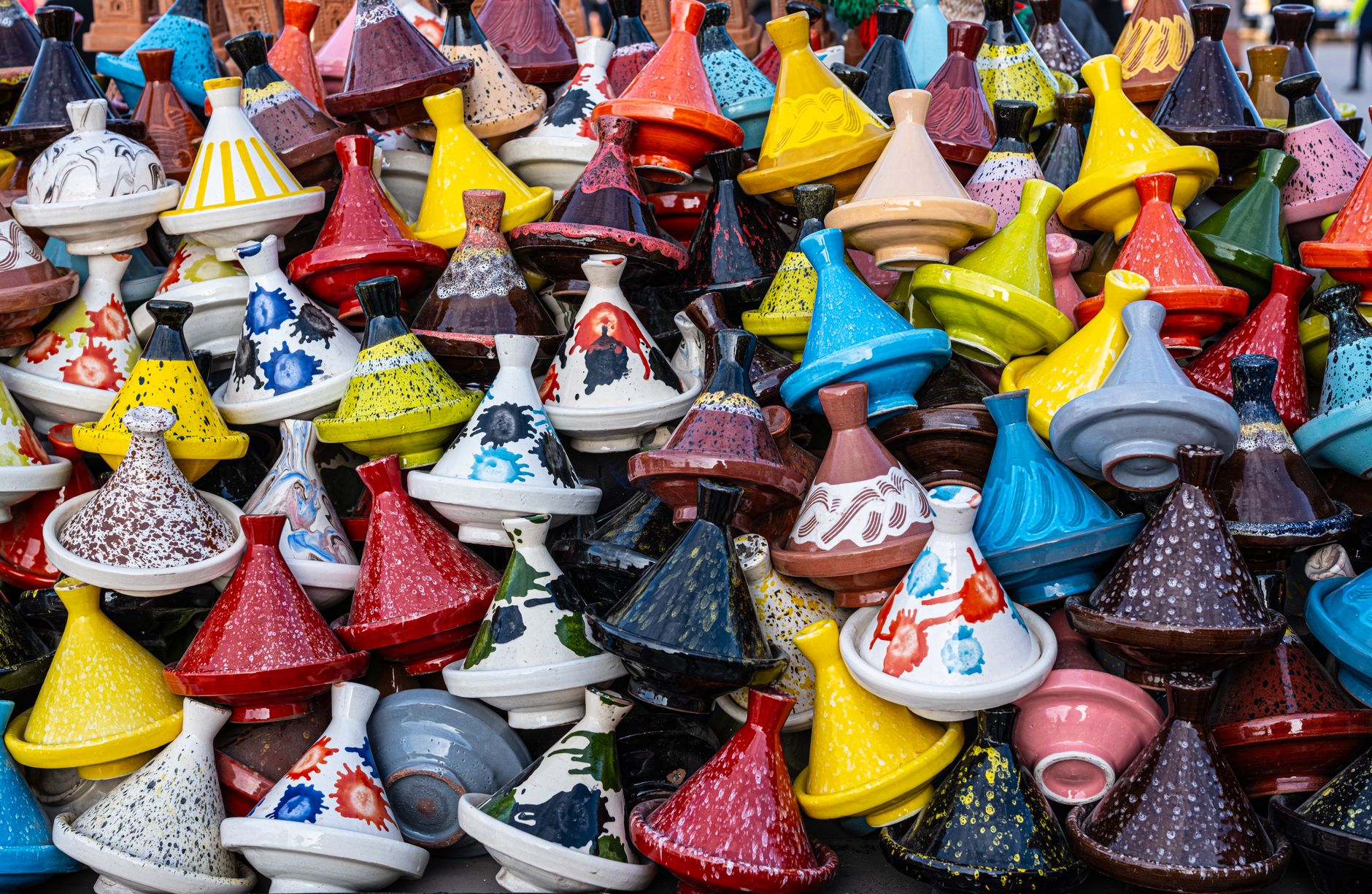
Moroccan food does not arrive. It reveals itself. The tagine lid is lifted and a private weather escapes: cumin, steam, softened onion, lamb fat, saffron, the sweet ambush of prune. One dish can taste of orchard, pasture, market, and prayer. That is not excess. That is syntax.
Couscous on Friday is not a side dish pretending to be a tradition. It is a weekly architecture of patience. Semolina steamed again and again until each grain remains separate, vegetables arranged with logic, broth added with restraint, family gathered with the seriousness usually reserved for treaties. You eat with the right hand or with bread, and your body learns that appetite can be orderly without becoming timid.
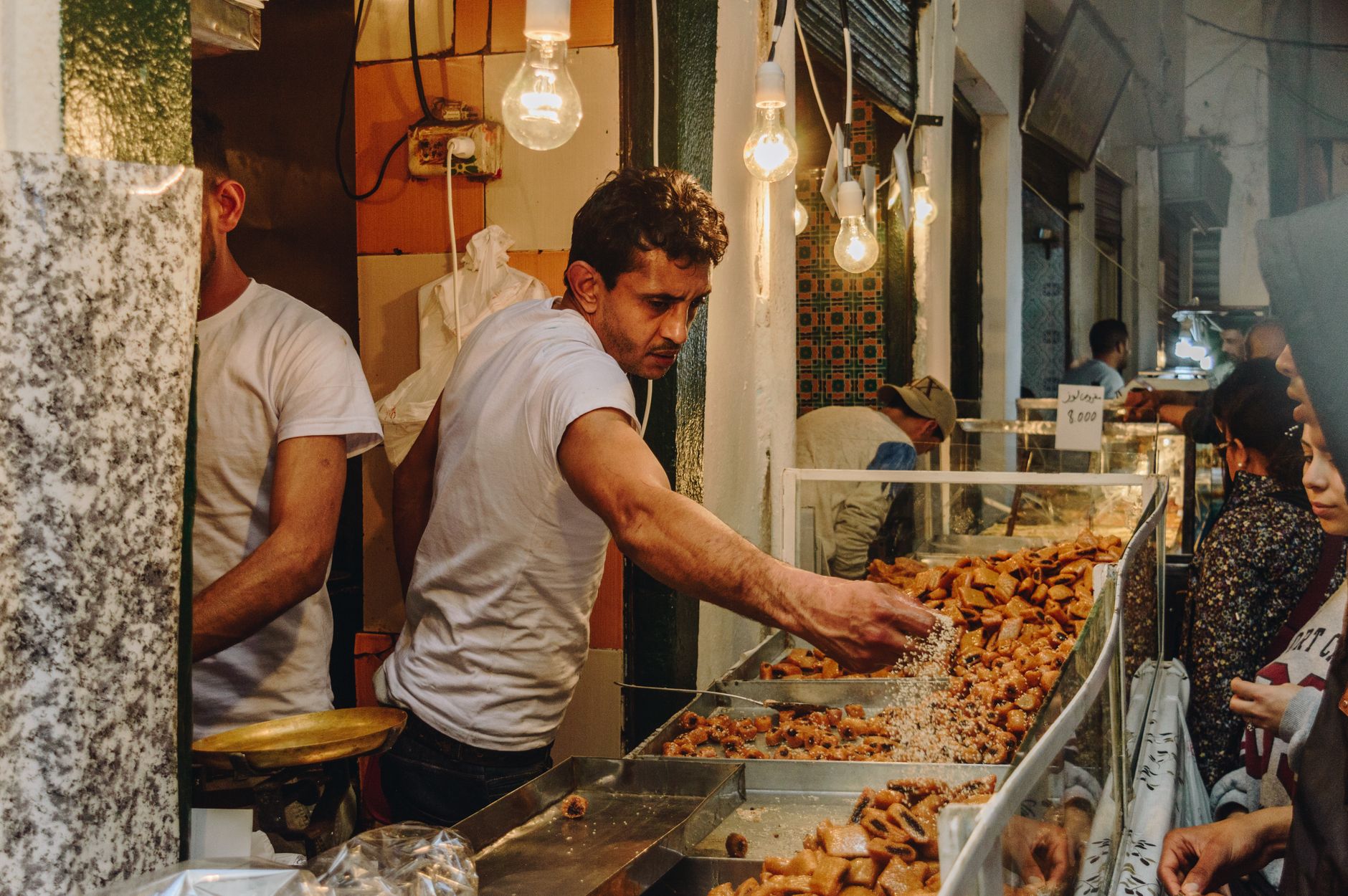
Then comes the empire of small astonishments: harira at sunset in Ramadan, thick with lentils and memory; msemen folded into shining layers; sardines in Essaouira so fresh that the sea still seems to be making up its mind; pastilla in Fès, where sugar and pigeon commit a scandal and are right to do so. Morocco understands a principle that many countries forget. Sweetness and gravity are not enemies.
Mint tea deserves its own clergy. The pour from height is not decorative. It cools, wakes, aerates, performs hospitality in liquid form. Too much sugar for your northern conscience? Of course. Your conscience will survive. The tea is saying something older than nutrition: you are here, you are received, and bitterness alone is an impoverished way to understand the world.
Moroccan etiquette is exacting in the most interesting way: it protects warmth by giving it form. You greet before you ask. You take time before you take space. A brusque efficiency, so admired in airports and certain offices, looks faintly barbaric here. Quite right.
Hospitality arrives quickly, but not casually. Tea may appear before the reason for your visit has even put on its coat. Refusing once can be courtesy. Refusing twice may be conviction. Refusing three times begins to look like theology. Bread is broken together, and the act contains more diplomacy than many summits. Use the right hand. Watch before acting. A table teaches faster than any phrasebook.
Respect has gradations. Older people receive more verbal care. Public irritation is often pressed back into civility, not because no one feels anger, but because dignity is a communal asset and wasting it in the street would be vulgar. Even bargaining has rules of elegance. The first price is a proposal, not a verdict. The counteroffer should contain wit, not contempt.
You feel this most clearly in the medina. In Fès or Chefchaouen, a doorway can be open while the life behind it remains rightfully opaque. Privacy is not coldness. It is an art. Morocco knows how to separate generosity from invasion, and that may be one of its highest accomplishments.
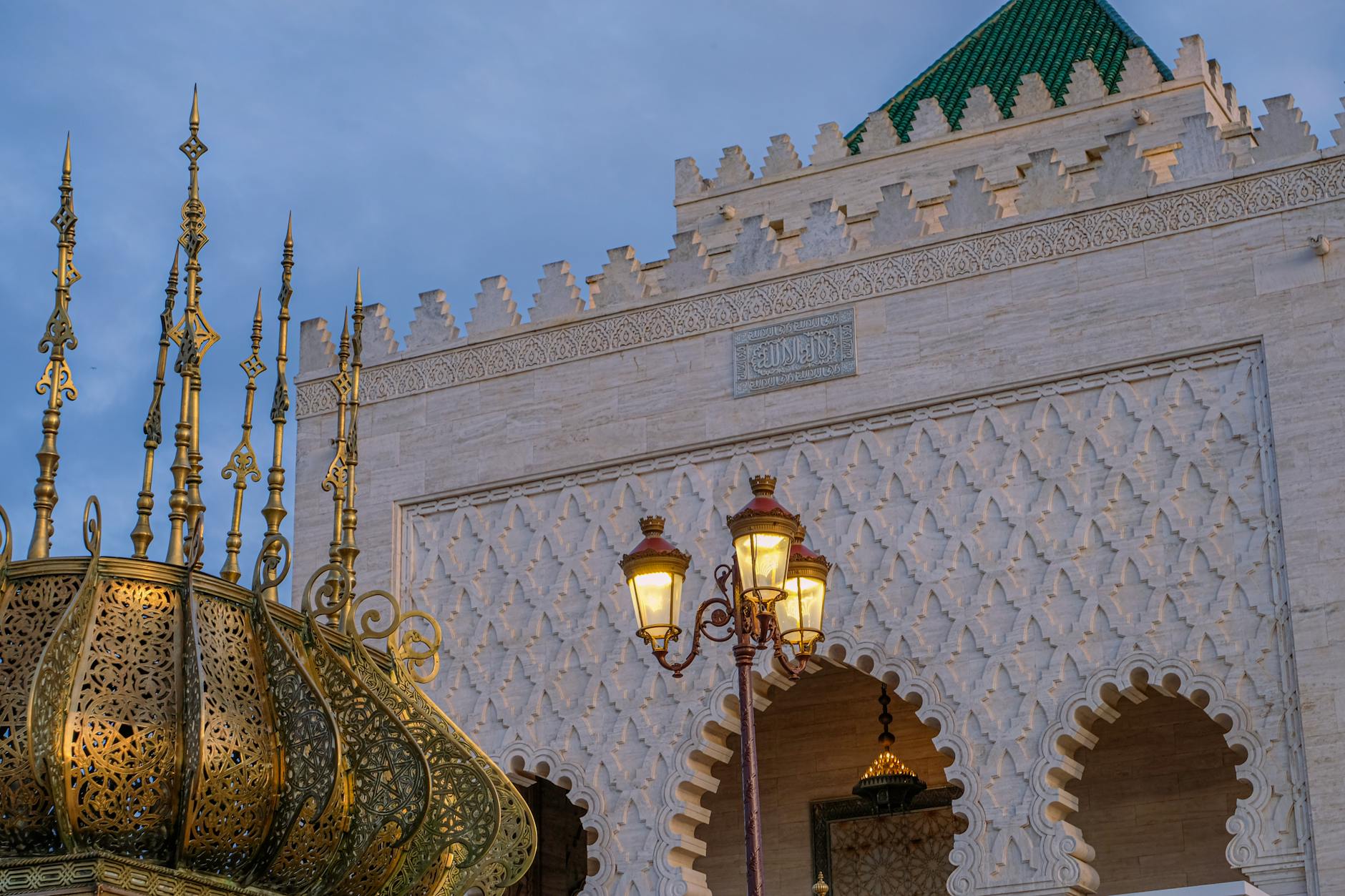
Moroccan architecture has the decency not to reveal everything at once. A wall gives you almost nothing. Then a door opens, and the hidden courtyard produces shade, water, zellij, cedar, geometry, the whole secret parliament of beauty. Modesty outside, delirium within. One begins to suspect that façades are for strangers and splendor is for the initiated.
The riad is the perfect rebuttal to exhibitionism. It turns inward without becoming timid. In Marrakesh, behind reddish walls that seem nearly mute under noon light, you find carved plaster as intricate as lace and orange trees performing their silent ministry. In Rabat, the white geometry and Atlantic light make austerity feel expensive. In Meknes and Fès, gates do what gates should do: they announce power without descending into chatter.
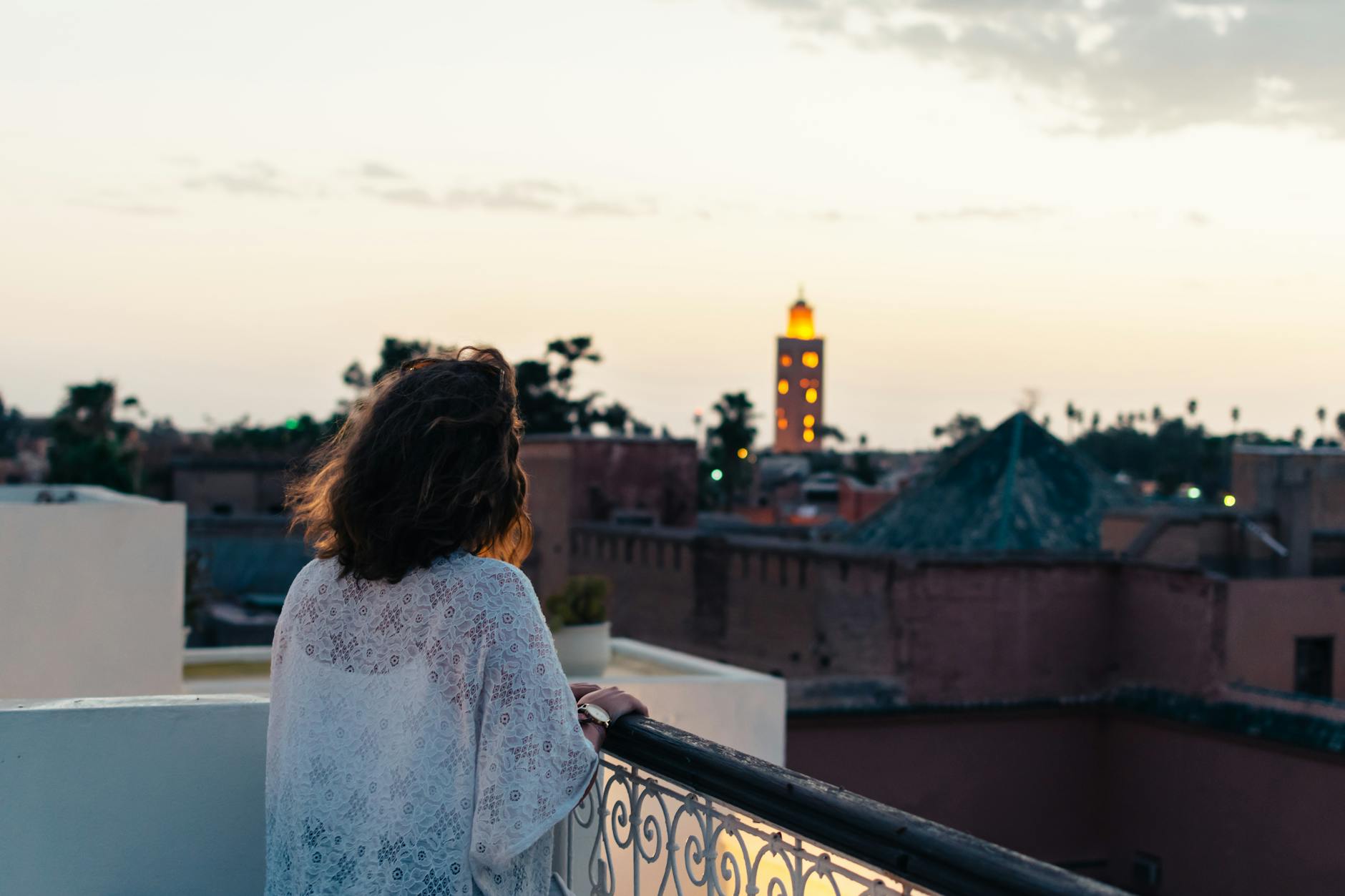
Then the monuments sharpen the argument. The Hassan Tower in Rabat is an unfinished sentence in red stone, and for that reason more moving than many completed buildings. The Kutubiyya in Marrakesh understands proportion better than most modern planners ever will. At Volubilis near Meknes, Roman columns remain like old bones under a different civilization's sky, and Morocco calmly absorbs them without losing its accent.
Zellij deserves a harder word than decoration. It is discipline made visible. Repetition here does not numb the eye; it trains it. You look longer. You begin to understand that order can intoxicate. That is a dangerous discovery, but architecture exists for such dangers.
Moroccan music rarely asks permission to cross categories. Andalusi refinement, Amazigh pulse, Gnawa trance, chaabi exuberance, desert cadence from the south: each keeps its lineage, yet the country lets them meet without panic. This is one of Morocco's most civilized habits. It can host contradiction and call it repertoire.
Gnawa is the sound that alters the room first and the body after. The guembri begins with a low, almost medicinal insistence, the qraqeb strike metal against time, and repetition stops being repetition. In Essaouira, during the festival season, night thickens around the rhythm until the Atlantic itself seems recruited into the ensemble. People call it music, and it is; people call it healing, and that is not absurd either.
Andalusi music offers the opposite intoxication: structure, lineage, patience, a cultivated melancholy that traveled from al-Andalus and found a new home in cities such as Fès and Tetouan. It does not seize you by the collar. It enters with manners. Then it stays. I mistrust any culture that cannot honor both ecstasy and restraint.
Even the everyday soundtrack has precision. In Casablanca, car radios release pop and chaabi into traffic. In Tangier, cafés accumulate songs with the smoke. In the Rif and Atlas regions, regional voices keep older textures alive without embalming them. Morocco does not put tradition in a museum and lock the door. It lets tradition sweat.
Religion in Morocco is audible before it is visible. The call to prayer lays a fine thread across the day, and suddenly time is no longer a single block for commerce, errands, and ambition. It has seams. Even if you do not pray, you begin to live among intervals. This improves a person.
The country is overwhelmingly Muslim, marked by Sunni practice and by the long prestige of saints, zawiyas, learned lineages, and royal religious legitimacy. Yet what strikes a visitor first is not doctrine. It is texture. Slippers left at a threshold. The murmur before a meal. The way Ramadan changes the hour of appetite, the hour of patience, the whole chemistry of the street. At sunset, harira appears and the city exhales.
Morocco also knows that piety can coexist with elegance. Mosques, madrasas, and shrines do not preach through clumsiness. They teach through proportion, shadow, calligraphy, ablution, repetition. The Hassan II Mosque in Casablanca places devotion beside the Atlantic with almost unreasonable confidence. In Fès, the old religious city still makes knowledge feel physical, as if learning had weight and needed walls to support it.
For a traveler, the only sensible posture is attentiveness. Dress with respect. Watch thresholds. Do not mistake reserve for refusal. The sacred here is not theatrical, though it can be magnificent. It is woven into sequence, voice, washing, waiting. Ritual is simply time given better manners.
Roman Volubilis near Meknes, the medina of Fès, and imperial Marrakesh show how Morocco kept rebuilding power without erasing what came before.
Few countries change this fast. You can move from High Atlas passes to palm oases and the dunes near Merzouga in the span of a long travel day.
Tagines, Friday couscous, sardines on the Atlantic coast, preserved lemon, orange-blossom sweets, and tea rituals turn ordinary meals into local history lessons.
Atlantic cities like Essaouira and Casablanca feel windier and looser, while Tangier and the Mediterranean north carry a tighter, strait-facing energy.
Morocco's beauty is built, not sprayed on. Zellige, carved cedar, woven rugs, tadelakt plaster, and brasswork still shape houses, riads, and workshops across the country.
Blue lanes in Chefchaouen, late sun on Rabat's ramparts, dawn over Marrakesh rooftops, and desert dusk near Ouarzazate give photographers more than postcard color.
13 cities — start with the ones we'd send you to first.
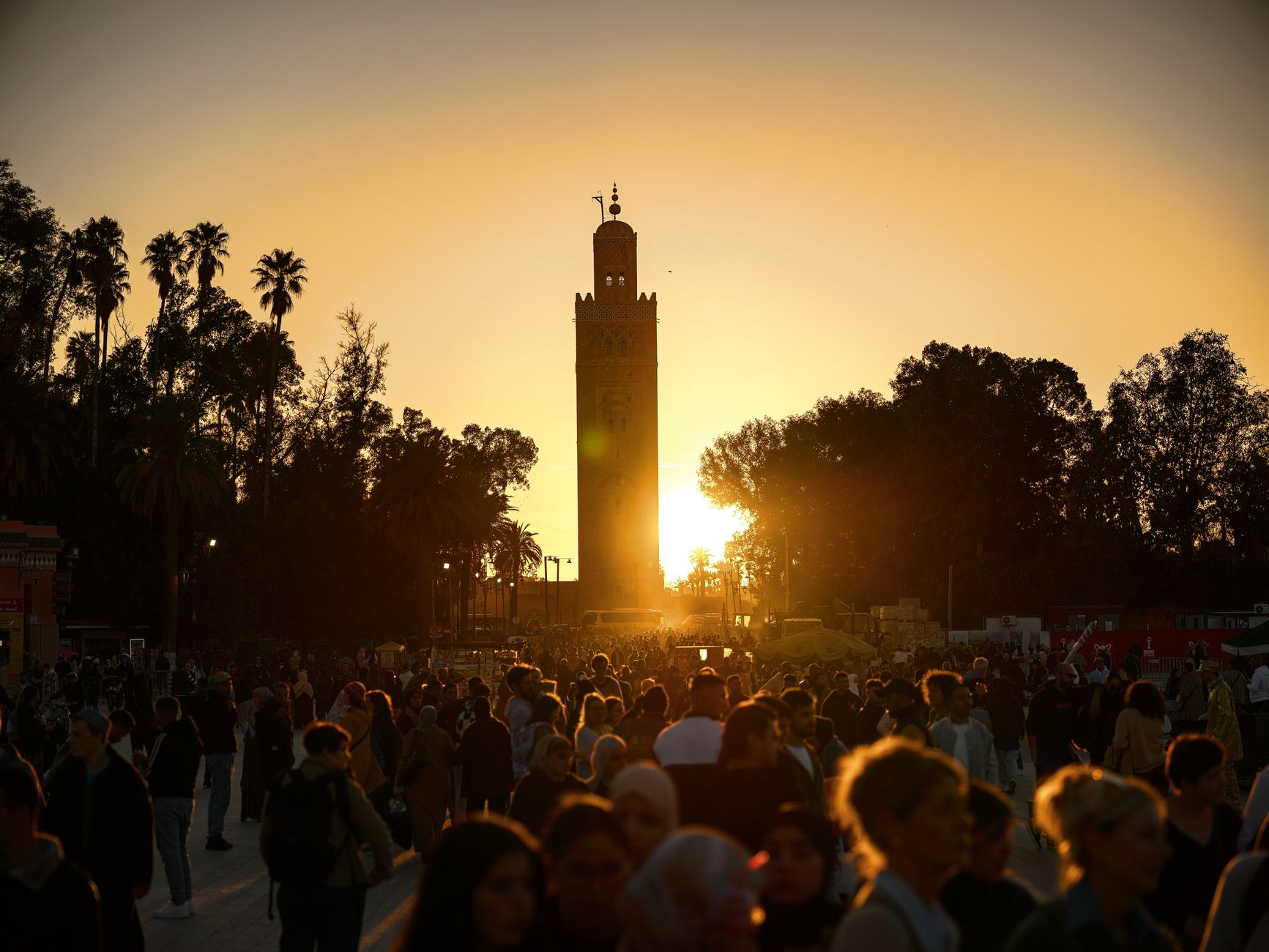
Marrakesh turns your senses up to eleven: the call to prayer ricochets off rose-coloured walls while argan smoke drifts past a Saint Laurent-blue garden gate that wasn’t here fifty years ago.
The Djemaa el-Fna square reinvents itself every evening — snake charmers at dusk, open-air kitchens by 8 pm, and a noise level that makes sleep feel like a radical act.
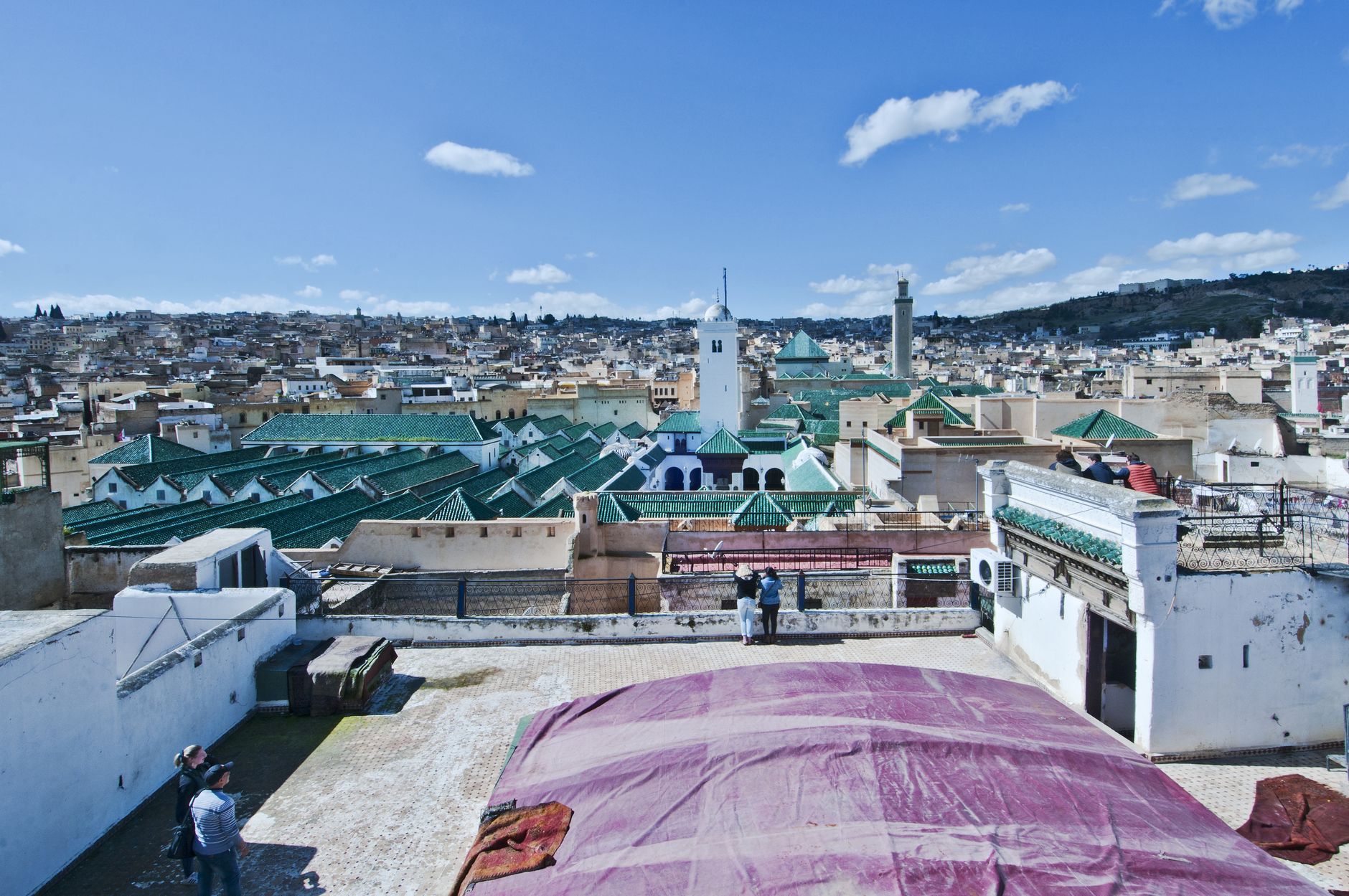
The medina of Fès el-Bali has been continuously inhabited since the 9th century, and the tanneries where hides are still cured in stone vats of pigeon dung look exactly as they did when Leo Africanus passed through.
Every wall in the old quarter is painted in a different shade of blue — cobalt, powder, slate — a chromatic obsession that started in the 1930s and has never stopped.
Morocco's actual capital is a functional, unhurried city where the 12th-century Hassan Tower stands unfinished mid-field, its 200 companion columns the only evidence of a mosque that was never completed.
Forget Bogart: modern Casablanca is a city of Art Deco facades crumbling beside glass towers, where the Hassan II Mosque — built on a platform over the Atlantic — holds 105,000 worshippers and is visible from the highway
Moulay Ismail built his imperial capital here in the late 17th century using 50,000 laborers and European captives, then lined it with granaries so vast they could feed an army for twenty years.
The Atlantic wind off the ramparts is so consistent and so violent that the town has become a global windsurfing destination, which sits oddly alongside the blue fishing boats and the gnawa musicians who have played here
The kasbah of Aït Benhaddou, 30 km northwest, has stood in for ancient Jerusalem, Egypt, and Persia in so many productions that the local guides can cite your favorite film before you finish the sentence.
Morocco's political and commercial spine runs along the Atlantic, where Rabat keeps its government calm and Casablanca does the country's real hurry. You come here for train-friendly cities, ocean light, and a more contemporary face of Morocco than the one travelers usually imagine first.
Tangier and Asilah belong to the threshold country: half Atlantic, half Mediterranean, with Spain close enough to feel like weather. Port history, whitewashed walls, and literary mythology sit beside container traffic and summer beach crowds.
This is the Morocco of dynasties, carved plaster, and arguments about legitimacy staged in stone. Fès carries the intellectual weight, while Meknes and nearby Volubilis show what happened when Roman memory and Islamic kingship shared the same ground.
The Rif shifts the scale of travel: tighter roads, cooler air, and mountain towns that feel removed from the country's big-city tempo. Chefchaouen can get crowded by midday, but early morning still belongs to wet stone, blue limewash, and the sound of shutters opening.
Marrakesh is the country's great stage set, but the region matters beyond the medina. West of the city, Essaouira brings salt air and ramparts; inland, olive groves and red-earth villages remind you how quickly the plains give way to mountain country.
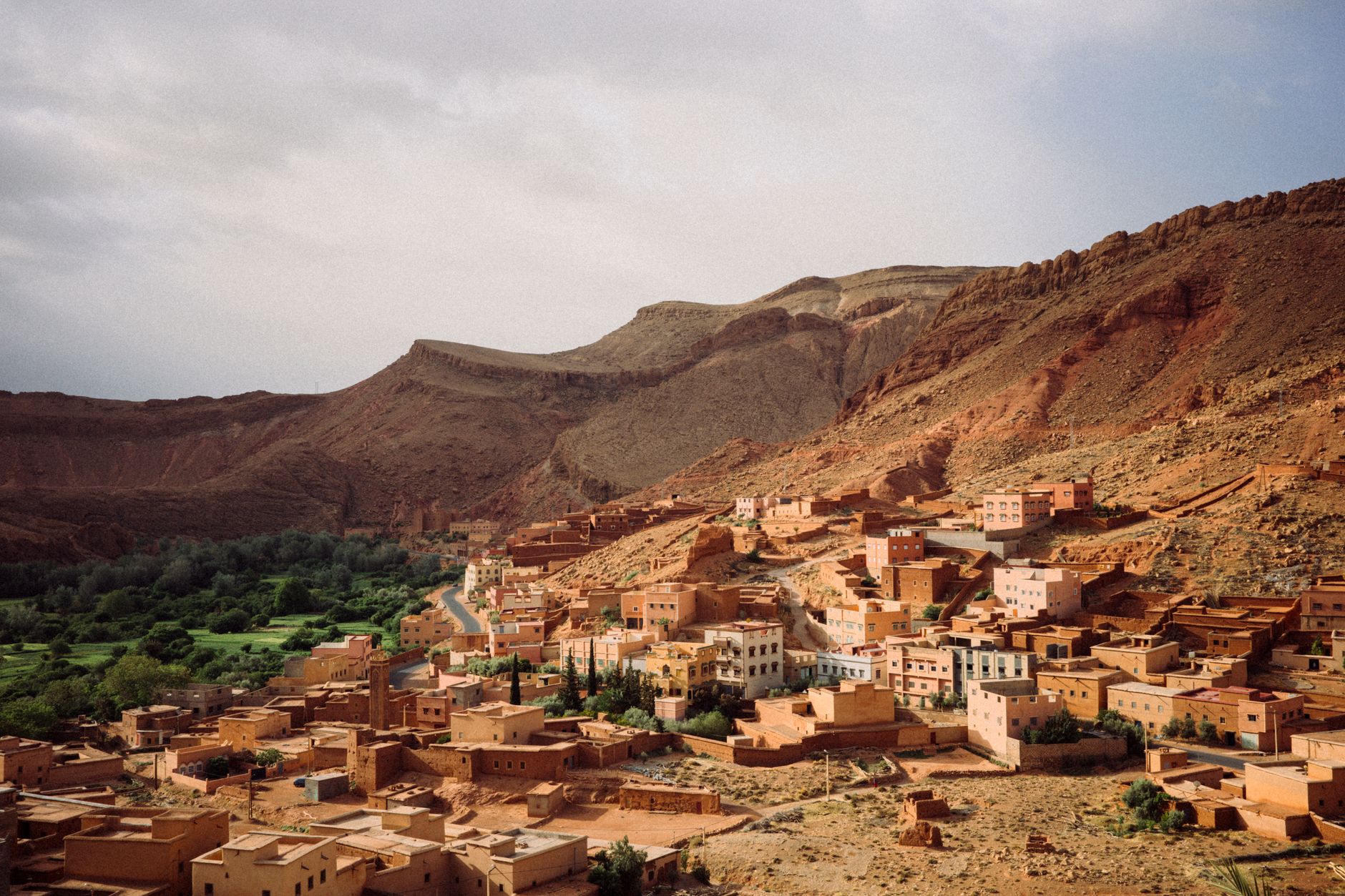
South of the High Atlas, Morocco stretches into kasbah country, date-palm valleys, and the long approach to the desert. Ouarzazate is the practical base, Merzouga is the dream image, and both make sense only if you respect the distances between them.
A late-16th-century Saadian house turned literary cafe, Dar Cherifa offers hush, carved cedar, and a rare glimpse of elite life in Marrakesh's medina.
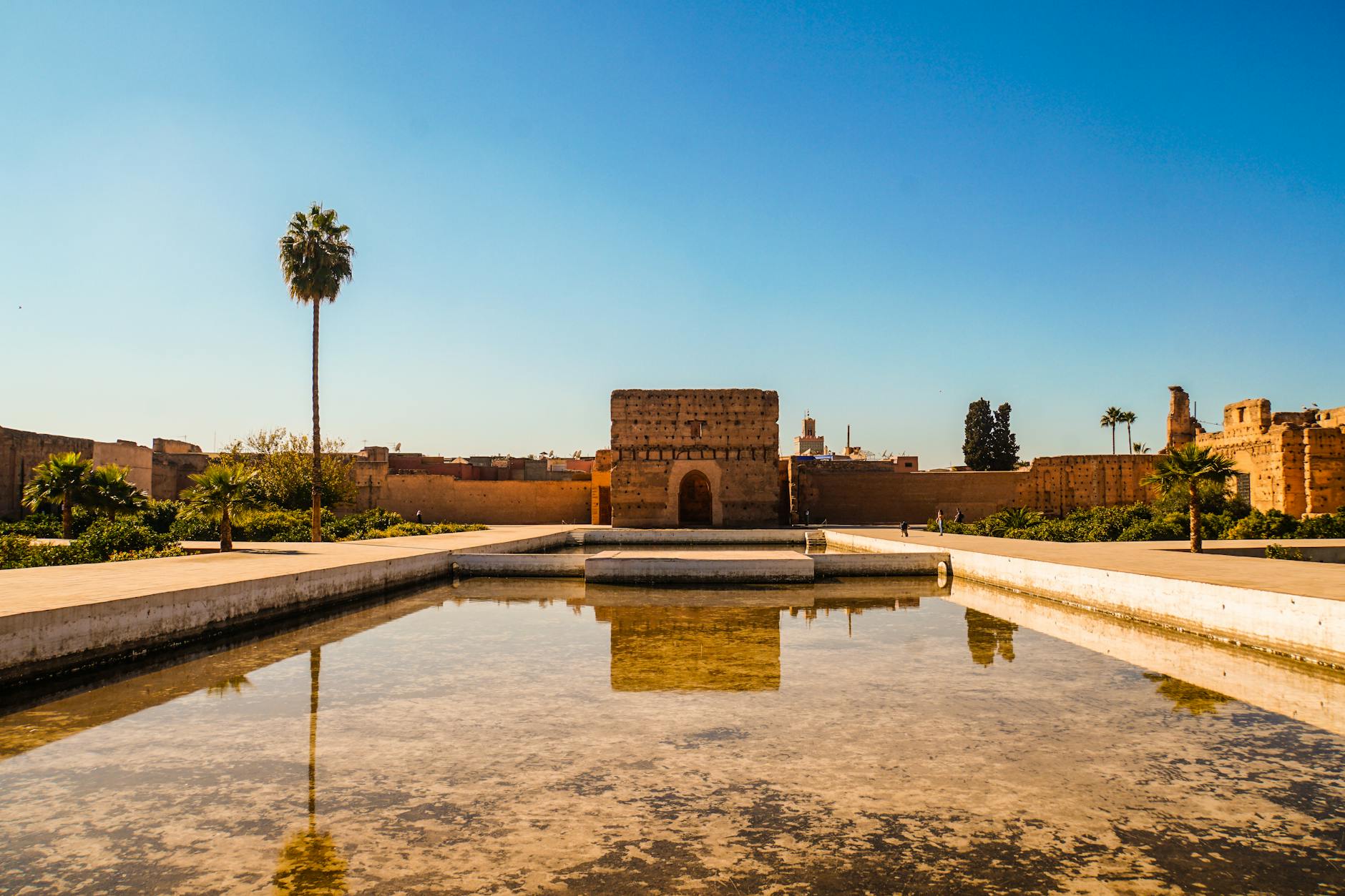
Sealed for centuries, the Saadian Tombs preserve a royal necropolis of marble, cedar, and zellij beside Marrakesh's Kasbah Mosque.
From prehistoric Morocco to the modern Alaouite state
Near present-day Marrakesh, fossil remains and stone tools from Jebel Irhoud pushed back the known history of Homo sapiens. Morocco entered the human story not at the edge, but near the beginning.
At Taforalt in eastern Morocco, burials with shell beads reveal ceremony, exchange, and adornment in deep prehistory. Even then, distance had social meaning.
Phoenician traders established a presence at Lixus on the Atlantic edge. Morocco became part of wider Mediterranean commerce long before Roman rule.
Rome installed Juba II as king of Mauretania, but he ruled with more than borrowed power. His court linked classical learning, royal display, and the western Maghrib.
The death of Juba II and Cleopatra Selene's son ended a remarkable royal line tied to both Rome and the Ptolemies. Ancient sources blame imperial jealousy, and revolt followed.
After dynastic collapse, Rome absorbed the region into imperial administration. Volubilis remained splendid, though always somewhat frontier in temperament.
An Alid refugee arrived at Walila near Volubilis and began the Idrisid state. Morocco's first Islamic dynasty rose among Roman ruins.
Idris I was killed after only a short reign. The bare fact is documented; the tales of poison and perfumed intrigue belong to the legend that quickly formed around him.
Idris II established Fès as a political and religious center. A city now carried the dynasty's claim to permanence.
The Almoravids founded Marrakesh as an imperial base. From this red city, Morocco would project force north into Iberia and south across caravan routes.
Summoned to help resist Christian expansion, Yusuf ibn Tashfin crossed the strait and won at Sagrajas. Rescue soon became domination.
The Almohads overthrew the Almoravids and made Morocco the center of a more ambitious imperial project. Their rule left a harder, more monumental visual language.
The Marinids displaced Almohad authority and shifted the center of gravity toward Fès. Scholarship, architecture, and courtly competition flourished together.
At twenty-two, Ibn Battuta departed Tangier for the hajj. The journey became one of the great travel narratives of the medieval world.
At Ksar el-Kebir, three rulers were swept away in one catastrophic contest. Morocco emerged strengthened, Portugal shattered, and Europe forced to reckon with the result.
Under Ahmad al-Mansur, Moroccan forces crossed the Sahara and seized the Songhai heartland. It was a dazzling assertion of power, costly and difficult to hold.
The Alaouites established the line that still reigns in Morocco today. Dynastic continuity, a rare thing in the region, became one of the kingdom's defining facts.
Moulay Ismail turned Meknes into an imperial capital and governed with formidable severity. His reign fused architectural grandeur with military discipline and fear.
France imposed a protectorate over most of Morocco while Spain controlled northern and southern zones. Sovereignty narrowed, though it did not vanish from political imagination.
Rif fighters under Abd el-Krim dealt Spain one of the worst defeats in its colonial history. Northern Morocco became a symbol of resistance far beyond the Maghrib.
French authorities deposed Sultan Mohammed V and sent him away, expecting obedience to follow. Instead, exile turned him into the emotional center of national resistance.
After Mohammed V's return, Morocco regained independence from the protectorate system. A modern kingdom emerged through negotiation, pressure, and deep popular investment in sovereignty.
Hassan II inherited the throne and shaped Morocco's late 20th century with brilliance, grandeur, and repression. His reign remains impossible to reduce to one mood.
The accession of Mohammed VI opened a new chapter in the Alaouite monarchy. Continuity remained, but so did pressure for reform, social justice, and a different public contract.
Origins and Ancient Kingdoms
Juba II was not merely a client king; he was a hostage turned intellectual, the sort of ruler who could commission splendor and write history in Greek.
A worked flint blade lies in the dust near Jebel Irhoud, west of Marrakesh, and suddenly Morocco stops being a margin on somebody else's map. The fossils found there were dated to roughly 315,000 years ago, which means one of the earliest known chapters of Homo sapiens surfaced in Moroccan rock after modern mining cut into a hillside. The beginning was accidental.
Ce que l'on ignore souvent, c'est que prehistory here already carries signs of ceremony. At Taforalt, around 15,000 years ago, people were buried with shell beads brought from the coast, and that small detail changes everything: distance, memory, adornment, social display. Before dynasties, there was already theater.
Then antiquity arrives with merchants, myths, and polished royal ambition. Phoenician traders settled at Lixus by the 7th century BCE, and later Volubilis turned into one of those Roman cities that still feel faintly theatrical even in ruin, all mosaics, olive wealth, and the confidence of empire built on a frontier that never felt entirely tame.
The human drama peaks with Juba II and Cleopatra Selene, a royal couple who look as if they were cast by history with indecent care. He was a scholar-king raised in Rome after being paraded in Julius Caesar's triumph; she was the daughter of Antony and Cleopatra, carrying the afterglow of Alexandria to Mauretania. Their son Ptolemy was killed in 40 CE, ancient writers blaming Caligula's jealousy, and after that old courtly splendor gave way to revolt, annexation, and the long preparation for another Morocco to appear.
Greek writers linked Lixus to the Garden of the Hesperides, so part of Morocco entered classical literature not as background, but as mythic real estate.
Idrisids, Almoravids, Almohads
Idris I remains moving because behind the founder stands a hunted man who turned flight into kingship and Roman debris into legitimacy.
Picture the broken columns of Walila, the old Volubilis, in 788. Into that Roman afterlife rode Idris I, an Alid refugee fleeing Abbasid power, and from those stones he began the Idrisid state. Morocco's first Islamic dynasty did not start in a blank landscape; it began in borrowed grandeur.
His story darkens quickly. Records agree he was assassinated in 791, while later accounts embroider the method with poison and perfumed deceit, and one senses at once the tone Morocco's dynastic history will often take: piety, exile, legitimacy, then murder. Idris II carried the project forward and founded Fès in the early 9th century, giving the realm a capital that was both political claim and sacred statement.
Two centuries later the Sahara answered with harder men. The Almoravids rose from desert religious discipline, founded Marrakesh in the 11th century, and under Yusuf ibn Tashfin crossed into Iberia where they first came as rescuers and then stayed as masters. Ce que l'on ignore souvent, c'est that Marrakesh was not conceived as decoration; it was a command post, a city meant to organize movement, loyalty, and conquest.
Then came the Almohads, stern reformers with imperial appetite. They overthrew the Almoravids, recast Morocco as the center of a vast polity stretching across the Maghrib and deep into al-Andalus, and left behind architecture that still argues with the sky in Rabat and Marrakesh. When their power began to fray, the stage shifted again toward Fès and a more urban, scholarly, and fragile brilliance.
According to tradition, Morocco's first ruler was killed by an Abbasid agent who came bearing an apparently innocent gift; the assassination is documented, the theatrical packaging belongs to legend.
Marinids, Saadians, and the Golden Caravans
Ibn Battuta matters because his greatness begins not in fame, but in one young man from Tangier walking away from home without knowing he would become the great witness of the medieval world.
In Marinid Fès, the sound was not cavalry first but study: recitation in courtyards, water in marble basins, footsteps under cedar ceilings. The Marinid rulers made the city a capital of scholarship and display, and their madrasas still show that power in Morocco often preferred to clothe itself in carved plaster and calligraphy before it reached for a blade.
One of the age's most intimate voices belongs to a traveler. Ibn Battuta left Tangier in 1325 at the age of twenty-two for the hajj and wrote that he set out alone, driven by an impulse that reads even now like youth and destiny conspiring together. He returned decades later to a homeland altered by plague and distance, which gives his Moroccan story its ache.
The 16th century changed the tempo. The Saadians fought the Portuguese, tightened their hold on Marrakesh, and in 1578 won the Battle of Ksar el-Kebir, the so-called Battle of the Three Kings, where Sebastian of Portugal, the deposed Moroccan sultan Abd al-Malik, and the claimant Muhammad al-Mutawakkil all vanished into death or catastrophe on the same day. Europe reeled. Morocco counted the profit.
Ahmad al-Mansur, gilded by that victory, built with the confidence of a man who believed history had personally endorsed him. His court in Marrakesh glittered with sugar wealth, diplomatic schemes, and dreams of trans-Saharan empire, culminating in the 1591 expedition toward Timbuktu. The splendor was real, but so was the cost, and after the sheen came fracture, rival claimants, and the search for a new house strong enough to govern the whole kingdom.
The Battle of the Three Kings in 1578 left Portugal without its king and helped trigger the Iberian Union, so a Moroccan battlefield altered the balance of power in Europe.
Alaouite Morocco, Protectorates, and the Long Return of Sovereignty
Mohammed V became larger in exile than on the throne, because removal turned him from monarch into national symbol.
When the Alaouite dynasty took hold in the 17th century, Morocco found the line that still reigns today. Its most theatrical early sovereign was Moulay Ismail, who made Meknes his capital and built with the appetite of a man trying to persuade stone that he was the equal of Louis XIV. The walls, granaries, and gates were not modest. That was the point.
Ce que l'on ignore souvent, c'est that this royal grandeur stood beside relentless coercion. Moulay Ismail relied on the 'Abid al-Bukhari, an army of enslaved and hereditary soldiers, and his court was feared as much as admired; the fairy tale of imperial construction came with taxes, forced labor, and bodies spent to make a dynasty visible. Morocco's palaces have always had servants' staircases, whether one sees them or not.
By the 19th and early 20th centuries, European pressure had become suffocating. The French protectorate was established in 1912, Spain held northern and southern zones, and the Rif War turned northern Morocco into one of the fiercest anti-colonial theaters of its age under Abd el-Krim. The map was partitioned, but loyalty was not.
The decisive modern scene comes in exile. Sultan Mohammed V was deposed and sent away by the French in 1953, only to return in triumph in 1955 as nationalist pressure made the protectorate untenable; independence followed in 1956, and the kingdom entered its modern chapter through negotiation, unrest, and unfinished argument. Hassan II would stamp the later 20th century with majesty and repression in equal measure, while Mohammed VI has ruled since 1999 over a country still balancing royal continuity, public demand, Atlantic modernity, and old historical memory from Rabat to Casablanca.
Moulay Ismail is said in courtly tradition to have fathered hundreds of children; the exact number is disputed, but even the lower estimates suggest a palace run like a dynasty factory.
Morocco speaks in layers. A taxi in Casablanca can begin in Darija, slip into French for the price, rise into formal Arabic for dignity, then finish with a joke that only works because all three were present in the same breath. You do not hear a language. You hear a social choreography.
Darija has speed, mischief, elbows. Modern Standard Arabic carries ceremony, school, sermon, decree. Tamazight changes the air entirely: the vowels open, the mountains enter the room, and the country remembers that it was old before any ministry existed. In Rabat, a government corridor may prefer formal registers; in Fès, a shopkeeper may test your ear with softness first and arithmetic second; in Marrakesh, bargaining itself becomes a small theater of grammar.
A greeting matters more than grammar. "Salam alaykom" opens a door. "Labas?" reduces distance by a measurable amount. "Inshallah" is not a promise and not an evasion. It is a civil way of admitting that time answers to larger authorities than your itinerary. I admire this. A country is revealed by the way it postpones certainty.
French remains everywhere and nowhere. Menu, invoice, lycée, legal phrase, flirtation, insult: it appears with perfect shamelessness. Morocco does not suffer from linguistic purity. It has better things to do. It uses language the way a great cook uses preserved lemon: precisely, without apology, and always at the exact moment when the dish would otherwise become dull.
Moroccan food does not arrive. It reveals itself. The tagine lid is lifted and a private weather escapes: cumin, steam, softened onion, lamb fat, saffron, the sweet ambush of prune. One dish can taste of orchard, pasture, market, and prayer. That is not excess. That is syntax.
Couscous on Friday is not a side dish pretending to be a tradition. It is a weekly architecture of patience. Semolina steamed again and again until each grain remains separate, vegetables arranged with logic, broth added with restraint, family gathered with the seriousness usually reserved for treaties. You eat with the right hand or with bread, and your body learns that appetite can be orderly without becoming timid.
Then comes the empire of small astonishments: harira at sunset in Ramadan, thick with lentils and memory; msemen folded into shining layers; sardines in Essaouira so fresh that the sea still seems to be making up its mind; pastilla in Fès, where sugar and pigeon commit a scandal and are right to do so. Morocco understands a principle that many countries forget. Sweetness and gravity are not enemies.
Mint tea deserves its own clergy. The pour from height is not decorative. It cools, wakes, aerates, performs hospitality in liquid form. Too much sugar for your northern conscience? Of course. Your conscience will survive. The tea is saying something older than nutrition: you are here, you are received, and bitterness alone is an impoverished way to understand the world.
Moroccan etiquette is exacting in the most interesting way: it protects warmth by giving it form. You greet before you ask. You take time before you take space. A brusque efficiency, so admired in airports and certain offices, looks faintly barbaric here. Quite right.
Hospitality arrives quickly, but not casually. Tea may appear before the reason for your visit has even put on its coat. Refusing once can be courtesy. Refusing twice may be conviction. Refusing three times begins to look like theology. Bread is broken together, and the act contains more diplomacy than many summits. Use the right hand. Watch before acting. A table teaches faster than any phrasebook.
Respect has gradations. Older people receive more verbal care. Public irritation is often pressed back into civility, not because no one feels anger, but because dignity is a communal asset and wasting it in the street would be vulgar. Even bargaining has rules of elegance. The first price is a proposal, not a verdict. The counteroffer should contain wit, not contempt.
You feel this most clearly in the medina. In Fès or Chefchaouen, a doorway can be open while the life behind it remains rightfully opaque. Privacy is not coldness. It is an art. Morocco knows how to separate generosity from invasion, and that may be one of its highest accomplishments.
Moroccan architecture has the decency not to reveal everything at once. A wall gives you almost nothing. Then a door opens, and the hidden courtyard produces shade, water, zellij, cedar, geometry, the whole secret parliament of beauty. Modesty outside, delirium within. One begins to suspect that façades are for strangers and splendor is for the initiated.
The riad is the perfect rebuttal to exhibitionism. It turns inward without becoming timid. In Marrakesh, behind reddish walls that seem nearly mute under noon light, you find carved plaster as intricate as lace and orange trees performing their silent ministry. In Rabat, the white geometry and Atlantic light make austerity feel expensive. In Meknes and Fès, gates do what gates should do: they announce power without descending into chatter.
Then the monuments sharpen the argument. The Hassan Tower in Rabat is an unfinished sentence in red stone, and for that reason more moving than many completed buildings. The Kutubiyya in Marrakesh understands proportion better than most modern planners ever will. At Volubilis near Meknes, Roman columns remain like old bones under a different civilization's sky, and Morocco calmly absorbs them without losing its accent.
Zellij deserves a harder word than decoration. It is discipline made visible. Repetition here does not numb the eye; it trains it. You look longer. You begin to understand that order can intoxicate. That is a dangerous discovery, but architecture exists for such dangers.
Moroccan music rarely asks permission to cross categories. Andalusi refinement, Amazigh pulse, Gnawa trance, chaabi exuberance, desert cadence from the south: each keeps its lineage, yet the country lets them meet without panic. This is one of Morocco's most civilized habits. It can host contradiction and call it repertoire.
Gnawa is the sound that alters the room first and the body after. The guembri begins with a low, almost medicinal insistence, the qraqeb strike metal against time, and repetition stops being repetition. In Essaouira, during the festival season, night thickens around the rhythm until the Atlantic itself seems recruited into the ensemble. People call it music, and it is; people call it healing, and that is not absurd either.
Andalusi music offers the opposite intoxication: structure, lineage, patience, a cultivated melancholy that traveled from al-Andalus and found a new home in cities such as Fès and Tetouan. It does not seize you by the collar. It enters with manners. Then it stays. I mistrust any culture that cannot honor both ecstasy and restraint.
Even the everyday soundtrack has precision. In Casablanca, car radios release pop and chaabi into traffic. In Tangier, cafés accumulate songs with the smoke. In the Rif and Atlas regions, regional voices keep older textures alive without embalming them. Morocco does not put tradition in a museum and lock the door. It lets tradition sweat.
Religion in Morocco is audible before it is visible. The call to prayer lays a fine thread across the day, and suddenly time is no longer a single block for commerce, errands, and ambition. It has seams. Even if you do not pray, you begin to live among intervals. This improves a person.
The country is overwhelmingly Muslim, marked by Sunni practice and by the long prestige of saints, zawiyas, learned lineages, and royal religious legitimacy. Yet what strikes a visitor first is not doctrine. It is texture. Slippers left at a threshold. The murmur before a meal. The way Ramadan changes the hour of appetite, the hour of patience, the whole chemistry of the street. At sunset, harira appears and the city exhales.
Morocco also knows that piety can coexist with elegance. Mosques, madrasas, and shrines do not preach through clumsiness. They teach through proportion, shadow, calligraphy, ablution, repetition. The Hassan II Mosque in Casablanca places devotion beside the Atlantic with almost unreasonable confidence. In Fès, the old religious city still makes knowledge feel physical, as if learning had weight and needed walls to support it.
For a traveler, the only sensible posture is attentiveness. Dress with respect. Watch thresholds. Do not mistake reserve for refusal. The sacred here is not theatrical, though it can be magnificent. It is woven into sequence, voice, washing, waiting. Ritual is simply time given better manners.
Juba II arrived in power by one of history's strangest routes: paraded as a child in Rome, educated by the conquerors, then sent back to rule. In Morocco he was not merely Rome's man; he gave the western Maghrib a court that read, built, and staged itself with real intellectual ambition.
Daughter of Antony and Cleopatra, Cleopatra Selene carried the last shimmer of Alexandria into North Africa. Her marriage to Juba II made ancient Morocco part of the afterlife of the Ptolemies, which is an astonishing sentence and also a historical fact.
Idris I reached Morocco as a fugitive and turned refuge into rule. That alchemy matters: the kingdom's first Islamic founder did not descend in triumph, he arrived pursued, and the state he built kept the memory of both sanctity and danger.
If Idris I planted the claim, Idris II gave it walls, streets, and ritual gravity in Fès. He understood something every great founder understands: a dynasty survives when it can point to a city and say, this is where our legitimacy lives.
Yusuf ibn Tashfin built Marrakesh as a base camp for authority, not a postcard. He crossed into al-Andalus as an ally and stayed as a ruler, which tells you all you need to know about his patience and his appetite.
He left Tangier intending to perform the hajj and ended up circling much of the known world. What gives his Moroccan connection its force is not simply birthplace, but return: after decades away, he came home to loss, memory, and the knowledge that travel always exacts a price.
Ahmad al-Mansur wore victory like jewelry after 1578 and governed as if providence had signed his name. His court in Marrakesh was rich, calculating, and cosmopolitan, but behind the gold leaf stood taxes, military ambition, and a ruler who never mistook elegance for softness.
Moulay Ismail built Meknes with the zeal of a monarch who wanted masonry to speak on his behalf for centuries. He has been compared to the Sun King, though the comparison flatters Louis XIV by suggesting he was as feared.
Abd el-Krim turned the Rif into a laboratory of modern anti-colonial warfare and humiliated a European army at Annual in 1921. His fight was local in terrain and global in consequence; later liberation movements studied him with care.
Mohammed V's greatness was sharpened by exile. When the French removed him in 1953, they meant to weaken the throne; instead they made him the emotional center of Moroccan independence.
This is the cleanest first look at modern urban Morocco: art deco blocks, government boulevards, and a port city staring at Europe across the Strait. Trains keep the route efficient, so you spend more time in Casablanca, Rabat, and Tangier than in stations.
Start in Fès for the oldest urban density in the country, add Meknes for a calmer imperial counterpoint, then finish in Chefchaouen where the pace drops and the streets turn blue. It is compact, historically rich, and easier on transit time than trying to force in the south.
Begin with the sensory overload of Marrakesh, slow down on the sea walls of Essaouira, then continue south to Agadir for beaches and easier resort logistics. This route works well in spring and autumn, when inland heat is manageable and the coast still earns long evenings outside.
This is the overland Morocco people imagine, but done in the right order: mountain passes, fortified towns, long valleys, then dunes. Ouarzazate and Merzouga reward patience, and ending in Marrakech gives you a soft landing after the road.
Noon meal. Family table. Shared platter, right hand, bread, broth, silence, talk.
Ramadan fast break. Dates first, soup next. Family, neighbors, guests, spoons, bread.
Evening dish. Shared pot, bread, fingers, slow eating. Weddings, weekends, honored guests.
Celebration table. Knife, fork, or fingers. Family lunches, feast days, city houses in Fès.
Breakfast or late afternoon. Tear, dip, drink. Home kitchens, street stalls, long conversations.
Grill smoke, lemon, bread. Lunch by the port, friends, sea wind, quick hands.
Arrival ritual. Host pours high, guest waits, glasses circle. Shops, homes, negotiations, forgiveness.






U.S. passport holders can enter Morocco visa-free for up to 90 days. Your passport should be valid for at least six months on entry, and rules can change for other nationalities, so check your consulate before you book.
Morocco uses the Moroccan dirham, written as MAD. Mid-range travelers usually spend about 1,600 to 2,900 MAD a day before international flights, with riads and beach hotels pushing that higher in Marrakesh, Casablanca, and peak-season Essaouira.
Most international arrivals land in Casablanca, Marrakesh, Rabat, Fès, Tangier, or Agadir. Casablanca works best for rail connections across the country, while Marrakesh is the easier entry point for the High Atlas, Essaouira, and southern desert routes.
Trains are the easiest way to move between Casablanca, Rabat, Tangier, Meknes, and Fès, with buses and shared grands taxis filling the gaps elsewhere. For Ouarzazate, Merzouga, and smaller Atlas or desert stops, expect long road days and book private transfers or CTM-style intercity coaches ahead in busy months.
Morocco runs on gradients, not one neat season. Atlantic cities stay milder, the Atlas can be cold enough for snow in winter, and inland routes toward Ouarzazate and Merzouga can turn brutally hot in summer, especially when chergui winds blow in from the desert.
4G coverage is solid in cities and along main travel corridors, and hotels usually offer workable Wi-Fi rather than heroic Wi-Fi. In older medinas and mountain areas, signal can drop fast, so download maps before you leave Rabat, Fès, or Marrakesh.
Most trips are trouble-free, but petty theft and tourist-targeted scams do happen in busy medinas and transport hubs. Use licensed guides when you want one, agree taxi prices before the ride when meters are not running, and keep extra cash and passport copies separate.
Small cafés, local taxis, and market stalls often prefer cash, especially outside Casablanca, Rabat, and Marrakesh. Keep a stash of 10, 20, and 50 MAD notes so you do not break a 200 for mint tea.
High-speed and intercity trains on the Casablanca-Rabat-Tangier axis fill up around weekends and holidays. Buy ahead when you can, especially if you need a fixed departure rather than any seat that day.
Merzouga camps, popular riads in Fès, and good-value places in Essaouira can sell out well before peak dates. Book those first, then build the transport around them.
In restaurants, 5 to 10 percent is normal when service is not already included. Porters, drivers, and hammam attendants also expect small tips, so budget for them instead of improvising awkwardly.
English goes far in tourism, but French still smooths out stations, pharmacies, and administrative moments. A few words of Darija help with warmth; a few words of French help with results.
You do not need to dress conservatively everywhere, but medinas, smaller towns, and religious areas reward a little tact. Light layers that cover shoulders and knees save sunburn and social friction at the same time.
From late spring to early autumn, inland afternoons can flatten your day fast in Marrakech, Ouarzazate, and Merzouga. Put museums, long walks, and bus arrivals early, then leave the dead heat for lunch or shade.
Explore Morocco with a personal guide in your pocket
Audio guides for 1,100+ cities across 96 countries. History, stories, and local insight — offline ready.
No, U.S. citizens can visit Morocco for up to 90 days without a tourist visa. Your passport should be valid for at least six months beyond entry, and airline staff may check that before boarding.
No, Morocco is manageable for most mid-range travelers if you book smart and do not jump between cities too fast. Trains, local food, and guesthouses keep costs down, while desert tours, boutique riads, and private drivers are what usually blow the budget.
Take the train. The rail network is fast, simple, and far less tiring than piecing together taxis or buses on that corridor.
Seven to ten days is enough for one strong route, not the whole country. Morocco looks compact on a map, but the jump from Fès to Merzouga or from Tangier to Agadir eats real time.
Usually yes, with the same street sense you would use in any busy destination. Harassment can happen, especially in crowded medinas, so firm refusals, prebooked stays, and avoiding aimless late-night wandering make a difference.
Yes, but not everywhere and not with the same visibility you might expect in Europe. Hotels, licensed restaurants, and some dedicated shops sell it, while smaller towns and conservative areas may offer little or none.
Spring and autumn are the easiest seasons for combining Marrakesh, Ouarzazate, and Merzouga. Summer heat inland can be punishing, and winter nights in the desert are colder than many travelers expect.
Carry both, but lean on cash outside major hotels, malls, and formal restaurants. Cards work well in much of Casablanca, Rabat, and upscale Marrakesh, then suddenly do not in a taxi queue or village café.
Last reviewed