Kotor
Montenegro Updated Apr 2026
The smell of salt and crushed limestone hits you before you even see the water. Kotor, Montenegro, does not announce itself with grand boulevards. It rewards slow walking and patient climbing with a layered history that most coastal towns lost centuries ago.
 Photo: Julien Goettelmann / Pexels
- Attractions
- 14
- Trip length
- 3–4 days
- Best season
- May–September
Why Kotor
Built from cited sources · see the method · How we make our guides →
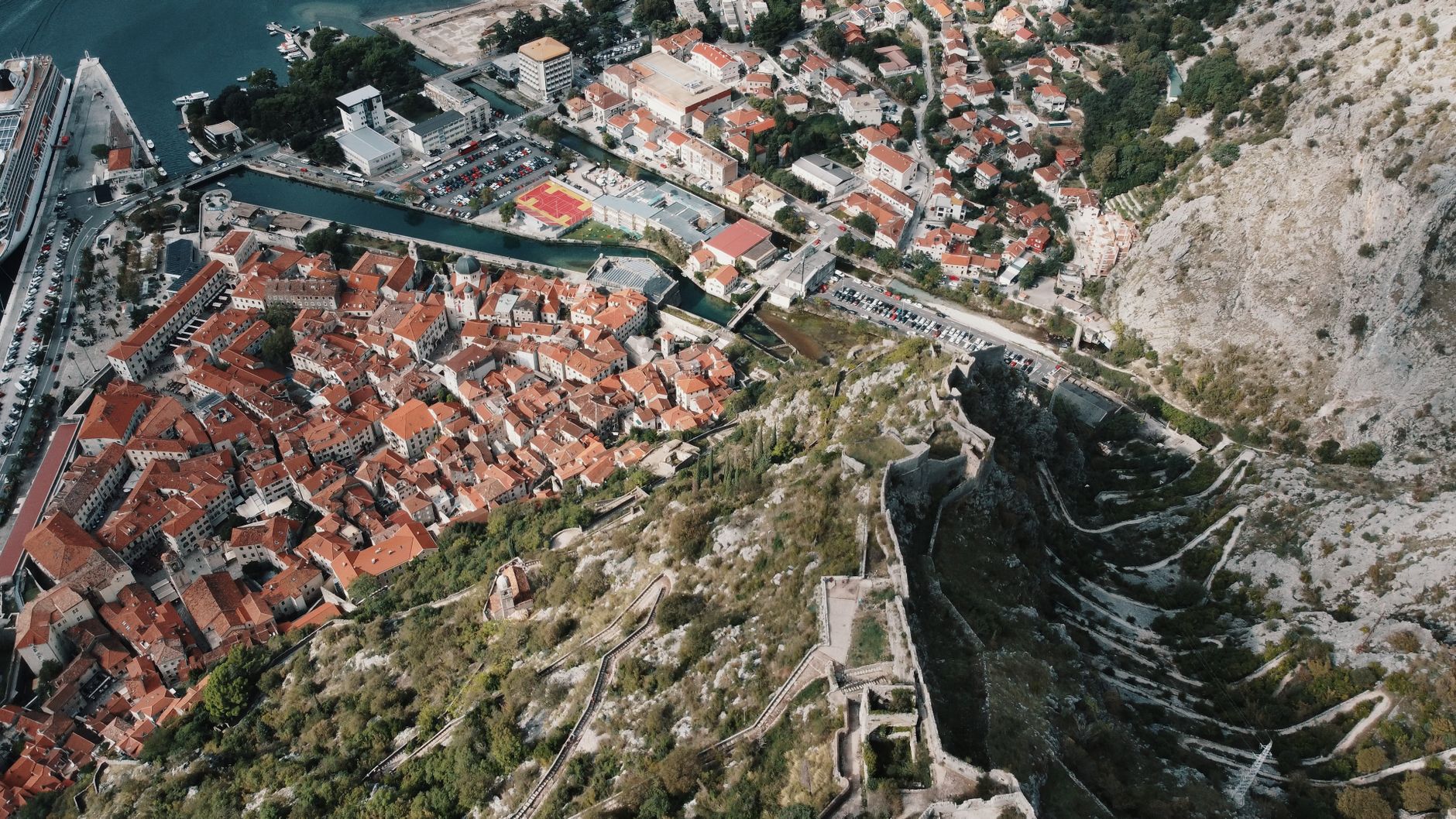
The defensive walls climb 4.5 kilometers up the mountain flank, reaching 20 meters in height and 15 meters thick in several critical sections. The climb takes 1,350 steps. You finally understand why Venetian sieges failed.
St. Tryphon’s Cathedral still stands because its 1166 Romanesque core survived the 1979 earthquake. You can still trace the cracks in the mortar.
The rhythm shifts once the cruise ships pull out at dusk. Skip the waterfront tables. Walk two streets south to find actual conversations.
Vertical Stone & Romanesque Anchors
The 4.5-kilometer defensive walls climb 260 meters from the waterfront, compressing centuries of Venetian engineering into a single limestone spine. Inside the gates, the 1166 Romanesque nave of St. Tryphon’s Cathedral still catches the Adriatic light, its surviving frescoes quietly outlasting the 1979 earthquake that cracked the foundations.The San Giovanni Ascent
One thousand three hundred fifty uneven steps cut upward through scrub pine and goat trails, trading crowded alleys for a sweeping panorama of the bay’s fjord-like folds. Start at dawn to avoid the midday heat and watch cruise ship wakes carve white lines across the dark water below.Maritime Echoes in Stone
The Grgurina Palace houses the Maritime Museum, where logbooks and brass astrolabes explain why Kotor’s narrow streets are lined with noble captains’ houses rather than merchant stalls. Walk the Dobrota promenade north of the old town to see the same architectural lineage stretched along the water, quiet and largely untouched by the day-trip crowds.
Neighborhoods
Where to wander, by quarter — each with its own rhythm.
Stari Grad
Arms Square anchors a maze of limestone lanes that smell faintly of brine. St. Tryphon’s Cathedral marks the threshold. Real architecture hides in quiet courtyards after the day-trippers leave.Dobrota
The promenade stretches 2 kilometers north of the old town walls. It trades fortifications for 19th-century captains’ villas. The evening light hits the limestone at a shallow angle.Škurda
This district sits where the town meets the steep gorge. The 1540 River Gate opens onto actual staircases. Locals start the mountain hike here.Kamelija
Modern Kotor lives across the river bridge. Mid-century concrete replaces medieval stone. You will find reliable supermarkets, cheap burek, and residents who actually work nine-to-five instead of renting seasonal apartments.
Plan your trip
Before you go
- Getting There
- Tivat Airport (TIV) sits just 8 kilometers from the old town, making taxis or pre-booked transfers the fastest route from the arrivals hall. Podgorica Airport (TGD) requires a split commute: take a BTC Zeta, MS Tours, or Zejdin shuttle to the capital, then transfer to an intercity coach bound for the Škaljari terminal. Travelers arriving via Dubrovnik Airport (DBV) must cross the Debeli brijeg or Kobila land borders, with direct regional buses taking roughly 1 hour and 40 minutes to reach the Kotor station.
- Getting Around
- Kotor operates without a metro or tram network, leaving the Blue Line local buses and walking as your daily options. The municipal e-bike share network runs through the coastal corridor, while regional coaches depart from the Škaljari terminal with ticket offices open from 06:00 to 20:00. Skip the timed-entry tourist buses during peak 2026 summer hours; the old town proves fastest on foot or via water transfer when road congestion peaks.
- Climate & Best Time
- Summer averages 24.1°C in July, while January settles around 7.7°C beneath a heavy rainfall pattern that dumps 2,152 millimeters across the year. May, June, and September offer the clearest walking conditions, balancing dry stone streets with manageable temperatures before the autumn downpours arrive. The bay stays swimmable from mid-May through early October, with sea temperatures holding above 18°C long after the inland peaks cool down.
- Language & Currency
- Montenegrin serves as the official language, though English handles most transactions in the old town and surrounding coastal strip. The euro is legal tender everywhere, and card terminals cover hotels, restaurants, and most museums, but keep cash on hand for Blue Line bus fares and small coastal cafes.
- Safety
- The U.S. State Department maintains a Level 1 advisory for Montenegro, with the primary local hazards being terrain and traffic rather than crime. The fortress ramparts turn dangerously slick after rain, and municipal authorities now enforce strict timed-entry windows for tourist coaches to prevent gridlock near the Sea Gate. Standard heat precautions apply between 10:00 and 17:00 during July and August.
Stone, Salt, and Shifting Flags
From Illyrian cliff fort to UNESCO heritage site
- 4th Century BCE
Illyrian Stronghold Takes Shape
Indigenous tribes carve a defensive position into the limestone cliffs above the bay. These early fortifications exploit the sheer drop of Mount Lovćen to control maritime approaches. The settlement survives through trade.
- 168 BCE
Rome Renames the Settlement Acruvium
Legionaries march down the coastal road and absorb the Illyrian post into the province of Dalmatia. The Romans straighten irregular hillside paths into a proper grid and lay the first mortar-bound walls. Trade ships from Brindisi now dock where local skiffs once tied off.
- c. 950
Byzantine Autonomy Takes Root
Constantinople grants the city self-governance under imperial protection. Local merchants begin minting coins bearing Greek letters alongside Latin script. The bay becomes a quiet waypoint for tax collectors.
- 1166
St. Tryphon’s Cathedral Opens Its Doors
Master masons consecrate a three-aisled basilica on the site of an older chapel. Romanesque arches rise from pale limestone. They catch harsh midday light and hold it until dusk, anchoring the city’s identity for centuries.
- 1195
Church of St. Luke Welcomes Two Faiths
Builders finish a compact brick church just outside the main square. Its interior splits down the middle, with a Catholic altar on one side and an Orthodox iconostasis on the other. Neighbors share the nave without sharing doctrine.
- c. 1275
Master Builder Vitus Learns His Trade
A young stonecutter named Vitus studies the cathedral’s vaults before heading inland to shape Serbian monasteries. His hands learn to read limestone grain and mortar ratios. The city teaches him how to make stone sing under heavy roofs.
Show the full timeline (20 moments)
- 1420
Venice Claims the Bay of Kotor
Venetian envoys sign treaties that fold the city into the maritime empire of the Serenissima. Officials in striped robes arrive to audit customs ledgers. The local dialect absorbs Italian maritime terms overnight.
- 1493
Anchoress Osanna Arrives in Exile
A young refugee from Ragusa slips through the Sea Gate and chooses a life of prayer inside a walled cell. Locals credit her with calming plague outbreaks and deterring Ottoman raids through sheer intercession. Her name becomes synonymous with quiet resilience.
- 1540
Renaissance Arch Guards the River Gate
Venetian engineers carve a new northern entrance over the Škurda stream. The stone arch bears the carved Lion of Saint Mark, its wings spread wide to face the mountains. Merchants pass beneath it carrying salt, wool, and gunpowder kegs.
- 1602
Clock Tower Rises in Arms Square
Masons hoist a heavy iron bell into a freestanding campanile overlooking the main plaza. The face tracks hours for sailors waiting on tide, not just churchgoers waiting for mass. Its shadow sweeps across the flags of docked merchant vessels.
- 1667
Earthquake Shatters the Cathedral Roof
Tremors roll up from the Adriatic. They crack the northern bell tower of St. Tryphon’s and leave it permanently asymmetrical. Dust settles on broken frescoes while masons patch what they can.
- 1807
French Troops Occupy the Fortifications
Napoleonic officers march through the Sea Gate to claim the bay for Paris. They strip bronze from church doors to cast cannonballs and rename the streets in French. The occupation lasts seven years and leaves behind a taste for centralized administration.
- 1814
Austrian Admirals Take Command
Habsburg naval architects convert the old arsenal into a fortified shipyard for the imperial fleet. German becomes the language of dockyard ledgers and military courts. The mountains echo with the clanging of iron hulls and Austrian marching songs.
- 1906
Composer Ivan Brkanović Takes First Lessons
A boy born in nearby Škaljari sits at a worn piano inside the town’s parish school. He absorbs the polyphonic folk songs drifting in from the fishing boats. Those melodies later shape symphonies performed across Central Europe.
- February 1918
Sailors Mutiny Against Imperial Command
Disillusioned crews lower the Austro-Hungarian flag and raise red pennants across the bay. They demand food, ceasefire negotiations, and an end to a war they never asked to fight. The rebellion lasts three days before imperial artillery silences the harbor.
- 1936
Jazz Pianist Larry Vuckovich Takes Flight
A toddler watches warships pass the harbor before his family packs for America. He carries the bay’s acoustic memory into San Francisco jazz clubs decades later. The rhythm of his playing keeps time with Adriatic waves.
- November 21, 1944
Partisan Liberation Cuts New Inscription
Tito’s fighters march through the old gates as German garrisons retreat toward the coast. The Sea Gate receives a fresh chiseling commemorating the town’s return to Yugoslav hands. Stone masons carefully preserve centuries of Venetian marks alongside the new text.
- April 15, 1979
Magnitude 7 Earthquake Levels Old Streets
The ground heaves at 6:19 AM. Centuries of dry-stone masonry collapse into narrow alleys as aftershocks rattle loose tiles. Four Romanesque churches crack open like walnuts.
- 1980
UNESCO Steps In With Emergency Funds
International conservators arrive with steel scaffolding and precise mortar recipes to stabilize the walls. The designation triggers a demolition order for four conflicting industrial warehouses inside the old town. Scaffolding becomes a permanent fixture for the next decade.
- June 3, 2006
Montenegro Votes for Independence
Ballot boxes open across the bay and tally a narrow majority for sovereign statehood. The Montenegrin flag replaces the Yugoslav tricolor above the customs house. Old town residents watch from terraces as cruise ships adjust their port registries.
Who lived here
-
Visionary and Anchoress · 1493–1565
Osanna of Cattaro
Lived as an anchoress in Kotor
She arrived in Kotor as a frightened girl fleeing Ottoman raids and sealed herself inside a stone cell near the Cathedral. Locals believed her prayers held the plague at bay, and her quiet defiance outlasted the city’s military garrisons. Her name still surfaces when Kotorans speak of endurance rather than conquest.
-
Master Builder · c. 1275–after 1335
Vitus of Kotor
Born and trained in Kotor
He learned to shape limestone in the city’s cramped workshops before hauling those skills inland to Serbia. His fingerprints remain in the soaring arches of Visoki Dečani, a monastery that still echoes with the exact masonry techniques he perfected on the bay. You can still spot his structural logic in Kotor’s surviving medieval vaults.
-
Painter · c. 1420–1478
Lovro Dobričević
Born in Kotor
Born in the shadow of the city walls, he carried Adriatic light with him to Venice and back again. His surviving panels blend Venetian precision with Balkan solemnity, capturing saints who look more like weathered sailors than heavenly beings. He never left the coast’s visual vocabulary behind.
-
Poet · c. 1500–1551
Ludovico Pasquali
Born, studied, and died in Kotor
He traded maritime trade for Latin hexameters and spent his life turning Kotor’s stone alleys into Renaissance poetry. His verses mapped the bay’s tides and merchant anxieties onto classical forms that still circulate in local archives. Walking past the Sea Gate, you are tracing the same streets he paced while drafting stanzas.
-
Jazz Pianist · born 1936
Larry Vuckovich
Born in Kotor
He learned to hear jazz on a crackling radio before the Adriatic breeze carried him to San Francisco. Decades later, his chord progressions still carry the rhythmic pulse of a Mediterranean port town. He never erased Kotor from his compositions. He just translated it into swing.
Where to Eat
Where locals actually book dinner — not the tourist menus.
-
Crni Rižot
Ink-stained arborio rice cooked with local white wine and tender cephalopod, leaving a dark briny finish on the teeth. It tastes like the bay itself, best ordered at family-run konobas away from the main square where the kitchen sources daily.
-
Njeguški Pršut
Air-cured ham from the nearby mountain village of Njeguši, smoked over beechwood and sliced paper-thin. The salt content cuts through the coastal humidity, and it arrives on the table draped over local cheese without fanfare.
-
Buzara na Buzaru
Shellfish stewed in garlic, olive oil, white wine, and a pinch of chili, served in the cooking pan with crusty bread for mopping the broth. The dish relies on catch quality rather than heavy seasoning, making it a litmus test for the kitchen’s sourcing.
-
Grilled Branzino
Whole Adriatic sea bass scored at the bone and roasted over open charcoal, the skin crisping while the flesh stays translucent and sweet. Order it simply, with a squeeze of lemon and a glass of local Vranac to balance the smoke.
-
Boka Oysters & Mussels
Farmed in the brackish meeting of river and sea near Risan and Herceg Novi, harvested by hand and served raw or lightly steamed. The water’s low salinity and high mineral content give them a clean, metallic finish that outperforms most Mediterranean stock.
Insider tips
Small things that change how the city treats you.
Sunrise Fortress Climb
Start the 1,350 steps to San Giovanni at 7 AM to beat the midday heat and cruise ship crowds. The summit sits 260 meters above town and offers unobstructed bay views.Order Black Risotto
Test a kitchen's seafood skill with crni rižot, colored by fresh cuttlefish ink rather than food dye. Look for briny, tender squid and ask if the catch arrived that morning.Walk to Dobrota
Leave the walled center and stroll the 7-kilometer Dobrota promenade for waterfront dinners at half the Old Town markup. You will trade tourist queues for local terraces and direct bay access.Cash for Markets
Hit the farmers market near the Southern Gate before noon with small bills for local cheese, smoked meat, and seasonal figs. Vendors rarely take cards, and weekend mornings offer the widest selection.Try Buzara Mussels
Order this classic Adriatic stew when you see fresh shellfish, as it relies on white wine, garlic, and olive oil rather than heavy sauces. Tear the crusty bread provided to soak up the briny broth.Time Festival Visits
Plan your trip around Bokeljska Noć in late August or the Winter Carnival in early February to see locals reclaim the squares. Boats parade with lights, and the Old Town fills with unscripted music rather than staged folklore.
Gallery
The city, as it actually looks.


Frequently asked
Is Kotor worth visiting?
Yes, especially if you want a compact medieval city where Romanesque architecture sits directly beside steep limestone cliffs. The real draw is the UNESCO-listed bay landscape and living civic traditions like the Boka Navy processions. It rewards slow walking over checklist tourism.
How many days in Kotor?
Three days covers the essentials without rushing. Spend one day climbing the fortress and mapping Old Town monuments, another for the Maritime Museum and a Dobrota waterfront dinner, and a third for a bay trip to Perast or Risan.
Is it safe to walk around Kotor at night?
The walled center remains safe after dark, though the narrow alleys lack heavy street lighting. Stick to main squares like Arms Square and the promenade, and keep standard precautions for pickpockets during peak summer months.
Can you do the Kotor Fortress hike without the full stairs?
Yes. Turn around at the Church of Our Lady of Remedy around the halfway mark to catch sweeping bay views without tackling all 1,350 steps. The path narrows and steepens significantly past that point.
How much does the Kotor Old Town entrance fee cost?
Visitors entering through the main Sea Gate pay a daily preservation fee that funds wall restoration and municipal maintenance. The exact rate shifts seasonally, so bring cash or a card and expect to tap in or show a receipt at the gatehouse.
Is Kotor good for families?
The Old Town's flat stone squares work well for strollers, though the fortress climb and steep side streets do not. Most konobas welcome children, and the Maritime Museum offers a straightforward introduction to Adriatic shipbuilding that holds younger attention spans.
Pick up where you left off
Saved and recently read places — kept on this device only.
Photo credits (13)
- Julien Goettelmann — Pexels License (https://www.pexels.com/license/) — Source: https://www.pexels.com/photo/26754188/
- Julien Goettelmann — Pexels License (https://www.pexels.com/license/) — Source: https://www.pexels.com/photo/27151408/
- Julien Goettelmann — Pexels License (https://www.pexels.com/license/) — Source: https://www.pexels.com/photo/18924402/
- Muhammed Fatih Beki — Pexels License (https://www.pexels.com/license/) — Source: https://www.pexels.com/photo/34061610/
- Julien Goettelmann — Pexels License (https://www.pexels.com/license/) — Source: https://www.pexels.com/photo/26753907/
- Muhammed Fatih Beki — Pexels License (https://www.pexels.com/license/) — Source: https://www.pexels.com/photo/34128969/
- Muhammed Fatih Beki — Pexels License (https://www.pexels.com/license/) — Source: https://www.pexels.com/photo/34118982/
- Julien Goettelmann — Pexels License (https://www.pexels.com/license/) — Source: https://www.pexels.com/photo/29071814/
- Julien Goettelmann — Pexels License (https://www.pexels.com/license/) — Source: https://www.pexels.com/photo/26753909/
- Julien Goettelmann — Pexels License (https://www.pexels.com/license/) — Source: https://www.pexels.com/photo/27151410/
- Julien Goettelmann — Pexels License (https://www.pexels.com/license/) — Source: https://www.pexels.com/photo/27151409/
- Julien Goettelmann — Pexels License (https://www.pexels.com/license/) — Source: https://www.pexels.com/photo/27821458/
- Nadtochiy Photography — Pexels License (https://www.pexels.com/license/) — Source: https://www.pexels.com/photo/34422211/
Photos may have been resized or cropped.