Introduction
A protest memorial standing on a colonial pedestal should feel unstable, and that is exactly why Glorieta De Las Mujeres Que Luchan in Ciudad De México, Mexico is worth your time. You come here to see how a traffic circle on Paseo de la Reforma turned into one of the capital's sharpest arguments about memory, grief, and power. Few places in the city speak so plainly. Fewer still keep changing while you stand there.
Documented records show that this roundabout first carried the 1877 monument to Christopher Columbus, commissioned by railroad magnate Antonio Escandón and sculpted by Charles Henri Joseph Cordier. The old stone base still stands there now, scarred where bronze figures once attached, so the past is not gone at all. It has been seized.
What draws people here is not beauty in the postcard sense. It is friction. Mothers of the disappeared, families of feminicide victims, Indigenous and Afro-Mexican activists, and feminist collectives turned an empty pedestal into a living memorial on 25 September 2021, then kept returning when officials tried to wipe away the names and the claim.
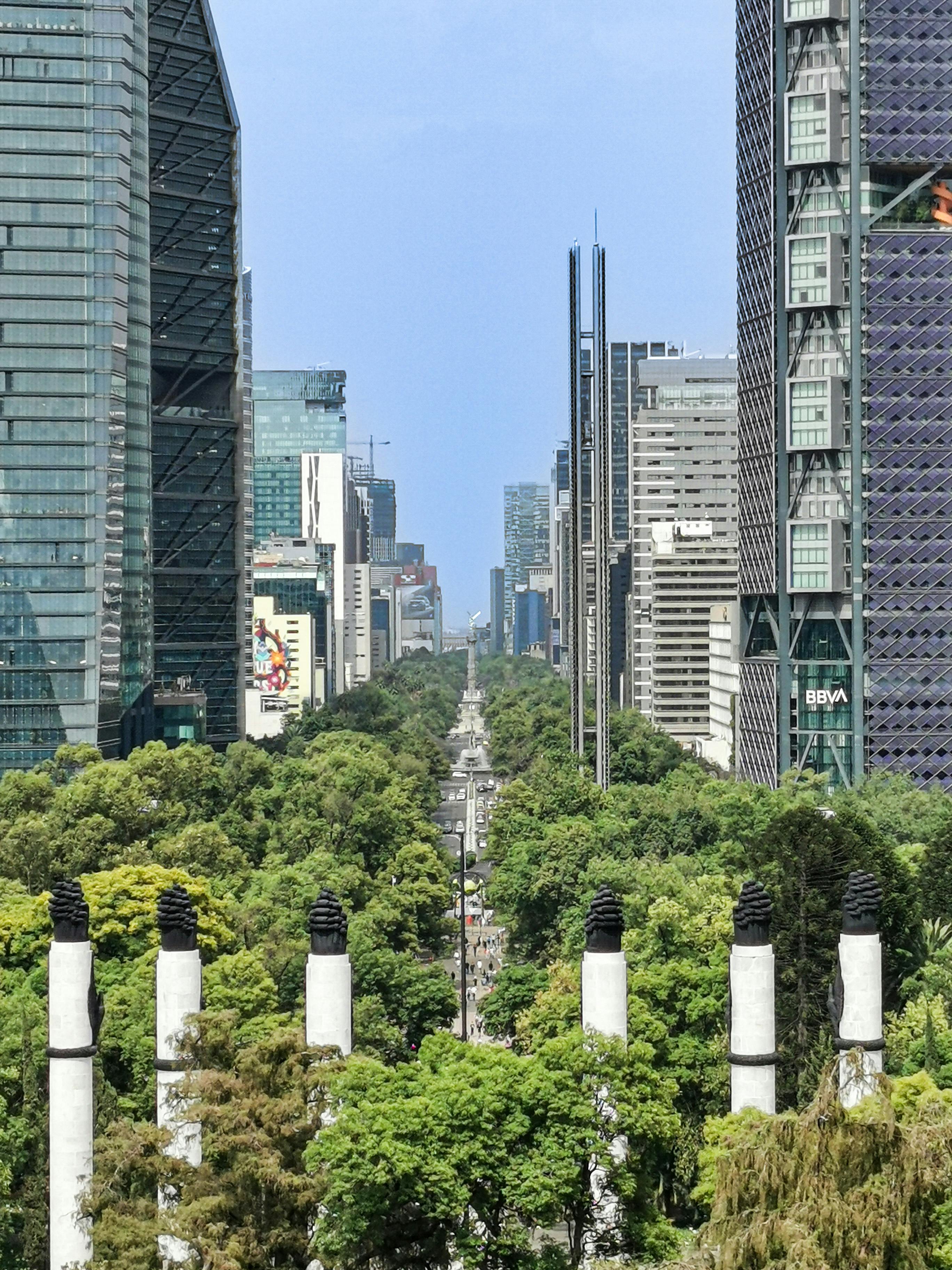
Come after seeing the grander old facades around the Ciudad De México center, even the polished tiles of Casa De Los Azulejos. Reforma sounds different here: traffic hisses, banners snap, and the stone seems to hold both accusation and refusal. This is not a monument that asks for admiration. It asks whether public memory belongs to the state or to the people who refuse to be erased.
#Ajoloberto | Glorieta de las Mujeres que Luchan
ChilangoWhat to See
The Purple Antimonumenta on the Old Columbus Plinth
The shock here is formal: a 19th-century pedestal built for Christopher Columbus now carries a raised purple fist called Justicia, first installed by feminist activists on 25 September 2021 and recast in steel in March 2022. Walk all the way around it, not just to the front where everyone takes the photo, because the back support spells out "justicia" and the view only makes sense once you feel the traffic of Paseo de la Reforma pressing in from every side, loud as a permanent argument.


The Fences, Names, and Memory Garden
The fences are part of the work. Black metal panels around the roundabout carry hand-painted names, photos, poems, denunciations, and the tendedero de denuncias, while the Jardín Somos Memoria adds steel structures and mosaics with hundreds of remembered women, so the site reads less like a statue and more like a public archive rewritten by hand. Look closely at the lettering and tape, the paper curled by rain, the marigold traces when ofrendas appear in late October, the little repairs after weather or vandalism; that rough surface tells you more about Mexico City than polished stone ever could.
A Reforma Memory Walk
Come on a Sunday morning during Muévete en Bici if you can, when Reforma sheds much of its engine noise and the roundabout feels briefly closer to a plaza than a traffic knot. Start here, then keep walking along Paseo de la Reforma as a self-guided route through Ciudad De México: the point is not distance but contrast, from official monuments to anti-monuments, from polished nationalism to names written in paint and grief, until you understand that this glorieta is not an interruption of the avenue's story but the sentence that finally says what the boulevard was always trying not to say.
Photo Gallery
Explore Glorieta De Las Mujeres Que Luchan in Pictures

A vibrant protest scene at the Glorieta De Las Mujeres Que Luchan in Mexico City, where activists gather beneath modern skyscrapers.
Comunicación wmmx · cc by-sa 4.0

A vibrant protest gathering at the Glorieta De Las Mujeres Que Luchan in Mexico City, set against a backdrop of modern architecture and a clear blue sky.
Comunicación wmmx · cc by-sa 4.0

Protesters gather at the Glorieta De Las Mujeres Que Luchan in Mexico City, a site dedicated to social activism and gender equality.
Comunicación wmmx · cc by-sa 4.0

The Glorieta De Las Mujeres Que Luchan stands as a powerful symbol of protest and memory in Mexico City, contrasting historic stone with modern architecture.
Comunicación wmmx · cc by-sa 4.0

A bustling scene at the Glorieta De Las Mujeres Que Luchan in Mexico City, where urban architecture meets a lively public gathering.
Comunicación wmmx · cc by-sa 4.0

The Glorieta De Las Mujeres Que Luchan stands as a powerful landmark in Mexico City, surrounded by modern architecture and a gathering of people.
Comunicación wmmx · cc by-sa 4.0

A participant holds a sign at the Glorieta De Las Mujeres Que Luchan in Mexico City during a vibrant public demonstration.
Comunicación wmmx · cc by-sa 4.0

Activists gather at the Glorieta De Las Mujeres Que Luchan in Mexico City, holding signs beneath the city's iconic modern architecture.
Comunicación wmmx · cc by-sa 4.0

A rainy day at the Glorieta De Las Mujeres Que Luchan in Mexico City, where a crowd gathers beneath umbrellas amidst the city's modern architecture.
PetrohsW · cc by-sa 4.0

A rainy day at the Glorieta De Las Mujeres Que Luchan in Mexico City, where a crowd of people with umbrellas gathers beneath towering modern skyscrapers.
PetrohsW · cc by-sa 4.0

Activists gather at the Glorieta De Las Mujeres Que Luchan in Mexico City to demand justice for the Ayotzinapa students on a rainy day.
PetrohsW · cc by-sa 4.0

A crowd gathers at the Glorieta De Las Mujeres Que Luchan in Mexico City on a rainy day, highlighting the intersection of urban architecture and social activism.
PetrohsW · cc by-sa 4.0
Videos
Watch & Explore Glorieta De Las Mujeres Que Luchan
🧳️ TOP 10 Que Ver en Ciudad de México ✈️ Guía Turística Que Hacer en Ciudad de México
How to Spend 5 Days in MEXICO CITY | Travel Itinerary & Travel Guide
Don't stop at the purple figure. Walk the edge of the plinth and look for the layers at knee height: names, crosses, flowers, taped poems, and denunciation cards that turn the roundabout into a living memorial.
Visitor Logistics
Getting There
The roundabout sits at Av. Paseo de la Reforma 96 in Tabacalera, a 5 to 8 minute walk from Metro Revolución and close to the Reforma Metrobús corridor, so public transit is usually faster than driving through central traffic. From Monumento a la Revolución, the walk takes about 10 minutes along broad sidewalks; by car or taxi, use Paseo de la Reforma and ask for either Glorieta de las Mujeres que Luchan or the old name, Glorieta de Colón, because both still circulate.
Opening Hours
As of 2026, this is an open public memorial in the middle of Paseo de la Reforma, so you can pass by at any hour and no gate controls entry. The real limit is the city around it: marches on 8 March, 25 November, and other protest dates can bring fences, police lines, traffic closures, and dense crowds.
Time Needed
Give it 10 to 15 minutes if you only want to understand what you are seeing and read the memorial elements. Stay 30 to 45 minutes if you want to circle it slowly, notice the names, photos, flowers, and protest traces, then continue toward Monumento a la Revolución; on a demonstration day, you may spend far longer because the site becomes an assembly point first and a visit second.
Accessibility
Reforma offers wide sidewalks and curb cuts, so the approach is workable for wheelchair users and anyone avoiding stairs. The catch is ground texture: protest installations, temporary barriers, uneven paving, and crowd surges can turn a short crossing into something more like threading through a moving bus station, so quieter daytime visits are easier.
Cost/Tickets
As of 2026, visiting the Glorieta is free and no ticket, reservation, or audio guide is involved. Save your money for the neighborhood instead: coffee at Finca Don Porfirio or a meal around Plaza de la República makes more sense than hunting for paid extras that do not exist here.
Tips for Visitors
Shoot Respectfully
Public photography is normal, but this is a memorial before it is a backdrop. Ask before taking close photos of mourners, activists, or anyone identifiable during a vigil or march, and skip drones unless you already know Mexico's AFAC rules.
Phone Away
Keep your phone in your pocket when checking directions near Metro and Metrobús crowds, especially on protest days. Distraction theft is the boring risk here, and the curbside map stare is practically an invitation.
Eat Nearby
Don't plan a meal at the roundabout itself. Go 10 minutes south-west toward Plaza de la República: Finca Don Porfirio works for budget coffee, La Soldadera is an easy mid-range stop, and Terraza Cha Cha Chá or Arango make sense if you want the Monumento view and don't mind splurge prices.
Pick Your Moment
Early afternoon gives you the clearest read of the site because the memorial materials, purple steel figure, and handwritten traces are easier to see in full daylight. Avoid 8 March and 25 November unless you want the political life of the place at full volume, with road closures and heavy police presence.
Pair The Walk
This stop works best as part of a civic-memory walk, not as a stand-alone detour. Combine it with Monumento a la Revolución and the Museo Nacional de San Carlos, both close enough to reach on foot without breaking the rhythm of the neighborhood.
Read The Mood
Dress for the day you arrive, not for a glossy Reforma photo. If a vigil, women-only contingent, or memorial action is forming, give it room and do not treat the names, crosses, poems, or clotheslines of denunciation like set dressing.
Where to Eat
Don't Leave Without Trying
La Penúltima
local favoriteOrder: Their signature cocktails and mezcal selection are what locals come for—order whatever the bartender recommends based on your mood, not the menu.
This is where the Juárez neighborhood crowd actually drinks. Nearly 360 reviews at 4.9 stars means this isn't a tourist trap—it's a genuine local bar with craft cocktails that respect Mexican spirits without being pretentious about it.
Cantaritos El Compa de Jalisco Reforma
local favoriteOrder: The cantaritos (traditional Jalisco-style drinks served in clay pots) are the reason to come—order a round and let the place's energy carry you through the evening.
Over 3,000 reviews make this a Mexico City institution. It's loud, it's packed, and it's exactly what you want when you crave the spirit of Jalisco without leaving the capital—no pretense, just good drinks and better company.
Rigan Café de Situación
cafeOrder: Specialty coffee drinks and whatever pastry they have fresh that morning—this is a spot where quality matters more than volume.
Perfect 5-star rating with a tight review count means this is a neighborhood gem that doesn't need hype. Juárez locals know it; tourists rarely stumble here. Ideal for a serious coffee break before or after exploring the Glorieta.
Pie Grande
quick biteOrder: Their pies and small plates—follow their Instagram for specials and what's available on any given weekend.
A tiny, hyper-local spot in Juárez with a perfect rating and a cult following. Open weekends only, which means they're selective about what they serve and when. This is the kind of place where every detail matters.
Dining Tips
- check The Juárez neighborhood (where three of these restaurants sit) is walkable and safe during the day and early evening—stick to main streets like Atenas and Versalles after dark
- check Cash is king at most local bars and casual spots; card payment is less reliable at smaller establishments
- check Tipping culture in Mexico City: 10–15% is standard at sit-down restaurants; at bars, round up or leave small change
- check Dinner service typically starts at 7:00 PM; many locals eat late (9:00 PM or later), so arriving early means quieter, less atmospheric service
Restaurant data powered by Google
Historical Context
The Pedestal That Changed Sides
Documented records show that the roundabout began as part of the grand boulevard laid out in the 19th century and took its defining form in August 1877, when the Columbus monument was inaugurated on Paseo de la Reforma. The message was plain enough: Mexico City would present itself as European, orderly, Catholic, and open for business. Stone can make an argument.
That argument weakened over decades of protest, especially after anti-Columbus actions in 1992 and 1994, but the real break came on 10 October 2020, when city authorities removed the sculpture officially for restoration. The empty base, left behind like a tooth socket in the middle of the avenue, gave activists something rare in a capital of finished speeches: a chance to rename the city in public.
María Herrera and the Day the Roundabout Refused Silence
Documented reports from 25 September 2021 describe feminist collectives and relatives of the disappeared climbing onto the empty pedestal and hoisting a purple figure into place. Among the women tied to the site's meaning is María Herrera Magdaleno, the searching mother of four disappeared sons, for whom this was never about symbolism alone. She needed a place where private grief could harden into public pressure.
What was at stake for Herrera was painfully concrete. If the capital's grand avenue could absorb the names of the missing and the murdered, then Mexico's most polished civic stage could no longer pretend those losses belonged somewhere else, somewhere poorer, somewhere easier to ignore.
The turning point came that same night, when city crews erased the new name and many of the painted names from the barriers. Instead of ending the action, the erasure clarified the stakes: this was no official tribute, politely inaugurated and left alone, but a memorial that would survive only if people kept returning to rewrite it. And they did.
Before the Occupation
Documented records show that businessman Antonio Escandón commissioned the Columbus monument in 1873 and that Cordier's sculpture arrived in Veracruz in December 1875 before its 1877 installation on Reforma. Even that older monument was less settled than it looked. Scholars still dispute the identities of some of the seated friars in the ensemble, which feels fitting for a monument that spent more than a century pretending certainty.
A Compromise You Can See
The city did not simply replace Columbus with this memorial. Documented events show a more awkward, more honest outcome: officials proposed Pedro Reyes's Tlali in September 2021, abandoned that plan, then unveiled La Joven de Amajac nearby on 23 July 2023 rather than on the old pedestal itself. Walk the site and you can read the compromise in stone and traffic lanes, official memory on one side, movement memory on the other.
Listen to the full story in the app
Your Personal Curator, in Your Pocket.
Audio guides for 1,100+ cities across 96 countries. History, stories, and local insight — offline ready.
Audiala App
Available on iOS & Android
Join 50k+ Curators
Frequently Asked
Is Glorieta De Las Mujeres Que Luchan worth visiting? add
Yes, if you want a place that tells you something real about Mexico City right now. This is less a monument than a public argument written in purple steel, painted names, flowers, and protest paper. Give it a stop if you care about memory, feminism, or the way Paseo de la Reforma keeps getting rewritten from below.
How long do you need at Glorieta De Las Mujeres Que Luchan? add
Plan on 20 to 40 minutes. The roundabout itself is compact, but the point is to circle it slowly, read the names on the fencing, look at the back of the sculpture where "justicia" appears, and notice how the old Columbus pedestal still carries the new memorial. If you visit on a march day, you could stay much longer.
How do I get to Glorieta De Las Mujeres Que Luchan from Ciudad De México? add
If you're already in central Ciudad de México, the easiest move is Metro, Metrobús, or a short taxi ride to Paseo de la Reforma 96 in Tabacalera. The site sits on Reforma near Monumento a la Revolución, so it connects easily with the central corridor. On protest days, walking the last stretch is often faster than sitting in traffic that crawls like a parade with no music.
What is the best time to visit Glorieta De Las Mujeres Que Luchan? add
Sunday morning is the calmest and smartest time. During Muévete en Bici, Reforma feels far less aggressive, and the roundabout reads more clearly when bikes replace a stream of cars. If you want the site at full political voltage, go near 8 March or 25 November, but expect crowds, chants, road closures, and a very different mood.
Can you visit Glorieta De Las Mujeres Que Luchan for free? add
Yes, it's completely free. This is public space, not a ticketed museum, and there is no entry fee. Bring respect instead of a wallet, because the names, photos, crosses, and denunciations are memorial material, not street décor.
What should I not miss at Glorieta De Las Mujeres Que Luchan? add
Don't miss the old stone pedestal, the painted names on the fences, and the word "justicia" on the back of the purple figure. Those details show the whole story at once: a 19th-century Columbus base taken over by a feminist antimonument on 25 September 2021. Walk the perimeter, because the fences are part of the memorial, not leftover hardware.
Sources
-
verified
Mexico City Tourism
Official venue entry with location and current civic framing of the Glorieta.
-
verified
Metrobús CDMX
Technical sheets showing station naming and persistence of the older Glorieta de Colón label in some materials.
-
verified
El País
Route and assembly details for the 2026 8M march using the Glorieta as a gathering point.
-
verified
SECGOB CDMX
Official note on the 10 October 2020 removal of the Columbus monument and historical background on the old ensemble.
-
verified
La Jornada
Report on the 2020 removal of the Columbus statue from Reforma.
-
verified
Animal Político
Coverage of the 2020 removal of the Columbus monument before planned protests.
-
verified
DW
International report on the Columbus statue removal and protest context.
-
verified
Jefatura de Gobierno CDMX
Official announcement of Pedro Reyes's proposed Tlali replacement for the roundabout.
-
verified
AWARE
Essay on feminist monumental interventions in Mexico, including the Glorieta's transformation.
-
verified
Jefatura de Gobierno CDMX
Official note on receiving more than 5,000 signatures advocating a monument to Indigenous women.
-
verified
Capital 21
Coverage of the Indigenous women signature campaign tied to the monument debate.
-
verified
Latin American and Latinx Visual Culture
Scholarly article on the counter-memory politics of the Glorieta.
-
verified
Agencia Presentes
Report on efforts to preserve the Glorieta as a feminist memorial site.
-
verified
Gaceta UNAM
Historical account of the original Columbus monument, its commissioning, and its political context.
-
verified
INAH Mediateca
Archival image record for the old Columbus monument on Reforma.
-
verified
University of Hamburg PDF
Johanna Spanke's article on the monument to progress and the Glorieta's counter-strategy.
-
verified
La Jornada
Report on the 25 September 2021 installation of the purple antimonumenta.
-
verified
CMDPDH
Open letter defending the Glorieta and documenting erasures and movement claims.
-
verified
El País
Detailed feature on the October 2022 standoff and the Glorieta as a living memorial.
-
verified
Glorieta de las Mujeres que Luchan
Movement website with archive material, events, and the site's own memory practices.
-
verified
CAV Diseño
Restoration-focused material on the old Columbus monument and damage from past protests.
-
verified
Excélsior
Historical reporting on attempts to damage or topple the Columbus statue.
-
verified
Letras Libres
Essay on the restoration and later fate of the Columbus sculptures.
-
verified
El Universal
Retrospective on the attempt to pull down the Columbus monument.
-
verified
Capital 21
Coverage tied to the official Tlali announcement and public debate.
-
verified
Amnistía Internacional México
Advocacy piece defending the Glorieta and documenting same-day erasures and later disputes.
-
verified
Milenio
Report on the 5 March 2022 steel antimonumenta and the Jardín Somos Memoria.
-
verified
Yahoo Noticias
Coverage of the installed sculpture and memorial elements at the Glorieta.
-
verified
La Jornada
Report on 12 October 2022 protest actions linked to the Glorieta dispute.
-
verified
Jefatura de Gobierno CDMX
Official announcement that La Joven de Amajac would be installed nearby on Reforma.
-
verified
Obras CDMX
Public works note on the installation of La Joven de Amajac beside the Glorieta.
-
verified
SEMUJERES CDMX
Official note on the 23 July 2023 unveiling of La Joven de Amajac.
-
verified
Expansión Política
Coverage of the compromise placement of La Joven de Amajac on an adjacent island.
-
verified
Metrobús CDMX
Official note on the 12 October 2023 station renaming to Amajac.
-
verified
INAH Mediateca
Archival image record related to 19th-century Columbus monument planning and memory.
-
verified
Reforma
Reporting on María Herrera Magdaleno and the Glorieta as a site of justice claims.
-
verified
Glorieta de las Mujeres que Luchan
Movement text on the meaning of the Glorieta and the role of searching mothers.
-
verified
Experiencias para la Memoria
Project page describing the memorial garden, anti-monument, and Route of Memory context.
-
verified
La Jornada
Report on the pink cross from Jardín No estamos todas and later site developments.
-
verified
Wikimedia Commons
Photographic reference used to understand layout, visibility, and viewpoints.
-
verified
Wikimedia Commons
Additional photographic reference for close views of the antimonumenta and fencing.
-
verified
SEMOVI CDMX
Official information on the Muévete en Bici route that changes the Sunday feel of Reforma.
-
verified
Jefatura de Gobierno CDMX
Current city update on Sunday cycling events along Reforma.
-
verified
El País
Article used for jacaranda season context along Mexico City's avenues.
-
verified
Excélsior
Background on jacarandas and their visual effect on Mexico City in spring.
-
verified
El País
Coverage of the 25N march route using the Glorieta as a departure point.
-
verified
El País
Report on the 25N march and turnout after the event.
-
verified
Mexico City Tourism
Official seasonal advice used for weather and rainy-season context.
-
verified
Wikipedia
Reference page for layout, materials, dates, and memorial features, treated cautiously where single-sourced.
-
verified
Wikipedia
Spanish reference page for site features, the sculpture, and inscriptions.
-
verified
Mexico City Tourism
English tourism entry with access notes, nearby transport, and current city framing.
-
verified
Wikipedia
Background on Reforma as the grand boulevard that gives the site its symbolic force.
-
verified
Alternautas
Scholarly framing of the Glorieta as movement-made memory produced by consent rather than decree.
-
verified
Expansión Política
Analysis of Reforma as a contested civic corridor filled with anti-monuments and movement claims.
-
verified
Expansión Política
Explainer on the Glorieta's history, meaning, and use in contemporary Mexico City.
-
verified
Animal Político
Coverage of clashes over whether the anti-monument should be moved.
-
verified
Milenio
Report on Amnesty's position regarding attempts to intervene in the site.
-
verified
Expansión Política
Coverage of 2024 8M march routes and assembly points at the Glorieta.
-
verified
Expansión Política
Report on the 2025 8M mobilization centered on the Glorieta.
-
verified
Expansión Política
Coverage of the 2025 25N demonstration using the Glorieta.
-
verified
Mexico City Tourism
Neighborhood context for Tabacalera and its civic character.
-
verified
Mexico City Tourism
Transport and area context near the Glorieta.
-
verified
Mexico City Tourism
Nearby landmark reference in Tabacalera.
-
verified
Mexico City Tourism
Context for Monumento a la Revolución as a nearby anchor on Reforma.
-
verified
Mexico City Tourism
Reference for nearby Museo Nacional de la Revolución.
-
verified
Mexico City Tourism
Reference for nearby Museo Nacional de San Carlos.
-
verified
Mexico City Tourism
Reference for Plaza San Carlos and the surrounding area.
-
verified
U.S. Department of State
General safety context for Mexico and big-city visitor caution.
-
verified
Chilango
Local guide to Tabacalera, including food and neighborhood character.
-
verified
Chilango
Local roundup of terraces and food spots around Plaza de la República.
-
verified
Godínez Gourmet
Food write-up used for atmosphere and approximate cost at Terraza Cha Cha Chá.
-
verified
El Financiero
Coverage of the decision that La Joven de Amajac would coexist with the Glorieta memorial.
-
verified
N+
Report on the unveiling of La Joven de Amajac in July 2023.
-
verified
Urban Matters Journal
Interpretive essay on anti-monuments in Mexico City and their politics of memory.
-
verified
Animal Político
Guide to the 2026 8M march, including practical route and assembly information.
-
verified
AFAC
Mexican drone regulations used for photography and filming context.
-
verified
Secretaría de Cultura CDMX
Permit information for professional filming in public streets in Mexico City.
-
verified
Tripadvisor
Reference for Finca Don Porfirio as a nearby café option.
-
verified
Tripadvisor
Reference for La Soldadera as a nearby mid-range restaurant.
-
verified
Tripadvisor
Reference for Coronela as a terrace dining option near the Glorieta.
-
verified
Tripadvisor
Reference for Cuchilleros as a nearby restaurant option.
Last reviewed: