
An introduction.
Researched by the Audiala editorial team from historical records, architectural archives, and local expertise.
AA cloak made of agave fiber should disintegrate within twenty years — thirty at most. The one hanging inside the Basílica de Santa María de Guadalupe in Mexico City, Mexico, has lasted nearly five centuries, surviving a bomb blast that bent a metal crucifix nearby but left the cloth untouched. Thirteen million people crowd into this spot on a single December day to see it, making it the most visited Marian shrine on Earth and a place where faith, history, and an unexplained material anomaly collide.
What you find at Tepeyac today is not one church but a sprawl of sacred architecture across a former hilltop on the northern edge of the city. The circular modern basilica, completed in 1976, seats ten thousand and hums with a low acoustic warmth designed for choral music. Beneath the tilma — the cloak bearing the image of the Virgin — a moving walkway carries visitors past at a steady pace, because stopping would create a human bottleneck that this building was specifically engineered to prevent.
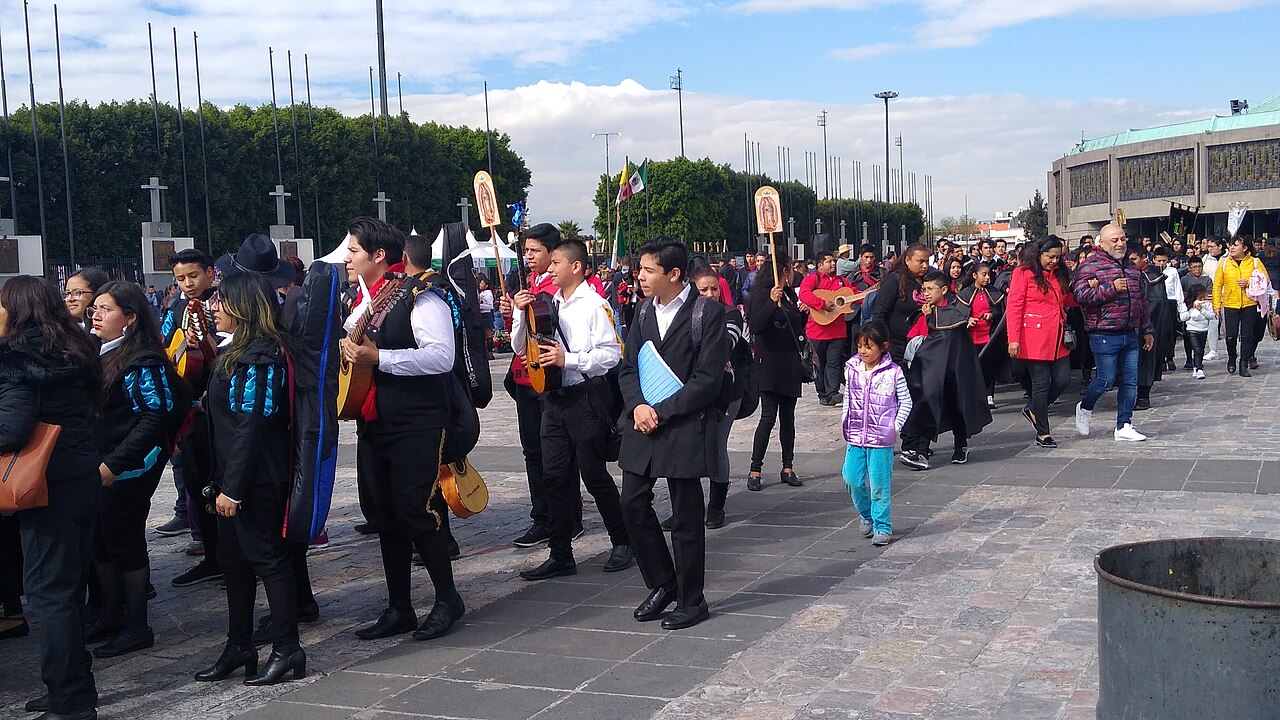
Across the plaza, the Old Basilica leans visibly. Three centuries of sinking into the soft lakebed soil of the Valley of Mexico have left its floors uneven and its walls off-true, a baroque monument slowly losing its argument with gravity. Between the two churches, the esplanade fills with indigenous dance groups, pilgrims completing vows on their knees, vendors selling roses and religious prints, and families eating tamales on the stone steps.
This is not a museum with a devotional afterthought. The basilica maintains daily Mass, rosary, novena, baptisms, confessions, and coordinated pilgrim services for groups arriving from across Mexico and beyond. The shrine's living rhythm — set by a ritual calendar that peaks in December but never truly pauses — is the reason to come. You are visiting a place that has been a destination for long-distance walkers since before the Spanish arrived, and has not stopped being one.
01 What to see.
The New Basilica and the Tilma
The Antigua Basílica
Cerro del Tepeyac and the Capilla del Cerrito
The Full Circuit: Plaza to Peak and Back
02 In pictures.



Plan and listen to Basilica Of Our Lady Of Guadalupe with Audiala.
Audio guide in your pocket, itinerary in your browser. Built for the way you actually visit.
Tickets & tours.
These are guided options from our partners — same price as booking direct.
Prices are indicative — final pricing and availability are confirmed at checkout. Audiala may earn a commission from bookings made through these links.
Also on GetYourGuide
More tours for Basilica Of Our Lady Of Guadalupe
Curated from GetYourGuide. Same price as official, free cancellation on most.

Mexico City: Teotihuacan & Guadalupe Shrine Tour with Lunch
from
€51

Mexico City: Basilica of Our Lady of Guadalupe Tour
from
€49

Mexico City: Basilica of Our Lady of Guadalupe Private Tour
from
€79

Mexico City: Lucha Libre Night with Hotel Pickup & Mask.
from
€63

Mexico City: Basilica of Our Lady of Guadalupe Tour
from
€45
Prices shown are indicative — final pricing and availability are confirmed at checkout. Audiala may receive a commission from bookings made via these links.
03 Visitor logistics.
The practical scaffolding for a good visit — kept short.
Getting There
Metro Line 6 to La Villa–Basílica station, then a five-minute walk — the station is literally named after the place. From the Zócalo, count on 20–30 minutes by metro. Uber and DiDi work well here; skip street-hailed taxis near the complex, where overcharging is routine.
Opening Hours
As of 2026, the New Basilica opens daily 6:00 AM–9:00 PM, with Mass celebrated every hour throughout the day. The complex operates 365 days a year — this is the second most visited religious site on earth, and it never sleeps. Entry may be restricted during active Mass, so time your arrival between services for the smoothest access.
Time Needed
For the New Basilica and the tilma alone, 45–60 minutes. To see both basilicas and the plaza properly, budget at least two hours. The full complex holds ten distinct sites — Old Basilica, Capilla del Pocito, the hilltop chapel, the museum — and doing them justice takes half a day.
Accessibility
The New Basilica is modern and flat, with moving travelators behind the altar designed so all visitors can pass beneath the tilma. The Old Basilica is a different story: its floor pitches and sinks from centuries of subsidence, making wheelchair access essentially impossible. Climbing Cerro del Tepeyac to the hilltop chapel involves steep, uneven terrain with no elevator.
Cost
Entry to the entire basilica complex is free — always has been, always will be. This is a working church, not a ticketed attraction. Paid parking and paid toilets are the only costs inside the grounds; the museum may charge a small separate fee.
05 Tips for visitors.
Small things that change the day.
Dress Code Enforced
Cover your shoulders and knees — this is actively enforced, not a suggestion. Remove hats on entering. Shawls or wraps are sometimes available at the entrance, but don't count on it.
Flash Off for the Tilma
Photography is allowed throughout the complex, including from the moving sidewalk beneath the tilma, but no flash and no tripods inside. Photograph crawling pilgrims only from a respectful distance, if at all — locals consider close-up shots of people in physical pain deeply disrespectful.
Watch for Scams
Unofficial "guides" approach tourists near the entrance — legitimate guides carry visible ID. The classic move from souvenir vendors: hand you something "free," then demand payment. Keep bags cross-body in the dense plaza crowds, especially around December 12.
Eat Like a Pilgrim
Skip sit-down restaurants near the complex — this is a street food district. Tamales de rajas and hot champurrado from the plaza vendors are the real local breakfast, running 30–80 MXN. For a full comida corrida lunch, walk along Calzada de Guadalupe and pick any place packed with locals.
Avoid December 12
Unless you specifically want to witness nine million pilgrims, some crawling on bloodied knees through the night while mariachis sing Las Mañanitas at dawn — and that is genuinely worth seeing once — avoid December 12 for normal sightseeing. The crowds make the complex physically impassable.
Don't Skip the Old Basilica
Most visitors beeline for the New Basilica and miss the 1709 original next door, where the floor visibly warps and tilts from three centuries of subsidence on Mexico City's old lakebed. Walking on it is disorienting — the whole room seems to lean. The colonial altarpieces inside are worth the vertigo.
Where to Eat
Don't Leave Without Trying
Dining Tips
- check Street food vendors line Calzada de los Misterios—expect to pay $1–3 USD per item and eat standing up or on the move.
- check Most neighborhood eateries open early (7–8 AM) to serve pilgrims and breakfast crowds; plan accordingly.
- check The area is dense with informal food stalls and sit-down restaurants catering to the millions of pilgrims who visit annually.
- check Mercado de Lindavista, 2–3 km south, is reachable by Metro (Line 6, Lindavista station) and has full market stalls with prepared food and local specialties if you want more variety.
Restaurant data powered by Google
04 A history of reinvention.
Five Hundred Years of Walking to the Same Hill
Before there was a basilica, before there was a colony, before anyone called this place Mexico, people walked to Tepeyac. Indigenous pilgrims crossed arid terrain to reach the hill where Tonantzin — the Nahuatl mother goddess — was venerated. After the Spanish conquest, after the reported apparition of 1531, after churches rose and sank and rose again on the soft valley floor, people kept walking. The buildings changed. The theology changed. The walking did not.
That continuity is the spine of this place's history. The choir tradition traces to 1776. The Dozavario — twelve days of communal preparation before the December 12 feast — echoes the original apparition sequence. Neighborhoods along pilgrimage routes still set out free food and water for walkers, a practice no one organized from above. The basilica is not a relic of a finished past. It is an institution in constant use, renewed and contested and rebuilt across five centuries without ever falling silent.
The Bishop, the Convert, and a Cloak That Refuses to Die
The surface story is clean. In December 1531, according to tradition, an indigenous convert named Juan Diego Cuauhtlatoatzin reported that the Virgin Mary had appeared to him on Cerro del Tepeyac, speaking Nahuatl, asking for a temple. Bishop Fray Juan de Zumárraga demanded proof. Juan Diego gathered roses that should not have been blooming in winter, carried them in his tilma, and when he opened the cloak before the bishop, the image of a dark-skinned Virgin was imprinted on the agave fiber. Conversion followed on a scale force had never achieved.
But step back into Zumárraga's world and the story gets harder to read. He was a Franciscan charged with Christianizing a continent, and the blunt approach — smashing temples, burning codices — was failing. Then an indigenous man arrives claiming the Virgin appeared on a hill already sacred to Tonantzin, speaking the local language, with brown skin. Whether Zumárraga believed the apparition as literal miracle or recognized a bridge between civilizations is a question no surviving document answers. What is documented is the result: Guadalupe gave indigenous Mexicans a Christianity rooted in their own geography and appearance. Millions converted within a generation.
The tilma itself became the physical proof and the ongoing puzzle. Ayate fiber degrades within decades. This cloth has survived close to five hundred years. During the Cristero War of the late 1920s, a bomb concealed in a floral arrangement detonated near the high altar of the Old Basilica at around 10:30 in the morning — shattering stained glass windows and bending a bronze crucifix. The tilma, meters away, was unscathed. For a time during the persecution, the image was secretly removed and sheltered in private homes. Mexico's most sacred object became a refugee in someone's living room.
Stand on the moving walkway beneath the image today and you see all of this compressed into a single object — a piece of cloth that bridged two civilizations, survived a bombing, hid in bedrooms, and still draws thirteen million people to a hilltop that was sacred before anyone here had heard the word 'church.'
What Changed: Three Churches, One Sinking Hill
What Endured: The Pilgrimage Never Stopped
Listen to the full story in the app
The whole Basilica Of Our Lady Of Guadalupe,
told well.
Audio guides for 1,100+ cities across 96 countries. History, stories, and local insight — offline ready.

06 Frequently asked.
The questions travellers send us most about Basilica Of Our Lady Of Guadalupe.
Is the Basilica of Guadalupe worth visiting?
Yes — even if you have no religious connection, this is where Mexican national identity lives and breathes. The sight of pilgrims crawling on their knees across the enormous plaza hits harder than any cathedral in Europe. Beyond the famous tilma, the full complex holds ten distinct sites including a surreally tilting 18th-century church, a baroque hilltop chapel, and a museum of colonial votive paintings that most visitors skip entirely.
How long do you need at the Basilica of Guadalupe?
At minimum two hours if you want more than a quick look at the tilma. A proper visit covering the New Basilica, Old Basilica, the hill climb to Capilla del Cerrito, and Capilla del Pocito takes half a day. The complex has ten separate sites — rushing through defeats the purpose, especially when the human spectacle in the plaza is half the experience.
Can you visit the Basilica of Guadalupe for free?
Admission to the entire basilica complex is free — no tickets, no booking, no skip-the-line passes. This is a working church, not a ticketed attraction. The only costs are paid toilets, paid parking, and a likely small fee for the Museo de la Basílica. Street food around the plaza runs 30–80 MXN per item.
How do I get to the Basilica of Guadalupe from Mexico City center?
Take Metro Line 6 to La Villa–Basílica station — the stop is literally named after the complex, so you can't miss it. From the Zócalo, the ride takes roughly 20–30 minutes. From the station, it's a five-minute walk, and the approach along the avenue gives you a slow, dramatic reveal of the basilica's scale. Metrobús Line 1 also serves the area, and ride-share apps work better than street taxis here.
What is the best time to visit the Basilica of Guadalupe?
Weekday mornings before 10 AM offer the calmest experience. Avoid December 12 unless you specifically want to witness the feast — 13 million people showed up in 2025, turning the area into something closer to a stadium event than a church visit. Masses run every hour from 6 AM to 9 PM, and entry can be restricted during services, so plan to arrive between masses for easier movement.
What should I not miss at the Basilica of Guadalupe?
The tilma — Juan Diego's cloak with the Virgin's image — is the centerpiece, viewed from moving sidewalks that glide beneath it behind the altar. But don't stop there. The Old Basilica's visibly sinking, undulating floor is genuinely disorienting to walk on, a physical record of Mexico City's unstable lakebed geology. Climb Cerro del Tepeyac for the intimate hilltop Capilla del Cerrito and city views, and seek out the overlooked Capilla del Pocito, an 18th-century baroque chapel near a sacred spring.
Is the Basilica of Guadalupe the most visited church in the world?
It's the second most visited religious site on Earth after the Vatican, drawing between 20 and 30 million visitors annually. On December 12, 2025 alone, Mexico City authorities counted roughly 13 million attendees — a number that temporarily reorganizes the city's entire traffic, sanitation, and emergency response systems. No other single-day religious gathering in the Americas comes close.
What should I wear to the Basilica of Guadalupe?
Modest clothing is expected and enforced — cover your shoulders and knees, and remove hats inside the basilica. This is an active place of worship where pilgrims arrive after days of walking or crawling. Comfortable shoes matter too: the Old Basilica's warped floor is uneven, and the hill climb to Capilla del Cerrito is a proper uphill walk.
Verified, and shown.
Researched and written by the Audiala editorial team from historical records, architectural archives, and local expertise.
Official Mass schedules, opening hours, pilgrimage coordination, live broadcasts, festival programming, and historical narrative of the apparitions
Construction history of the Old Basilica, 1695–1709 by Pedro de Arrieta, neoclassical renovations, 1904 elevation to minor basilica, and the Cristero War bombing
Overview of the complex's ten sites, annual visitor counts, architectural details, and the 1921 bomb attack
Official city tourism information on the New Basilica and annual visitor statistics
December 12 attendance figures: 12 million in 2024, 13 million in 2025, plus city security and logistics operations
Cultural significance of the Virgin, pilgrimage traditions, embodied devotion practices, and December 12 celebrations
Pre-Hispanic origins of Tepeyac, the apparition narrative, local nicknames, and neighborhood character
Visitor reviews from October 2025–March 2026 covering opening hours, accessibility, time needed, paid toilets, moving sidewalks, and the Old Basilica's sinking floor
Dress code enforcement, photography rules, and museum information
List of the ten sites within the complex and guided tour options
Anthropological research on Tepeyac's pre-Hispanic sacred geography, community pilgrimage traditions, and indigenous musical heritage
Preparations for the 2026 fiftieth anniversary of the New Basilica's consecration and the 2031 quincentenary
Confirmation of construction dates and the 1531 apparition timeline
Last reviewed


