Puerta De Chihuahua
Chihuahua CityMexico 28° N · 105° W Updated Apr 2026
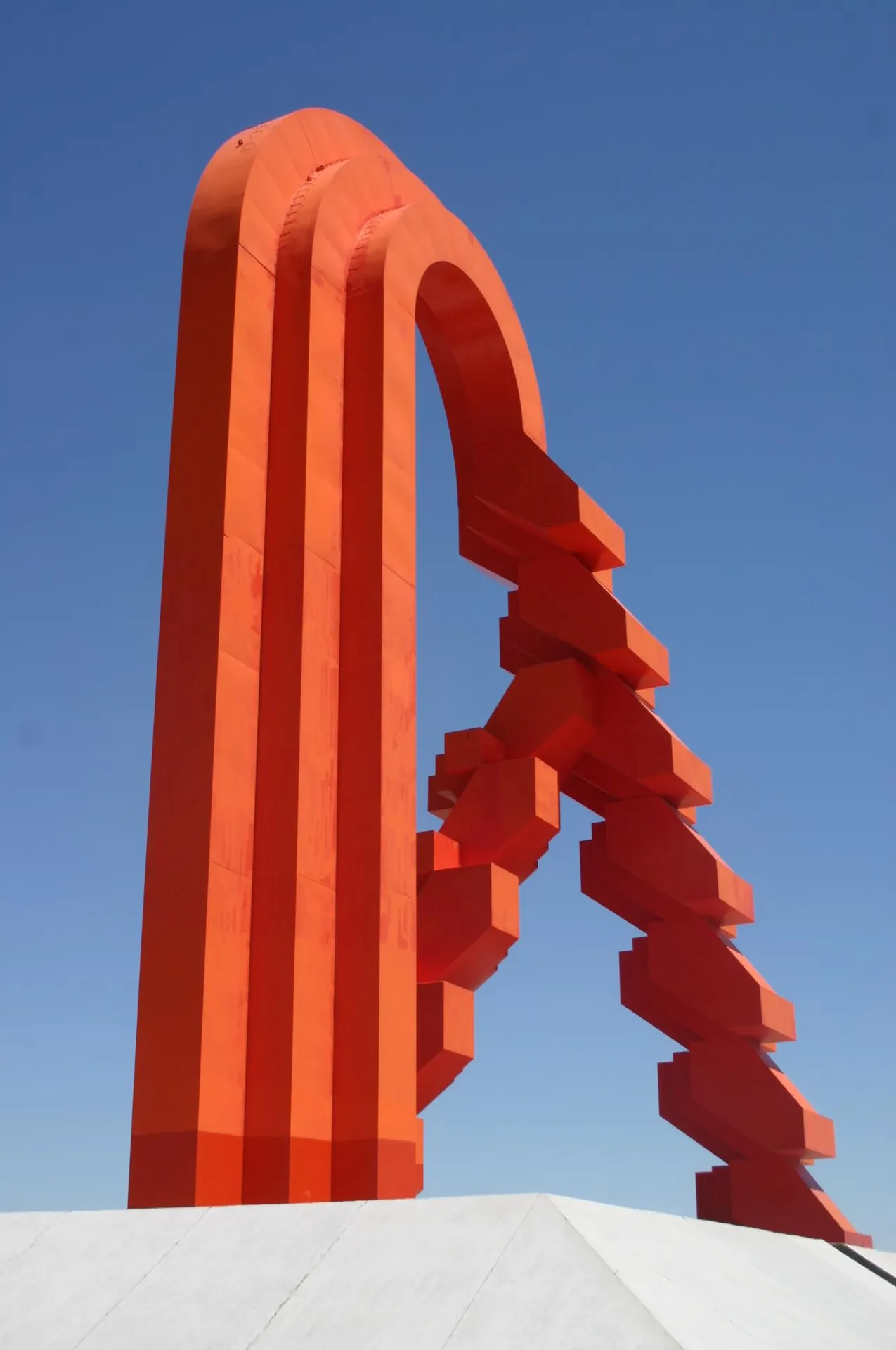
A 43-meter red steel arch weighing 500 tons marks Chihuahua's southern gateway — sculptor Sebastián's first work in his home state, free to visit anytime.
- Time needed
- 30–45 minutes
- Entry
- Free
- Access
- Flat outdoor site; specific facilities unconfirmed
- Best season
- Spring (March–May) or autumn (September–November)
Forty-three meters of crimson steel erupt from the flat Chihuahuan desert, framing nothing but highway and sky. Puerta de Chihuahua stands at the southern gate of Chihuahua City, Mexico — a 500-ton arch by sculptor Sebastián that rises taller than a twelve-story building, costs nothing to visit, and is almost perpetually empty. This might be the loneliest monumental sculpture you'll ever walk beneath.
Sebastián — born Enrique Carbajal González in the nearby town of Camargo — spent three decades placing colossal geometric sculptures across Latin America before anyone commissioned one for his home state. The Puerta, inaugurated in 1997, was that commission: a personal homecoming encoded in steel.
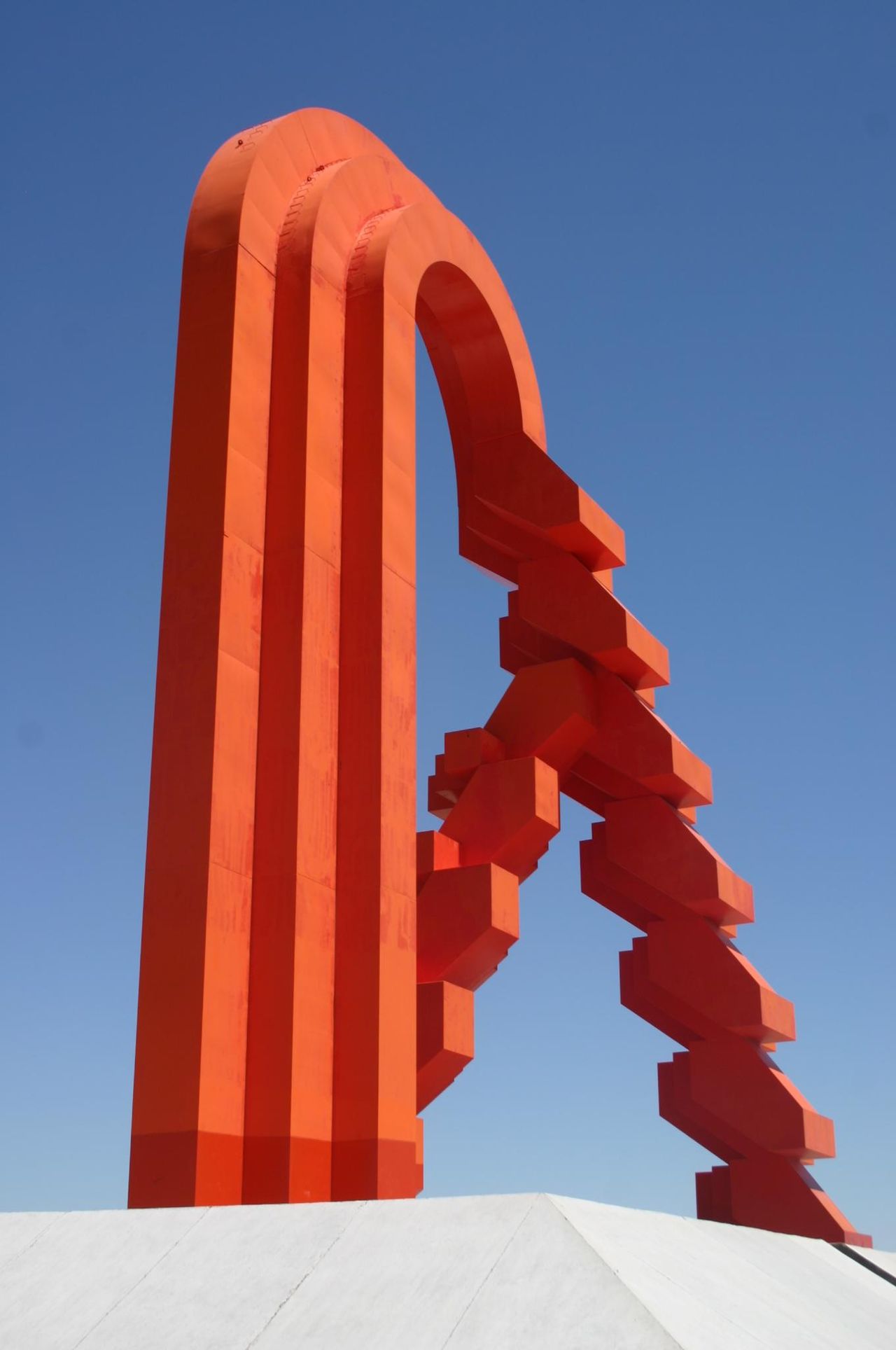
The design fuses two architectural vocabularies. Metallic staircases reference the stepped profiles of pre-Hispanic pyramids, while the flared semicircular arch echoes Spanish colonial gateways. Red, Sebastián's signature color, makes the whole structure impossible to miss against the brown desert hills and pale sky.
Reaching the Puerta means a ten-to-fifteen-minute drive south from Chihuahua's historic center along Highway 45 toward Delicias. It sits on the roadside, not in the walkable old town. Plan it as a deliberate stop, and you'll have the place more or less to yourself.
What to see
-
The Arch from Below
Standing beneath the Puerta de Chihuahua changes your sense of its scale. From the highway, it registers as a large red arch — impressive but comprehensible. Step under it and tilt your head back, and forty-three meters of steel bear down with a weight you can almost feel. The interior is rougher than the exterior: geometric bracing, visible joints, the functional bones of the structure exposed. Late afternoon light turns the red steel almost orange, and the shadow of the arch stretches east across the desert scrub in a long, clean line. Give yourself time here. The silence is as much a feature as the steel. -
The Highway Approach
If you're arriving from the south along Highway 45 — the same road connecting Chihuahua to Delicias and the agricultural heartland beyond — the Puerta appears gradually on the horizon, small and red against the brown desert. Over several kilometers it grows until the arch fills your windshield, and for a brief moment you drive through it. Sebastián designed the sculpture for precisely this experience: the transformation from distant curiosity to overwhelming presence in the span of a few minutes at highway speed. Pull over just before you reach it for the best photographs, when the arch is close enough to show detail but far enough to fit the frame. -
A Monument in Need of Friends
Honesty compels a caveat. Visitors report graffiti, paint deterioration, and general neglect around the Puerta — the city has not maintained the sculpture to match its ambition. Come anyway. The sheer mass of 500 tons of red steel absorbs a good deal of indignity, and the structural form remains powerful regardless. But temper your expectations for polish. This is a monument that rewards visitors who care more about geometry and scale than about pristine upkeep.
Plan your visit
- Getting There
- The sculpture stands on México 45, the federal highway connecting Chihuahua to Delicias, at the city's southern entrance. Drive south from the historic center for about 10–15 minutes — you can't miss a 43-meter red steel arch. There's no dedicated public transit stop, so a car or taxi is your best bet; rideshare from the Zócalo runs roughly 80–120 MXN.
- Opening Hours
- As of 2026, Puerta de Chihuahua is an open-air roadside sculpture with no gates or barriers — accessible 24 hours a day, 365 days a year. No tickets, no closing time, no staff on site.
- Time Needed
- A quick stop takes 15–20 minutes: walk beneath the arch, snap photos, absorb the scale. If you want to study the geometric details, catch shifting light on the steel, and explore the base from multiple angles, budget closer to 45 minutes. This isn't a half-day destination — plan it as a detour when arriving or leaving the city from the south.
- Cost
- Completely free. No entrance fee, no parking charge, no donation box. Your only expense is getting there and back — a round-trip taxi from downtown Chihuahua costs roughly 160–240 MXN.
Photo Gallery


History
A Sculptor Comes Home
Before 1997, Chihuahua's capital had no signature sculpture to match the monumental gateway arches found in cities like Monterrey or Mexico City. The state's most famous export in the art world was Sebastián himself — and he'd been building for everyone else.
The commission came as his career was at full velocity. He had placed geometric steel giants in dozens of cities across Mexico and beyond. But Chihuahua, the state that raised him, had none of his work. The Puerta was designed to correct that absence with a single, outsize gesture on the highway where he once traveled as a young man leaving home.
The turning point
The Boy from Camargo Who Built a Gate to His Own State
Enrique Carbajal González grew up in Camargo, a small city 160 kilometers south of Chihuahua on the same Highway 45 that would eventually carry his arch. He left for Mexico City in the 1960s to study art, adopted the single name Sebastián, and developed a sculptural language rooted in geometric abstraction — op-art, kinetic forms, minimalism scaled up to public dimensions.
By the 1990s, he had become Mexico's default sculptor of civic ambition. If a city wanted a monumental gateway, they called Sebastián. Chihuahua finally placed the call, and the result was a 43-meter flared arch weighing roughly as much as a fully loaded Boeing 747, painted in his trademark red and set precisely where the highway enters the city from the south. The 1997 inauguration made it his first major work in Chihuahua — a homecoming thirty years in the making.
Some sources put the height at 46 meters rather than 43, and the discrepancy has never been publicly resolved. That ambiguity feels fitting for a sculpture whose flared geometry shifts proportions depending on your angle of approach.
Two Civilizations in One Arch
A Second Gate Across Town
Tips for visitors
Chase Golden Hour
The red steel catches fire in late-afternoon light — visit an hour before sunset and the arch practically glows against the desert sky. Midday sun flattens the geometric details and the heat in summer can hit 40°C, so timing matters twice over.Frame the Highway
Stand directly beneath the arch and shoot through it toward the highway stretching south — the sculpture was designed as a gateway, and this angle captures that intent. A wide-angle lens helps; at 43 meters tall (roughly a 14-story building), you'll struggle to fit it in frame from up close with a standard lens.Watch for Wear
Recent visitors report graffiti and signs of neglect at the base — the monument's scale remains impressive, but don't expect a polished museum experience. Stick to daylight hours and avoid lingering after dark, as the site is isolated and unattended.Spring or Fall Visit
Chihuahua's desert climate punishes extremes: summers push past 38°C and winters can dip below freezing with occasional snow. March through May and September through November offer the mildest conditions for standing outdoors staring up at 500 tons of steel.Eat in the Centro
There's nothing to eat or drink near the sculpture — no vendors, no cafés, no water fountains. Stock up before you go, or save your appetite for the restaurants around the Zócalo and historic center, a 10–15 minute drive north.Pair with La Puerta del Sol
Sebastián built a second monumental arch in Chihuahua — La Puerta del Sol, a white 35-meter structure inspired by the ancient doorways of Paquimé, located at Periférico de la Juventud. Seeing both in one afternoon gives you Sebastián's full conversation between pre-Hispanic and colonial forms.
Frequently asked
Is Puerta de Chihuahua worth visiting?
Worth a stop, yes — but adjust your expectations. It's a 43-meter steel arch taller than a 14-story building, created by one of Mexico's foremost sculptors, and entry is free. The honest caveat: reviews note maintenance issues including graffiti and general wear, so come for the scale and geometry, not for a pristine landmark experience.
How long do you need at Puerta de Chihuahua?
Around 45 minutes is enough for most visitors. Walk beneath the arch, circle it, photograph the framing effect from a distance, and you've seen what it has to offer. It's a roadside monument, not a museum — plan it as a dedicated short detour or an en-route stop when entering or leaving the city from the south via Highway 45.
Who created Puerta de Chihuahua?
The sculptor is Sebastián, born Enrique Carbajal González in Camargo, Chihuahua. Inaugurated in 1997, it was his first major work created in his home state — a fact that adds weight to the arch's position as a gateway into Chihuahua City. His geometric, constructivist style draws on op-art and minimalist traditions developed across a career beginning in the 1960s.
What does Puerta de Chihuahua symbolize?
The arch layers two civilizations into one structure: the metallic staircases reference pre-Hispanic pyramids, while the sweeping arch evokes Spanish colonial architecture. Sebastián designed it as a literal and symbolic gateway — the first major landmark travelers encounter arriving from the south on federal highway 45.
How tall is Puerta de Chihuahua?
Most sources cite 43 meters — roughly as tall as a 14-story building, and weighing 500 tons of steel. Some sources list 46 meters; the discrepancy hasn't been officially resolved. Either way, the scale only registers properly when you're standing beneath it.
Is Puerta de Chihuahua free to visit?
Yes, completely free. It's an outdoor public sculpture on federal highway 45 with no entrance fee and no barriers. The site is open 24 hours, seven days a week.
How do you get to Puerta de Chihuahua?
By car via Highway 45 (México 45) heading south from the city center toward Delicias. The arch sits at the southern entrance to Chihuahua City, roughly a 10–15 minute drive from the historic center. It's a roadside stop — arriving by car is the practical approach.
Sources & attribution 4
- Wanderlog — Puerta de Chihuahua — Visitor reviews, hours, time on site estimates, and practical access notes
- Audiala — Puerta de Chihuahua — History, physical specs, symbolism, sculptor biography, visitor information
- mxcity.mx via Audiala — Sebastián's artistic background, design symbolism, and constructivist influences
- Wikipedia — La Puerta del Sol — Contextual information on Sebastián's other Chihuahua work and his regional origins
Built from cited sources · see the method · How we make our guides →
Pick up where you left off
Saved and recently read places — kept on this device only.
Photo credits (2)
- Puerta de chihuahua - panoramio — verdo_iglesias — CC BY-SA 3.0 (https://creativecommons.org/licenses/by-sa/3.0/) — Source: https://commons.wikimedia.org/wiki/File:Puerta_de_chihuahua_-_panoramio.jpg
- Picture 034-Puerta — Lyricmac at English Wikipedia — CC BY-SA 3.0 (https://creativecommons.org/licenses/by-sa/3.0/) — Source: https://commons.wikimedia.org/wiki/File:Picture_034-Puerta.jpg
Photos may have been resized or cropped.