
Place
Mexico Updated Apr 2026
Salt hangs in the air in Cancún, Mexico, but so does exhaust, grilled fish, and the sweet burn of fresh coffee on Avenida Nader. That mix catches first-time visitors off guard. Cancún sells itself as turquoise water and wristbands, yet the city makes more sense when you notice how a Maya museum on stilts, a seafood port in Puerto Juárez, and a public square full of families all sit inside the same urban sprawl.
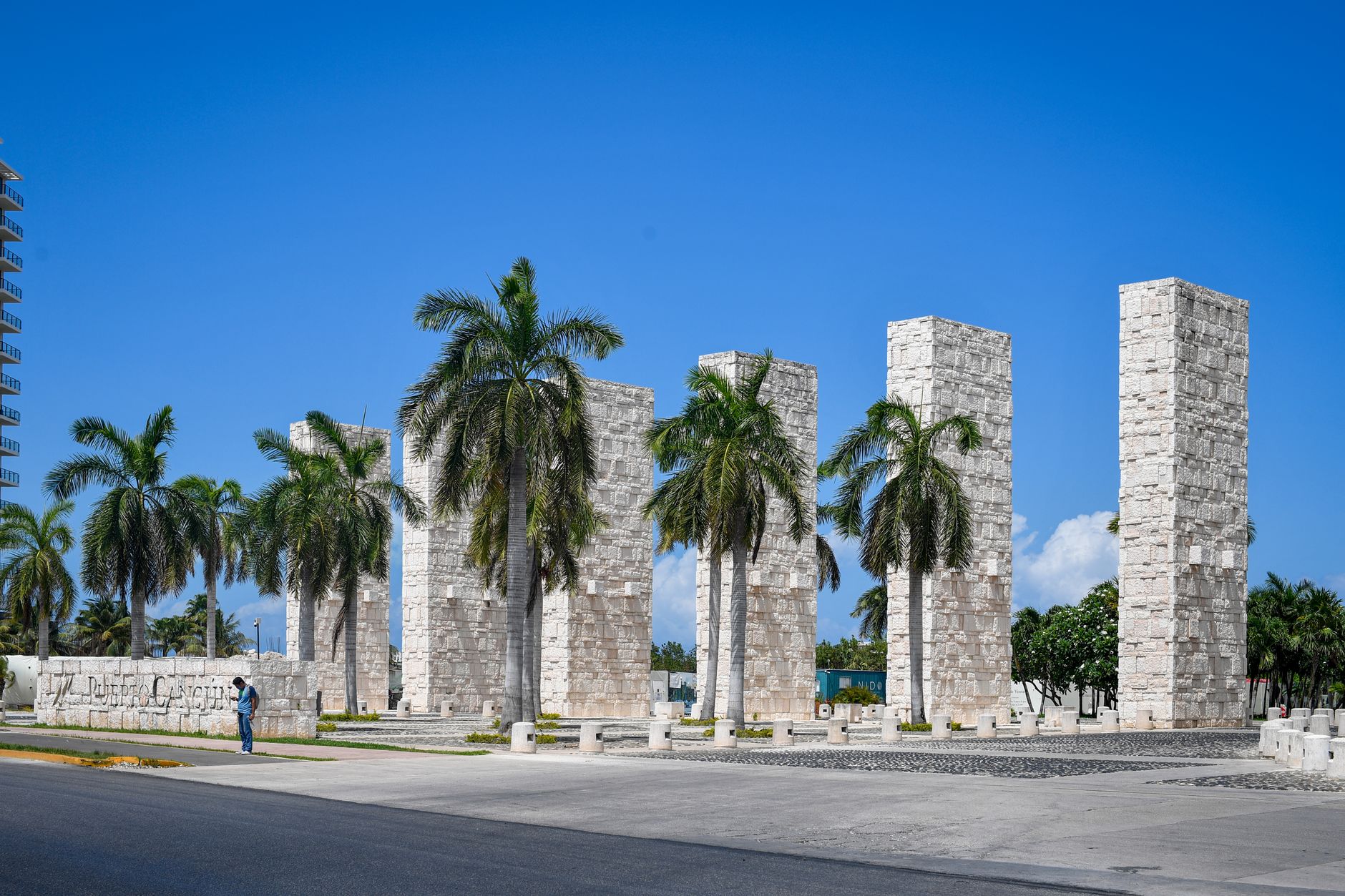 Photo: Margo Evardson / Pexels
Built from cited sources · see the method · How we make our guides →
The Hotel Zone is the obvious face of Cancún: a long, narrow strip between the Caribbean and Nichupté Lagoon where the sea flashes electric blue and buses rumble past all-inclusives at all hours. Then the script breaks. Ten or fifteen minutes inland, Parque de las Palapas fills with kids chasing balloons, vendors pressing out marquesitas, and residents who are not performing vacation for anyone.
Cancún's history isn't buried under the resorts; it keeps surfacing through it. El Rey stands at Km 18 in the Hotel Zone, Yamil Lu'um peers out from a bluff near the shopping complexes, and the Museo Maya de Cancún, designed by Alberto García Lascurain, lifts its concrete volumes above the ground so the surrounding vegetation and the San Miguelito site still matter. Smart building. Smarter setting.
What changes your understanding of Cancún is the city's split personality, and how badly the usual beach narrative undersells it. Come for Playa Delfines if you want. Stay alert for Puerto Juárez seafood lunches, late coffee on Nader, a free salsa night at Las Palapas, or the quiet shock of finding serious Maya archaeology wedged between resort towers and sunburned tourists.
Not every monument, just the ones we'd walk you past ourselves.


Where to wander, by quarter — each with its own rhythm.
Before you go
Curated from places in this city. Same price as official sites.




Prices shown are indicative — final pricing and availability are confirmed at checkout. Audiala may receive a commission from bookings made via these links.
From Maya salt makers and sea traders to a purpose-built resort that became a metropolis in one lifetime
Most scholars date the first settlement at El Rey to around 300 BCE, on the long sandbar now called Cancún's Hotel Zone. Small groups raised stone platforms above the glare and salt, building light structures where the Caribbean wind still whistles through the ruins.
By about 200 CE, El Rey's inhabitants were living from the sea and the flats behind it, fishing offshore and extracting salt from the coast. That matters because Cancún's oldest local story is commercial, not imperial: boats, trade, labor, and the practical business of surviving beside bright water.
North of present-day Cancún, El Meco emerged as a fishing settlement by at least the 3rd century CE. Its position near the bay made it a lookout post as much as a town, the kind of place where a raised platform could tell you who was arriving before you heard the paddles.
Between 1200 and 1500, El Meco grew into a major coastal trading center tied to maritime traffic and the sanctuary on Isla Mujeres. Its pyramid, El Castillo, watched the water like a stone signal tower, proof that this coast belonged to a Caribbean network long before package tourism found it.
San Miguelito, now folded into the Museo Maya complex, entered its strongest phase between the 13th and 16th centuries. Burials, trade goods, and architecture show a settlement plugged into the wider Maya coast, where shells, salt, obsidian, and ritual moved with the tides.
El Rey reached its visible peak in the Late Postclassic, working as a coastal trading enclave in a chain that linked Tulum, Xcaret, Xel-Há, Muyil, and ports farther north. Cancún's oldest urban inheritance is not a grand inland capital but a shoreline economy, sharp with salt and open to the sea.
After the Spaniards reached the region in the 16th century, El Rey was abandoned. Disease, warfare, famine, and displacement emptied much of the coast, and the site of modern Cancún slipped into centuries of relative silence.
John Stephens referred to ruins on the island of 'Kancune' in 1842, one of the earliest modern references to the site. The note is brief, almost offhand, but it catches a place that the colonial period had largely left to scrub, wind, and memory.
The Caste War of Yucatán erupted in 1847 and turned eastern Quintana Roo into a stronghold of Maya resistance. Cancún itself was not a battlefield city, but the conflict shaped the political map that would later make a federal development project here possible.
On 5 May 1901, Porfirian authorities marked the federal victory over the rebel Maya as the end of the long conflict. The word was 'pacification,' a cold administrative label for a violent break that reopened the region to ports, roads, logging, gum extraction, and settler control.
President Porfirio Díaz created the Federal Territory of Quintana Roo on 24 November 1902. That decree sits behind Cancún's later existence more than any colonial charter does, because this city would be born from modern state planning, not from a viceroy's pen.
After being abolished in 1931, Quintana Roo was restored as a federal territory by President Lázaro Cárdenas in January 1935. Borders changed on paper, but the effect was real on the ground: the region regained a political frame sturdy enough for future settlement and investment.
Sigfrido Paz Paredes, born in 1938, became one of the engineers of Cancún's creation. As executive manager of Proyecto Cancún from 1969 to 1976, he pushed the provisional airport and the dredging works that improved lagoon circulation; the Canal Sigfrido still carries his name like a footnote written in water.
Hurricane Janet devastated Chetumal in 1955 and hardened official suspicion of exposed coastal settlement. In the north, that helped push development inland along the road system near Puerto Juárez, a practical decision with long shadows for how modern Cancún would spread.
In 1969, INFRATUR moved from theory to selection and chose Cancún as a state-backed tourism project after comparing climate, beaches, access, rainfall, and hurricane exposure. The choice was strikingly modern: spreadsheets first, paradise second.
Cancún marks 20 April 1970 as its foundation date because that is when crews began clearing vegetation for the new city. Two rough tracks were opened from Puerto Juárez, one toward the future Hotel Zone and one toward the mainland camp, and an invented city suddenly had dust, machete marks, and direction.
A federal decree published on 10 August 1970 formally declared the planning and tourist development of Isla Cancún and the nearby coast to be in the public interest. April gave the city its civic birthday; August gave it paperwork, authority, and the machinery of the Mexican state.
Javier Rojo Gómez did not live to watch Cancún fully bloom, but Quintana Roo's official history credits his administration with the gestation of the project. He backed tourism as policy rather than fantasy, helping turn a sandy edge of the Caribbean into a federal priority before his death in 1970.
By 1974, Cancún had its airport and its first generation of hotels, including Playa Blanca, Bojórquez, and Cancún Caribe. The original master plan was now visible from the air: one strip for tourists, one mainland city for workers and services, and runways binding both to the outside world.
Graphic designer Joe Vera gave Cancún one of its lasting symbols in 1974 when he designed the city's emblem. Young cities need myths fast; a good logo helps, and his did the job with the clean confidence of a place still being sketched into existence.
Quintana Roo became a state on 8 October 1974, turning Cancún from a federal experiment into the leading city of a new political unit. One year it was a project. The next it was helping define a state.
Ana Claudia Talancón was born in Cancún in 1980 and began acting here before moving to Mexico City. Her link matters because Cancún rarely gets to claim cultural figures who are not imported by the hotel trade; in her case, the city was the beginning, not the backdrop.
On 22 and 23 October 1981, leaders from 22 countries gathered in the Hotel Zone for the North-South Summit. A city barely old enough to have school reunions became a diplomatic stage, with interpreters, motorcades, and hard security where mangroves had stood a decade earlier.
Cancún opened its first archaeological museum in 1982 near the Convention Center. The gesture was revealing: the resort city had begun to explain the older coast beneath its hotel carpets and poured concrete.
Hurricane Gilbert hit in September 1988 and badly damaged the archaeological museum, forcing its closure. Hurricanes are the real recurring power in Cancún's history, more consistent than any army, and Gilbert reminded the city that white sand shifts faster than master plans do.
Carlos Vela was born in Cancún in 1989 and grew up playing for local side Ko Cha Wolis before the wider football world noticed him. His story gives the city a different kind of origin myth: not developers and dredgers this time, but a kid with a left foot sharp enough to carry Cancún onto international broadcasts.
Hurricane Wilma in October 2005 became one of Cancún's defining modern shocks, battering hotels, beaches, and daily life. Storm recovery here is never abstract; it smells like wet drywall, diesel, and seaweed piled in brown lines where lounge chairs used to be.
The modern Museo Maya de Cancún opened on 2 November 2012, designed by architect Alberto García Lascurain, with San Miguelito beside it and a sculpture by Jan Hendrix at the entrance. Few buildings explain Cancún better: a young city finally giving proper room to the older worlds under its feet.
The first stage of the Tren Maya opened to Cancún in December 2023, linking the city more tightly to the wider Yucatán Peninsula by rail. For decades, Cancún mostly arrived by plane. Now steel tracks were making a different argument about the region's future.
El Meco reopened in December 2024 and El Rey followed in July 2025 after visitor upgrades and conservation work tied to the broader archaeological circuit. That may sound administrative. On the ground, it means more of Cancún's oldest stones are readable again, with paths, signage, and access restored.
By March and April 2026, officials were inspecting the final works on the Puente Nichupté, with the opening still in its last pre-opening phase as of 22 April 2026. The bridge is more than a traffic project. It reveals the city's old problem in concrete form: Cancún was designed around separation, and now it keeps building ways to stitch itself back together.
Where locals actually book dinner — not the tourist menus.
Small things that change how the city treats you.
The city, as it actually looks.


Yes, if you treat it as more than a resort strip. Cancún gives you free public beaches, in-city Maya sites like El Rey and El Meco, a serious archaeology museum, easy ferries to Isla Mujeres, and a downtown food scene that feels nothing like an all-inclusive buffet.
Four to five days is the sweet spot for most travelers. That gives you time for two beach days, one archaeology or museum day, one downtown evening, and one island or reef trip without turning the whole week into bus transfers.
The cleanest budget option is the ADO airport bus to Plaza Fiesta in the Hotel Zone. The state-announced service runs from Terminals 2, 3, and 4 for MX$140, while the older ADO downtown route is cheaper if you're staying in Centro.
Usually yes, with ordinary caution and better judgment at night. Quintana Roo is under the U.S. State Department's 'Exercise Increased Caution' advisory, and the practical rule is simple: stay in well-lit areas, avoid street-hailed taxis, watch your drinks, and be more careful in downtown Cancún after dark than in the Hotel Zone.
Public buses are the cheapest useful option. Visitors usually lean on routes R1, R2, and R10, with fares around MX$15, and R1 is especially handy because it links downtown, the Hotel Zone, and in some cases Puerto Juárez for the Isla Mujeres ferry.
Late February to April is the best all-round stretch for beach weather with lower rain odds. May gets hotter, while June through November brings wetter weather and hurricane season, with September and October usually taking the prize for soggy afternoons.
Cancún can be expensive if you stay inside the resort bubble, but it doesn't have to be. Free public beaches, MX$15 city buses, ADO airport buses, and cheap meals around Parque de las Palapas or Mercado 23 make the city easier on your wallet than its hotel ads suggest.
You should carry both, but small peso cash still matters. Cards work in airports, resorts, and larger restaurants, yet buses, tips, market buys, and some taxis still go more smoothly with cash, and Profeco says businesses should not add a card surcharge if they accept cards.
6 places to discover
Saved and recently read places — kept on this device only.
Photos may have been resized or cropped.